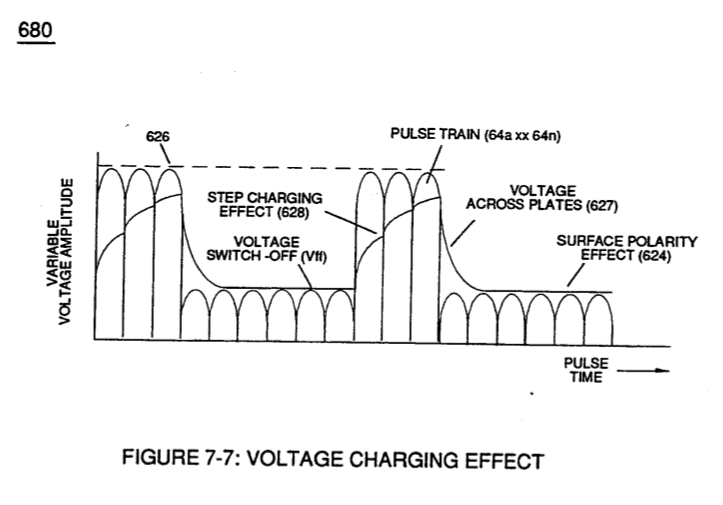
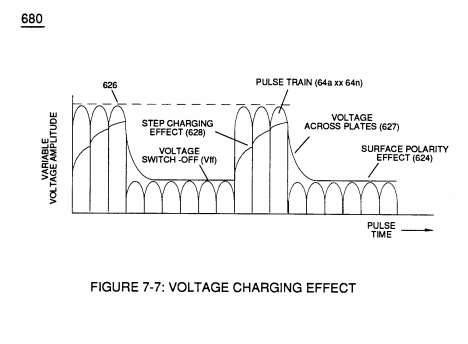
Figure (7-7)
Voltage Charging Effect
How it is written
- (7-7) 9×
Drawings 4
-
(628) of Figure (7-7) · Instant Explosion of Water
-
(627) of Figure (7-7) · Inductance Reactance (Rs - Cd - FL)
-
Captioned as this figure · WFC 426 - Illustrations
-
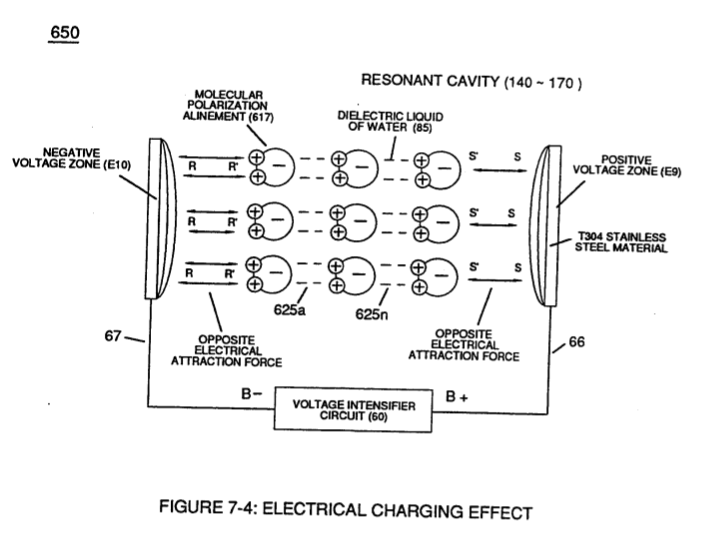
(650) of Figure (7-4) · Capacitance (Cd)
On this figure 14
- 49 Voltage Pulse frequency
- 85 Water Molecule
- 140 Resonant Capacitor
- 170 Resonant Cavity
- 617 Molecular Polarization Alignment
- 624 —
- 626 Voltage Potential
- 627 —
- 628 Capacitance Charging Effect
- 680 Step Charging Effect
- ER Excitor-Array
- Re Water
- T1 Duty Cycle of Pulse Train
- T2 Duty Cycle of Pulse Train
Where it is named · 9
Instant Explosion of Water 2×
-
… s (56/62) of Figure (3-22) in conjunction with Switching Diode (55) to encourage and make use of "Electron Bounce" phenomena (700) of Figure (7-9) to help promote Step Charging Effect (628) of Figure (7-7) by preventing electrical discharge of Resonant Cavity (140 - 170) since Blocking Diode functions as an "Open" switch during Pulse Off-time;
-
(628) of Figure (7-7)
Capacitance (Cd) 2×
Inductance Reactance (Rs - Cd - FL) 4×
-
Inductance Reactance not only increases voltage across water-capacitor (ER) beyond applied Voltage Potential (626) of Figure (7-7) but, also, establishes "Impedance Field" (FL) across Inductors (L1-L2) of Figure (7-6) which acts and performs as Resonant Charging Chokes (614/615) of Figure (7-1) once placed on opposite side of ca …
-
Voltage Potential (626) of Figure (7-7)
-
… nput signal Pulse-Frequency (49a xx 49n) to "tune-in" to the "dielectric property" (Re) of water (85) causing amp flow to be reduce to a minimum value while allowing voltage potential (627) of Figure (7-7) to go toward infinity if the electronic components would allow it to happen, as graphically illustrated in (750) of Figure (7-14).
-
(627) of Figure (7-7)