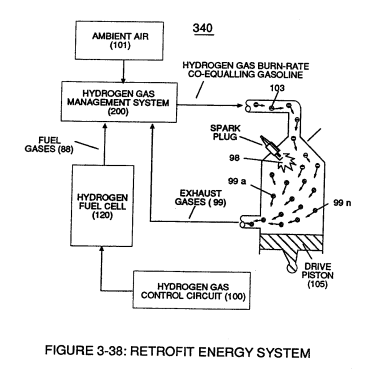
Figure (3-38)
Retrofit Energy System
How it is written
- (3-38) 19×
Drawings 6
-
(340) of Figure (3-38) · Gas Modulator Process
-
(340) of Figure (3-38) · Gas Modulator Process
-
engine cylinder (102) of Figure (3-38) · Gas Processor
-
Captioned as this figure · WFC 422DA - Illustrations
-
Captioned as this figure · Water Fuel Injection System
-
Captioned as this figure · Water Fuel Injection System - Page 1
On this figure 14
- 55 Switching Diode
- 86 Hydrogen
- 87 Oxygen
- 88 Fuel-Gases
- 98 Gas Ignition Process
- 99 Non-Combustible Gases
- 101 Ambient Air Gases
- 102 Engine Cylinder
- 103 Superheated Water Mist
- 105 Filter Chamber
- 127 Thermal atomic interaction
- 142 Spark-rotor
- 200 Hydrogen Gas Control Circuit
- 340 Car Design
Where it is named · 19
Gas Modulator Process 6×
-
The non-combustible gases (74) physically retards and slows down the speed by which oxygen atom (87) unites with (covalent link up) hydrogen atoms (86a / 86b) to bring on and support gas ignition process (gas combustion process) (98), as further illustrated in (340) of Figure (3-38).
-
(340) of Figure (3-38)
-
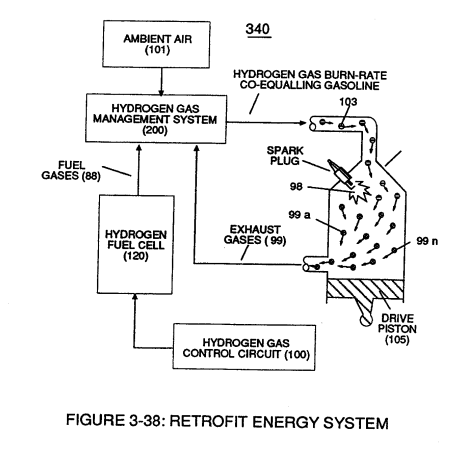
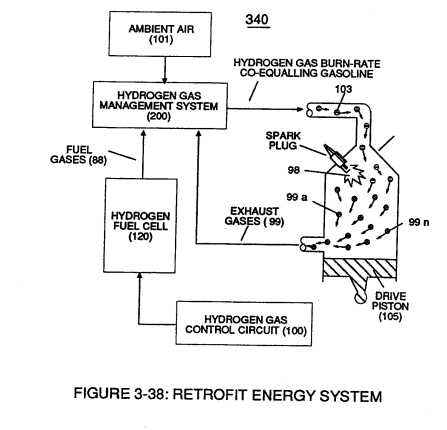
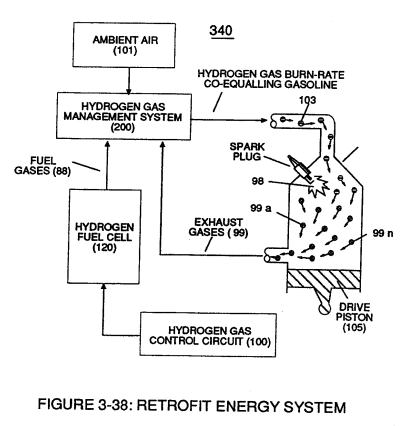
To further reduce hydrogen burn-rate (330) of Figure (3-37) to other fossil-fuel burning levels, additional non-combustible gases (99a xxx 99n) (supplied via ambient air 101) is added to gas-mixture (88) by way of gas ignition process (98) occurring inside internal combustion engine (55) piston cylinder (102), as illustrated in (340) of Figure (3-38).
-
(340) of Figure (3-38)
-
… berated and cooled exhaust gases (99) is, now, directed to hydrogen injector system (200) which systematically meter-mixes and superimposes a predetermined amount of non-burnable gases (99) of Figure (3-38) onto incoming ambient air gases (101) which is being directed to engine cylinder (102) to sustain and maintain both the "Gas Modulator Process" (320) of Figure (3-36) and the "Gas Ignition Process" ( …
-
(340) of Figure (3-38)
Gas Processor 6×
-
Figure (3-38)
-
Once electron ejection occurs, the liberated and free floating electrons (117a xxx 117n) continue to migrate toward positive voltage zone (106); whereas, the newly formed ionized gas atom (having missing electrons) (104) continues to move onward and through air intake manifold (109) of Figure (3-31) to engine cylinder (102) of Figure (3-38).
-
engine cylinder (102) of Figure (3-38)
-
(340) of Figure (3-38)
Hydrogen Fracturing Process 2×
-
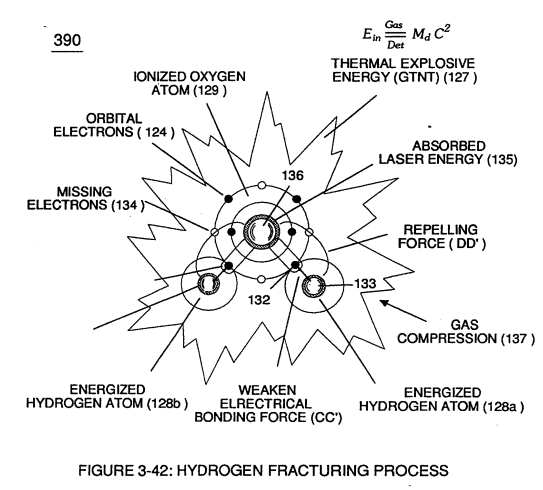
Incoming processed hydrogen fuel gas (103) is, now, exposed to thermal spark ignition process (98) which triggers thermal explosive energy-yield (gtnt) (127) that causes piston-action (105) of Figure (3-38) to exceed normal gas combustion process associated with hydrogen to air mixture of gases in stable state.
-
These "'abnormal" and "unstable" conditions coupled with thermal interaction (gas ignition) under gas compression (137) of Figure (3-42) as to Figure (3-38) (fuel-gas 88 being compressed via piston-action 105) causes combustible gas atoms (129 and 128a/b) to decay ... releasing thermal explosive energy (gtnt) (127) under control means.
Laser Distributor 2×
-
engine cylinder (102) of Figure (3-38)
Diesel Application 2×
-
Fuel-gases (88) of figure (3-38)
Water Fuel Injection System - Page 1 1×
-
Reciprocating WFC fuel-kits can be similar to car design (340) of Figure (3-38) of WFC (422 DA);