Figure (3-39)
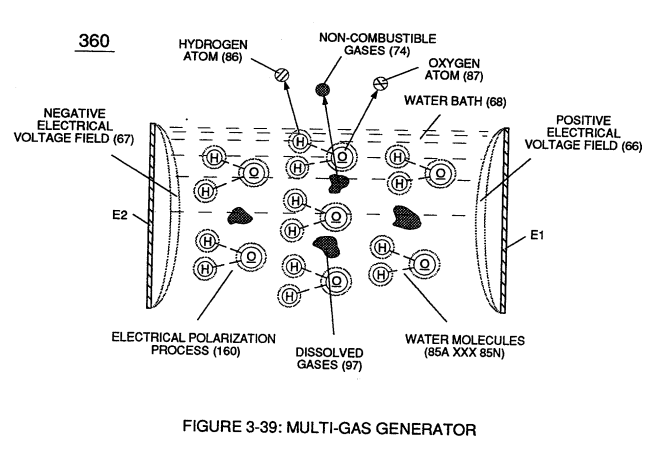
Multi-gas Generator
How it is written
- (3-39) 7×
Drawings 2
-
Figure (3-39) · Resonant Action
-
Captioned as this figure · WFC 422DA - Illustrations
On this figure 4
Where it is named · 7
Resonant Action 2×
-
Figure (3-39)
Gas Modulator Process 5×
-
Dissolved air gases (97) of Figure (3-39)
-
Volatility of hydrogen fuel-mixture or Fuel-Gas (88) is reduced from 325 cm/sec. to approximately 47 cm/sec. since ambient air gases (97) (dissolved air gases in water) is primarily composed of non-combustible gases (74) (such as nitrogen, argon, and other non-burnable gases) of Figure (3-39) which acts and performs as a "Gas Modulator" during thermal gas ignition (98), as illustrated in (320) of Figure (3-36).
-
Figure (3-39)
-
Water bath (68) of Figure (3-39) as to Figure (3-24), now, becomes and functions as a "Gas Mixing Regulator" since the highest possible thermal explosive energy yield (gtnt) obtainable from hydrogen during "normal" gas ignition (98) is the exact composition of water where two hydrogen atoms (86a / 86b) unite with oxygen atom (87).