(101) · also written as a run, 101a xxx 101n
Ambient Air Gases
Also written air gases · processed ambient air gases · gas atom · gas atoms
Where it is first named
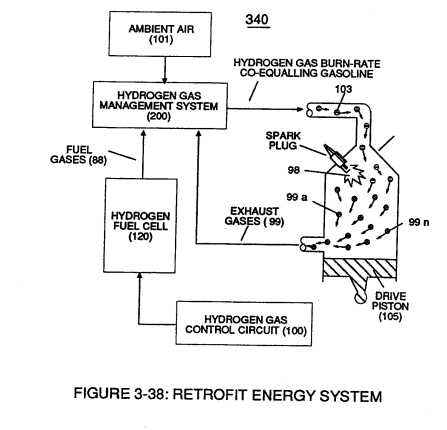
… s, now, directed to hydrogen injector system (200) which systematically meter-mixes and superimposes a predetermined amount of non-burnable gases (99) of Figure (3-38) onto incoming ambient air gases (101) which is being directed to engine cylinder (102) to sustain and maintain both the "Gas Modulator Process" (320) of Figure (3-36) and the "Gas Ignition Process" (98), simultaneously.
How it is written
- (101) 14×
- (101a xxx 101n) 1×
101a xxx 101n is Meyer's shorthand for a run of the same thing: 101a is the first, 101n the last, and the x's stand for however many lie between. Every stage of the run is this one numeral.
Drawings 22
-
(340) of Figure (3-38) · Gas Modulator Process
-
(340) of Figure (3-38) · Gas Modulator Process
-
engine cylinder (102) of Figure (3-38) · Gas Processor
-
Figure (3-33) · Gas Processor
-
(270) of Figure (3-34) · Gas Processor
-
(240) of Figure (3-31) · Gas Processor
-
Carries this number · WFC 422DA - Illustrations
-
Carries this number · WFC 422DA - Illustrations
-
Carries this number · WFC 422DA - Illustrations
-
Carries this number · WFC 422DA - Illustrations
-
Carries this number · Water Fuel Injection System
-
Carries this number · Water Fuel Injection System - Page 1
-
Figure (3-31) · Water Fuel Injection System - Page 1
-
(270) of (3-34) · In Application of Usage
-
(Light Emitting Diodes) (1100 xxx 116n) of Figure (3-33) · WFC Exhaust Air Reclaimer
-
Figure (3-34) · Propagating Electrical Stress
-
blocking diode (55) of Figure (3-34) · Voltage to Amp Differential Ratio
-
"Gas Modulator Process" (320) of Figure (3-36) · Gas Modulator Process
-
The figure it sits on · WFC 422DA - Illustrations
-
The figure it sits on · WFC 422DA - Illustrations
-
(280) of Figure (34) · Funneling Effect
-
(280) of Figure (3-35) · Voltage to Amp Differential Ratio
Where it is named · 15
Gas Modulator Process 4×
-
ambient air gases (101)
… s, now, directed to hydrogen injector system (200) which systematically meter-mixes and superimposes a predetermined amount of non-burnable gases (99) of Figure (3-38) onto incoming ambient air gases (101) which is being directed to engine cylinder (102) to sustain and maintain both the "Gas Modulator Process" (320) of Figure (3-36) and the "Gas Ignition Process" (98), simultaneously.
-
ambient air gases (101)
In essence, then, ambient air gases (101) becomes an endless supply of non-combustible gases (99A xxx 99n) during the gas ignition process.
-
… tor process (320) continues to allow a conventional internal combustion engine (55) to run on ambient air gases; while, fuel-gas (88) not only cuts back and reduces oxygen extraction form ambient air (101) but produces a environmentally safe exhaust gases since non-combustible gases (99/74) from both ambient air gases (101) and Fuel-Gas (88) are thermally inert to gas ignition process (98).
-
ambient air gases (101)
… fuel-gas (88) not only cuts back and reduces oxygen extraction form ambient air (101) but produces a environmentally safe exhaust gases since non-combustible gases (99/74) from both ambient air gases (101) and Fuel-Gas (88) are thermally inert to gas ignition process (98).
Gas Processor 10×
-
air gases (101)
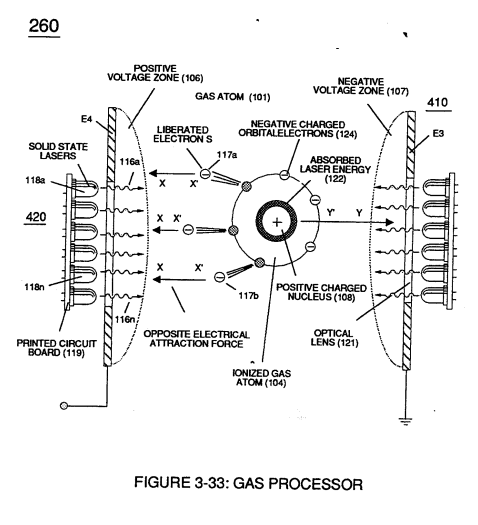
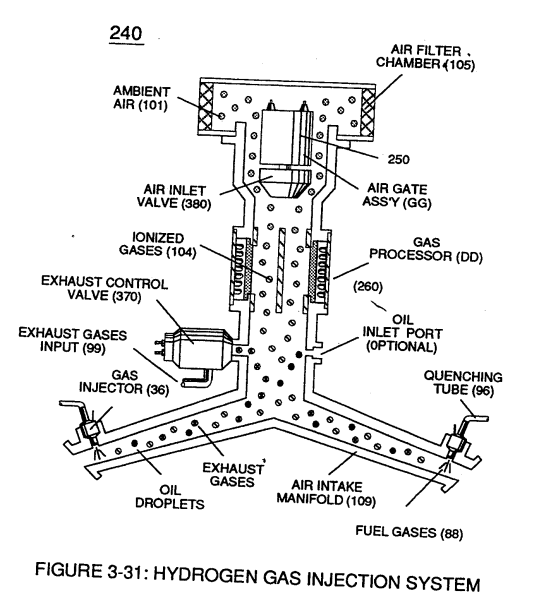
As ambient air gases (101) enters into and passes through air filter chamber (105) toward and beyond air gate assembly (GG), the moving air gases (101) are exposed to high energy voltage fields (up to and beyond 2,000 volts) (106/107) of opposite electrical polarity which causes ambient air gases to become ionized gases (104), as illustrated in (260) of Figure (3-33).
-
air gases (101)
As ambient air gases (101) enters into and passes through air filter chamber (105) toward and beyond air gate assembly (GG), the moving air gases (101) are exposed to high energy voltage fields (up to and beyond 2,000 volts) (106/107) of opposite electrical polarity which causes ambient air gases to become ionized gases (104), as illustrated in (260) of Figure (3-33).
-
Positive electrical voltage field (106) causes negative charged orbital electrons (124a xxx) to be ejected from gas atom (101) due to opposite electrical attraction force (xx'); while, at the same time, negative electrical voltage field (107) exerts a second electrical attraction force (yy') on gas atom positive charged nucleus (108)
-
gas atom (101)
... thereby preventing electrons (117a xxx 117n) from re-entering ionized gas process (260) ... destabilizing gas atom (101).
-
gas atoms (101a xxx 101n)
The newly established and on-going electron conversion process (390) continues to aid ionized gas process (260) as other gas atoms (101a xxx 101n) are destabilized into ionized gas vapor (104a xxx 104n).
-
ambient air gases (101)
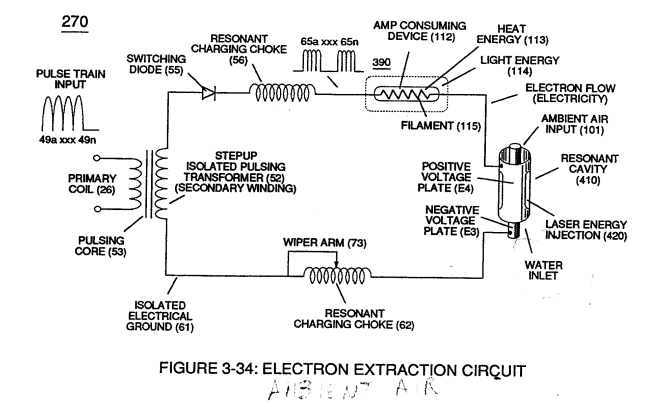
Pulsating voltage potential or voltage intensity (65a xx 65n) is adjusted, also, to "tune-in" to the resonant properties of ambient air gases (101) since ambient air gases (101) exhibits a dielectric value (air-gap of one inch resisting electron arc-over of up to 17,000 volts applied) between voltage plates (E3) and (E4), forming capacitor (410) of Figure (3-34).
-
ambient air gases (101)
Pulsating voltage potential or voltage intensity (65a xx 65n) is adjusted, also, to "tune-in" to the resonant properties of ambient air gases (101) since ambient air gases (101) exhibits a dielectric value (air-gap of one inch resisting electron arc-over of up to 17,000 volts applied) between voltage plates (E3) and (E4), forming capacitor (410) of Figure (3-34).
-
gas atom (101)
In essence, then, laser interaction (280) along with applied voltage process (260) causes gas atom (101) to go into sub-critical state (destabilizing the mass entity of a gas atom) since absorbed laser energy (122) prevents electrons re-capture (atoms accepting electrons) while interfacing circuit (270) …
-
ambient air gases (101)
… prevents electrons re-capture (atoms accepting electrons) while interfacing circuit (270) dislodges, captures, and immediately consumes ejected electrons (117a xxx) In other words, ambient air gases (101) has, now, become electromagnetically primed destabilized gas atoms (l04a xxx 100n) having missing electrons.
-
gas atom (101)
Applied voltage amplitude (Va xxx Vn), applied voltage pulse frequency (65a xxx 65n), and applied current pulse train (126a xxx 126n) are design variable to "tune-in" to the resonant properties of gas atom (101) while stimulating and performing gas process (260) which attenuates electrical force (AA') of Figure (3-35) to disrupt the mass equilibrium of gas atom (104).
Laser Distributor 1×
-
processed ambient air gases (101)
… e (3-10) except light-gate (141) of Figure (3-44) rotates in the same direction of Spark-rotor (142) and being displaced opposite to rotor blade (142), allowing intermixed processed ambient air gases (101) and Fuel-Gases (88) to enter engine cylinder (102) of Figure (3-38), as illustrated in Injector Control Circuit (300) of Figure (3-4).