(320)
Gas Modulator Process
Also written process
Where it is first named
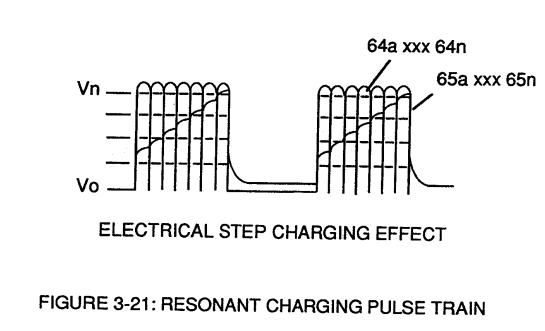
During resonant interaction, the incoming unipolar pulse train (64a xxx 64n) of Figure (320) as to Figure (3-21) produces a step charging voltage effect across excitor-array (66/67) (57) as so illustrated in Figure (3-21).
How it is written
- (320) 7×
Drawings 11
-
Carries this number · WFC 421 - Illustrations
-
"Gas Modulator Process" (320) of Figure (3-36) · Gas Modulator Process
-
Carries this number · WFC 422DA - Illustrations
-
Carries this number · WFC 422DA - Illustrations
-
Carries this number · Differential Air-Gas Inlet Control
-
2-3 Water Inlet Housing · Water Fuel Injector Illustrations
-
Figure (3-21) · Voltage Amplitude Control Circuit (50)
-
Figure (3-21) · Voltage Intensifier Circuit (60)
-
The figure it sits on · Voltage Dynamics
-
The figure it sits on · Gas Processor
-
The figure it sits on · WFC 422DA - Illustrations
Where it is named · 7
Voltage Intensifier Circuit (60) 1×
-
During resonant interaction, the incoming unipolar pulse train (64a xxx 64n) of Figure (320) as to Figure (3-21) produces a step charging voltage effect across excitor-array (66/67) (57) as so illustrated in Figure (3-21).
Gas Modulator Process 6×
-
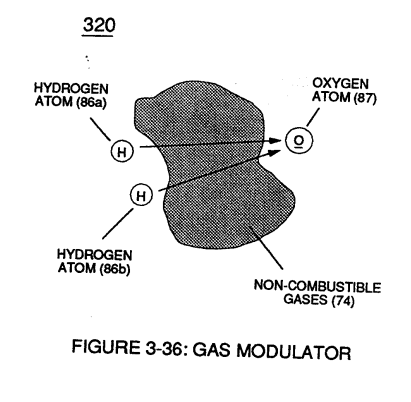
Volatility of hydrogen fuel-mixture or Fuel-Gas (88) is reduced from 325 cm/sec. to approximately 47 cm/sec. since ambient air gases (97) (dissolved air gases in water) is primarily composed of non-combustible gases (74) (such as nitrogen, argon, and other non-burnable gases) of Figure (3-39) which acts and performs as a "Gas Modulator" during thermal gas ignition (98), as illustrated in (320) of Figure (3-36).
-
(320) of Figure (3-36)
-
Gas Modulator Process (320)
… ined amount of non-burnable gases (99) of Figure (3-38) onto incoming ambient air gases (101) which is being directed to engine cylinder (102) to sustain and maintain both the "Gas Modulator Process" (320) of Figure (3-36) and the "Gas Ignition Process" (98), simultaneously.
-
Gas Modulator Process (320)
"Gas Modulator Process" (320) of Figure (3-36)
-
Gas Modulator Process (320)
The resultant and on-going Gas Modulator Process (320) of Figure (3-36), now, allows hydrogen fuel cell (120) of Figure (3-24) to be retrofitted to any conventional internal combustion engine (55) of Figure (3-1) without engine change by simply metering …
-
process (320)
In terms of operability and performance, gas modulator process (320) continues to allow a conventional internal combustion engine (55) to run on ambient air gases; while, fuel-gas (88) not only cuts back and reduces oxygen extraction form ambient air (101) but produce …