(74)
Non-Combustible Gases
Also written Control
Where it is first named
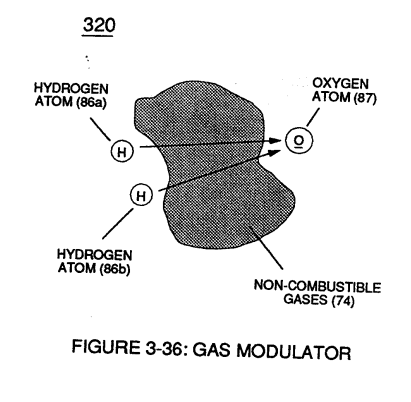
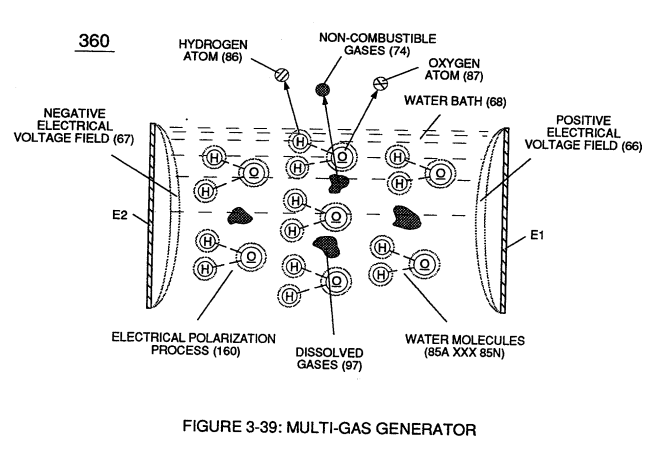
Volatility of hydrogen fuel-mixture or Fuel-Gas (88) is reduced from 325 cm/sec. to approximately 47 cm/sec. since ambient air gases (97) (dissolved air gases in water) is primarily composed of non-combustible gases (74) (such as nitrogen, argon, and other non-burnable gases) of Figure (3-39) which acts and performs as a "Gas Modulator" during thermal gas ignition (98), as illustrated in (320) of Figure (3-36).
How it is written
- (74) 2×
- (99/74) 1× with (99) Non-Combustible Gases
- (via solenoid Control 74) 1×
Drawings 17
-
Carries this number · WFC 421 - Illustrations
-
Figure (3-24) · Voltage Amplitude Control Circuit (50)
-
Figure (3-25) · Voltage Intensifier Circuit (60)
-
Figure (3-24) · Electrical Polarization process
-
Figure (3-39) · Resonant Action
-
"Gas Modulator Process" (320) of Figure (3-36) · Gas Modulator Process
-
Carries this number · WFC 422DA - Illustrations
-
Carries this number · WFC 422DA - Illustrations
-
Carries this number · WFC 422DA - Illustrations
-
Carries this number · WFC 422DA - Illustrations
-
Carries this number · WFC 422DA - Illustrations
-
Carries this number · Energy Pumping Action
-
(57 of Figure 3- 25 ~35 of Figure 6-2) · Instant Explosion of Water
-
Figure (3-24) · Inductance (FL)
-
(370) of Figure (3-40) · Taper Resonant Capacitor (ERt)
-
Quenching Circuit (370) of Figure (3-40) · Capacitance Reactance
-
(170) of Figure (3-25) · 8-4 - State Space (Sp)
Where it is named · 4
Gas Modulator Process 3×
-
Volatility of hydrogen fuel-mixture or Fuel-Gas (88) is reduced from 325 cm/sec. to approximately 47 cm/sec. since ambient air gases (97) (dissolved air gases in water) is primarily composed of non-combustible gases (74) (such as nitrogen, argon, and other non-burnable gases) of Figure (3-39) which acts and performs as a "Gas Modulator" during thermal gas ignition (98), as illustrated in (320) of Figure (3-36).
-
non-combustible gases (74)
The non-combustible gases (74) physically retards and slows down the speed by which oxygen atom (87) unites with (covalent link up) hydrogen atoms (86a / 86b) to bring on and support gas ignition process (gas combustion process) (98), as further illustrated in (340) of Figure (3-38).
-
non-combustible gases (99/74)
… to run on ambient air gases; while, fuel-gas (88) not only cuts back and reduces oxygen extraction form ambient air (101) but produces a environmentally safe exhaust gases since non-combustible gases (99/74) from both ambient air gases (101) and Fuel-Gas (88) are thermally inert to gas ignition process (98).
Funneling Effect 1×
-
Control (via solenoid Control 74)
To return or lower Voltage Intensity (xxx Vmn) to Secondary Voltage Level (71), once again, inductance core-slug (73) (magnetic core material) advances (via solenoid Control 74) toward, passes through inside coil-wrap (250) in linear manner to "Switch-Off" each adjacent coil-stage (61a xxx 61n) by "Shunting" or "Redirecting" induced voltage intensity (Vmn xxx Vma) to its res …