(103)
Superheated Water Mist
Also written hydrogen fuel gas · gas-mixture
Where it is first named
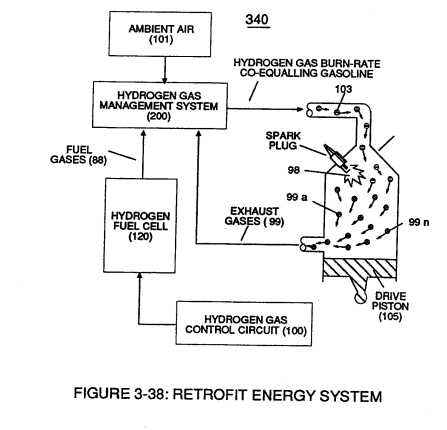
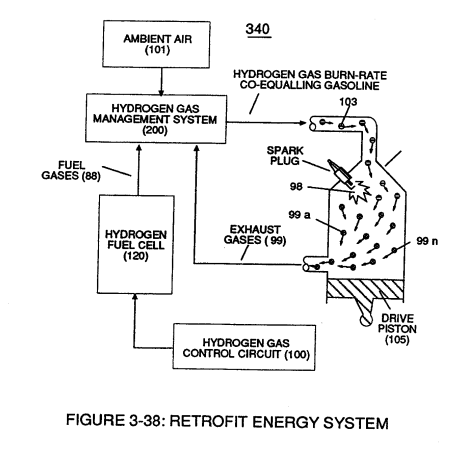
As fuel-gas (88) enters into engine cylinder (102) and is exposed to thermal gas ignition process (98), the incoming and moving fuel-gases (88) are converted into non-combustible gases (99) (gases passing through the gas combustion process) since both the hydrogen (86) and oxygen (87) gas atoms are being consumed during the formation of superheated water mist (103)
How it is written
- (103) 3×
Drawings 10
-
(340) of Figure (3-38) · Gas Modulator Process
-
(340) of Figure (3-38) · Gas Modulator Process
-
engine cylinder (102) of Figure (3-38) · Gas Processor
-
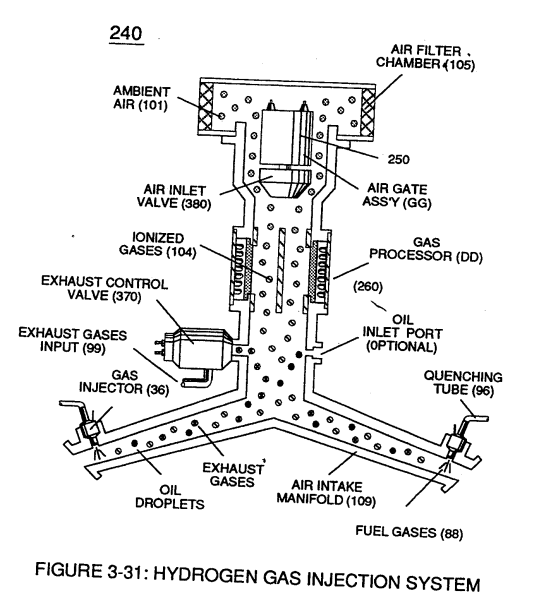
In terms of assembly, gas resonant cavity (410), electron extraction circuit (270), optical lens (121) forms gas processor (260) of Figure (3-31). · Gas Processor
-
In terms of assembly, gas resonant cavity (410), electron extraction circuit (270), optical lens (121) forms gas processor (260) of Figure (3-31). · Gas Processor
-
(240) of Figure (3-31) · Gas Processor
-
The figure it sits on · WFC 422DA - Illustrations
-
The figure it sits on · Water Fuel Injection System
-
The figure it sits on · Water Fuel Injection System - Page 1
-
Figure (3-31) · Water Fuel Injection System - Page 1
Where it is named · 3
Gas Modulator Process 1×
-
superheated water mist (103)
As fuel-gas (88) enters into engine cylinder (102) and is exposed to thermal gas ignition process (98), the incoming and moving fuel-gases (88) are converted into non-combustible gases (99) (gases passing through the gas combustion process) since both the hydrogen (86) and oxygen (87) gas atoms are being consumed during the formation of superheated water mist (103)
Gas Processor 1×
-
gas-mixture (103)
… to and beyond both exhaust gas metering port (370) and injector port (36) where metered fuel-gas (88), metered exhaust gases (99), and metered sub-critical gas atoms (104a xxx 104n) forms gas-mixture (103) entering engine cylinder (102), as illustrated in (240) of Figure (3-31) as to (340) of Figure (3-38).
Hydrogen Fracturing Process 1×
-
hydrogen fuel gas (103)
Incoming processed hydrogen fuel gas (103) is, now, exposed to thermal spark ignition process (98) which triggers thermal explosive energy-yield (gtnt) (127) that causes piston-action (105) of Figure (3-38) to exceed normal gas combustion process associated with hydrogen to air mixture of gases in stable state.