(99) · also written as a run, 99a xxx 99n
Non-Combustible Gases
Also written exhaust gases · non-combustible exhaust gases · metered exhaust gases · non-burnable gases
Where it is first named
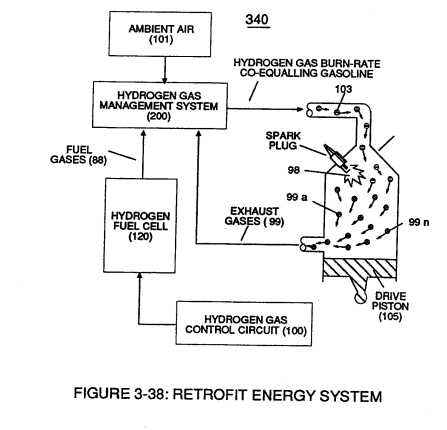
To further reduce hydrogen burn-rate (330) of Figure (3-37) to other fossil-fuel burning levels, additional non-combustible gases (99a xxx 99n) (supplied via ambient air 101) is added to gas-mixture (88) by way of gas ignition process (98) occurring inside internal combustion engine (55) piston cylinder (102), as illustrated in (340) of Figure (3-38).
How it is written
- (99) 5×
- (99a xxx 99n) 2×
- (99/74) 1× with (74) Non-Combustible Gases
- (99A xxx 99n) 1×
99a xxx 99n is Meyer's shorthand for a run of the same thing: 99a is the first, 99n the last, and the x's stand for however many lie between. Every stage of the run is this one numeral.
Drawings 15
-
(340) of Figure (3-38) · Gas Modulator Process
-
(340) of Figure (3-38) · Gas Modulator Process
-
engine cylinder (102) of Figure (3-38) · Gas Processor
-
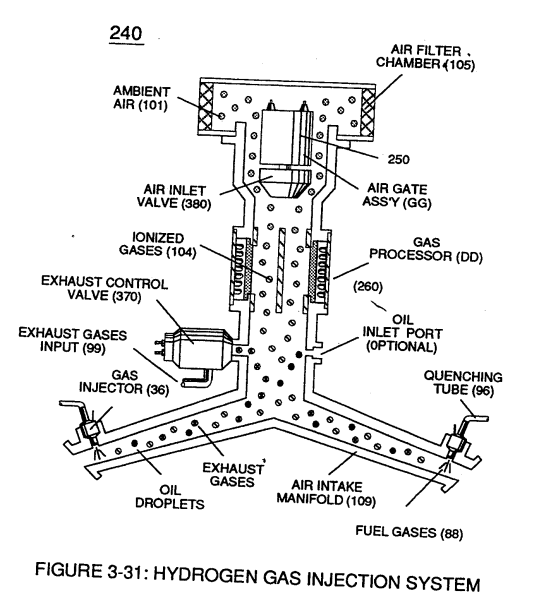
(240) of Figure (3-31) · Gas Processor
-
Carries this number · WFC 422DA - Illustrations
-
Carries this number · WFC 422DA - Illustrations
-
Carries this number · Water Fuel Injection System
-
Carries this number · Steam Resonator Assembly
-
Carries this number · Water Fuel Injection System - Page 1
-
Figure (3-31) · Water Fuel Injection System - Page 1
-
(330) of Figure (3-37) · Gas Modulator Process
-
In terms of assembly, gas resonant cavity (410), electron extraction circuit (270), optical lens (121) forms gas processor (260) of Figure (3-31). · Gas Processor
-
In terms of assembly, gas resonant cavity (410), electron extraction circuit (270), optical lens (121) forms gas processor (260) of Figure (3-31). · Gas Processor
-
burn-rate (330) of Figure (3-37) · Diesel Application
-
The figure it sits on · WFC 422DA - Illustrations
Where it is named · 9
Gas Modulator Process 8×
-
non-combustible gases (99a xxx 99n)
To further reduce hydrogen burn-rate (330) of Figure (3-37) to other fossil-fuel burning levels, additional non-combustible gases (99a xxx 99n) (supplied via ambient air 101) is added to gas-mixture (88) by way of gas ignition process (98) occurring inside internal combustion engine (55) piston cylinder (102), as illustrated in (340) of Figure (3-38).
-
non-combustible gases (99)
As fuel-gas (88) enters into engine cylinder (102) and is exposed to thermal gas ignition process (98), the incoming and moving fuel-gases (88) are converted into non-combustible gases (99) (gases passing through the gas combustion process) since both the hydrogen (86) and oxygen (87) gas atoms are being consumed during the formation of superheated water mist (103)
-
non-combustible exhaust gases (99)
... releasing thermal explosive energy (gtnt) which, in turns, causes piston-action to expel the newly formed non-combustible exhaust gases (99) for recycling.
-
exhaust gases (99)
The liberated and cooled exhaust gases (99) is, now, directed to hydrogen injector system (200) which systematically meter-mixes and superimposes a predetermined amount of non-burnable gases (99) of Figure (3-38) onto incoming ambient air gase …
-
non-burnable gases (99)
The liberated and cooled exhaust gases (99) is, now, directed to hydrogen injector system (200) which systematically meter-mixes and superimposes a predetermined amount of non-burnable gases (99) of Figure (3-38) onto incoming ambient air gases (101) which is being directed to engine cylinder (102) to sustain and maintain both the "Gas Modulator Process" (320) of Figure (3-36) and the "Gas Ig …
-
non-combustible gases (99A xxx 99n)
In essence, then, ambient air gases (101) becomes an endless supply of non-combustible gases (99A xxx 99n) during the gas ignition process.
-
exhaust gases (99a xxx 99n)
… ogen fuel cell (120) of Figure (3-24) to be retrofitted to any conventional internal combustion engine (55) of Figure (3-1) without engine change by simply metering the proper amount of exhaust gases (99a xxx 99n) to comply with and co-equaling any type or different fossil-fuel burning levels, as further illustrated in (330) of Figure (3-37).
-
non-combustible gases (99/74)
… to run on ambient air gases; while, fuel-gas (88) not only cuts back and reduces oxygen extraction form ambient air (101) but produces a environmentally safe exhaust gases since non-combustible gases (99/74) from both ambient air gases (101) and Fuel-Gas (88) are thermally inert to gas ignition process (98).
Gas Processor 1×
-
metered exhaust gases (99)
… 4n) are directed onward through air intake manifold (109) of Figure (3-31) to and beyond both exhaust gas metering port (370) and injector port (36) where metered fuel-gas (88), metered exhaust gases (99), and metered sub-critical gas atoms (104a xxx 104n) forms gas-mixture (103) entering engine cylinder (102), as illustrated in (240) of Figure (3-31) as to (340) of Figure (3-38).