(106)
Positive electrical voltage field
Also written positive voltage zone · Voltage fields
Where it is first named
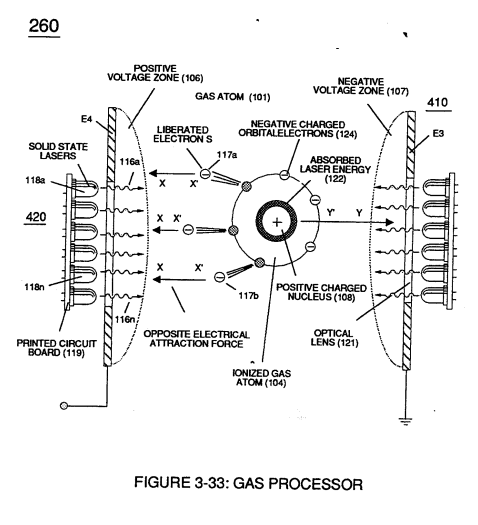
As ambient air gases (101) enters into and passes through air filter chamber (105) toward and beyond air gate assembly (GG), the moving air gases (101) are exposed to high energy voltage fields (up to and beyond 2,000 volts) (106/107) of opposite electrical polarity which causes ambient air gases to become ionized gases (104), as illustrated in (260) of Figure (3-33).
How it is written
- (106) 2×
- (106/107) 2× with (107) Voltage fields
Drawings 10
-
Figure (3-33) · Gas Processor
-
In terms of assembly, gas resonant cavity (410), electron extraction circuit (270), optical lens (121) forms gas processor (260) of Figure (3-31). · Gas Processor
-
Carries this number · WFC 422DA - Illustrations
-
Carries this number · WFC 422DA - Illustrations
-
(280) of Figure (34) · Funneling Effect
-
(Light Emitting Diodes) (1100 xxx 116n) of Figure (3-33) · WFC Exhaust Air Reclaimer
-
(280) of Figure (3-35) · Voltage to Amp Differential Ratio
-
In terms of assembly, gas resonant cavity (410), electron extraction circuit (270), optical lens (121) forms gas processor (260) of Figure (3-31). · Gas Processor
-
(240) of Figure (3-31) · Gas Processor
-
Figure (3-31) · Water Fuel Injection System - Page 1
Where it is named · 4
Gas Processor 4×
-
As ambient air gases (101) enters into and passes through air filter chamber (105) toward and beyond air gate assembly (GG), the moving air gases (101) are exposed to high energy voltage fields (up to and beyond 2,000 volts) (106/107) of opposite electrical polarity which causes ambient air gases to become ionized gases (104), as illustrated in (260) of Figure (3-33).
-
Positive electrical voltage field (106)
Positive electrical voltage field (106) causes negative charged orbital electrons (124a xxx) to be ejected from gas atom (101) due to opposite electrical attraction force (xx'); while, at the same time, negative electrical voltage field (107) exerts a second electrical attraction force (yy') on gas atom positive charged nucleus (108)
-
positive voltage zone (106)
Once electron ejection occurs, the liberated and free floating electrons (117a xxx 117n) continue to migrate toward positive voltage zone (106); whereas, the newly formed ionized gas atom (having missing electrons) (104) continues to move onward and through air intake manifold (109) of Figure (3-31) to engine cylinder (102) of Figure (3-38).
-
Voltage fields (106/107)
Voltage fields (106/107) are physically configured (skin effect) by T304 stainless steel material to form voltage plates (E3/E4) of Figure (3-33) which are not only chemically inert to gas ionization process (260) but, also, forms tubular Gas Resonant Cavity (410) of Figure (3-34) having approximately the same size and shape of liquid resonant cavity (170) of Figure (3-25), as illustrated in (270) of Figure (3-34).