(127)
Thermal atomic interaction
Where it is first named
Incoming processed hydrogen fuel gas (103) is, now, exposed to thermal spark ignition process (98) which triggers thermal explosive energy-yield (gtnt) (127) that causes piston-action (105) of Figure (3-38) to exceed normal gas combustion process associated with hydrogen to air mixture of gases in stable state.
How it is written
- (127) 3×
Drawings 14
-
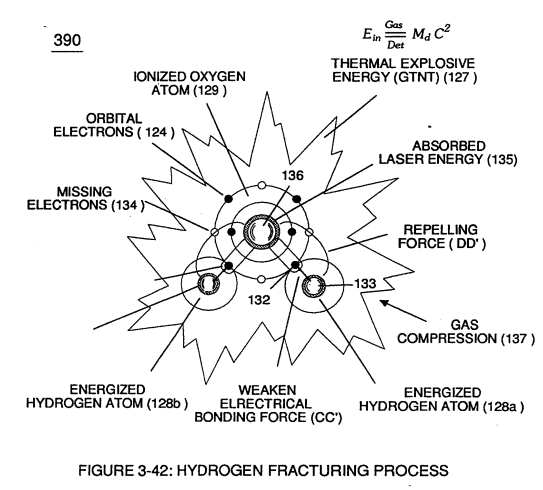
This atomic thermal-interaction between sub-critical combustible gas atoms (127 and 128a/b) is, now, herein after called "The Hydrogen fracturing Process. " · Hydrogen Fracturing Process
-
Carries this number · WFC 422DA - Illustrations
-
(390) of Figure (41) · Water Fuel Injector (Taper Resonant Cavity Chamber)
-
Carries this number · Funneling Effect
-
Hydrogen Fracturing Process (390) of Figure (3-42) · Water Fuel Injection System - Page 1
-
(390) of Figure (3-42) · In Application of Usage
-
(390) of Figure (3-42) · Resistance (Rs)
-
(390) of Figure (3-42) · Capacitance Reactance
-
(340) of Figure (3-38) · Gas Modulator Process
-
(340) of Figure (3-38) · Gas Modulator Process
-
engine cylinder (102) of Figure (3-38) · Gas Processor
-
The figure it sits on · WFC 422DA - Illustrations
-
The figure it sits on · Water Fuel Injection System
-
The figure it sits on · Water Fuel Injection System - Page 1
Where it is named · 3
Hydrogen Fracturing Process 3×
-
Incoming processed hydrogen fuel gas (103) is, now, exposed to thermal spark ignition process (98) which triggers thermal explosive energy-yield (gtnt) (127) that causes piston-action (105) of Figure (3-38) to exceed normal gas combustion process associated with hydrogen to air mixture of gases in stable state.
-
Thermal atomic interaction (127)
Thermal atomic interaction (127) is caused when sub-critical gas ions (104a xxx 104n) (derived from both water bath ~ and ambient air gases) fails to unite with or covalently link up or covalent bond with highly energized (laser primed) hydrogen atom (128).
-
These "'abnormal" and "unstable" conditions coupled with thermal interaction (gas ignition) under gas compression (137) of Figure (3-42) as to Figure (3-38) (fuel-gas 88 being compressed via piston-action 105) causes combustible gas atoms (129 and 128a/b) to decay ... releasing thermal explosive energy (gtnt) (127) under control means.