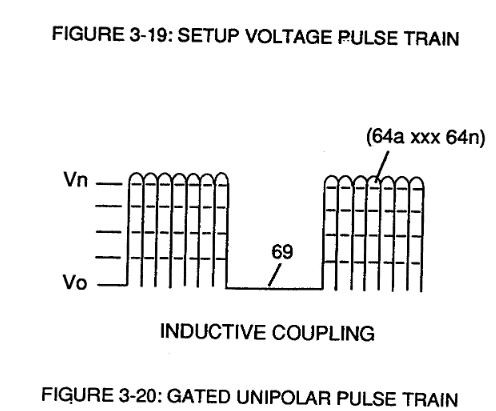
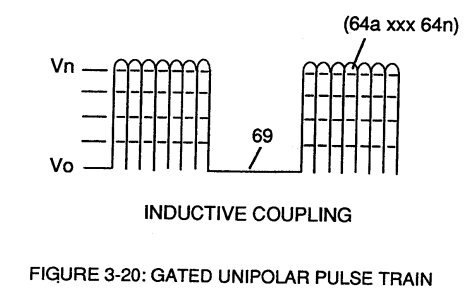
Figure (3-20)
Gated Unipolar Pulse Train
How it is written
- (3-20) 7×
Drawings 5
-
Figure (3-20) · Voltage Intensifier Circuit (60)
-
Captioned as this figure · WFC 422DA - Illustrations
-
Beside the passage · Laser Accelerator Assembly
-
Beside the passage · 8-1 - Propagating "Resonant Action" By Voltage Tickling of State Space
-
(612) of Figure (8-1) · 8-5 - Energy Vectoring (Ev)
On this figure 12
- 52 Secondary Coil
- 55 Switching Diode
- 56 Resonant Charging Choke
- 64 Pulse Train
- 69 Pulse Off-Time
- 76 Oxygen Atom
- 79 Electrons
- 85 Water Molecule
- 120 Fuel Cell
- E9 Capacitor
- VpT Unipolar Voltage Pulse Train
- Vps Voltage Priming Stage
Where it is named · 7
Laser Accelerator Assembly 1×
-
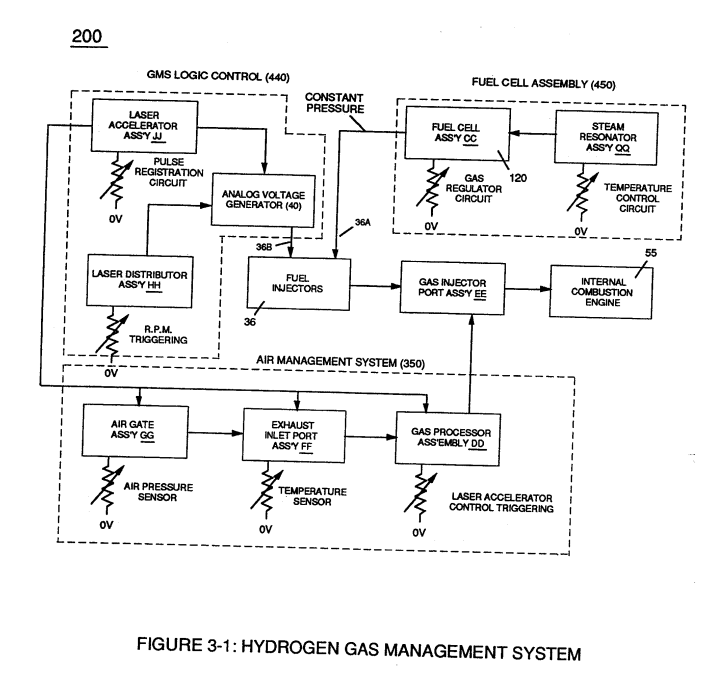
This "shut-down" or "Switch-off" condition helps provide a fail-safe operable Fuel Cell (120) of Figure (3-20) by negating acceleration beyond driver's control.
Voltage Intensifier Circuit (60) 3×
-
These controlled and variable pulse features are, now, translated to Resonant Charging pulse train (65a xxx 65n) of Figure (3-21) via Unipolar pulse train (64a xxx 64n) of Figure (3-20) during Resonant Action (160) of Figure (3-26) when signal coupling is applied across Resonant Cavity (170) of Figure (3-24) via positive voltage zone (66).
-
Figure (3-20)
Water Fuel Injector 1×
-
... dielectric value of water being 78.54 since water molecule (85) oxygen atom "L" orbit (76) occupies the maximum allowance eight electrons (79a xxx 79n), calibrated gated unipolar pulse train (64a xxx 64n) of Figure (3-20) is outputted from resonant choke (56) and electrically transmitted to positive outer conical surface (E9);
8-1 - Propagating "Resonant Action" By Voltage Tickling of State Space 1×
-
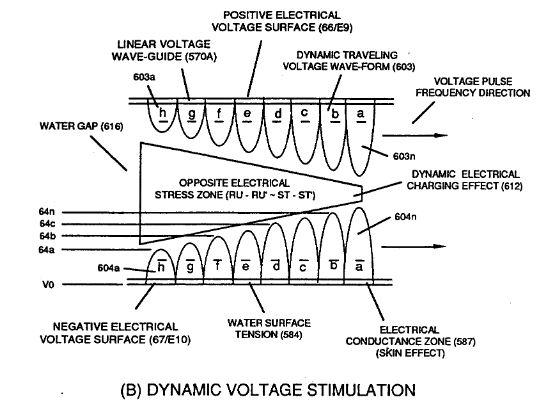
Static variables condition is established when the resultant gas pressure is held constant with the never-changing static electrical stress of opposite polarity of Voltage Pulse-Wave (64) of Figure (3-20) of WFC memo 422DA.