(160)
Electrical Polarization Process
Also written Resonant Action · Excitor-Array
Where it is first named
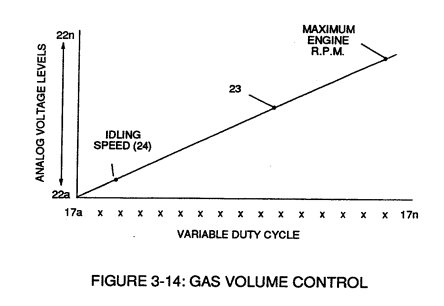
In terms of functional-ability and purpose, analog circuit (40) of Figure (3-5) provides a variable (controlled) voltage output (23) in direct relationship to light gate (9) displacement which, in turns, sets up and controls Resonant Action (160) of Figure (3-23) that produces Fuel Gases on demand.
How it is written
- (160) 37×
Drawings 45
-
Figure (3-26) · Voltage Intensifier Circuit (60)
-
Figure (3-26) · Electrically Charged Water Molecule
-
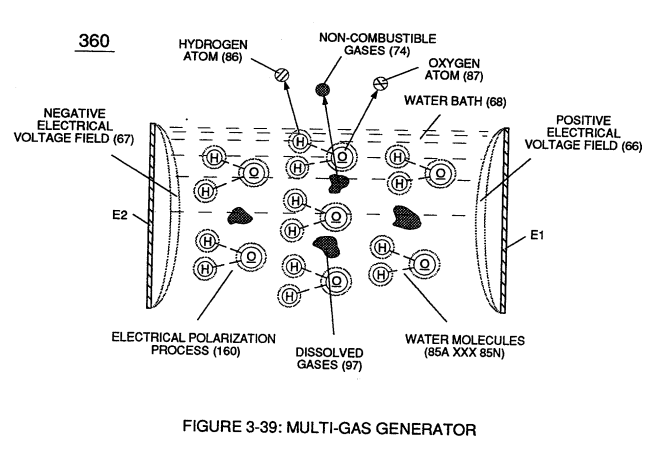
Figure (3-39) · Resonant Action
-
Figure (4-14) · Aviation Application
-
Carries this number · WFC 422DA - Illustrations
-
Carries this number · WFC 422DA - Illustrations
-
Figure (25) · Water Fuel Injector (Taper Resonant Cavity Chamber)
-
Figure (17) · Water Fuel Injector (Taper Resonant Cavity Chamber)
-
Carries this number · Funneling Effect
-
Carries this number · Funneling Effect
-
(160) of Figure (3-26) · Water Fuel Injection System - Page 1
-
Figure (4-14) · Water Fuel Injection System - Page 3
-
(85) of Figure (3-26) · In Application of Usage
-
(160) of Figure (3-26) · In Application of Usage
-
"Voltage Intensity of Opposite Potential" (600) of Figure (6-3) · Voltage Intensifier Coil-Assembly
-
Carries this number · WFC 425 - Illustrations
-
(85) of Figure (3-26) · Resistance (Rs)
-
(600) of Figure (6-3) · Inductance (FL)
-
(600) of Figure (6-3) · Inductance (FL)
-
Carries this number · 8-1 - Propagating "Resonant Action" By Voltage Tickling of State Space
-
Carries this number · WFC Exhaust Air Reclaimer
-
(160) of Figure (3-26) · Propagating Electrical Stress
-
Figure (3-28) · Voltage Intensifier Circuit (60)
-
Ohm's law of LC circuit (180) of Figure (3-28) in series is given by (Eq 5) · Voltage Intensifier Circuit (60)
-
Voltage (Vc) of Figure (3-28) across the capacitor is given by (Eq 7) · Voltage Intensifier Circuit (60)
-
Figure (3-25) · Voltage Intensifier Circuit (60)
-
Figure (3-23) · Voltage Intensifier Circuit (60)
-
Figure (3-23) · Voltage Dynamics
-
In both cases, electrical charge deflection or movement is directly related to applied voltage (65). · Voltage Dynamics
-
Ions or particle mass having the same or like electrical charges will move away from one another, as illustrated in (220) of Figure (3-29). · Voltage Dynamics
-
Figure (3-29) · Electrically Charged Water Molecule
-
The figure it sits on · WFC 422DA - Illustrations
-
The figure it sits on · WFC 422DA - Illustrations
-
The figure it sits on · WFC 422DA - Illustrations
-
The figure it sits on · WFC 422DA - Illustrations
-
The figure it sits on · Electronic Circuit Design
-
The figure it sits on · Water Fuel Injector (Taper Resonant Cavity Chamber)
-
The figure it sits on · Energy Pumping Action
-
(190) of Figure (3-23) · Tri - Coil Construction
-
Inductance Pulsing-Core (190) of Figure (3-23) · Inductance Reactance (Rs - Cd - FL)
-
The figure it sits on · Electron Bounce Phenomenon
-
Voltage Dynamics (220) of Figure (3-29) · Electron Bounce Phenomenon
-
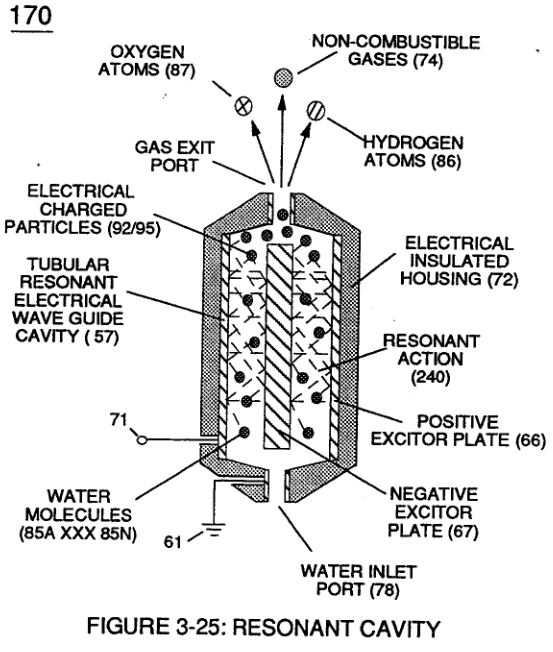
(170) of Figure (3-25) · 8-4 - State Space (Sp)
-
The figure it sits on · Electrovalent Bonding
-
Voltage Dynamics (220) of Figure (3-29) · WFC Exhaust Air Reclaimer
Where it is named · 37
Analog Voltage generator (40) 1×
-
Resonant Action (160)
In terms of functional-ability and purpose, analog circuit (40) of Figure (3-5) provides a variable (controlled) voltage output (23) in direct relationship to light gate (9) displacement which, in turns, sets up and controls Resonant Action (160) of Figure (3-23) that produces Fuel Gases on demand.
Voltage Intensifier Circuit (60) 2×
-
Resonant Action (160)
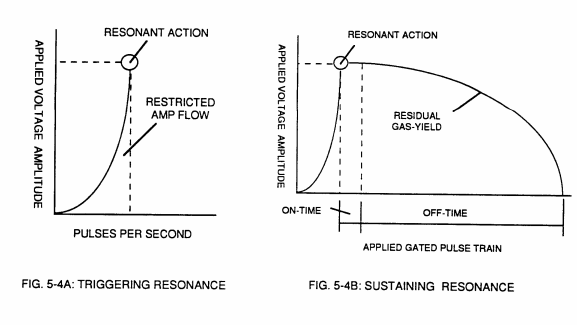
These controlled and variable pulse features are, now, translated to Resonant Charging pulse train (65a xxx 65n) of Figure (3-21) via Unipolar pulse train (64a xxx 64n) of Figure (3-20) during Resonant Action (160) of Figure (3-26) when signal coupling is applied across Resonant Cavity (170) of Figure (3-24) via positive voltage zone (66).
-
Excitor-Array (160)
Resonant charging choke (56) in series with Excitor-Array (160) of Figure (25) forms an inductor-capacitor circuit (180) of Figure (3-28) since Excitor-Array (66/67) acts and performs as a capacitor (dielectric liquid between opposite electrical plates) during pulsing operations.
Electrically Charged Water Molecule 2×
-
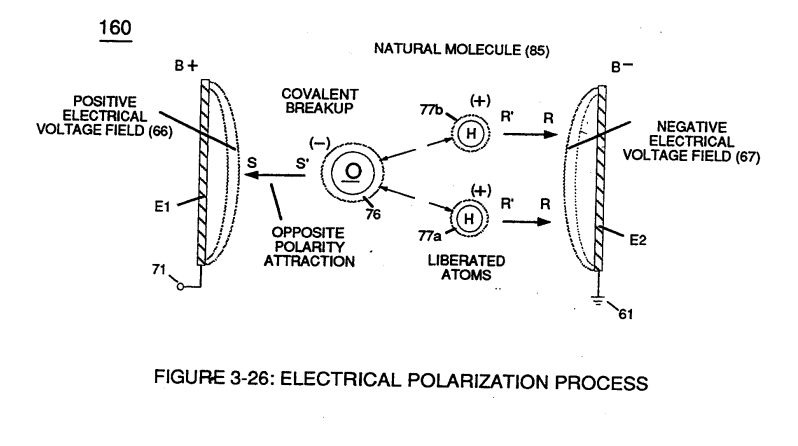
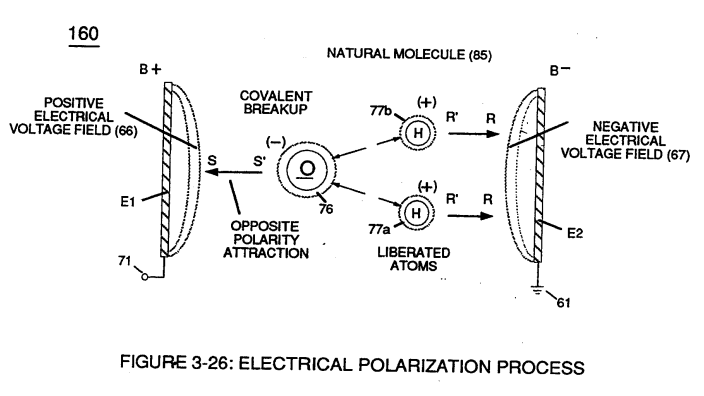
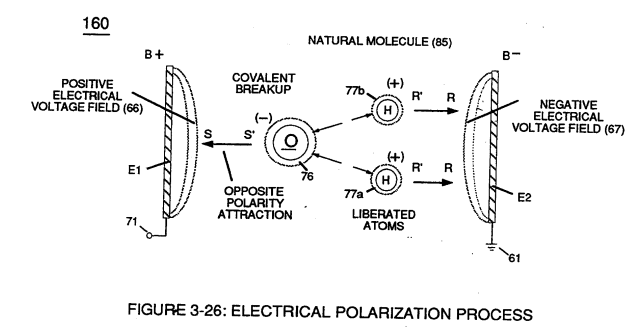
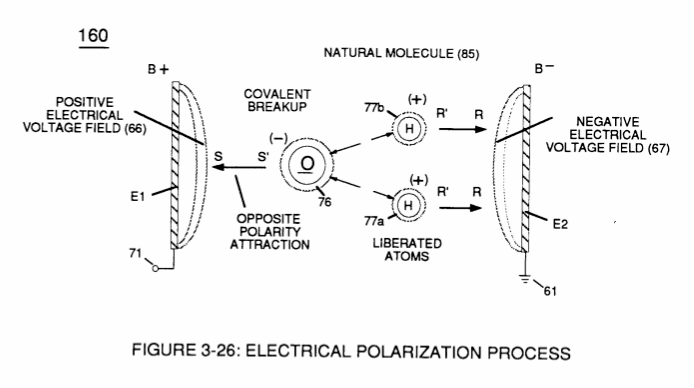
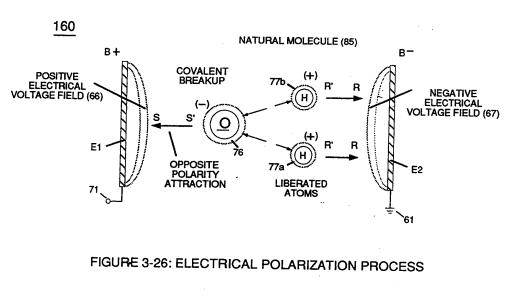
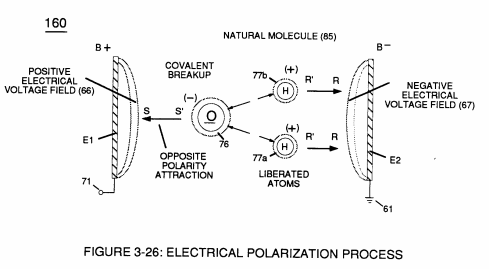
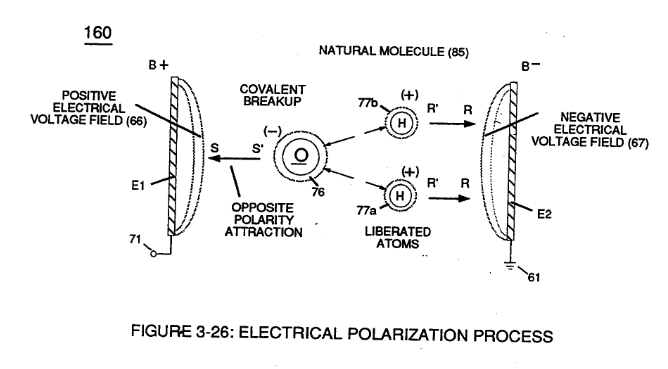
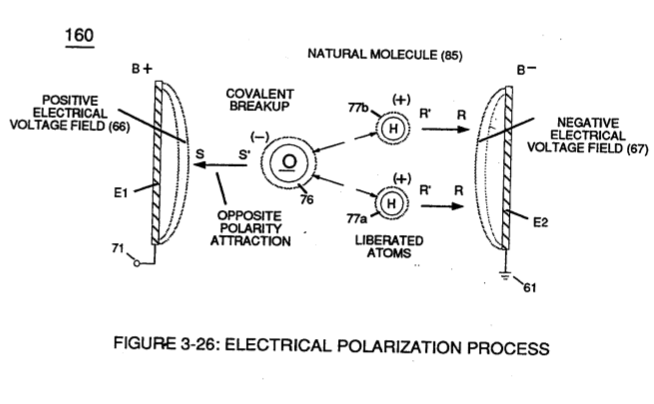
Voltage potential (65) within electrical circuit (60) can cause one or more electrons (79) to be dislodged from the water molecule atom (85) of Figure (3-26) due to opposite electrical polarity attraction (qq') of Figure (3-29) between unlike charged entities, as shown in (160) of Figure (326) as to Newton's and Coulomb's laws of electrical-force.
-
… 190) of figure (3-23), now, allows voltage to dissociates water molecule (85) by overcoming electrostatic bonding force (qq') between unlike atoms (76n7) while restricting amp flow, as illustrated in (160) of Figure (3-26).
Electrical Polarization process 3×
-
… to separate into its component parts (released hydrogen and oxygen gases) by pulling away (utilizing opposite attraction forces SS' and RR') its charged water molecule atoms (76n7), as illustrated in (160) of Figure (3-26).
-
Once negative electrically charged oxygen atom (76) is dislodged from water molecule (85), covalent bonding (sharing electrons between atoms) ceases to exist, switching-off and disrupting electrical attraction force (qq') between unlike atoms (76/77), as further illustrated in (160) of Figure (3-26).
-
Dissociation of water molecule (85) by way of voltage stimulation (65) is herein called "The Electrical Polarization Process", as illustrated in (160) of Figure (3-26).
Resonant Action 2×
-
electrical polarization process (160)
Applied together, electrical forces (TT') and (UU'), now, causes these moving electrically charged particles to superimpose a physical impact unto electrical polarization process (160), as shown in (170) of Figure (3-25)
-
electrical polarization process (160)
At resonance, electrical polarization process (160) interacts uniformly with liberated charged particles (92/95) of Figure (3-25) to obtain a even higher gas-yield (88) at maximum voltage deflection (xxx Vn).
Gas Modulator Process 4×
-
Electrical Polarization Process (160)
Dissolved air gases (97) of Figure (3-39) being uniformly released from water bath (85) via the Electrical Polarization Process (160) of Figure (3-26) is automatically intermixed with released hydrogen (86) and oxygen (87) gas atoms (also derived from water bath 85) to form Fuel-Gas mixture (88) of Figure (3-24) having a hydrogen g …
-
Electrical Polarization Process (160)
Electrical Polarization Process (160) of Figure (3-26)
-
Electrical Polarization Process (160)
Inherently, the utilization of the Electrical Polarization Process (160) of Figure (3-26) in conjunction with the use of chemically inert stainless steel (T304 material) voltage zones (E1 / E2) submerged in natural water (68) sustains and maintains gas mixing ratio (88) b …
-
Electrical Polarization Process (160)
Remember, Electrical Polarization Process (160) is a physical process which uses opposite electrical polarity attraction force (qq') to perform work by disrupting and switching off the covalent bond between the unlike charged water molecule atoms.
Aviation Application 1×
-
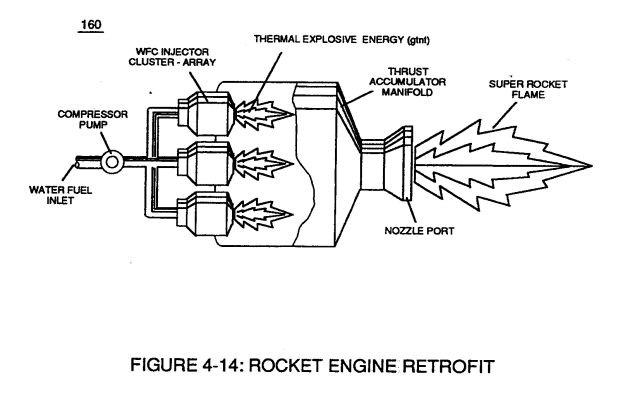
or be used to produce\rocket-thrust, as illustrated in (160) of Figure (4-14);
Water Fuel Injection System 2×
-
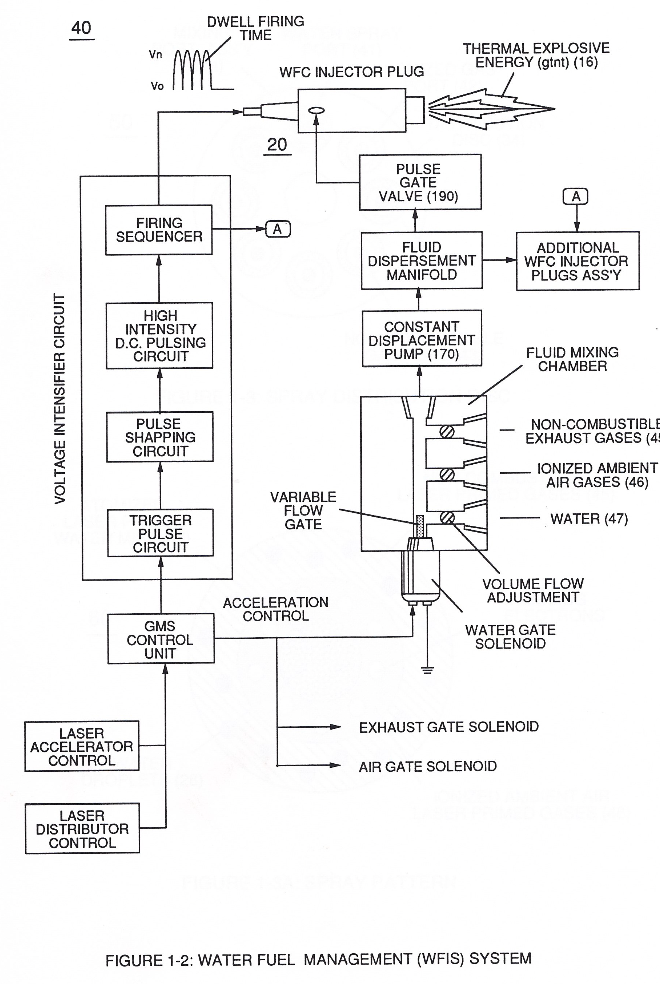
...which, in turn, not only performs electrical polarization process (160) of Figure (25) undergoing Dielectric Resonant (240) of Figure (30); but, also sets up and triggers Hydrogen Fracturing Process (390) of Figure (41) as to Figure (6) under control state (on demand) vi …
-
Electrical Polarization Process (160)
Water droplets (28a xxx 28n) escaping from spray-mist (47) and exposed to high intensity voltage fields of opposite polarity 33/ 36) are stimulated to undergo Electrical Polarization Process (160) of Figure (25)...which not only separates and splits the unlike atoms of the water molecule but also causes the unlike atoms (hydrogen atoms 77a / 77b and oxygen atom 76) to experience electron eject …
Water Fuel Injector (Taper Resonant Cavity Chamber) 1×
-
Electrical Polarization Process (160)
By first, separating water molecule (47) into its component gases (oxygen 76 / hydrogen 77a - 77b) by way of the Electrical Polarization Process (160) of Figure (25) (WFC Memo 422 DA);
Funneling Effect 1×
-
Electrical Polarization Process (160)
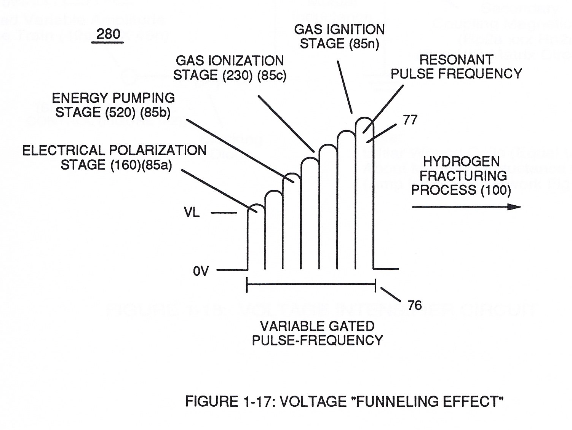
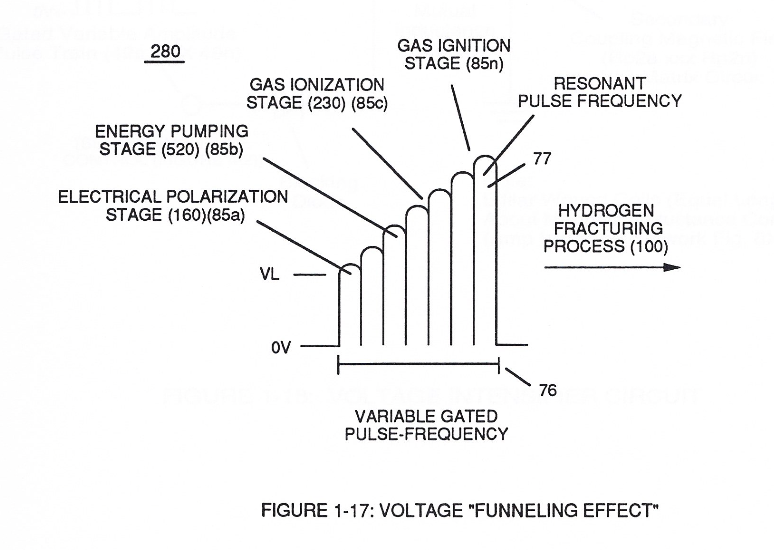
Voltage amplitude level VL of Pulse-wave (58) is predetermined (20,000 V.D.C. typically) to start and cause Electrical Polarization Process (160) at a relative rapid rate of gas production at segmental point (85a) when voltage point (VL xx Va) is reached.
Amp Inhibiting Circuit Vs Voltage Enhancement 1×
-
Furthermore, the paired coils-wires opposite voltage potential [positive electrical attraction force (B+) equaling negative electrical force (B-)] [herein called "Electrical Stress" (SS' = RR") as to (160) of Figure (3-26)] are always equal in electrical magnitude/electrical intensity since the wire-length of each coil are the same.
Water Fuel Injection System - Page 1 2×
-
...which, in turn, not only performs electrical polarization process (160) of Figure (3-26) undergoing Dielectric Resonant (240) of Figure (3-31);
-
(160) of Figure (3-26)
Water Fuel Injection System - Page 2 1×
-
Electrical Polarization Process (160)
Water droplets (28a xxx 28n) escaping from spray-mist (47) and exposed to high intensity voltage fields of opposite polarity 33/36) are stimulated to undergo Electrical Polarization Process (160) of Figure (3-26)
Energy Pumping Action 1×
-
Electrical Polarization Process (160)
Once unlike atoms of the Water Molecule (210) separates into its component gases by way of Electrical Polarization Process (160), the newly liberated and subsequently free floating hydrogen (77 a/b), oxygen (76), and dissolved air gases (97) (see WFC memo 420 DA Figure 325) submerged in water bath ( 68) are further subjected to pulse-voltage stimulation ( SS' / RR ' _ IT ' / UU ' ) ... …
Resonant Propagation 1×
-
Electrical Polarization Process (160)
Compounding Action (22) (deflection of electrical charged particles) by way of voltage stimulation aids Resonant Action by superimposing particle impact onto to the Electrical Polarization Process (160).
In Application of Usage 2×
-
Electrical Polarization Process (160)
The Voltage Intensifier Circuit (110) of Figure (4-9) brings on the "Electrical Polarization Process" (160) of Figure (3-26) that switches off the covalent bond (550) of Figure (5-8) of the water molecule without amp influxing.
-
(160) of Figure (3-26)
Covalent Switch-Off 2×
-
(160) of Figure (3-26) (Memo WFC 422DA)
-
Electrical Polarization Process (160)
which, when occurring, directly weakens the covalent bonding of the water molecule (q-q') by attenuating the electromagnetic fields of each atom Structure of the water molecule (210) of Figure (3-27) (Memo WFC 422DA) being subjected to and undergoing Electrical Polarization Process (160) of Figure (3-26) (Memo WFC 422DA), as further illustrated in (550) of Figure (5-8).
Water Fuel Injector 1×
-
Electrical Polarization Process (160)
at activation point (E9b) voltage intensity is increased sufficiently to perform Electrical Polarization Process (160) of Figure (3-26);
Taper Water Fuel Injectors 1×
-
... allowing Water Fuel Injectors (20a xxx 20n) to replace standard Internal Combustion Engine spark-plugs and fossil-fuel injector ports, as graphically illustrated in Figure (140) of Figure (4-12) titled "Furnace Retrofit," (150) of Figure (4-13) titled "Jet Engine retrofit," and (160) of Figure (4-14) titled "Rocket Engines Retrofit."
8-4 - State Space (Sp) 1×
-
Electrical Polarization Process (160)
… Potential of opposite electrical polarity of attraction (RR' - SS' as to RU/RU' – ST/DST') to perform work in the following sequence of events in an instant of time: Electrical Polarization Process (160) (elongating the water molecule
WFC Exhaust Air Reclaimer 2×
-
Electrical Polarization Process (160)
.•• performing the same function as Electrical Polarization Process (160) of Figure (3-26) by which the positive electrical voltage potential (71) attracts the negative charged oxygen atom; while, simultaneously, negative electrical voltage potential (61) attracts the positive charged Nitrogen Atom
-
Electrical Polarization Process (160)
Likewise, other chemical-oxide gas molecule (s) such as Nitrogen Dioxide N02 (940) of Figure (9-5) exposed to Electrical Polarization Process (160) utilizing Gas Resonant Cavity (140) undergoes the same molecule-to-atom separation
Propagating Electrical Stress 3×
-
Electrical Polarization Process (160)
… Validation Report dated January 14, 1983 as per WFC Test-Results "Mode of Operability" of using "Voltage Potential" to "Dissociates the Water Molecule" by way of the "Electrical Polarization Process" (160) of Figure (3-26) as so specified under U.S. …
-
Furthermore, the paired coil-wires opposite voltage potential [positive electrical attraction force (B+) - negative electrical attraction force (B-)] [hereinafter called Electrical Stress (SS' - RR') as to (160) of Figure (3-26)] are always equal in electrical magnitude/intensity since the wire-lengths of each coil are the same.
-
(160) of Figure (3-26)