(76) · also written as a run, 76a xxx 76n
Oxygen Atom
Also written negative charged oxygen atom · negative electrically charged oxygen atom · liberated oxygen atom · atom · oxygen · electromagnetic coupling field · Combustible Gas Atoms · gated pulse width and 2 more
Where it is first named
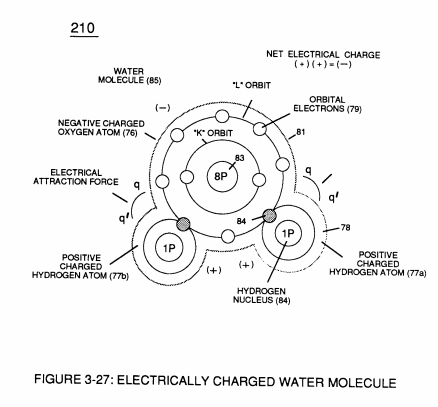
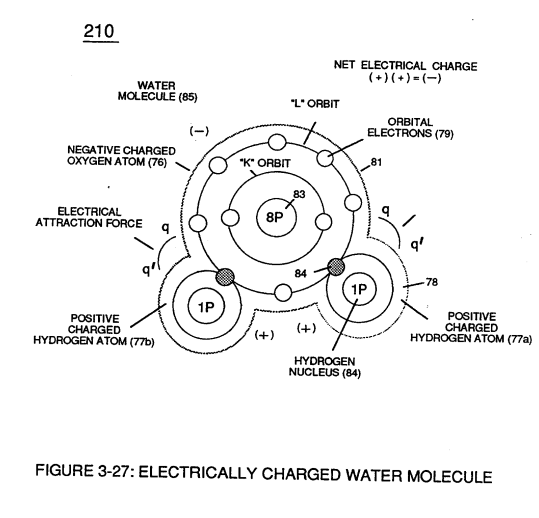
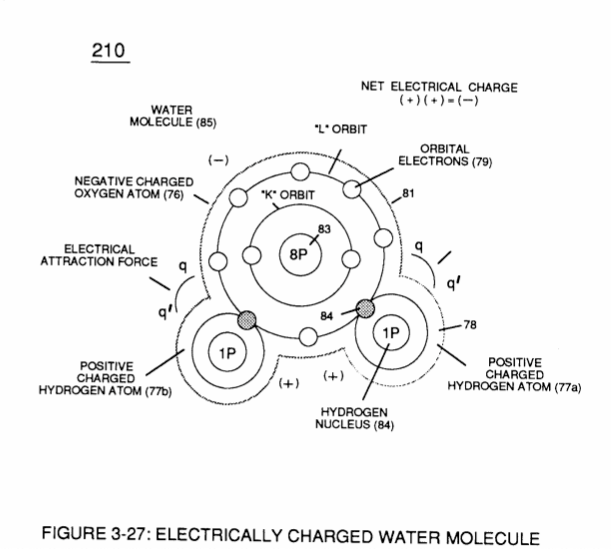
Atomic structure of an atom (76) and (77) of Figure (3-27) exhibits two types of electrical charged mass entities, orbital electrons (79) having negative electrical charges ( - ) and a nucleus (84) (at least one proton) having a positive electrical charge ( + ).
How it is written
- (76) 17×
- (76, 77a - 77b) 3× with (77) Hydrogen Atom
- (76/77) 2× with (77) Hydrogen Atom
- (76b) 2×
- (76a) 1×
- (76a xxx 76n) 1×
76a xxx 76n is Meyer's shorthand for a run of the same thing: 76a is the first, 76n the last, and the x's stand for however many lie between. Every stage of the run is this one numeral.
Drawings 30
-
Figure (3-27) · Voltage Intensifier Circuit (60)
-
Carries this number · Electrically Charged Water Molecule
-
Carries this number · WFC 422DA - Illustrations
-
...positive charged gas particles (81a xxx 81n) being directed to and attached to negative charged oxygen atom (76) of water molecule (47); · Water Fuel Injector (Taper Resonant Cavity Chamber)
-
Figure (29) · Water Fuel Injector (Taper Resonant Cavity Chamber)
-
Carries this number · Steam Resonator Assembly
-
Carries this number · Energy Pumping Action
-
...converts water mist (68) into it's component gases hydrogen (77 a/b) oxygen (76) and ambient air gases (97); · Triggering Process
-
...converts water mist (68) into it's component gases hydrogen (77 a/b) oxygen (76) and ambient air gases (97); · Triggering Process
-
(510) of Figure (5-2) · In Application of Usage
-
(210) of Figure (3-27) (Memo WFC 422DA) · Covalent Switch-Off
-
(970) of Figure (5-12) · Solar Energy Actuator
-
Carries this number · Illustrations
-
Carries this number · Illustrations
-
(210) of Figure (3-27) · Inductance (FL)
-
(510) of Figure (5-2) · 8-4 - State Space (Sp)
-
(210) of Figure (3-27) · Electrovalent Bonding
-
Figure (5-2) · Propagating Electrical Stress
-
Figure (3-20) · Voltage Intensifier Circuit (60)
-
Figure (3-26) · Voltage Intensifier Circuit (60)
-
Figure (3-26) · Electrically Charged Water Molecule
-
The figure it sits on · WFC 422DA - Illustrations
-
The figure it sits on · WFC 422DA - Illustrations
-
Figure (25) · Water Fuel Injector (Taper Resonant Cavity Chamber)
-
(160) of Figure (3-26) · Water Fuel Injection System - Page 1
-
(85) of Figure (3-26) · In Application of Usage
-
(160) of Figure (3-26) · In Application of Usage
-
(85) of Figure (3-26) · Resistance (Rs)
-
The figure it sits on · WFC Exhaust Air Reclaimer
-
(160) of Figure (3-26) · Propagating Electrical Stress
Where it is named · 26
Electrically Charged Water Molecule 7×
-
atom (76)
Atomic structure of an atom (76) and (77) of Figure (3-27) exhibits two types of electrical charged mass entities, orbital electrons (79) having negative electrical charges ( - ) and a nucleus (84) (at least one proton) having a positive electrical charge ( + ).
-
oxygen atom (76)
The liquid molecule of water (210) of Figure (3-27) is formed when the two hydrogen atoms (77a1b) takes-on a net "positive electrical charge" (78), which is, equal to the net "negative electrical charge" (81) of the oxygen atom (76).
-
oxygen (76)
The resultant electrical force (qq') between the opposite electrical charged hydrogen (77) and oxygen (76) atoms keeps water molecule (210) intact when the hydrogen atom (77) shares its electron (84) with oxygen atom (76).
-
oxygen atom (76)
The resultant electrical force (qq') between the opposite electrical charged hydrogen (77) and oxygen (76) atoms keeps water molecule (210) intact when the hydrogen atom (77) shares its electron (84) with oxygen atom (76).
-
oxygen atom (76)
Oxygen atom becomes negative electrical charged (81) since oxygen atom (76), now, has a total of ten negative charged electrons (79a xxx 79n) in its "K" plus "L" orbits while maintaining it's original eight positive charged protons which makes up oxygen nucleus (83).
-
oxygen atom (76)
Electromagnetic bonding forces between unlike atoms (76n7) are negligible or non-existence, since oxygen atom (76) electrons are paired together, while rotating in opposite direction which, in turn, causes oxygen atom (76) to be electromagnetically neutral to hydrogen atom (77).
-
oxygen atom (76)
Electromagnetic bonding forces between unlike atoms (76n7) are negligible or non-existence, since oxygen atom (76) electrons are paired together, while rotating in opposite direction which, in turn, causes oxygen atom (76) to be electromagnetically neutral to hydrogen atom (77).
Electrical Polarization process 5×
-
negative charged oxygen atom (76)
Stationary "positive" electrical voltage-field (66) (voltage plate E1) not only attracts negative charged oxygen atom (76) but also pulls away negative charged covalent electrons (84) from water molecule (210).
-
negative electrically charged oxygen atom (76)
Once negative electrically charged oxygen atom (76) is dislodged from water molecule (85), covalent bonding (sharing electrons between atoms) ceases to exist, switching-off and disrupting electrical attraction force (qq') between unlike atoms (76/77), as further illustrated in (160) of Figure (3-26).
-
Once negative electrically charged oxygen atom (76) is dislodged from water molecule (85), covalent bonding (sharing electrons between atoms) ceases to exist, switching-off and disrupting electrical attraction force (qq') between unlike atoms (76/77), as further illustrated in (160) of Figure (3-26).
-
negative charged oxygen atom (76)
Opposite polarity electrical attraction force (SS') continues to cause negative charged oxygen atom (76) to migrate to positive voltage-plate (E1) (positive voltage zone 66); while, at the same time, opposite polarity electrical attraction force (RR') causes positive charged hydrogen atoms (77a/b) to mi …
-
… increases in voltage amplitude from several millivolts to several hundred volts during each pulse train (65a xxx 65n) which, in application, causes water molecule (210) of Figure (3-27) charged atoms (76/77) to elongate (increasing distance between unlike atoms 76/77) to the point where covalent hydrogen electrons (84) of Figure (3-27) breaks away from electrostatic force (qq').
Water Fuel Injector (Taper Resonant Cavity Chamber) 3×
-
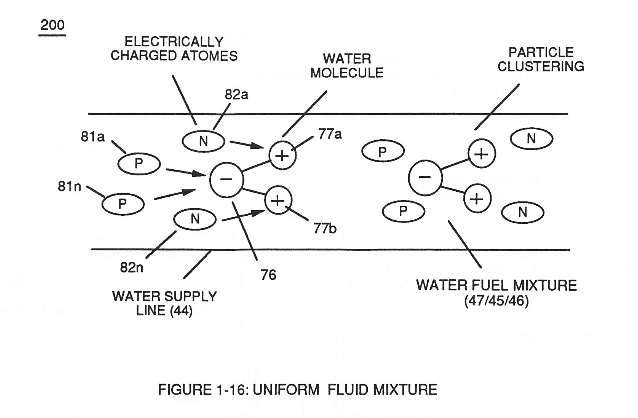
...positive charged gas particles (81a xxx 81n) being directed to and attached to negative charged oxygen atom (76) of water molecule (47);
-
secondly, by electrically attenuating the electrical-forces of the newly formed and liberated combustible gases (76, 77a - 77b) via Energy-Priming Process (520) (see WFC Memo 424 titled "Atomic Energy Balance of Water);
-
This further increase in voltage amplitude (xxxx VL) simply exerts a greater magnitude of opposite Electrical-Stress (SS'-RR') of Figure (25) (TT' - UU') of Figure (29) (WFC Memo 422 DA) across combustible gas atoms (76, 77a - 77b)
Funneling Effect 6×
-
Combustible Gas Atoms (76, 77a - 77b)
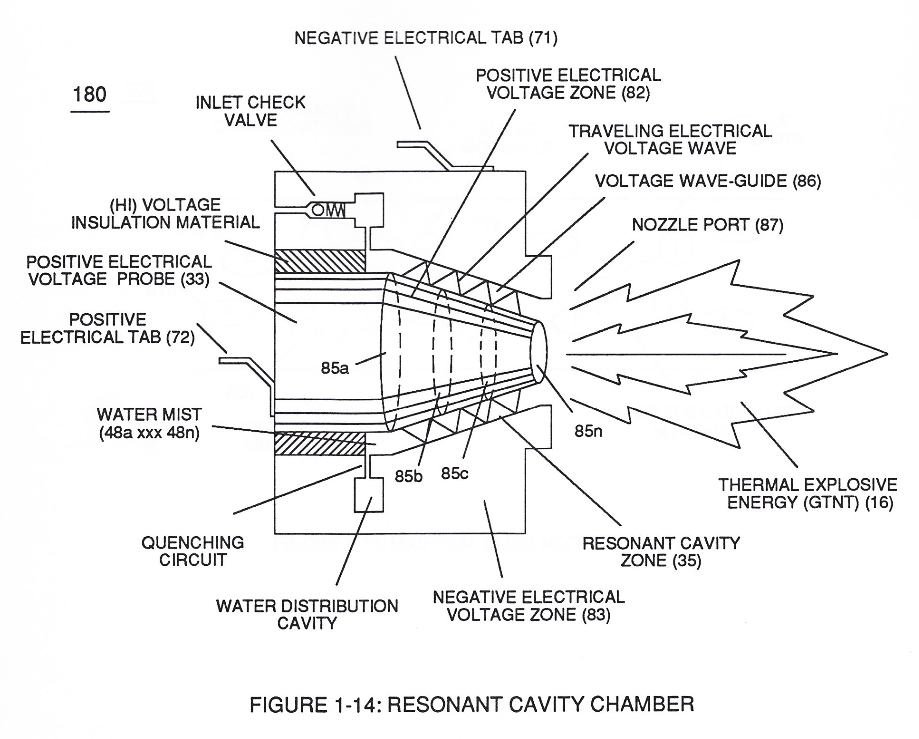
At termination point (85), voltage intensity (VL x Va x Vb x Vc x Vn) is, now, increased to the point to cause Gas Ignition as Combustible Gas Atoms (76, 77a - 77b) which are, then, expelled from Gas Nozzle Port (87) of Figure (14) under dynamic pressure to allow thermal gas expansion (16) ... releasing thermal explosive energy (gtnt) beyond and away from Resonant Cavity Chamber (180), as illustrated in Figure (14).
-
… ng -off Choke Coils (77a xxx 77n) to allow applied Voltage Intensity (VL ~ Vn xxx) to be placed across Voltage Expander Coils (78a xxx 78n) in direct relationship to electrically energized shunt-coil (76).
-
Shunt-Coil (76b)
For example, as adjacent Shunt-Coil (76b) is switch-on while, simultaneously, Choke Coil (76a) is switch-off by Electronic Switch Circuit (79), Voltage Intensity (VL ~ Vn xxx) is increased due to inductance / capacitance of Voltage Expander …
-
Choke Coil (76a)
For example, as adjacent Shunt-Coil (76b) is switch-on while, simultaneously, Choke Coil (76a) is switch-off by Electronic Switch Circuit (79), Voltage Intensity (VL ~ Vn xxx) is increased due to inductance / capacitance of Voltage Expander Coil (78a) which is, now, added to Electrical Circuit …
-
electromagnetic coupling field (76b)
… ~ Vn xxx) is increased due to inductance / capacitance of Voltage Expander Coil (78a) which is, now, added to Electrical Circuit (250) by electrical pathway (82a) since electromagnetic coupling field (76b) prevents electron flow to cause open circuit (82b)...
-
gated pulse width (76a xxx 76n)
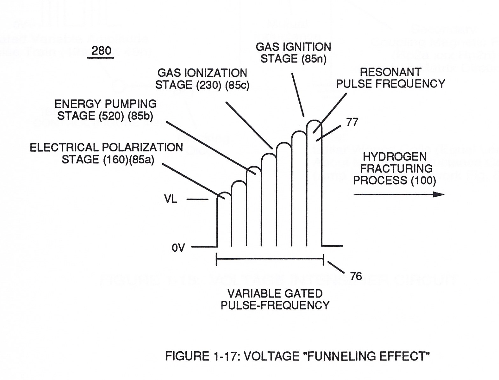
Attenuating variable voltage amplitude (72a xxx 72n) in conjunction with incoming gated pulse-train (210a xxx 210n), now, expands gated pulse width (76a xxx 76n) as voltage amplitudes (Vo xxx Vn) increases, forming step up voltage wave Form (77) of Figure (17).
Energy Pumping Action 2×
-
oxygen (76)
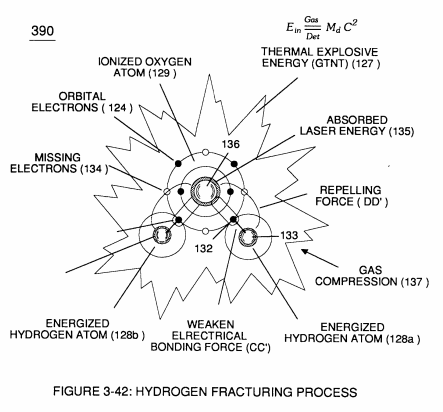
… like atoms of the Water Molecule (210) separates into its component gases by way of Electrical Polarization Process (160), the newly liberated and subsequently free floating hydrogen (77 a/b), oxygen (76), and dissolved air gases (97) (see WFC memo 420 DA Figure 325) submerged in water bath ( 68) are further subjected to pulse-voltage stimulation ( SS' / RR ' _ IT ' / UU ' ) ... …
-
liberated oxygen atom (76)
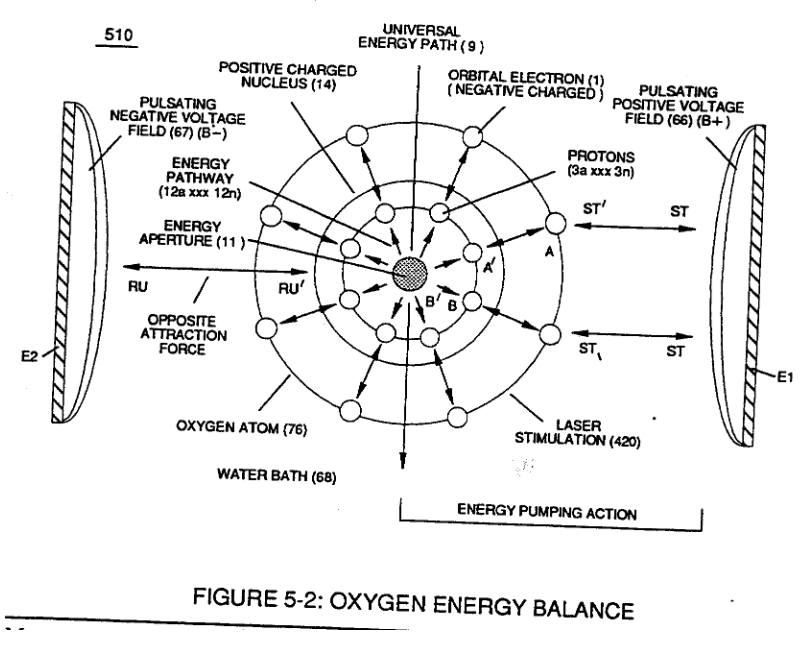
The resultant energy state of increase is directly related to applied pulse voltage frequency at a predetermined Voltage level. Likewise, liberated oxygen atom (76) and other dissolved air gases (97) submerged in water bath (68) undergo and experience similar Energy Pumping Action (520) (aperture oscillation) of their respective Energy Aperture (11a xxx 11n) whe …
Triggering Process 1×
-
...converts water mist (68) into it's component gases hydrogen (77 a/b) oxygen (76) and ambient air gases (97);
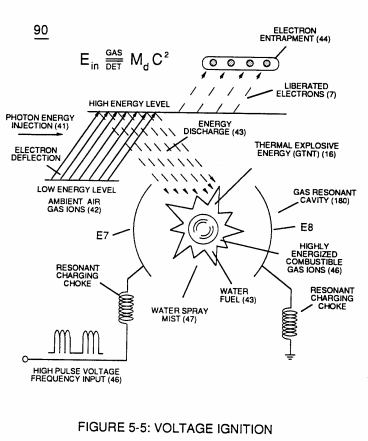
Water Fuel Injector 1×
-
... dielectric value of water being 78.54 since water molecule (85) oxygen atom "L" orbit (76) occupies the maximum allowance eight electrons (79a xxx 79n), calibrated gated unipolar pulse train (64a xxx 64n) of Figure (3-20) is outputted from resonant choke (56) and electrically transmitted to positive outer conical surface (E9);
Inductance (FL) 1×
-
… er (85) being 78.54 ohms since the electron "L" orbit of the water molecule (210) of Figure (3-27) occupies the maximum allowable number of eight electrons when covalent linkup of 'unlike oxygen atom (76) and hydrogen atoms (77a/b) occurs' stabilizing Water molecule (85) into existence ... …