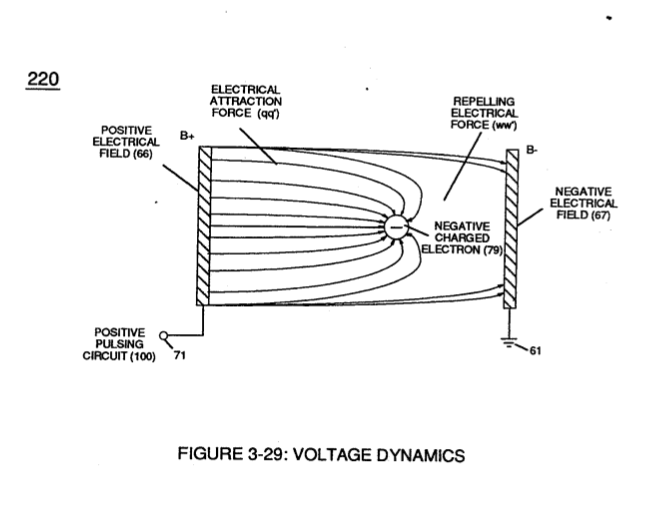
Figure (3-29)
Voltage Dynamics
How it is written
- (3-29) 11×
Drawings 6
-
In both cases, electrical charge deflection or movement is directly related to applied voltage (65). · Voltage Dynamics
-
Ions or particle mass having the same or like electrical charges will move away from one another, as illustrated in (220) of Figure (3-29). · Voltage Dynamics
-
Figure (3-29) · Electrically Charged Water Molecule
-
Captioned as this figure · WFC 422DA - Illustrations
-
Voltage Dynamics (220) of Figure (3-29) · Electron Bounce Phenomenon
-
Voltage Dynamics (220) of Figure (3-29) · WFC Exhaust Air Reclaimer
On this figure 9
- 60 Voltage Intensifier Circuit
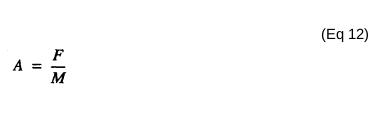
- 65 Voltage Potential
- 160 Electrical Polarization Process
- 220 Voltage Dynamics
- 326 —
- E1 Voltage Zones
- E2 Voltage Zones
- V Voltage Amplitude
- Vo Applied Voltage Amplitude
Where it is named · 11
Voltage Dynamics 3×
-
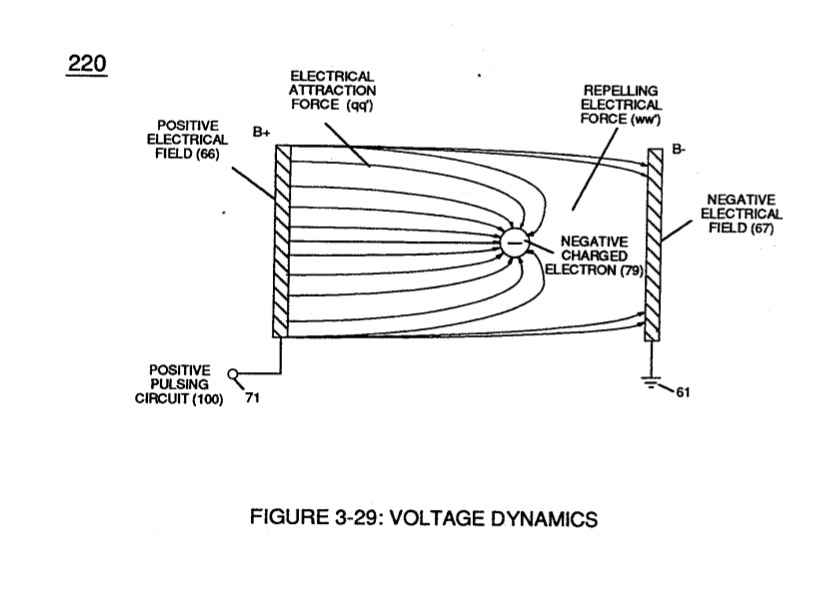
The higher the voltage potential (Vo xxx Vn), the greater "electrical attraction force" (qq') or "electrical repelling force" (ww') of Figure (3-29) is applied to electrical circuit (60) of Figure (3-22).
-
Ions or particle mass having the same or like electrical charges will move away from one another, as illustrated in (220) of Figure (3-29).
Electrically Charged Water Molecule 2×
-
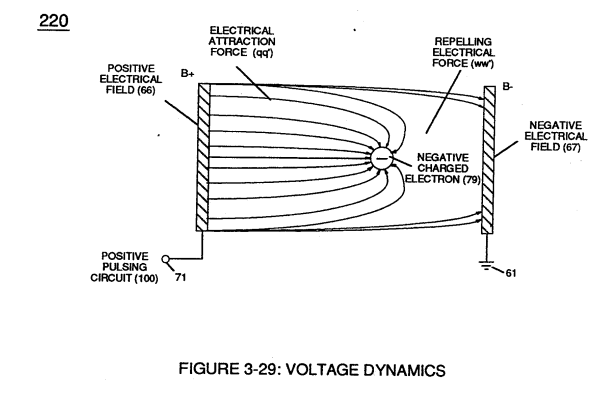
Voltage potential (65) within electrical circuit (60) can cause one or more electrons (79) to be dislodged from the water molecule atom (85) of Figure (3-26) due to opposite electrical polarity attraction (qq') of Figure (3-29) between unlike charged entities, as shown in (160) of Figure (326) as to Newton's and Coulomb's laws of electrical-force.
-
Figure (3-29)
Electrical Polarization process 2×
-
Placement of a pulse voltage potential (65) across Excitor plates (E1/E2) (voltage zones 66/67) of Figure (3-29) as to Figure (3-26) while inhibiting and preventing electron flow within voltage intensifier circuit (190) of Figure (3-23) causes water molecule (210) of Figure (3-27) to separate into its component …
-
Figure (3-29)
Electron Bounce Phenomenon 2×
-
Voltage Dynamics (220) of Figure (3-29)
WFC Exhaust Air Reclaimer 2×
-
Voltage Dynamics (220) of Figure (3-29)