(210) · also written as a run, 210a xxx 210n
Water Molecule
Also written electrical charged water molecule · pulse-train · gated electrical voltage pulse-train · Adjusting Pulse-train · gated pulse-train · Oxygen Atom ID · water
Where it is first named
The resultant interfacing voltage circuit (190), now, exposes water molecule (210) of Figure (3-27) to a pulsating high intensity voltage field (65a xxx 65n) of opposite polarity (66/67) while restricting amp flow within circuit (60) of Figure (3-22).
How it is written
- (210) 25×
- (210a xxx 210n) 4×
210a xxx 210n is Meyer's shorthand for a run of the same thing: 210a is the first, 210n the last, and the x's stand for however many lie between. Every stage of the run is this one numeral.
Drawings 11
-
Figure (3-27) · Voltage Intensifier Circuit (60)
-
Carries this number · Electrically Charged Water Molecule
-
Figure (3-46) · Steam Resonator
-
Carries this number · WFC 422DA - Illustrations
-
Carries this number · WFC 422DA - Illustrations
-
Figure (29) · Water Fuel Injector (Taper Resonant Cavity Chamber)
-
(210) of Figure (3-27) (Memo WFC 422DA) · Covalent Switch-Off
-
(210) of Figure (3-27) · Inductance (FL)
-
(210) of Figure (3-27) · Electrovalent Bonding
-
bipolar electrically charged water molecule (210) of Figure (3-46) · Voltage Flexing Process
-
"Voltage Energized Thermal Transference Effect" (1050) of Figure (11-5) · Voltage Flexing Process
Where it is named · 29
Voltage Intensifier Circuit (60) 1×
-
water molecule (210)
The resultant interfacing voltage circuit (190), now, exposes water molecule (210) of Figure (3-27) to a pulsating high intensity voltage field (65a xxx 65n) of opposite polarity (66/67) while restricting amp flow within circuit (60) of Figure (3-22).
Voltage Dynamics 1×
-
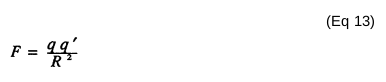
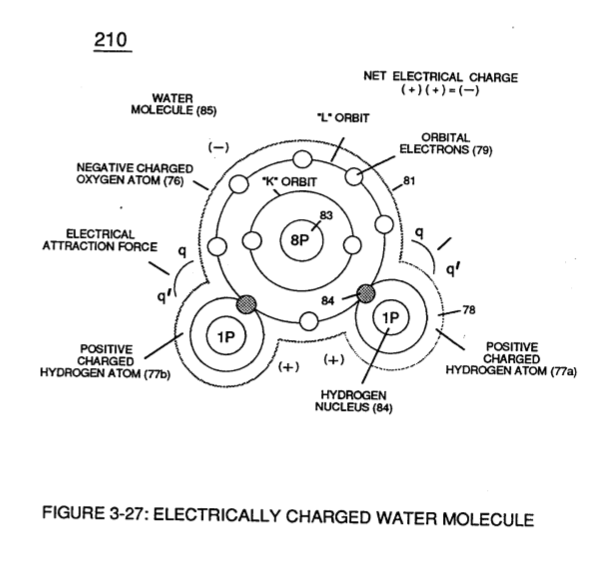
Whereby, net force (F) is the "electrical attraction force" (qq') between opposite electrically charged entities (210) of Figure (3-27), and, is given by Coulomb's law (Eq 13)
Electrically Charged Water Molecule 3×
-
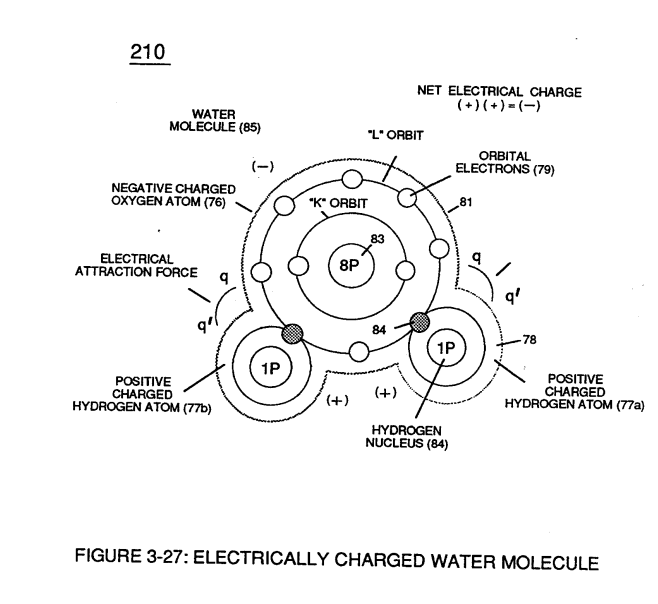
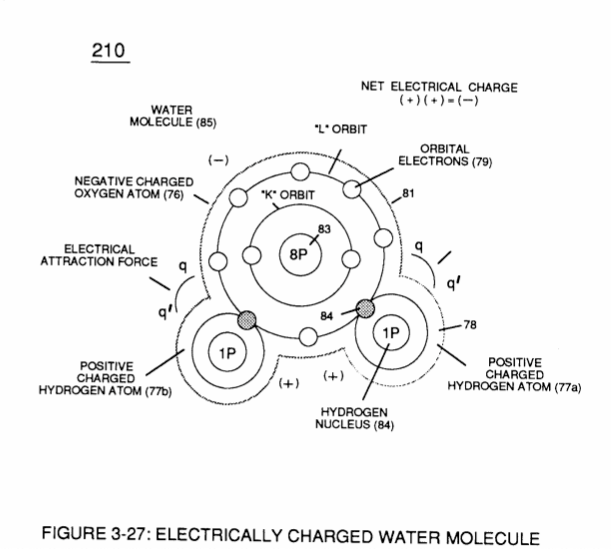
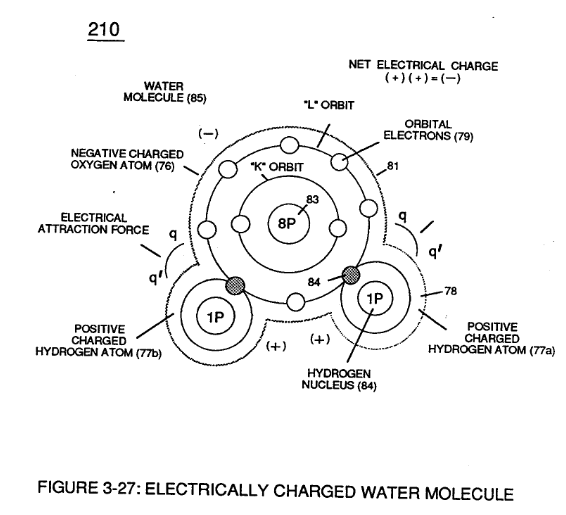
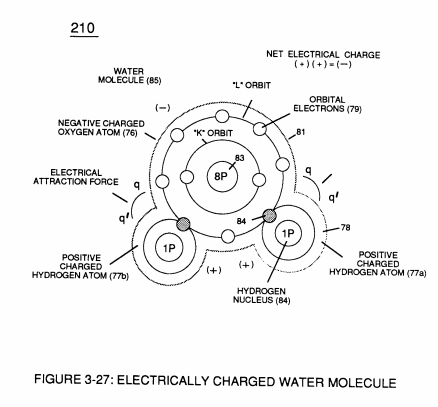
These same laws of electrical-force (qq') are used to combine or join atoms together by way of covalent bonding (opposite electrical forces) to form a molecule of water (85), as illustrated in (210) of Figure (3-27).
-
water (210)
The liquid molecule of water (210) of Figure (3-27) is formed when the two hydrogen atoms (77a1b) takes-on a net "positive electrical charge" (78), which is, equal to the net "negative electrical charge" (81) of the oxygen atom (76).
-
water molecule (210)
The resultant electrical force (qq') between the opposite electrical charged hydrogen (77) and oxygen (76) atoms keeps water molecule (210) intact when the hydrogen atom (77) shares its electron (84) with oxygen atom (76).
Electrical Polarization process 3×
-
… plates (E1/E2) (voltage zones 66/67) of Figure (3-29) as to Figure (3-26) while inhibiting and preventing electron flow within voltage intensifier circuit (190) of Figure (3-23) causes water molecule (210) of Figure (3-27) to separate into its component parts (released hydrogen and oxygen gases) by pulling away (utilizing opposite attraction forces SS' and RR') its charged water molecule atoms (76n7), …
-
water molecule (210)
Stationary "positive" electrical voltage-field (66) (voltage plate E1) not only attracts negative charged oxygen atom (76) but also pulls away negative charged covalent electrons (84) from water molecule (210).
-
water molecule (210)
… ) as step-charging voltage-wave (65) increases in voltage amplitude from several millivolts to several hundred volts during each pulse train (65a xxx 65n) which, in application, causes water molecule (210) of Figure (3-27) charged atoms (76/77) to elongate (increasing distance between unlike atoms 76/77) to the point where covalent hydrogen electrons (84) of Figure (3-27) breaks away from electrostatic …
Steam Resonator 2×
-
water molecule (210)
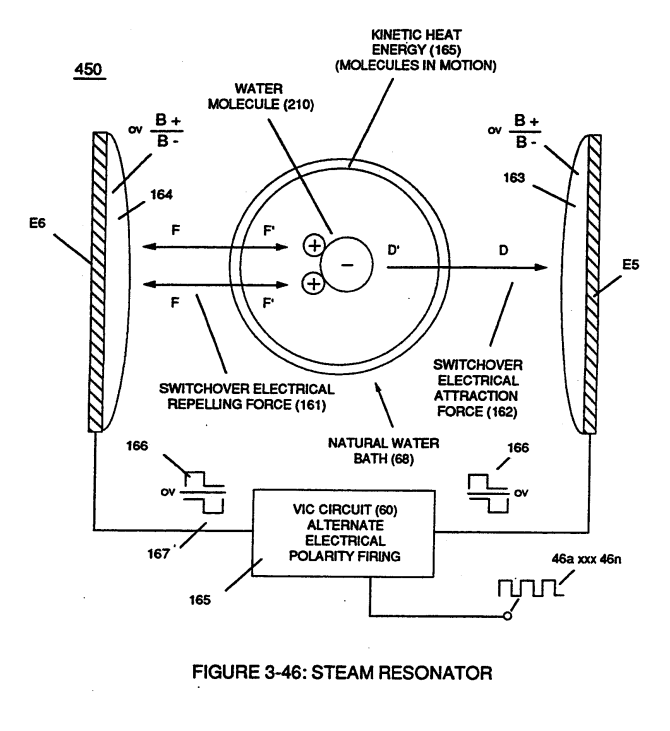
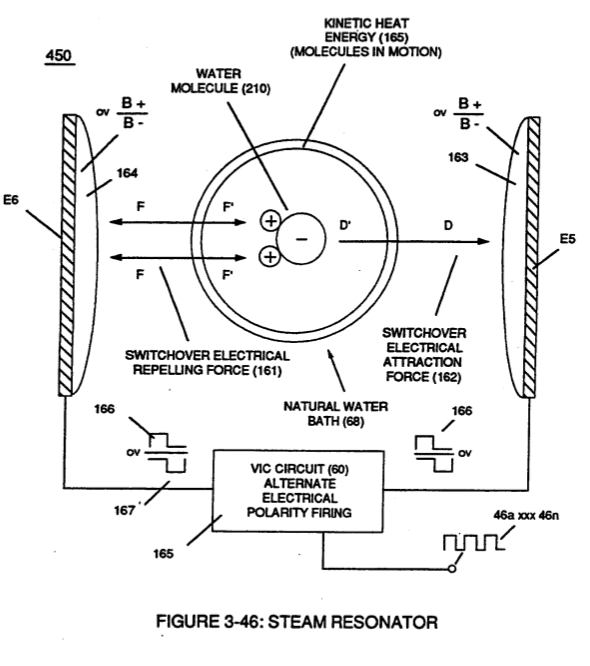
Once positive energized, water molecule (210) of water bath (68) is deflected toward voltage surface (E5) via both opposite electrical attraction force (162) and electrical repelling force (161).
-
water molecule (210)
By simply reversing to a negative voltage pulse (167), now, causes water molecule (210) to be deflected in the opposite direction toward voltage surface (E6)
Water Fuel Injector (Taper Resonant Cavity Chamber) 6×
-
gated electrical voltage pulse-train (210a xxx 210n)
Subsequent and repetitive formation of applied gated electrical voltage pulse-train (210a xxx 210n) of Figure (17) to continued in-flow of water fuel droplets (48a xxx 48n) not only sustains and maintains Hydrogen Fracturing Process (100) of Figure (6) but, also, regulates Thermal Explosive Energy …
-
Voltage Intensifier Circuit (220) of Figure (18) allows Electrical-Stress variation (SS' = RR' / TT' = UU') since voltage Intensifier Circuit (220) inhibits electron-flow (amp restriction) into voltage triggering process (210) of Figure (17) as to (100) of Figure (6).
-
voltage triggering process (210) of Figure (17)
-
pulse-train (210a xxx 210n)
Incoming pulse-train (210a xxx 210n) is adjusted to "tune-in" to the Dielectric Properties of Water (47) which allows Resonant Action (see WFC Memo 424, once again) to occur since the Dielectric property of water (78.54 value) becomes a integral part of Electronic Circuit (110) of Figure (7) as to (220) of Figure (18)
-
Adjusting Pulse-train (210a xxx 210n)
Adjusting Pulse-train (210a xxx 210n) in such a way as to allow pulse off-time (T2) to be synchronized with collapsing and re-formation of electromagnetic field coupling across pulsing transformer (52/53) to produce unipolar pulse frequency (T1a xxx T1n), as illustrated in (220) of Figure (18) as to Figure (17).
-
pulse-train (210)
The resultant and newly formed gated Resonant Pulse-train (T1 + T2a xxx T1 + T2n) (58) voltage amplitude (Vo xxx Vn) is, now, attenuated by Sequential Voltage Amplitude Control Circuit (59) once step up Secondary Coil (53) produces a higher voltage level (xxxVL) above incoming pulse-train (210) since Secondary Coil (53) has a greater number of turns of wire.
Funneling Effect 2×
-
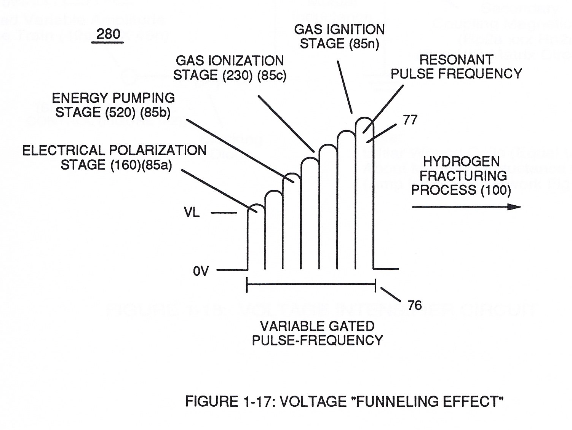
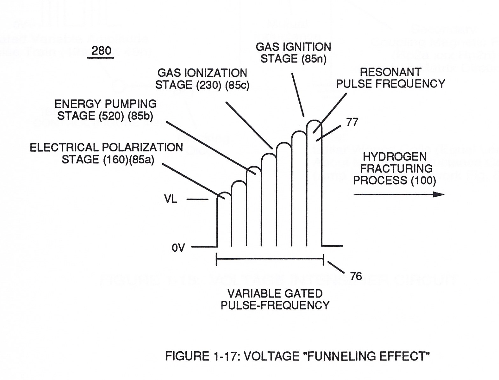
This resultant "Funneling Effect" (260), now, allows voltage amplitude (Vn) wave-form (58) to travel the length of Resonant Cavity Zone (35) from Start-Point (85a) to End-Point (85n) increasing voltage intensity (xxx VL = Vn) as parallel voltage surfaces (83/84) diminishes in size relationship (85a ~ 85n), as illustrated in (210) of Figure (17).
-
gated pulse-train (210a xxx 210n)
Attenuating variable voltage amplitude (72a xxx 72n) in conjunction with incoming gated pulse-train (210a xxx 210n), now, expands gated pulse width (76a xxx 76n) as voltage amplitudes (Vo xxx Vn) increases, forming step up voltage wave Form (77) of Figure (17).
Energy Pumping Action 1×
-
Water Molecule (210)
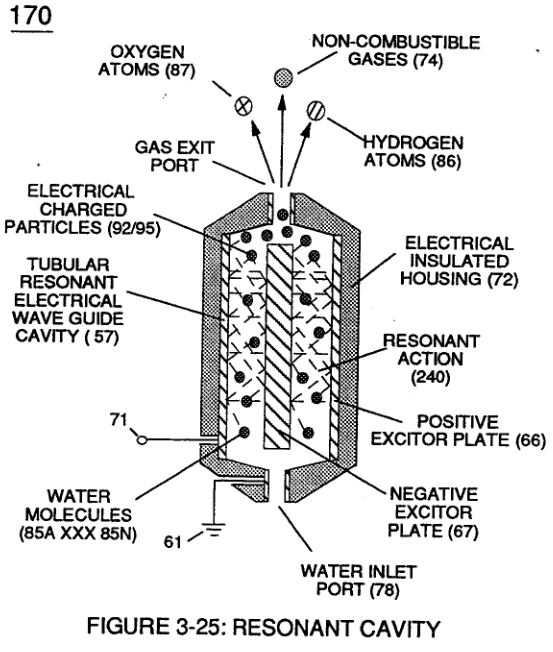
Once unlike atoms of the Water Molecule (210) separates into its component gases by way of Electrical Polarization Process (160), the newly liberated and subsequently free floating hydrogen (77 a/b), oxygen (76), and dissolved air gases (97) (se …
Covalent Switch-Off 2×
-
(210) of Figure (3-27) (Memo WFC 422DA)
-
which, when occurring, directly weakens the covalent bonding of the water molecule (q-q') by attenuating the electromagnetic fields of each atom Structure of the water molecule (210) of Figure (3-27) (Memo WFC 422DA) being subjected to and undergoing Electrical Polarization Process (160) of Figure (3-26) (Memo WFC 422DA), as further illustrated in (550) of Figure (5-8).
Inductance (FL) 2×
-
The established Dielectric Value of Water (85) being 78.54 ohms since the electron "L" orbit of the water molecule (210) of Figure (3-27) occupies the maximum allowable number of eight electrons when covalent linkup of 'unlike oxygen atom (76) and hydrogen atoms (77a/b) occurs' stabilizing Water molecule (85) into existence ... …
-
(210) of Figure (3-27)
Electrovalent Bonding 2×
-
Oxygen Atom ID (210)
In similar manner by which polar Water Molecule unlike atoms (Hydrogen Atoms 78 / Oxygen Atom ID (210) of Figure (3-27) take-on opposite electrical Charges (B+ / B-), other gas-atoms molecule (s) experience the same Electrical Charge Effect (q - q') when covalent-electron sharing occurs, as illustrate …
-
(210) of Figure (3-27)
Voltage Flexing Process 3×
-
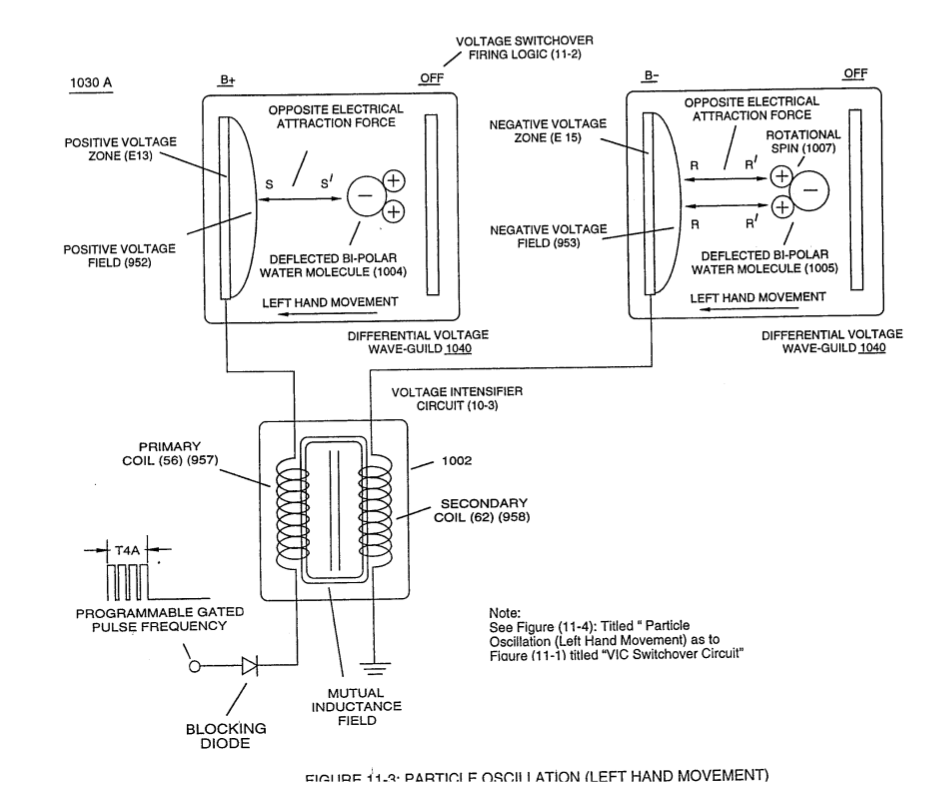
In order to accomplish this task, dual unipolar voltage pulse circuit (1010) of Figure (11-1) is, now, utilized to deflect (Physical Movement) the bipolar electrically charged water molecule (210) of Figure (3-46) while undergoing and experiencing both physical and electrical stress, simultaneously
-
bipolar electrically charged water molecule (210) of Figure (3-46)
-
... whichever the case may be, the applied stationary voltage fields (952/E13 – 953/E14) or (954/E15 – 956/E16) alternately switch over periodically superimposes electrical stress forces (S-S' and R - R') onto the energy spectrum of the water molecule atom (s )(210) while physical flexing (951) of Figure (11-5) of the water molecule atom (s) occurs
VIC Switchover Circuit 1×
-
electrical charged water molecule (210)
while, at the same time, allowing voltage potential of opposite electrical attraction forces (S-S' /R-R') to perform work by deflecting the bipolar electrical charged water molecule (210) in a given directional pathway, as so in accordance to/with Coulomb's (Eq12) and Newton's second law of electrical force (Eq13) in an electrical/electronic circuit.