(25)
(25)
Where it is first named
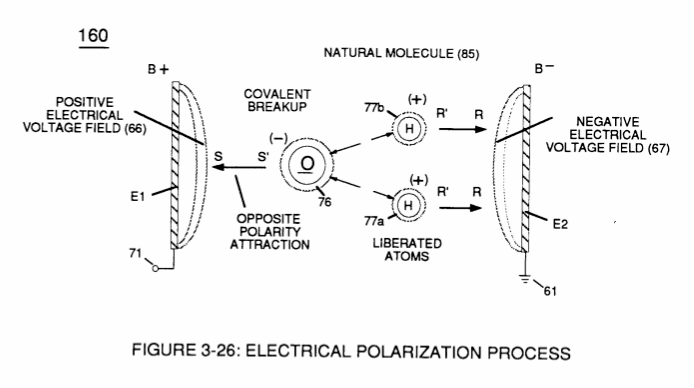
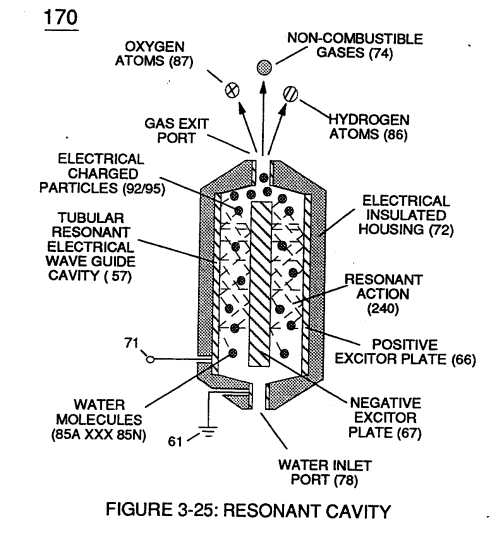
Resonant charging choke (56) in series with Excitor-Array (160) of Figure (25) forms an inductor-capacitor circuit (180) of Figure (3-28) since Excitor-Array (66/67) acts and performs as a capacitor (dielectric liquid between opposite electrical plates) during pulsing operations.
How it is written
- (25) 6×
Drawings 22
-
Stanley A. Meyer Page_2 of 28 · WFC 417 — WFC 417
-
Stanley A. Meyer Page 25 of 28 · WFC 417 — WFC 417
-
memo WFC417 · WFC 417 — WFC 417
-
Figure (3-25) · Voltage Intensifier Circuit (60)
-
Carries this number · WFC 422DA - Illustrations
-
Carries this number · Water Fuel Injection System
-
Carries this number · Electronic Circuit Design
-
Carries this number · Electronic Circuit Design
-
Carries this number · Electronic Circuit Design
-
Carries this number · Electronic Circuit Design
-
Carries this number · Electronic Circuit Design
-
Figure (25) · Water Fuel Injector (Taper Resonant Cavity Chamber)
-
2-2 Plug Housing · Water Fuel Injector Illustrations
-
Carries this number · Energy Pumping Action
-
(57 of Figure 3- 25 ~35 of Figure 6-2) · Instant Explosion of Water
-
Carries this number · Transformer Action
-
(631) of Figure (7-9) · 8-3 - Electrical Voltage-Pulse Wave-Transmission
-
(170) of Figure (3-25) · 8-4 - State Space (Sp)
-
Figure (3-28) · Voltage Intensifier Circuit (60)
-
Ohm's law of LC circuit (180) of Figure (3-28) in series is given by (Eq 5) · Voltage Intensifier Circuit (60)
-
Voltage (Vc) of Figure (3-28) across the capacitor is given by (Eq 7) · Voltage Intensifier Circuit (60)
-
The figure it sits on · WFC 422DA - Illustrations
Where it is named · 6
Voltage Intensifier Circuit (60) 1×
-
Resonant charging choke (56) in series with Excitor-Array (160) of Figure (25) forms an inductor-capacitor circuit (180) of Figure (3-28) since Excitor-Array (66/67) acts and performs as a capacitor (dielectric liquid between opposite electrical plates) during pulsing operations.
Water Fuel Injection System 2×
-
...which, in turn, not only performs electrical polarization process (160) of Figure (25) undergoing Dielectric Resonant (240) of Figure (30); but, also sets up and triggers Hydrogen Fracturing Process (390) of Figure (41) as to Figure (6) under control state (on demand) via electrical-st …
-
… roplets (28a xxx 28n) escaping from spray-mist (47) and exposed to high intensity voltage fields of opposite polarity 33/ 36) are stimulated to undergo Electrical Polarization Process (160) of Figure (25)...which not only separates and splits the unlike atoms of the water molecule but also causes the unlike atoms (hydrogen atoms 77a / 77b and oxygen atom 76) to experience electron ejection (230) of Fi …
Water Fuel Injector (Taper Resonant Cavity Chamber) 3×
-
By first, separating water molecule (47) into its component gases (oxygen 76 / hydrogen 77a - 77b) by way of the Electrical Polarization Process (160) of Figure (25) (WFC Memo 422 DA);
-
This further increase in voltage amplitude (xxxx VL) simply exerts a greater magnitude of opposite Electrical-Stress (SS'-RR') of Figure (25) (TT' - UU') of Figure (29) (WFC Memo 422 DA) across combustible gas atoms (76, 77a - 77b)
-
Figure (25)