(77) · also written as a run, 77a xxx 77n
Hydrogen Atom
Also written Choke Coils · positive charged hydrogen atoms · Combustible Gas Atoms · hydrogen · Form
Where it is first named
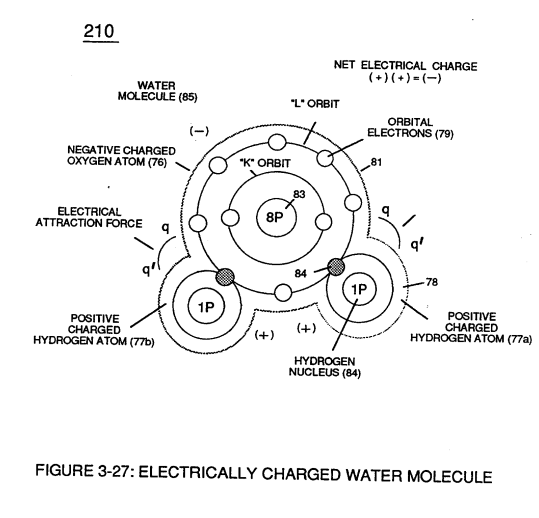
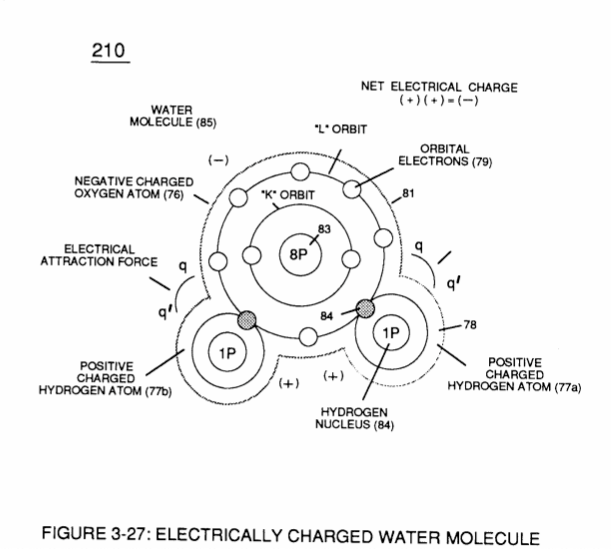
Atomic structure of an atom (76) and (77) of Figure (3-27) exhibits two types of electrical charged mass entities, orbital electrons (79) having negative electrical charges ( - ) and a nucleus (84) (at least one proton) having a positive electrical charge ( + ).
How it is written
- (77) 6×
- (76, 77a - 77b) 3× with (76) Oxygen Atom
- (77a xxx 77n) 3×
- (76/77) 2× with (76) Oxygen Atom
- (77a / 77b) 1×
77a xxx 77n is Meyer's shorthand for a run of the same thing: 77a is the first, 77n the last, and the x's stand for however many lie between. Every stage of the run is this one numeral. A pair before the letters, 583/602a, is a run of two things that go together, one of each per stage.
Drawings 33
-
Carries this number · Laser Accelerator Assembly
-
Figure (3-27) · Voltage Intensifier Circuit (60)
-
Carries this number · Electrically Charged Water Molecule
-
To further prevent voltage fluctuation during resonant action, Phase Lock Loop technique of Pulse Indicator circuit (110) is utilized during pulsing operations. · Resonant Action
-
Carries this number · WFC 422DA - Illustrations
-
Carries this number · WFC 422DA - Illustrations
-
Carries this number · WFC 422DA - Illustrations
-
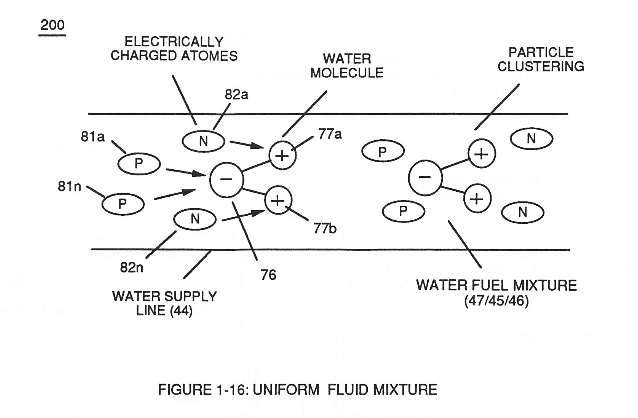
...positive charged gas particles (81a xxx 81n) being directed to and attached to negative charged oxygen atom (76) of water molecule (47); · Water Fuel Injector (Taper Resonant Cavity Chamber)
-
Figure (29) · Water Fuel Injector (Taper Resonant Cavity Chamber)
-
Figure (17) · Water Fuel Injector (Taper Resonant Cavity Chamber)
-
(160) of Figure (3-26) · Water Fuel Injection System - Page 1
-
Figure (5-1) · Energy Pumping Action
-
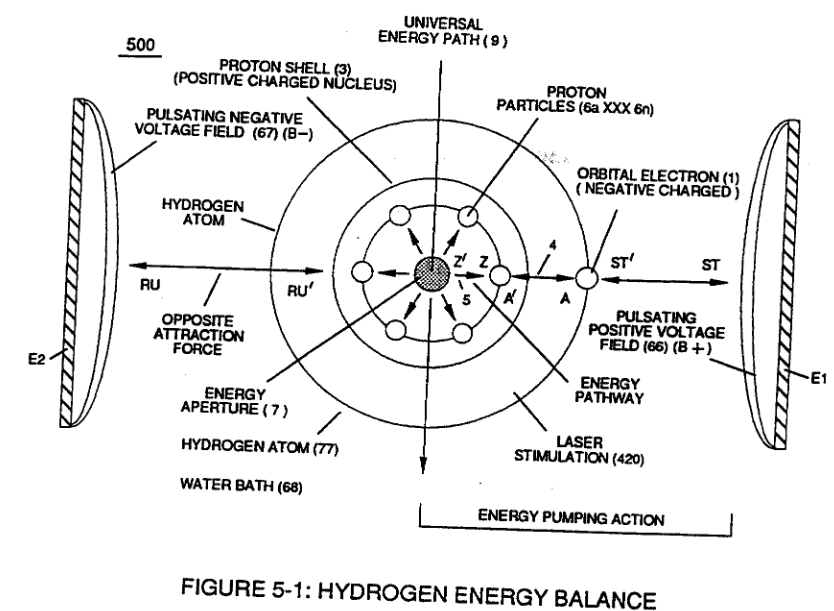
This established increase or decrease in Electrical Pressure (4 / 5 ), now causes Energy Aperture (7) to either enlarge or become smaller as to applied voltage amplitude (VO xxx Vn), respectively. · Energy Pumping Action
-
(160) of Figure (3-26) · In Application of Usage
-
(500) of Figure (5-1) · In Application of Usage
-
(210) of Figure (3-27) (Memo WFC 422DA) · Covalent Switch-Off
-
(970) of Figure (5-12) · Solar Energy Actuator
-
Carries this number · Illustrations
-
Carries this number · Illustrations
-
(85) of Figure (3-26) · Resistance (Rs)
-
(210) of Figure (3-27) · Inductance (FL)
-
(210) of Figure (3-27) · Electrovalent Bonding
-
Carries this number · WFC Exhaust Air Reclaimer
-
Energy Priming Stage (500) of Figure (5-1) · Propagating Electrical Stress
-
WFC Figure (5-1) · WFC Atomic Degaussing Process
-
energy aperture (7) of Figure (5-1) · Voltage Flexing Process
-
(500) of Figure (5-1) · Voltage Flexing Process
-
Figure (3-26) · Voltage Intensifier Circuit (60)
-
Figure (3-26) · Electrically Charged Water Molecule
-
The figure it sits on · WFC 422DA - Illustrations
-
Figure (25) · Water Fuel Injector (Taper Resonant Cavity Chamber)
-
(85) of Figure (3-26) · In Application of Usage
-
(160) of Figure (3-26) · Propagating Electrical Stress
Where it is named · 15
Electrically Charged Water Molecule 4×
-
Atomic structure of an atom (76) and (77) of Figure (3-27) exhibits two types of electrical charged mass entities, orbital electrons (79) having negative electrical charges ( - ) and a nucleus (84) (at least one proton) having a positive electrical charge ( + ).
-
hydrogen (77)
The resultant electrical force (qq') between the opposite electrical charged hydrogen (77) and oxygen (76) atoms keeps water molecule (210) intact when the hydrogen atom (77) shares its electron (84) with oxygen atom (76).
-
hydrogen atom (77)
The resultant electrical force (qq') between the opposite electrical charged hydrogen (77) and oxygen (76) atoms keeps water molecule (210) intact when the hydrogen atom (77) shares its electron (84) with oxygen atom (76).
-
hydrogen atom (77)
Electromagnetic bonding forces between unlike atoms (76n7) are negligible or non-existence, since oxygen atom (76) electrons are paired together, while rotating in opposite direction which, in turn, causes oxygen atom (76) to be electromagnetically neutral to hydrogen atom (77).
Electrical Polarization process 2×
-
Once negative electrically charged oxygen atom (76) is dislodged from water molecule (85), covalent bonding (sharing electrons between atoms) ceases to exist, switching-off and disrupting electrical attraction force (qq') between unlike atoms (76/77), as further illustrated in (160) of Figure (3-26).
-
… increases in voltage amplitude from several millivolts to several hundred volts during each pulse train (65a xxx 65n) which, in application, causes water molecule (210) of Figure (3-27) charged atoms (76/77) to elongate (increasing distance between unlike atoms 76/77) to the point where covalent hydrogen electrons (84) of Figure (3-27) breaks away from electrostatic force (qq').
Water Fuel Injector (Taper Resonant Cavity Chamber) 3×
-
positive charged hydrogen atoms (77a / 77b)
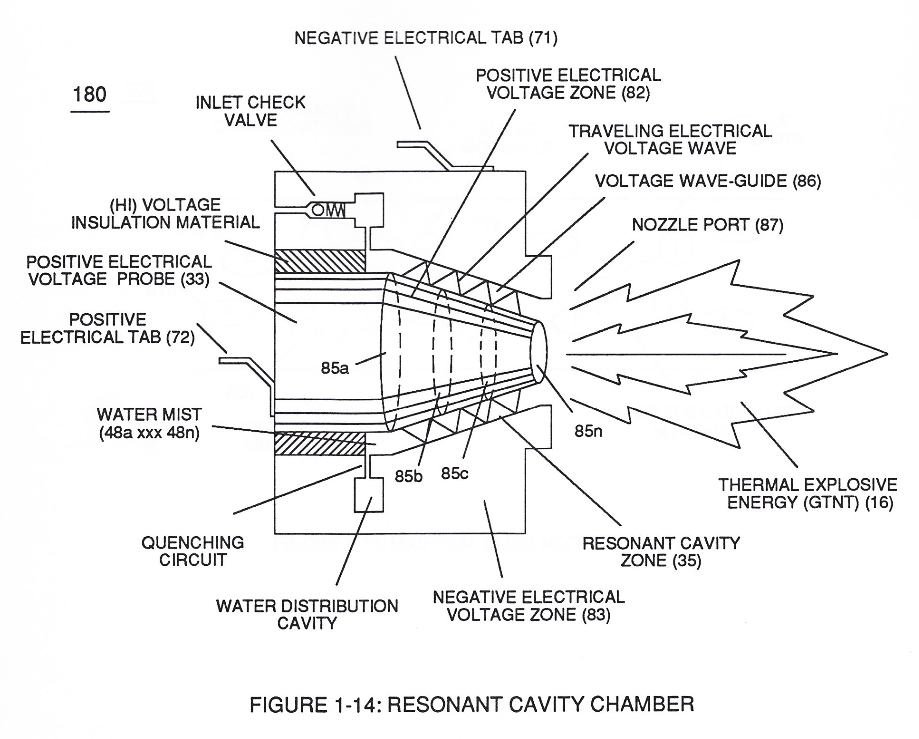
while, during the same interim period of time, negative charged gas particles (82a xxx 82n) being directed onward to and affix themselves to positive charged hydrogen atoms (77a / 77b), as illustrated in (200) of Figure (16).
-
secondly, by electrically attenuating the electrical-forces of the newly formed and liberated combustible gases (76, 77a - 77b) via Energy-Priming Process (520) (see WFC Memo 424 titled "Atomic Energy Balance of Water);
-
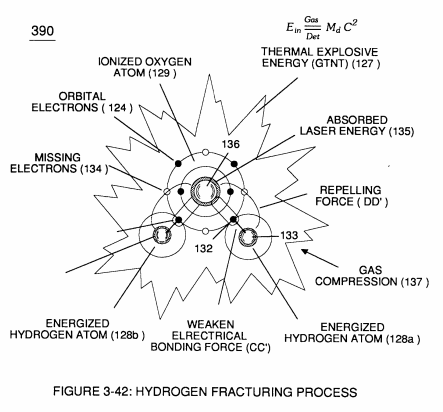
This further increase in voltage amplitude (xxxx VL) simply exerts a greater magnitude of opposite Electrical-Stress (SS'-RR') of Figure (25) (TT' - UU') of Figure (29) (WFC Memo 422 DA) across combustible gas atoms (76, 77a - 77b)
Funneling Effect 5×
-
Combustible Gas Atoms (76, 77a - 77b)
At termination point (85), voltage intensity (VL x Va x Vb x Vc x Vn) is, now, increased to the point to cause Gas Ignition as Combustible Gas Atoms (76, 77a - 77b) which are, then, expelled from Gas Nozzle Port (87) of Figure (14) under dynamic pressure to allow thermal gas expansion (16) ... releasing thermal explosive energy (gtnt) beyond and away from Resonant Cavity Chamber (180), as illustrated in Figure (14).
-
Choke Coils (77a xxx 77n)
In alternate form, Core-Slug (73) is replaced by a series of Choke Coils (77a xxx 77n) arranged in such a way as to increase voltage Intensity (Voltage Pulse Amplitude) (VL ~ Vn xxx) digitally by sequentially switching-on / switching -off Choke Coils (77a xxx 77n) to allow applied Volt …
-
Choke Coils (77a xxx 77n)
… series of Choke Coils (77a xxx 77n) arranged in such a way as to increase voltage Intensity (Voltage Pulse Amplitude) (VL ~ Vn xxx) digitally by sequentially switching-on / switching -off Choke Coils (77a xxx 77n) to allow applied Voltage Intensity (VL ~ Vn xxx) to be placed across Voltage Expander Coils (78a xxx 78n) in direct relationship to electrically energized shunt-coil (76).
-
Form (77)
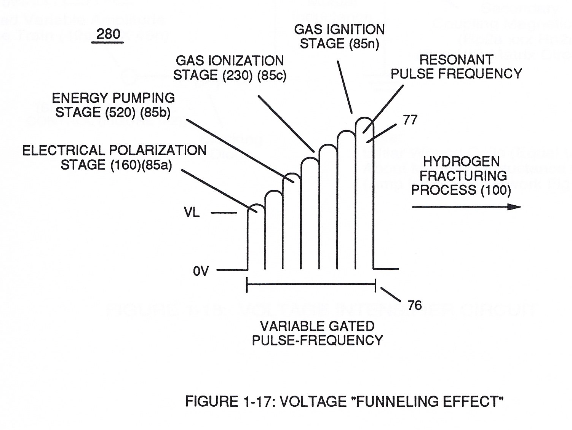
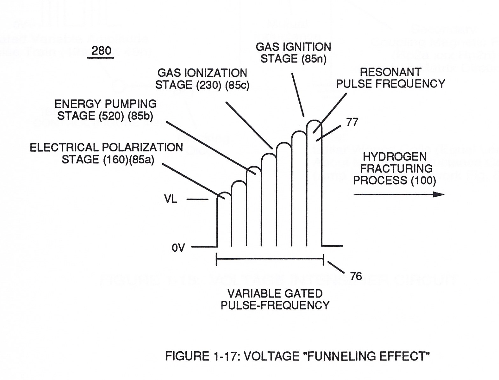
Attenuating variable voltage amplitude (72a xxx 72n) in conjunction with incoming gated pulse-train (210a xxx 210n), now, expands gated pulse width (76a xxx 76n) as voltage amplitudes (Vo xxx Vn) increases, forming step up voltage wave Form (77) of Figure (17).
-
This newly formed synchronized and repetitive dual expanding voltage wave form (77a xxx 77n) is further enhanced by "Funneling Effect" (260)... maximizing voltage dynamic across Resonant Cavity (35) always subjecting and exerting increase "Electrical-Stress" (SS'-RR' / TT'-UU') of opposite polarity across Hydrogen Fracturing Process (100 / 390) to the point of gas ignition.
Energy Pumping Action 1×
-
Hydrogen Atom (77)
Applied voltage fields (66-El/67-E2) causes and forms both opposite attraction forces (ST - ST') and (RU - RU') across exposed Hydrogen Atom (77) since the negative charged hydrogen electron (1) is attracted and deflected toward stationary positive voltage field (66);