(84)
Negative Charged Covalent Electrons
Also written covalent hydrogen electrons · negative charged electrons · hydrogen nucleus proton · hydrogen proton · electron · nucleus
Where it is first named
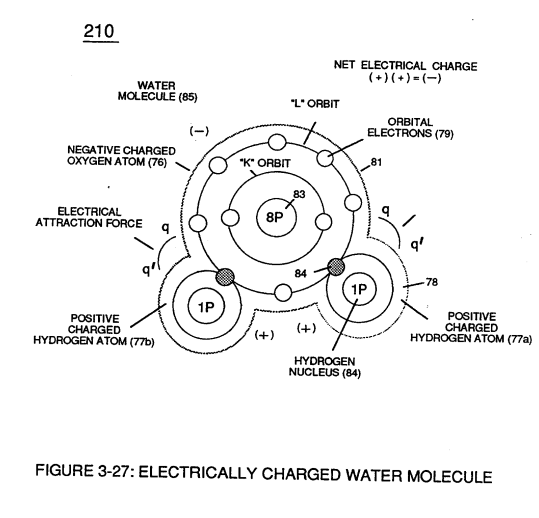
Atomic structure of an atom (76) and (77) of Figure (3-27) exhibits two types of electrical charged mass entities, orbital electrons (79) having negative electrical charges ( - ) and a nucleus (84) (at least one proton) having a positive electrical charge ( + ).
How it is written
- (84) 7×
- (83/84) 2× with (83) Oxygen Nucleus
Drawings 10
-
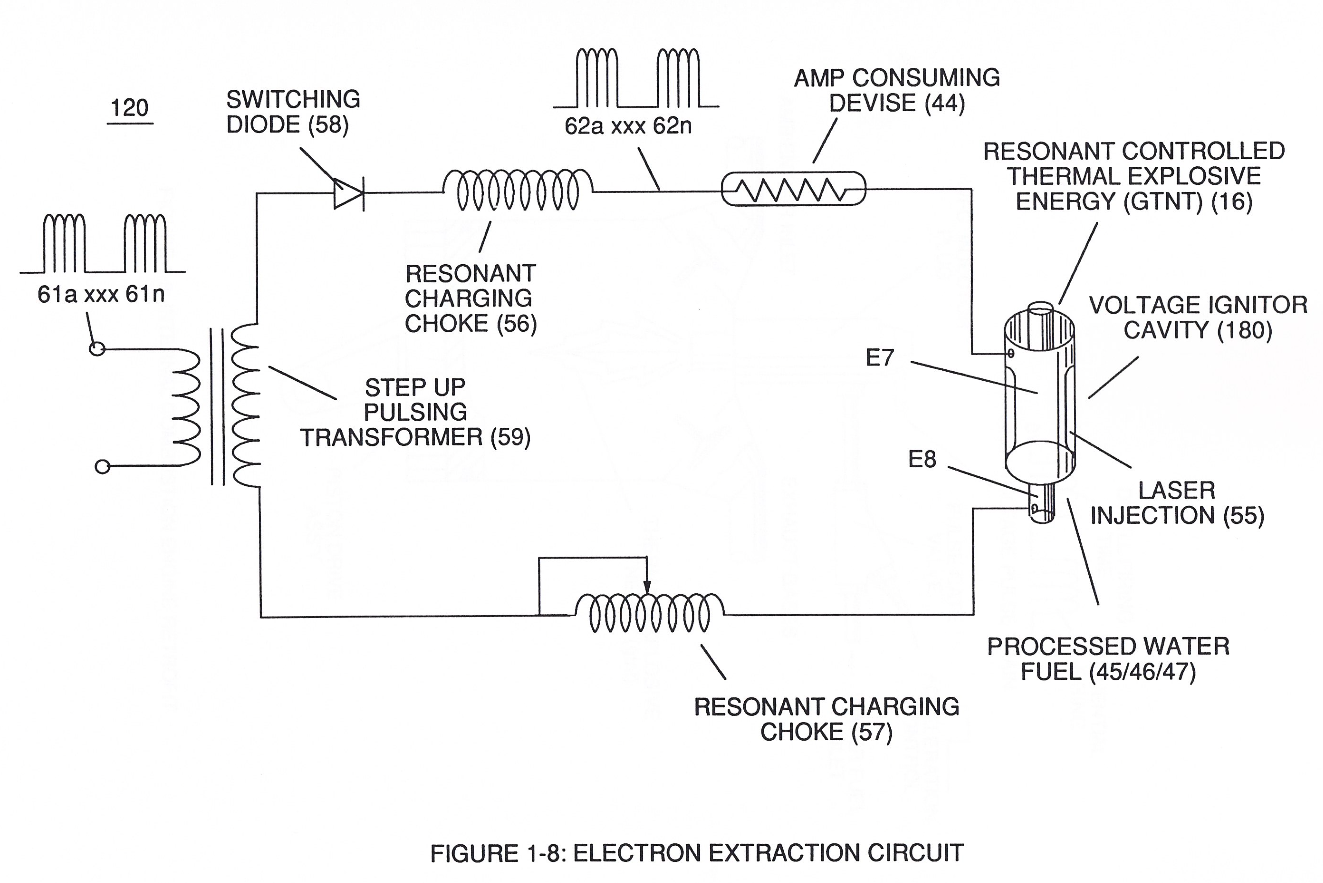
Figure (3-27) · Voltage Intensifier Circuit (60)
-
Carries this number · Electrically Charged Water Molecule
-
Carries this number · WFC 422DA - Illustrations
-
Carries this number · WFC 422DA - Illustrations
-
Carries this number · Electronic Circuit Design
-
Figure (29) · Water Fuel Injector (Taper Resonant Cavity Chamber)
-
Carries this number · Steam Resonator Assembly
-
(210) of Figure (3-27) (Memo WFC 422DA) · Covalent Switch-Off
-
(210) of Figure (3-27) · Inductance (FL)
-
(210) of Figure (3-27) · Electrovalent Bonding
Where it is named · 9
Electrically Charged Water Molecule 5×
-
nucleus (84)
Atomic structure of an atom (76) and (77) of Figure (3-27) exhibits two types of electrical charged mass entities, orbital electrons (79) having negative electrical charges ( - ) and a nucleus (84) (at least one proton) having a positive electrical charge ( + ).
-
electron (84)
The resultant electrical force (qq') between the opposite electrical charged hydrogen (77) and oxygen (76) atoms keeps water molecule (210) intact when the hydrogen atom (77) shares its electron (84) with oxygen atom (76).
-
negative charged electrons (84)
The electrical strength of attraction force (qq') between the water molecule atoms is determined by the electrical size of the hydrogen atoms and the displacement of its negative charged electrons (84) during covalent sharing.
-
hydrogen proton (84)
Since the hydrogen proton (84) (hydrogen nucleus) remains (after covalent link up), then the hydrogen atom takes-on a positive charge (78) co-equalling the positive charge of the hydrogen nucleus proton (84).
-
hydrogen nucleus proton (84)
Since the hydrogen proton (84) (hydrogen nucleus) remains (after covalent link up), then the hydrogen atom takes-on a positive charge (78) co-equalling the positive charge of the hydrogen nucleus proton (84).
Electrical Polarization process 2×
-
negative charged covalent electrons (84)
Stationary "positive" electrical voltage-field (66) (voltage plate E1) not only attracts negative charged oxygen atom (76) but also pulls away negative charged covalent electrons (84) from water molecule (210).
-
covalent hydrogen electrons (84)
… ) which, in application, causes water molecule (210) of Figure (3-27) charged atoms (76/77) to elongate (increasing distance between unlike atoms 76/77) to the point where covalent hydrogen electrons (84) of Figure (3-27) breaks away from electrostatic force (qq').
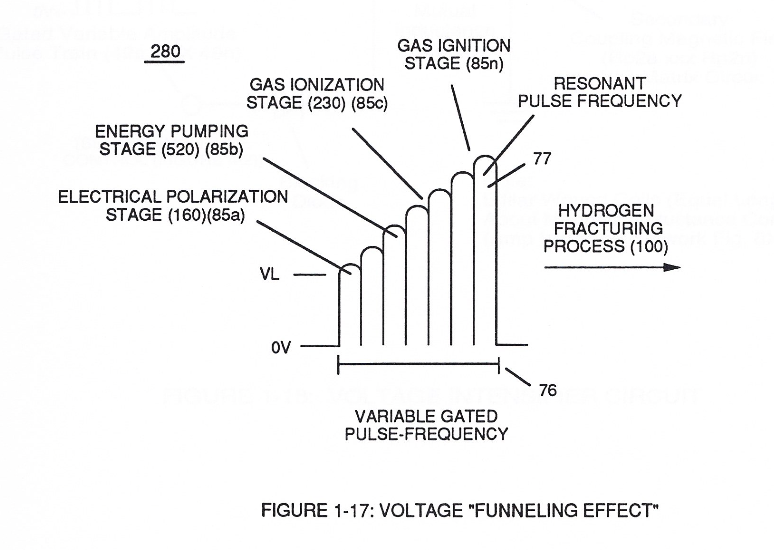
Funneling Effect 2×
-
causing Resonant Cavity Zone (35) to function and perform as a voltage wave-guide (86) of Figure (14) since the gradual decrease in cross-sectional circumference area (85) of Figure (14) is in linear progression ... reducing both voltage surfaces areas (83/84) in parallel space relationship from larger segmental area (85a) to smaller segmental area (85n).
-
This resultant "Funneling Effect" (260), now, allows voltage amplitude (Vn) wave-form (58) to travel the length of Resonant Cavity Zone (35) from Start-Point (85a) to End-Point (85n) increasing voltage intensity (xxx VL = Vn) as parallel voltage surfaces (83/84) diminishes in size relationship (85a ~ 85n), as illustrated in (210) of Figure (17).