(68) · also written as a run, 68a xxx 68n
Water Bath
Also written voltage coupling to water bath · heat water bath · natural water · laser primed ionized liquid oxygen
Where it is first named
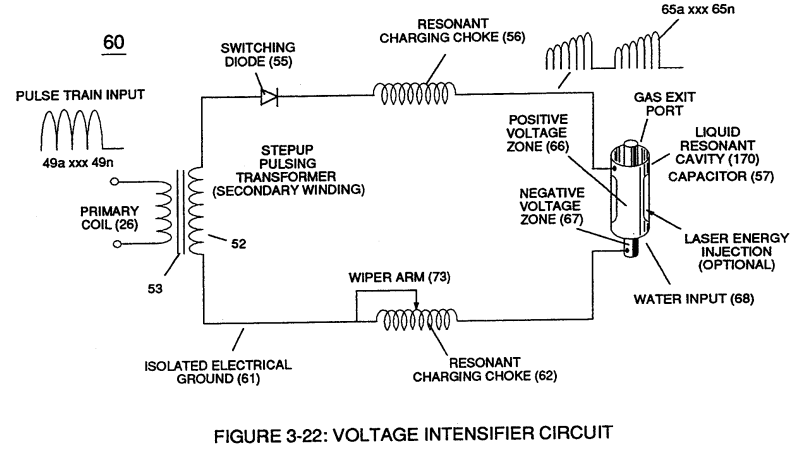
The resultant signal coupling ( 65a xx 65n ) of Figure (3-21) is accomplished since primary coil (26), pulsing core (53), secondary coil (52), switching diode (55), resonant charging choke (56), resonant cavity assembly (170), natural water (68), and variable resonant charging choke (62) forms Voltage Intensifier Circuit (60) of Figure (3-22), as illustrated in Figure (3-22) as to Figure (3-23).
How it is written
- (68) 26×
- (68a xxx 68n) 1×
68a xxx 68n is Meyer's shorthand for a run of the same thing: 68a is the first, 68n the last, and the x's stand for however many lie between. Every stage of the run is this one numeral.
Drawings 97
-
Figure (3-22) · Analog Voltage generator (40)
-
Figure (3-22) · Voltage Amplitude Control Circuit (50)
-
Figure (3-22) · Voltage Intensifier Circuit (60)
-
Figure (3-22) · Voltage Dynamics
-
Figure (3-39) · Resonant Action
-
Voltage Intensifier Circuit (60) of Figure (3-22) · Gas Processor
-
... thereby, extracting contaminates (144a xxx 144n) from water bath (68) · Impurity Extraction Process
-
Figure (3-46) · Steam Resonator
-
Carries this number · WFC 422DA - Illustrations
-
Carries this number · WFC 422DA - Illustrations
-
Carries this number · WFC 422DA - Illustrations
-
Carries this number · WFC 422DA - Illustrations
-
Carries this number · WFC 422DA - Illustrations
-
Carries this number · Electronic Circuit Design
-
Carries this number · Electronic Circuit Design
-
Carries this number · Water Fuel Injector (Taper Resonant Cavity Chamber)
-
(520) of Figure (4-3) · Funneling Effect
-
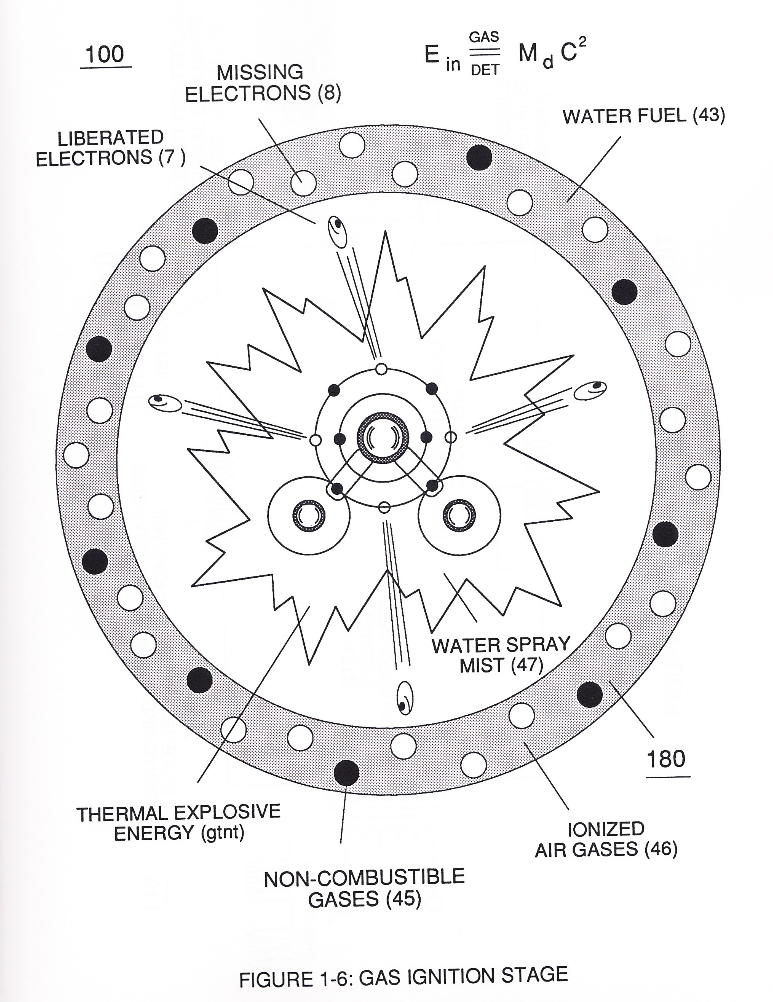
laser primed ionized liquid oxygen (68) of Figure (1-21) · Water Fuel Injection System - Page 3
-
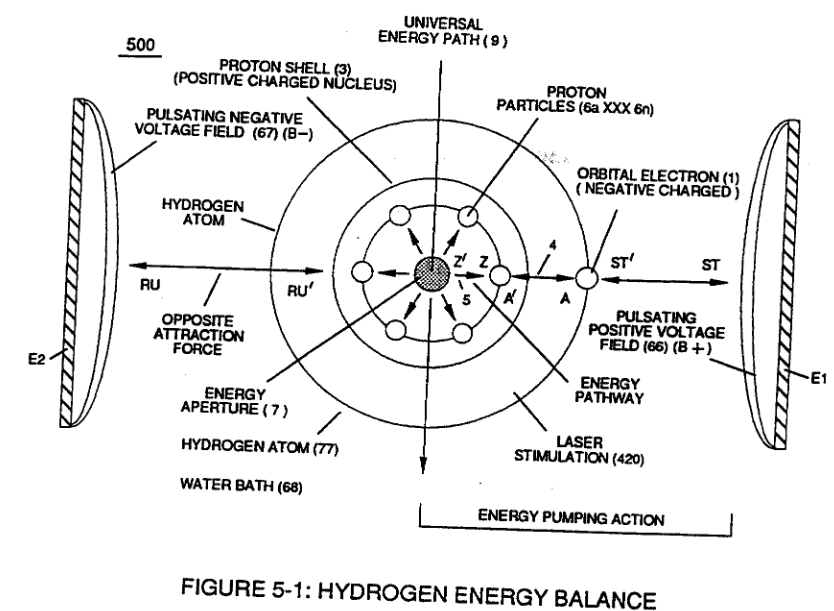
Figure (5-1) · Energy Pumping Action
-
This established increase or decrease in Electrical Pressure (4 / 5 ), now causes Energy Aperture (7) to either enlarge or become smaller as to applied voltage amplitude (VO xxx Vn), respectively. · Energy Pumping Action
-
Carries this number · Energy Pumping Action
-
Carries this number · Energy Pumping Action
-
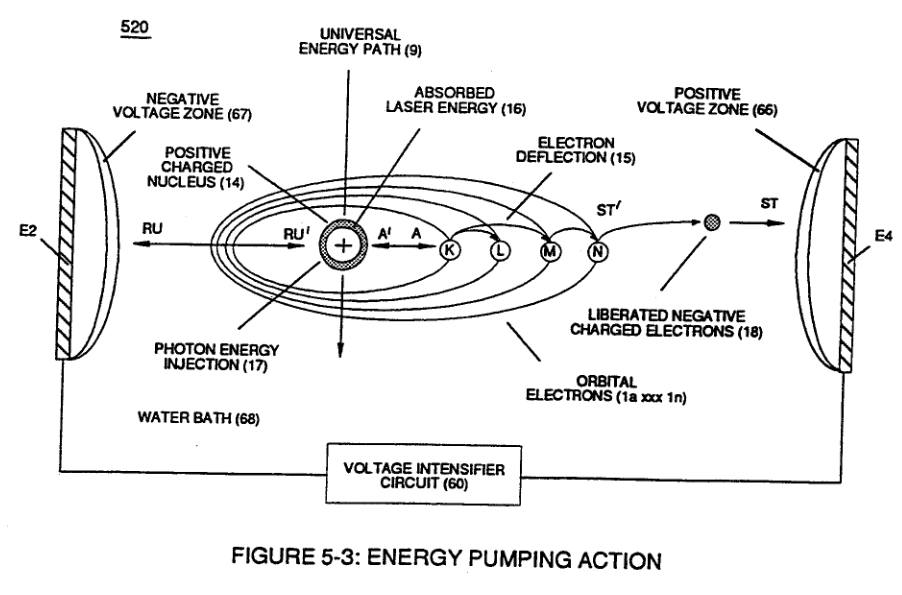
(520) in Figure (5-3) · Resonant Propagation
-
...converts water mist (68) into it's component gases hydrogen (77 a/b) oxygen (76) and ambient air gases (97); · Triggering Process
-
...converts water mist (68) into it's component gases hydrogen (77 a/b) oxygen (76) and ambient air gases (97); · Triggering Process
-
(520) of Figure (5-3) · In Application of Usage
-
(500) of Figure (5-1) · In Application of Usage
-
(510) of Figure (5-2) · In Application of Usage
-
(520) of Figure (5-3) · Solar Energy Actuator
-
Carries this number · Illustrations
-
Carries this number · Illustrations
-
Carries this number · Illustrations
-
Hydrogen Fracturing Process (520) of Figure (5-3) · Voltage Intensifier Coil-Assembly
-
Voltage Intensifier Circuit (60) of Figure (3-22) · Instant Explosion of Water
-
(56/62) of Figure (3-22) · Instant Explosion of Water
-
(56) of Figure (3-22) · Instant Explosion of Water
-
(520) of Figure (5-3) · 8-2 - Traveling Voltage Wave-Guides
-
(510) of Figure (5-2) · 8-4 - State Space (Sp)
-
Energy Pumping Action (520) of Figure (5-3) · WFC Development Objectives
-
Voltage Intensifier Circuit (60) of Figure (3-22) · Propagating Electrical Stress
-
(60) of Figure (3-22) · Propagating Electrical Stress
-
Figure (5-2) · Propagating Electrical Stress
-
Energy Priming Stage (500) of Figure (5-1) · Propagating Electrical Stress
-
WFC Figure (5-1) · WFC Atomic Degaussing Process
-
bipolar electrically charged water molecule (210) of Figure (3-46) · Voltage Flexing Process
-
energy aperture (7) of Figure (5-1) · Voltage Flexing Process
-
(500) of Figure (5-1) · Voltage Flexing Process
-
Oscillation (back and forth movement) of electrically charged particles by way of voltage deflection is hereinafter called "Resonant Action", as illustrated in Figure (1-10). · Voltage Dissociation of The Water Molecule
-
The figure it sits on · Rocket Propulsion
-
Figure (3-24) · Voltage Amplitude Control Circuit (50)
-
Figure (3-26) · Voltage Intensifier Circuit (60)
-
Figure (3-28) · Voltage Intensifier Circuit (60)
-
Ohm's law of LC circuit (180) of Figure (3-28) in series is given by (Eq 5) · Voltage Intensifier Circuit (60)
-
Voltage (Vc) of Figure (3-28) across the capacitor is given by (Eq 7) · Voltage Intensifier Circuit (60)
-
Figure (3-26) · Electrically Charged Water Molecule
-
Figure (3-24) · Electrical Polarization process
-
Fuel Cell (120) of Figure (3-24) · Operational Parameters
-
The figure it sits on · WFC 422DA - Illustrations
-
The figure it sits on · WFC 422DA - Illustrations
-
The figure it sits on · Differential Air-Gas Inlet Control
-
Gas Processor Assembly 2 · Differential Air-Gas Inlet Control
-
The figure it sits on · Differential Air-Gas Inlet Control
-
Figure (25) · Water Fuel Injector (Taper Resonant Cavity Chamber)
-
(650) of Figure (7-4) · Amp Inhibiting Circuit Vs Voltage Enhancement
-
(160) of Figure (3-26) · Water Fuel Injection System - Page 1
-
(85) of Figure (3-26) · In Application of Usage
-
(160) of Figure (3-26) · In Application of Usage
-
The figure it sits on · Illustrations
-
(FI) of Figure (7-3b) · Instant Explosion of Water
-
(85) of Figure (3-26) · Resistance (Rs)
-
(650) of Figure (7-4) · Resistance (Rs)
-
The figure it sits on · Inductance (FL)
-
(650) of Figure (7-4) · Inductance (FL)
-
Figure (7-3) · Inductance (FL)
-
Figure (3-24) · Inductance (FL)
-
(650) of Figure (7-4) · Capacitance (Cd)
-
(640) of Figure (7-3) · Capacitance (Cd)
-
Figure (7-3) · Multi-layer Coil
-
"Voltage Deflection" of Figure (7-4) · Capacitance Reactance
-
(90) of Figure (5-5) · Capacitance Reactance
-
Distributed Capacitance (Cda xxx Cdn) of Figure (7-3) · Electron Bounce Phenomenon
-
Opposite Electrical Attraction Force (SS' ~ 617 ~ RR' - T3 - SS' ~ 617 - RR') of Figure (7-4) · Electron Bounce Phenomenon
-
... causing "electron clustering" (641a xxx 641n) to take place within Copper Wire Zone (52) during pulse on- time (T1) · Electron Bounce Phenomenon
-
The figure it sits on · WFC 426 - Illustrations
-
The figure it sits on · WFC 426 - Illustrations
-
The figure it sits on · 8-2 - Traveling Voltage Wave-Guides
-
(90) of Figure (5-5) · 8-2 - Traveling Voltage Wave-Guides
-
(650) of Figure (7-4) · 8-4 - State Space (Sp)
-
(650) of Figure (7-4) · 8-6 - VIC Voltage Sync-Pulse Circuit
-
The figure it sits on · WFC Exhaust Air Reclaimer
-
"bifilar" wrapped coils (Figure 7-3) · Propagating Electrical Stress
-
(160) of Figure (3-26) · Propagating Electrical Stress
-
The figure it sits on · Propagating Electrical Stress
-
gated pulse-voltage waveform (1020) of Figure (11-2) · Voltage Flexing Process
-
The figure it sits on · VIC Switchover Circuit
-
The figure it sits on · VIC Switchover Circuit
-
Differential Voltage Wave-Guild (1040B) · Electrical Crossover Switching Circuit
Where it is named · 27
Voltage Intensifier Circuit (60) 4×
-
natural water (68)
The resultant signal coupling ( 65a xx 65n ) of Figure (3-21) is accomplished since primary coil (26), pulsing core (53), secondary coil (52), switching diode (55), resonant charging choke (56), resonant cavity assembly (170), natural water (68), and variable resonant charging choke (62) forms Voltage Intensifier Circuit (60) of Figure (3-22), as illustrated in Figure (3-22) as to Figure (3-23).
-
natural water (68)
The dielectric properties (insulator to the flow of amps) of natural water (68) of Figure (3-28) as to Figure (3-26)
-
water bath (68)
Amp leakage (electron coupling to water) to water bath (68) of Figure (3-24) is further prevented by encapsulating resonant cavity (57) in delrin material (72) of Figure (3-25) which is an electrical insulator to high voltage.
-
water bath (68)
Inherently, then, pulsing core (53) of Figure (3-23) aids amp restriction while voltage intensifier circuit (190) is being "tuned" (adjusting pulse train 49a xxx 49n pulse-frequency 63 via pulse frequency generator 70 of figure 3-5) to match the resonant frequency properties of water bath (68) of Figure (3-22), as illustrated in Fuel Cell (120) of Figure (3-24).
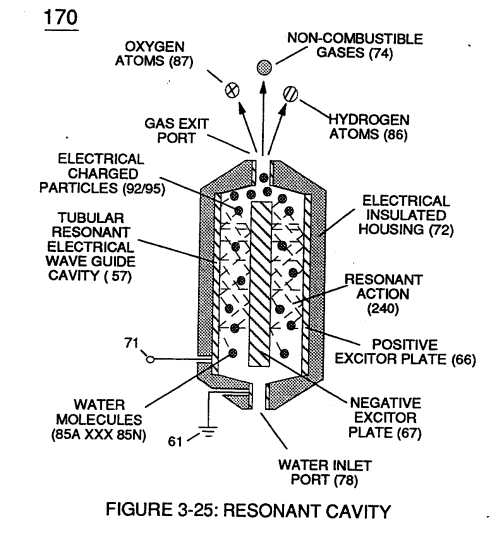
Resonant Action 3×
-
voltage coupling to water bath (68)
Insulated housing (72) prevents voltage coupling to water bath (68) which allows applied voltage amplitude (xxx Vn) to remain constant across water molecules (85a xxx 85n)
-
water bath (68)
In terms of Longevity, voltage zones (E1/E2) are composed of or made of stainless steel T304 material which is chemically inert to hydrogen, oxygen, and ambient air gases (dissolved gases in water) being liberated from water bath (68) during voltage stimulation (65).
-
water bath (68)
Under actual certified laboratory testing stainless steel T304 life expectancy (material decomposition) is .0001 per year since voltage (65) is a physical force, setting up a non-chemical environment since amps consumption is being restricted to a minimum and "no" electrolyte is added to water bath (68).
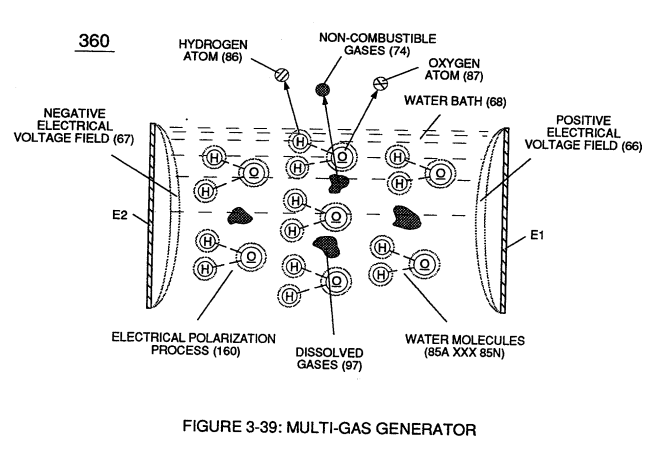
Gas Modulator Process 2×
-
Water bath (68)
Water bath (68) of Figure (3-39) as to Figure (3-24), now, becomes and functions as a "Gas Mixing Regulator" since the highest possible thermal explosive energy yield (gtnt) obtainable from hydrogen during "normal" gas ignition (98) is the exact composition of water where two hydrogen atoms (86a / 86b) unite with oxygen atom (87).
-
natural water (68)
… zation of the Electrical Polarization Process (160) of Figure (3-26) in conjunction with the use of chemically inert stainless steel (T304 material) voltage zones (E1 / E2) submerged in natural water (68) sustains and maintains gas mixing ratio (88) by simply preventing the consumption of both the hydrogen (86) and oxygen (87) gases by way of not encouraging "electrical heat" or "chemical interaction" …
Impurity Extraction Process 3×
-
water bath (68)
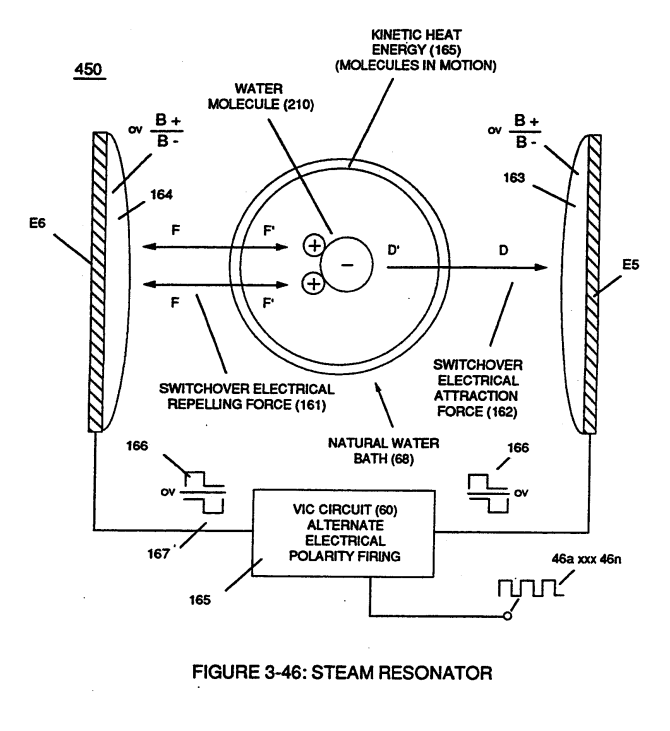
Suspended and dissolved water contaminates (144a xxx 144n) (typically 20 ppm to 40 ppm in natural water) of Figure (3-24) being uniformly released from and superimposed onto remaining water bath (68) during Resonant Action (170) are directed to and passes through water inlet line (145)
-
water bath (68)
... thereby, extracting contaminates (144a xxx 144n) from water bath (68)
-
water bath (68)
Exposing water contaminates (144a xxx 144n) to applied voltage fields (E1/E2) not only produces electrical charged contaminates (157/158); but, also, kills bacteria that might be present in water bath (68).
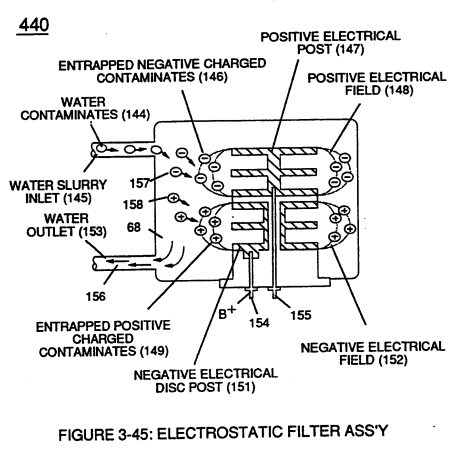
Steam Resonator 3×
-
water bath (68)
Once positive energized, water molecule (210) of water bath (68) is deflected toward voltage surface (E5) via both opposite electrical attraction force (162) and electrical repelling force (161).
-
water bath (68)
... producing kinetic energy (165) (particle impact) which, in turns, heats water bath (68).
-
heat water bath (68)
Repetitive formation of opposite voltage pulses (166/167) at a given pulse-frequency continues to heat water bath (68) until a desired temperature is reached.
Water Fuel Injection System 1×
-
In other or alternate applications, laser primed ionized liquid oxygen (68) of Figure (1-10) CF* memo 420) and laser primed liquid hydrogen (69) of Figure (1-10) stored in separate fuel tanks can be used in place of fuel-mixture (48); or, liquefied ambient air gases (6) alone with source (8) can, also, be substituted as a fuel-source (48) to trigger Hydrogen Fracturing 10).
Water Fuel Injection System - Page 3 2×
-
laser primed ionized liquid oxygen (68)
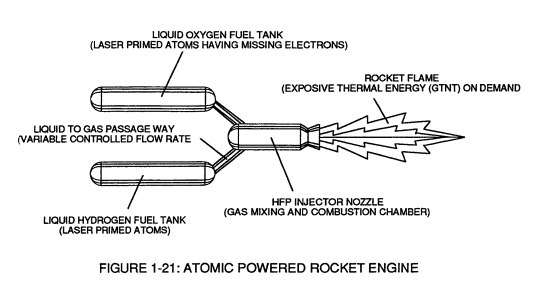
In other or alternate applications, laser primed ionized liquid oxygen (68) of Figure (1-21) (see WFC memo 420) and laser primed liquid hydrogen (69) of Figure (1-21) stored in separate fuel-tanks can be used in place of fuel-mixture (48); or, liquefied ambient air gases (6) alone with water-source (8) can, also, be substituted as a fuel-source (48) to trigger Hydrogen Fracturing Process (100).
-
laser primed ionized liquid oxygen (68)
laser primed ionized liquid oxygen (68) of Figure (1-21)
Energy Pumping Action 2×
-
water bath (68)
… al Polarization Process (160), the newly liberated and subsequently free floating hydrogen (77 a/b), oxygen (76), and dissolved air gases (97) (see WFC memo 420 DA Figure 325) submerged in water bath ( 68) are further subjected to pulse-voltage stimulation ( SS' / RR ' _ IT ' / UU ' ) ... …
-
water bath (68)
… Likewise, liberated oxygen atom (76) and other dissolved air gases (97) submerged in water bath (68) undergo and experience similar Energy Pumping Action (520) (aperture oscillation) of their respective Energy Aperture (11a xxx 11n) when exposed to voltage stimulation (66/67), as further illustrated …
Triggering Process 2×
-
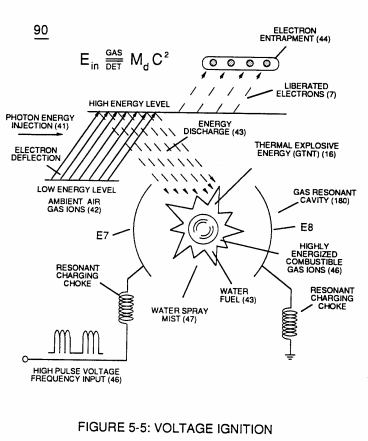
As water mist (68a xxx 68n) is injected and metered into Resonant Cavity (180) of Figure (5-5) (Water Fuel Injector) under pressure, applied Resonant Pulse Voltage (46) performs several functions sequentially in a instant of time:
-
...converts water mist (68) into it's component gases hydrogen (77 a/b) oxygen (76) and ambient air gases (97);
VIC Switchover Circuit 5×
-
water bath (68)
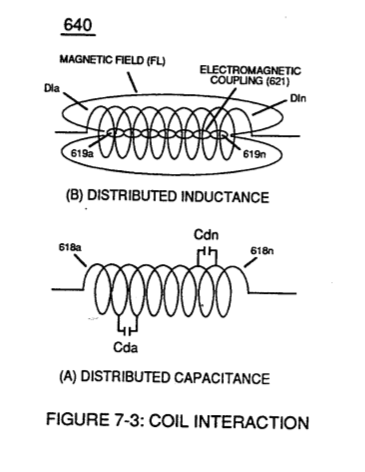
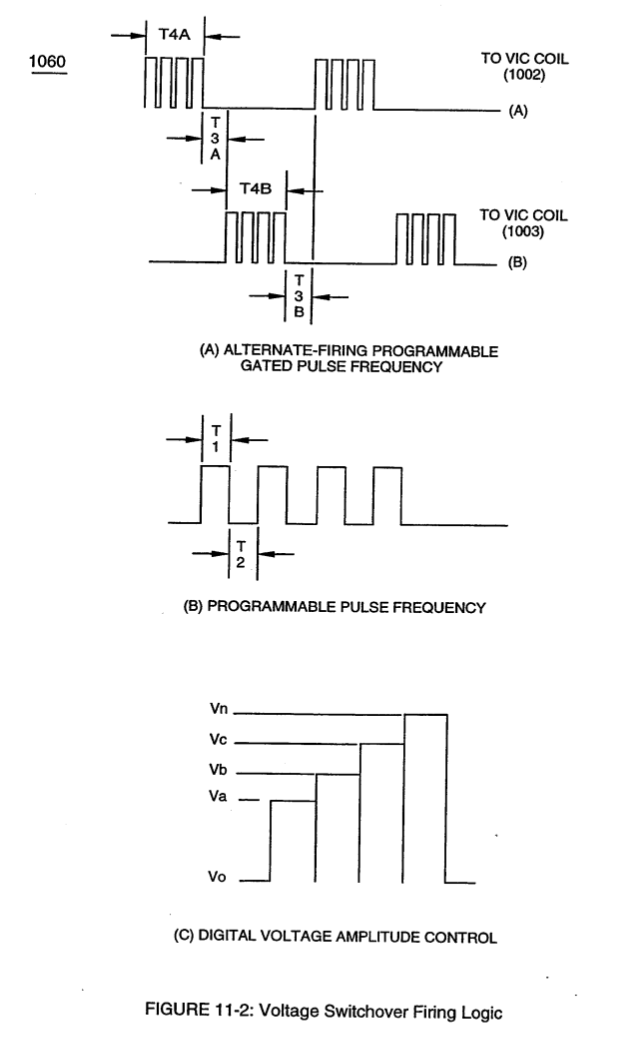
Automatically, the self-inductance coupling (619a xxx 619n) of Figure (7-3) prevents amp influxing [restricting current flow into and away from water bath (68) during each pulsing cycle T4A / T4B].
-
… e (1004/1006) or any other bipolar molecule of water interlocking with ever changing electrical attraction forces (S-S' /R-R') collides with neighboring water molecules present in the same water bath (68).
-
… xxx T4bn), whether be it positive or negative in electrical polarity, to be electrically transmitted and linearly displaced along the longitudinal axis of the inner side walls adjacent to water bath (68), as so illustrated in (1040) of Figure (11-4).
-
The resultant pulsating electrical stress (S-S' /R-R) penetrates the liquid bath of water since the water bath takes on an electrical charge when the rotational spin (1019) of the water molecule (s) occurs to bring about bipolar alignment of the water molecule comprising water bath (68) during each and every reversing voltage pulsing cycle (B+/O - B-/O - OIB+ - OIB-), as so illustrated in (650) of Figure (7-4).
-
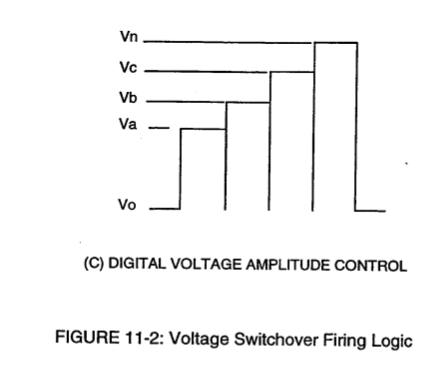
Varying the gated pulse-width (T4A f T4B), attenuating voltage amplitude (xxx Vn), and the Switchover pulse frequency rate (Sopr), collectively determines the rate by which the water temperature rises as the water medium (68) travels through the Differential Voltage Wave-Guild (1040), as so illustrated in (1060) of Figure (11-2) as to (1040) of Figure (11-6).