(E3)
Positive Electrical Voltage Field
Also written voltage plates · positive voltage zone · electrical plates · Excitor-array · voltage zones · voltage-field
Where it is first named
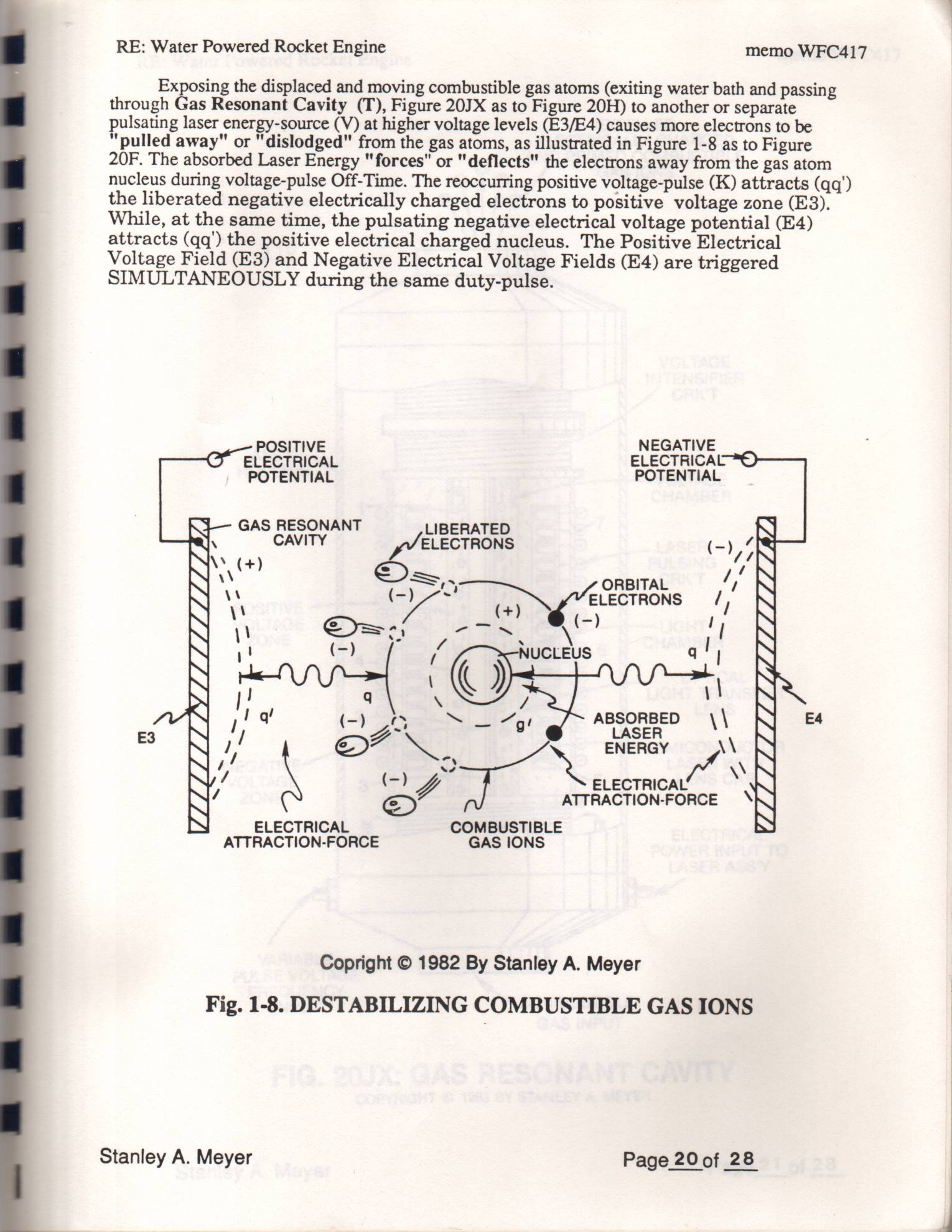
Exposing the displaced and moving combustible gas atoms (exiting water bath and passing through Gas Resonant Cavity (T), Figure 20JX as to Figure 20H) to another or separate pulsating laser energy-source (V) at higher voltage levels (E3/E4) causes more electrons to be “pulled away" or "dislodged" from the gas atoms, as illustrated in Figure 1-8 as to Figure
How it is written
- (E3/E4) 7× with (E4) Negative Electrical Voltage Fields
- (E3) 6×
Drawings 18
-
Stanley A. Meyer Page 20 of 28 · WFC 417 — WFC 417
-
The Positive Electrical Voltage Field (E3) and Negative Electrical Voltage Fields (E4) are triggered "Simultaneously" during the same duty-pulse. · Electron Extraction Process
-
(270) of Figure (3-34) · Gas Processor
-
Carries this number · WFC 422DA - Illustrations
-
(270) of (3-34) · In Application of Usage
-
Figure (3-34) · Propagating Electrical Stress
-
blocking diode (55) of Figure (3-34) · Voltage to Amp Differential Ratio
-
The forming Argon ion (Ar+) is now exposed to Iron ions (Fe+) (magnetic properties) experiencing and undergoing the same Electron Extraction Process. · Magnetic Gas Lattice
-
Figure (1-8) · Atomic Interaction to Voltage Stimulation
-
Figure (1-15) · Electron Extraction Process
-
Figure (1-8) · Electron Extraction Process
-
Laser activated or laser primed gas ions repel the "dislodged" electrons being consumed as illustrated in Figure (1-8) as to Figure (1-20). · Electron Extraction Process
-
Figure (3-33) · Gas Processor
-
The figure it sits on · WFC 422DA - Illustrations
-
Quenching Disc Structure (190) of Figure (15) · Water Fuel Injector (Taper Resonant Cavity Chamber)
-
The figure it sits on · Funneling Effect
-
The figure it sits on · Water Fuel Injection System - Page 3
-
(Light Emitting Diodes) (1100 xxx 116n) of Figure (3-33) · WFC Exhaust Air Reclaimer
Where it is named · 13
WFC 417 — WFC 417 3×
-
Exposing the displaced and moving combustible gas atoms (exiting water bath and passing through Gas Resonant Cavity (T), Figure 20JX as to Figure 20H) to another or separate pulsating laser energy-source (V) at higher voltage levels (E3/E4) causes more electrons to be “pulled away" or "dislodged" from the gas atoms, as illustrated in Figure 1-8 as to Figure
-
… The reoccurring positive voltage-pulse (K) attracts (qq') the liberated negative electrically charged electrons to positive voltage zone (E3). …
-
Positive Electrical Voltage Field (E3)
… The Positive Electrical Voltage Field (E3) and Negative Electrical Voltage Fields (E4) are triggered SIMULTANEOUSLY during the same duty-pulse.
CIRCUIT COMPONENT INTERACTION 3×
-
Excitor-array (E3/E4)
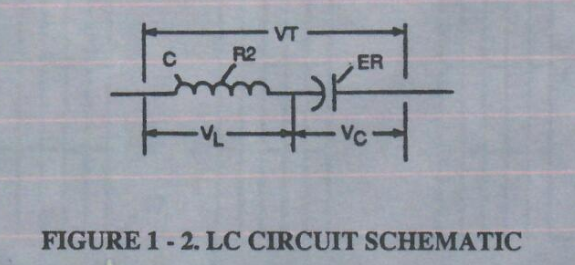
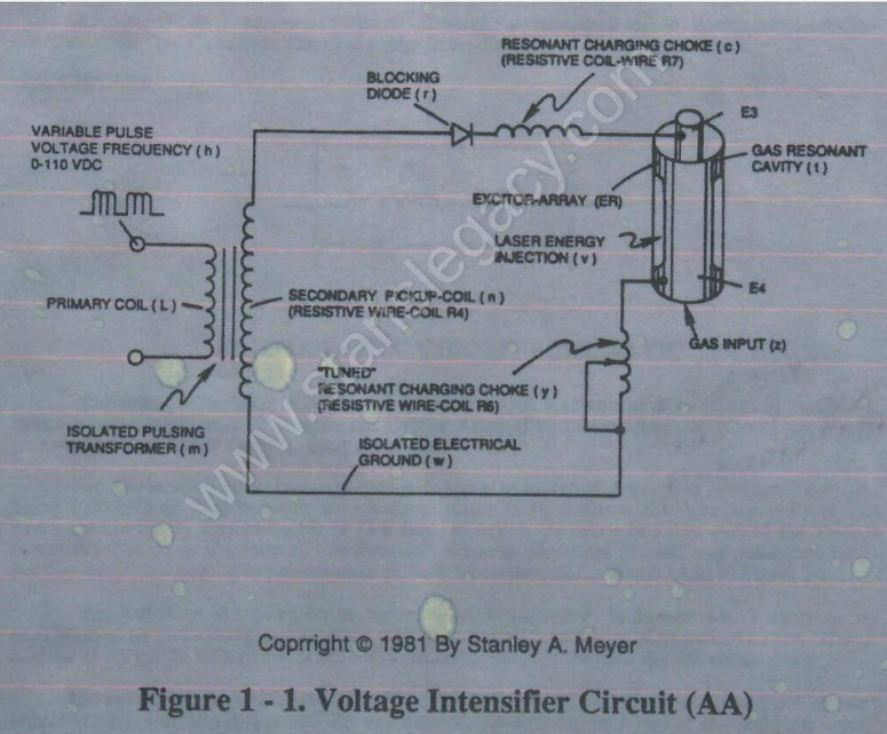
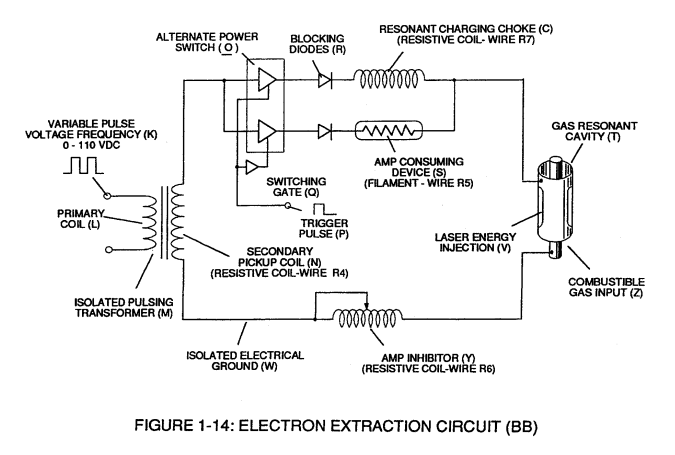
Resonant Charging Choke (c) in series with Excitor-array (E3/E4) forms an inductor-capacitor circuit (LC) since the Excitor-Array (ER) of Gas Resonant Cavity (t) acts or performs as a capacitor during pulsing operations.
-
electrical plates (E3/E4)
The Dielectric Properties (insulator to the flow of amps) of Argon Gas (dielectric constant being 1.000545 @ 23°C) between the electrical plates (E3/E4) forms the capacitor (ER) of Gas Resonant Cavity (t).
-
voltage zones (E3/E4)
The Inductor (c) takes on-or becomes a Modulator Inductor which steps up an oscillation of an given charging frequency when the effective capacitance of an pulse-forming network in order to charge the voltage zones (E3/E4) to an higher potential beyond applied voltage input.
RLC CIRCUIT 1×
-
Inductor (y) in relationship to inductor (c) electrically balances the opposite voltage electrical potential across voltage zones (E3/E4).
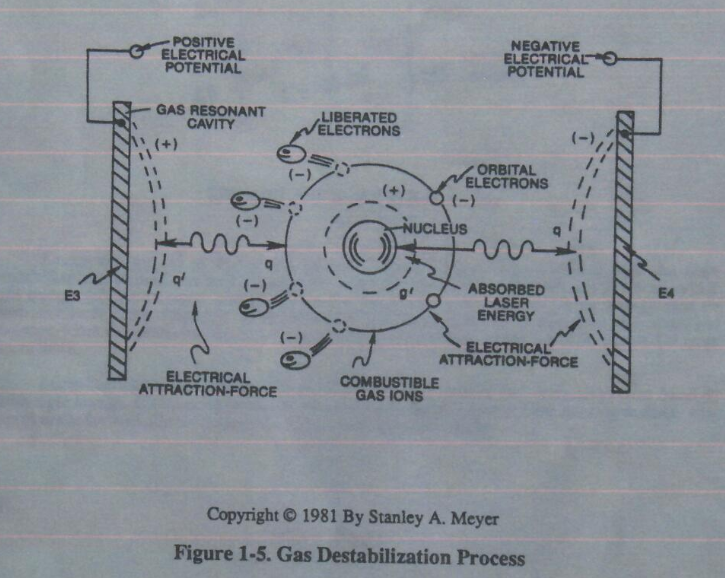
Gas Destabilization Process 1×
-
voltage-field (E3)
The stationary "positive" electrical voltage-field (E3) attracts the negative charged electrons from the Gas Atom.
Electron Extraction Process 3×
-
Exposing the displaced and moving combustible gas atoms (exiting waterbath and passing through Gas Resonant Cavity (T), Figure (1-17) as to Figure (1-18) to another or separate pulsating laser energy-source (V) at higher voltage levels (E3/E4) causes more electrons to be "pulled away" or "dislodged" from the gas atoms, as illustrated in Figure (1-15) as to Figure (1-8).
-
positive voltage zone (E3)
The recurring positive voltage-pulse (k) attracts (qq') the liberated negative electrically charged electrons to positive voltage zone (E3).
-
Positive Electrical Voltage Field (E3)
The Positive Electrical Voltage Field (E3) and Negative Electrical Voltage Fields (E4) are triggered "Simultaneously" during the same duty-pulse.
Gas Processor 2×
-
voltage plates (E3)
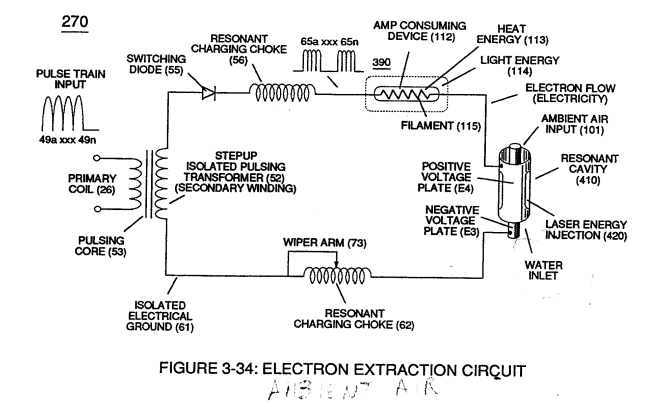
Pulsating voltage potential or voltage intensity (65a xx 65n) is adjusted, also, to "tune-in" to the resonant properties of ambient air gases (101) since ambient air gases (101) exhibits a dielectric value (air-gap of one inch resisting electron arc-over of up to 17,000 volts applied) between voltage plates (E3) and (E4), forming capacitor (410) of Figure (3-34).
-
voltage plates (E3/E4)
Voltage fields (106/107) are physically configured (skin effect) by T304 stainless steel material to form voltage plates (E3/E4) of Figure (3-33) which are not only chemically inert to gas ionization process (260) but, also, forms tubular Gas Resonant Cavity (410) of Figure (3-34) having approximately the same size and shape of liquid resonant cavity (170) of Figure (3-25), as illustrated in (270) of Figure (3-34).