Figure (8-2A)
Figure (8-2A)
How it is written
- (8-2A) 2×
Drawings 1
-
Beside the passage · Quartz Tube Configuration & Operational Parameters
On this figure 10
- 64 Pulse Train
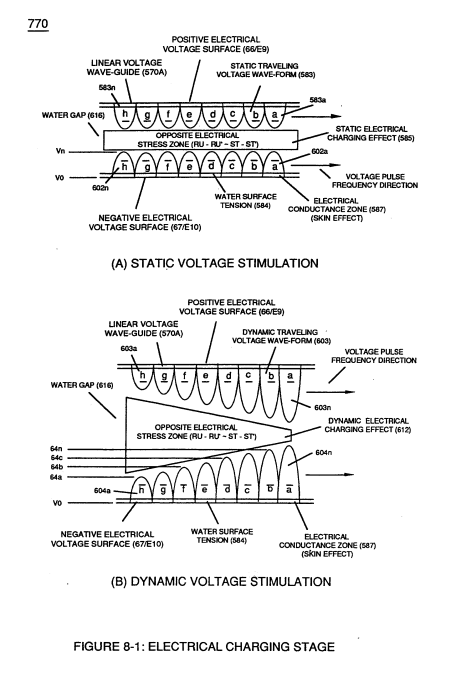
- 583 Voltage Pulse Train
- 585 Static Electrical Charging Effect
- 602 Voltage Pulse Train
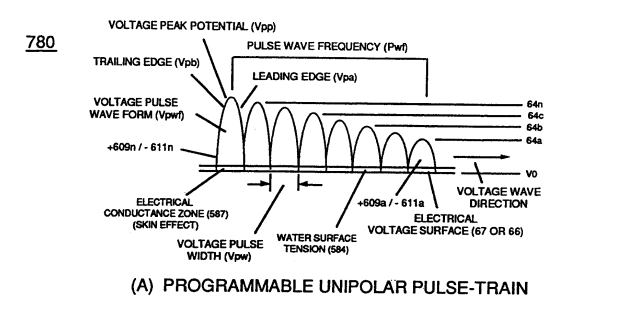
- 780 —
- Fd Flex-Density
- Fs Field Strength
- Gs Ground State
- Qs Quiescent State
- Vpp Voltage Peak Potential
Where it is named · 2
Quartz Tube Configuration & Operational Parameters 2×
-
… then back again to "Quiescent State" (Qs) once applied unipolar pulse-wave (583/602) goes through Voltage Pulsing Cycle (Vpwf) from "Ground State" (Gs) to Voltage Peak potential (Vpp) (780) of Figure (8-2A) and then returns to "Ground State" (Gs) for continued repetitive Voltage-Pulsing (583/602a xxx 583/602n)
-
The resultant Flex-Density (Fd) of the hydrogen atom(s) is, now, directly related to applied Voltage Amplitude (64a - 64b - 64c - 64n) of Figure (8-2A) which directly determines the Field Strength (Fs) of Static Electrical Charging Effect (Sece)(585).