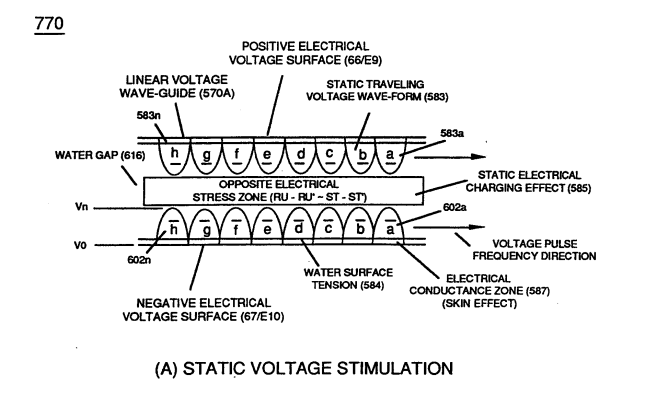
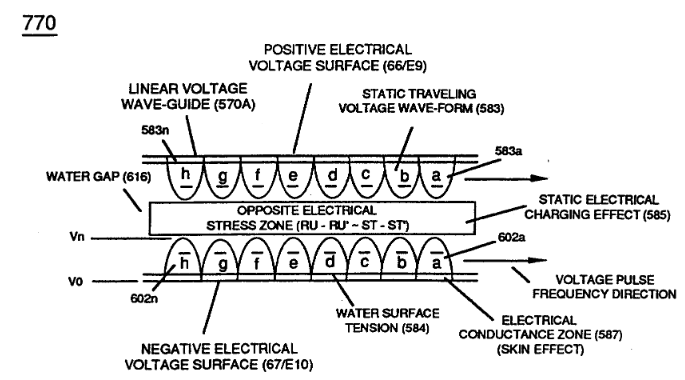
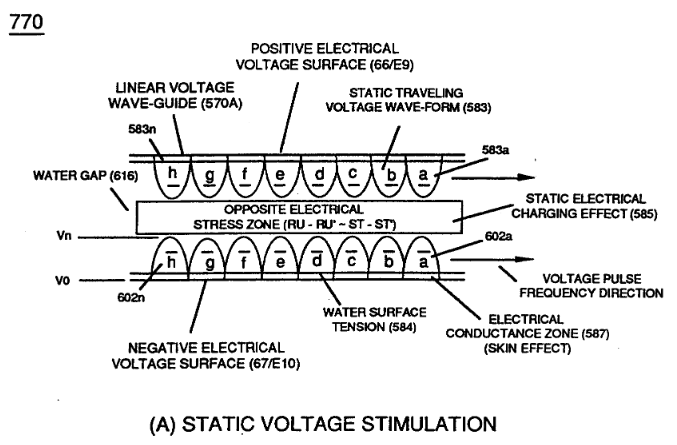
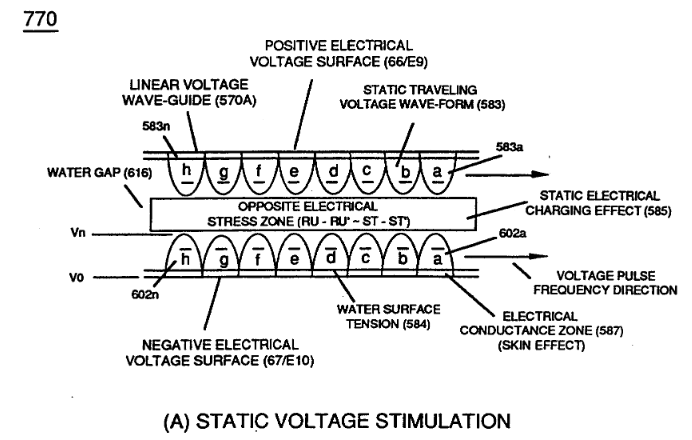
(583) · also written as a run, 583a xxx 583n
Voltage Pulse Train
Also written Unipolar Voltage Pulse Train · Unipolar Voltage Pulse-Wave · Electrical Voltage-Wave · Voltage Pulse-Wave · Voltage-wave · Electrical Voltage-Pulse Wave-Transmission · Traveling Electrical Voltage Wave-Guide · Voltage Sync-Pulse Gated Frequency and 6 more
Where it is first named
… ongitudinal length of water-gap (616) since stainless steel material (s/s) (T304) forming Voltage surfaces (E9/E1O) electrically conducts and transfers (skin effect) Voltage Pulse-Freqnency Potential (583) along the inside surface area of the chemically inert and non-oxidizing stainless steel (s/s) tubular material (E9/E1O) which physically dictates the shape and configuration of voltage waves (66/67)
How it is written
- (583/602) 4× with (602) Voltage Pulse Train
- (583) 4×
- (583/602a xxx 583/602n) 3× with (602) Voltage Pulse Train
- (583 - 602) 2× with (602) Voltage Pulse Train
- (66- 583/67-602) 1× with (66) Positive Voltage Potential, (67) Opposite Polarity, (602) Voltage Pulse Train
- (66-583 - 67-602) 1× with (66) Positive Voltage Potential, (67) Opposite Polarity, (602) Voltage Pulse Train
- (66 - 583a xxx 583n) 1×
- (583/602a xxx 583/602) 1× with (602) Voltage Pulse Train
583a xxx 583n is Meyer's shorthand for a run of the same thing: 583a is the first, 583n the last, and the x's stand for however many lie between. Every stage of the run is this one numeral. A pair before the letters, 583/602a, is a run of two things that go together, one of each per stage.
Drawings 36
-
(770) of Figure(8-1) · 8-2 - Traveling Voltage Wave-Guides
-
(770) of Figure (8-1) · 8-3 - Electrical Voltage-Pulse Wave-Transmission
-
(770 A) of Figure (8-1) · 8-4 - State Space (Sp)
-
(770A) of Figure (8-1) · 8-5 - Energy Vectoring (Ev)
-
Carries this number · 8-6 - VIC Voltage Sync-Pulse Circuit
-
(840) of Figure (8-10) · 8-6 - VIC Voltage Sync-Pulse Circuit
-
Carries this number · WFC 427 Illustrations
-
Carries this number · WFC 427 Illustrations
-
"Voltage Tickling of State Space" (770A) of Figure (8-1) · WFC Exhaust Air Reclaimer
-
Carries this number · Quartz Tube Configuration & Operational Parameters
-
(650) of Figure (7-4) · Amp Inhibiting Circuit Vs Voltage Enhancement
-
(650) of Figure (7-4) · Resistance (Rs)
-
The figure it sits on · Inductance (FL)
-
(650) of Figure (7-4) · Inductance (FL)
-
(650) of Figure (7-4) · Capacitance (Cd)
-
"Voltage Deflection" of Figure (7-4) · Capacitance Reactance
-
Opposite Electrical Attraction Force (SS' ~ 617 ~ RR' - T3 - SS' ~ 617 - RR') of Figure (7-4) · Electron Bounce Phenomenon
-
The figure it sits on · WFC 426 - Illustrations
-
(780A) Figure (8-2) · 8-2 - Traveling Voltage Wave-Guides
-
The figure it sits on · 8-2 - Traveling Voltage Wave-Guides
-
Figure (8-2) · 8-2 - Traveling Voltage Wave-Guides
-
(650) of Figure (7-4) · 8-4 - State Space (Sp)
-
(770 B) of Figure (8-1) · 8-4 - State Space (Sp)
-
(780 B) of Figure (8-2) · 8-4 - State Space (Sp)
-
(780 A/B/C) of Figure (8-2) · 8-4 - State Space (Sp)
-
(585) of Figure (8-1) · 8-4 - State Space (Sp)
-
Clipped Voltage Wave-form (780C) of Figure (8-2) · 8-5 - Energy Vectoring (Ev)
-
(612) of Figure (8-1) · 8-5 - Energy Vectoring (Ev)
-
The figure it sits on · 8-6 - VIC Voltage Sync-Pulse Circuit
-
(650) of Figure (7-4) · 8-6 - VIC Voltage Sync-Pulse Circuit
-
The figure it sits on · WFC 427 Illustrations
-
"Voltage Tickling of State Space" (770B) of Figure (8-1) · WFC Exhaust Air Reclaimer
-
The figure it sits on · Propagating Electrical Stress
-
Dynamic Electrical Charging Effect (612) of Figure (8-1) · Propagating Electrical Stress
-
The figure it sits on · Quartz Tube Configuration & Operational Parameters
-
... establishing variable Dynamic Electrical Charging Effect (612). · Quartz Tube Configuration & Operational Parameters
Where it is named · 19
8-2 - Traveling Voltage Wave-Guides 2×
-
Voltage Pulse-Freqnency Potential (583)
… ongitudinal length of water-gap (616) since stainless steel material (s/s) (T304) forming Voltage surfaces (E9/E1O) electrically conducts and transfers (skin effect) Voltage Pulse-Freqnency Potential (583) along the inside surface area of the chemically inert and non-oxidizing stainless steel (s/s) tubular material (E9/E1O) which physically dictates the shape and configuration of voltage waves (66/67)
-
Traveling Electrical Voltage Wave-Guide (583/602)
… n (Eq 21) and the Voltage Coefficient of the stainless steel (s/s) material fanning voltage surfaces (E9/E10), now, allows the establishment and performance of Traveling Electrical Voltage Wave-Guide (583/602) since electrical conductance zone (587) between electrical surface (S) (E9/E10) and the dielectric surface tension of water (584) acts and performs as a electrical conductor (Skin Effect)
8-3 - Electrical Voltage-Pulse Wave-Transmission 5×
-
Electrical Voltage-Pulse Wave-Transmission (583a xxx 583n)
Electrical Voltage-Pulse Wave-Transmission (583a xxx 583n), now formed, occurs along Electrical Conductance Zone (587) since applied Electrical Pulse Voltage amplitude (Vo - 64a - 64b- 64c - Vn) is time responsive (T1/T2a - T3 – T1/T2n) to incoming gated Voltage Pulse Frequency (49a xxx - 1'3 - xxx 49n).
-
Unipolar Voltage Pulse-Wave (583)
… period (T1 on time) from start to finish is directly related to applied Voltage-Pulse Amplitude (Vo xxx Vn) and reoccurring Voltage Pulse Frequency (49a xxx 49n) forming "Unipolar Voltage Pulse-Wave" (583) from zero voltage ground state (Vo) to a predetermined Voltage Level ( xxx 64 x - 64y - 64z - Vn) on the leading edge of the Voltage Pulse-Wave (Vpa) and, then, reversing voltage up swing to drop on …
-
Voltage-wave (583)
… rmined Voltage Level ( xxx 64 x - 64y - 64z - Vn) on the leading edge of the Voltage Pulse-Wave (Vpa) and, then, reversing voltage up swing to drop on the trailing edge (Vpb), completing Voltage-wave (583).
-
Voltage Pulse-Wave (583)
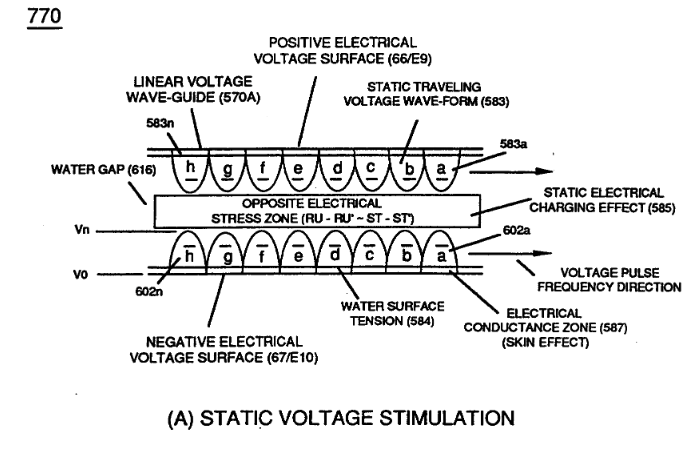
… 9) which, inactivated electrical-state, allows positive Voltage Pulse-Wave (583) to be duplicated in succession to form Voltage Pulse Train (66 - 583a xxx 583n), as illustrated in (770) of Figure (8-1).
-
Voltage Pulse Train (66 - 583a xxx 583n)
… 9) which, inactivated electrical-state, allows positive Voltage Pulse-Wave (583) to be duplicated in succession to form Voltage Pulse Train (66 - 583a xxx 583n), as illustrated in (770) of Figure (8-1).
8-4 - State Space (Sp) 4×
-
Electrical Voltage-Wave (66-583 - 67-602)
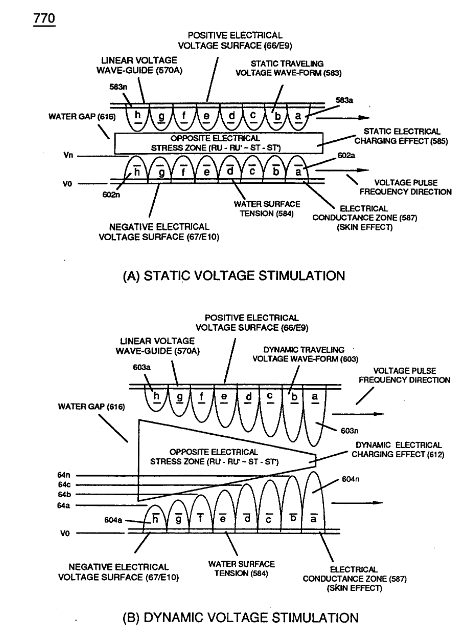
During the electrical-formation (66- Vpa/Vpb - 67- Vpa/Vpb) of each opposite Electrical Voltage-Wave (66-583 - 67-602), opposite electrical attraction force (RR' - SS') of Figure (7-4) is produced across water cap (Cp) of Figure (7-8) which, now, sets up and defines the conditions of “State Space," as illustrated in (770 A/B) of Figure (8-1) as to (650) of Figure (7-4).
-
Unipolar Voltage Pulse Wave (583/602)
… related to the applied Voltage Amplitude Burst-Time (Vpa - Vn -Vpb) as to the Voltage Burst-Frequency (49a xxx 49n) as to Voltage Peak Excursion Point "P" at the height of Unipolar Voltage Pulse Wave (583/602) which, in turns, determines maximum Voltage Peak-Potential (Vpp) at any given time during each Voltage Pulsing Cycle (Vpa/Vpb).
-
Pulse Wave-Form (66- 583/67-602)
Electrical Attraction Force intensity (RR' - SS' as to RU/RU' - ST/ST' as to 550 of Figure 5-8) at Peak Voltage Potential (Vpp) is either increasing or decreasing or remaining constant as to Voltage Peak Excursion Point "P" trace-position which scans the exact Pulse Wave-Form (66- 583/67-602) being produced, as illustrated in (780B) of Figure (8-2).
-
Voltage Pulse Train (583/602a xxx 583/602n)
Equalizing Voltage Pulse-Scan (Bps) from start of one Voltage Pulse-Field (Vpf) to the start of next Voltage Pulse-Field (Vpfa + Vpfb + Vpfc + Vpfn) is determined by the total average of the number of applied Voltage-Pulses (Vp ave.) making up opposite Voltage Pulse Train (583/602a xxx 583/602n) in synchronous movement.
8-5 - Energy Vectoring (Ev) 3×
-
opposite Voltage Pulse Wave (583 - 602)
… which combined together (Vpf + Vpb) Electrical Stress (Es) variances corresponds to the Voltage Pulse Shape of each synchronized opposite Voltage Pulse Wave (583 - 602) of (770A) of Figure (8-1) being produced during applied Voltage Pulse Operation (49a xxx 49n);
-
Static State Space (Sss) is the electrical condition by which Electrical Attraction Force (RR' - SS' as to RU/RU' - ST/ST') is being held constant once Voltage Pulse Burst Vpb) occurs during Voltage Pulsing Operation (Vpwf) ... forming synchronized Clipped Voltage Wave-form (780C) of Figure (8-2) in like manner to voltage sync-pulse (583 - 602).
-
Unipolar Voltage Pulse Train (583/602a xxx 583/602)
In the area of Voltage Sync-Wave (+/-) propagation, Unipolar Voltage Pulse Train (583/602a xxx 583/602) of (770A) of Figure (8-1), clipped Voltage Pulse Train (605/606a xxx 605/606n) of Figure (780C) of Figure (8-2), and Crossover Unipolar Pulse Train (607/608a xxx 607/608n) brings-on Static Voltage St …
8-6 - VIC Voltage Sync-Pulse Circuit 1×
-
Voltage Sync-Pulse Gated Frequency (583/602a xxx 583/602n)
Voltage Sync-Pulse Gated Frequency (583/602a xxx 583/602n) (603/604a xxx 603/604n) of Figure (8-1) as to (605/606a xxx 605/606n) (607/608a xxx 607/608n) (609/611a xxx 609/611n) of Figure (8-2)
Quartz Tube Configuration & Operational Parameters 4×
-
… p "Voltage Tickling of State Space" which takes the hydrogen atom (s) from "Quiescent State" (Qs) to "Active State" (As) and then back again to "Quiescent State" (Qs) once applied unipolar pulse-wave (583/602) goes through Voltage Pulsing Cycle (Vpwf) from "Ground State" (Gs) to Voltage Peak potential (Vpp) (780) of Figure (8-2A) and then returns to "Ground State" (Gs) for continued repetitive Voltage-Puls …
-
Voltage-Pulsing (583/602a xxx 583/602n)
… s through Voltage Pulsing Cycle (Vpwf) from "Ground State" (Gs) to Voltage Peak potential (Vpp) (780) of Figure (8-2A) and then returns to "Ground State" (Gs) for continued repetitive Voltage-Pulsing (583/602a xxx 583/602n)
-
Unipolar Pulse Train (583a/602a-583b/602b - 583n/602n)
The Electrical Conduction Zone (587) (Skin Effect) between the dielectric gas medium (919) and the Electrical Contact Surface of the inside surface area of the Voltage Wave-Guides (66/67) allows Unipolar Pulse Train (583a/602a-583b/602b - 583n/602n) to travel the entire length of the Voltage Wave Guides that make up Voltage Zones (66/E9 – 67/E10).
-
In both cases, Static Voltage Stimulation (770) of Figure (8-1A) and Dynamic Voltage Stimulation (770) of Figure (8-1B) incorporates the use of Positive Electrical Voltage Potential (B+) (Ell) and Negative Electrical Voltage Potential (B-) (EI2) to form synchronized diametrically opposed Voltage Gate-Pulse (Vgp) (583/602) across Vacuum Gap (Vc)