(Fd) · also written as a run, Fda xxx Fdn
Flex-Density
Where it is first named
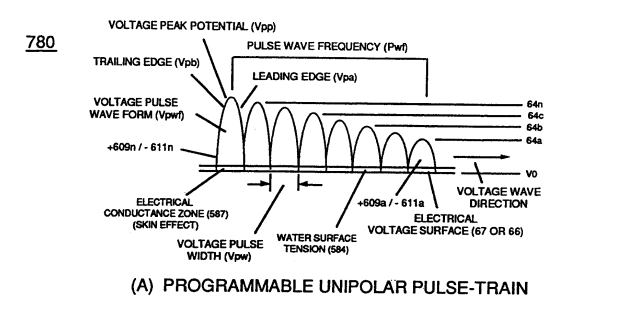
The resultant Flex-Density (Fd) of the hydrogen atom(s) is, now, directly related to applied Voltage Amplitude (64a - 64b - 64c - 64n) of Figure (8-2A) which directly determines the Field Strength (Fs) of Static Electrical Charging Effect (Sece)(585).
How it is written
- (Fd) 2×
- (xxx Fdn) 1×
Fda xxx Fdn is Meyer's shorthand for a run of the same thing: Fda is the first, Fdn the last, and the x's stand for however many lie between. Every stage of the run is this one numeral.
Drawings 2
-
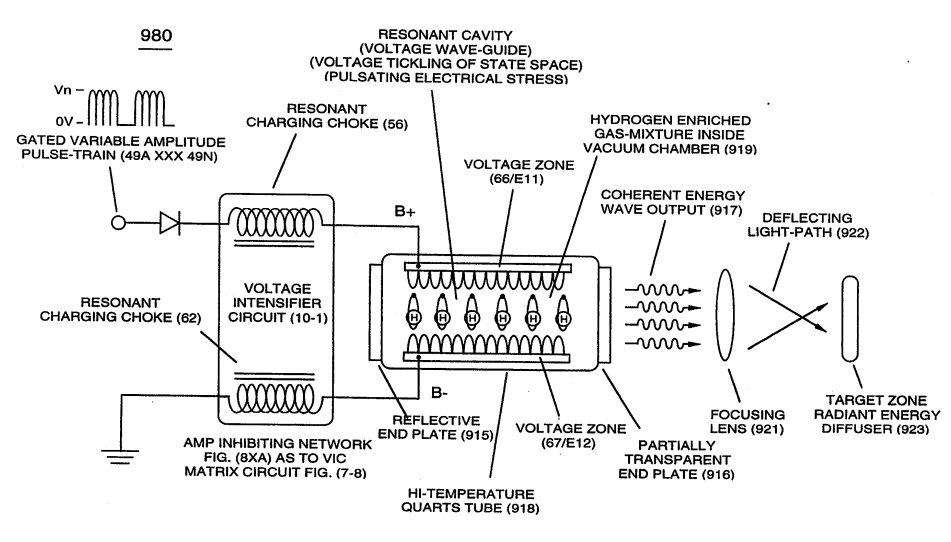
... emitting Coherent Energy Wave-Form (917), as so illustrated in (980) of Figure (10-2). · Optical Thermal Lens
-
Beside the passage · Quartz Tube Configuration & Operational Parameters
Where it is named · 3
Quartz Tube Configuration & Operational Parameters 1×
-
Flex-Density (Fd)
The resultant Flex-Density (Fd) of the hydrogen atom(s) is, now, directly related to applied Voltage Amplitude (64a - 64b - 64c - 64n) of Figure (8-2A) which directly determines the Field Strength (Fs) of Static Electrical Charging Effect (Sece)(585).
A Technique Called "Easer" 2×
-
Flex-Density (Fd)
... Flex-Density (Fd) being the measure of energy-intensity (Wavelets of energy) emitted/released from the oscillatory hydrogen atom (undergoing particle oscillation) in proportional relationship to the field strength/intensity of the external electrical stress-force (Est) superimposed onto the electrical field strength (AA' -ZZ') of Figure (5-3) of the hydrogen atom in "Quiescent State-Space" (Qss)
-
Flex-Density (xxx Fdn)
The greater the electrical stress force (xxxEsfn) per (-) Voltage Gate-Pulse (Esf- V gpa xxx Esf- V gpn) applied, the greater amount of Flex-Density (xxx Fdn) of electromagnetic radiant energy (917 a xxx 917) of Figure (10-2) per cm3 occurs.