patent · US5089107
Bi-polar auto electrolytic hydrogen generator
18 February 1992
Page 1 — bibliographic record
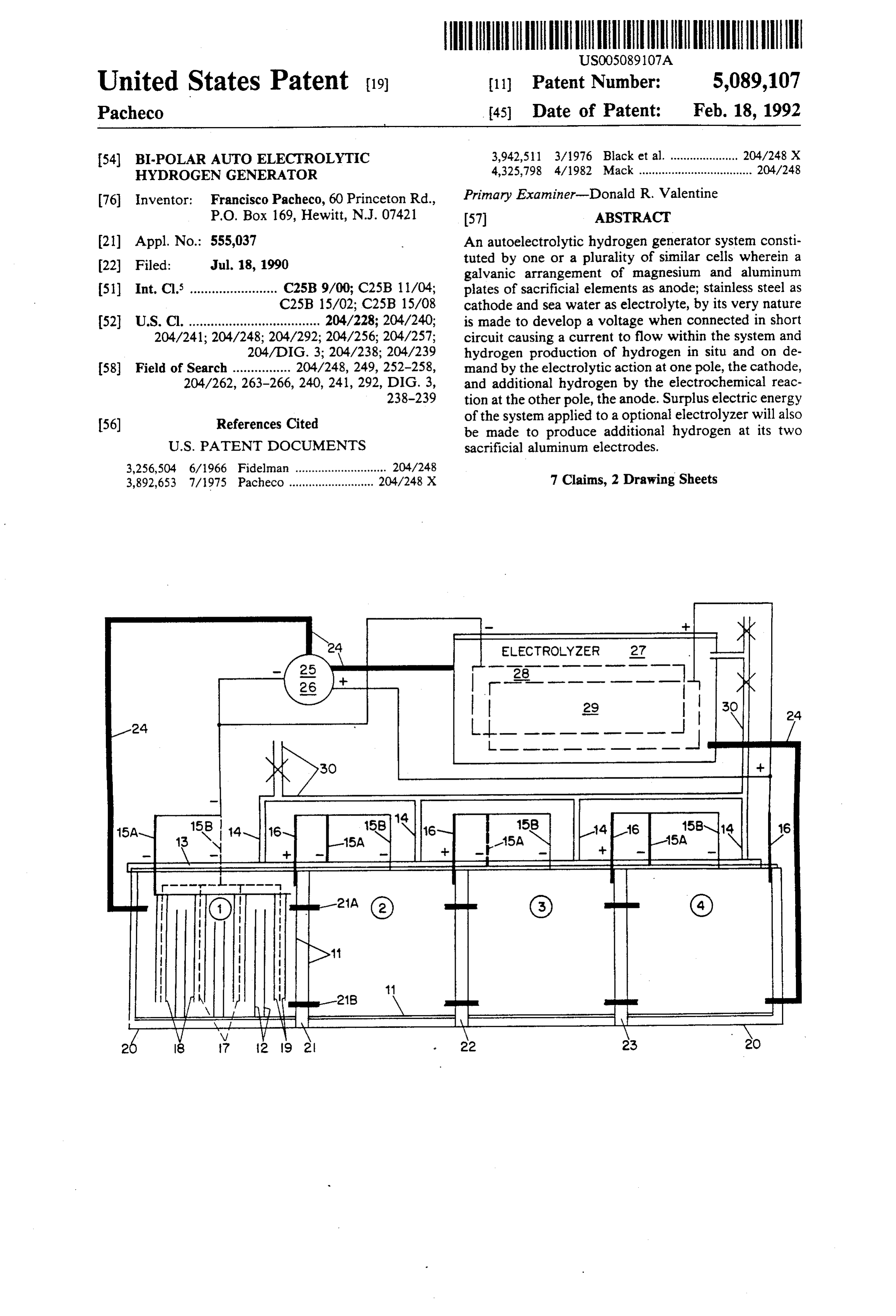
United States Patent (19) 11 Patent Number: 5,089,107 Pacheco (45) Date of Patent: Feb. 18, 1992 (54) BI-POLAR AUTOELECTROLYTIC 3,942,511 3/1976 Black et al. ..................... 204/248 X HYDROGEN GENERATOR 4,325,798 4/1982 Mack ................................... 204/248 76 Inventor: Francisco Pacheco, 60 Princeton Rd., Primary Examiner-Donald R. Valentine P.O. Box 169, Hewitt, N.J. O7421 (57) ABSTRACT (21) Appl. No.: 555,037 An autoelectrolytic hydrogen generator system consti 22 Filed: Jul. 18, 1990 tuted by one or a plurality of similar cells wherein a galvanic arrangement of magnesium and aluminum 51) Int. Cl. ........................ C25B 9/00; C25B 11/04; plates of sacrificial elements as anode; stainless steel as C25B 15/02; C25B 15/08 cathode and sea water as electrolyte, by its very nature 52 U.S. Cl. .................................... 204/228; 204/240; is made to develop a voltage when connected in short 204/241; 204/248; 204/292; 204/256; 204/257; circuit causing a current to flow within the system and 204/DIG. 3; 204/238; 204/239 hydrogen production of hydrogen in situ and on de 58 Field of Search ................ 204/248, 249, 252-258, mand by the electrolytic action at one pole, the cathode, 204/262, 263-266, 240, 241, 292, DIG. 3, and additional hydrogen by the electrochemical reac 238-239 tion at the other pole, the anode. Surplus electric energy
of the system applied to a optional
electrolyzer will also 56) eferences Cited be made to produce additional hydrogen at its two
3,256,504 6/1966 Fidelman ............................ 204/248 3,892,653 7/1975 Pacheco .......................... 204/248 X 7 Claims, 2 Drawing Sheets
Page 2
Drawing sheet — no readable text.
Page 3
Drawing sheet — no readable text.
Page 4
current that is inversely related to the load resistance
BI-POLAR AUTOELECTROLYTIC HYDROGEN and directly to the surface of the electrodes. The elec GENERATOR tric energy causes the magnesium anode to produce chlorine, the chemical reaction of the magnesium with
BACKGROUND OF THE INVENTION 5 the electrolyte produces hydrogen that is liberated at This invention relates in general to the production of this electrode (anode). Hydrogen and sodium hydrox electrolytic hydrogen from a suitable electrolyte: sea ides are produced by electrolysis at the stainless steel water, tap water sodium chloride solution or brine, cathode, the hydrogen is liberated at this electrode particularly as a prime object to a technique that (cathode); the aluminum component of the anode evolves hydrogen 99.98% pure at both electrodes of an O slowly at first, reacts also chemically with the sodium electrolysis cell in which the arrangement and function hydroxides produced, and the resultant hydrogen in of such electrodes are integrant parts of the invention. creases the total output. It is not well understood, other In the electrolysis of brine or sea water, chlorine is than by speculative theory (time element?), the action of produced at the anode, hydrogen together with sodium 15 the permeable separator between the metals magnesium hydroxides at the cathode, i.e. "Dow cell'. and aluminum, however and being incontrovertible the Increasingly large amounts of hydrogen are used in fact that it causes to be produced an excess of hydrogen industrial processes and actually as propeller fuel for above the predictable quantities produced by electro space vehicles and in recent years is being recognized as chemical reactions, this fact is disclosed and incorpo the ideal one for automotive and other engines as well 20 rated as principal and very important part of the inven as utility fuel, inasmuch as its combustion with oxygen tion.
produces pure steam instead of pollutants, and with air The system produces analytically tested, hydrogen of minimal controllable emission of nitrogen oxides. While 99.98 percent purity being evolved at the two elec the proposed use of hydrogen for the above purposes is trodes with no traces detected of chlorine. Also as by subject of many technical papers, actually, besides the products
NASA program there is not widespread commercial hydroxidesthethat 25 cell produces magnesium and aluminum when recuperated from the system, use of the concept, experimental work in projects to represent the stock material industrially obtained from power automobiles fueled by hydrogen were and are actually performed in this Country, Europe and Japan, sea water and bauxite as first step in the industrial pro duction of the mentioned elements, magnesium and while every one demonstrated the excellence of the gas aluminum.
as energy carrier and its superior performance, in all 30 cases hydrogen was and is supplied by the following SUMMARY OF THE INVENTION methods:
1-PRESSURIZED In view of the foregoing it is the main object of this 2-LIQUEFIED invention to provide an autoelectrolytic hydrogen gen 3-STORED IN METALLIC HYDRIDES 35 erator making use of 30% of the total electric energy The major factor that actually precludes the use of employed to industrially produce the elements magne the gas hydrogen as automobile fuel or for that matter sium and aluminum from sea water and bauxite, the as utility fuel is that beside the problems of storage an invention makes use of such elements as an ideal and delivery, the cost of production with the known tech fully charged electric storage system. niques in amounts equivalent in terms of BTU's of en More particularly it is an object of this invention to ergy, exceeds greatly the cost of conventional fossil provide a hydrogen generator of the above identified fuels, even considering the fact that weight by weight, type wherein the electric energy obtained by the ar hydrogen is three times more powerful than gasoline. rangement of magnesium and aluminum as sacrificial The invention's disclosure will lead to the evidence metals is exploited to evolve electrolytic hydrogen at that the cost of hydrogen will be appreciably reduced 45 one electrode and electrochemical reactions to produce inasmuch as it is evolved at both electrodes, cathode also hydrogen at the other electrode. and anode of the generator. The invention represents Also an object of the invention is to provide a system the solution of storage and delivery problems since the eliminating the problem of hydrogen storage inasmuch gas is produced in situ and on demand as described as the so far disclosed arrangement of the metals will further, also represents a radical departure from the 50 produce hydrogen directly from sea water, its natural conventional electrolysis of sea water or brine and its storage as electrolyte, only on demand and in situ thus results.
The electrolysis cell described in drawing (1) consists zards that areeliminating effectively related to consequent expenses and ha hydrogen stored under pressure of: 1-CATHODE, the stainless steel lining of the plas or in liquid form.
tic vessel and its permanently connected twin stainless 55
Still another object of the invention is to provide a steel plates between the anode banks. 2-ANODE system in which the voltage generated in one or more BANKS, consisting of an arrangement of magnesium plates (key element of the system), permeable separators cells wherein hydrogen is being produced electrochem and aluminum plates. 4-The sea water as the electro ically also serves to effect electrolysis in these cells and lyte. 60 in a optional electrolyzer to increase the total volume of By its nature the cell as described above, is also a hydrogen output.
galvanic arrangement of elements that makes of it a embodiment Briefly stated, these objects are attained in one basic source of electricity with a nominal 1.5 volts as differ of the invention wherein a voltaic sell ence of potential in open circuit at its plus and minus constituted by magnesium-aluminum sacrificial anode, a terminals and a negligible chemical reaction between 65 stainless steel cathode and sea water as electrolyte is magnesium and the electrolyte. provided with an external flow loop and a pump pow Referring to a single cell; when a variable load closes ered by the cell surplus electric energy to: 1-circulate the circuit, an electric current flows trough the system, the electrolyte. 2-filter the same to separate it from the
Page 5
metal hydroxides. 3-to utilize the thermal output of electrodes 28 and 29, of the electrolyzer cell 27, proper the system in an independent heath exchange coil. and known changes can be achieved. In another embodiment of the invention, to a plural I claim:
ity system of said basic cells an optional, conventional 1. A bi-polar auto electrolytic hydrogen generating electrolyzer is attached at, wherein the surplus electric 5 System comprising:
energy of the system is applied and additional electro (a)(i)ataleast one voltaic cell comprising: non conductive air-impermeable tank comprising lytic hydrogen produced also at both electrodes made of aluminum. a stainless steel inner tank lining adapted for con taining a salt-water electrolyte selected from the
OUTLINE OF THE DRAWING 10 group consisting of sea water, brine, and an aque For a better understanding of the invention as well as ous solution of sodium chloride, and a cover por other objects and further features thereof, reference is tion having a hydrogen outlet located above said made to the detailed description and read in conjunc tank lining, tion with the included drawing wherein: (ii) a first electrode portion located within the tank and comprising the stainless steel inner tank lining
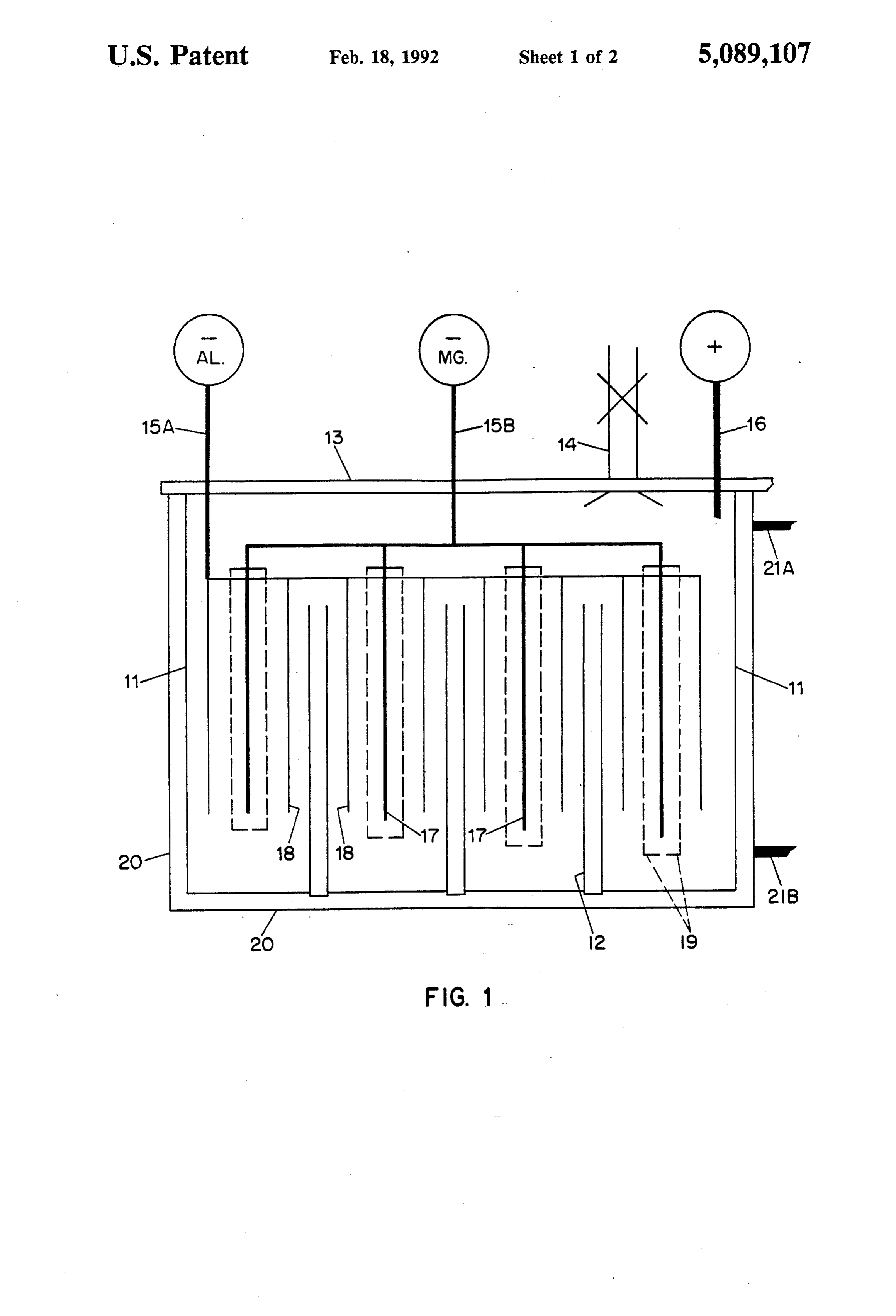
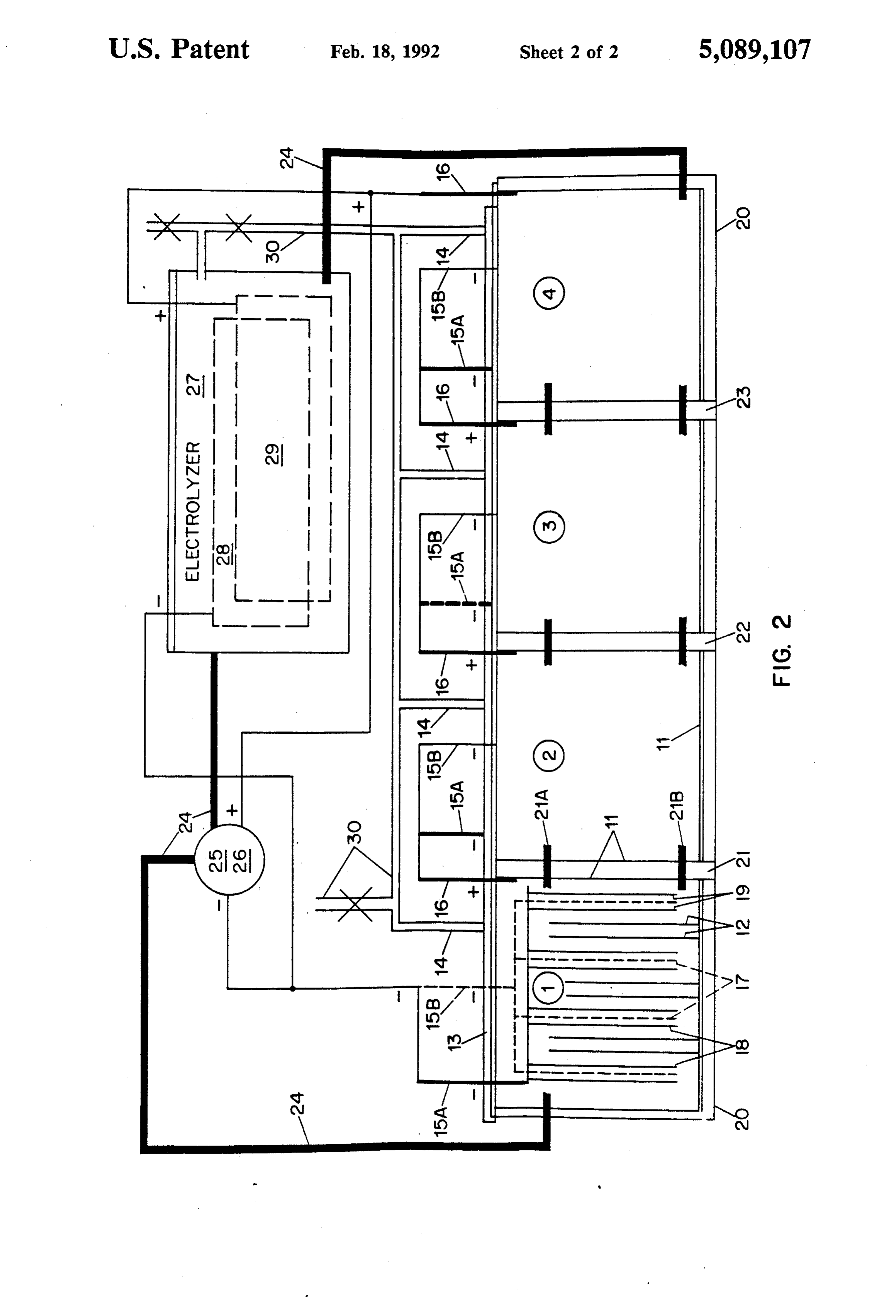
FIG. 1 is a schematic diagram of the basic embodi 15 and a plurality of pairs of stainless steel plates per ment of the invention, and manently affixed to the inner tank lining, wherein FIG. 2 is a schematic diagram of a preferred embodi said first electrode portion is provided with a (--) ment of the invention. terminal located externally on the cover portion of DESCRIPTION OF THE INVENTION 20 the tank, and (iii) a second electrode portion comprising a plurality
First embodiment of sets of magnesium plates, a plurality of sets of Referring now to FIG. 1, there is shown a basic hy aluminum plates, and a plurality of non-conductive drogen generating cell in accordance with the invention permeable separators, wherein each magnesium in which sea water as electrolyte is contained in a tank 25 plate is arranged between a pair of separators all 10 fabricated of a high strength non-reactive plastic adapted to be immersed in the electrolyte, and said material, the internally stainless steel tank lining 11 and second electrode portion is provided with (-) the permanently connected twin plates 12 of the same terminals located externally on the cover portion metal constitutes the cathode. The cover 13 of the tank of the tank; and (b) a variable load resistor external to the cell which 10 includes a gas outlet 14 and the terminals 15A, 15B 30 may be connected, at will, across the positive (--) and (-) and 16 (--). negative (-) terminals of the system to develop a Immersed in the electrolyte and supported within the voltage and a controlled current in the cell, inversely tank 10 are the plates of magnesium 17 and aluminum 18 proportional to the resistance of said variable load together with the separator 19, an arrangement that resistor, thereby evolving hydrogen, autoelectrolyti constitutes the anode. External terminals of magnesium 35 cally and electrochemically from the electrolyte, on and aluminum to be connected when operating the cell. demand at said first and second electrode portions, in Since the cell generates the electric energy for the elec a volume directly proportional to the current pro trolysis, the cell operates as an auto-electrolysis device duced by the total surface area of the electrodes. requiring no external energy source. 40 2. A system according to claim 1, in which each pair
Second embodiment of stainless steel plates is arranged within the tank so that each pair of stainless steel plates resides between
The arrangement in FIG. 2, shows a group of hydro each set of aluminum and magnesium plates of said gen generator cells 1, 2, 3, and 4. identical in every second electrode portion.
detail as described in the first embodiment that are lo 45 3. A system according to claim 1, in which a plurality cated within a plastic tank 20 with three partitions 21, of voltaic cells are electrically connected in series to 22, and 23 and provided with electrolyte circulating one another, and have a flow loop therebetween to ports such as 21A and 21B. permit the flow of electrolyte through each cell. In closing the circuit onto itself, the cells 1, 2, 3, and ity4.ofAvoltaic system according to claim 3, in which the plural cells is in communication with an external 4, connected in series, will develop about four times the 50 flow loop to effect continuous circulation of electrolyte voltage of a single cell. through each cell, the loop including an electrically An external flow loop 24 may be coupled to the tank 21 including a strainer 25 and a pump 26 that powered operated pump for pumping the electrolyte through the loop, wherein the pump is electrically connected to the by the voltage derived from the system will separate the load resistor and powered by the voltage produced insoluble hydroxides from the electrolyte. 55 from the cell.
As disclosed, the four cells electric energy output 5. A system according to claim 4, in which the loop may be utilized to operate as an integrant part of this embodiment an optional electrolyzer cell 27 that will further includes a heat-exchange coil to cool the elec trolyte and produce a thermal output.
evolve additional hydrogen also at both electrodes 28 6. A system according to claim 4, in which the loop and 29, being these electrodes made of aluminum. A 60 further includes a filter to separate hydroxides of mag manifold 30 is provided to discharge the total volume of nesium and aluminum from the electrolyte. hydrogen produced by the system. 7. A system according to claim 4, in which the loop While there has been shown preferred embodiments further includes an electrolyzer cell having electrodes of the invention, it will be appreciated that many modi therein connected across the load resistor, wherein fications and changes may be made without, however, 65 hydrogen is additionally evolved from the electrolyzer departing from the essential spirit of the invention. For cell and combined with hydrogen produced from the example, utilizing the electric energy developed by the voltaic cells.
system, the nature of the electrolyte and elements of the
Provenance
- Collection
- Cited prior art
- Original PDF
- patentimages.storage.googleapis.com →
- Filed
- 1990-07-18
- Pages
- 5
- Method
- pdftotext (the PDF's own text layer) + pdftoppm 300dpi page scans
- Source
- Google Patents bibliographic record
- Granted
- 1992-02-18
- Inventors
- Francisco Pacheco
- Transcribed from
- patentimages.storage.googleapis.com →