patent · US3256504
Galvanic hydrogen producer
14 June 1966
Page 1
Drawing sheet — no readable text.
Page 2
United States Patent Office 3,256,504 Patented June 14, 1966
3,256,504 magnesium weight ratio of at least 5:1. Appropriate GALVANIC HYDROGEN PRODUCER hydrogen outlet valves and water inlet valves may be in Morris Fidelman, Prince Georges County, Md. corporated on the generator housing.
(2004 Van Buren St., W. Hyattsville, Md.) The basic galvanic couple employed for the practice of Filed Jan. 11, 1961, Ser. No. 82,080 5 the instant invention comprises magnesium as the anode, 5 Claims. (C. 204-248) an aqueous saline electrolyte and an inert metal as the cathode. For the anode sheets, either pure magnesium
This invention relates to the production of hydrogen or high magnesium content alloys may be used. The term through the reaction of magnesium with water, the reac tion being effected by galvanically coupling magnesium 0 “magnesium' both pure as employed herein is intended to include magnesium and high magnesium content alloys.
with an active inert metal in saline water. The cathode is a metallic sheet surfaced with a dull Metallic magnesium is a reactive metal with a theoreti plate of a metal selected from the group consisting of iron, cal potential high enough even to have created consider nickel, cobalt and alloys thereof containing not more than able interest in the possibility of employing the magne minor percentages of other metals. This dull plate sur sium-water reaction galvanically as a source of electrical 5 face is what actually constitutes the cathode of the gal energy through the reaction: vanic cell; the basis metal serves to support the cathode surface. Ordinarily the plate would be electrodeposited upon
However, employment of this galvanic reaction solely steel sheet.a suitable ferrous basis metal such as ordinary mild for production of hydrogen has not been seriously con 20 copper, even Other metals available in sheet form, like magnesium itself, can serve alternatively as sidered by the art, principally because the construction de the basis metal on which to plate the cathode surface. tails which permit production of electrical energy are vir However, for preferred practice of the instant invention, tually inconsistent with rapid evolution of hydrogen. An dull nickel electroplated on magnesium itself, or on steel effective external short circuit so that a magnesium-water sheet is the cathode element.
primary battery can be used as a hydrogen generator is 25 It has been determined that iron, nickel and cobalt are simply not feasible. The various design characteristics by far the best materials from which to form the dull or of these power generating devices make them too large, matte plate constituting the active cathode surface. More or too complex, or too expensive for generation of hydro generally, these preferred materials may be plated individ gen. Under short circuit conditions even the efficient ually or codeposited with minor percentages of an other magnesium galvanic cells disclosed in related copending 30 wise uncontemplated metal in the form of an alloy. applications S.N. 749,363 and 749,008 now Patents 3,036,- Within the intent of the term dull is included those 141 and 3,036,142 generate hydrogen at but a small frac finishes known to the electroplating art as dull, burnt, den tion of the rates desired for a hydrogen producer. dritic and matte. Rolled nickel, even after etching, results The object of the instant invention is to provide a in comparatively low hydrogen generation rates. What is device employing the magnesium-water reaction which 35 known as bright nickel plate is not materially better, nor rapidly generates hydrogen at a uniform rate. is burnished plate. However, a commercially obtained Further objects and the advantages of the instant in matte nickel plate (on steel sheet) coupled to a non vention will be apparent from the following description of descript magnesium alloy resulted in a hydrogen genera the invention and its relationship to the art.
Elemental hydrogen is in wide-spread and large-scale 40 tion rate of about a liter per minute per square foot of anode area.
use throughout the world. In large quantities, e.g. for A specific advantage of forming the cathode elements the production of ammonia, hydrogen can be supplied at as above described lies in the self-supporting nature of a an exceedingly low cost. Unfortunately the unit cost of thin metal sheet. Thus, a 12' by 6' nickel plated cathode hydrogen climbs sharply as the demand level decreases. can be roughly 12 mils in thickness (10 mils for the basis Moderate quantities of hydrogen have been commercially 45 metal and 1 mill of Niplate on each side), yet still be shock supplied by cracking ammonia or by electrolytically de resistant and self-supporting. The reactive magnesium composing water, both relatively high cost expedients. metal can constitute more than 60% of the total cell as The demand for very small quantities of hydrogen has sembly weight and volume. Thus the galvanic cell assem been filled commercially by shipment of compressed bly of the instant invention generates large quantities of hydrogen from a central source, as cylinder hydrogen. 50 hydrogen for its own weight and volume. Nonetheless, This expedient commonly involves shipment of about 100 this assembly contains the high area of anode and cathode pounds of cylinder for every 100-200 standard cubic feet surface needed to generate the hydrogen in relatively brief of hydrogen. An alternative expedient for generating periods of time.
small quantities of hydrogen is the reaction of aluminum Advantageously, extensive tests have demonstrated that chips and caustic soda with water. This last expedient is plated surfaces of iron, nickel or cobalt are chemically commonly employed for filling meteorological balloons. inert to the electrolyte, retaining their activity throughout When the need does not exceed a couple of hundred cubic the useful life of the cell assembly. Indeed, if desired, feet, hydrogen is a high cost material whose use most the cathode elements can be removed and re-used in a often involves the inconvenience either of operating a new cell assembly. In the dry state these cathode mate potentially dangerous chemical generator or of handling 60 rials and the magnesium anodes as well have virtually an heavy high pressure cylinders. A clearcut need exists for indefinite shelf life. Therefore, the cell assembly can be a safe and simple way to generate hydrogen in Small quan easily shipped and then stored until needed. tities not more than about two pound moles, that is less In assembling the galvanic cell each individual cathode than 1000 cubic feet. The instant device is intended to fill sheet is positioned face to face with a magnesium anode
Briefly stated, the instant invention comprises: an inter sheet spaced apart therefrom a distance of 0.1 to 20 mil limeters. This spacing is quite important and should not nally short circuited single galvanic cell made of a plural be exceeded even when the magnesium has been almost ity of magnesium anode and inert metal cathode plates entirely consumed by reaction with the water. In a sense, assembled together as a unit; an enclosed generator hous 70 the requirement for proper spacing determines the maxi ing for containing said galvanic cell assembly, and enough mum thickness for the magnesium sheet usable in the saline water inside the housing to provide a water to practice of the instant invention. The basic reason for
Page 3
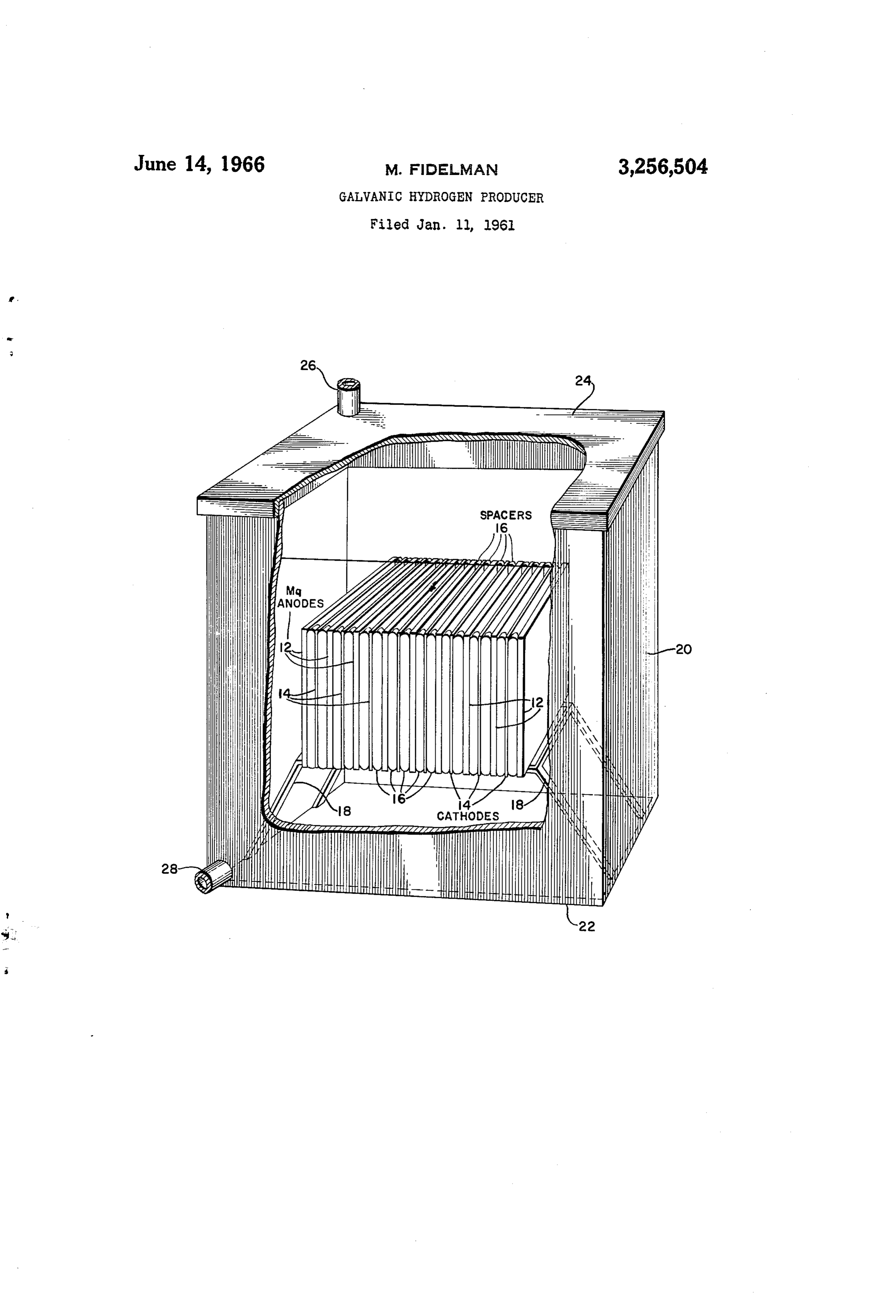
the limitation on spacing resides in the internal voltage assembly to contain the needed quantity of electrolyte. or IR drop through the electrolyte. Above a 20 millimeter The lid 24 of generator housing 20 is provided with a spacing the electrical resistance of the electrolyte is so valved outlet 26 through which the generated hydrogen large as to reduce the hydrogen generation rate below leaves the housing. Desirably, the housing 20 itself con a practical minimum. On the other hand, a spacing less 5 tains a valved electrolyte inlet-outlet line 28 in or near than 0.1 millimeter is actually too close to allow generated the bottom thereof for either the addition of water or hydrogen to escape through the electrolyte with any the removal of water to the electrolyte. facility, again reducing the hydrogen generation rate. In Aside from the more substantial quantity of water re addition, extremely close spacing is rather difficult to con quired principally for cooling purposes when the above struct into a multiplate assembly. O described galvanic cell assembly is employed as a hydro Operation of the galvanic cell assembly as a hydrogen gen generator, other differences exist between the above producer involves the continuing consumption of both me described device and the structure of a power producing tallic magnesium and water with with concomitant pro battery (such as for example the type described in the duction of hydrogen and magnesium hydroxide. The hy aforementioned copending applications). As one note drogen must be able to evolve freely and pass rapidly worthy distinction, the instant device comprises a multi out of the electrolyte. Similarly the magnesium hydrox plate or multielement single cell. Another equally signifi ide which appears as a flocculiant precipitate should be cant difference is that the cell is internally short circuited. removed promptly from between each pair of electrodes Externally short circuiting an already assembled battery in the galvanic cell assembly. Also, relatively. minor even made up as a single cell is not desirable because of quantities of water must be provided to maintain the cell the extremely high electrical currents involved. Genera assembly full of electrolyte at all times, and to make up tion of approximately 250 cubic feet of hydrogen in an the loss due to actual consumption of water in the reac hour involves passage of approximately 2500 ampere tion. However, much more substantial quantities of hours. When currents of this magnitude are involved, water must be provided to take up the heat of the mag 2 5 the resistance of even the best external short circuit has nesium-water reaction. All told the water-magnesium to be relatively high or the construction must be so mas ratio must exceed 5:1. A lesser ratio of water to mag sive as to be virtually impractical. An external IR volt nesium, results in the presence of substantial quantities of age drop of even 0.1 volt for the galvanic cell constitutes water vapor in the product hydrogen. For maintaining a a load which materially reduces the hydrogen generation cool reaction ratios exceeding 10:1 should be employed. 30 rate. However, maximum rates are attained if the short Removal of hydrogen and magnesium hydroxide from were made internally, i.e., inside the electrolyte and on between each pair of electrodes is effected by a proper an electrode to electrode basis (i.e. individual anode to cell construction which leaves the space between elec cathode). Relatively small current flows between each trodes free, for bottom to top passage of electrolyte. Also individual pair of electrodes (e.g. about 200 amperes) the cell assembly is intended to be disposed inside the and the length of the electrical connection is low being generator housing, at a location beneath the electrolyte equal to the electrode spacing distance of not more than surface level but spaced above the housing floor and about 20 millimeters. In the illustrated mode, such a spaced also from the side walls of the housing. A free shunt can be simply the flat portion of a knife blade unburdened vertical passage is provided between the side pressed against the side edge of the assembly (not illus or end walls (or both) of the housing and the cell assem 40 trated). This internal short circuit has a further advan bly. This construction allows electrolyte to circulate tage over any external circuit in that it is made and broken cyclically from beneath the assembly up between each inside the electrolyte and therefore is free from the Spark pair of electrodes and over the top of the cell assembly. ing hazards which exist when an external circuit is made Provision of top to bottom spacing elements at the side or broken in what might be an explosive hydrogen-air atmosphere.
edges of the electrodes prevents lateral flow into or out of the cell assembly. Since the housing must be large enough However, the preferred mode of the instant invention to contain the requisite quantity of electrolyte, the as is to build the internal short circuit directly into the cell sembly can be spaced from the walls so that electrolyte assembly by making the spacer members 16 out of an can flow down between the cell assembly and the housing electrically conducting material. In the illustrated mode, walls to complete the cyclic flow path. Copper wire of appropriate width (e.g. #15) is employed For further understanding of the instant invention, 50 for the spacers 16. Forming the spacers of the elec reference is now made to the drawing, wherein is illus trically conducting material simultaneously arranges for trated diagrammatically the galvanic cell assembly dis the important spacer function and for the internal short posed inside the generator housing. circuit. An alternative mode (not illustrated) is to form As shown in the drawing, the galvanic cell assembly a rolled, bent or beaded marginal edge directly on the comprises a plurality of magnesium or magnesium alloy 55 vertical side edges of magnesium anode sheets or on the anodes 12, each spaced apart from an adjacent inert cath metal cathode sheets. These spacer elements, whether ode 14 by vertical spacer elements 16 disposed adjacent of copper or formed as an integral part of one electrode, the vertical side edges of the electrode pair. Desirably, should, of course, be elongated enough to provide a sub each spacer element 16 extends substantially the entire stantial barrier against lateral in-or-out flow of electrolyte vertical height of the electrodes. Importantly, there are 60 at the side edges of the paired electrodes. By the same no horizontal barriers against vertical movement of elec token their very length provides extremely low resistance trolyte into or out of the volume bounded by each anode electrical connections.
12, cathode 14 and their spacers 16. Electroltye can flow With the above described construction any desired up freely through this volume. number of galvanic couples can be assembled from paired The entire assembly is illustrated as being mounted 65 magnesium and cathode sheets into one single cell assem centrally of generator housing 20 atop of an open frame bly. Indeed, since the hydrogen generator is internally work 18 which in turn is raised up from the bottom 22 short circulated, there is virtually no limit to the number of the generator housing 20. Alternatively (not shown) of electrode pairs which can be assembled into a cell the entire assembly may be suspended in the electrolyte assembly. This is because each pair of electrodes acts from the lid 24 of the generator housing. In any event independently. Hydrogen evolving on both electrode sur the assembly is spaced apart from the top, bottom and at faces creates a gas lift of sufficient force to draw elec least two (preferably all) side walls of generator housing trolyte from beneath the assembly up through each elec 20. In operation, the cell assembly is entirely submerged trode pair in the cell assembly. When the electrolyte beneath the top of the electrolyte. The generator housing flows up over the top of the cell assembly and back down 20 as a whole is sufficiently oversized relative to the cell alongside the cell assembly towards the bottom of hous
Page 4
ing 20, it carries with it the flocculent magnesium hy What is claimed is:
droxide product of the reaction. The Mg(OH) ulti 1. A hydrogen generator comprising an enclosed hous mately settles out on the housing bottom 22. ing, Saline water inside said housing and a galvanic cell Fresh electrolyte is always flowing up through the cell assembly submerged in said water beneath the surface assembly serving to cool each pair of electrodes in the level thereof and spaced above the floor of said housing, assembly. The electrolyte seems also to depolarize the Said assembly comprising a plurality of paired spaced electrodes by a mechanical effect, scrubbing the hydrogen apart magnesium anodes and inert metal cathodes, means away from the electrode surfaces. This electrolyte cir associated with said assembly for providing a short circuit culation is therefore what permits maintenance of the electrical connection directly between each adjacent desired high current density. O anode-cathode pair in said assembly, the housing being Interestingly enough, the built-in short circuit arrange Sufficiently larger than said assembly to accommodate a ment preferred for the practice of the instant invention weight ratio of saline water to magnesium of at least does not prevent maintenance of reasonable control over 5 to 1.
the reaction. The galvanic reaction can be halted con 2. The generator of claim it wherein the anode-cathode pletely by merely draining the electrolyte out of the inlet pairs are simultaneously spaced apart and electrically outlet 28. Far less drastic, however, is control of the connected by metallic wire spacers disposed adjacent the reaction rate through the salinity of the electrolyte. Thus, side edges of the pair.
for example, a cell assembly employed under conditions 3. A unit adapted to produce hydrogen when sub where it is completely consumed in about two hours and merged in Saline water which comprises a galvanic cell generates approximately 500 cubic feet of hydrogen dur 20 assembly made of a multiplicity of paired spaced apart ing the course of the reaction, can be slowed down or magnesium anodes and inert metal cathodes and elec speeded up by adjustment of the electrolyte salinity. trically conductive spacing elements adjacent the longi Since the above-mentioned exemplary consumption rate tudinal side edges of each pair of plates, whereby a short was predicated upon the electrolyte being about 20% circuit current flows directly between each pair, the cath sodium chloride in water, employment of a 5% salt solu odes each being a dull plated surface selected from the tion as the electrolyte would sharply decrease the gen group consisting of nickel, cobait, iron, and alloys thereof erating rate while employment of a saturated KCl brine with minor percentages of other metals. would virtually double the hydrogen generation rate. To 4. A unit adapted to produce hydrogen when sub a substantial extent the hydrogen generation rate can be predetermined by appropriate selection of electrolyte 30 assemblyinmade merged saline water which comprises a galvanic cell of a multiplicity of paired spaced apart salinity. Indeed even during operation, the reaction rate magnesium anode sheets and inert metal cathode sheets can be changed by draining out some of the Salt water and electrically conductive spacing elements adjacent the through outlet 28 and prompt replacement thereof with either fresher or saltier water. longitudinal side edges of each pair of plates, whereby As a specific example of the instant invention 44 sheets the short circuit current flows directly between each paired of /8' pure magnesium, 6' by 12' totalling 35 lbs. were electrodes, the cathode sheets being a dull plated Surface paired with a like number (actually 45) 6' by 12' dull selected from the group consisting of nickel, cobalt, iron nickel electroplated steel sheets (about 0.010’) into a and alloys thereof with minor percentages of other metals. single galvanic cell assembly. Copper wire side edge 5. The unit of claim 3 wherein each of the cathode separators provided a 0.030' spacing. Immersed in a 40 surfaces is a dull nickel plate formed directly on the 55 gallon drum filled with a 20% NaCl solution, this backside of a magnesium anode member. galvanic cell assembly generated almost 500 cubic feet of hydrogen over a two hour period. References Cited by the Examiner In another specific embodiment the basic structure was UNITED STATES PATENTS altered. For this assembly one surface of each magne 45 sium sheet was plated with nickel according to known 1,214,934 2/1917. Levin ------------- 204-292 techniques, then a dull nickel electroplate surfacing (0.5 2,451,066 10/1948 Butler ------------- 204-248 mil) was added, effectively forming a bi-electrode. A 2,938,066 5/1960 Weigand ----------- 136-161 total of 90 6' by 12' sheets (A6' magnesium) so pre 3,026,259 3/1962 Philips ------------ 204-150 pared were assembled with the copper wire into an inter 3,036,142 5/1962 Goldenberg et al. ---- 136-100 nally short circuited battery (0.030' plate spacing). 3,207,149 9/1965 Spindler ------------ 126-263 When employed to generate hydrogen the results were FOREIGN PATENTS comparable to that of the previously described embodi ment. Since each paired anode and cathode Surface was 2,662 2/1885 Great Britain. uw individually short circuited the unit as a whole still 5 5 303,027 10/1928 Great Britain. amounted to one short circuited galvanic cell. 837,864 6/1960 Great Britain. It is to be understood that various element changes 345,332 12/1936 Italy.
may be made in the above-described structure without departing from the spirit of the invention or the appended WINSTON A. DOUGLAS, Primary Examiner. claims. O
JOSEPH REBOLD, JOHN H. MACK, Examiners.
lTechniques for plating on magnesium are described in a B. G. JOHNSON, A. B. CURTIS, A. SKAPARS, manual published by the Dow Chemical Co. (1958) entitled Assistant Examiners. 'Magnesium Finishing, pages 75-87.
Provenance
- Collection
- Cited prior art
- Original PDF
- patentimages.storage.googleapis.com →
- Filed
- 1961-01-11
- Pages
- 4
- Method
- pdftotext (the PDF's own text layer) + pdftoppm 300dpi page scans
- Source
- Google Patents bibliographic record
- Granted
- 1966-06-14
- Inventors
- Fidelman Morris
- Transcribed from
- patentimages.storage.googleapis.com →