patent · US3942511
Sandwiched structure for production of heat and hydrogen gas
9 March 1976
Page 1 — bibliographic record
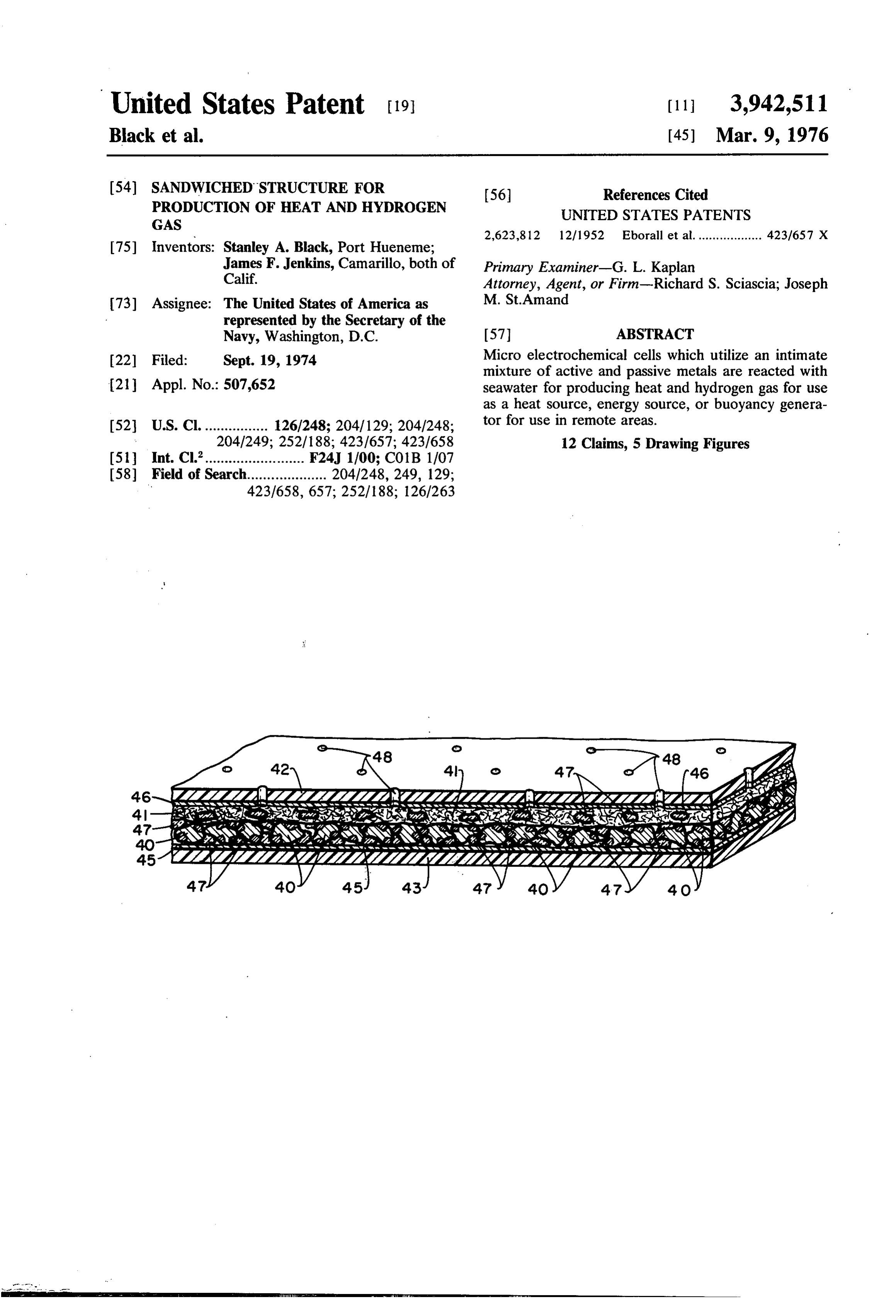
United States Patent (19) (11 3,942,511 Black et al. (45) Mar. 9, 1976 (54) SANDWICHED STRUCTURE FOR 56 References Cited PRODUCTION OF HEAT AND HYDROGEN UNITED STATES PATENTS GAS 2,623,812 12/1952 Eborall et al................... 423/657 X 75) Inventors: Stanley A. Black, Port Hueneme;
James F. Jenkins, Camarillo, both of Primary Examiner-G. L. Kaplan
Calif. Attorney, Agent, or Firm-Richard S. Sciascia; Joseph 73) Assignee: The United States of America as M. St.Amand represented by the Secretary of the
Navy, Washington, D.C. 57 ABSTRACT 22 Filed: Sept. 19, 1974 Micro electrochemical cells which utilize an intimate mixture of active and passive metals are reacted with 21 Appl. No.: 507,652 seawater for producing heat and hydrogen gas for use as a heat source, energy source, or buoyancy genera 52 U.S. Cl. ................ 126/248; 204/129; 204/248; tor for use in remote areas. 204/249; 252/188; 423/657; 423/658 12 Claims, 5 Drawing Figures
essassassasas a sasa say is a vasayas a suaves a saasa
SSSSSSSS %
seas SyS, GSS - War
asay.
a weae
any
swa wyvX w.xw swa wa w ww.waws waw
a sasa as a vavas, as vavy Yarakasasaurs, a
Page 2
MAGNESUM
RON PARTICLE
RON PARTICLE
O-O COARSE POWDER
A- - - -AVERY FENE POWOER
5OO A = RONZED PRODUCTS
B = SIMPLE MIXTURE OF ROM AND MAGNESUM
C = MAGNESIUM ONLY (NO ROM)
O 5 O 5 2O 25 3O 35 4.O
ZZZZZZZZZZYZZZZ YSSSSSSSSSSSSSSASA
SSS systeSat
seas ra sa wavevaravay 32k Ry, Pr
assassessess SSSSSSSSSSSSSSSSSSSSSS
foN 52N N 52-22
SSSSSSSSSSSSSSSSSSS
52 SN K23S f By Nigenesses sgry 23 Servis Warr Y. &N2
way
al se &SQS SSS NSSS SS NS
ao) sy sav
Page 3
herein, another order of magnitude increase in reaction
SANDWICHED STRUCTURE FOR PRODUCTION rate can be achieved for use in generating hydrogen. OF HEAT AND HYDROGEN GAS SUMMARY
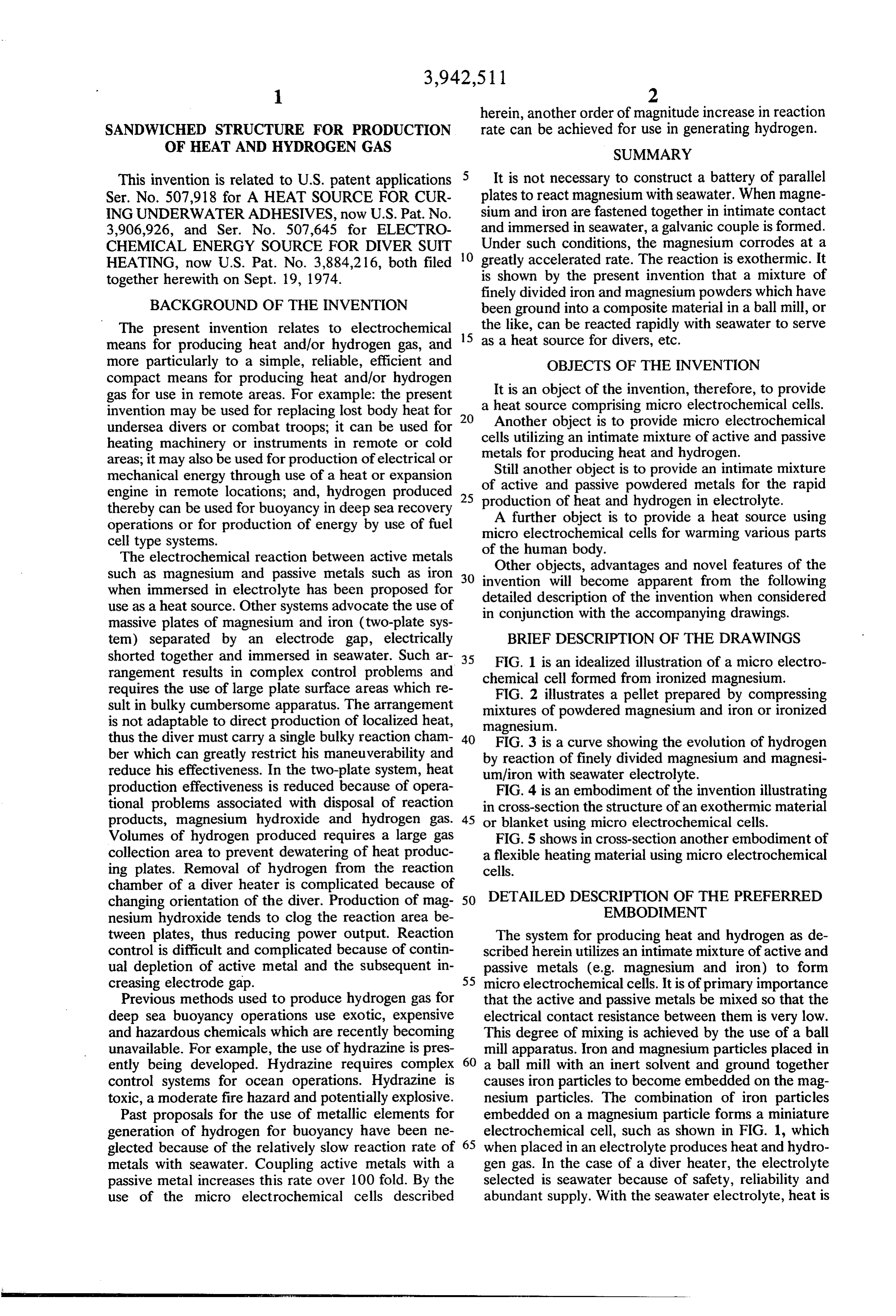
This invention is related to U.S. patent applications 5 It is not necessary to construct a battery of parallel Ser. No. 507,918 for A HEAT SOURCE FORCUR plates to react magnesium with seawater. When magne ING UNDERWATER ADHESIVES, now U.S. Pat. No. sium and iron are fastened together in intimate contact 3,906,926, and Ser. No. 507,645 for ELECTRO and immersed in seawater, a galvanic couple is formed. CHEMICAL ENERGY SOURCE FOR DIVER SUIT Under such conditions, the magnesium corrodes at a HEATING, now U.S. Pat. No. 3,884,216, both filed O greatly accelerated rate. The reaction is exothermic. It together herewith on Sept. 19, 1974. is shown by the present invention that a mixture of finely divided iron and magnesium powders which have
BACKGROUND OF THE INVENTION been ground into a composite material in a ball mill, or The present invention relates to electrochemical the like, can be reacted rapidly with seawater to serve means for producing heat and/or hydrogen gas, and 15 as a heat source for divers, etc.
more particularly to a simple, reliable, efficient and OBJECTS OF THE INVENTION compact means for producing heat and/or hydrogen gas for use in remote areas. For example: the present It is an object of the invention, therefore, to provide invention may be used for replacing lost body heat for a heat source comprising micro electrochemical cells. undersea divers or combat troops; it can be used for cells Another object is to provide micro electrochemical heating machinery or instruments in remote or cold metalsutilizing an intimate mixture of active and passive for producing heat and hydrogen.
areas; it may also be used for production of electrical or mechanical energy through use of a heat or expansion ofStill another object is to provide an intimate mixture active and passive powdered metals for the rapid engine in remote locations; and, hydrogen produced 25 production of heat and hydrogen in electrolyte. thereby can be used for buoyancy in deep sea recovery A further object is to provide a heat source using operations or for production of energy by use of fuel micro electrochemical cells for warming various parts cell type systems. of the human body.
The electrochemical reaction between active metals
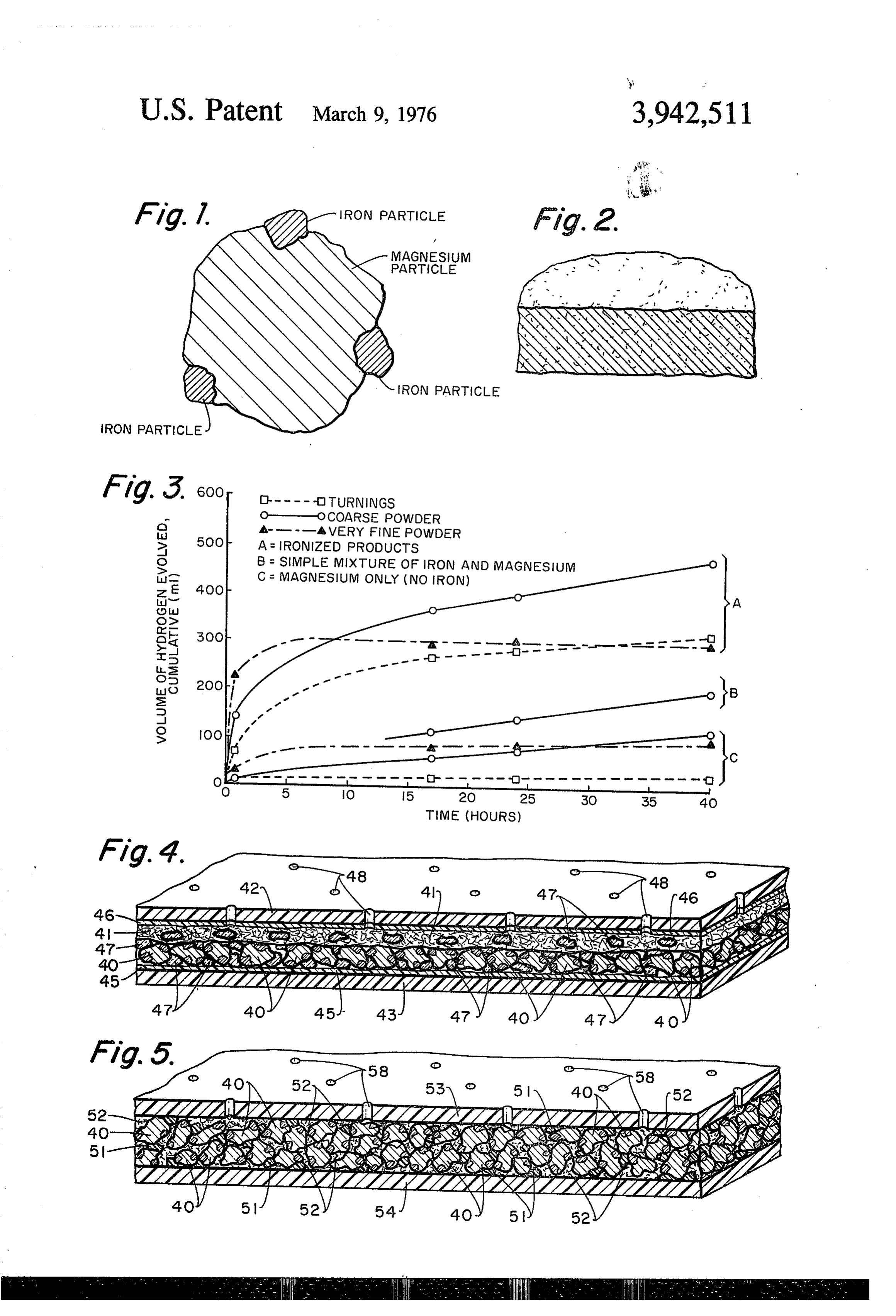
Other objects, advantages and novel features of the such as magnesium and passive metals such as iron 30 invention will become apparent from the following when immersed in electrolyte has been proposed for detailed description of the invention when considered use as a heat source. Other systems advocate the use of massive plates of magnesium and iron (two-plate sys in conjunction with the accompanying drawings. tem) separated by an electrode gap, electrically BRIEF DESCRIPTION OF THE DRAWINGS shorted together and immersed in seawater. Such ar 35 FIG. 1 is an idealized illustration of a micro electro rangement results in complex control problems and chemical cell formed from ironized magnesium. requires the use of large plate surface areas which re FIG. 2 illustrates a pellet prepared by compressing sult in bulky cumbersome apparatus. The arrangement mixtures of powdered magnesium and iron or ironized is not adaptable to direct production of localized heat, magnesium.
thus the diver must carry a single bulky reaction cham 40 FIG. 3 is a curve showing the evolution of hydrogen ber which can greatly restrict his maneuverability and by reaction of finely divided magnesium and magnesi reduce his effectiveness. In the two-plate system, heat um/iron with seawater electrolyte. production effectiveness is reduced because of opera FIG. 4 is an embodiment of the invention illustrating tional problems associated with disposal of reaction in cross-section the structure of an exothermic material products, magnesium hydroxide and hydrogen gas. 45 or blanket using micro electrochemical cells. Volumes of hydrogen produced requires a large gas FIG. S shows in cross-section another embodiment of collection area to prevent dewatering of heat produc a flexible heating material using micro electrochemical ing plates. Removal of hydrogen from the reaction cells.
chamber of a diver heater is complicated because of changing orientation of the diver. Production of mag 50 DETAILED DESCRIPTION EMBODIMENT
OF THE PREFERRED
nesium hydroxide tends to clog the reaction area be tween plates, thus reducing power output. Reaction The system for producing heat and hydrogen as de control is difficult and complicated because of contin scribed herein utilizes an intimate mixture of active and ual depletion of active metal and the subsequent in passive metals (e.g. magnesium and iron) to form creasing electrode gap. 55 micro electrochemical cells. It is of primary importance Previous methods used to produce hydrogen gas for that the active and passive metals be mixed so that the deep sea buoyancy operations use exotic, expensive electrical contact resistance between them is very low. and hazardous chemicals which are recently becoming This degree of mixing is achieved by the use of a ball unavailable. For example, the use of hydrazine is pres mill apparatus. Iron and magnesium particles placed in ently being developed. Hydrazine requires complex 60 a ball mill with an inert solvent and ground together control systems for ocean operations. Hydrazine is causes iron particles to become embedded on the mag toxic, a moderate fire hazard and potentially explosive. nesium particles. The combination of iron particles Past proposals for the use of metallic elements for embedded on a magnesium particle forms a miniature generation of hydrogen for buoyancy have been ne 65 electrochemical cell, such as shown in FIG. 1, which glected because of the relatively slow reaction rate of when placed in an electrolyte produces heat and hydro metals with seawater. Coupling active metals with a gen gas. In the case of a diver heater, the electrolyte passive metal increases this rate over 100 fold. By the selected is seawater because of safety, reliability and use of the micro electrochemical cells described abundant supply. With the seawater electrolyte, heat is
Page 4
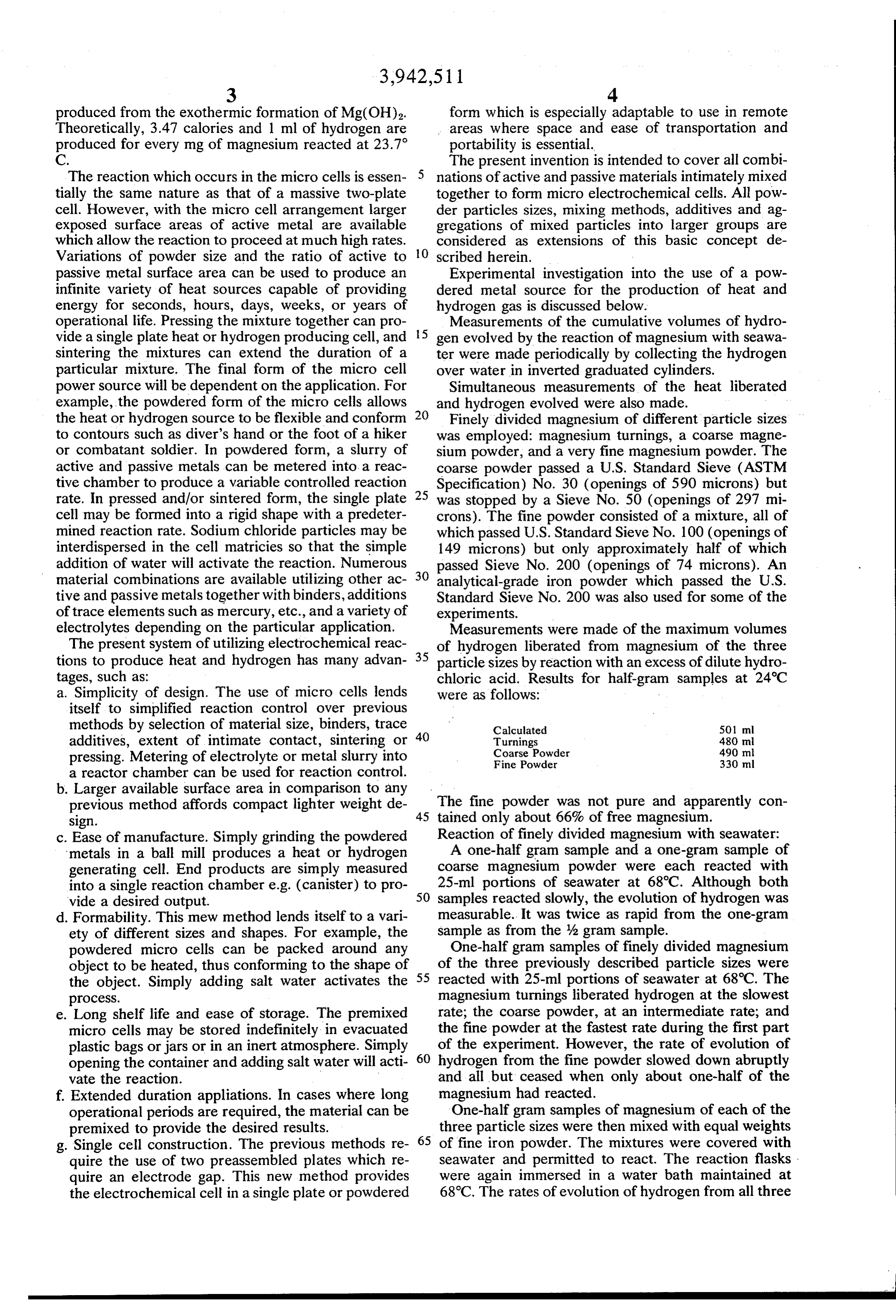
produced from the exothermic formation of Mg(OH). form which is especially adaptable to use in remote Theoretically, 3.47 calories and 1 ml of hydrogen are areas where space and ease of transportation and produced for every mg of magnesium reacted at 23.7 portability is essential. C The present invention is intended to cover all combi The reaction which occurs in the micro cells is essen- 5 nations of active and passive materials intimately mixed tially the same nature as that of a massive two-plate together to form micro electrochemical cells. All pow cell. However, with the micro cell arrangement larger der particles sizes, mixing methods, additives and ag exposed surface areas of active metal are available gregations of mixed particles into larger groups are which allow the reaction to proceed at much high rates. 10 considered as extensions of this basic concept de Variations of powder size and the ratio of active to scribed herein.
passive metal surface area can be used to produce an Experimental investigation into the use of a pow infinite variety of heat sources capable of providing dered metal source for the production of heat and energy for seconds, hours, days, weeks, or years of hydrogen gas is discussed below.
operational life. Pressing the mixture together can pro 15 Measurements of the cumulative volumes of hydro vide a single plate heat or hydrogen producing cell, and gen evolved by the reaction of magnesium with seawa sintering the mixtures can extend the duration of a ter were made periodically by collecting the hydrogen particular mixture. The final form of the micro cell over water in inverted graduated cylinders. power source will be dependent on the application. For Simultaneous measurements of the heat liberated example, the powdered form of the micro cells allows 20 and hydrogen evolved were also made. the heat or hydrogen source to be flexible and conform Finely divided magnesium of different particle sizes to contours such as diver's hand or the foot of a hiker was employed: magnesium turnings, a coarse magne or combatant soldier. In powdered form, a slurry of sium powder, and a very fine magnesium powder. The active and passive metals can be metered into a reac coarse powder passed a U.S. Standard Sieve (ASTM tive chamber to produce a variable controlled reaction 25 Specification) No. 30 (openings of 590 microns) but rate. In pressed and/or sintered form, the single plate was stopped by a Sieve No. 50 (openings of 297 mi cell may be formed into a rigid shape with a predeter crons). The fine powder consisted of a mixture, all of mined reaction rate. Sodium chloride particles may be which passed U.S. Standard Sieve No. 100 (openings of interdispersed in the cell matricies so that the simple 149 microns) but only approximately half of which addition of water will activate the reaction. Numerous passed Sieve No. 200 (openings of 74 microns). An material combinations are available utilizing other ac analytical-grade iron powder which passed the U.S. tive and passive metals together with binders, additions Standard Sieve No. 200 was also used for some of the of trace elements such as mercury, etc., and a variety of experiments.
electrolytes depending on the particular application. Measurements were made of the maximum volumes The present system of utilizing electrochemical reac of hydrogen liberated from magnesium of the three tions to produce heat and hydrogen has many advan 35 particle sizes by reaction with an excess of dilute hydro tages, such as: chloric acid. Results for half-gram samples at 24°C a. Simplicity of design. The use of micro cells lends were as follows:
itself to simplified reaction control over previous methods by selection of material size, binders, trace 40 Calculated 501 ml additives, extent of intimate contact, sintering or Turnings 480 ml pressing. Metering of electrolyte or metal slurry into Coarse Powder
Fine Powder
a reactor chamber can be used for reaction control.
b. Larger available surface area in comparison to any previous method affords compact lighter weight de 45 The fine powder was not pure and apparently con Sign. tained only about 66% of free magnesium. c. Ease of manufacture. Simply grinding the powdered Reaction of finely divided magnesium with seawater: metals in a ball mill produces a heat or hydrogen A one-half gram sample and a one-gram sample of generating cell. End products are simply measured coarse magnesium powder were each reacted with into a single reaction chamber e.g. (canister) to pro 50 25-ml portions of seawater at 68°C. Although both vide a desired output. samples reacted slowly, the evolution of hydrogen was d. Formability. This mew method lends itself to a vari measurable. It was twice as rapid from the one-gram ety of different sizes and shapes. For example, the sample as from the 2 gram sample.
powdered micro cells can be packed around any One-half gram samples of finely divided magnesium object to be heated, thus conforming to the shape of 55 of the three previously described particle sizes were the object. Simply adding salt water activates the reacted with 25-ml portions of seawater at 68°C. The process. magnesium turnings liberated hydrogen at the slowest e. Long shelf life and ease of storage. The premixed rate; the coarse powder, at an intermediate rate; and micro cells may be stored indefinitely in evacuated the fine powder at the fastest rate during the first part plastic bags or jars or in an inert atmosphere. Simply of the experiment. However, the rate of evolution of opening the container and adding salt water will acti 60 hydrogen from the fine powder slowed down abruptly vate the reaction. and all but ceased when only about one-half of the f. Extended duration appliations. In cases where long magnesium had reacted.
operational periods are required, the material can be One-half gram samples of magnesium of each of the premixed to provide the desired results. three particle sizes were then mixed with equal weights g. Single cell construction. The previous methods re 65 of fine iron powder. The mixtures were covered with quire the use of two preassembled plates which re seawater and permitted to react. The reaction flasks . quire an electrode gap. This new method provides were again immersed in a water bath maintained at the electrochemical cell in a single plate or powdered 68°C. The rates of evolution of hydrogen from all three
Page 5
mixtures were approximately double the rates in the Reaction of pelletized magnesium products with seawa previous tests in which iron powder had not been ter:
added. Pellets approximately 1.25 inches in diameter and Twenty-five gram samples of magnesium of each of 0.25 inch thick, such as shown in cross-section in FIG. the three particle sizes were then “ironized.” In this 3,siumwereunder prepared by compressing the ironized magne a pressure of 37,500 psi. A comparison was process, the magnesium samples were mixed with equal weights of iron powder, placed in ball mill jars, covered made of the reaction rates of the pelletized and un with an inert solvent (1, 1, 1-trichloroethane), and then pelletized ironized magnesium powder. For the test, a ground together on the ball mill for 16 hours. The 10 pellet was sawed in two and each half was trimmed to solvent was evaporated and, when dry, the magnesium a weight of one-half gram. The experiment was con ducted in duplicate. Two 2-gram samples of the un turnings were separated from most of the iron powder pelletized by sifting. A little of the iron powder remained embed pellets werepowder used.
and two 4-gram segments of the
The pelletized samples reacted a ded in the magnesium turnings. Similarly, the coarse little more slowly than the unpelletized powder, espe magnesium powder was separated from the fine iron 5 cially during the first half hour. They also reacted at a powder by sifting. The fine magnesium powder and the little more uniform rate than the unpelletized powder fine iron powder were both approximately the same which reacted at a very rapid initial, but steadily declin size and could not be conveniently separated by sifting ing rate.
so they were permitted to remain as a mixture.
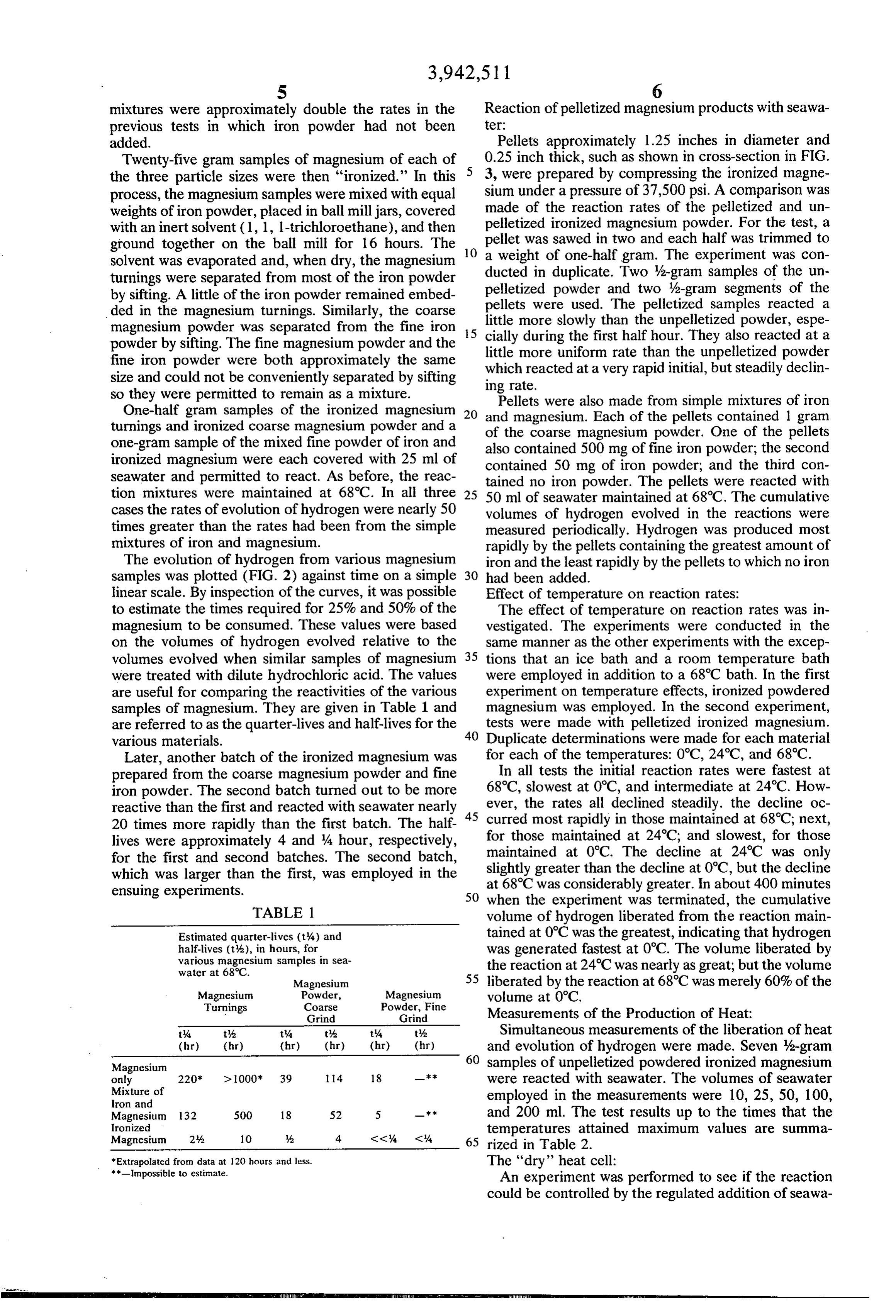
One-half gram samples of the ironized magnesium 20 andPellets were also made from simple mixtures of iron magnesium. Each of the pellets contained 1 gram turnings and ironized coarse magnesium powder and a of the coarse magnesium powder. One of the pellets one-gram sample of the mixed fine powder of iron and also contained 500 mg of fine iron powder, the second ironized magnesium were each covered with 25 ml of contained 50 mg of iron powder; and the third con seawater and permitted to react. As before, the reac tained no iron powder. The pellets were reacted with tion mixtures were maintained at 68°C. In all three 25 50 ml of seawater maintained at 68°C. The cumulative cases the rates of evolution of hydrogen were nearly 50 volumes of hydrogen evolved in the reactions were times greater than the rates had been from the simple measured periodically. Hydrogen was produced most mixtures of iron and magnesium. rapidly by the pellets containing the greatest amount of The evolution of hydrogen from various magnesium iron and the least rapidly by the pellets to which no iron samples was plotted (FIG. 2) against time on a simple 30 had been added.
linear scale. By inspection of the curves, it was possible Effect of temperature on reaction rates: to estimate the times required for 25% and 50% of the The effect of temperature on reaction rates was in magnesium to be consumed. These values were based vestigated. The experiments were conducted in the on the volumes of hydrogen evolved relative to the same manner as the other experiments with the excep volumes evolved when similar samples of magnesium 35 tions that an ice bath and a room temperature bath were treated with dilute hydrochloric acid. The values were employed in addition to a 68°C bath. In the first are useful for comparing the reactivities of the various experiment on temperature effects, ironized powdered samples of magnesium. They are given in Table 1 and magnesium was employed. In the second experiment, are referred to as the quarter-lives and half-lives for the tests were made with pelletized ironized magnesium. various materials. 40 Duplicate determinations were made for each material Later, another batch of the ironized magnesium was for each of the temperatures: 0°C, 24°C, and 68°C. prepared from the coarse magnesium powder and fine In all tests the initial reaction rates were fastest at iron powder. The second batch turned out to be more 68°C, slowest at O'C, and intermediate at 24°C. How reactive than the first and reacted with seawater nearly 45 ever, the rates all declined steadily. the decline oc 20 times more rapidly than the first batch. The half curred most rapidly in those maintained at 68°C; next, lives were approximately 4 and 4 hour, respectively, for those maintained at 24°C; and slowest, for those for the first and second batches. The second batch, maintained at 0°C. The decline at 24°C was only which was larger than the first, was employed in the slightly greater than the decline at 0°C, but the decline at 68°C was considerably greater. In about 400 minutes ensuing experiments. 50 when the experiment was terminated, the cumulative TABLE 1 volume of hydrogen liberated from the reaction main
Estimated quarter-lives (t'4) and tained at 0°C was the greatest, indicating that hydrogen half-lives (te), in hours, for various magnesium samples in sea was generated fastest at 0°C. The volume liberated by water at 68°C. the reaction at 24°C was nearly as great; but the volume Magnesium 55 liberated by the reaction at 68°C was merely 60% of the
Magnesium Powder, Magnesium volume at O'C.
Turnings Coarse Powder, Fine Measurements of the Production of Heat:
tA t tA t tA t Simultaneous measurements of the liberation of heat (hr) (hr) (hr) (hr) (hr) (hr) and evolution of hydrogen were made. Seven 2-gram Magnesium 60 samples of unpelletized powdered ironized magnesium only 220- > 000* 39 4. 18 skk were reacted with seawater. The volumes of seawater Mixture of
Iron and employed in the measurements were 10, 25, 50, 100, Magnesium 132 500 18 52 5 k and 200 ml. The test results up to the times that the Ironized
Magnesium 2. 10 4. <<A CA 65 temperatures attained maximum values are summa rized in Table 2.
*Extrapolated from data at 120 hours and less.
**-impossible to estimate.
The “dry” heat cell:
An experiment was performed to see if the reaction could be controlled by the regulated addition of seawa
Page 6
ter to the dry ironized magnesium. One-half gram of ordinarily be corrected for the energy consumed in ironized magnesium powder was placed in a dry test expanding the hydrogen. At atmospheric pressure, this tube which was rested on the bottom of the dewar flask. correction would be approximately 0.6 kilogram calo Fifty ml of seawater was added to the flask. The water ries per mole of magnesium. At ocean depths where the Surrounded the bottom half of the test tube to serve as hydrostatic pressure is 10 atmospheres, the correction a heat sink but none was permitted to enter it. The test would be a mere 0.06 kilogram calories per mole. Dis tube was so positioned in the dewar that the tip of the regarding these corrections, the calculated values for dropping burette was over the top of the test tube. Via the heat liberated is 3,470 calories per gram or 1,830 the burette, 0.2 ml of seawater was added to the iro watt hours per pound. nized magnesium powder initially and an additional 0.2 O The theoretical volumes of hydrogen liberated in the was added every 10 minutes until a total of 2 ml had reaction of magnesium with seawater is 1.007 ml per been added. In 35 minutes the temperature rose from mg at 250°C (1.000 ml at 23.7°C). This is equivalent to 25°C to 33°C and it was maintained at 33 - 35°C for 16.1 cubic feet of hydrogen per pound of magnesium at the ensuing 2% hours. 25°C. When the volume of hydrogen is measured at 15 23.7°C, there are 3.47 calories liberated for each ml of
TABLE 2
hydrogen evolved.
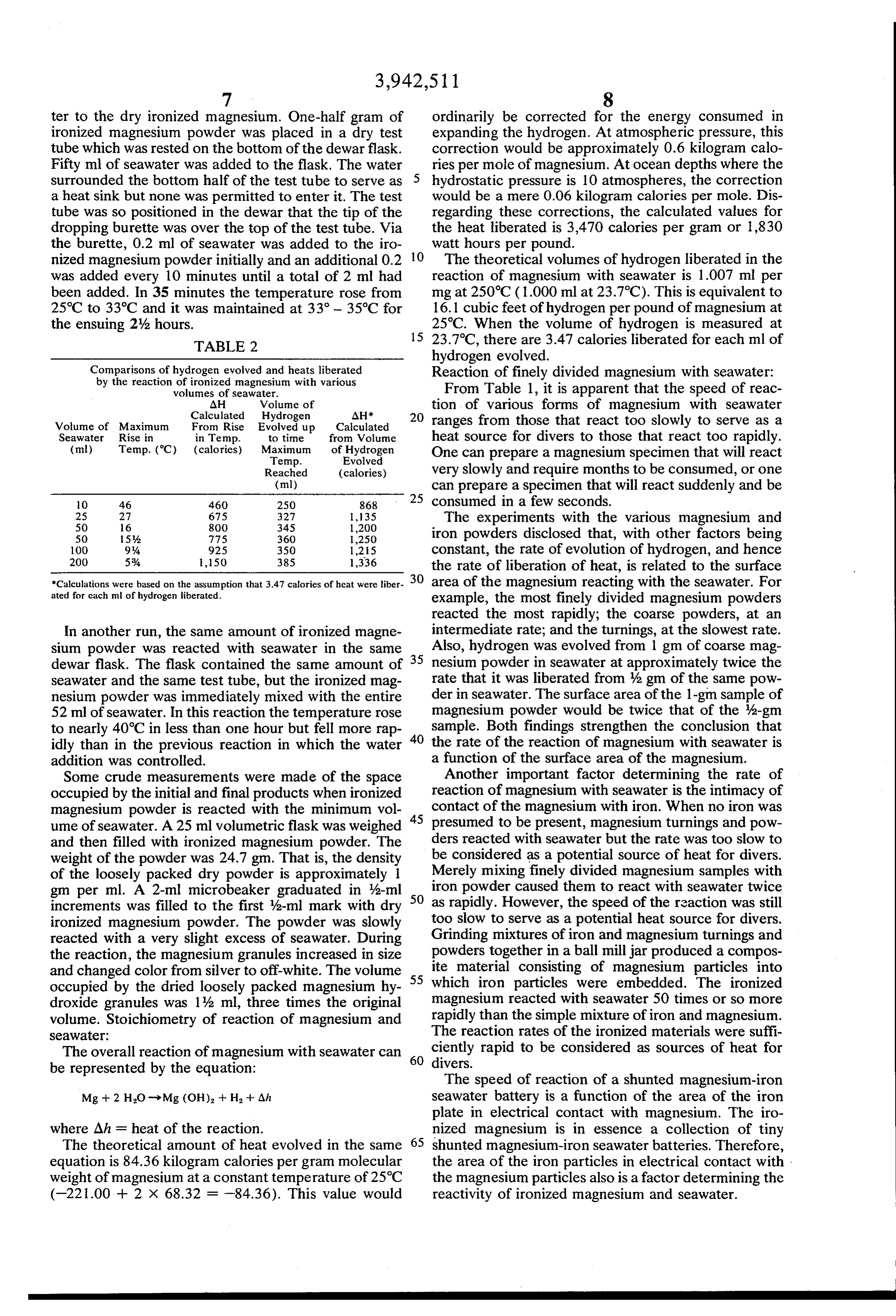
Comparisons of hydrogen evolved and heats liberated Reaction of finely divided magnesium with seawater: by the reaction of ironized magnesium with various From Table 1, it is apparent that the speed of reac volumes of seawater.
AH Volume of
Calculated Hydrogen AH tion of various forms of magnesium with seawater 20 ranges from those that react too slowly to serve as a
Volume of Maximum From Rise Evolved up Calculated
Seawater Rise in
in Temp. to time
Temp. (C) (calories) Maximum of Hydrogen from Volume heat source for divers to those that react too rapidly.
Temp. Evolved One can prepare a magnesium specimen that will react
Reached (calories) very slowly and require months to be consumed, or one (ml) can prepare a specimen that will react suddenly and be
O 46 460 250 868 25 consumed in a few seconds.
The experiments with the various magnesium and 50 Sa 775 360 1,250 iron powders disclosed that, with other factors being
constant, the rate of evolution of hydrogen, and hence the rate of liberation of heat, is related to the surface *Calculations were based on the assumption that 3.47 catories of heat were liber 30 area of the magnesium reacting with the seawater. For ated for cachm of hydrogen liberated. example, the most finely divided magnesium powders reacted the most rapidly; the coarse powders, at an
In another run, the same amount of ironized magne intermediate rate; and the turnings, at the slowest rate. sium powder was reacted with seawater in the same Also, hydrogen was evolved from 1 gm of coarse mag dewar flask. The flask contained the same amount of nesium powder in seawater at approximately twice the seawater and the same test tube, but the ironized mag rate that it was liberated from 4 gm of the same pow nesium powder was immediately mixed with the entire der in seawater. The surface area of the 1-gm sample of 52 ml of seawater. In this reaction the temperature rose magnesium powder would be twice that of the 2-gm to nearly 40°C in less than one hour but fell more rap 40 sample. Both findings strengthen the conclusion that idly than in the previous reaction in which the water the rate of the reaction of magnesium with seawater is addition was controlled. a function of the surface area of the magnesium. Some crude measurements were made of the space Another important factor determining the rate of occupied by the initial and final products when ironized reaction of magnesium with seawater is the intimacy of magnesium powder is reacted with the minimum vol 45 contact of the magnesium with iron. When no iron was ume of seawater. A 25 ml volumetric flask was weighed presumed to be present, magnesium turnings and pow ders reacted with seawater but the rate was too slow to and then filled with ironized magnesium powder. The weight of the powder was 24.7gm. That is, the density be considered as a potential source of heat for divers. of the loosely packed dry powder is approximately 1 Merely mixing finely divided magnesium samples with gm per ml. A 2-ml microbeaker graduated in 2-ml 50 iron powder caused them to react with seawater twice increments was filled to the first /2-ml mark with dry as rapidly. However, the speed of the reaction was still ironized magnesium powder. The powder was slowly too slow to serve as a potential heat source for divers. reacted with a very slight excess of seawater. During Grinding mixtures of iron and magnesium turnings and the reaction, the magnesium granules increased in size powders together in a ball mill jar produced a compos and changed color from silver to off-white. The volume 55 ite material consisting of magnesium particles into occupied by the dried loosely packed magnesium hy which iron particles were embedded. The ironized droxide granules was 1% ml, three times the original magnesium reacted with seawater 50 times or so more volume. Stoichiometry of reaction of magnesium and The rapidly than the simple mixture of iron and magnesium. SeaWater reaction rates of the ironized materials were suffi The overall reaction of magnesium with seawater can 60 ciently divers.
rapid to be considered as sources of heat for be represented by the equation:
The speed of reaction of a shunted magnesium-iron seawater battery is a function of the area of the iron plate in electrical contact with magnesium. The iro where Ah = heat of the reaction. nized magnesium is in essence a collection of tiny The theoretical amount of heat evolved in the same 65 shunted magnesium-iron seawater batteries. Therefore, equation is 84.36 kilogram calories per gram molecular the area of the iron particles in electrical contact with weight of magnesium at a constant temperature of 25°C the magnesium particles also is a factor determining the (-221.00 + 2 x 68.32 = -84.36). This value would reactivity of ironized magnesium and seawater.
Page 7
Reaction of pelletized magnesium powder with seawa added for activation. Heat will be liberated whenever te: seawater is injected into the charge of ironized magne There was no striking difference in the reactivities of sium powder. If NaCl is mixed with the dry ironized pelletized and unpelletized ironized magnesium pow 5 magnesium powder, only water need be added. der. The pellets reacted at a little slower rate than the In another experiment, water addition did control the unpelletized material during the first half hour of the rate of the reaction somewhat for the first half hour. experiment, but they reacted more rapidly in the ensu After that, however, sufficient water was present to ing time intervals. decompose all of the magnesium. Temperature curves The reactivity of pellets made from simple mixtures 10 indicated that less heat was produced per given weight of iron and magnesium was a function of the amount of of ironized magnesium when the seawater was admitted iron they contained. Hydrogen was evolved most rap slowly, as in the dry heat cell, than when an abundance idly from the pellets to which the greatest amount of of seawater was added immediately. iron powder had been added, and the least rapidly by The dry heat cell has numerous desirable features. It the pellets to which no iron powder had been added. 15 is simple to operate and regulate. The diver can admit Intimate galvanic contact between the iron and magne water to the cell whenever he feels cold and the re sium was apparently achieved by the compressing pro sponse will be quite rapid. It is not necessary to use up cess. It was not necessary to first ironize the magnesium all of the ironized magnesium in a single dive. The cell in a ball mill jar. will soon cease to react if water is cut off. The size of Pelletizing magnesium and iron powders apparently 20 the cell can easily be scaled up or down. Tiny cylinders affected their reactivity with seawater in two ways. can be made to fit into the finger holes of gloves; me Compressing the mixture of iron and magnesium pow dium sized cylinders would be made for short dives; or ders brought iron and magnesium particles into more large cylinders could be made for extended dives. Inter intimate contact, thereby causing the product to react changeable cylinders charged with ironized magnesium more readily than the initial mixture. Compressing the 25 could be made to fit into a water jacket which sur ironized magnesium powder did not significantly alter rounds the cylinders. Only one pump is required to the proximity of the magnesium and iron particles to conduct the heat exchanger fluid to the diver. each other. They were already in intimate contact. The In the “dry cell' experiment, approximately 350 ml compression process did, however, at least partially of hydrogen were evolved from 500 mg of ironized fuse the magnesium and iron particles into a solid pel 30 magnesium. Calculations based on 350 ml of hydrogen let. Seawater had access only to the outside of the indicate that approximately 2,500 calories will be liber ated per gram of ironized magnesium. A charge of 344 pellet when it was immersed. After the pellet reacted a grams of ironized magnesium are required for a one little, however, it crumbled and reacted at a slightly more rapid rate than the unpelletized material. kilowatt-hour (kwh) cell. Initially this would occupy A material more thoroughly fused than the pellets, about one-third of a liter of space. After reacting with which were compressed at 37,500 psi, should react at a 35 approximately 500 ml of seawater, the magnesium more uniform rate throughout its existence in seawater. would swell to completely occupy a one-liter container. Reaction rates thus can be controlled by the area of the A14-kwh cylinder the size of a standard scuba tank will hold a surface of the pellets. The area will change slowly if the kilogramscell, and can be initially charged with nearly 5 of ironized magnesium powder. It requires a pellets do not crumble and the reaction will proceed at a nearly uniform rate. More thorough fusion can be minimum of 7 liters of seawater for complete reaction. During the reaction, 3,700 liters of hydrogen will be achieved by higher pressures and temperatures than evolved.
have been used. Addition of other materials that are soft, malleable, and highly conductive can also be con been From the above experimental investigation, it has sidered as a means for achieving fusion. determined that:
45 Magnesium alone reacts spontaneously with seawater
Measurements of the production of heat:
The calculated heat of reaction for the complete but the rate is far too slow to use as a heat source for reaction of one-half gram of magnesium with seawater divers.Hydrogen is evolved and heat is produced at a rate is 1,735 calories at 25°C. However, as seen in Table 2, the calculated heat corresponding to the volume of 0 which is approximately proportional to the surface area hydrogen evolved up to the time that the maximum depends upon reacting of magnesium with seawater. The surface area the weight of magnesium and the parti temperature was reached was in the vicinity of 1,250 cle size.
calories. The measured calories approached the calcu Merely mixing iron powder with finely divided mag lated as the volume of water was increased. This was to nesium causes magnesium to react with seawater twice be expected because temperature rise and the heat loss 55 as rapidly become smaller as the volume of water is made larger. as before mixing.
Grinding iron and magnesium powders or turnings
The rises in temperature were of a range of magni together tudes expected for the theoretical amount of heat liber reacts with in a ball mill jar produces a material which ated. The rises were in a range consistent with the than pure magnesium seawater nearly 100 times more rapidly classical thermodynamic statement for the reaction of powders. magnesium and water represented by the equation: Compressing iron and magnesium powders together under a pressure of 37,500 psi produces pellets which
Mg+ 2 HO-Mg(OH) + H+ Ah react with seawater many times more rapidly than pure magnesium powder. The reaction rates are a function where Ah = 3.57 calories per mg of magnesium or 65 of the amount of iron powder the pellets contain. 1,830 watt-hours per pound of magnesium Ironized magnesium powder initially reacts very rap The “dry” magnesium heat cell: idly with seawater and slows down rather abruptly as A heat cell can be made with the dry ironized magne the reaction proceeds. Pelletized ironized magnesium sium powder to which a limited amount of seawater is reacts with a somewhat more uniform rate and does not
Page 8
undergo an initial spurt in activity. Obviously many modifications and variations of the The initial rate of reaction of magnesium and seawa present invention are possible in light of the above ter is a function of temperature. The higher the temper teachings. It is therefore to be understood that within ature is, the more rapid the initial reaction. the scope of the appended claims the invention may be Once the initial high velocity reactions have sub practiced otherwise than as specifically described. sided, less hydrogen and presumably less heat is We claim:
evolved by the reaction of magnesium and seawater at 1. An electrochemical source for the rapid genera 68°C than at OC or at 24°C. tion of heat and hydrogen gas upon activation by elec The experimental measurements of the liberation of trolyte, comprising:
heat by the reaction of magnesium and seawater are in 10 a. an intimate mixture of powdered magnesium and a range to be consistent with a theoretical heat of reac iron metal particles in contact with each other such tion of 84.36 kilogram calories per mole of magnesium. that the normal electrical contact resistance be The reaction of ironized magnesium and seawater tween said magnesium and iron powdered metal can be regulated by the controlled addition of seawa 5 particles is substantially reduced; ter. b. said iron metal particles being embedded in the The space required for a 1-kwh heat cell charged surface of at least a substantial portion of said mag with dry ironized magnesium is 1 liter. nesium metal particles to form ironized magnesium Finely divided iron and magnesium can be made into particles;
a composite material sufficiently reactive with seawater 20 c. each ironized magnesium metal particle forming a to serve as a heat source. One manner in which the shorted micro electrochemical cell; reaction can be controlled is to control the addition of d. said intimate powdered metal mixture which in seawater, adding water only when more heat is desired. cludes micro electrochemical cells being sand Another use for the powdered metal heat source of wiched between sheets of plastic material; this invention is in the making of a material, such as 25 e. moisture retaining absorbent means being included shown in FIGS. 4 and 5, which have a large variety of with said intimate powdered metal mixture be applications. For example, such heating materials can tween said sheets of plastic; be used for gloves, socks, boot liners, foot pads and f, said intimate mixture of powdered metal particles other garments for warming various parts of the body, operable to produce heat and hydrogen by exother as well as for medical heat pads, warmers for food cans, 30 mic reaction upon addition of suitable electrolyte; and sleeping bag heaters to provide a thermal barrier g. the variation of powder sizes and of the ratio of between the sleeping bag and cold ground, and the like. magnesium to iron metal surface area exposed, As shown in the embodiment of FIG. 4, by way of operating to control the amount of heat and hydro example, ironized magnesium particles 40 are sand gen produced and the operational life of said wiched together with an absorbent material 41 which 35 source in the electrolyte. retains moisture, between two flexible sheets of thin 2. An electrochemical source as in claim 1 wherein plastic material 42 and 43, such as mylar or polysulfon said moisture retaining absorbent means is mixed with ates, for example. Plastic sheet 43 is provided with an said intimate mixture of ironized magnesium particles adhesive layer 45 which holds the ironized magnesium and an adhesive and is sandwiched between said sheets particles 40 in place. Plastic sheet 42 can also be pro 40 of plastic material to form a flexible exothermic fabric, vided with an adhesive layer 46 for adhering to the said sandwiched structure having means for introduc absorbent material 41. Sodium chloride particles 47 ing electrolyte to said micro electrochemical cells. can be mixed with either the absorbent material 41 or 3. A structure as in claim 1 wherein NaCl particles the ironized magnesium particles 40, or both, as de are mixed with said metal particles such that addition sired. Holes 48 are provided in plastic sheet 42 to admit 45 of water will provide electrolyte. water which dissolves the sodium chloride and acti 4. An electrochemical source as in claim 1 wherein vates the micro electrochemical cells 40. Holes may be each of said sheets of plastic have an adhesive coating provided in both sheets of plastic material 42 and 43, if on at least one side thereof and said moisture retaining desired, for faster introduction of water. Where seawa absorbent means is an absorbent material layer; said ter is introduced via holes 48, the sodium chloride 50 intimate mixture of magnesium and iron metal particles particles 47 would not need to be provided in the ab being sandwiched between one said adhesive-coated sorbent material 41 or mixed with the magnesium and sheet of plastic and said layer of moisture retaining iron particles. absorbent material which in turn is attached to an ad The embodiment illustrated in FIG. 5 shows a mix hesive coating on the second sheet of plastic to form a ture of ironized magnesium particles 40, adhesive 51 55 flexible sandwiched heating structure, said plastic and absorbent material 52 all sandwiched between sheets forming the outside of said sandwiched struc plastic sheets 53 and 54. The adhesive particles 51 ture, means provided in at least one of said plastic bond the ironized magnesium particles and absorbent sheets for introducing electrolyte to said mixture when material together and to plastic sheets 53 and 54. Holes desired.
58 are provided for admitting seawater to start the 60 5. An electrochemical structure as in claim 4 wherein exothermic reaction. If desired, sodium chloride parti NaCl particles are interdispersed throughout said layer cles can be mixed with the ironized magnesium parti of moisture retaining absorbent material such that ad cles 40, adhesive 51 and absorbent material 52, thus dition of water thereto will provide electrolyte for the only requiring plain water to be introduced for starting exothermic reaction involving said shorted micro elec the reaction. Powdered iron and powdered magnesium 65 trochemical cells.
can be used instead of ironized magnesium particles in 6. An electrochemical source as in claim 5 wherein either of the embodiments shown in FIGS. 4 and 5 the ratio of magnesium to iron metal particles by where a slower reaction is desired. weight is 1 to 1.
Page 9
7. An electrochemical source as in claim 4 wherein out said powdered metal particle mixture such that NaCl particles are interdispersed throughout said inti addition of water will dissolve said salt to start electro mate mixture of magnesium and iron metal particles. chemical reaction.
8. An electrochemical source as in claim 1 wherein 11. An electrochemical source as in claim 1 wherein said metal particles range in size up to 590 microns insaid intimate mixture of iron and magnesium powdered diameter.
9. An electrochemical source as in claim 1 wherein metal particles are pressed and sintered together into a said intimate mixture of ironized magnesium metal rigid form.
particles are compressed and formed into a rigid com 10 12. An electrochemical source as in claim 1 wherein posite material. the ratio of magnesium to iron metal particles by 10. An electrochemical source as in claim 9 wherein weight is 1 to 1.
dry electrolyte salt particles are interdispersed through sie : k k sk
Provenance
- Collection
- Cited prior art
- Original PDF
- patentimages.storage.googleapis.com →
- Filed
- 1974-09-19
- Pages
- 9
- Method
- pdftotext (the PDF's own text layer) + pdftoppm 300dpi page scans
- Source
- Google Patents bibliographic record
- Granted
- 1976-03-09
- Inventors
- Stanley A. Black; James F. Jenkins; US Department of Navy
- Transcribed from
- patentimages.storage.googleapis.com →