patent · US20050016840A1
Method and apparatus for generating hydrogen
27 January 2005
Page 1 — bibliographic record
(19) United States (12) Patent Application Publication (10) Pub. No.: US 2005/0016840 A1
Petill0 (43) Pub. Date: Jan. 27, 2005 (54) METHOD AND APPARATUS FOR Publication Classification
GENERATING HYDROGEN
(51) Int. Cl." ....................................................... C25B 9/00 (76) Inventor: Phillip J. Petillo, Ocean, NJ (US) (52) U.S. Cl. .............................................................. 204/248 Correspondence Address: (57) ABSTRACT
BAKER & BOTTS
30 ROCKEFELLER PLAZA An electro-galvanic hydrogen generator System that has two NEW YORK, NY 10112 or more anode materials, a cathode material; and an elec trolyte. The electrolyte comprises a metal hydride, at least (21) Appl. No.: 10/871,727 one Stabilizing agent, and a Solvent. Hydrogen gas is gen erated whenever an anode material and the cathode material (22) Filed: Jun. 18, 2004 are electrically connected, and the different anode materials can be used Separately or in combination to control the
Related U.S. Application Data quantity and rate of hydrogen generation. An insulating Shield may be used to catch reaction debris from the anodes.
(60) Provisional application No. 60/506,327, filed on Sep. A removable inert layer may cover the electrodes. The use 25, 2003. Provisional application No. 60/495,291, of cell pressure may regulate the rate of hydrogen genera filed on Aug. 16, 2003. Provisional application No. tion. The hydrogen generator may have a separate catalyst 60/486,357, filed on Jul. 11, 2003. Provisional appli chamber, and the hydrogen generator may also function as cation No. 60/479,396, filed on Jun. 18, 2003. a battery.
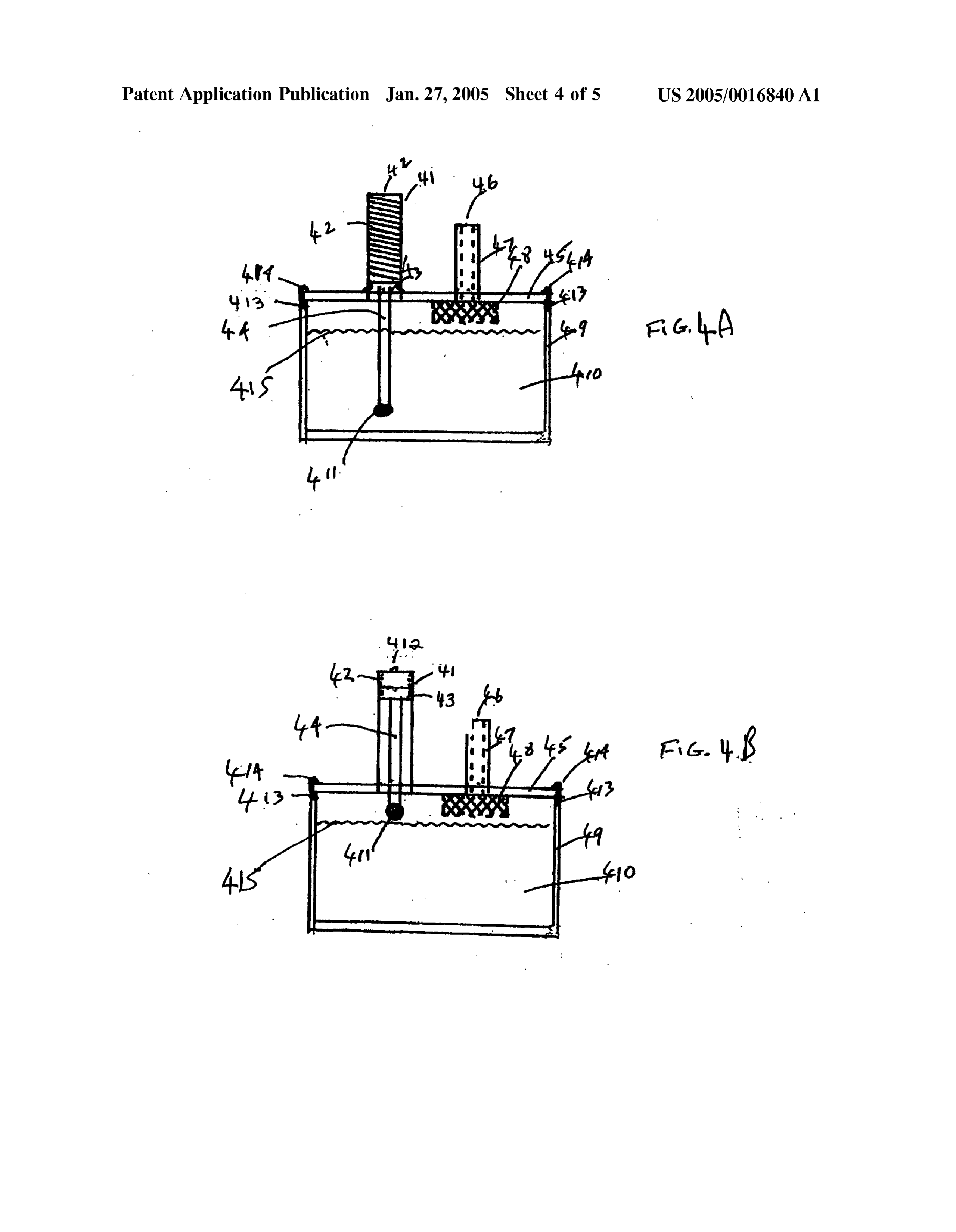
Page 2
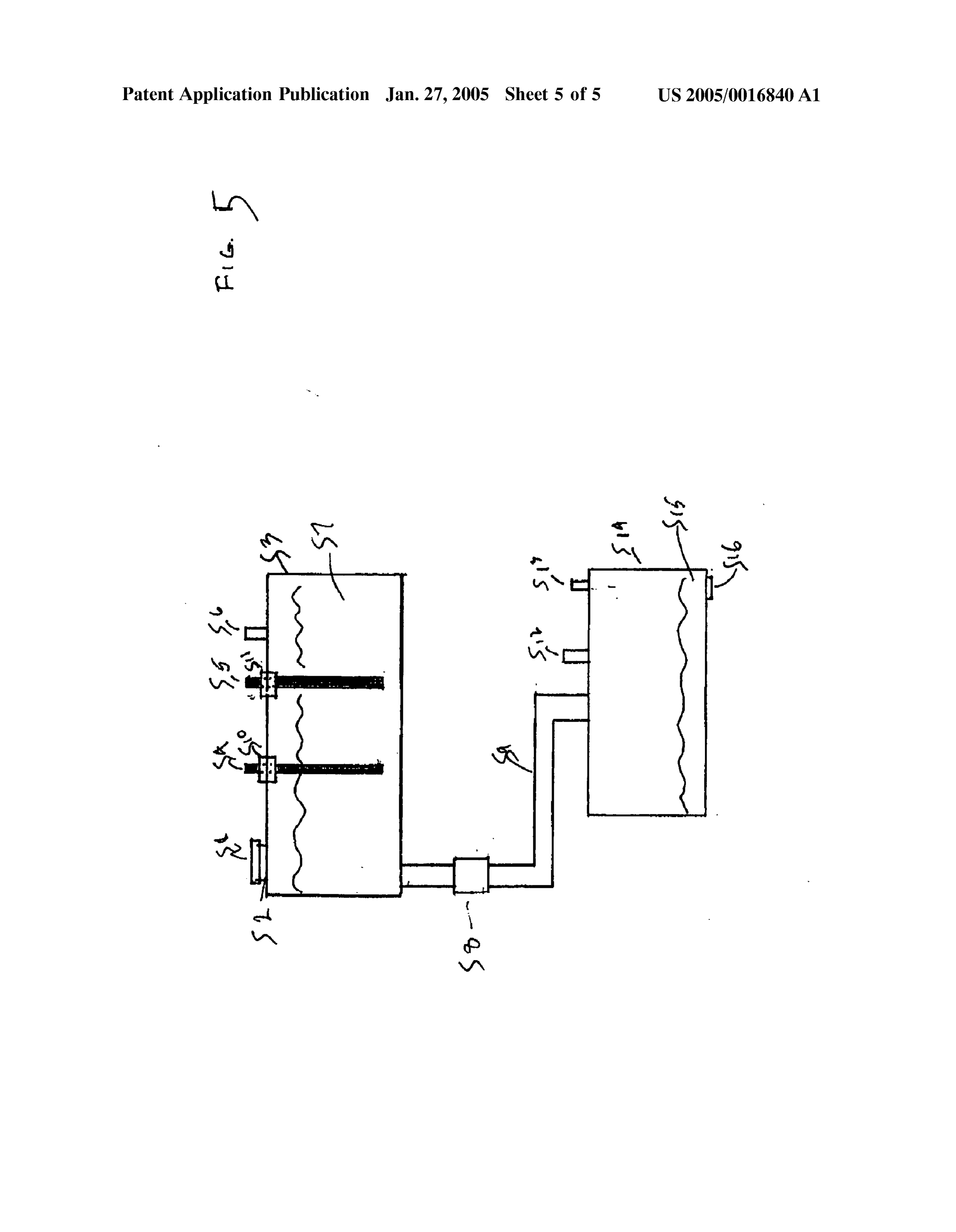
Drawing sheet — no readable text.
Page 3
Drawing sheet — no readable text.
Page 4
Drawing sheet — no readable text.
Page 5
Drawing sheet — no readable text.
Page 6
Drawing sheet — no readable text.
Page 7
US 2005/OO16840 A1 Jan. 27, 2005
METHOD AND APPARATUS FOR GENERATING on the electro-galvanic principle in which hydrogen is HYDROGEN generated by establishing an electrical connection between a cathode material and an anode material that is at least 0001) This application claims the benefit of U.S. Provi partially Submerged in a Stabilized metal borohydride elec sional Applications No. 60/506,327, filed on Sep. 25, 2003, trolyte Solution, wherein the cathode material forms at least No. 60,495,291, filed on Aug. 16, 2003; No. 60,486,357, part of the inner Surface of the electrolyte container. 392 filed on Jul. 11, 2003, and also claims the benefit of No. Application FIGS. 1 and 1A. Further embodiments provided 60/479,396, filed on Jun. 18, 2003, which applications are in the 392 Application include the use of an anode fabri incorporated herein by reference. cated from many types of anode material (392 Application TECHNICAL FIELD OF THE INVENTION FIG. 3); the use of internal and external water Storage and release into the electrolyte to replenish water consumed 0002 The present invention pertains to a method and during hydrogen production (392 Application FIGS. 4-6); apparatus for generating hydrogen. the use of multiple anodes fabricated from the same anode material and an electrolyte Storage and release tank made of
BACKGROUND OF THE INVENTION different materials (392 Application FIG. 7); and the imple mentation of a mechanism for raising or lowering the anodes 0.003 Hydrogen is a “clean fuel” because it can be from or into the electrolyte solution (392 Application FIG. reacted with oxygen in hydrogen-consuming devices, Such 8). The teachings of the 392 Application are incorporated as a fuel cell or combustion engine, to produce energy and herein by reference into the present application. water. Virtually no other reaction byproducts are produced in the exhaust. As a result, the use of hydrogen as a fuel may SUMMARY OF THE INVENTION Solve many environmental problems associated with the use of petroleum based fuels. Cost-effective, safe and efficient 0007 One or more embodiments of the present invention Storage of hydrogen gas is important for many applications overcome one or more of the above-identified problems, or that use hydrogen. In particular, minimizing the Volume and overcome limitations in the art. In particular, one embodi weight of hydrogen Storage Systems is important in mobile ment of the present invention is a hydrogen generator System applications. that comprises: (a) two or more anode materials; (b) a cathode material; and (c) an electrolyte; wherein the elec 0004 Several methods of storing hydrogen currently trolyte comprises a metal hydride, at least one Stabilizing exist but are either inadequate or impractical for consumer agent, and a Solvent; and wherein hydrogen gas is generated applications. For example, hydrogen can be Stored in liquid whenever an anode material and the cathode material are form at very low temperature or hydrogen can be Stored electrically connected, and wherein the different anode under high pressure in cylinders, however, both of Such materials can be used Separately or in combination to control Storage methods are not practical for most consumer appli the quantity and rate of hydrogen generation. cations for a number of well known reasons related, for example, to Safety and economics. Other methods of hydro 0008 Another embodiment of the present invention is a gen Storage include the use of chemical compounds that hydrogen generator with an insulating Shield to catch reac either: (a) chemically react with water or other species to tion debris from the anodes. A further embodiment of the generate hydrogen; or (b) reversibly adsorb and then release present invention is a hydrogen generator with the electrodes hydrogen. However, these methods are also not practical for at least partially covered by an inert layer that can be most consumer applications for a number of well known removed to initiate hydrogen production. Yet another reasons related, for example, to Safety and economics. embodiment is a Self-regulating hydrogen generator in which the electrodes are extracted from the electrolyte 0005 U.S. Pat. No. 6,534,033 issued Mar. 18, 2003, Solution as the cell preSSure increases. A further embodiment discloses a hydrogen generation System that includes a is a Self-regulating, Self-Starting and Self-pressurizing hydro Stabilized metal hydride Solution and a hydrogen generation gen generator utilizing a catalyst chamber. In another catalyst System which includes a Supported hydrogen gen embodiment, utilizing the addition of Salts, acids or Silicates eration catalyst having molecules of a hydrogen generation to the metal hydride electrolyte, the hydrogen generator can catalyst bound to, entrapped within, and/or coated onto a function as a battery to generate electrical current. Substrate. In one disclosed System, mechanical pumps pump a Sodium borohydride Solution through a catalyst chamber BRIEF DESCRIPTION OF THE DRAWINGS containing precious metal catalysts. One disadvantage of
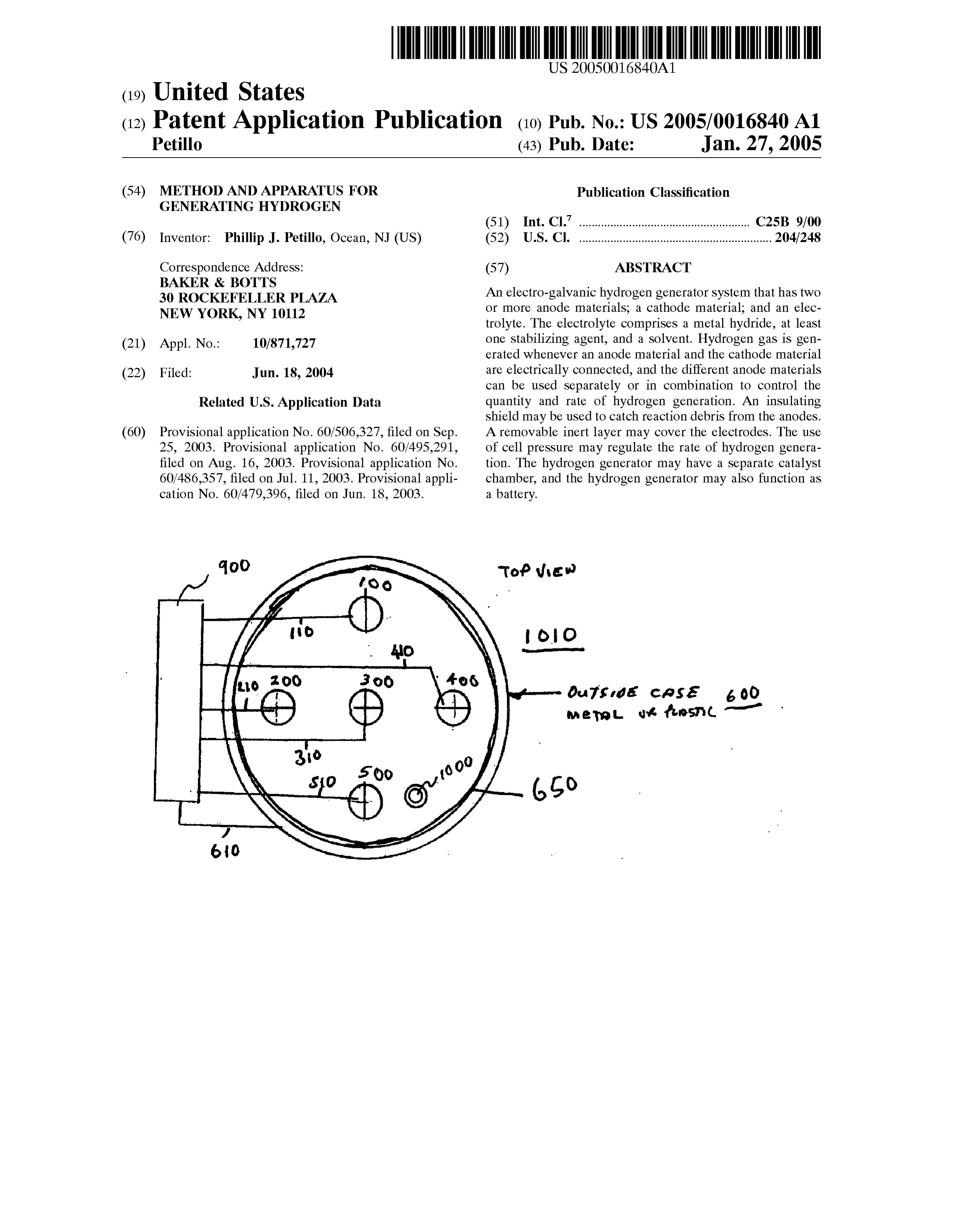
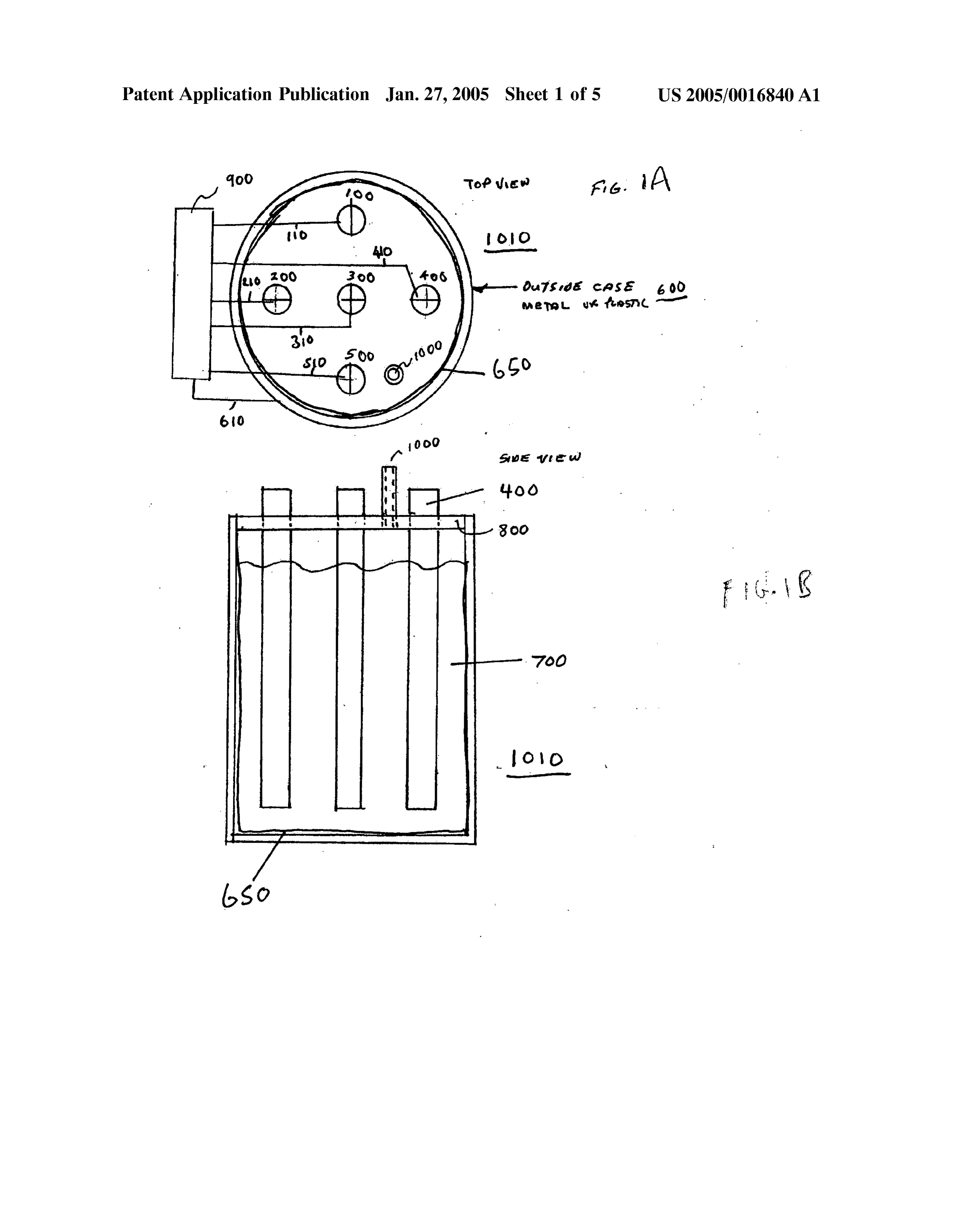
Such a System is that mechanical pumps are not only 0009 FIG. 1A and 1B show a hydrogen generator with unreliable and heavy, but tend to leak and/or clog in the multiple anode materials.
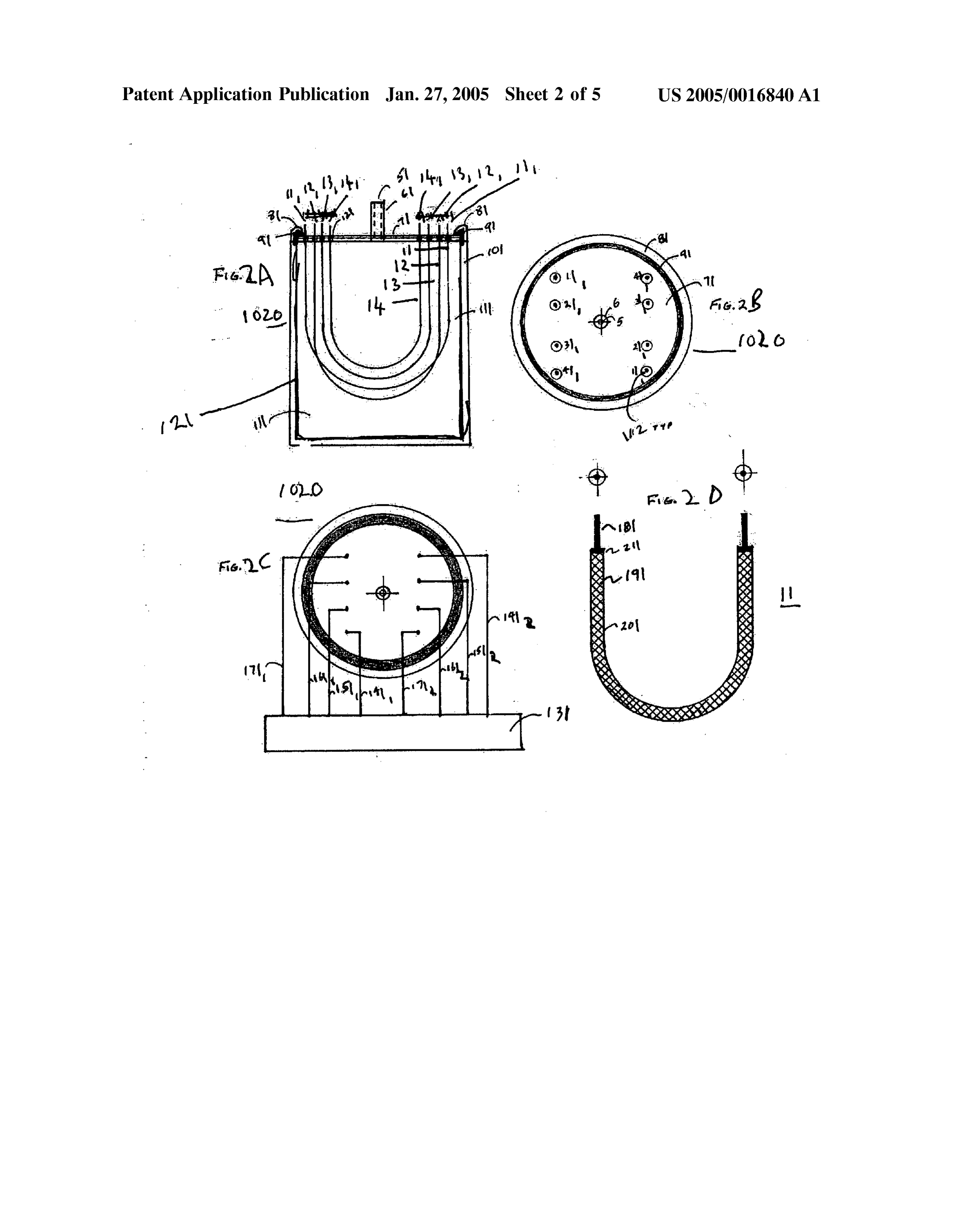
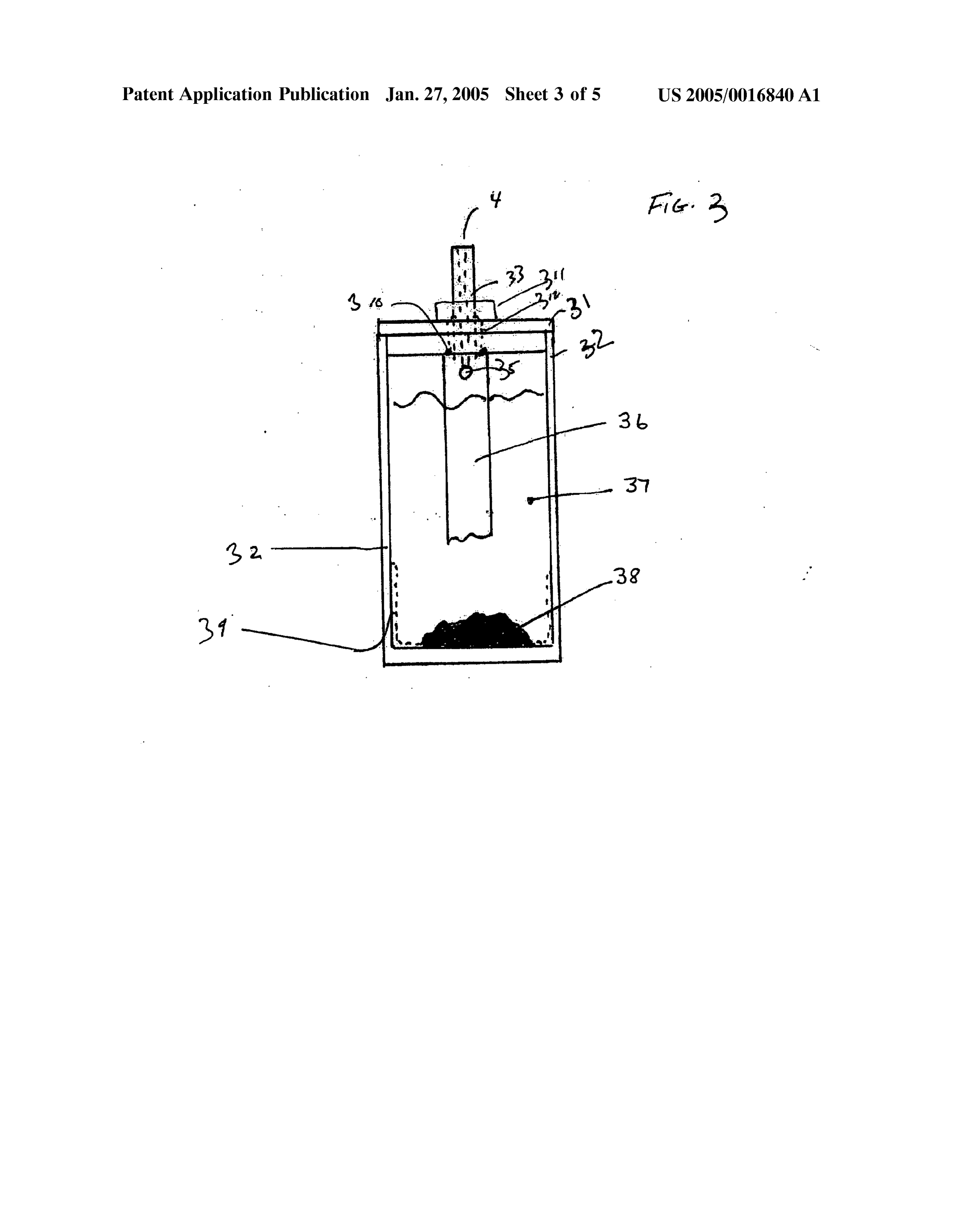
presence of the highly caustic Solutions used. This reduces the reliability of the device. In addition, precious metal 0010 FIGS. 2A, 2B, 2C and 2D show a hydrogen catalysts tend to wash out of the catalyst chamber due to the generator with multiple anode materials. abrasive nature of the Solution. This loSS of precious metal 0011 FIG. 3 shows a hydrogen generator with an insu catalyst is not only expensive but also results in Seriously lating shield to trap anode reaction debris. reduced catalytic activity and reduced hydrogen output. In further addition, the catalyst chamber must be periodically 0012 FIGS. 4A and 4B show a hydrogen generator that replaced. is Self-regulated using hydrogen pressure. 0006 U.S. Patent Application No. 2004/0009392 A1, 0013 FIG. 5 shows a self-regulating, self-starting and published on Jan. 15, 2004, (the “392 Application”), dis Self-pressurizing hydrogen generator using a catalyst cham closes a compact and efficient hydrogen generator operating ber.
Page 8
US 2005/OO16840 A1 Jan. 27, 2005
DETAILED DESCRIPTION OF THE 0.019 and for Zn:
INVENTION
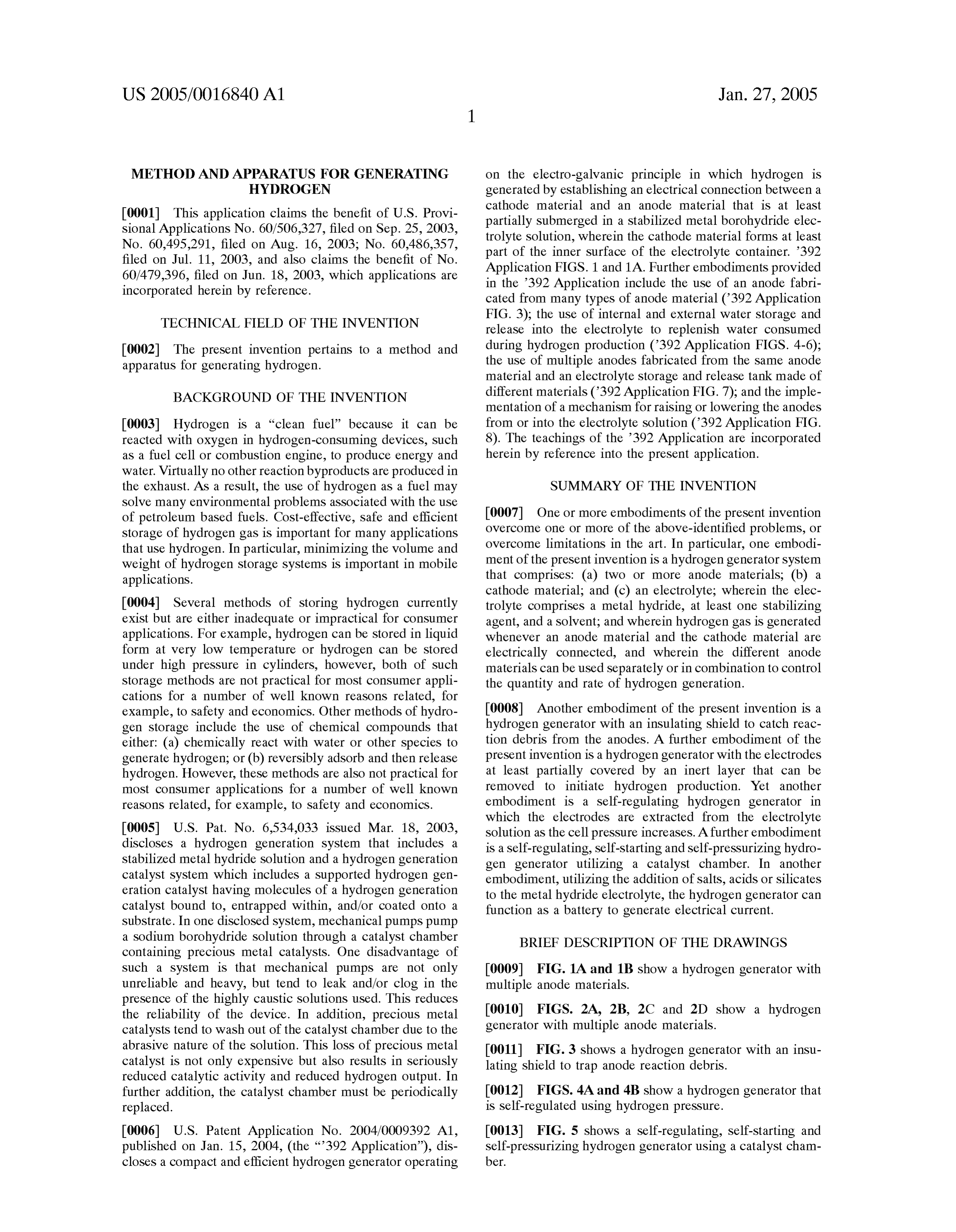
0.014. It is believed that an oxidation-reduction potential 0020. It is believed that the external electrical connection generated between an anode material and a cathode material between an anode material and the cathode material facili facilitates: (a) an electro-galvanic hydrogen generation tates these exothermic reactions, which exothermic reactions mechanism that causes hydrogen gas to be generated from are otherwise inhibited by an oxide coating on the metal. In an electrolyte that includes water; and (b) a chemical hydro addition, it is believed that the cathode material produces gen generation mechanism that causes hydrogen gas to be reduced species in the water (OH), which reduced species generated from a chemical reaction among constituents of migrate back to the anode material and react with the anode the electrolyte, both of which hydrogen generation mecha material to complete the reaction as Stated above. Thus, nisms are regulated by the rate at which current is drawn by hydrogen generation can be turned on or off by making or electrically connecting the anode material and the cathode breaking the electrical connection between the anode mate material. rial and the cathode material.
0.015. In accordance with one or more embodiments of 0021. It is believed that a corresponding reaction at a the present invention, while any material with a Voltage in cathode of the hydrogen generator formed of an inert the electrochemical Series less than Zero volts may be used cathode material is:
as an anode material, the more negative the Voltage, the faster hydrogen will be produced. 392 Application at para graph O24). Materials with an electronegativity more nega 0022 AS can be readily appreciated, there is no need for tive than -0.75 Volts, with low molecular weight and high the cathode to participate chemically. However, embodi density, are preferred materials including group 2 and 3 ments of the present invention exist wherein the cathode elements, i.e., the lanthanide metals and actinide metals, material is consumable. As originally set forth in the 392 magnesium, aluminum, Zinc, beryllium, titanium, Vanadium, Application, for example and without limitation, a consum chromium, Silicon, iron, nickel, and Zirconium. 392 Appli able cathode material may be MnO. For such a cathode cation at paragraph 024. material, a reaction at the cathode of the hydrogen generator would be:
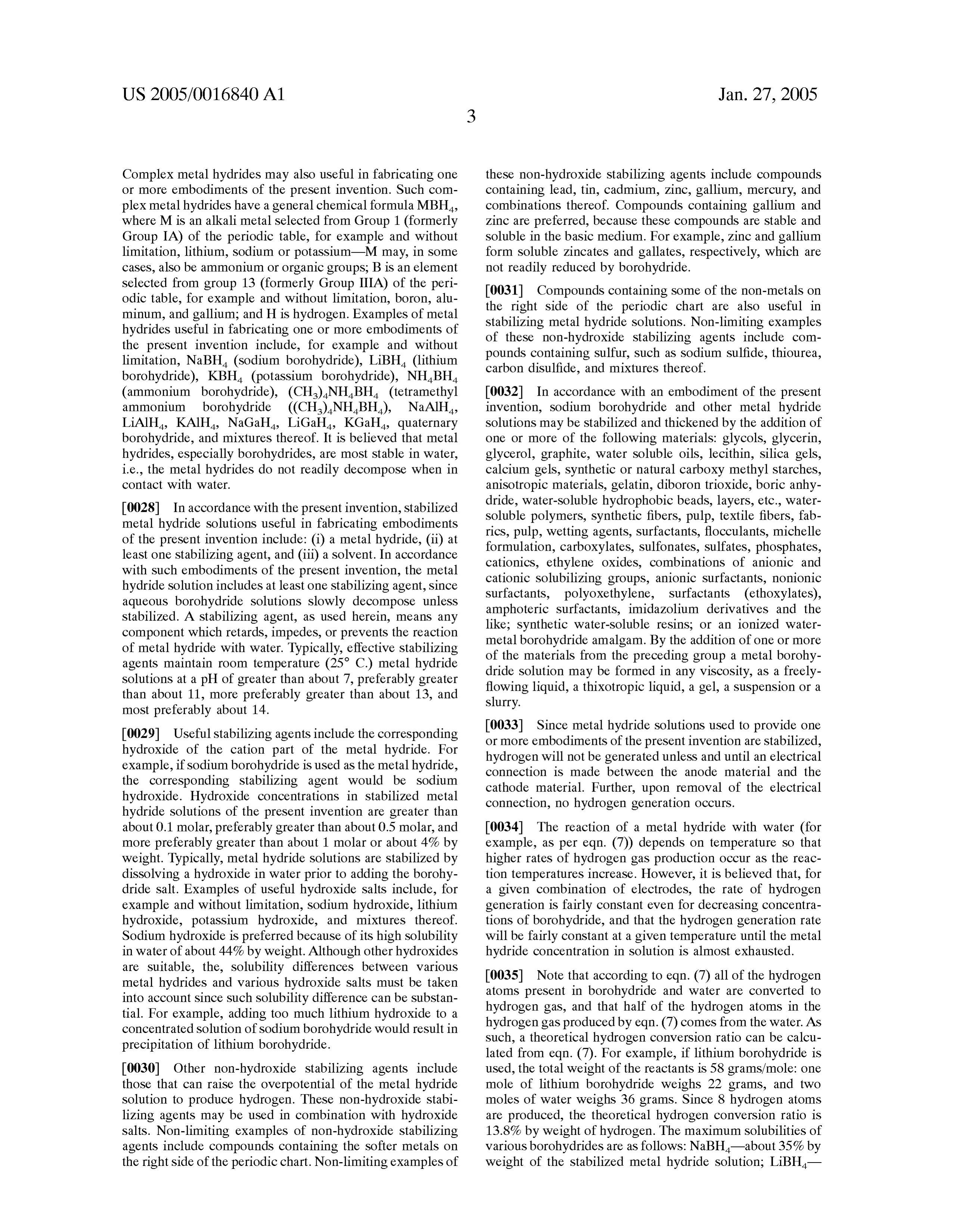
0016 Further embodiments of the present invention include, without limitation, the use of the following com pounds, alloys or amalgams to fabricate at least one of the 0023. As described above, the OH species will be electrodes: titanium tetrachloride (TiCl), Zirconium tetra attracted to the anode to maintain the charge balance from chloride (ZrOl), aluminum boron, Silicon iron, Sodium the loSS of electrons, and the corresponding reaction at the hydroxide, Sodium compounds and amalgams, gallium mer anode of the hydrogen generator, for example and without cury amalgams, copper amalgams, or Zirconium alloys, limitation, would be:
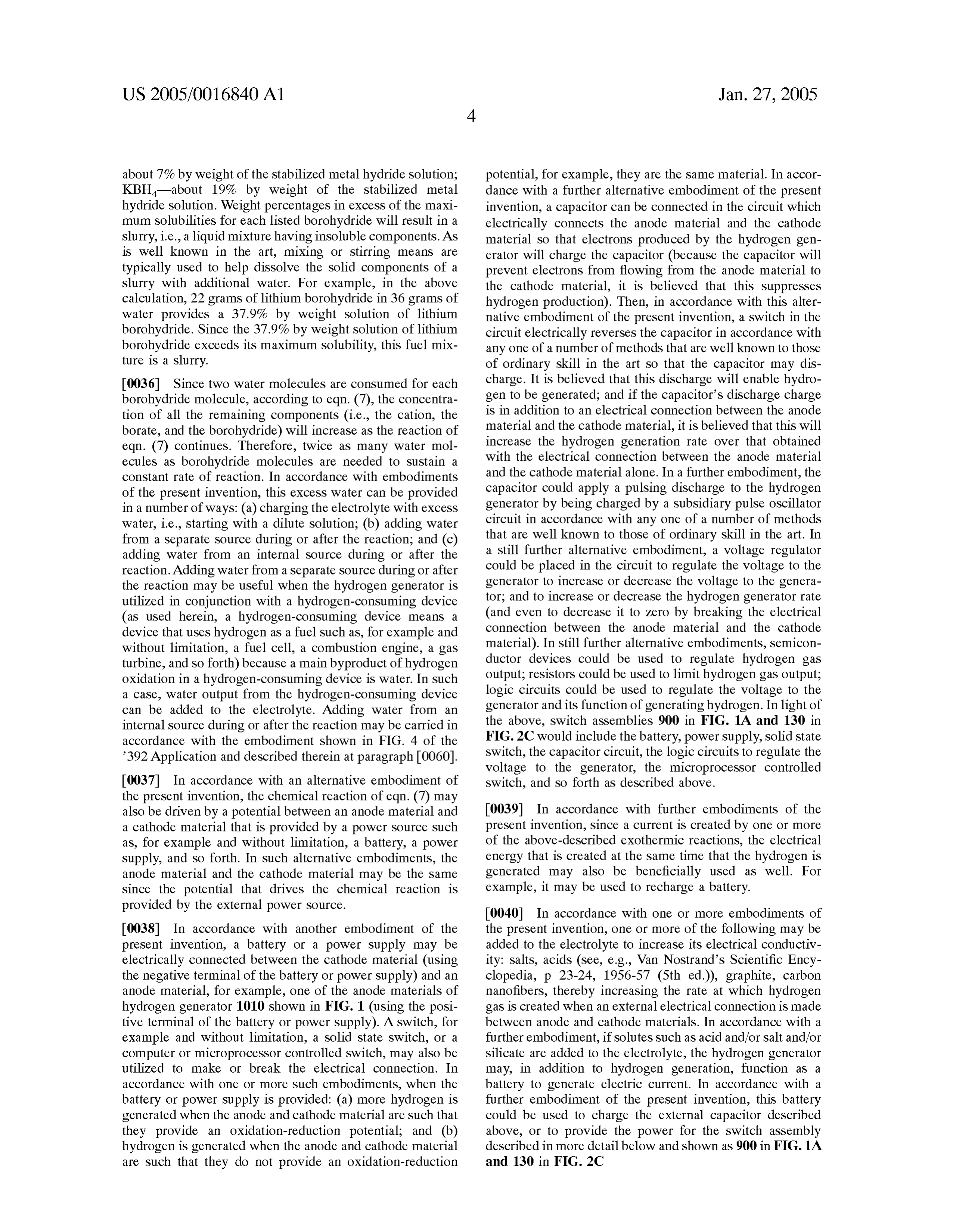
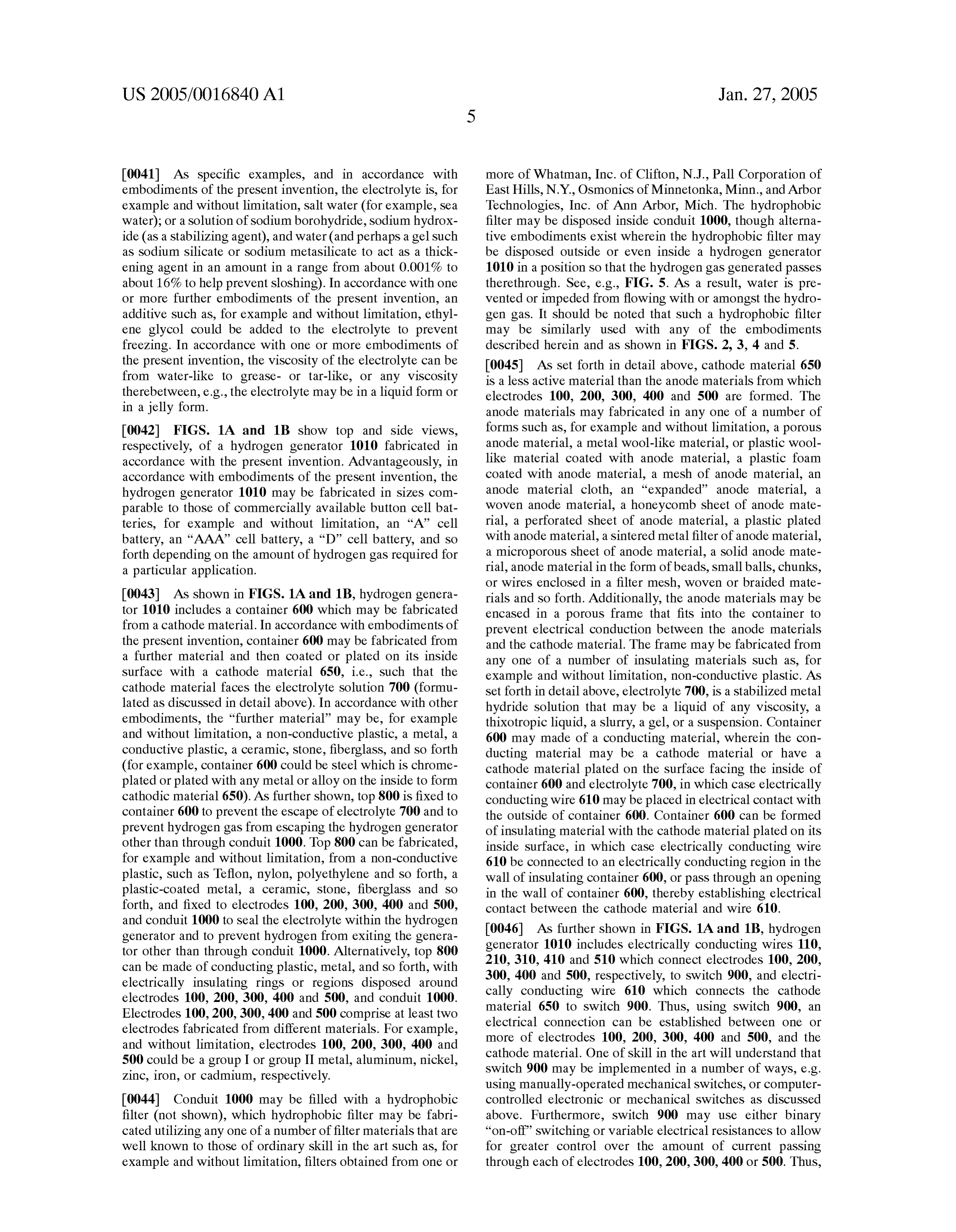
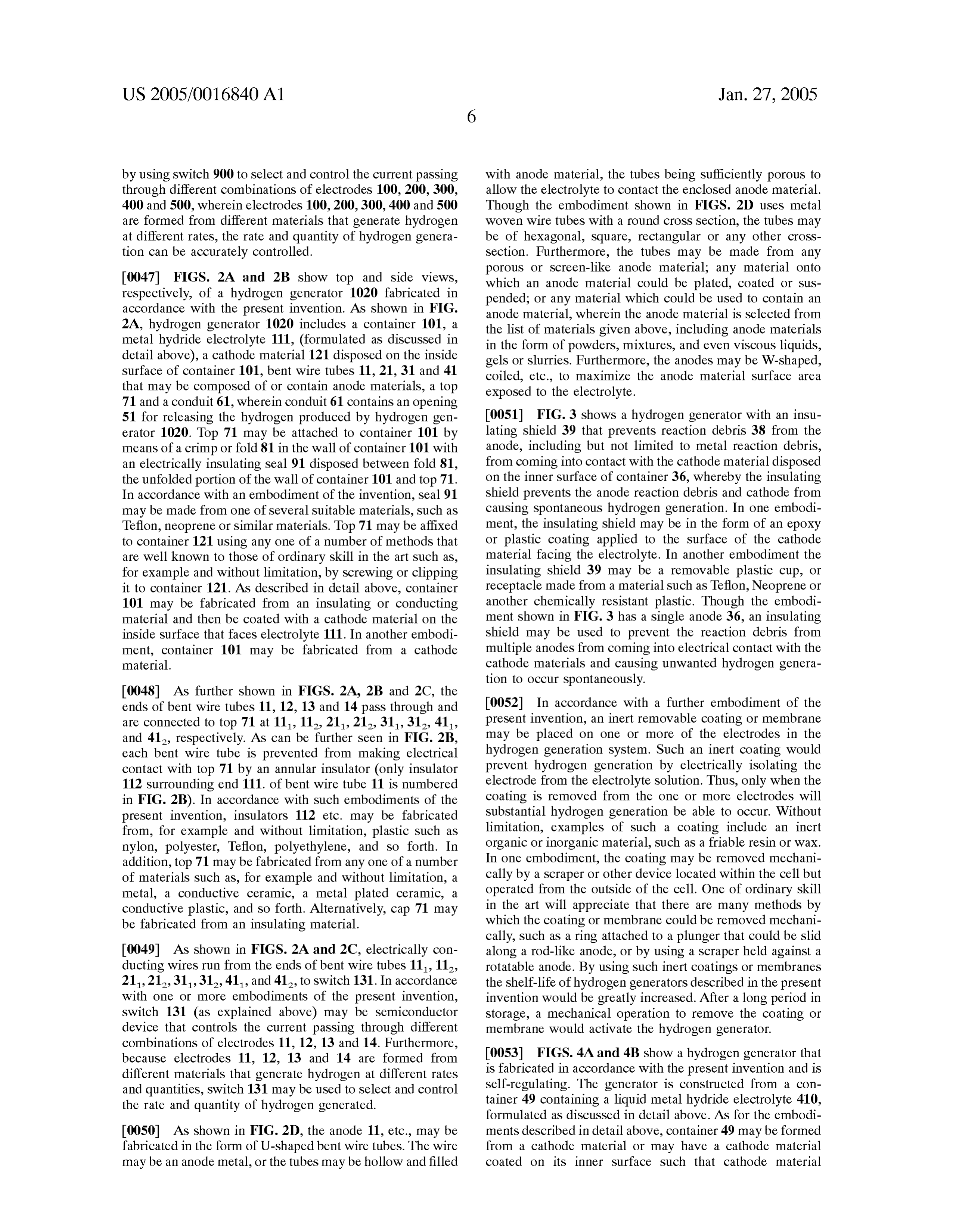
amalgams or compounds. The term amalgam is used to refer to an intimate plastic mixture of a metal or metals with another metal or compound. In addition, one or more of the 0024. It should be noted that the presence of a consum electrodes may be fabricated from the following materials: able cathode material may take up space that might be used graphite particles, graphite mixed with metal particles, car for anodic material, thereby reducing the amount of hydro bon granules, carbon granules mixed with metal particles, gen that can be produced from a given Space. carbon nanoparticles or nanofibers, carbon nanoparticles or fibers mixed with metal particles, Silver-impregnated graph 0025. In accordance with an embodiment of the present ite, nickel beryllium alloys, nickel alloys, copper alloys, invention, the electrolyte includes a reducing compound (as Silver alloys, or nickel-cobalt-iron alloys. Furthermore, one in the case of a solution of a borohydride). It is believed that or more of the electrodes may be fabricated from the the oxidation-reduction potential generated between the following items: carbon rods, commercially available motor anode material and the cathode material facilitates the brushes with or without metals in them; graphite or carbon release of hydrogen from the borohydride as well. In par Screens, wires or tubes (as set forth in more detail below); ticular, it is believed that a chemical reaction occurs wherein graphite or carbon twisted wrapped, twisted or braided with the borohydride is oxidized by water to generate hydrogen. metal wires, commercially available wire. brushes, plastic Such a chemical reaction wherein hydrogen gas (H) and brushes, electro-plated, Sputter-coated or otherwise covered borate (BO) are generated by reacting borohydride with with a conductive material; and metal, ceramic or plastic water is represented as follows: Wools. Furthermore, electrodes may be bent, machined, twisted or formed into a variety of different shapes, as described in more detail below. 0026. The resulting borate is non-toxic and environmen tally Safe. In addition, borate can be regenerated into boro 0.017. In accordance with one or more embodiments of hydride.
the present invention, the active material acts as an anode material. In the case of a metal, the reaction at an anode of 0027 Hydride solutions useful in fabricating embodi the hydrogen generator is: ments of the present invention include a metal hydride. The term “Solution,” as used herein, includes a liquid in which all
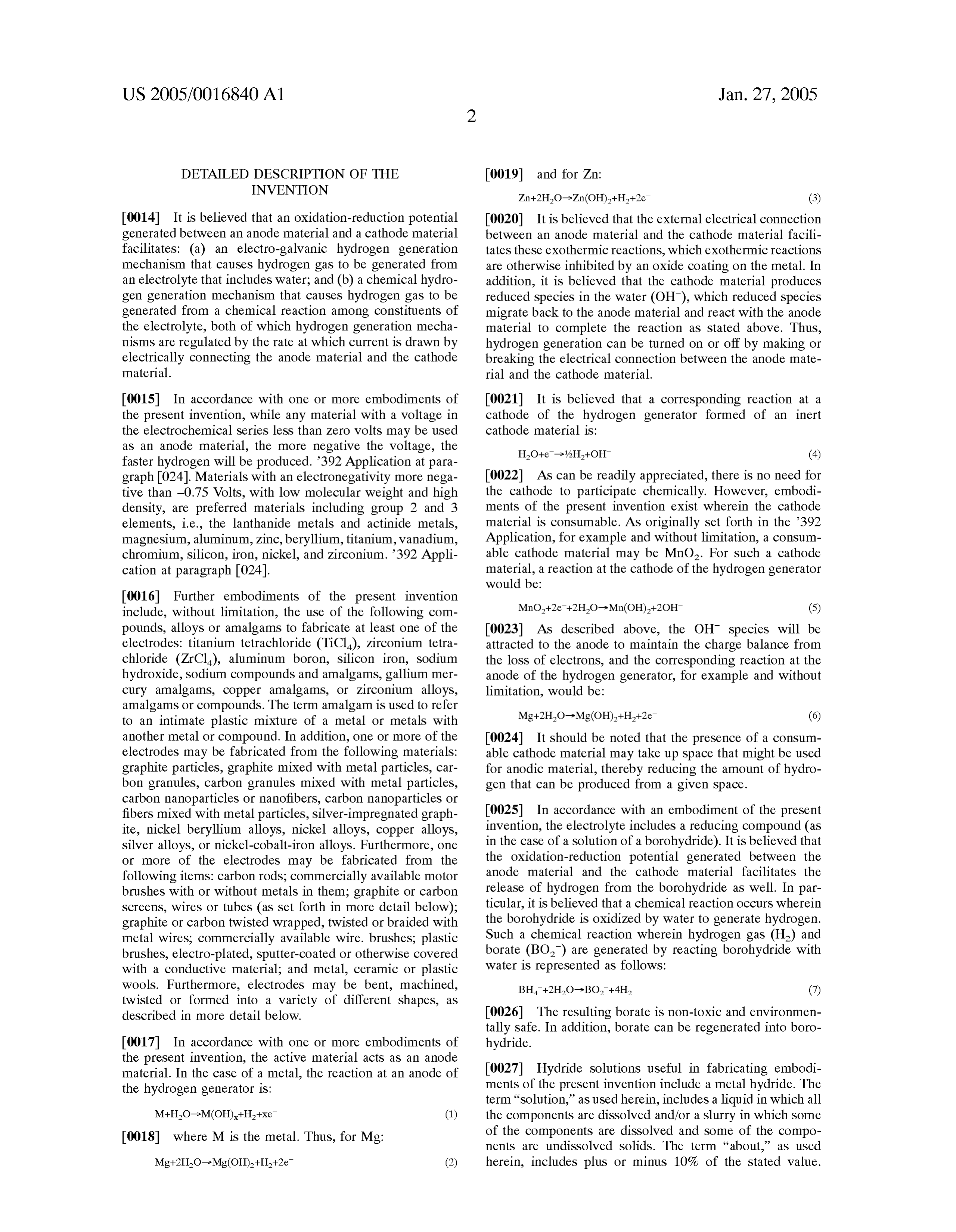
M+H.O->M(OH)+H+xe (1) the components are dissolved and/or a slurry in which Some 0018 where M is the metal. Thus, for Mg: of the components are dissolved and Some of the compo nents are undissolved solids. The term “about,” as used herein, includes plus or minus 10% of the stated value.
Page 9
US 2005/OO16840 A1 Jan. 27, 2005
Complex metal hydrides may also useful in fabricating one these non-hydroxide Stabilizing agents include compounds or more embodiments of the present invention. Such com containing lead, tin, cadmium, Zinc, gallium, mercury, and plex metal hydrides have a general chemical formula MBH, combinations thereof. Compounds containing gallium and where M is an alkali metal selected from Group 1 (formerly Zinc are preferred, because these compounds are stable and Group IA) of the periodic table, for example and without Soluble in the basic medium. For example, Zinc and gallium limitation, lithium, Sodium or potassium-M may, in Some form Soluble Zincates and gallates, respectively, which are cases, also be ammonium or organic groups; B is an element not readily reduced by borohydride. selected from group 13 (formerly Group IIIA) of the peri 0031 Compounds containing some of the non-metals on odic table, for example and without limitation, boron, alu the right Side of the periodic chart are also useful in minum, and gallium; and H is hydrogen. Examples of metal Stabilizing metal hydride Solutions. Non-limiting examples hydrides useful in fabricating one or more embodiments of of these non-hydroxide Stabilizing agents include com the present invention include, for example and without pounds containing Sulfur, Such as Sodium Sulfide, thiourea, limitation, NaBH (sodium borohydride), LiBH (lithium carbon disulfide, and mixtures thereof. borohydride), KBH (potassium borohydride), NHBH (ammonium borohydride), (CH)NHBH (tetramethyl 0032. In accordance with an embodiment of the present ammonium borohydride ((CH)NHBH), NaAlH, invention, Sodium borohydride and other metal hydride LiAlH, KAIH, NaGaH, LiGaH, KGaH, quaternary solutions may be stabilized and thickened by the addition of borohydride, and mixtures thereof. It is believed that metal one or more of the following materials: glycols, glycerin, hydrides, especially borohydrides, are most Stable in water, glycerol, graphite, water Soluble oils, lecithin, Silica gels, i.e., the metal hydrides do not readily decompose when in calcium gels, Synthetic or natural carboxy methyl Starches, contact with water. anisotropic materials, gelatin, diboron trioxide, boric anhy 0028. In accordance with the present invention, stabilized dride, water-Soluble hydrophobic beads, layers, etc., water metal hydride Solutions useful in fabricating embodiments Soluble polymers, Synthetic fibers, pulp, textile fibers, fab of the present invention include: (i) a metal hydride, (ii) at rics, pulp, wetting agents, Surfactants, flocculants, michelle least one stabilizing agent, and (iii) a Solvent. In accordance formulation, carboxylates, Sulfonates, Sulfates, phosphates, with Such embodiments of the present invention, the metal cationics, ethylene oxides, combinations of anionic and hydride Solution includes at least one Stabilizing agent, Since cationic Solubilizing groups, anionic Surfactants, nonionic aqueous borohydride Solutions slowly decompose unless Surfactants, polyoxethylene, Surfactants (ethoxylates), Stabilized. A Stabilizing agent, as used herein, means any amphoteric Surfactants, imidazolium derivatives and the component which retards, impedes, or prevents the reaction like, Synthetic water-Soluble resins, or an ionized water of metal hydride with water. Typically, effective stabilizing metal borohydride amalgam. By the addition of one or more agents maintain room temperature (25 C.) metal hydride of the materials from the preceding group a metal borohy Solutions at a pH of greater than about 7, preferably greater dride Solution may be formed in any Viscosity, as a freely than about 11, more preferably greater than about 13, and flowing liquid, a thixotropic liquid, a gel, a Suspension or a most preferably about 14. Slurry.
0029. Useful stabilizing agents include the corresponding 0033 Since metal hydride solutions used to provide one hydroxide of the cation part of the metal hydride. For or more embodiments of the present invention are Stabilized, example, if Sodium borohydride is used as the metal hydride, hydrogen will not be generated unless and until an electrical connection is made between the anode material and the the corresponding Stabilizing agent would be Sodium cathode material. Further, upon removal of the electrical hydroxide. Hydroxide concentrations in stabilized metal connection, no hydrogen generation occurs. hydride Solutions of the present invention are greater than about 0.1 molar, preferably greater than about 0.5 molar, and 0034) The reaction of a metal hydride with water (for more preferably greater than about 1 molar or about 4% by example, as per eqn. (7) depends on temperature So that weight. Typically, metal hydride Solutions are Stabilized by higher rates of hydrogen gas production occur as the reac dissolving a hydroxide in water prior to adding the borohy tion temperatures increase. However, it is believed that, for dride salt. Examples of useful hydroxide salts include, for a given combination of electrodes, the rate of hydrogen example and without limitation, Sodium hydroxide, lithium generation is fairly constant even for decreasing concentra hydroxide, potassium hydroxide, and mixtures thereof. tions of borohydride, and that the hydrogen generation rate Sodium hydroxide is preferred because of its high solubility will be fairly constant at a given temperature until the metal in water of about 44% by weight. Although other hydroxides hydride concentration in Solution is almost exhausted. are suitable, the, solubility differences between various 0035) Note that according to eqn. (7) all of the hydrogen metal hydrides and various hydroxide Salts must be taken atoms present in borohydride and water are converted to into account Since Such Solubility difference can be Substan hydrogen gas, and that half of the hydrogen atoms in the tial. For example, adding too much lithium hydroxide to a hydrogen gas produced by eqn. (7) comes from the water. AS concentrated solution of sodium borohydride would result in Such, a theoretical hydrogen conversion ratio can be calcu precipitation of lithium borohydride.
lated from eqn. (7). For example, if lithium borohydride is 0.030. Other non-hydroxide stabilizing agents include used, the total weight of the reactants is 58 grams/mole: one those that can raise the overpotential of the metal hydride mole of lithium borohydride weighs 22 grams, and two Solution to produce hydrogen. These non-hydroxide Stabi moles of water weighs 36 grams. Since 8 hydrogen atoms lizing agents may be used in combination with hydroxide are produced, the theoretical hydrogen conversion ratio is Salts. Non-limiting examples of non-hydroxide Stabilizing 13.8% by weight of hydrogen. The maximum solubilities of agents include compounds containing the Softer metals on various borohydrides are as follows: NaBH-about 35% by the right Side of the periodic chart. Non-limiting examples of weight of the stabilized metal hydride solution; LiBH
Page 10
US 2005/OO16840 A1 Jan. 27, 2005
about 7% by weight of the stabilized metal hydride solution; potential, for example, they are the same material. In accor KBH-about 19% by weight of the stabilized metal dance with a further alternative embodiment of the present hydride Solution. Weight percentages in excess of the maxi invention, a capacitor can be connected in the circuit which mum solubilities for each listed borohydride will result in a electrically connects the anode material and the cathode Slurry, i.e., a liquid mixture having insoluble components. AS material So that electrons produced by the hydrogen gen is well known in the art, mixing or Stirring means are erator will charge the capacitor (because the capacitor will typically used to help dissolve the Solid components of a prevent electrons from flowing from the anode material to slurry with additional water. For example, in the above the cathode material, it is believed that this Suppresses calculation, 22 grams of lithium borohydride in 36 grams of hydrogen production). Then, in accordance with this alter water provides a 37.9% by weight solution of lithium native embodiment of the present invention, a Switch in the borohydride. Since the 37.9% by weight solution of lithium circuit electrically reverses the capacitor in accordance with borohydride exceeds its maximum solubility, this fuel mix any one of a number of methods that are well known to those ture is a slurry. of ordinary skill in the art So that the capacitor may dis 0.036 Since two water molecules are consumed for each charge. It is believed that this discharge will enable hydro borohydride molecule, according to eqn. (7), the concentra gen to be generated; and if the capacitor's discharge charge tion of all the remaining components (i.e., the cation, the is in addition to an electrical connection between the anode borate, and the borohydride) will increase as the reaction of material and the cathode material, it is believed that this will eqn. (7) continues. Therefore, twice as many water mol increase the hydrogen generation rate over that obtained ecules as borohydride molecules are needed to Sustain a with the electrical connection between the anode material constant rate of reaction. In accordance with embodiments and the cathode material alone. In a further embodiment, the of the present invention, this excess water can be provided capacitor could apply a pulsing discharge to the hydrogen in a number of ways: (a) charging the electrolyte with excess generator by being charged by a Subsidiary pulse oscillator water, i.e., starting with a dilute Solution; (b) adding water circuit in accordance with any one of a number of methods from a separate Source during or after the reaction; and (c) that are well known to those of ordinary skill in the art. In adding water from an internal Source during or after the a still further alternative embodiment, a Voltage regulator reaction. Adding water from a separate Source during or after could be placed in the circuit to regulate the Voltage to the the reaction may be useful when the hydrogen generator is generator to increase or decrease the Voltage to the genera utilized in conjunction with a hydrogen-consuming device tor; and to increase or decrease the hydrogen generator rate (as used herein, a hydrogen-consuming device means a (and even to decrease it to Zero by breaking the electrical device that uses hydrogen as a fuel Such as, for example and connection between the anode material and the cathode without limitation, a fuel cell, a combustion engine, a gas material). In Still further alternative embodiments, Semicon turbine, and So forth) because a main byproduct of hydrogen ductor devices could be used to regulate hydrogen gas oxidation in a hydrogen-consuming device is water. In Such output; resistors could be used to limit hydrogen gas output; a case, water output from the hydrogen-consuming device logic circuits could be used to regulate the Voltage to the can be added to the electrolyte. Adding water from an generator and its function of generating hydrogen. In light of internal Source during or after the reaction may be carried in the above, Switch assemblies 900 in FIG. 1A and 130 in accordance with the embodiment shown in FIG. 4 of the FIG. 2C would include the battery, power supply, solid state 392 Application and described therein at paragraph O060). Switch, the capacitor circuit, the logic circuits to regulate the Voltage to the generator, the microprocessor controlled 0037. In accordance with an alternative embodiment of Switch, and so forth as described above. the present invention, the chemical reaction of eqn. (7) may also be driven by a potential between an anode material and 0039. In accordance with further embodiments of the a cathode material that is provided by a power Source Such present invention, Since a current is created by one or more as, for example and without limitation, a battery, a power of the above-described eXothermic reactions, the electrical Supply, and So forth. In Such alternative embodiments, the energy that is created at the same time that the hydrogen is anode material and the cathode material may be the same generated may also be beneficially used as well. For Since the potential that drives the chemical reaction is example, it may be used to recharge a battery. provided by the external power Source.
0040. In accordance with one or more embodiments of 0.038. In accordance with another embodiment of the the present invention, one or more of the following may be present invention, a battery or a power Supply may be added to the electrolyte to increase its electrical conductiv electrically connected between the cathode material (using ity: Salts, acids (see, e.g., Van Nostrand's Scientific Ency the negative terminal of the battery or power Supply) and an clopedia, p 23-24, 1956-57 (5th ed.)), graphite, carbon anode material, for example, one of the anode materials of nanofibers, thereby increasing the rate at which hydrogen hydrogen generator 1010 shown in FIG. 1 (using the posi gas is created when an external electrical connection is made tive terminal of the battery or power Supply). A Switch, for between anode and cathode materials. In accordance with a example and without limitation, a Solid State Switch, or a further embodiment, if Solutes Such as acid and/or Salt and/or computer or microprocessor controlled Switch, may also be Silicate are added to the electrolyte, the hydrogen generator utilized to make or break the electrical connection. In may, in addition to hydrogen generation, function as a accordance with one or more Such embodiments, when the battery to generate electric current. In accordance with a battery or power Supply is provided: (a) more hydrogen is further embodiment of the present invention, this battery generated when the anode and cathode material are Such that could be used to charge the external capacitor described they provide an oxidation-reduction potential; and (b) above, or to provide the power for the Switch assembly hydrogen is generated when the anode and cathode material described in more detail below and shown as 900 in FIG. 1A are Such that they do not provide an oxidation-reduction and 130 in FIG. 2C
Page 11
US 2005/OO16840 A1 Jan. 27, 2005
0041 AS specific examples, and in accordance with more of Whatman, Inc. of Clifton, N.J., Pall Corporation of embodiments of the present invention, the electrolyte is, for East Hills, N.Y., Osmonics of Minnetonka, Minn., and Arbor example and without limitation, Salt water (for example, Sea Technologies, Inc. of Ann Arbor, Mich. The hydrophobic water); or a Solution of Sodium borohydride, Sodium hydrox filter may be disposed inside conduit 1000, though alterna ide (as a Stabilizing agent), and water (and perhaps a gel Such tive embodiments exist wherein the hydrophobic filter may as Sodium Silicate or Sodium metasilicate to act as a thick be disposed outside or even inside a hydrogen generator ening agent in an amount in a range from about 0.001% to 1010 in a position So that the hydrogen gas generated passes about 16% to help prevent Sloshing). In accordance with one therethrough. See, e.g., FIG. 5. As a result, water is pre or more further embodiments of the present invention, an vented or impeded from flowing with or amongst the hydro additive Such as, for example and without limitation, ethyl gen gas. It should be noted that Such a hydrophobic filter ene glycol could be added to the electrolyte to prevent may be similarly used with any of the embodiments freezing. In accordance with one or more embodiments of described herein and as shown in FIGS. 2, 3, 4 and 5. the present invention, the Viscosity of the electrolyte can be 0045. As set forth in detail above, cathode material 650 from water-like to grease- or tar-like, or any Viscosity is a less active material than the anode materials from which therebetween, e.g., the electrolyte may be in a liquid form or electrodes 100, 200, 300, 400 and 500 are formed. The in a jelly form. anode materials may fabricated in any one of a number of 0042 FIGS. 1A and 1B show top and side views, forms Such as, for example and without limitation, a porous respectively, of a hydrogen generator 1010 fabricated in anode material, a metal wool-like material, or plastic wool accordance with the present invention. Advantageously, in like material coated with anode material, a plastic foam accordance with embodiments of the present invention, the coated with anode material, a mesh of anode material, an hydrogen generator 1010 may be fabricated in sizes com anode material cloth, an “expanded' anode material, a parable to those of commercially available button cell bat woven anode material, a honeycomb sheet of anode mate teries, for example and without limitation, an “A” cell rial, a perforated sheet of anode material, a plastic plated battery, an “AAA” cell battery, a “D” cell battery, and so with anode material, a sintered metal filter of anode material, forth depending on the amount of hydrogen gas required for a microporous sheet of anode material, a Solid anode mate a particular application. rial, anode material in the form of beads, Small balls, chunks, or wires enclosed in a filter mesh, woven or braided mate 0043. As shown in FIGS. 1A and 1B, hydrogen genera rials and So forth. Additionally, the anode materials may be tor 1010 includes a container 600 which may be fabricated encased in a porous frame that fits into the container to from a cathode material. In accordance with embodiments of prevent electrical conduction between the anode materials the present invention, container 600 may be fabricated from and the cathode material. The frame may be fabricated from a further material and then coated or plated on its inside any one of a number of insulating materials Such as, for Surface with a cathode material 650, i.e., Such that the example and without limitation, non-conductive plastic. AS cathode material faces the electrolyte solution 700 (formu set forth in detail above, electrolyte 700, is a stabilized metal lated as discussed in detail above). In accordance with other hydride Solution that may be a liquid of any Viscosity, a embodiments, the “further material” may be, for example thixotropic liquid, a Slurry, a gel, or a Suspension. Container and without limitation, a non-conductive plastic, a metal, a 600 may made of a conducting material, wherein the con conductive plastic, a ceramic, Stone, fiberglass, and So forth ducting material may be a cathode material or have a (for example, container 600 could be steel which is chrome cathode material plated on the Surface facing the inside of plated or plated with any metal or alloy on the inside to form container 600 and electrolyte 700, in which case electrically cathodic material 650). As further shown, top 800 is fixed to conducting wire 610 may be placed in electrical contact with container 600 to prevent the escape of electrolyte 700 and to the outside of container 600. Container 600 can be formed prevent hydrogen gas from escaping the hydrogen generator of insulating material with the cathode material plated on its other than through conduit 1000. Top 800 can be fabricated, inside Surface, in which case electrically conducting wire for example and without limitation, from a non-conductive 610 be connected to an electrically conducting region in the plastic, Such as Teflon, nylon, polyethylene and So forth, a wall of insulating container 600, or pass through an opening plastic-coated metal, a ceramic, Stone, fiberglass and So in the wall of container 600, thereby establishing electrical forth, and fixed to electrodes 100, 200, 300, 400 and 500, contact between the cathode material and wire 610. and conduit 1000 to seal the electrolyte within the hydrogen 0046) As further shown in FIGS. 1A and 1B, hydrogen generator and to prevent hydrogen from exiting the genera generator 1010 includes electrically conducting wires 110, tor other than through conduit 1000. Alternatively, top 800 210, 310, 410 and 510 which connect electrodes 100, 200, can be made of conducting plastic, metal, and So forth, with 300, 400 and 500, respectively, to switch 900, and electri electrically insulating rings or regions disposed around electrodes 100, 200, 300, 400 and 500, and conduit 1000. cally conducting wire 610 which connects the cathode Electrodes 100, 200, 300, 400 and 500 comprise at least two material 650 to switch 900. Thus, using switch 900, an electrical connection can be established between one or electrodes fabricated from different materials. For example, more of electrodes 100, 200, 300, 400 and 500, and the and without limitation, electrodes 100, 200, 300, 400 and cathode material. One of skill in the art will understand that 500 could be a group I or group II metal, aluminum, nickel, Switch 900 may be implemented in a number of ways, e.g. Zinc, iron, or cadmium, respectively. using manually-operated mechanical Switches, or computer 0044) Conduit 1000 may be filled with a hydrophobic controlled electronic or mechanical Switches as discussed filter (not shown), which hydrophobic filter may be fabri above. Furthermore, Switch 900 may use either binary cated utilizing any one of a number of filter materials that are “on-off Switching or variable electrical resistances to allow well known to those of ordinary skill in the art such as, for for greater control over the amount of current passing example and without limitation, filters obtained from one or through each of electrodes 100, 200, 300, 400 or 500. Thus,
Page 12
US 2005/OO16840 A1 Jan. 27, 2005
by using Switch 900 to select and control the current passing with anode material, the tubes being Sufficiently porous to through different combinations of electrodes 100, 200, 300, allow the electrolyte to contact the enclosed anode material. 400 and 500, wherein electrodes 100, 200, 300, 400 and 500 Though the embodiment shown in FIGS. 2D uses metal are formed from different materials that generate hydrogen woven wire tubes with a round croSS Section, the tubes may at different rates, the rate and quantity of hydrogen genera be of hexagonal, Square, rectangular or any other croSS tion can be accurately controlled. Section. Furthermore, the tubes may be made from any porous or Screen-like anode material; any material onto 0047 FIGS. 2A and 2B show top and side views, which an anode material could be plated, coated or SuS respectively, of a hydrogen generator 1020 fabricated in pended; or any material which could be used to contain an accordance with the present invention. As shown in FIG. anode material, wherein the anode material is Selected from 2A, hydrogen generator 1020 includes a container 101, a the list of materials given above, including anode materials metal hydride electrolyte 111, (formulated as discussed in in the form of powders, mixtures, and even Viscous liquids, detail above), a cathode material 121 disposed on the inside gels or Slurries. Furthermore, the anodes may be W-shaped, Surface of container 101, bent wire tubes 11, 21, 31 and 41 coiled, etc., to maximize the anode material Surface area that may be composed of or contain anode materials, a top exposed to the electrolyte.
71 and a conduit 61, wherein conduit 61 contains an opening 51 for releasing the hydrogen produced by hydrogen gen 0051 FIG. 3 shows a hydrogen generator with an insu erator 1020. Top 71 may be attached to container 101 by lating shield 39 that prevents reaction debris 38 from the means of a crimp or fold 81 in the wall of container 101 with anode, including but not limited to metal reaction debris, an electrically insulating seal 91 disposed between fold 81, from coming into contact with the cathode material disposed the unfolded portion of the wall of container 101 and top 71. on the inner Surface of container 36, whereby the insulating In accordance with an embodiment of the invention, Seal 91 Shield prevents the anode reaction debris and cathode from may be made from one of Several Suitable materials, Such as causing Spontaneous hydrogen generation. In one embodi Teflon, neoprene or similar materials. Top 71 may be affixed ment, the insulating shield may be in the form of an epoxy to container 121 using any one of a number of methods that or plastic coating applied to the Surface of the cathode are well known to those of ordinary skill in the art Such as, material facing the electrolyte. In another embodiment the for example and without limitation, by Screwing or clipping insulating Shield 39 may be a removable plastic cup, or it to container 121. AS described in detail above, container receptacle made from a material Such as Teflon, Neoprene or 101 may be fabricated from an insulating or conducting another chemically resistant plastic. Though the embodi material and then be coated with a cathode material on the ment shown in FIG. 3 has a single anode 36, an insulating inside surface that faces electrolyte 111. In another embodi shield may be used to prevent the reaction debris from ment, container 101 may be fabricated from a cathode multiple anodes from coming into electrical contact with the material. cathode materials and causing unwanted hydrogen genera tion to occur Spontaneously.
0048. As further shown in FIGS. 2A, 2B and 2C, the ends of bent wire tubes 11, 12, 13 and 14 pass through and 0052. In accordance with a further embodiment of the are connected to top 71 at 11, 11, 21, 212, 31, 31, 41, present invention, an inert removable coating or membrane and 41, respectively. As can be further seen in FIG. 2B, may be placed on one or more of the electrodes in the each bent wire tube is prevented from making electrical hydrogen generation System. Such an inert coating would contact with top 71 by an annular insulator (only insulator prevent hydrogen generation by electrically isolating the 112 surrounding end 111. of bent wire tube 11 is numbered electrode from the electrolyte solution. Thus, only when the in FIG. 2B). In accordance with such embodiments of the coating is removed from the one or more electrodes will present invention, insulators 112 etc. may be fabricated Substantial hydrogen generation be able to occur. Without from, for example and without limitation, plastic Such as limitation, examples of Such a coating include an inert nylon, polyester, Teflon, polyethylene, and So forth. In organic or inorganic material, Such as a friable resin or wax. addition, top 71 may be fabricated from any one of a number In one embodiment, the coating may be removed mechani of materials Such as, for example and without limitation, a cally by a scraper or other device located within the cell but metal, a conductive ceramic, a metal plated ceramic, a operated from the outside of the cell. One of ordinary skill conductive plastic, and So forth. Alternatively, cap 71 may in the art will appreciate that there are many methods by be fabricated from an insulating material. which the coating or membrane could be removed mechani cally, Such as a ring attached to a plunger that could be slid 0049. As shown in FIGS. 2A and 2C, electrically con along a rod-like anode, or by using a Scraper held against a ducting wires run from the ends of bent wire tubes 11, 11, rotatable anode. By using Such inert coatings or membranes 21, 21, 31, 31, 41, and 41, to Switch 131. In accordance the shelf-life of hydrogen generators described in the present with one or more embodiments of the present invention, invention would be greatly increased. After a long period in switch 131 (as explained above) may be semiconductor Storage, a mechanical operation to remove the coating or device that controls the current passing through different membrane would activate the hydrogen generator. combinations of electrodes 11, 12, 13 and 14. Furthermore, because electrodes 11, 12, 13 and 14 are formed from 0053 FIGS. 4A and 4B show a hydrogen generator that different materials that generate hydrogen at different rates is fabricated in accordance with the present invention and is and quantities, Switch 131 may be used to Select and control Self-regulating. The generator is constructed from a con the rate and quantity of hydrogen generated. tainer 49 containing a liquid metal hydride electrolyte 410, formulated as discussed in detail above. As for the embodi 0050. As shown in FIG. 2D, the anode 11, etc., may be ments described in detail above, container 49 may be formed fabricated in the form of U-shaped bent wire tubes. The wire from a cathode material or may have a cathode material may be an anode metal, or the tubes may be hollow and filled coated on its inner Surface Such that cathode material
Page 13
US 2005/OO16840 A1 Jan. 27, 2005
contacts electrolyte 410. Top 45 is affixed to container 49 Teflon or Some other Suitable insulating material. The mate using seal 413 and crimp or fold 414, or by other means rials for electrodes 55 and 54 are chosen Such that, when an known to those of ordinary skill, Such as Screws, clipS or electrical connection is established between these elec welding, as set forth in detail above. A conduit 47 for trodes, hydrogen gas is produced, as Set forth in detail above. releasing hydrogen through opening 46 is shown equipped In one or more embodiments of the hydrogen generator with a hydrophobic filter 48. As explained in detail above, shown in FIG. 5, Sacrificial metal electrodes such as Al, Zn, the hydrophobic filter 48 may be located within the conduit Mg, etc. may be used to generate hydrogen. In an embodi 47 or beyond opening 46. An air cylinder 41 with a com ment of the hydrogen generator shown in FIG. 5, the pressed Spring 42 is configured to urge cylinder plunger 43 electrodes may be attached to a Spring loaded cylinder, See in a downward direction towards the Surface of the electro lyte 415. The anode 44 is attached at one end to cylinder FIGS. 4A and 4B as discussed in detail above, to further plunger 43, while a catalyst material 411 is attached to the regulate the rate and quantity of hydrogen production. other end of anode 44. In FIG. 4A the catalyst 411 is Further, check-valve 58 may be a manually operated or completely Submerged beneath the Surface of electrolyte computer-controlled Solenoid valve, and more than the two 415, while anode 44 is only partially submerged. According electrodes shown in FIG. 5 may be used. to Such an embodiment, once a Sufficient amount of hydro 0056. In the hydrogen generator shown in FIG. 5, check gen has been generated, the pressure of hydrogen gas can valve 58 leads to catalyst chamber 59 which contains one or overcome the force exerted by Spring 42 and will oppose the more conventional catalysts, whereby the metal hydride Spring to raise the anode 44 and the catalyst material 411 electrolyte will react to produce hydrogen gas, for example, above the surface of electrolyte 415. by exposure to conventional catalysts Such as Ru, Pt, Co and 0054 FIG. 4B shows the hydrogen generator of FIG. 4A So forth. Such catalyst may be plated, coated or Suspended with the Spring 42 compressed and the anode 44 and catalyst on a Substrate, as is known in the art. Upon passing through material 411 withdrawn above the level of the electrolyte the catalyst chamber the spent electrolyte 515 and hydrogen Surface 415, thereby terminating the generation of hydrogen. enterS Spent electrolyte container 514, wherein spent elec According to Such an embodiment, once the gas preSSure trolyte container 514 is provided with a pressure relief valve reduces, as the hydrogen is removed from the cell through 512, a conduit 513 for extracting hydrogen, and a drain 516 conduit 47, the Spring will push the anode 44 and catalyst for extracting spent electrolyte. Though not shown in FIG. material 411 into the electrolyte 410, at which point the catalyst material 411 will cause the hydrogen generation to 5, conduit 513 may be provided with a hydrophobic filter as resume, and the hydrogen pressure will begin to increase. described in detail above.
Eventually, the hydrogen pressure will be sufficient to over 0057 Conduits that enable hydrogen to exit a hydrogen come the force of Spring 42 and causing anode material 44 generator that is fabricated in accordance with any one of the and catalyst material 411 to again be withdrawn above the embodiments of the present invention may be fabricated in level of the electrolyte surface 415. Such a cycle, whereby the anode and catalyst are Sequentially removed and Sub any one of a number of shapes. For example and without merged in the electrolyte, will act as a Self-regulating means limitation, the conduits may have an arc-shape inside the of producing hydrogen at a given rate range. In Such an container. Further, the conduit may have a multiplicity of embodiment, by adjusting the Strength of Spring 42 and the holes therein which are disposed, for example and without Viscosity of the electrolyte, it may possible to critically damp limitation, inside the container. Advantageously, Such holes the Vertical oscillation of the cylinder and generate hydrogen may provide multiple acceSS by hydrogen gas to the conduit at a constant rate until Such time as the electrolyte is to better enable the hydrogen gas to exit the hydrogen depleted. Though the embodiment shown in FIGS. 4A and generator. Further Still, an end of the conduit inside the 4B have a single anode 44, embodiments with multiple container may have an expanded opening (Such as, for anodes made from multiple materials could be implemented example and without limitation, an opening in the shape of to employ Self-regulation using hydrogen pressure. In a a funnel), which expanded opening may better enable hydro further embodiment (not shown), no catalyst material need gen gas to exit the hydrogen generator. In accordance with be fixed to the anode 44, Sufficient hydrogen pressure being one or more further embodiments of the present invention, generated by the reaction of the anode 44 and the electrolyte filter membranes that only pass hydrogen may be disposed 410 to operate the self-regulation mechanism described in around and/or inside the conduit. Advantageously, Such filter detail above. membranes may act to prevent electrolyte or reaction byproducts from exiting through the conduit if the hydrogen 0.055 FIG. 5 shows a self-regulating, self-starting, self generator is jostled or turned upside down. Such filter preSSurizing catalytic hydrogen generator that is fabricated membranes are well known to those of ordinary skill in the in accordance with one or more embodiments of the present art and may be obtained from companies Such as, for invention. As shown in FIG. 5, container 53 holds electrodes example and without limitation, W. L. Gore & ASSociates, 55 and 54 that are submerged in a liquid metal hydride Inc. of Elkton, Md., Celgard, Inc. of Charlotte, N.C., and so electrolyte 57, formulated as discussed in detail above. forth.
Container 53 may be fabricated from metal or plastic and is equipped as shown with a pressure relief valve 56, a filler 0058 Although various embodiments that incorporate port for introducing electrolyte 52, a filler cap 51, and a the teachings of the present invention have been shown and check-valve 58, i.e., a one-way valve. The electrodes 55 and described in detail herein, those skilled in the art will readily 54 pass through the walls of container 53 but are prevented understand that many other variations may be employed that from making electrical contact with the wall of container 53 will incorporate the present invention, and these variations by annular insulators 510 and 511, respectively. As set forth are deemed to come within the Scope of the present inven in more detail above, the insulators may be fabricated from tion.
Page 14
US 2005/OO16840 A1 Jan. 27, 2005
1. A hydrogen generator comprising at least two anodes, carbon Screen: a tube twisted, wrapped or braided from at least one cathode; and an electrolyte; wherein Said anodes metal wire; a commercially available wire brush; a plastic are formed from different materials; wherein the electrolyte brush, electro-plated, Sputter-coated or otherwise covered comprises a metal hydride, at least one Stabilizing agent, and with anode material; a porous material, metal or plastic a Solvent; and wherein hydrogen gas is generated whenever wool-like material; a plastic foam coated with anode mate at least one anode is electrically connected to the cathode. rial; an expanded material; a mesh; a cloth; a woven mate 2. The hydrogen generator of claim 1 wherein an insu rial; a honeycomb sheet; a perforated sheet, or a plastic. lating shield covers at least part of a Surface of the cathode, 12. The hydrogen generator of claim 1 wherein the and wherein the insulating Shield prevents reaction debris electrolyte is stabilized and thickened by the addition of a from the at least two anodes from making electrical contact material Selected from the group consisting of glycols, with the cathode. glycerin, glycerol, graphite, water Soluble oils, lecithin, 3. The hydrogen generator of claim 1 wherein an inert Silica gels, calcium gels, Synthetic or natural carboxy methyl coating is disposed on a Surface of at least one cathode or Starches, anisotropic materials, gelatin, diboron trioxide, anode, and means for removing the inert coating, wherein boric anhydride, water-Soluble hydrophobic beads, layers, hydrogen gas is generated whenever an anode is electrically etc., water-Soluble polymers, Synthetic fibers, pulp, textile connected to the cathode by the removal of at least part of fibers, fabrics, pulp, wetting agents, Surfactants, flocculants, the inert coating. michelle formulation, carboxylates, Sulfonates, Sulfates, 4. The hydrogen generator of claim 1 wherein the elec phosphates, cationics, ethylene oxides, combinations of trolyte further comprises a Solute, and wherein hydrogen gas anionic and cationic Solubilizing groups, anionic Surfactants, and an electrical current is generated when the at least one nonionic Surfactants, polyoxethylene, Surfactants (ethoxy anode is electrically connected to the cathode. lates), amphoteric Surfactants, imidazolium derivatives and 5. The hydrogen generator of claim 1 wherein the metal the like, Synthetic water-Soluble resins, and an ionized hydride includes at least one material Selected from the water-metal borohydride amalgam, and any combination group consisting of NaBH (sodium borohydride), LiBH thereof.
(lithium borohydride), KBH (potassium borohydride), 13. The hydrogen generator of claim 1 wherein the NHBH (ammonium borohydride), (CH4), NH, BH (tet electrical connection is made between at least one of the at ramethyl ammonium borohydride ((CH)NHBH), least one anodes and the cathode using an electrical circuit NaAlH, LiAlH, KAIH, NaGaH, LiGaH, KGaH and comprising at least one of a Switch or a variable resistor quaternary borohydrides. configured to control a rate and quantity of hydrogen gen 6. The hydrogen generator of claim 1 wherein the at least erated by connecting different combinations of the at least one Stabilizing agent includes a corresponding hydroxide of one anodes and the cathode.
a cation part of the metal hydride. 14. The hydrogen generator of claim 13 wherein the at 7. The hydrogen generator of claim 6 wherein the hydrox least one Switch or resistor is controlled by at least one ide includes at least one material Selected from the group Semiconductor device or computer. consisting of Sodium hydroxide, lithium hydroxide and 15. The hydrogen generator of claim 1 wherein the potassium hydroxide. conductivity of Said electrolyte is increased by the addition 8. The hydrogen generator of claim 1 wherein the solvent of a material Selected from the group consisting of Salts, is water. acids, graphite and carbon nanofibers, and any combination 9. The hydrogen generator of claim 1 wherein one or more thereof.
electrode materials are Selected from the group consisting of 16. The hydrogen generator of claim 1 wherein the the lanthanide metals, the actinide metals, magnesium, alu cathode is disposed on the inside of a container, and wherein minum, Zinc, beryllium, titanium, Vanadium, chromium, the at least two anodes are disposed within Said container. Silicon, iron, nickel and Zirconium, and any combination 17. The hydrogen generator of claim 16 wherein the at thereof. least two anodes are formed from tubes comprising an anode 10. The hydrogen generator of claim 1 wherein at least material, and wherein Said tubes are fixed at their ends to a one electrode is fabricated from a material Selected from the cap that Seals said container.
group consisting of titanium tetrachloride (TiCl), Zirconium 18. The hydrogen generator of claim 16 wherein the at tetrachloride (ZrOl), aluminum boron, Silicon iron alloys, least two anodes are formed from tubes containing an anode Sodium hydroxide, Sodium compounds, Sodium amalgams, material, and wherein Said tubes are fixed at their ends to a gallium mercury amalgams, copper, Zirconium alloys, Zir cap that Seals said container.
conium amalgams, Zirconium compounds, graphite par 19. A hydrogen generator comprising at least one anode, ticles, graphite mixed with metal particles, carbon granules, a cathode; an insulating Shield covering at least part of a carbon granules mixed with metal particles, carbon nano Surface of the cathode; and an electrolyte, wherein the particles, carbon nanofibers, carbon nanoparticles mixed electrolyte comprises a metal hydride, at least one Stabiliz with metal particles, carbon nanofibers mixed with metal ing agent, and a Solvent, wherein hydrogen gas is generated particles, Silver-impregnated graphite, nickel beryllium whenever an anode is electrically connected to the cathode; alloys, nickel alloys, copper alloys, Silver alloys, and nickel and wherein the insulating Shield prevents reaction debris cobalt-iron alloys, and any combination thereof. from the at least one anode from making electrical contact 11. The hydrogen generator of claim 1 wherein the with the cathode.
cathode is disposed on an inside Surface of a container and 20. The hydrogen generator of claim 19 wherein the the at least two anodes are disposed within the container, and insulating Shield is formed from an epoxy or plastic coating wherein at least one anode is fabricated from a carbon rod; applied to the at least part of the Surface of the cathode. a commercially available motor brush; a commercially 21. The hydrogen generator of claim 19 wherein the available motor brush impregnated with metal; a graphite or insulating Shield is a removable receptacle.
Page 15
US 2005/OO16840 A1 Jan. 27, 2005
22. The hydrogen generator of claim 21 wherein the fibers, fabrics, pulp, wetting agents, Surfactants, flocculants, removable receptacle is made from Teflon, neoprene or a michelle formulation, carboxylates, Sulfonates, Sulfates, chemically resistant plastic. phosphates, cationics, ethylene oxides, combinations of 23. The hydrogen generator of claim 19 wherein the anionic and cationic Solubilizing groups, anionic Surfactants, electrolyte further comprises a Solute, and wherein hydrogen nonionic Surfactants, polyoxethylene, Surfactants (ethoxy gas and an electrical current is generated when the at least lates), amphoteric Surfactants, imidazolium derivatives and one anode is electrically connected to the cathode. the like, Synthetic water-Soluble resins, and an ionized 24. The hydrogen generator of claim 19 the metal hydride water-metal borohydride amalgam, and any combination includes at least one material Selected from the group thereof.
consisting of NaBH (sodium borohydride), LiBH (lithium 32. A hydrogen generator comprising at least one anode, borohydride), KBH (potassium borohydride), NH.BH a cathode; an inert coating disposed on a Surface of at least (ammonium borohydride), (CH)NHBH (tetramethyl one cathode or anode, a means for removing the inert ammonium borohydride ((CH)NHBH), NaAlH, coating, and an electrolyte, wherein the electrolyte com LiAlH, KAIH, NaGaH, LiGaH, KGaH and quaternary prises a metal hydride, at least one Stabilizing agent, and a borohydrides. Solvent; and wherein hydrogen gas is generated whenever an 25. The hydrogen generator of claim 19 wherein the at anode is electrically connected to the cathode by the removal least one Stabilizing agent includes a corresponding hydrox of at least part of the inert coating. ide of a cation part of the metal hydride. 33. The hydrogen generator of claim 32 wherein the inert 26. The hydrogen generator of claim 25 wherein the coating is a friable resin or wax.
hydroxide includes one or more of Sodium hydroxide, 34. The hydrogen generator of claim 32 wherein the inert lithium hydroxide and potassium hydroxide. coating is disposed on an outer Surface of a cylindrical 27. The hydrogen generator of claim 19 wherein the electrode, and wherein the means for removing the inert Solvent is water. coating comprises a ring disposed around Said cylindrical 28. The hydrogen generator of claim 19 wherein one or electrode, whereby sliding Said ring lengthwise along Said more electrode materials are Selected from the group con outer Surface of Said electrode removes Said inert coating Sisting of the lanthanide metals, the actinide metals, mag from Said outer Surface.
nesium, aluminum, Zinc, beryllium, titanium, Vanadium, 35. The hydrogen generator of claim 32 wherein the inert chromium, Silicon, iron, nickel and Zirconium, and any coating is disposed on an Outer Surface of a rotatable combination thereof. cylindrical electrode, and wherein the means for removing 29. The hydrogen generator of claim 19 wherein at least the inert coating comprises a Scraper disposed against the one electrode is fabricated from a material Selected from the outer Surface of Said cylindrical electrode, whereby rotating group consisting of titanium tetrachloride (TiCl), Zirconium Said cylindrical electrode with respect to Said Scraper tetrachloride (ZrOl), aluminum boron, Silicon iron alloys, removes Said inert coating from Said outer Surface. Sodium hydroxide, Sodium compounds, Sodium amalgams, 36. The hydrogen generator of claim 32 wherein the gallium mercury amalgams, copper, Zirconium alloys, Zir electrolyte further comprises a Solute, and wherein hydrogen conium amalgams, Zirconium compounds, graphite par gas and an electrical current is generated when the at least ticles, graphite mixed with metal particles, carbon granules, one anode is electrically connected to the cathode. carbon granules mixed with metal particles, carbon nano 37. The hydrogen generator of claim 32 wherein the metal particles, carbon nanofibers, carbon nanoparticles mixed hydride includes at least one material Selected from the with metal particles, carbon nanofibers mixed with metal group consisting of NaBH (sodium borohydride), LiBH particles, Silver-impregnated graphite, nickel beryllium (lithium borohydride), KBH (potassium borohydride), alloys, nickel alloys, copper alloys, Silver alloys, and nickel NHBH (ammonium borohydride), (CH4), NH, BH (tet cobalt-iron alloys, and any combination thereof. ramethyl ammonium borohydride ((CH)NHBH), 30. The hydrogen generator of claim 19 wherein the NaAlH, LiAlH, KAIH, NaGaH, LiGaH, KGaH and cathode is disposed on an inside Surface of a container and quaternary borohydrides.
the anodes is disposed within the container, and wherein the 38. The hydrogen generator of claim 32 wherein the at anode is a carbon rod; a commercially available motor least one Stabilizing agent includes a corresponding hydrox brush; a commercially available motor brush impregnated ide of a cation part of the metal hydride. with metal; a graphite or carbon Screen: a tube twisted, 39. The hydrogen generator of claim 38 wherein the wrapped or braided from metal wire; a commercially avail hydroxide includes one or more of Sodium hydroxide, able wire brush; a plastic brush, electro-plated, Sputter lithium hydroxide and potassium hydroxide. coated or otherwise covered with anode material; a porous 40. The hydrogen generator of claim 32 wherein the material, metal or plastic wool-like material; a plastic foam Solvent is water.
coated with anode material; an expanded material; a mesh; 41. The hydrogen generator of claim 32 wherein one or a cloth; a woven material; a honeycomb sheet; a perforated more electrode materials are Selected from the group con sheet, or a plastic. Sisting of the lanthanide metals, the actinide metals, mag 31. The hydrogen generator of claim 19 wherein the nesium, aluminum, Zinc, beryllium, titanium, Vanadium, electrolyte is stabilized and thickened by the addition of a chromium, Silicon, iron, nickel and Zirconium, and any material Selected from the group consisting of glycols, combination thereof.
glycerin, glycerol, graphite, water Soluble oils, lecithin, 42. The hydrogen generator of claim 32 wherein at least Silica gels, calcium gels, Synthetic or natural carboxy methyl one electrode is fabricated from a material Selected from the Starches, anisotropic materials, gelatin, diboron trioxide, group consisting of titanium tetrachloride (TiCl), Zirconium boric anhydride, water-Soluble hydrophobic beads, layers, tetrachloride (ZrOl), aluminum boron, Silicon iron alloys, etc., water-Soluble polymers, Synthetic fibers, pulp, textile Sodium hydroxide, Sodium compounds, Sodium amalgams,
Page 16
US 2005/OO16840 A1 Jan. 27, 2005
gallium mercury amalgams, copper, Zirconium alloys, Zir 51. The hydrogen generator of claim 44 wherein the at conium amalgams, Zirconium compounds, graphite par least one Stabilizing agent includes a corresponding hydrox ticles, graphite mixed with metal particles, carbon granules, ide of a cation part of the metal hydride. carbon granules mixed with metal particles, carbon nano 52. The hydrogen generator of claim 51 wherein the particles, carbon nanofibers, carbon nanoparticles mixed hydroxide includes one or more of Sodium hydroxide, with metal particles, carbon nanofibers mixed with metal lithium hydroxide and potassium hydroxide. particles, Silver-impregnated graphite, nickel beryllium alloys, nickel alloys, copper alloys, Silver alloys, and nickel 53. The hydrogen generator of claim 44 wherein the Solvent is water.
cobalt-iron alloys, and any combination thereof.
43. The hydrogen generator of claim 32 wherein the 54. The hydrogen generator of claim 44 wherein one or electrolyte is stabilized and thickened by the addition of a more electrode materials are Selected from the group con material Selected from the group consisting of glycols, Sisting of the lanthanide metals, the actinide metals, mag glycerin, glycerol, graphite, water Soluble oils, lecithin, nesium, aluminum, Zinc, beryllium, titanium, Vanadium, Silica gels, calcium gels, Synthetic or natural carboxy methyl chromium, Silicon, iron, nickel and Zirconium, and any Starches, anisotropic materials, gelatin, diboron trioxide, combination thereof.
boric anhydride, water-Soluble hydrophobic beads, layers, 55. The hydrogen generator of claim 44 wherein at least etc., water-Soluble polymers, Synthetic fibers, pulp, textile one electrode is fabricated from a material Selected from the fibers, fabrics, pulp, wetting agents, Surfactants, flocculants, group consisting of titanium tetrachloride (TiCl), Zirconium michelle formulation, carboxylates, Sulfonates, Sulfates, tetrachloride (ZrOl), aluminum boron, Silicon iron alloys, phosphates, cationics, ethylene oxides, combinations of Sodium hydroxide, Sodium compounds, Sodium amalgams, anionic and cationic Solubilizing groups, anionic Surfactants, gallium mercury amalgams, copper, Zirconium alloys, Zir nonionic Surfactants, polyoxethylene, Surfactants (ethoxy conium amalgams, Zirconium compounds, graphite par lates), amphoteric Surfactants, imidazolium derivatives and ticles, graphite mixed with metal particles, carbon granules, the like, Synthetic water-Soluble resins, and an ionized carbon granules mixed with metal particles, carbon nano water-metal borohydride amalgam, and any combination particles, carbon nanofibers, carbon nanoparticles mixed thereof. with metal particles, carbon nanofibers mixed with metal 44. A hydrogen generator comprising an anode, a cathode; particles, Silver-impregnated graphite, nickel beryllium an electrolyte, wherein the electrolyte comprises a metal alloys, nickel alloys, copper alloys, Silver alloys, and nickel hydride, at least one stabilizing agent, and a Solvent, wherein cobalt-iron alloys, and any combination thereof. hydrogen gas is generated whenever the anode is electrically 56. The hydrogen generator of claim 44 wherein the connected to the cathode; further comprising means for cathode is disposed on an inside Surface of a container and contacting the anode with the electrolyte, wherein at least a the anode is disposed within the container, and wherein the portion of the anode is removed from the electrolyte as anode is fabricated from a carbon rod; a commercially hydrogen pressure increases, and reintroduced into the elec available motor brush; a commercially available motor trolyte as hydrogen preSSure decreases, thereby regulating a brush impregnated with metal; a graphite or carbon Screen: rate at which hydrogen is produced. a tube twisted, wrapped or braided from metal wire, a 45. The hydrogen generator of claim 44 further compris commercially available wire brush; a plastic brush, electro ing a conduit for removing hydrogen, and wherein the means plated, Sputter-coated or otherwise covered with anode for contacting the anode with the electrolyte comprises an material; a porous material, metal or plastic wool-like mate air cylinder with a movable plunger and Spring disposed rial; a plastic foam coated with anode material; an expanded within the body of the cylinder to oppose displacement of material; a mesh; a cloth; a woven material; a honeycomb the plunger away from an equilibrium position. sheet; a perforated sheet, or a plastic. 46. The hydrogen generator of claim 45 further compris 57. The hydrogen generator of claim 44 wherein the ing a catalyst material attached to Said anode whereby electrolyte is stabilized and thickened by the addition of a immersion of the anode in the electrolyte initiates the material Selected from the group consisting of glycols, production of hydrogen. glycerin, glycerol, graphite, water Soluble oils, lecithin, 47. The hydrogen generator of claim 46 wherein catalyst Silica gels, calcium gels, Synthetic or natural carboxy methyl is formed from a metal Selected from the group consisting of Starches, anisotropic materials, gelatin, diboron trioxide, Pt, Ru and Pd, or any combination thereof. boric anhydride, water-Soluble hydrophobic beads, layers, 48. the hydrogen generator of claim 45 wherein the etc., water-Soluble polymers, Synthetic fibers, pulp, textile hydrogen gas passing through Said conduit also passes fibers, fabrics, pulp, wetting agents, Surfactants, flocculants, through a hydrophobic filter. michelle formulation, carboxylates, Sulfonates, Sulfates, 49. The hydrogen generator of claim 44 wherein the phosphates, cationics, ethylene oxides, combinations of electrolyte further comprises a Solute, and wherein hydrogen anionic and cationic Solubilizing groups, anionic Surfactants, gas and an electrical current is generated when the anode is nonionic Surfactants, polyoxethylene, Surfactants (ethoxy electrically connected to the cathode. lates), amphoteric Surfactants, imidazolium derivatives and 50. The hydrogen generator of claim 44 wherein the metal the like, Synthetic water-Soluble resins, and an ionized hydride includes at least one material Selected from the water-metal borohydride amalgam, and any combination group consisting of NaBH (sodium borohydride), LiBH thereof.
(lithium borohydride), KBH (potassium borohydride), 58. The hydrogen generator of claim 44 wherein the NHBH (ammonium borohydride), (CH4), NH, BH (tet electrical connection is made between the anode and the ramethyl ammonium borohydride ((CH)NHBH), cathode using an electrical circuit comprising at least one of NaAlH, LiAlH, KAIH, NaGaH, LiGaH, KGaH and a Switch or a variable resistor configured to control a rate and quaternary borohydrides. quantity of hydrogen generated.
Page 17
US 2005/0016840 A1 Jan. 27, 2005
59. The hydrogen generator of claim 58 wherein the at conium amalgams, Zirconium compounds, graphite par least one Switch or resistor is controlled by a semiconductor ticles, graphite mixed with metal particles, carbon granules, device or computer. carbon granules mixed with metal particles, carbon nano 60. The hydrogen generator of claim 44 wherein the particles, carbon nanofibers, carbon nanoparticles mixed conductivity of said electrolyte is increased by the addition With metal particles, carbon nanofibers mixed with metal of a material Selected from the group consisting of salts, particles, silver-impregnated graphite, nickel beryllium acids, graphite and carbon nanofibers, and any combination alloys, nickel alloys, copper alloys, silver alloys, and nickel thereof. cobalt-iron alloys, and any combination thereof. 61. A hydrogen generator comprising at least one anode; 71. The hydrogen generator of claim 61 wherein at least at least one cathode; an electrolyte; wherein the electrolyte one anode is fabricated from a carbon rod; a commercially comprises a metal hydride, at least one stabilizing agent, and available motor brush; a commercially available motor a Solvent; wherein hydrogen gas is generated whenever at brush impregnated with metal; a graphite or carbon screen: least one anode is electrically connected to at least one a tube twisted, wrapped or braided from metal wire; a cathode; wherein said generated hydrogen causes the elec commercially available wire brush; a plastic brush, electro trolyte to be introduced into a catalyst chamber; and wherein plated, Sputter-coated or otherwise covered with anode said electrolyte is reacted with said catalyst to form hydro material; a porous material, metal or plastic wool-like mate gen. rial; a plastic foam coated with anode material; an expanded 62. The hydrogen generator of claim 61 wherein a check material; a mesh; a cloth; a woven material; a honeycomb Valve is interposed between said catalyst chamber and said sheet; a perforated sheet; or a plastic. at least one anode and at least one cathode, wherein said 72. The hydrogen generator of claim 61 wherein the check Valve is configured to prevent passage of hydrogen electrical connection is made between the at least one anode generated in the catalyst chamber, wherein a spent electro and the at least one cathode using an electrical circuit lyte container is disposed to receive reacted electrolyte and comprising at least one of a Switch or variable resistor hydrogen from Said catalyst chamber, and wherein the spent configured to control a rate and quantity of hydrogen gen electrolyte container is provided with a pressure relief valve, erated by connecting different combinations of at least one a conduit for extracting generated hydrogen and a drain for of the at least one anodes and at least one of the at least one extracting spent electrolyte. cathodes.
63. The hydrogen generator of claim 61 wherein sacrifi 73. The hydrogen generator of claim 72 wherein the at cial metal electrodes Selected from the group consisting of least one switch or variable resistor is controlled by a Al, Zn and Mg, and any combination thereof, are used to Semiconductor device or computer. generate the hydrogen which causes the electrolyte to be 74. The hydrogen generator of claim 61 wherein the introduced into the catalyst chamber. conductivity of Said electrolyte is increased by the addition 64. The hydrogen generator of claim 61 wherein the of a material Selected from the group consisting of salts, electrolyte further comprises a Solute, and wherein hydrogen acids, graphite and carbon nanofibers, and any combination gas and an electrical current is generated when the at least thereof.
one anode is electrically connected to the cathode. 75. A hydrogen generator battery comprising at least one 65. The hydrogen generator of claim 61 wherein the metal anode; a cathode; and an electrolyte; wherein the electrolyte hydride includes at least one material selected from the comprises a metal hydride, at least one stabilizing agent, a group consisting of NaBH (sodium borohydride), LiBH Solute, and a solvent; wherein hydrogen gas and an electrical (lithium borohydride), KBH (potassium borohydride), current is generated when the at least one anode is electri NHBH (ammonium borohydride), (CH4), NH, BH (tet cally connected to the cathode.
ramethyl ammonium borohydride ((CH)NHBH), 76. The hydrogen generator battery of claim 75 wherein NaAlH, LiAlH, KAIH, NaGaH, LiGaH, KGaH and the Solute comprises a salt, an acid or a silicate. quaternary borohydrides. 77. The hydrogen generator of claim 75 wherein the 66. The hydrogen generator of claim 61 wherein the at electrolyte further comprises a Solute, and wherein hydrogen least one stabilizing agent includes a corresponding hydrox gas and an electrical current is generated when at least one ide of a cation part of the metal hydride. of the at least one anodes is electrically connected to the 67. The hydrogen generator of claim 66 wherein the cathode.
hydroxide includes one or more of Sodium hydroxide, 78. The hydrogen generator of claim 75 wherein the metal lithium hydroxide and potassium hydroxide. hydride includes at least one material selected from the 68. The hydrogen generator of claim 61 wherein the group consisting of NaBH (sodium borohydride), LiBH Solvent is water. (lithium borohydride), KBH (potassium borohydride), 69. The hydrogen generator of claim 61 wherein one or NHBH (ammonium borohydride), (CH4), NH, BH (tet more electrode materials are selected from the group con ramethyl ammonium borohydride ((CH)NHBH), Sisting of the lanthanide metals, the actinide metals, mag NaAlH, LiAlH, KAIH, NaGaH, LiGaH, KGaH and nesium, aluminum, zinc, beryllium, titanium, vanadium, quaternary borohydrides.
chromium, Silicon, iron, nickel and zirconium, and any 79. The hydrogen generator of claim 75 wherein the at combination thereof. least one stabilizing agent includes a corresponding hydrox 70. The hydrogen generator of claim 61 wherein at least ide of a cation part of the metal hydride. one electrode is fabricated from a material selected from the 80. The hydrogen generator of claim 79 wherein the group consisting of titanium tetrachloride (TiCl), Zirconium hydroxide includes one or more of sodium hydroxide, tetrachloride (ZrOl), aluminum boron, silicon iron alloys, lithium hydroxide and potassium hydroxide. Sodium hydroxide, Sodium compounds, sodium amalgams, 81. The hydrogen generator of claim 75 wherein the gallium mercury amalgams, copper, Zirconium alloys, Zir Solvent is water.
Page 18
US 2005/OO16840 A1 Jan. 27, 2005
82. The hydrogen generator of claim 75 wherein one or material Selected from the group consisting of glycols, more electrode materials are Selected from the group con glycerin, glycerol, graphite, water Soluble oils, lecithin, Sisting of the lanthanide metals, the actinide metals, mag Silica gels, calcium gels, Synthetic or natural carboxy methyl nesium, aluminum, Zinc, beryllium, titanium, Vanadium, Starches, anisotropic materials, gelatin, diboron trioxide, chromium, Silicon, iron, nickel and Zirconium, and any boric anhydride, water-Soluble hydrophobic beads, layers, combination thereof.
83. The hydrogen generator of claim 75 wherein at least etc., water-Soluble polymers, Synthetic fibers, pulp, textile one electrode is fabricated from a material Selected from the fibers, fabrics, pulp, wetting agents, Surfactants, flocculants, group consisting of titanium tetrachloride (TiCl), Zirconium michelle formulation, carboxylates, Sulfonates, Sulfates, tetrachloride (ZrOl), aluminum boron, Silicon iron alloys, phosphates, cationics, ethylene oxides, combinations of Sodium hydroxide, Sodium compounds, Sodium amalgams, anionic and cationic Solubilizing groups, anionic Surfactants, gallium mercury amalgams, copper, Zirconium alloys, Zir nonionic Surfactants, polyoxethylene, Surfactants (ethoxy conium amalgams, Zirconium compounds, graphite par lates), amphoteric Surfactants, imidazolium derivatives and ticles, graphite mixed with metal particles, carbon granules, the like, Synthetic water-Soluble resins, and an ionized carbon granules mixed with metal particles, carbon nano water-metal borohydride amalgam, and any combination particles, carbon nanofibers, carbon nanoparticles mixed thereof.
with metal particles, carbon nanofibers mixed with metal 86. The hydrogen generator of claim 75 wherein the particles, Silver-impregnated graphite, nickel beryllium alloys, nickel alloys, copper alloys, Silver alloys, and nickel electrical connection is made between at least one of the at cobalt-iron alloys, and any combination thereof. least one anodes and the cathode using an electrical circuit 84. The hydrogen generator of claim 75 wherein the comprising at least one of a Switch or a variable resistor cathode is disposed on an inside Surface of a container and configured to control a rate and quantity of hydrogen gen the at least one anode is disposed within the container, and erated by connecting different combinations of the at least wherein the at least one anode is fabricated from a carbon one of the at least one anodes and the cathode. rod; a commercially available motor brush; a commercially 87. The hydrogen generator of claim 75 wherein the at available motor brush impregnated with metal; a graphite or least one Switch or variable resistor is controlled by at least carbon Screen: a tube twisted, wrapped or braided from one of a Semiconductor device or computer. metal wire; a commercially available wire brush; a plastic 88. The hydrogen generator of claim 75 wherein the brush, electro-plated, Sputter-coated or otherwise covered with anode material; a porous material, metal or plastic conductivity of said electrolyte is increased by the addition wool-like material; a plastic foam coated with anode mate of a material Selected from the group consisting of Salts, rial; an expanded material; a mesh; a cloth; a woven mate acids, graphite and carbon nanofibers, and any combination rial; a honeycomb sheet; a perforated sheet, or a plastic. thereof.
85. The hydrogen generator of claim 75 wherein the electrolyte is stabilized and thickened by the addition of a
Provenance
- Collection
- Patents citing this work
- Pages
- 18
- Method
- pdftotext (the PDF's own text layer) + pdftoppm 300dpi page scans
- Patent office record
- patents.google.com →
- Source
- Google Patents citing-documents table
- Assignee
- Petillo Phillip J.
- Inventors
- Phillip Petillo
- Published
- 2005-01-27
- Transcribed from
- patentimages.storage.googleapis.com →