patent · US4747925
Apparatus for simultaneous generation of oxygen and hydrogen gases
31 May 1988
Page 1 — bibliographic record
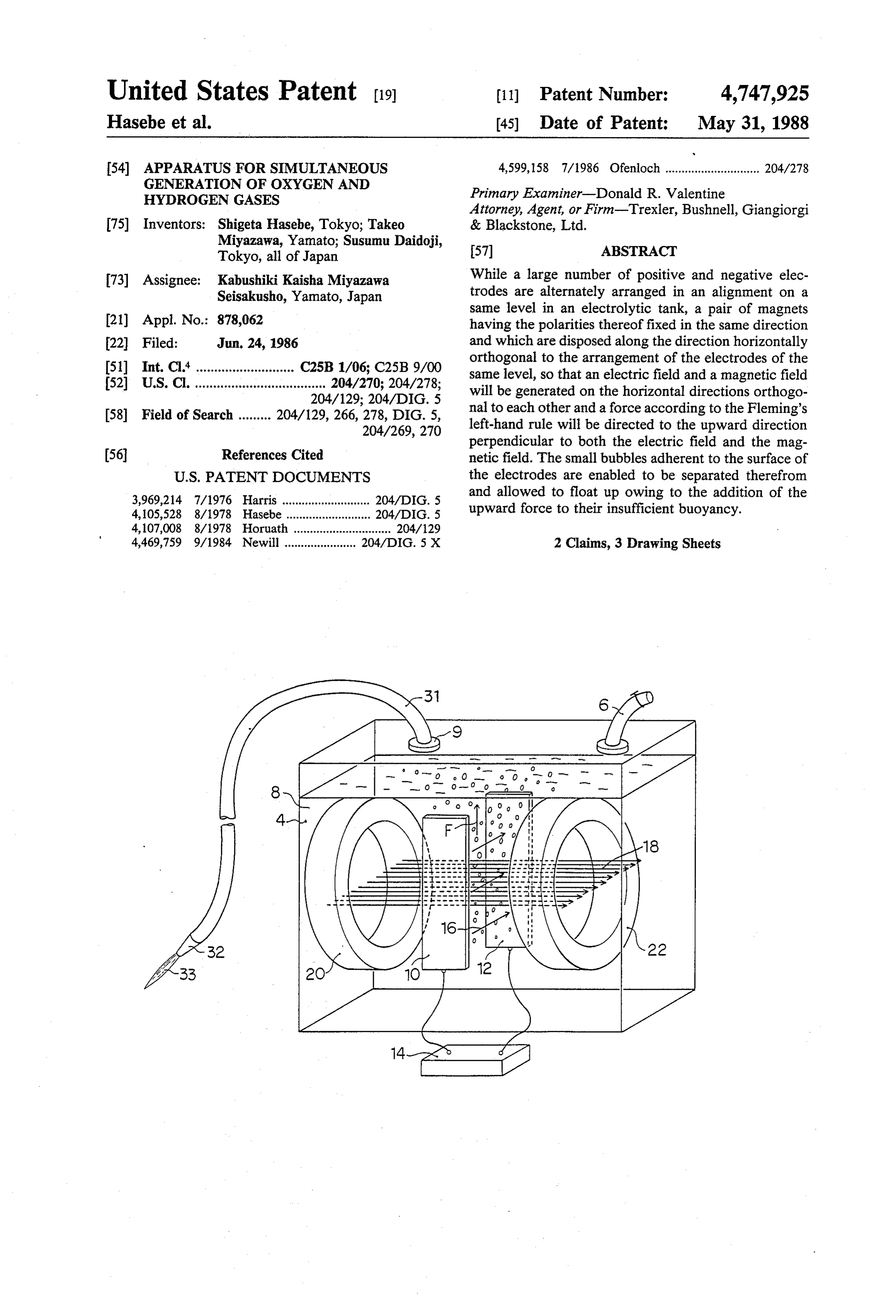
United States Patent (19) 11 Patent Number: 4,747,925 Hasebe et al. (45) Date of Patent: May 31, 1988 (54) APPARATUS FOR SIMULTANEOUS 4,599,158 7/1986 Ofenloch ............................. 204/278
GENERATION OF OXYGEN AND
HYDROGEN GASES Primary Examiner-Donald R. Valentine
Attorney, Agent, or Firm-Trexler, Bushnell, Giangiorgi 75) Inventors: Shigeta Hasebe, Tokyo; Takeo & Blackstone, Ltd.
Miyazawa, Yamato; Susumu Daidoji,
Tokyo, all of Japan 57 ABSTRACT 73 Assignee: Kabushiki Kaisha Miyazawa While a large number of positive and negative elec Seisakusho, Yamato, Japan trodes are alternately arranged in an alignment on a same level in an electrolytic tank, a pair of magnets 21) Appl. No.: 878,062 having the polarities thereof fixed in the same direction 22 Filed: Jun. 24, 1986 and which are disposed along the direction horizontally (51) Int. Cl* ........................... C25B 1/06; C25B 9/00 orthogonal to the arrangement of the electrodes of the 52 U.S. C. .................................... 204/270; 204/278; same level, so that an electric field and a magnetic field 204/129; 204/DIG. 5 will be generated on the horizontal directions orthogo 58 Field of Search ......... 204/129, 266, 278, DIG. 5, nal to each other and a force according to the Fleming's 204/269,270 left-hand rule will be directed to the upward direction perpendicular to both the electric field and the mag (56. References Cited netic field. The small bubbles adherent to the surface of
3,969,214 7/1976 Harris ........................... 2O4/DEG. 5 and allowed to float up owing to the addition of the 4,105,528 8/1978 HaSebe .......................... 204/EDIG. 5 upward force to their insufficient buoyancy. 4,107,008 8/1978 Horuath.............................. 204/129 4,469,759 9/1984 Newill ...................... 204/DIG. 5 X 2 Claims, 3 Drawing Sheets
Page 2
Drawing sheet — no readable text.
Page 3
Drawing sheet — no readable text.
Page 4
Drawing sheet — no readable text.
Page 5
electrodes. In the aqueous solution which now consti
APPARATUS FOR SIMULTANEOUS tutes an ion conductor, the cations migrate toward the GENERATION OF OXYGEN AND HYDROGEN cathode and the anions toward the anode and, as the GASES result, chemical reactions occur in the boundaries be tween the electrodes and the ion conductor to generate
BACKGROUND OF THE INVENTION oxygen (O2) from the anode and hydrogen (H2) from 1. Field of the Invention the cathode in the ratio of 1:2 in the form of bubbles. This invention relates to an apparatus for simulta The Faraday's law is established between the amount of neous and continuous generation of oxygen gas and 10 bubbles and the amount of electricity generated. The hydrogen gas either in an intermixed state or in separate two amounts are directly proportional to each other. states from a unitary mechanism. Where the bubbles are expected to be generated in a It is universally known that there have existed numer large amount, the electric field energy is required to be ous devices for separate generation of oxygen or hydro proportionately large.
gen. This invention easily permits the aforementioned The bubbles which are generated on the surface of separate generation. The primary object of this inven 15 the electrodes are invariably small globules. The buoy tion resides rather in deriving many benefits from simul ancy possessed by the bubbles themselves is not suffi taneously generating a mixed oxygen-hydrogen gas cient for the bubbles to separate themselves from the from a unitary mechanism. plate surfaces and float to the top of the aqueous solu The reason for this primary object is as follows. Hy tion. When the group of small globules have grown to
drogen and oxygen react with each other to form water the extent of acquiring a total buoyancy past a certain at room temperature. When this reaction is promoted level, the globules set themselves free from the surface with electric spark or with a platinum catalyst, it pro ceeds exothermally with explosive vigor. The reaction of the electrodes and float up. Especially when a multi plicity of electrodes are densely installed side by side, evolves a heat of 68.313 kcal/mol at 25 C. under 1 the uniformity of float of such bubbles is liable to be atmosphere, for example. In this case, the temperature 25 impaired. The phenomenon of such interrupted float of can reach 2,800 C. Thus, it is useful as an oxyhydrogen gas as described above is greatly inconvenient where torch in thermal treatments such as welding and cutting steel plates and deforming glass articles. It can also be the gas is required to be continuously supplied in a fixed flow volume. In the meantime, the group of bubbles utilized easily as a direct heat source or light source.
The welding by the use of a mixed oxygen-hydrogen 30 adhering insulating to the surface of electrodes function as an layer and possibly degrade the ability of elec gas (hereinafter referred to as "oxyhydrogen welding') tric conduction and decelerate the occurrence of elec is held to excel the other methods of welding such as, trolysis.
for example, oxyacetylene gas welding, arc welding, and electric resistance welding in the following points, As one means of solving the aforementioned inconve nience, it may be conceived to fix the electric field i.e. the point that since the phenomena of oxidation and 35 energy nitration possibly induced during the welding operation constantly at a large excess and heighten the are suppressed, alterations of mechanical properties ability itself to generate the group of bubbles. This causable in such readily oxidizable metals, light alloys, method, however, has the possibility of entailing contin and nichrome steels in consequence of padding, cutting, uous consumption of a large volume of electric power and other works during the welding operation are small 40 for a long time.
and the point that the original strength and hardness can SUMMARY OF THE IVNENTION be retained intact.
2. Description of the Prior Art The first object of this invention is to eliminate the In the conventional oxyhydrogen welding, however, disadvantage completely and create and provide an high-pressure oxygen gas and hydrogen gas separately 45 apparatus for simultaneous generation of oxygen and contained as compressed in a seamless cylindrical con hdyrogen gases, which enables even small bubbles of tainer of steel of a large wall thickness generally passing insufficient buoyancy to be quickly separated from the as a "bomb' are used as mixed in a prescribed ratio such surface of electrodes and allowed to float up, permits as, for example, 1:4. It is universally known that the continuous supply of oxygen and hydrogen gases in a bomb is so heavy as to render the mobility or portability 50 fixed volume, retains the ability of electric conduction of the welding operation inferior and further that rigid satisfactorily and enables the electric field energy to be control regulations are imposed on the welding opera effectively utilized constantly.
tion to preclude various dangers arising from the han The second object of this invention is to create and dling of high-pressure gases. provide an inexpensive apparatus for simultaneous gen If a device is developed which permits continuous 55 eration of oxygen and hydrogen gases, which permits supply of a mixed oxygen-hydrogen gas conveniently minimization of the electric power to be supplied and under atmospheric pressure, the aforementioned ha consumed as the electric field energy and decrease of zards to the oxyhydrogen welding operation will be the amount of water consumed to only 1/1800 of the completely eliminated. amount of gases to be generated. Among the well-known conventional means of gen 60 The third object of this invention is to create and erating a mixed oxygen-hydrogen gas is counted a de provide a small apparatus for simultaneous generation vice which relies on the electrolysis of water. To de of oxygen and hydrogen gases, which for the formation scribe the fundamental construction and operation of of a mixed oxygen-hydrogen gas, has no use for the this device, a pair of electrodes are parallelly set up in conventional high-pressure bomb adapted to contain an electrolyte of the smallest possible electric resistance 65 the two gases therein and can be handled and moved such as, for example, an aqueous 20% sodium hydrox easily and safely.
ide (NaOH) or 30% potassium hydroxide (KOH) solu The fourth object of this invention is to create and tion and a direct electric current is passed between the provide an apparatus for simultaneous generation of
Page 6
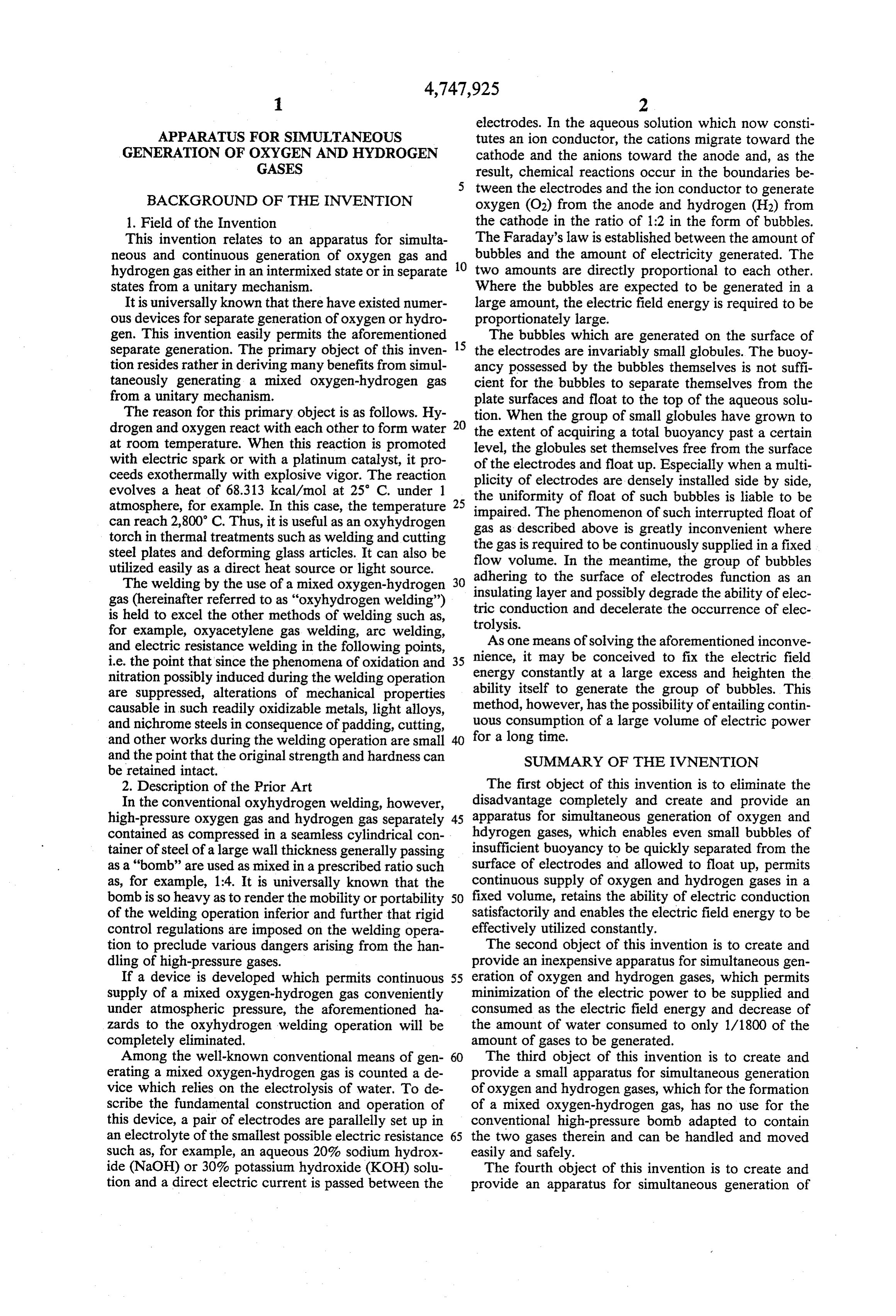
oxygen and hydrogen gases, which permits oxygen gas bubbles of oxygen issue from the boundary of the anode and hydrogen gas to be easily taken out in an intermixed 10 and bubbles of hydrogen from the boundary of the state or in mutually separated states. cathode 12 in a ratio of 1:2. The fifth object of this invention is to obtain an appa The construction and operation described above are ratus which is capable of generating meagerly flamma nothing but those of the conventionally well-known ble, safe, and stable para-hydrogen as compared with means of generation of oxygen and hydrogen gases by the highly flammable and dangerous ortho-hydrogen the electrolysis of water. The present invention has generated by the conventional apparatus. mended the defects inherent in the conventional means The sixth object of this invention is to obtain an appa described above.
ratus for simultaneous generation of oxygen and hydro 10 The group of bubbles of oxygen and hydrogen gen gases, of which the produced gases are reverted to formed on the boundaries between the two electrodes water on combustion and have no possibility of causing and the ion conductor at first are only a group of minute any environmental pollution. bubbles whose individual buoyancy is too weak for the The seventh object of this invention is to obtain an bubbles to liberate themselves from the surface of elec apparatus for simultaneous generation of oxygen and 15 trodes. Thus, the group of these minute bubbles adhere hydrogen gases, of which the produced mixed gas can densely to the surface. The group of minute bubbles so be used for welding works performed under atmo adhering function as an insulating layer for intercepting spheric pressure, negative pressure, or water, can be the electric field 16 and the ability of the boundaries to used as fuels for general purposes and for operation of generate bubbles is degraded. Under these conditions, vehicles, can be utilized for production of glass articles, 20 continuous supply of oxygen and hydrogen gases in a fabrication of optical fibers, and fabrication of semicon fixed volume cannot be guaranteed. ductors, and can serve for purification of air. In the present invention, therefore, a pair of powerful The other objects and characteristics of the present magnetic members 20 and 22 are parallelly disposed so invention will become more apparent to those skilled in as to establish a magnetic field 18 in the direction con the art as the disclosure is made in the following de 25 forming to the Fleming's left-hand rule with respect to scription of preferred embodiments of the invention, as the electric field 16, i.e. in the direction from left to illsutrated in the accompanying drawings. right perpendicularly to the electric field 16 directed BRIEF DESCRIPTION OF THE DRAWINGS from the nearer side to the farther side in the diagram of FIG. 1. Consequently, there is generated a force F
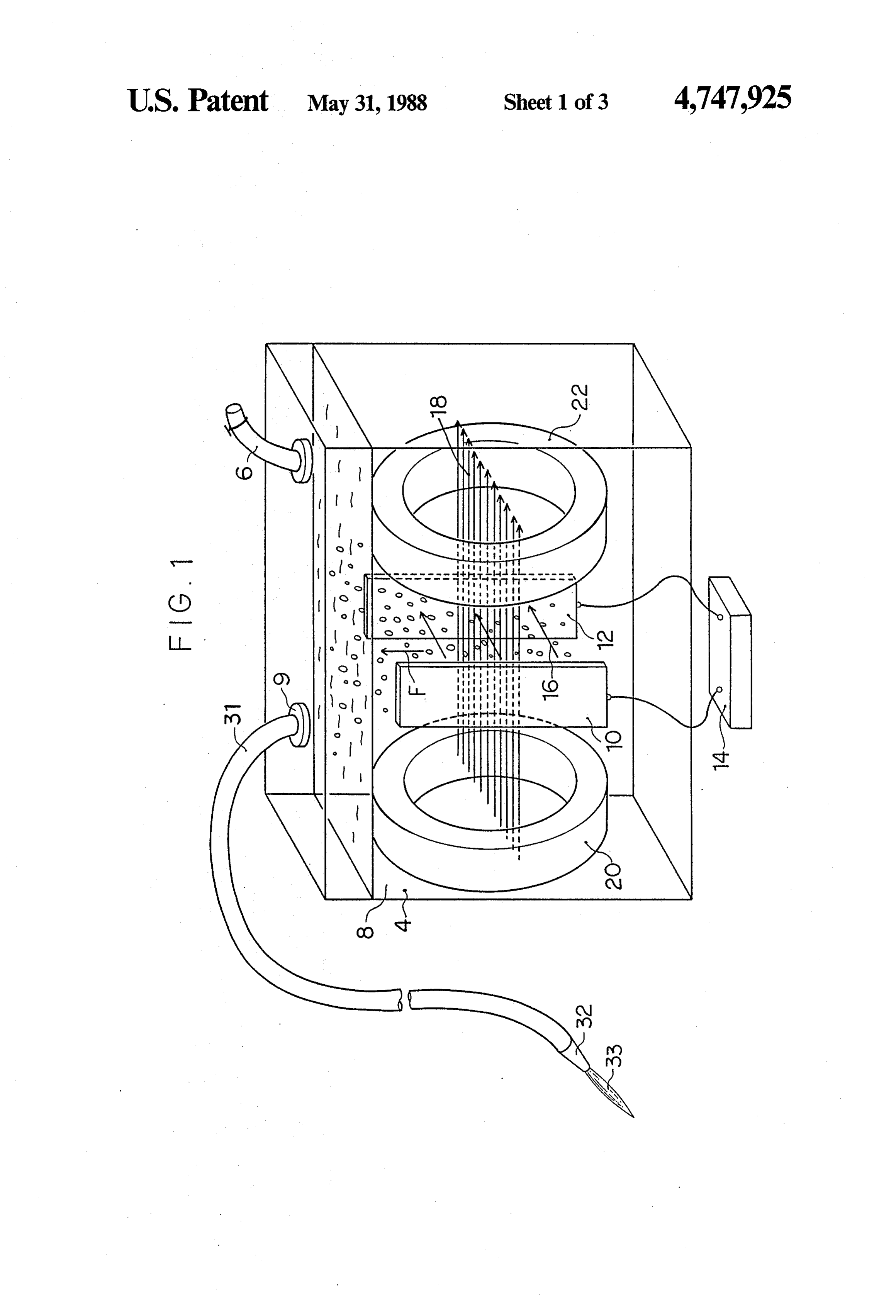
FIG. 1 is an explanatory diagram illustrating the 30 directed upwardly in accordance with the Fleming's . . principle of the present invention. left-hand rule.
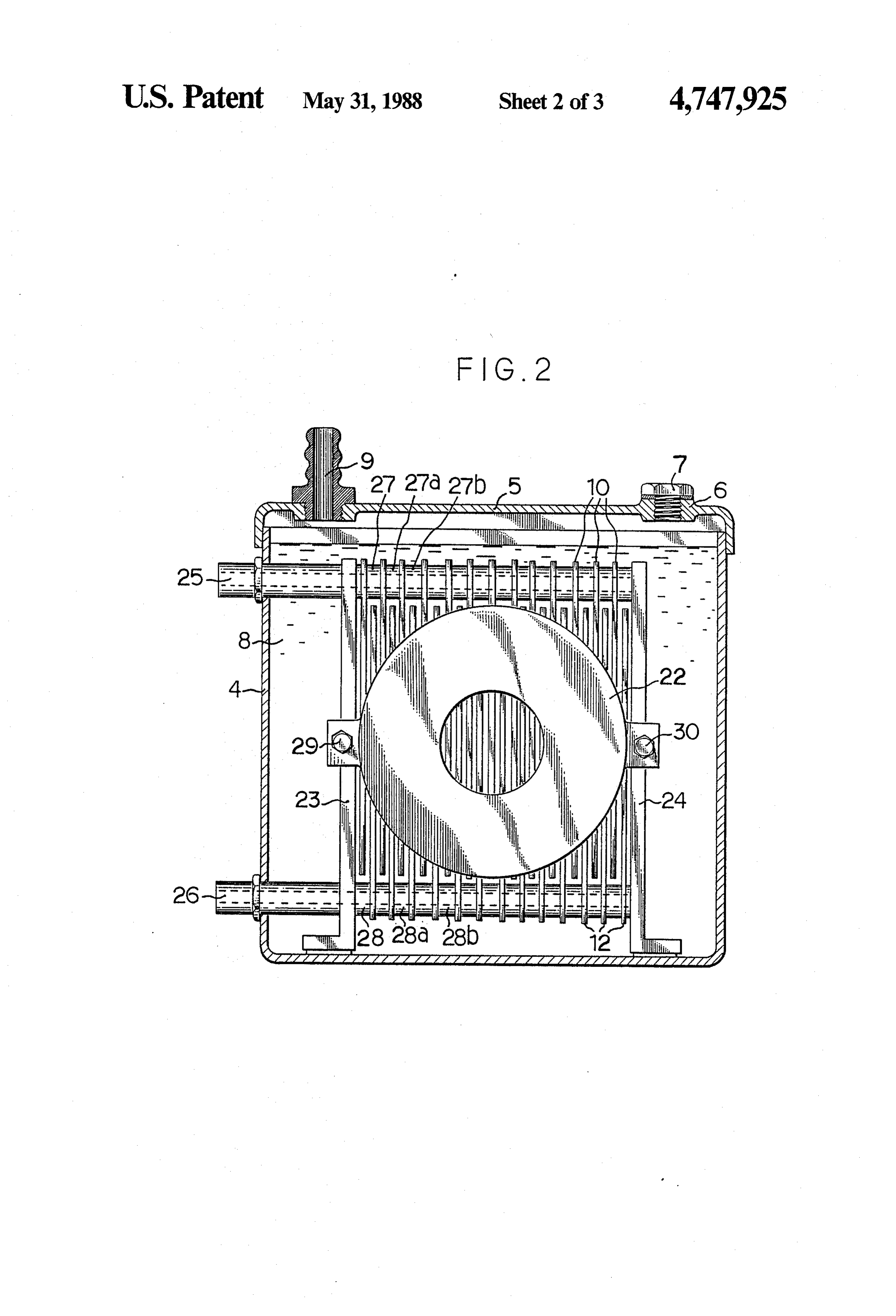
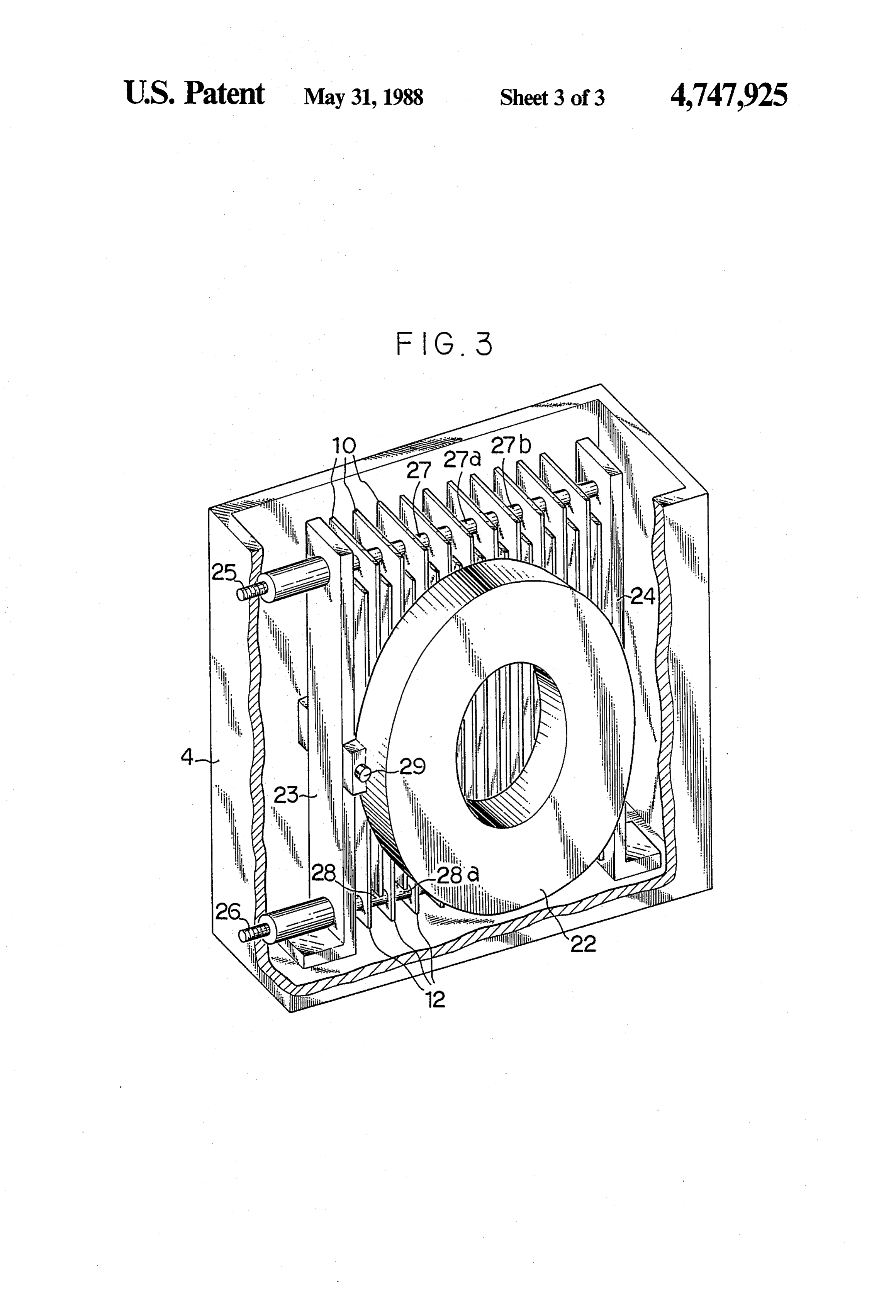
FIG. 2 is a longitudinally sectioned front view illus When the group of minute bubbles so far adhering ...trating a concrete embodiment of the present invention. inevitably to the surface of the electrodes owing to the FIG. 3 is a perspective view of a tank, with the front deficiency of buoyancy are exposed to the aforemen side cut away. 35 tioned force F, they are observed to drift quickly up DETAILED DESCRIPTION OF THE wardly, namely, in the direction perpendicular to both INVENTION the electric field 16 and the magnetic field 18.
In other words, the individual bubbles are enabled to
This invention, to accomplish the objects described set themselves free from the adhesive force of the sur above, effects simultaneous generation of a mixed oxy face of the electrodes owing to the addition of the afore gen-hydrogen gas by disposing at least one pair of posi mentioned force of drifting to their individual buoy tive and negative electrodes as opposed to each other ancy. As the result, the bubbles are enabled to float up inside a water tank provided on the upper side thereof toward the free surface of the aqueous solution. with a gas outlet hole and disposing at least one pair of The floating movement due to the drift seems to magnetic members with the polarities thereof fixed in 45 occur commonly on both the oxygen gas and the hydro one and the same direction so that the forces thereby gen gas. Particularly to the hydrogen gas, the following will be directed upwardly in accordance with the inference appears to apply.
Fleming's left-hand rule in connection with the direc It is widely known that hydrogen has two atomic tion of the potential difference generated between the nuclei spinning in each of the molecules thereof. The pair of electrodes. 50 hydrogen of the kind having both the atomic nuclei Separate issue of oxygen and hydrogen is attained by spinning in one direction is called ortho-hydrogen and interposing a diaphragm between the pair of electrodes that of the kind having the atomic nuclei spinning in and, at the same time, forming separate outlet holes for opposite directions is called para-hydrogen. Under the the two gases. condition of at least normal room temperature, the two First with reference to FIG. 1, a tank 4 is filled with 55 kinds of hydrogen occur in the proportions of one para an aqueous electrolyte solution 8 of a small magnitude hydrogen molecule per three ortho-hydrogen mole of electric resistance introduced through a water inlet 6. cules. It is held that the hydrogen molecules in the In the aqueous solution, a pair of electrodes, i.e. an ortho state are instable because repulsive force is ex anode 10 and a cathode 12, are disposed as opposed to erted between the atomic nuclei, whereas the hydrogen each other. 60 molecules in the para state are stable and are activated When a direct electric current from a DC power because attractive force is exerted between the atomic source 14 installed outside the tank is passed between nuclei. It is held that the instable ortho-hydrogen can be the two electrodes, a potential difference is produced converted into the stable para-hydrogen by using mag between the two electrodes and an electric field is netic members as a catalyst. formed in the direction, of the arrow 16. Consequently, 65 In the present invention in which hydrogen mole the aqueous solution 8 constitutes itself an ion conduc cules are placed where the electric field 16 and the tor and the cations in the solution migrate toward the magnetic field 18 perpendicularly intersect each other, cathode 12 and the anions toward the anode 10 and therefore, if the direction of the force F is assumed to be
Page 7
opposite the direction of spin of orthohydrogens, the It is easy to furnish the apparatus with means of ortho-hydrogens will be converted into para-hydrogens switching between the two modes, mixed discharge and and, if the direction of the aforementioned force F is separate discharge of the gases, so that the gases will be assumed to be in agreement with the direction of spin of used in whichever of the modes to be selected to suit the para-hydrogens, the para-hydrogens will be further 5 occasion.
accelerated and enabled to float up. To ensure perfect safety of the operation of the appa When the quick incessant floating movement of bub ratus, the apparatus may be provided at various posi bles is realized as described above, the group of bubbles tions thereof with flow meters, safety valves, means of otherwise suffered to adhere fast to the surface of elec preventing backfire, and means of actuating an auto trodes are always kept cleared of the surface of elec 10 matic discharge device and discharging the produced trodes. Thus, the surface of each of the electrodes ena mixed gas outdoors in case of power failure. bles the aqueous solution as the ion conductor to pro The first effect of the present invention resides in the mote the electrode reaction again. As the result, the fact that since the magnetic field 18 is established per effect of electrolysis is notably promoted and the forma pendicularly to the electric field 16 and, consequently, tion of bubbles is attained efficiently even when the 5 the force F directed upwardly is exerted upon the group electric field energy is small. of minute bubbles adhering to the surface of electrodes, Now, a concrete working example of this invention this force F serves the purpose of enabling the group of will be described in detail below with reference to FIG. bubbles to separate from the surface of the electrodes 10
and 12 and
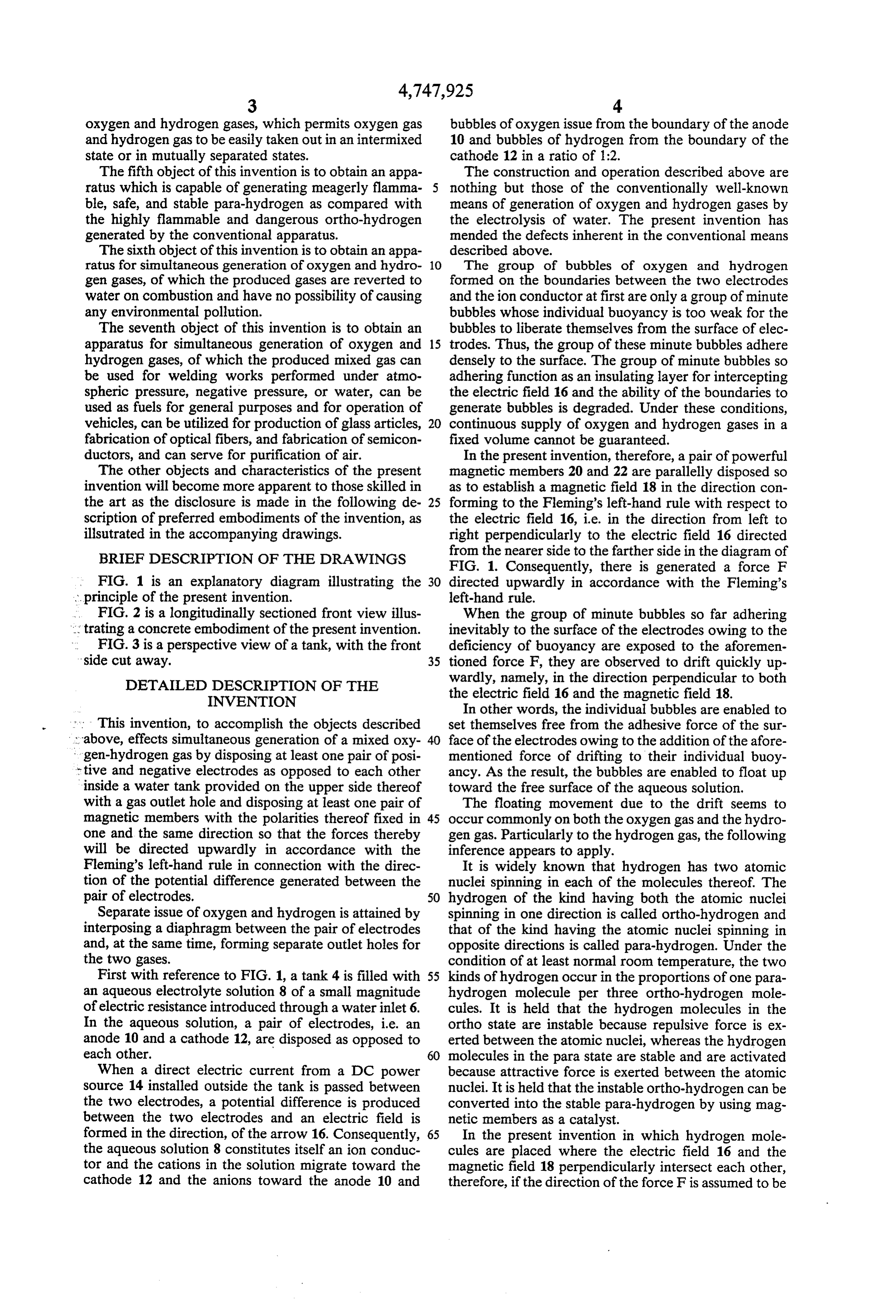
A rectangular tank 4 has a lid 5. This lid is provided of oxygen and 20 float up, warrants continuous stable supply with a water inlet hole 6 fitted with a plug 7 and a gas nates completely hydrogen gases in a fixed amount, elimi outlet hole 9. The tank 4 is filled with an aqueous elec of the group of minute the disadvantage that the fast adhesion trolyte solution 8. bubbles to the surface of elec trodes has produced an insulating
Side frames 23 and 24 are parallelly disposed at the the property of electric conduction, activity and lowered enables the ability left and right ends of the inner bottom of the tank. Ter 25 of the surface of electrodes in the conduction minal bars 25 and 26 are supported between the upper tricity to remain in the most desirable state at alloftimes, elec parts and between the lower parts respectively of the frames. On the upper terminal bar 25, upper electrodes and permits the electric field energy to be effectively utilized.
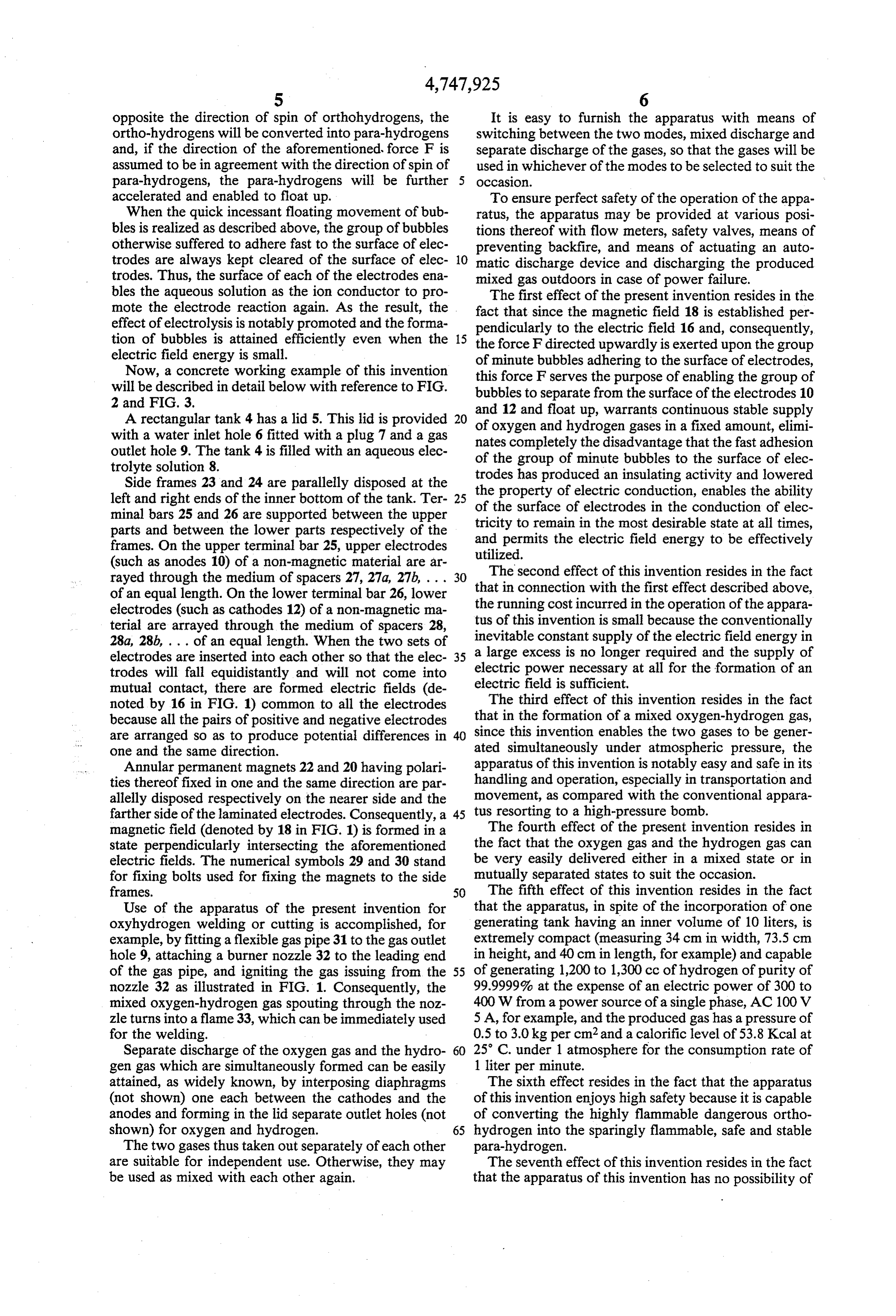
(such as anodes 10) of a non-magnetic material are ar rayed through the medium of spacers 27, 27a, 27b, ... 30 thatThe in second effect of this invention resides in the fact connection with the first effect described above, of an equal length. On the lower terminal bar 26, lower the running cost incurred in the operation of the appara electrodes (such as cathodes 12) of a non-magnetic ma tus of this invention is small because the conventionally terial are arrayed through the medium of spacers 28, 28a, 28b, . . . of an equal length. When the two sets of inevitable constant supply of the electric field energy in electrodes are inserted into each other so that the elec 35 a large excess is no longer required and the supply of electric power necessary at all for the formation of an trodes will fall equidistantly and will not come into electric mutual contact, there are formed electric fields (de field is sufficient, noted by 16 in FIG. 1) common to all the electrodes thatThe third effect of this invention resides in the fact in the formation of a mixed oxygen-hydrogen gas, because all the pairs of positive and negative electrodes are arranged so as to produce potential differences in 40 since this invention enables the two gases to be gener one and the same direction. ated simultaneously under atmospheric pressure, the Annular permanent magnets 22 and 20 having polari apparatus of this invention is notably easy and safe in its ties thereof fixed in one and the same direction are par handling and operation, especially in transportation and allelly disposed respectively on the nearer side and the movement, as compared with the conventional appara farther side of the laminated electrodes. Consequently, a 45 tus resorting to a high-pressure bomb. magnetic field (denoted by 18 in FIG. 1) is formed in a The fourth effect of the present invention resides in state perpendicularly intersecting the aforementioned the fact that the oxygen gas and the hydrogen gas can electric fields. The numerical symbols 29 and 30 stand be very easily delivered either in a mixed state or in for fixing bolts used for fixing the magnets to the side mutually separated states to suit the occasion. frames. 50 The fifth effect of this invention resides in the fact Use of the apparatus of the present invention for that the apparatus, in spite of the incorporation of one oxyhydrogen welding or cutting is accomplished, for generating tank having an inner volume of 10 liters, is example, by fitting a flexible gas pipe 31 to the gas outlet extremely compact (measuring 34 cm in width, 73.5 cm hole 9, attaching a burner nozzle 32 to the leading end in height, and 40 cm in length, for example) and capable of the gas pipe, and igniting the gas issuing from the 55 of generating 1,200 to 1,300 cc of hydrogen of purity of nozzle 32 as illustrated in FIG. 1. Consequently, the 99.9999% at the expense of an electric power of 300 to mixed oxygen-hydrogen gas spouting through the noz 400W from a power source of a single phase, AC 100 V zle turns into a flame 33, which can be immediately used 5A, for example, and the produced gas has a pressure of for the welding. 0.5 to 3.0 kg per cm2 and a calorific level of 53.8 Kcal at Separate discharge of the oxygen gas and the hydro 60 25° C. under 1 atmosphere for the consumption rate of gen gas which are simultaneously formed can be easily 1 liter per minute.
attained, as widely known, by interposing diaphragms The sixth effect resides in the fact that the apparatus (not shown) one each between the cathodes and the of this invention enjoys high safety because it is capable anodes and forming in the lid separate outlet holes (not of converting the highly flammable dangerous ortho shown) for oxygen and hydrogen. 65 hydrogen into the sparingly flammable, safe and stable The two gases thus taken out separately of each other para-hydrogen.
are suitable for independent use. Otherwise, they may The seventh effect of this invention resides in the fact be used as mixed with each other again. that the apparatus of this invention has no possibility of
Page 8
causing any environmental pollution because the pro- field generated by the electrodes and the magnets, duced gas is reverted to water on combustion. in accordance with Fleming's left-hand rule. The eighth effect of this invention resides in the fact 2. Apparatus for simultaneous generation of oxygen that the produced gas can be used for welding works performed under atmospheric pressure, negative pres- 5 anda tank hydrogen gases, which comprises for containing an aqueous electrolyte solution;
sure or water, for fabrication of glass articles, optical a pair of side frames disposed in the tank; fibers, and semiconductors, as fuels for general purposes an upper terminal bar and a lower terminal bar sup and for operation of vehicles, and for the purification of ported between upper pair and between lower a11. parts of said frames respectively; While the present invention has been described by 1. 0 a plurality of upper electrodes each of which com prise a rectangular plate of non-magnetic material means of specific embodiments, it is to be understood and which are disposed in parallel arrangement on that numerous changes and modifications may be made the upper terminal bar and separated by spacers of therein without departing from the spirit and scope of an equal length;
the invention as defined in the appended claims. 15 a plurality of lower electrodes each of which com What is claimed is:
1. Apparatus for simultaneous generation of oxygen prise a rectangular plate of non-magnetic material and hydrogen gases, which comprises and which are disposed in parallel arrangement on a tank for containing an aqueous electrolyte solution; the lower terminal bar and separated by spacers of an equal length;
a plurality of positive and negative electrodes alter- 20 the said upper and lower electrodes arranged in alter nately arranged in an opposing alignment on a nate opposition for interleaved alignment; and same vertical level in the tank; and a pair of magnets having the polarities thereof fixed in a pair of magnets having the polarities thereof fixed in the same direction and which are disposed along the same direction and which are disposed along the direction horizontally orthogonal to the ar the direction horizontally orthogonal to the ar- 25 rangement of the electrodes in relation to said rangement of the electrodes on said vertical level, upper and lower frames in order to impose up SO that the magnetic field generated by said mag- wardly directed force perpendicular to both the nets is orthogonally superimposed upon the elec- electric field and the magnetic field generated by tric field generated by said plurality of electrodes, the electrodes and the magnets, in accordance with in order to impose upwardly directed force perpen- 30 Fleming's left-hand rule.
dicular to both the electric field and the magnetic ck k is :
Provenance
- Collection
- Cited prior art
- Original PDF
- patentimages.storage.googleapis.com →
- Filed
- 1986-06-24
- Pages
- 8
- Method
- pdftotext (the PDF's own text layer) + pdftoppm 300dpi page scans
- Source
- Google Patents bibliographic record
- Granted
- 1988-05-31
- Inventors
- Shigeta Hasebe; Takeo Miyazawa; Susumu Daidoji; Miyazawa Seisakusho KK
- Transcribed from
- patentimages.storage.googleapis.com →