patent · US5632998
Personal care compositions containing hydrophobic graft copolymer and hydrophobic, volatile solvent
27 May 1997
Page 1 — bibliographic record
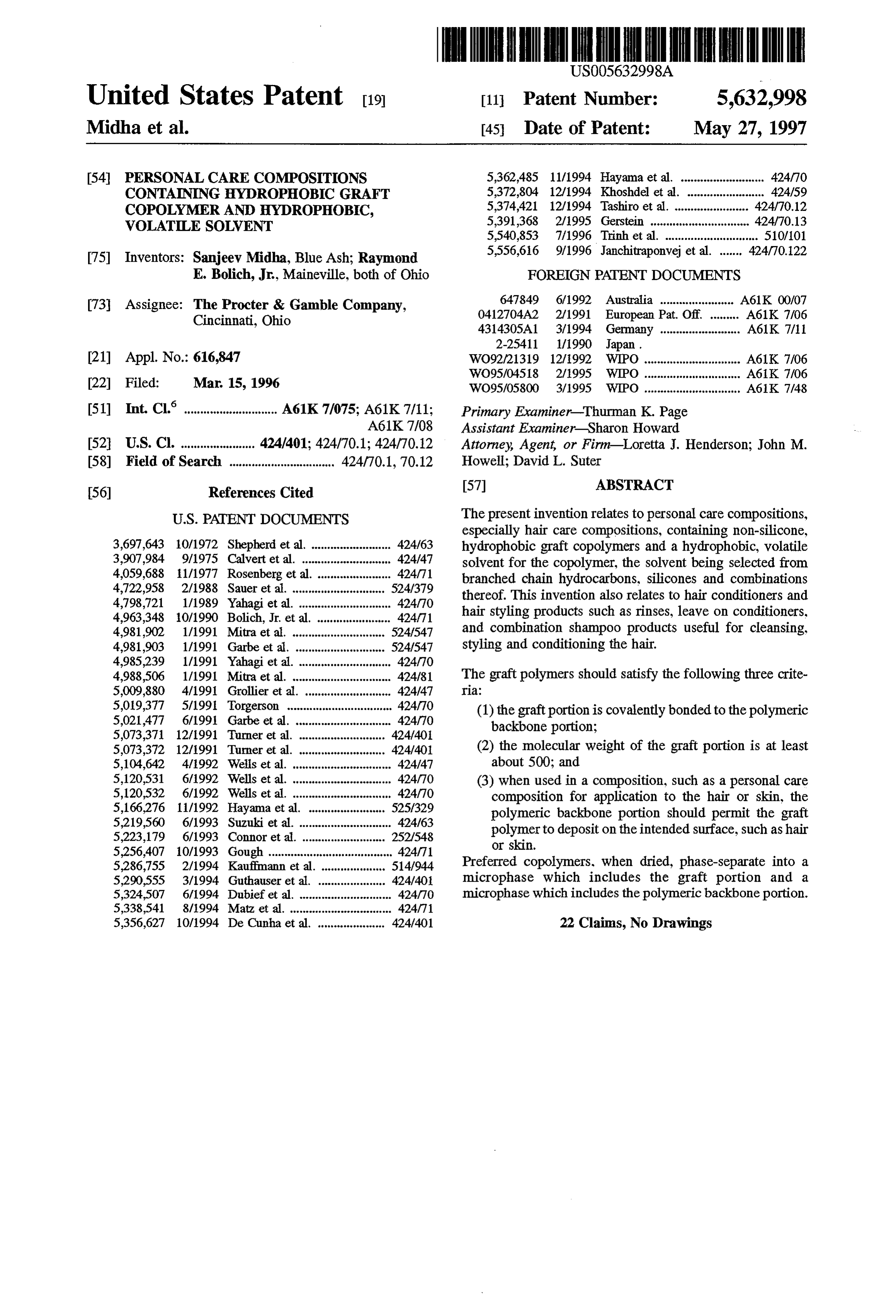
United States Patent (19) 11 Patent Number: 5,632,998 Midha et al. 45 Date of Patent: May 27, 1997 54 PERSONAL CARE COMPOSITIONS 5,362,485 11/1994 Hayama et al. .......................... 424/70 CONTAINING HYDROPHOBC GRAFT 5,372,804 12/1994 Khoshdel et al. .. ... 424/59 COPOLYMER AND HYDROPHOBIC, 5,374,421 12/1994 Tashiro et al. .. ... 424/70.12 WOLATLE SOLVENT 5,391,368 2/1995 Gerstein ... ... 424/70.13 5,540,853 7/1996 Trinh et al. ............................. 510/01 75 Inventors: Sanjeev Midha, Blue Ash; Raymond 5,556,616 9/1996 Janchitraponveet al. ....... 424/70.22 E. Bolich, Jr., Maineville, both of Ohio FOREIGN PATENT DOCUMENTS 73 Assignee: The Procter & Gamble Company, 647849 6/1992 Australia .............. A61K 00/07 Cincinnati, Ohio 0412704A2 2/1991 European Pat. Off. ... A61K 7/06
21 Appl. No.: 616,847 WO92/21319 12/1992 WIPO ............................. A61K 7/06 WO95/04518 2/1995 WIPO ... ... A61K 7/06 22 Filed: Mar 15, 1996 WO95/05800 3/1995 WIPO .............................. A61K 7/48 51 Int. Cl. ................ A61K 7/075; A61K 7/11; Primary Examiner. Thurman K. Page A61K7/08 Assistant Examiner Sharon Howard 52 U.S. Cl. ....................... 424/401; 424/70.1; 424/70.12 Attorney, Agent, or Firm-Loretta J. Henderson; John M. 58) Field of Search ................................ 424/70.1, 70.12 Howell; David L. Suter 56) References Cited 57 ABSTRACT
especially hair care compositions, containing non-silicone, 3,697,643 10/1972 Shepherd et al. ......................... 424/63 hydrophobic graft copolymers and a hydrophobic, volatile 3,907,984 9/1975 Calvert et al. ...... ... 424/47 solvent for the copolymer, the solvent being selected from 4,059,688 11/1977 Rosenberg et al. . ... 424/71 branched chain hydrocarbons, silicones and combinations 4,722,958 2/1988 Sauer et al. ......... 524/379 thereof. This invention also relates to hair conditioners and 4,798,721 1/1989 Yahagi et al........ 424/70 hair styling products such as rinses, leave on conditioners, 4,963,348 10/1990 Bolich, Jr. et al. . ... 424/71 4,981,902 1/1991 Mitra et al. ............................. 524/547 and combination shampoo products useful for cleansing, 4,981,903 1/1991 Garbe et al. ............................ 524/547 styling and conditioning the hair.
4,985,239 1/1991 ... 424/70 4,988,506 1/1991 ... 424/81 The graft polymers should satisfy the following three crite 5,009,880 4/1991 ... 424/47 ria:
5,019,377 5/1991 Torgerson ................................. 424/70 (1) the graft portion is covalently bonded to the polymeric 5,021,477 6/1991 Garbe et al. .............................. 424/70 backbone portion;
5,073,371 12/1991 Turner et al. ... . 424/40 5,073,372 12/1991 Turner et al. ... . 424/40 (2) the molecular weight of the graft portion is at least 5,104,642 4/1992 Weis et al. ..... ... 424/47 about 500; and 5,120,531 6/1992 Wells et al. . ... 424/70 (3) when used in a composition, such as a personal care 5,120,532 6/1992 Wells et al. .. ... 424/70 composition for application to the hair or skin, the 5,166,276 11/1992 Hayama et al. ... 525/329 polymeric backbone portion should permit the graft 5,219,560 6/1993 Suzuki et al. ....... ... 424/63 polymerto deposit on the intended surface, such as hair 5,223,179 6/1993 Connor et al. .. . . 252A548 or skin.
5,256,407 10/1993 Gough ................. ... 424/71
Preferred copolymers, when dried, phase-separate into a 5,286,755 2/1994 Kauffmann et al. 514/944 5,290,555 3/1994 Guthauser et al. . 424/40. microphase which includes the graft portion and a 5,324,507 6/1994 Dubief et al. ....... ... 424/70 microphase which includes the polymeric backbone portion. 5,338,541 8/1994 Matz et al. .......... ... 424/71 5,356,627 10/1994 De Cunha et al. ..................... 424/401 22 Claims, No Drawings
Page 2
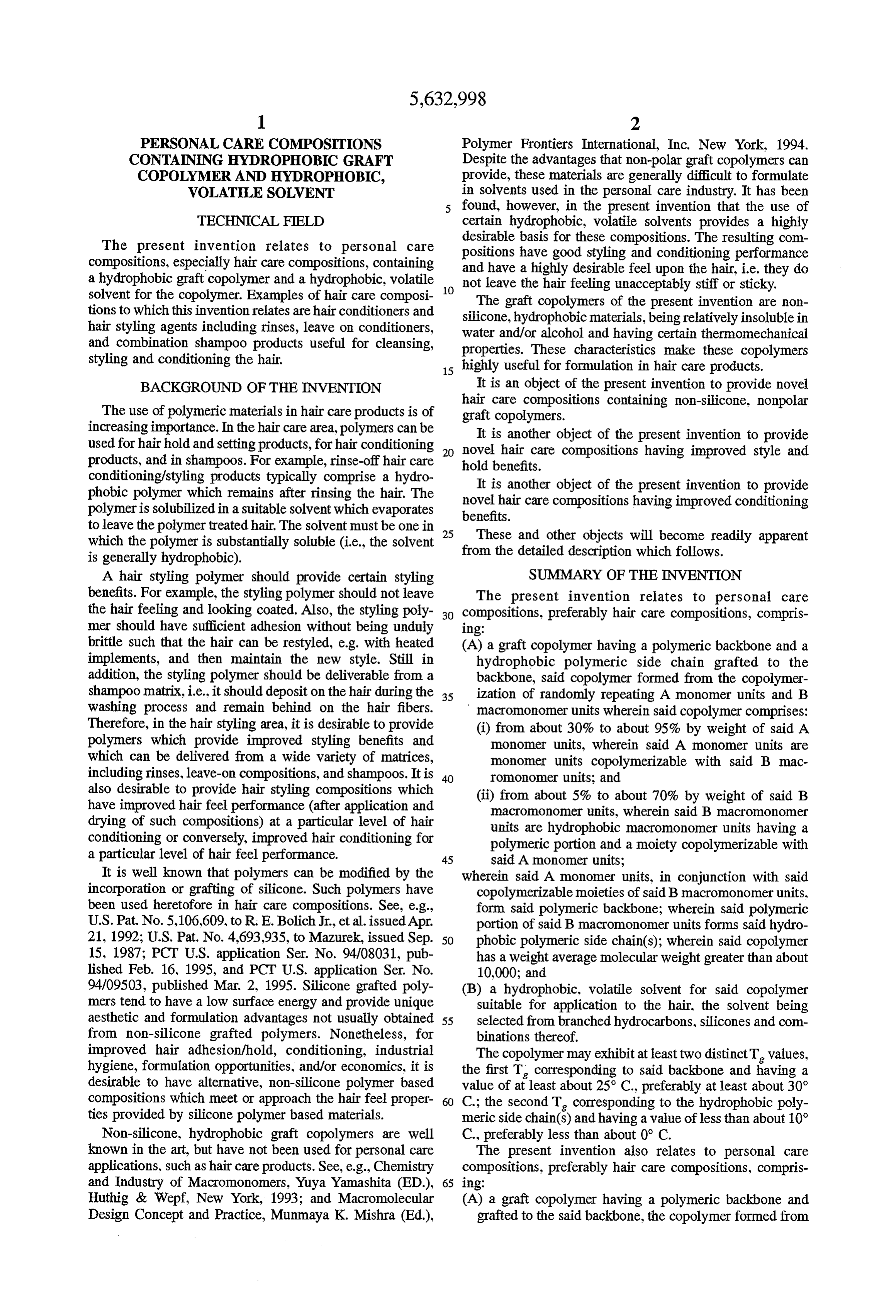
PERSONAL CARE COMPOSITIONS Polymer Frontiers International, Inc. New York, 1994. CONTAINING HYDROPHOBC GRAFT Despite the advantages that non-polar graft copolymers can COPOLYMER AND HYDROPHOBIC, provide, these materials are generally difficult to formulate WOLATLE SOLVENT in solvents used in the personal care industry. It has been found, however, in the present invention that the use of
TECHNICAL FIELD certain hydrophobic, volatile solvents provides a highly The present invention relates to personal care positions have desirable basis for these compositions. The resulting com compositions, especially hair care compositions, containing and have a highly good styling and conditioning performance a hydrophobic graft copolymer and a hydrophobic, volatile 10 not leave the hair feeling desirable feel upon the hair, i.e. they do unacceptably stiff or sticky.
solvent for the copolymer. Examples of hair care composi The graft copolymers of the present invention are non tions to which this invention relates are hair conditioners and hair styling agents including rinses, leave on conditioners, water and/or alcohol and havingbeing silicone, hydrophobic materials, relatively insoluble in and combination shampoo products useful for cleansing, properties. These characteristics make thermomechanical certain these copolymers styling and conditioning the hair. 15 highly useful for formulation in hair care products. BACKGROUND OF THE INVENTION It is an object of the present invention to provide novel hair care compositions containing non-silicone, nonpolar
The use of polymeric materials in hair care products is of graft copolymers.
increasing importance. In the hair care area, polymers can be It is another object of the present invention to provide used for hair hold and setting products, for hair conditioning 20 novel hair care compositions having improved style and products, and in shampoos. For example, rinse-off hair care hold benefits.
conditioning/styling products typically comprise a hydro It is another object of the present invention to provide phobic polymer which remains after rinsing the hair. The novel hair care compositions having improved conditioning polymeris solubilized in a suitable solvent which evaporates benefits.
to leave the polymer treated hair. The solvent must be one in These and other objects will become readily apparent which the polymer is substantially soluble (i.e., the solvent 25 from the detailed description which follows. is generally hydrophobic).
A hair styling polymer should provide certain styling SUMMARY OF THE INVENTION benefits. For example, the styling polymer should not leave The present invention relates to personal care the hair feeling and looking coated. Also, the styling poly 30 compositions, preferably hair care compositions, compris mer should have sufficient adhesion without being unduly 1ng:
brittle such that the hair can be restyled, e.g. with heated (A) a graft copolymer having a polymeric backbone and a implements, and then maintain the new style. Still in hydrophobic polymeric side chain grafted to the addition, the styling polymer should be deliverable from a backbone, said copolymer formed from the copolymer shampoo matrix, i.e., it should deposit on the hair during the 35 ization of randomly repeating A monomer units and B washing process and remain behind on the hair fibers. macromonomer units wherein said copolymer comprises: Therefore, in the hair styling area, it is desirable to provide (i) from about 30% to about 95% by weight of said A polymers which provide improved styling benefits and monomer units, wherein said. A monomer units are which can be delivered from a wide variety of matrices, monomer units copolymerizable with said B mac including rinses, leave-on compositions, and shampoos. It is romonomer units; and also desirable to provide hair styling compositions which (ii) from about 5% to about 70% by weight of said B have improved hair feel performance (after application and macromonomer units, wherein said B macromonomer drying of such compositions) at a particular level of hair units are hydrophobic macromonomer units having a conditioning or conversely, improved hair conditioning for polymeric portion and a moiety copolymerizable with a particular level of hair feel performance. 45 said A monomer units;
It is well known that polymers can be modified by the wherein said A monomer units, in conjunction with said incorporation or grafting of silicone. Such polymers have copolymerizable moieties of said B macromonomer units, been used heretofore in hair care compositions. See, e.g., form said polymeric backbone; wherein said polymeric U.S. Pat. No. 5,106,609, to R. E. Bolich Jr., et al. issued Apr. portion of said B macromonomer units forms said hydro 21, 1992; U.S. Pat. No. 4,693.935, to Mazurek, issued Sep. 50 phobic polymeric side chain(s); wherein said copolymer 15, 1987; PCT U.S. application Ser. No. 94/08031, pub has a weight average molecular weight greater than about lished Feb. 16, 1995, and PCT U.S. application Ser. No. 10,000; and 94/09503, published Mar. 2, 1995. Silicone grafted poly (B) a hydrophobic, volatile solvent for said copolymer mers tend to have a low surface energy and provide unique suitable for application to the hair, the solvent being aesthetic and formulation advantages not usually obtained 55 selected from branched hydrocarbons, silicones and com from non-silicone grafted polymers. Nonetheless, for binations thereof.
improved hair adhesion/hold, conditioning, industrial hygiene, formulation opportunities, and/or economics, it is theThe copolymer may exhibit at least two distinct T values, first T corresponding to said backbone and having a desirable to have alternative, non-silicone polymer based value of at least about 25°C., preferably at least about 30° compositions which meet or approach the hair feel proper C.; the second T corresponding to the hydrophobic poly ties provided by silicone polymer based materials. meric side chain(s) and having a value of less than about 10° Non-silicone, hydrophobic graft copolymers are well C., preferably less than about 0°C.
known in the art, but have not been used for personal care The present invention also relates to personal care applications, such as hair care products. See, e.g., Chemistry compositions, preferably hair care compositions, compris and Industry of Macromonomers, Yuya Yamashita (ED.), 65 1ng:
Huthig & Wepf, New York, 1993; and Macromolecular (A) a graft copolymer having a polymeric backbone and Design Concept and Practice, Munmaya K. Mishra (Ed.), grafted to the said backbone, the copolymer formed from
Page 3
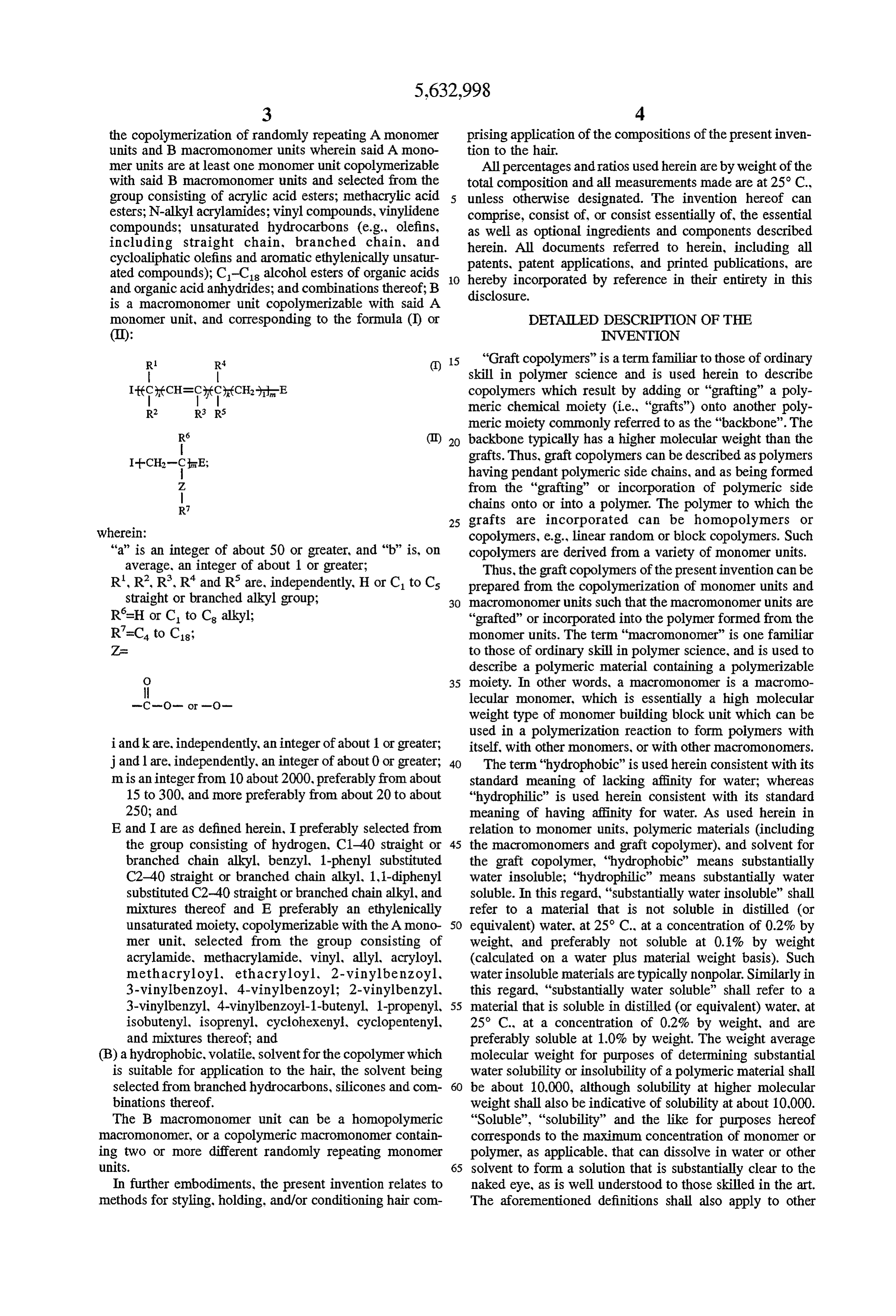
the copolymerization of randomly repeating Amonomer prising application of the compositions of the present inven units and B macromonomer units wherein said A mono tion to the hair.
mer units are at least one monomer unit copolymerizable All percentages and ratios used herein are by weight of the with said B macromonomer units and selected from the total composition and all measurements made are at 25°C., group consisting of acrylic acid esters; methacrylic acid unless otherwise designated. The invention hereof can esters; N-alkyl acrylamides; vinyl compounds, vinylidenecomprise, consist of, or consist essentially of, the essential compounds; unsaturated hydrocarbons (e.g., olefins, as well as optional ingredients and components described including straight chain, branched chain, and herein. All documents referred to herein, including all cycloaliphatic olefins and aromatic ethylenically unsatur patents, patent applications, and printed publications, are ated compounds); C-C alcohol esters of organic acids 10 hereby incorporated by reference in their entirety in this and organic acid anhydrides; and combinations thereof;B is a macromonomer unit copolymerizable with said A disclosure.
monomer unit, and corresponding to the formula (D or DETALED DESCRIPTION OF THE (II): INVENTION
R (T) skill“Graft 15 copolymers” is a term familiar to those of ordinary in polymer science and is used herein to describe
It R2is CH=y:CH-like copolymers which result by adding or 'grafting” a poly R3 R5 meric chemical moiety (i.e., "grafts') onto another poly meric moiety commonly referred to as the "backbone". The
(II) 20 backbone typically has a higher molecular weight than the grafts. Thus, graft copolymers can be described as polymers
I+CH- E; having pendant polymeric side chains, and as being formed Z. from the "grafting” or incorporation of polymeric side R7 chains onto or into a polymer. The polymer to which the 25 grafts are incorporated can be homopolymers or wherein: copolymers, e.g., linear random or block copolymers. Such “a” is an integer of about 50 or greater, and "b" is, on copolymers are derived from a variety of monomer units. average, an integer of about 1 or greater; Thus, the graft copolymers of the present invention can be R", R. R. R. and Rare, independently, H or C to Cs prepared from the copolymerization of monomer units and straight or branched alkyl group; macromonomer units such that the macromonomer units are R=H or C to C alkyl; "grafted” or incorporated into the polymer formed from the monomer units. The term "macromonomer" is one familiar
Zac to those of ordinary skill in polymer science, and is used to describe a polymeric material containing a polymerizable
O 35 moiety. In other words, a macromonomer is a macromo al-Cu-Oca or -O- lecular monomer, which is essentially a high molecular weight type of monomer building block unit which can be used in a polymerization reaction to form polymers with i and kare, independently, an integer of about 1 or greater; itself, with other monomers, or with other macromonomers. jand l are, independently, an integer of about 0 or greater; 40 The term "hydrophobic" is used herein consistent with its misan integer from 10 about 2000, preferably from about standard meaning of lacking affinity for water; whereas 15 to 300, and more preferably from about 20 to about "hydrophilic” is used herein consistent with its standard 250; and meaning of having affinity for water. As used herein in E and I are as defined herein, I preferably selected from relation to monomer units, polymeric materials (including the group consisting of hydrogen, C1-40 straight or 45 the macromonomers and graft copolymer), and solvent for branched chain alkyl, benzyl, 1-phenyl substituted the graft copolymer, "hydrophobic" means substantially C2-40 straight or branched chain alkyl, 1,1-diphenyl water insoluble; "hydrophilic' means substantially water substituted C2-40 straight or branched chain alkyl, and soluble. In this regard, “substantially water insoluble” shall mixtures thereof and E preferably an ethylenically refer to a material that is not soluble in distilled (or unsaturated moiety, copolymerizable with the Amono 50 equivalent) water, at 25° C. at a concentration of 0.2% by mer unit, selected from the group consisting of weight, and preferably not soluble at 0.1% by weight acrylamide, methacrylamide, vinyl, allyl, acryloyl, (calculated on a water plus material weight basis). Such methacryloyl, ethacryloyl 2-vinylbenzoyl, water insoluble materials are typically nonpolar. Similarly in 3-vinylbenzoyl, 4-vinylbenzoyl: 2-vinylbenzyl. this regard, “substantially water soluble" shall refer to a 3-vinylbenzyl, 4-vinylbenzoyl-1-butenyl, 1-propenyl, 55 material that is soluble in distilled (or equivalent) water, at isobutenyl, isoprenyl, cyclohexenyl, cyclopentenyi, 25° C., at a concentration of 0.2% by weight, and are and mixtures thereof; and preferably soluble at 1.0% by weight. The weight average (B) a hydrophobic, volatile, solventforthe copolymer which molecular weight for purposes of determining substantial is suitable for application to the hair, the solvent being water solubility or insolubility of a polymeric material shall selected from branched hydrocarbons, silicones and com 60 be about 10,000, although solubility at higher molecular binations thereof. weight shall also be indicative of solubility at about 10,000. The B macromonomer unit can be a homopolymeric “Soluble”, “solubility” and the like for purposes hereof macromonomer, or a copolymeric macromonomer contain corresponds to the maximum concentration of monomer or ing two or more different randomly repeating monomer polymer, as applicable, that can dissolve in water or other units. 65 solvent to form a solution that is substantially clear to the In further embodiments, the present invention relates to naked eye, as is well understood to those skilled in the art. methods for styling, holding, and/or conditioning hair com The aforementioned definitions shall also apply to other
Page 4
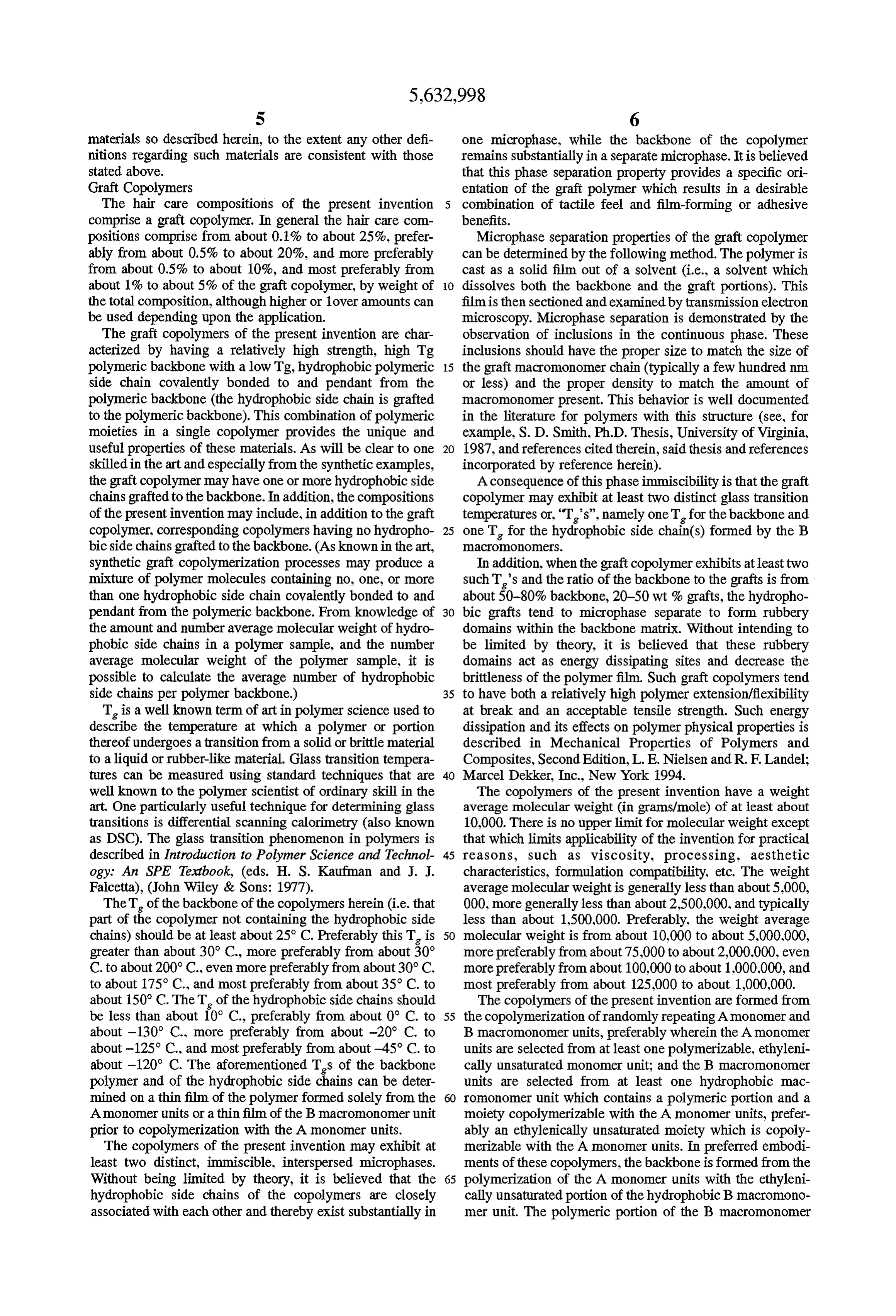
S 6 materials so described herein, to the extent any other defi one microphase, while the backbone of the copolymer nitions regarding such materials are consistent with those remains substantially in a separate microphase. It is believed stated above. that this phase separation property provides a specific ori Graft Copolymers entation of the graft polymer which results in a desirable The hair care compositions of the present invention combination of tactile feel and film-forming or adhesive comprise a graft copolymer. In general the hair care com benefits.
positions comprise from about 0.1% to about 25%, prefer Microphase separation properties of the graft copolymer ably from about 0.5% to about 20%, and more preferably can be determined by the following method. The polymer is from about 0.5% to about 10%, and most preferably from cast as a solid film out of a solvent (i.e., a solvent which about 1% to about 5% of the graft copolymer, by weight of O dissolves both the backbone and the graft portions). This the total composition, although higher or lover amounts can filmis then sectioned and examined by transmission electron be used depending upon the application. microscopy. Microphase separation is demonstrated by the The graft copolymers of the present invention are char observation of inclusions in the continuous phase. These acterized by having a relatively high strength, high Tg inclusions should have the proper size to match the size of polymeric backbone with a low Tg, hydrophobic polymeric 15 the graft macromonomer chain (typically a few hundred nm. side chain covalently bonded to and pendant from the or less) and the proper density to match the amount of polymeric backbone (the hydrophobic side chain is grafted macromonomer present. This behavior is well documented to the polymeric backbone). This combination of polymeric in the literature for polymers with this structure (see, for moieties in a single copolymer provides the unique and example, S. D. Smith, Ph.D. Thesis, University of Virginia, useful properties of these materials. As will be clear to one 20 1987, and references cited therein, said thesis and references skilled in the art and especially from the synthetic examples, incorporated by reference herein). the graft copolymer may have one or more hydrophobic side A consequence of this phase immiscibility is that the graft chains grafted to the backbone. In addition, the compositions copolymer may exhibit at least two distinct glass transition of the present invention may include, in addition to the graft temperatures or, "T's", namely one T for the backbone and copolymer, corresponding copolymers having no hydropho 25 one T for the hydrophobic side chain(s) formed by the B bic side chains grafted to the backbone. (As known in the art, COOOCS
Synthetic graft copolymerization processes may produce a In addition, when the graft copolymer exhibits at least two mixture of polymer molecules containing no, one, or more such T's and the ratio of the backbone to the grafts is from than one hydrophobic side chain covalently bonded to and about 50-80% backbone, 20-50 wt % grafts, the hydropho pendant from the polymeric backbone. From knowledge of 30 bic grafts tend to microphase separate to form rubbery the amount and number average molecular weight of hydro domains within the backbone matrix. Without intending to phobic side chains in a polymer sample, and the number be limited by theory, it is believed that these rubbery average molecular weight of the polymer sample, it is domains act as energy dissipating sites and decrease the possible to calculate the average number of hydrophobic brittleness of the polymer film. Such graft copolymers tend side chains per polymer backbone.) 35 to have both a relatively high polymer extension/flexibility T is a well known term of artin polymer science used to at break and an acceptable tensile strength. Such energy describe the temperature at which a polymer or portion dissipation and its effects on polymer physical properties is thereof undergoes a transition from a solid or brittle material described in Mechanical Properties of Polymers and to a liquid or rubber-like material. Glass transition tempera Composites, Second Edition, L. E. Nielsen and R. F. Landel; tures can be measured using standard techniques that are 40 Marcel Dekker, Inc., New York 1994.
well known to the polymer scientist of ordinary skill in the The copolymers of the present invention have a weight art. One particularly useful technique for determining glass average molecular weight (in grams/mole) of at least about transitions is differential scanning calorimetry (also known 10,000. There is no upper limit for molecular weight except as DSC). The glass transition phenomenon in polymers is that which limits applicability of the invention for practical described in Introduction to Polymer Science and Technol 45 reasons, such as viscosity, processing, aesthetic ogy: An SPE Textbook, (eds. H. S. Kaufman and J. J. characteristics, formulation compatibility, etc. The weight Falcetta), (John Wiley & Sons: 1977). average molecular weight is generally less than about 5,000, The T of the backbone of the copolymers herein (i.e. that 000, more generally less than about 2,500,000, and typically part of the copolymer not containing the hydrophobic side less than about 1,500,000. Preferably, the weight average chains) should be at least about 25° C. Preferably this T is 50 molecular weight is from about 10,000 to about 5,000,000, greater than about 30° C., more preferably from about 30° more preferably from about 75,000 to about 2,000,000, even C. to about 200° C., even more preferably from about 30°C. more preferably from about 100,000 to about 1,000,000, and to about 175°C., and most preferably from about 35° C. to most preferably from about 125,000 to about 1,000,000. about 150° C. The T of the hydrophobic side chains should The copolymers of the present invention are formed from be less than about 10° C., preferably from about 0° C. to 55 the copolymerization of randomly repeating Amonomer and about -130° C., more preferably from about -20° C. to B macromonomer units, preferably wherein the Amonomer about -125° C., and most preferably from about -45° C. to units are selected from at least one polymerizable, ethyleni about -120° C. The aforementioned Ts of the backbone cally unsaturated monomer unit; and the B macromonomer polymer and of the hydrophobic side chains can be deter units are selected from at least one hydrophobic mac mined on a thin film of the polymer formed solely from the romonomer unit which contains a polymeric portion and a Amonomer units or a thin film of the B macromonomer unit moiety copolymerizable with the Amonomer units, prefer prior to copolymerization with the A monomer units. ably an ethylenically unsaturated moiety which is copoly The copolymers of the present invention may exhibit at merizable with the Amonomer units. In preferred embodi least two distinct, immiscible, interspersed microphases. ments of these copolymers, the backbone is formed from the Without being limited by theory, it is believed that the 65 polymerization of the A monomer units with the ethyleni hydrophobic side chains of the copolymers are closely cally unsaturated portion of the hydrophobic B macromono associated with each other and thereby exist substantially in mer unit. The polymeric portion of the B macromonomer
Page 5
units forms the hydrophobic side chains of the copolymer. of acrylic acid esters; methacrylic acid esters; N-alkyl acry The A monomer units and B macromonomer units can be lamides; vinyl compounds, vinylidene compounds; unsatur selected from a wide variety of structures as long as the ated hydrocarbons (e.g., olefins, including straight chain, copolymer has the required properties of solubility, T's, and branched chain, and cycloaliphatic olefins and aromatic molecular weights described herein. ethylenically unsaturated compounds); C1-C1s alcohol The A monomer units and the hydrophobic B mac esters of organic acids and organic acid anhydrides; and romonomer units comprise or are derived from hydrophobic combinations thereof.
monomers and optionally a limited amount of hydrophilic Representative examples of such hydrophobic monomers monomers. The particular relative amounts of hydrophilic include acrylic or methacrylic acid esters of C-C, and hydrophobic monomers can vary as long as the graft copolymeras a whole is soluble in the hydrophobic, volatile, 10 alcohols,
such as methanol, ethanol, methoxy ethanol,
solventhereof. Solubility of the graft copolymer material (or 1-pentanol, 2-pentanol 3-pentanol, 2-methyl-1-butanol, component thereof) in the hydrophobic, volatile solvents 1-methyl-1-butanol 3-methyl-1-butanol, 1-methyl-1- hereof is determined according to whether such material can pentanol, 2-methyl-1-pentanol, 3-methyl-1-pentanol, stay in solution or precipitates out of solution at 25°C. at the 15 concentration present in a given composition. Graft copoly t-butanol (2-methyl-2-propanol), cyclohexanol, neodecanol, mers that are soluble in such solvents typically comprise 2-ethyl-1-butanol, 3-heptanol, benzyl alcohol, 2-octanol, from about from about 50% to about 100% by weight, of 6-methyl-1-heptanol, 2-ethyl- 1-hexanol, 3,5-dimethyl-1- hydrophobic monomers and from about 0% to about 50%, hexanol, 3.5.5-tri methyl-1-hexanol. 1-decanol, by weight, of hydrophilic monomer units. 1-dodecanol, 1-hexadecanol, 1-octa decanol, and the like, By appropriate selection and combination of the particular 20 the alcohols having from about 1-18 carbon atoms with the A monomer units and B macromonomer units, and by the number of carbon atoms preferably being from about 1-12; choice of specific relative ratios of the units well within the dicyclopentenyl acrylate; 4-biphenyl acrylate; pentachlo ability of one of ordinary skill in the art, the copolymers can rophenyl acrylate; 3,5-dimethyladamantyl acrylate; 3.5- be optimized for various physical properties such as dimethyladamentyl methacrylate; solubility. T's, and the like, and for compatibility with other 25 4-methoxycarbonylphenyl methacrylate; trimethylsilyl ingredients commonly used in hair care applications. methacrylate; styrene; alkyl substituted styrenes including AMonomer Units alpha-methylstyrene and t-butylstyrene; vinyl esters, includ The A monomer unit is selected from copolymerizable ing vinyl acetate, vinyl neononanoate, vinyl pivalate and monomers, preferably ethylenically unsaturated monomers. vinyl propionate; vinyl chloride; vinylidene chloride; vinyl Either a single type of A monomer or combinations of two 30 toluene; alkyl vinyl ethers, including isobutyl vinyl ether or more Amonomers can be utilized. The Amonomers are ands-butyl vinyl ether; butadiene; cyclohexadiene; bicyclo selected to meet the requirements of the copolymer. By heptadiene; 2,3-dicarboxylmethyl-1,6-hexadiene; ethylene; "copolymerizable", as used herein, is meant a material can propylene; indene; norbornylene; B-pinene; C-pinene; and be reacted with another material (e.g., the Amonomer and combinations thereof.
B macromonomer) in a polymerization reaction using one or 35 Preferred hydrophobic monomers suitable for use as the A more conventional synthetic techniques, such as ionic, monomer units include n-butyl methacrylate, isobutyl emulsion, dispersion, Ziegler-Natta, free radical, group methacrylate, t-butyl acrylate, t-butyl methacrylate, transfer or step growth polymerization. In the present 2-ethylhexyl methacrylate, methyl methacrylate, indene, invention, monomers and macromonomers that are copoly norbornylene, B-pinene, o-pinene, vinyl pivalate, vinyl merizable using conventional free radical initiated tech 40 neononanoate, dicyclopentenyl acrylate, 4-biphenyl niques are preferred. The term "ethylenically unsaturated” is a crylate, penta chlorophenyl acrylate, 3,5- used herein to mean a material (including preferred A dimethyladamentyl acrylate, 3,5-dimethyladamentyl monomers and B macromonomers) that contains at least one methacrylate, 4-methoxycarbonyphenyl methacrylate, trim polymerizable carbon-carbon double bond (which can be ethylsilyl methacrylate, t-butyl styrene and combinations mono-, di-, tri-, or tetra-substituted). The Amonomer units 45 thereof. Most preferably, the hydrophobic monomer is and B Macromonomers preferably consist of monomers selected from t-butyl styrene, t-butyl acrylate, t-butyl that, when polymerized, form a saturated polymer. The A methacrylate, and combinations thereof.
monomer units of the copolymers of the present invention Nonlimiting classes of A monomers useful herein also can comprise from about 30% to about 95%, more prefer include hydrophilic monomers selected from the group ably from about 35% to about 85%, and most preferably 50 consisting of unsaturated mono-, di- and poly-carboxylic from about 50% to about 80%, by weight, of the copoly acids; (meth)acrylamides; (meth)acrylates; (meth)acrylate CTS. alcohols; organic acid anhydrides; esters of organic acid A wide variety of A monomer units can be used in the anhydrides; hydrophilic vinyl compounds; hydrophilicallyl present invention, including mixtures of two of more compounds; hydrophilic imides; salts of any such com monomers, so long as the T molecular weight, and solu 55 pounds; and combinations thereof.
bility requirements of the graft copolymers are met. The A Representative examples of such hydrophilic monomers monomer units include hydrophobic monomer units and include acrylic acid, methacrylic acid, N.Noptionally hydrophilic monomer units. The polymeric back dimethylacrylamide, dimethylaminoethyl methacrylate, bone will preferably comprise from about 50% to about quaternized dimethylaminoethyl methacrylate, 100%, more preferably from about 60% to about 98%, most 60 methacrylamide, N-t-butyl acrylamide, maleic acid, maleic preferably from about 75% to about 95%, by weight of the anhydride and its half esters, crotonic acid, itaconic acid, polymer, of hydrophobic monomer units, and from about 0% acrylamide, acrylate alcohols, hydroxyethyl methacrylate, to about 50%, preferably from about 2% to about 40%, more dialyldimethyl ammonium chloride, vinyl pyrrolidone, preferably from about 5% to about 25%, of hydrophilic vinyl ethers (such as methyl vinyl ether), maleimides, vinyl monomer units. 65 pyridine, vinyl imidazole, other polar vinyl heterocyclics, Nonlimiting classes of Amonomers useful herein include styrene sulfonate, allyl alcohol, vinyl alcohol (such as that hydrophobic monomers selected from the group consisting produced by the hydrolysis of vinyl acetate after
Page 6
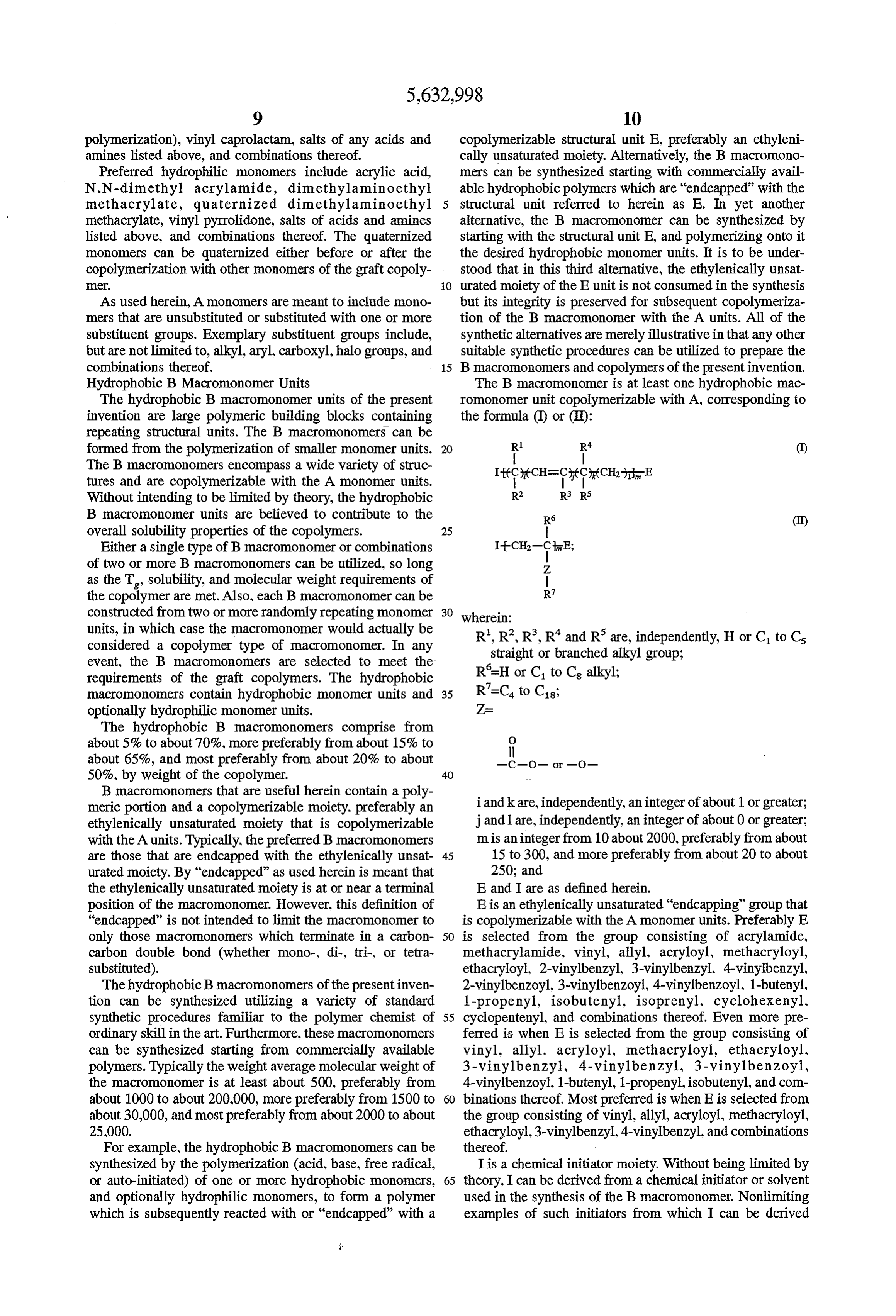
polymerization), vinyl caprolactam, salts of any acids and copolymerizable structural unit E, preferably an ethyleni amines listed above, and combinations thereof. cally unsaturated moiety. Alternatively, the B macromono Preferred hydrophilic monomers include acrylic acid, mers can be synthesized starting with commercially avail N,N-dimethyl acrylamide, dimethylaminoethyl able hydrophobic polymers which are "endcapped" with the methacrylate, quaternized dimethylaminoethyl structural unit referred to herein as E. In yet another methacrylate, vinyl pyrrolidone, salts of acids and aminesalternative, the B macromonomer can be synthesized by listed above, and combinations thereof. The quaternized starting with the structural unit E, and polymerizing onto it monomers can be quaternized either before or after the the desired hydrophobic monomer units. It is to be under copolymerization with other monomers of the graft copoly stood that in this third alternative, the ethylenically unsat . O urated moiety of the E unit is not consumed in the synthesis As used herein, Amonomers are meant to include mono but its integrity is preserved for subsequent copolymeriza mers that are unsubstituted or Substituted with one or more tion of the B macromonomer with the A units. All of the Substituent groups. Exemplary substituent groups include, synthetic alternatives are merely illustrative in that any other suitable synthetic procedures can be utilized to prepare the but are not limited to, alkyl, aryl, carboxyl, halo groups, and combinations thereof. 15 B macromonomers and copolymers of the present invention. Hydrophobic B Macromonomer Units The B macromonomer is at least one hydrophobic mac The hydrophobic B macromonomer units of the present romonomer unit copolymerizable with A, corresponding to invention are large polymeric building blocks containing the formula (D or ():
repeating structural units. The B macromonomers can be formed from the polymerization of Smaller monomer units. 20 (I) The B macromonomers encompass a wide variety of struc tures and are copolymerizable with the A monomer units. It'sR2 CH=yer Christ
Without intending to be limited by theory, the hydrophobic R3 R5
B macromonomer units are believed to contribute to the (II) overall solubility properties of the copolymers. 25
Either a single type of B macromonomer or combinations I+CH-i-E, of two or more B macromonomers can be utilized, so long Z.
as the T solubility, and molecular weight requirements of R7 the copolymer are met. Also, each B macromonomer can be constructed from two or more randomly repeating monomer wherein:
units, in which case the macromonomer would actually be R", R, R, R and Rare, independently, H or C to Cs considered a copolymer type of macromonomer. In any straight or branched alkyl group; event, the B macromonomers are selected to meet the requirements of the graft copolymers. The hydrophobic R=H or C, to Cs alkyl;
macromonomers contain hydrophobic monomer units and 35 R’=C, to Cls;
optionally hydrophilic monomer units. Z
The hydrophobic B macromonomers comprise from about 5% to about 70%, more preferably from about 15% to O about 65%, and most preferably from about 20% to about -C-O- or -O- 50%, by weight of the copolymer. 40
B macromonomers that are useful herein contain a poly meric portion and a copolymerizable moiety, preferably an i and kare, independently, an integer of about 1 or greater; ethylenically unsaturated moiety that is copolymerizable jandare, independently, an integer of about 0 or greater; with the A units. Typically, the preferred B macromonomers mis an integer from 10 about 2000, preferably from about are those that are endcapped with the ethylenically unsat 45 15 to 300, and more preferably from about 20 to about urated moiety. By "endcapped” as used herein is meant that 250; and the ethylenically unsaturated moiety is at or near a terminal E and I are as defined herein. position of the macromonomer. However, this definition of E is an ethylenically unsaturated "endcapping” group that "endcapped' is not intended to limit the macromonomer to is copolymerizable with the Amonomer units. Preferably E only those macromonomers which terminate in a carbon 50 is selected from the group consisting of acrylamide, carbon double bond (whether mono-, di-, tri-, or tetra methacrylamide, vinyl, allyl, acryloyl, methacryloyl, substituted). ethacryloyl, 2-vinylbenzyl, 3-vinylbenzyl, 4-vinylbenzyl, The hydrophobic B macromonomers of the present inven 2-vinylbenzoyl, 3-vinylbenzoyl, 4-vinylbenzoyl, 1-butenyl, tion can be synthesized utilizing a variety of standard 1-propenyl, isobutenyl, isoprenyl, cyclohexenyl, synthetic procedures familiar to the polymer chemist of 55 cyclopentenyl, and combinations thereof. Even more pre ordinary skillin the art. Furthermore, these macromonomers ferred is when E is selected from the group consisting of can be synthesized starting from commercially available vinyl, allyl, acryloyl, methacryloyl ethacryloyl, polymers. Typically the weight average molecular weight of 3-vinylbenzyl, 4-vinylbenzyl, 3-vinylbenzoyl, the macromonomer is at least about 500, preferably from 4-vinylbenzoyl, 1-butenyl, 1-propenyl, isobutenyl, and com about 1000 to about 200,000, more preferably from 1500 to binations thereof. Most preferred is when E is selected from about 30,000, and most preferably from about 2000 to about the group consisting of vinyl, allyl, acryloyl, methacryloyl, 25,000. ethacryloyl, 3-vinylbenzyl, 4-vinylbenzyl, and combinations For example, the hydrophobic B macromonomers can be thereof.
synthesized by the polymerization (acid, base, free radical, I is a chemical initiator moiety. Without being limited by or auto-initiated) of one or more hydrophobic monomers, 65 theory, I can be derived from a chemical initiator or solvent and optionally hydrophilic monomers, to form a polymer used in the synthesis of the B macromonomer. Nonlimiting which is subsequently reacted with or "endicapped” with a examples of such initiators from which I can be derived
Page 7
include hydrogen ion, hydrogen radical, hydride ion, 1,3-butadiene, isoprene etc.). A wide variety of initiating hydroxide ion, hydroxyl radical, peroxide radical, peroxide systems can be used, nonlimiting examples of which include anion, C1-20 carbocations, C1-20 carbanions (e.g., sec cationic initiators, such as cumyl acetate/TiCl, cumyl butyl carbanions, and 1,1-diphenyl-4-methylpentyl methyl ether/BCl; and anionic initiators such as n-butyl carbanion), C1-20 carbon radicals, C1-20 aliphatic and lithium, sec-butyl lithium, t-butyl lithium, lithium aluminum aromatic alkoxy anions, ammonium ion, substituted ammo hydride, sodium hydride, and the like. Nonlimiting nium ions (e.g., C1-20 alkyl and C1-20 alkoxy substituted), examples of these initiating systems are provided in and C1-20 carbanions (e.g., cumyl carbocation). I can be Designed Polymers by Carbocationic Macromolecular derived from any useful solvent, nonlimiting examples of Engineering, Theory and Practice, J. P. Kennedy and B. which inlcude water, methanol ethanol, propanol. 10 Anionic Ivan, Chapter II, p.5, Hanser Publishers, N.Y. (1991), and in isopropanol, acetone, hexane, dichloromethane, chloroform, Polymerization: Principles and Practice, Maurice benzene, and toluene. Nonlimiting examples of I include Morton, Chapter 2, p. 13, Academic Press, N.Y. (1983). chemical moieties selected from the group consisting of In the case of cationic polymerization, once the desired hydrogen, C1-40 straight or branched chain alkyl, benzyl, degree of polymerization is complete the polymer is isolated 1-phenyl substituted C2-40 straight or branched chain alkyl, 15 orand further derivatized to obtain vinyl benzyl, methacryloyl acryloyl end capped polymer. A nonlimiting example of 1,1-diphenyl substituted C2-40 straight or branched chain a macromonomer alkyl, and combinations thereof. More preferably I is poly(isobutylene). synthesized by cationic polymerization is In the case of anionic polymerization, selected from the group consisting of 1, 1-diphenyl 14 methylpentyl, sec-butyl, and cumyl. Most preferably I is once the desired degree of polymerization is achieved, an sec-butyl or cumyl. 20 appropriate endcapping reagent is typically used to termi R. R. R. R. and Rare suitably independently derived Nonlimitingnate the polymerization and to endcap the macromonomer. from monomer units such as those described in reference to examples of these endcapping reagents include the Amonomer units. Preferred monomers are selected from 2-vinylbenzyl chloride, 3-vinylbenzyl chloride, the group consisting of ethylenically unsaturated, straight or 4-vinylbenzyl chloride, and the like. Alternatively, the end branched hydrocarbons and ethylenically unsaturated esters 25 capping can be achieved by reacting the polymeric reaction of acrylic acid and methacrylic acid. Preferred such mono the mixture with one equivalent of ethylene oxide to terminate mers are hydrocarbons selected fromisobutylene, butadiene, polymer with a -CHCH-O-moiety, followed by isoprene, 1-butene, 5-methyl-1-hexene, 6-methyl-1-heptene, acid reaction with an endcapping reagent such as an unsaturated 44-dimethyl-1-pentene etc.; esters of acrylic acid and an halide.
Preferred alcohol selectcd from n-butyl, dodecyl 2-ethylhexyl, 30 Particularly Polymers of the Present Invention 2-ethylbutyl, n-ethyl, n-heptyl, n-hexyl, iso-butyl, iso-decyl preferred polymers for use in the present iso-propyl, 3-methylbutyl, 2-methylpentyl, nonyl, octyl, and invention include the following (the weight percents below propyl alcohol; and esters of methacrylic acid and an alcohol refer to the amount of reactants added in the polymerization selected from dodecyl, 2-ethylhexyl, hexyl, decyl reaction, not necessarily the amount in the finished octadecyl, octyl, n-pentyl, and tridecyl alcohol. 35 polymer):
Nonlimiting examples of these endcapped hydrophobic (i) Polypoly(tert-butylacrylate)-graft-poly(isobutylene) macromonomers include acryloyl, methacryloyl, or 2-3- or macromonomer (80/20 wiv); total graft copolymer 4-vinyl benzyl endcapped polymers of methacrylic or weight avenge molecular weight of 100.000; mac acrylic acid esters, Such as, poly(n-butyl acrylate), poly romonomer weight average molecular weight 5000. (dodecyl acrylate), poly(2-ethylhexyl acrylate), poly(2- 40 (ii) Polypoly(4-tert-butylstyrene)- graft-poly ethylbutyl acrylate), poly(n-ethyl acrylate), poly(n-heptyl (isobutylene) macromonomer (70/30 wifw); total graft acrylate), poly(n-hexyl acrylate), poly(iso-butyl acrylate), copolymer weight avenge molecular weight of 150, poly(iso-decyl acrylate), poly(iso-propyl acrylate), poly(3- 000; macromonomer weight avenge molecular weight methylbutyl acrylate), poly(2-methylpentyl acrylate), poly 3000.
(nonyl acrylate), poly(octyl acrylate), poly (2-ethylhexyl 45 (iii) Poly(4-tert-butylstyrene)-graft-poly(2-ethylhexyl methacrylate), poly(tridecyl methacrylate), poly(n-pentyl methacrylate) macromonomer) (80/20 w/w); total graft methacrylate), poly(octyl methacrylate), poly(octadecyl copolymer weight average molecular weight of 150, methacrylate), poly(dodecyl methacrylate), poly(n-pentyl 000; macromonomer weight average molecular weight methacrylate). Other examples include, methacryloyl, acry 10,000.
loyl or 2-, 3-, or 4-vinyl benzyl endcapped polymers of 50 (iv) Poly(tert-butylacrylate-co-styrene)-graft-poly poly(isobutylene), poly(isoprene), hydrogenated poly(1,2- (isobutylene) (60/20/20 w/w/w);total graft copolymer butadiene), hydrogenated poly(1,4-butadiene), hydroge weight average molecular weight of 100,000; mac nated poly(isoprene), poly(1.2-butadiene), poly(1-butene). romonomer weight average molecular weight 5000. poly(5-methyl-1-hexene), poly(6-methyl-1-heptene), poly Synthesis of the Graft Copolymers (44-dimethyl-1-pentene), and poly(iso-butyl vinyl ether). 55 The graft copolymers can be made by free radical poly Examples of other macromonomers include "copolymer" merization of the Amonomers with the B macromonomers. type B macromonomers containing two or more randomly It is not intended to necessarily exclude from this invention repeating monomer units. Nonlimiting examples of these any copolymers made by means other than free radical "copolymer" type of macromonomers include acryloyl end polymerization, so long as the product has the desired capped poly(4-t-butyl vinyl benzene-co-2-ethylhexyl 60 physical properties. The copolymers herein are formed from acrylate), poly 2-ethylhexyl acrylate-co-octyl acrylamide), randomly repeating A monomer units, and B macromono poly[2-ethyl vinyl benzene-co-octyl methacrylate)), and the mer units.
like. The general principles of free radical polymerization The endcapped hydrophobic macromonomers can be syn methods are well understood. See, for example, Odian, thesized using standard synthetic procedures which involve 65 "Principles of Polymerization", 2nd edition, John Wiley & polymerzing, usually under cationic or anionic initiation Sons, 1981, pp. 179-318. The desired monomers and mac conditions, the appropriate monomer unit, (e.g., isobutylene, romonomers are all placed in a reactor, along with a suffi
Page 8
cient amount of a mutual solvent so that when the reaction The graft copolymer is soluble in the hydrophobic, vola is complete the viscosity of the reaction is reasonable. tile solvent in the present compositions. In general, the Typical monomer and macromonomer loadings are from copolymer should be soluble at 25° C. at a concentration of about 10% to about 50%, on a weight basis. Undesired 0.1% by weight of the solvent, preferably at 1%, more terminators, especially oxygen, can be removed as needed. preferably at 5%, most preferably at 15%. This is done by evacuation or by purging with an inert gas, The hydrophobic, volatile solvent, however, is insolubie such as argon or nitrogen. The initiator is introduced and the in aqueous carriers of the composition. This is determined in reaction brought to the temperature needed for initiation to the absence of the copolymer, or other emulsifying agents, occur, assuming thermal initiators are used. Nonlimiting and can easily be verified by observing whether the solvent examples of suitable initiators include those selected from O and aqueous carrier form separate phases after being mixed the group consisting of azo initiators, peroxide initiators, together at room temperature (as viewed without redox initiators, and photochemical initiators. The polymer magnification).
ization is allowed to proceed as long as needed for a high Preferred hydrophobic, volatile branched chain hydrocar level of conversion to be achieved, typically from a few bons useful as the solvent herein contain from about 10 to hours to a few days. The solvent is then removed, usually by 15 about 16, more preferably from about 12 to about 16, most evaporation or by precipitating the copolymer by addition of preferably from about 12 to about 14 carbon atoms. (E.g., a nonsolvent. The copolymer can be further purified, as preferred branched chain hydrocarbons include Co-C needed utilizing a variety of techniques including filtration, branched chain hydrocarbons, C-C branched chain extraction, membrane separation, gel permeation hydrocarbons, and C branched chain hydrocarbons). Satu chromatography, and the like. rated hydrocarbons are preferred, although it is not intended There are numerous variations on these procedures which to exclude unsaturated hydrocarbons. Examples of such are entirely up to the discretion of the synthetic chemist preferred branched chain hydrocarbons include isoparaffins (e.g., choice of degassing method and gas, choice of initiator of the above chain sizes. Isoparaffins are commercially type, extent of conversion, reaction loading, etc). The choice available from Exxon Chemical Co.; examples include of initiator and solvent are often determined by the require IsoparTM and K (C-C isoparaffins), and IsopartM ments of the particular monomers and macromonomer used, 25 (C-C isoparaffins). Other suitable branched chain hydro because different monomers and macromonomers have dif carbons are isododecane and isohexadecane. Isododecane is ferent solubilities and different reactivities to a specific preferred and is commercially available from Preperse, Inc. initiator. (South Plainfield, N.J., U.S.A.) as PermethylTM 99A. The copolymers of the present invention can also be Preferred silicones useful as the hydrophobic, volatile synthesized by first preparing a reactive, intermediary poly 30 solventherein include hydrophobic, volatile siloxanes (such mer from A monomer units, followed by further polymer as phenylpentamethyl disiloxane, phenylethyl pentamethyl ization of the resulting intermediary copolymer with suitable disiloxane, hexamethyl disiloxane, methox3propyl heptam monomers to form the hydrophobic side chains. ethyl cyclotetrasiloxane, chloropropyl pentamethyl Analysis of the graft copolymer reaction product and the disiloxane, hydroxypropyl pentamethyl disiloxane, extracted materials, and the purified graft copolymer can be 35 cyclomethicones, including octamethyl cyclotetrasiloxane performed by conventional analysis techniques known in the and decamethyl cyclopentasiloxane), and mixtures thereof. art. These include, for example, nuclear magnetic resource Preferred solvents are cyclomethicones, more preferably (NMR), infrared molecular spectroscopies, gel permeation/ octamethyl cyclotetrasiloxane and decamethyl cyclopenta size exclusion chromatography, membrane osmometry, and siloxane.
atomic absorption and emission spectroscopies. 40
Hair Care Compositions
Solvent For The Graft Copolymer
The compositions of the present invention comprise a The compositions of the present invention also comprise hydrophobic, volatile, liquid which is a solvent for the graft a suitable carrier or hair care matrix for delivering the graft copolymers of the present invention. Suitable solvents are copolymer and the hydrophobic, volatile solvent to the hair. selected from hydrophobic, volatile branched chain 45 Any carrier suitable for delivery of the copolymer? hydrocarbons, silicones and combinations thereof. hydrocarbon solvent to the hair can be used. The carrier can In general, the present compositions will comprise from comprise a volatile liquid which is water or is otherwise about 0.1% to about 75%, preferably from about 0.2% to water soluble, or a mixture thereof and in which the volatile about 25%, and more preferably from about 0.5% to about solvent of the copolymer is not soluble. In general, the 15%, of the solvent. The weight ratio of linear copolymer to 50 compositions will comprise from about 50% to about 99.3%, solvent is generally from about 1: 100 to about 5:1, prefer preferably from about 70% to about 99%, more preferably ably from about 1:10 to about 1:1, more preferably from from about 85% to about 98%, of carrier or hair care matrix. about 1:8 to about 2:3. The carrier liquid herein can include water or other The hydrophobic, volatile solvent exhibits a significant hydrophilic fluids, and combinations thereof. Suitable car vapor pressure at ambient conditions (e.g., atmosphere, 55 rier fluids for use in the present invention, in addition to 25°C.), as is understood by those in the art. As used herein, water, include lower alcohols (C-C alcohols, preferably the term “volatile” refers to solvents having a boiling point C-C alcohols such as ethanol and isopropanol) and mix at one atmosphere of 260° C. or less, preferably 250° C. or tures of lower alcohols. Preferred solvents include water, less, more preferably 230° C. or less, most preferably 225° ethanol, and mixtures thereof. Especially preferred is water. C. or less. In addition, the boiling point or the hydrophobic, 60 The preferred compositions are in the form of a discon volatile solvent will generally be at least about 50° C., tinuous phase of dispersed droplets, or particles, of the preferably at least about 100° C. The term “nonvolatile", on copolymer and the hydrophobic volatile solvent distributed the other hand, shall refer to solvents which have a boiling throughout the carrier. The carrier can also comprise a point at one atmosphere of greater than 260° C. The solvent variety of other components, such as other active should also be acceptable for topical application to the hair 65 ingredients, theology modifiers such as thickeners, gelling and skin (i.e., no undue irritation, sensitization or other. agents, etc. The compositions of the present invention can be reactions are induced by the solvent). in the form of liquids, lotions, creams gels, etc.
Page 9
The carrier may include gel vehicle materials or other which are capable of producing highly viscous aqueous theology modifiers. These are particularly contemplated for solutions in practical concentrations. These materials are use in products such as hair rinses, shampoos, mousses, and nonionic cellulose ethers having a sufficient degree of non creams and lotions. ionic substitution selected from the group consisting of Gel vehicles can comprise two essential components: a be methyl, hydroxyethyl, and hydroxypropyl to cause them to water-soluble and which are further substituted with a lipid vehicle material and a surfactant vehicle material. Gel hydrocarbon radical having from about 10 to 24 carbon vehicles are generally described in the following documents: atoms in an amount between about 0.2 weight percent and Barry, "The Self Bodying Action of the Mixed Emulsifier the amount which renders said cellulose ether less than 1%, Sodium Dodecyl Sulfate/Cetyl Alcohol". 28 J. of Colloid by weight, soluble in water.
and Interface Science 82-91 (1968); Barry, et al., "The modified is preferably one of The 10 cellulose ether to be
Self-Bodying Action of Alkyltrimethylammonium weight; i.e. less than about 800,000 and medium low to molecular Bromides/Cetostearyl Alcohol Mixed Emulsifiers; Influence about 20,000 and 700,000 (about 75 to 2500 D.P).between preferably of Quaternary Chain Length",35J. of Colloid and Interface used, commercially-available nonionic cellulose Widely ethers Science 689-708 (1971); and Barry, et al., “Rheology of include methyl cellulose, hydroxy propyl methyl cellulose, Systems Containing Cetomacrogol 1000-Cetostearyl 15
Alcohol, I. Self Bodying Action", 38 J. of Colloid and hydroxyethylhydroxyethyl cellulose, hydroxypropyl cellulose and ethyl cellulose.
Interface Science 616-625 (1972). Other carrier ingredients for use in the compositions of The carrier may incorporate one or more lipid vehicle materials which are essentially water-insoluble, and which 20 the present invention, especially for hair rinses, include contain hydrophobic and hydrophilic moieties. Lipid vehicle meric materialsof one combinations or more nonionic, water soluble poly that have been hydrophobically-modified materials include naturally or synthetically-derived acids, (hereinafter alternatively referred to as "hydrophobically acid derivatives, alcohols, esters, ethers, ketones, and modified nonionic water-soluble polymer”), with one or amides with carbon chains of from about 12 to about 22, more surfactants, such preferably from about 16 to about 18, carbon atoms in 25 (such as ditallowdimethyl ammonium as quaternary ammonium compounds length. Fatty alcohols and fatty esters are preferred; fatty vehicles are described in detail in the following chloride). These alcohols are particularly preferred. patents: U.S.
Preferred esters for use herein include cetyl palmitate and U.S. Pat. No. 5,100,658, issued Mar. 31, 1992 to Bolich et glycerylmonostearate. Cetyl alcohol and stearyl alcohol are al., U.S. Pat. No. 5,104,646, issued Apr. 14, 1992 to Bolich preferred alcohols. A particularly preferred lipid vehicle 30 et al, and U.S. Pat. No. 5,100,657, issued Mar. 31, 1992 to material is comprised of a mixture of cetyl alcohol and Pansher-Jackson et at.
stearyl alcohol containing from about 55% to about 65% (by These systems provide a gel-like rheology without nec weight of mixture) of cetyl alcohol. essarily being gels in the technical sense. When such sys Lipid vehicle materials among those useful herein are tems are used to thicken the present compositions, from disclosed in Bailey's Industrial Oil and Fat Products, (3rd 35 about 0.3% to about 5.0%, preferably from about 0.4% to edition, D. Swem, ed., 1979). Fatty alcohols included among about 3.0%, of the hydrophobically modified nonionic those useful herein are disclosed in the following docu water-soluble polymer is preferably utilized with from about ments: U.S. Pat. No. 3,155,591, Hilfer, issued Nov. 3, 1964: 0.3% to about 5.0%, preferably from about 0.4% to about U.S. Pat. No. 4.165.369, Watanabe, et al., issued Aug. 21, 3.0%, of a water-soluble polymeric thickening material such 1979; U.S. Pat. No. 4,269,824, Villamarin, etat., issued May 40 as described herein.
26, 1981; British Specification 1,532.585, published Nov. By “hydrophobically modified nonionic water-soluble 15, 1978; and Fuku Shima, et al., "The Effect of Cetostearyl polymer" is meant a nonionic water-soluble polymer which Alcohol in Cosmetic Emulsions', 98 Cosmetics de Toiletties 89-112 (1983). Fatty esters included among those useful has been modified by the substitution with a sufficient amount of hydrophobic groups to make the polymer less herein are disclosed in U.S. Pat. No. 3,341,465. Kaufman, et 45 soluble in water. By “water-soluble" what is meant is the al., issued Sep. 12, 1976. If included in the compositions of polymer or salt, thereof, constituting the polymer backbone the present invention, the lipid vehicle material is typically of the thickener should be sufficiently soluble such that it present at from about 0.1% to about 10.0% of the compo forms a substantially clear solution when dissolved in water sition; the cationic surfactant vehicle material is present at at a level of 1%, by weight of the solution, at 25° C. from about 0.05% to about 5.0% of the composition. 50 The polymer backbone of the hydrophobically modified Cationic surfactant materials are suitable for use in the gel nonionic water-soluble polymer can be essentially any vehicles, and include, but are not limited to, those described water-soluble polymer. Examples of water soluble polymers in detail below. The compositions hereof can also contain a useful for forming the hydrophobically modified nonionic lipid vehicle without the inclusion of a cationic surfactant. water-soluble polymer include hydroxyethylcellulose, The use of nonionic cellulose ethers and water-soluble 55 hydroxypropyl cellulose, hydroxypropyl methylcellulose, gums for thickening compositions is also contemplated. See polyethylene glycol, polyacrylamide, polyacrylic acid, poly for example, U.S. Pat. No. 4.557,928. Glover, issued Dec. vinyl alcohol, polyvinyl pyrrollidone, dextrans, for example 10, 1985, teaching a hair conditioner comprising a suspen Dextran purified crude Grade 2P, available from D&O sion system which consists of one of glueart gum, guar gum, Chemicals, plant exudates such as acacia, ghatti, and and hydroxyethylcellulose; and U.S. Pat. No. 4,581,230, 60 tragacanth, seaweed extracts such as sodium alginate, pro Grollier et al., issued Apr. 8, 1986, which teaches cosmetic pylene glycol alginate, sodium carrageenan, cationic poly compositions for treating hair which comprise as thickening mers such as Ucare JR-polymer (a cationic modified agents hydroxyethylcellulose, or water-soluble vegetable hydroxyethyl cellulose available from Union Carbide), natu thickening agents, such as guar gum. ral polysaccharide materials, such as guar gum, locust bean Nonionic water-soluble cellulose ethers are preferred 65 gum, and xanthan gum. Nonionic water-soluble cellulose polymers that can be employed in hair care compositions. ethers are preferred to be employed as the polymer substrate Cellulose ethers are relatively low molecular weight but of such hydrophobically modified polymers. Thus, e.g.,
Page 10
hydroxyethyl cellulose, hydroxypropyl cellulose, methyl surfactant preferably has a molecular weight of less than cellulose, hydroxypropyl methyl cellulose, ethyl hydroxy about 20,000. Essentially any water-insoluble surfactant ethyl cellulose, and methylhydroxyethylcellulose can all be material which meets these requirements will work in the modified. The amount of nonionic substituent such as present invention, however, water-insoluble cationic surfac methyl, hydroxyethyl or hydroxypropyl is taught not to be tant materials are preferred. Cationic surfactants are critical so long as there is an amount sufficient to assure that described below. The following nonexclusive materials are the ether is water-soluble. suitable: stearamide diethanolamine (stearamide DEA), The hydrophobic groups which modify the nonionic cocoamide methanolamine (cocoamide MEA), dimethyl Stearamine oxide, glyceryl monooleate, sucrose stearate, water-soluble polymer can be C to C alkyl, aryl alkyl, PEG-2 stearamine, polyethylene glycol ethers of fatty alkyl aryl groups and mixtures thereof. One or more hydro phobic groups can be attached to the cellulose ether sub alcohols, such as Cetheth-2 of the formula CH-(CH2)- CH-(OCHCH)-OH, where n has an average value of strate via an ether, ester or urethane linkage. The ether 2 (commercially available under the trade name Brij56 from linkage is preferred. ICI Americas), glycerol stearate oilrate, dihydrogenated The degree of hydrophobic substitution on the polymer tallow dimethyl ammonium chloride, polyoxyethylene, backbone should be from about 0.10% to about 1.0%, 15 polyoxypropylene block polymers such as Poloxamer 181, depending on the particular polymer backbone. More of the formula:
generally, the ratio of hydrophilic portion to hydrophobic portion of the polymer is from about 10:1 to about 1000:1. CH3
One commercially available hydrophobically modified non 20 ionic water-soluble polymer material which meets the fore going requirements is NATROSOL PLUS Grade 430, hydrophobically modified hydroxyethylcellulose available wherein available on average x=3, y=30 and Z=3 (commercially from BASF Wyandotte under the trade name from Aqualon Company, Wilmington, Del. This material has Pluronic L-61), hydrogenated tallow dimethyl betaine, and a C6 alkyl substitution of about 0.5% to about 0.9% by 25 hydrogenated tallow amide DEA.
weight. The hydroxyethyl molar substitution for this mate When such systems are used to thicken the present rial is from about 2.8 to about 3.2. The average molecular compositions, from about 0.1% to about 10.0%, preferably weight for the water-soluble cellulose prior to modification from about 0.2% to about 5.0%, of the hydrophobically is approximately 300,000. modified nonionic polymer is generally utilized with from Another material of this type is sold under the trade name about 0.02% to about 10.0%, preferably from about 0.05% NATROSOL PLUS CS Grade D-67, by Aqualon Company, to about 3.0%, most preferably from about 0.05% to about Wilmington, Del. This material has a C alkyl substitution 2.0%, of the water-insoluble surfactant.
of from about 0.50% to about 0.95%, by weight. The Cationic surfactants useful in the compositions of the hydroxyethyl molar substitution for this material is from present invention, including the gel vehicle systems as well about 2.3 to about 3.3. The average molecular weight for the as hydrophobically modified nonionic polymer systems, include those containing amino or quaternary ammonium water-soluble cellulose prior to modification is approxi 35 hydrophilic mately 700,000. moieties which are positively charged when The hydrophobically modified nonionic water-soluble dissolved in the aqueous composition of the present inven polymer can be used in combination with water soluble or tion. Cationic Surfactants among those useful herein are disclosed in more detail below.
water insoluble surfactants. It is also contemplated to utilize a suspending agent to
In this regard, “water-soluble surfactant” means surfac thicken the compositions and/or to suspend the copolymer tant materials which form substantially clear, isotropic solu branched hydrocarbon solvent phase in the carrier. Suitable tions when dissolved in water at 0.2 weight percent at 25°C. suspending agents are long chain acyl derivatives, long The water-soluble surfactant preferably has a molecular chain amine oxides, and mixtures thereof, wherein such weight of less than about 20,000. 45 suspending agents are present in the shampoo compositions Essentially any water-soluble surfactant material which in crystalline form. A variety of such suspending agents are meets these requirements will workin the present invention. described in U.S. Pat. No. 4,741,855, Grote et al., issued However, the following materials have been found to be May 3, 1988. Especially preferred is ethylene glycol dis particularly preferred: cetyl betaine, ammonium lauryl tearate.
Sulfate, ammonium laureth sulfate, cetyl trimethyl ammo 50 Also included among the long chain acyl derivatives nium chloride, and mixtures thereof. useful as suspending agents are the N,N-di(hydrogenated) When such systems are used to thicken the present C-C (preferably C-C more preferably C-Cs) compositions, from about 0.1% to about 10.0%, preferably amidobenzoic acid, or soluble salt (e.g., K, Nasalts) thereof from about 0.2% to about 5.0%, of the hydrophobically particularly N,N-di(hydrogenated)tallow amido benzoic modified nonionic water soluble polymer is generally uti 55 acid which is commercially marketed by Stepan Company lized with from about 0.02% to about 0.30%, preferably (Northfiled, III., U.S.A.).
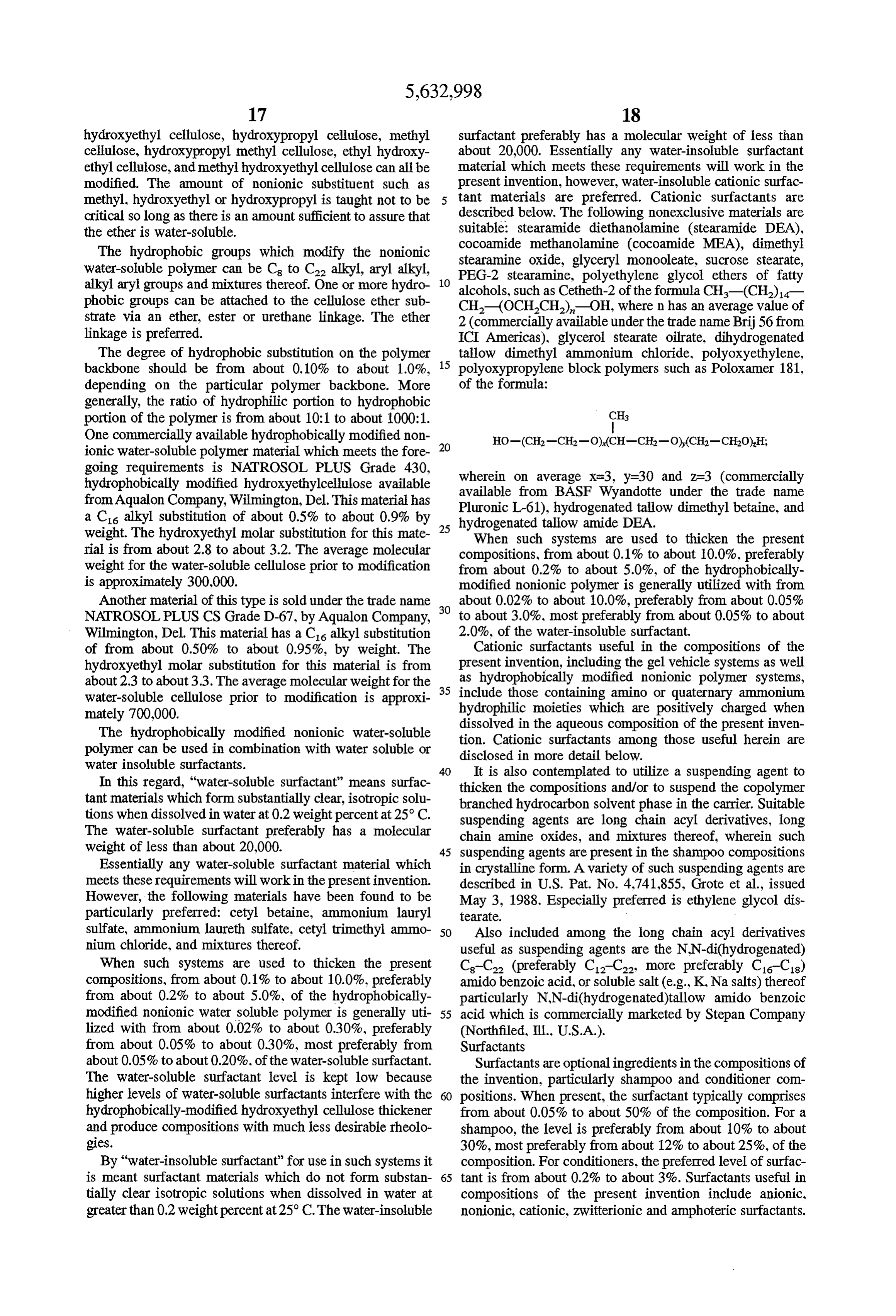
from about 0.05% to about 0.30%, most preferably from Surfactants about 0.05% to about 0.20%, of the water-soluble surfactant. Surfactants are optional ingredients in the compositions of The water-soluble surfactant level is kept low because the invention, particularly shampoo and conditioner com higher levels of water-soluble surfactants interfere with the positions. When present, the Surfactant typically comprises hydrophobically-modified hydroxyethyl cellulose thickener from about 0.05% to about 50% of the composition. For a and produce compositions with much less desirable rheolo shampoo, the level is preferably from about 10% to about gies. 30%, most preferably from about 12% to about 25%, of the By “water-insoluble surfactant" for use in such systems it composition. For conditioners, the preferred level of surfac is meant surfactant materials which do not form substan 65 tant is from about 0.2% to about 3%. Surfactants useful in tially clear isotropic solutions when dissolved in water at compositions of the present invention include anionic, greater than 0.2 weight percent at 25°C. The water-insoluble nonionic, cationic, Zwitterionic and amphoteric surfactants.
Page 11
Synthetic anionic detergents useful herein, particularly for Also U.S. Pat. No. 3,929,678. Laughlin et at., issued Dec. shampoo compositions, include alkyl and alkyl ether sul 30, 1975, discloses many other anionic as well as other fates. These materials typically have the respective formulae surfactant types.
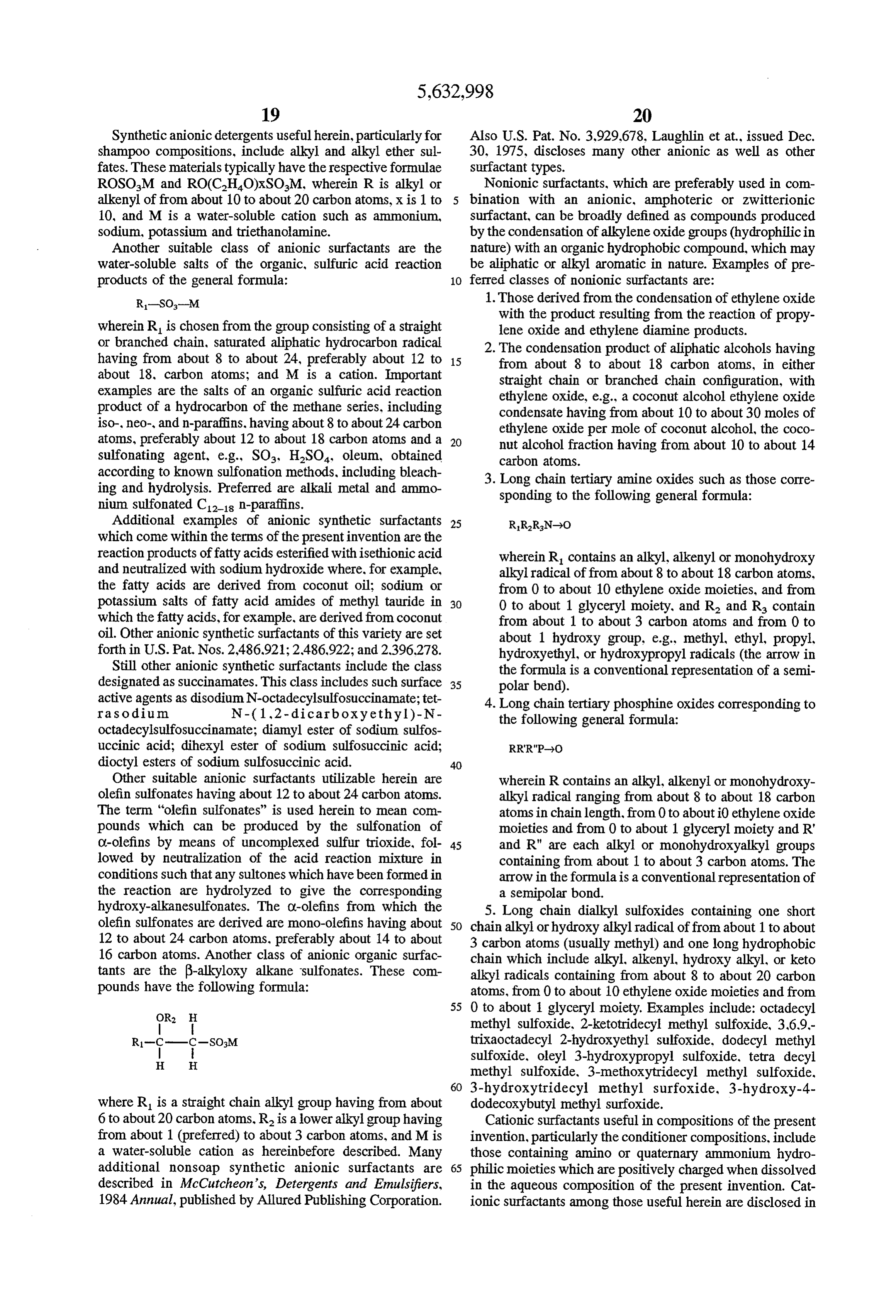
ROSOM and RO(CHO)xSOM, wherein R is alkyl or Nonionic surfactants, which are preferably used in com alkenyl of from about 10 to about 20 carbon atoms, x is 1 to bination with an anionic, amphoteric or zwitterionic 10, and M is a water-soluble cation Such as ammonium, Surfactant, can be broadly defined as compounds produced sodium, potassium and triethanolamine. by the condensation of alkylene oxide groups (hydrophilicin Another Suitable class of anionic surfactants are the nature) with an organic hydrophobic compound, which may water-soluble salts of the organic, sulfuric acid reaction be aliphatic or alkyl aromatic in nature. Examples of pre products of the general formula: 10 ferred classes of nonionic surfactants are: R-SO-M 1. Those derived from the condensation of ethylene oxide with the product resulting from the reaction of propy wherein R is chosen from the group consisting of a straight lene oxide and ethylene diamine products. or branched chain, saturated aliphatic hydrocarbon radical 2. The condensation product of aliphatic alcohols having having from about 8 to about 24, preferably about 12 to 15 from about 8 to about 18 carbon atoms, in either about 18, carbon atoms; and M is a cation. Important Straight chain or branched chain configuration, with examples are the salts of an organic sulfuric acid reaction ethylene oxide, e.g., a coconut alcohol ethylene oxide product of a hydrocarbon of the methane series, including condensate having from about 10 to about 30 moles of iso-, neo-, and n-paraffins, having about 8 to about 24 carbon ethylene oxide per mole of coconut alcohol, the coco atoms, preferably about 12 to about 18 carbon atoms and a 20 nut alcohol fraction having from about 10 to about 14 Sulfonating agent, e.g., SO, H2SO, oleum, obtained carbon atoms.
according to known Sulfonation methods, including bleach 3. Long chain tertiary amine oxides such as those corre ing and hydrolysis. Preferred are alkali metal and ammo sponding to the following general formula: nium sulfonated C-1s n-paraffins.
Additional examples of anionic synthetic surfactants 25 RRRN-O which come within the terms of the present invention are the reaction products offatty acids esterified withisethionic acid wherein R contains an alkyl, alkenyl or monohydroxy and neutralized with sodium hydroxide where, for example, alkyl radical of from about 8 to about 18 carbon atoms, the fatty acids are derived from coconut oil; sodium or from 0 to about 10 ethylene oxide moieties, and from potassium salts of fatty acid amides of methyl tauride in 30 0 to about 1 glyceryl moiety, and R and R contain which the fatty acids, for example, are derived from coconut from about 1 to about 3 carbon atoms and from 0 to oil. Other anionic synthetic surfactants of this variety are set about 1 hydroxy group, e.g., methyl, ethyl, propyl, forth in U.S. Pat. Nos. 2486.921:2486,922; and 2,396,278. hydroxyethyl, or hydroxypropyl radicals (the arrow in Still other anionic synthetic surfactants include the class the formula is a conventional representation of a semi designated as Succinamates. This class includes such surface 35 polar bend).
active agents as disodium N-octadecylsulfosuccinamate; tet 4. Long chain tertiary phosphine oxides corresponding to rasodium N-(1,2-dicarboxyethyl)-N- the following general formula: octadecylsulfosuccinamate; diamyl ester of sodium sulfos uccinic acid; dihexyl ester of sodium sulfosuccinic acid;
dioctyl esters of sodium sulfosuccinic acid.
Other suitable anionic surfactants utilizable herein are wherein R contains an alkyl, alkenyl or monohydroxy olefin Sulfonates having about 12 to about 24 carbon atoms. alkyl radical ranging from about 8 to about 18 carbon The term "olefin sulfonates' is used herein to mean com atoms in chain length, from 0 to abouti0 ethylene oxide pounds which can be produced by the sulfonation of moieties and from 0 to about 1 glyceryl moiety and R' O-olefins by means of uncomplexed sulfur trioxide, fol 45 and R" are each alkyl or monohydroxyalkyl groups lowed by neutralization of the acid reaction mixture in containing from about 1 to about 3 carbon atoms. The conditions such that any sultones which have been formed in arrow in the formula is a conventional representation of the reaction are hydrolyzed to give the corresponding a semipolar bond.
hydroxy-alkanesulfonates. The O-olefins from which the 5. Long chain dialkyl sulfoxides containing one short olefin Sulfonates are derived are mono-olefins having about 50 chain alkyl or hydroxy alkyl radical of from about 1 to about 12 to about 24 carbon atoms, preferably about 14 to about 3 carbon atoms (usually methyl) and one long hydrophobic 16 carbon atoms. Another class of anionic organic surfac chain which include alkyl, alkenyl, hydroxy alkyl, or keto tants are the 3-alkyloxy alkane sulfonates. These com alkyl radicals containing from about 8 to about 20 carbon pounds have the following formula: atoms, from 0 to about 10 ethylene oxide moieties and from 55 0 to about 1 glyceryl moiety. Examples include: octadecyl
R. H methyl sulfoxide, 2-ketotridecyl methyl sulfoxide, 3,69 trixaoctadecyl 2-hydroxyethyl sulfoxide, dodecyl methyl
Sulfoxide, oleyl 3-hydroxypropyl sulfoxide, tetra decyl methyl sulfoxide, 3-methoxytridecyl methyl sulfoxide.
60 3-hydroxytridecyl methyl surfoxide, 3-hydroxy-4- where R is a straight chain alkyl group having from about dodecoxybutyl methyl surfoxide.
6 to about 20 carbon atoms, R2 is a lower alkyl group having Cationic surfactants useful in compositions of the present from about 1 (preferred) to about 3 carbon atoms, and M is invention, particularly the conditioner compositions, include a water-soluble cation as hereinbefore described. Many those containing amino or quaternary ammonium hydro additional nonsoap synthetic anionic surfactants are 65 philic moieties which are positively charged when dissolved described in McCutcheon's, Detergents and Emulsifiers, in the aqueous composition of the present invention. Cat 1984 Annual, published by Allured Publishing Corporation. ionic Surfactants among those useful herein are disclosed in
Page 12
the following documents: M. C. Publishing Co., stearylamine, and arachidylbehenylamine. Suitable amine McCutcheon's, Detergents & Emulsifiers, (North American salts include the halogen, acetate, phosphate, nitrate, citrate, edition 1979); Schwartz, et al., Surface Active Agents, Their lactate and alkyl sulfate salts. Such salts include steary Chemistry and Technology, New York: Interscience lamine hydrochloride, soyamine chloride, stearylamine Publishers, 1949; U.S. Pat. No. 3,155,591, Hilfer, issued formate, N-tallowpropane diamine dichloride and stearami Nov. 3, 1964; U.S. Pat, No. 3,929,678, Laughlin, et al., dopropyl dimethylamine citrate. Cationic amine surfactants issued Dec. 30, 1975; U.S. Pat. No. 3,959.461, Bailey, et al., included among those useful in the present invention are issued May 25, 1976; and U.S. Pat. No. 4,387,090, Bolich, disclosed in U.S. Pat. No. 4,275,055, Nachtigal, et al., issued Jr., issued Jun. 7, 1983. If included in the compositions of the Jun. 23, 1981.
present invention, the cationic surfactant is present at from 1O Zwitterionic surfactants, useful in shampoos as well as about 0.05% to about 5%. conditioners, are exemplified by those which can be broadly Among the quaternary ammonium-containing cationic described as derivatives of aliphatic quaternary ammonium, surfactant materials useful herein are those of the general phosphonium, and sulfonium compounds, in which the formula: aliphatic radicals can be straight or branched chain, and
wherein one of the aliphatic substituents contains from about 8 to about 18 carbon atoms and one contains an anionic
R1 R3 water-solubilizing group, e.g., carboxy, sulfonate, Sulfate,
phosphate, or phosphonate. A general formula for these
M. N. compounds is:
wherein R-R are independently an aliphatic group of from about 1 to about 22 carbon atoms, or an aromatic, alkoxy, polyoxyalkylene, alkylamido, hydroxyalkyl, aryl or alky laryl group having from about 12 to about 22 carbon atoms; wherein R* contains an alkyl, alkenyl, or hydroxy alkyl and X is an anion selected from halogen, acetate, phosphate, 25 radical of from about 8 to about 18 carbon atoms, from 0 to nitrate and alkylsulfate radicals. The aliphatic groups may about 10 ethylene oxide moieties and from 0 to about 1 contain, in addition to carbon and hydrogen atoms, ether glyceryl moiety; Y is selected from the group consisting of linkages, and other groups such as amino groups. The longer nitrogen, phosphors, and sulfur atoms; R is an alkyl or chain aliphatic groups, eg., those of about 12 carbons, or monohydroxyalkyl group containing about 1 to about 3 higher, can be saturated or unsaturated. 30 carbon atoms; X is 1 when Y is a sulfur atom, and 2 when Other quaternary ammonium salts useful herein are diqua Y is a nitrogen or phosphorus atom; R is an alkylene or ternary ammonium salts, such as tallow propane diammo hydroxyalkylene of from about 1 to about 4 carbon atoms nium dichloride. and Z is a radical selected from the group consisting of Quaternary ammonium salts include dialkyldimethyl carboxylate, sulfonate, sulfate, phosphonate, and phosphate ammonium chlorides, wherein the alkyl groups have from 35 groups.
about 12 to about 22 carbon atoms and are derived from Other Zwitterionics such as betaines are also useful in the long-chain fatty acids, such as hydrogenated tallow fatty present invention. Examples of betaines useful herein acid (tallow fatty acids yield quaternary compounds wherein include the high alkyl betaines, such as coco dimethyl RandR have predominately from 16 to 18 carbon atoms). carboxymethyl betaine, lauryl dimethyl carboxymethyl Examples of quaternary ammonium salts useful in the 40 betaine, lauryl dimethyl alpha carboxyethyl betaine, cetyl present invention include ditallowdimethyl ammonium dimethyl carboxymethyl betaine, lauryl bis-(2- chloride, ditallowdimethyl ammonium methyl sulfate, hydroxyethyl) carboxymethyl betaine, stearyl bis-(2- dihexadecyl dimethyl ammonium chlorides, hydroxypropyl) carboxymethyl betaine, oleyl dimethyl di(hydrogenated tallow) dimethyl ammonium chloride, dio gamma-carboxypropyl betaine, and lauryl bis-(2- ctadecyl dimethyl ammonium chloride, dieocosyol dimethyl 45 hydroxypropyl)alpha-carboxyethyl betaine. The sulfobe ammonium chloride, didocosyl dimethyl ammonium taines may be represented by coco dimethyl sulfopropyl chloride, di(hydrogenated tallow) dimethyl ammonium betaine, stearyl dimethyl sulfopropyl betaine, lauryl dim acetate, dihexadecyl dimethyl ammonium chloride, dihexa ethyl sulfoethyl betaine, lauryl bis-(2-hydroxyethyl) sulfo decyl dimethyl ammonium acetate, ditallow dipropyl ammo propyl betaine and the like; amidobetaines and nium phosphate, ditallow dimethyl ammonium nitrate, 50 amidosulfobetaines, wherein the RCONHCCH) radical is di(coconutalkyl) dimethyl ammonium chloride, and stearyl attached to the nitrogen atom of the betaine are also useful dimethyl benzyl ammonium chloride. Ditallow dimethyl in this invention.
ammonium chloride, dicetyl dimethyl ammonium chloride, Examples of amphoteric surfactants which can be used in stearyl dimethyl benzyl ammonium chloride and cetyl tri the compositions of the present invention are those which methyl ammonium chloride are preferred quaternary ammo 55 are broadly described as derivatives of aliphatic secondary nium salts useful herein. Di-(saturated or unsaturated tallow) and tertiary amines in which the aliphatic radical can be dimethyl ammonium chloride is a particularly preferred straight or branched chain and wherein one of the aliphatic quaternary ammonium salt. substituents contains from about 8 to about 18 carbon atoms Salts of primary, secondary and tertiary fatty amines are and one contains an anionic water solubilizing group, e.g., also suitable cationic surfactant materials. The alkyl groups 60 carboxy, sulfonate, sulfate, phosphate, or phosphonate. of such amines preferably have from about 12 to about 22 Examples of compounds falling within this definition are carbon atoms, and may be substituted or unsubstituted. Such sodium 3 - dodecyl-aminopropio nate, sodium amines, useful herein, include Stearamido propyl dimethyl 3-dodecylamino propane sulfonate, N-alkyltaurines such as amine, diethylamino ethyl stearamide, dimethyl Stearamine, the one prepared by reacting dodecylamine with sodium dimethyl soyamine, soyamine, myristyl amine, tridecyl 65 isethionate according to the teaching of U.S. Pat. No. amine, ethyl stearylamine, N-tallowpropane diamine, 2.658,072, N-higher alkyl aspartic acids such as those pro ethoxylated (5 moles E.O.) stearylamine, dihydroxy ethyl duced according to the teaching of U.S. Pat. No. 2,438,091,
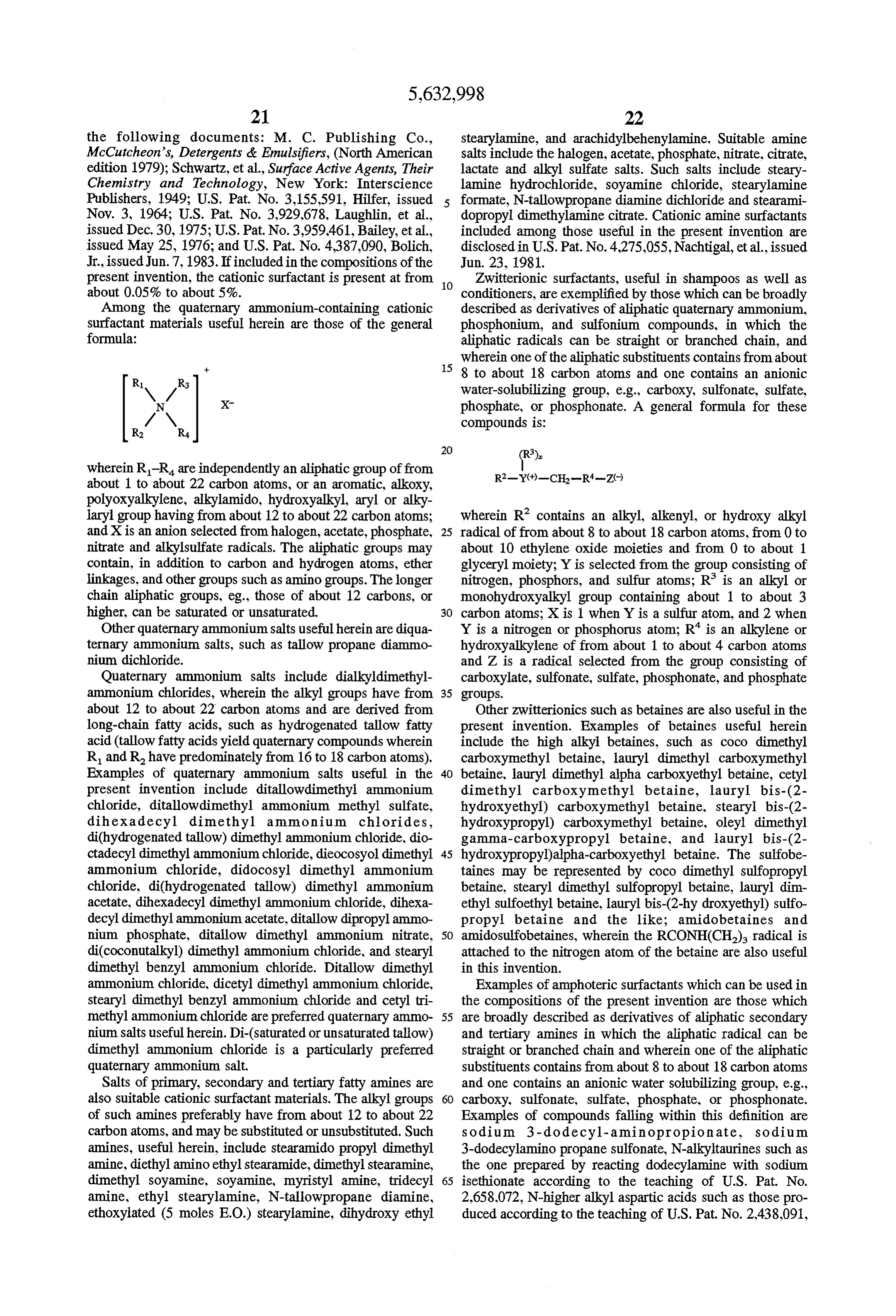
Page 13
and the products sold under the trade name "Miranol" and anes are available, for example, from the General Electric described in U.S. Pat. No. 2,528,378. Company in their Viscasil and SF 96 series, and from Dow Silicone Hair Conditioning Agent Corning in their Dow Corning 200 series. An optional component of the present invention is a The polyalkylaryl siloxane fluids that may be used, also nonvolatile, silicone conditioning agent which is not soluble include, for example, polymethylphenylsiloxanes. These in the aqueous or water soluble phase of compositions siloxanes are available, for example, from the General wherein the carrier is aqueous-based or otherwise based on Electric Company as SF 1075 methyl phenyl fluid or from water soluble solvents. Dow Corning as 556° Cosmetic Grade Fluid. The silicone hair conditioning agent for use herein will The polyether siloxane copolymers that may be used preferably have an average viscosity of from about 1,000 to 10 include, for example, a polypropylene oxide modified poly about 20,000,000 centistokes at 25° C., more preferably dimethylsiloxane (e.g., Dow Corning DC-1248) although from about 10,000 to about 10,000,000, even more prefer ethylene oxide or mixtures of ethylene oxide and propylene ably from about 100,000 to about 5,000,000. The viscosity oxide may also be used. The ethylene oxide and polypro of silicones herein can, in general, be measured by means of pylene oxide level must be sufficiently low to prevent a glass capillary viscometer as set forth in Dow Coming 15 solubility in water and the composition hereof. Corporate Test Method CTM0004, Jul. 20, 1970. Another silicone material that can be especially useful in The silicone hair conditioning agent will typically be used the silicone conditioning agents is insoluble silicone gum. in the shampoo compositions hereof at levels of from about The term “silicone gum”. as used herein, means polyorga 0.05% to about 10% by weight of the composition, prefer nosiloxane materials having a viscosity at 25° C. of greater ably from about 0.1% to about 10%, more preferably from 20 than or equal to 1,000,000 centistokes. Silicone gums are about 0.5% to about 8%, most preferably from about 0.5% described by Petrarch and others including U.S. Pat. No. to about 5%. 4,152.416, Spitzer et al., issued May 1, 1979 and Noll, Suitable nonvolatile silicone fluids include polyalkyl Walter, Chemistry and Technology of Silicones, New York: siloxanes, polyaryl siloxanes, polyalkyl siloxanes, polyether Academic Press 1968. Also describing silicone gums are siloxane copolymers, and mixtures thereof. Other insoluble, 25 General Electric Silicone Rubber Product Data Sheets SE nonvolatile silicone fluids having hair conditioning proper 30, SE 33, SE 54 and SE 76. The “silicone gums” will ties can also be used. The term "nonvolatile' as used herein typically have a mass molecular weight in excess of about shall mean that the silicone material exhibits very low or no 200,000, generally between about 200,000 and about 1,000. significant vapor pressure at ambient conditions, as is under 000. Specific examples include polydimethylsiloxane, stood by those in the art. The term “silicone fluid” shall (polydimethylsiloxane) (methylvinylsiloxane) copolymer, mean flowable silicone materials having a viscosity of less 30 poly (dimethylsiloxane) (diphenyl siloxane) than 1,000,000 centistokes at 25°C. Generally, the viscosity (methylvinylsiloxane) copolymer and mixtures thereof. of the fluid will be between about 5 and 1,000,000 centis Cationic Polymer Hair Conditioning Agent tokes at 25° C. preferably between about 10 and about The compositions of the present invention can also com 100,000. prise a water soluble, cationic organic polymer conditioning Silicone fluids hereof also include polyalkyl or polyaryl 35 agent for hair. The polymeric cationic conditioning agent siloxanes with the following structure: hereof will generally be present at levels of from about 0.05% to about 5%, preferably from about 0.1% to about
R R R 4%, more preferably from about 0.2% to about 3%, by weight, of the shampoo composition. By “water soluble"
A-i-o i-o i-A cationic organic polymer, what is meant is a polymer which R R R is sufficiently soluble in water to form a substantially clear
solution to the naked eye at a concentration of 0.1% in water (distilled or equivalent) at 25° C. Preferably, the polymer wherein R is alkyl or aryl, and X is an integer from about 1 will be sufficiently soluble to form a substantially clear to about 8,000 may be used, preferably from about 5 to about 45 solution at 0.5% concentration, more preferably at 1.0% 8,000. “A” represents groups which block the ends of the concentration.
silicone chains. The cationic organic polymers useful in the hair condi The alkyl or aryl groups substituted on the siloxane chain tioning agent hereof are organic polymers that can provide (R) or at the ends of the siloxane chains (A) may have any conditioning benefits to hair and that are soluble in the structure as long as the resulting silicones remain fluid at 50 shampoo composition. Any cationic polymers which can room temperature, are hydrophobic, are neither irritating, provide these benefits can be used. As used herein, the term toxic nor otherwise harmful when applied to the hair, are "polymer' shall include materials whether made by poly compatible with the other components of the composition, merization of one type of monomer or made by two (i.e., are chemically stable under normal use and storage copolymers) or more types of monomers.
conditions, and are capable of being deposited on and of 55 The cationic polymers hereof will generally have a weight conditioning hair. average molecular weight which is at least about 5,000. Suitable A groups include methyl, methoxy, ethoxy, typically at least about 10,000, and is less than about 10 propoxy, and aryloxy. The two R groups on the silicone atom million. Preferably, the molecular weight is from about may represent the same group or different groups. 100,000 to about 2 million. The cationic polymers will have Preferably, the two R groups represent the same group. 60 cationic nitrogen-containing moieties such as quaternary Suitable R groups include methyl, ethyl, propyl, phenyl, ammonium or cationic amino moieties, or a mixture thereof. methylphenyl and phenylmethyl. The preferred silicones are The cationic charge density is preferably at least about 0.9 polydimethyl siloxane, polydiethylsiloxane, and polymeth meq/gram, more preferably at least about 1.0 meq/gram, ylphenylsiloxane, Polydimethylsiloxane is especially pre even more preferably at least abut 1.1 meg/gram, most ferred. 65 preferably at least about 1.2 meq/gram. The cationic charge The nonvolatile polyalkylsiloxane fluids that may be used density is preferably no greater than about 4 meq/gram, include, for example, polydimethylsiloxanes. These silox more preferably no greater than about 3.0 meq/gram, most
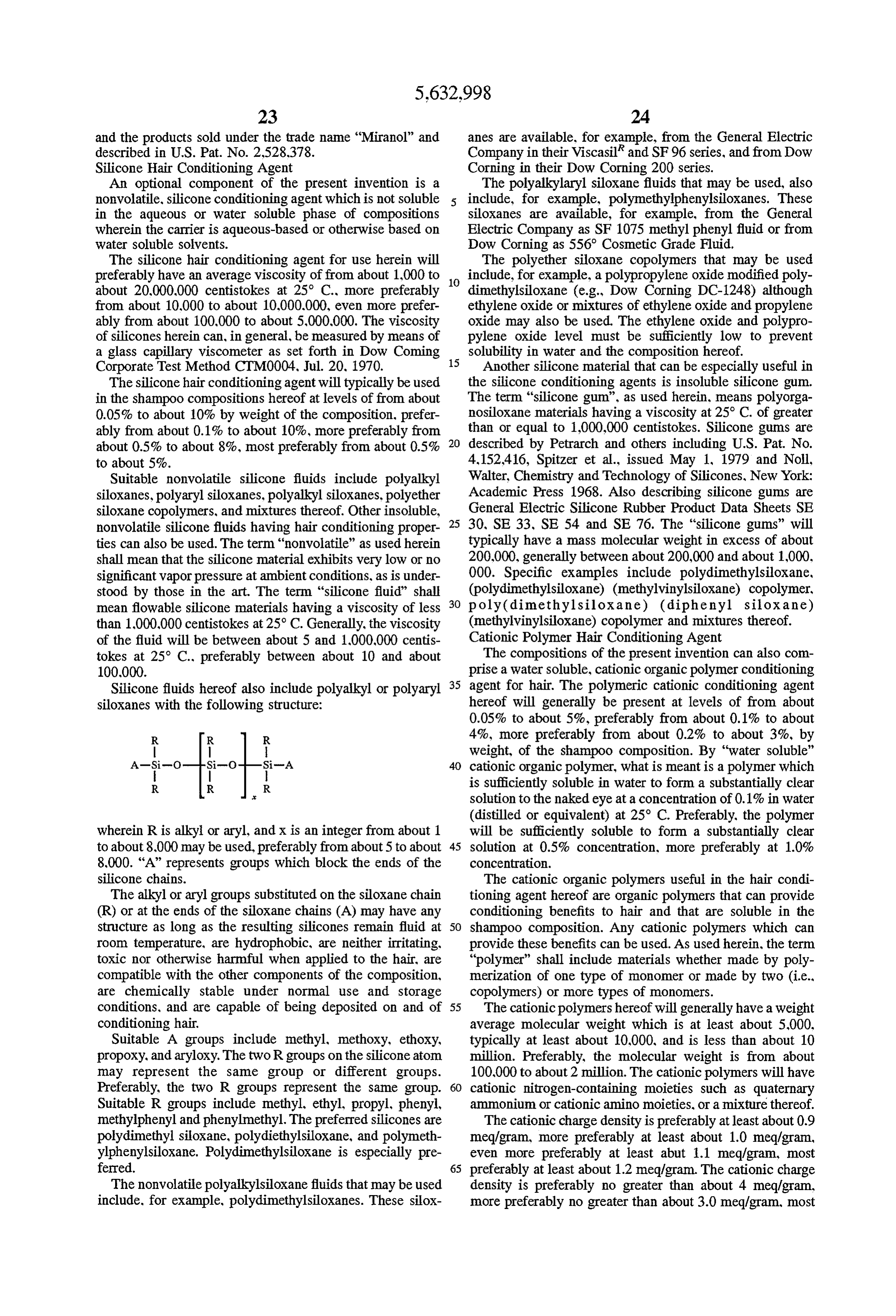
Page 14
preferably no greater than about 2.0 meq/gram. Cationic laminoalkyl methacrylamide, wherein the alkyl groups are charge density of the cationic polymer can be determined preferably C-C, hydrocarbyls, more preferably C-C, according to the Kjeldahl Method. Those skilled in the art alkyls.
will recognize that the charge density of amino-containing The cationic polymers hereof can comprise mixtures of polymers may vary depending upon pH and the isoelectric monomer units derived from amine- and/or quaternary point of the amino groups. The charge density should be ammonium-substituted
OOS.
monomer and/or compatible spacer within the above limits at the pH of intended use, which will Suitable cationic hair conditioning polymers include, for in general be from about pH3 to about pH 9, most generally example: copolymers of 1-vinyl-2-pyrrolidone and 1-vinyl from about pH 4 to about pH 8.
Any anionic counterions can be utilized for the cationic 10 3-methylimidazolium salt (e.g., chloride salt) (referred to in polymers so long as the water solubility criteria is met. Association, “CTFA", asCosmetic, the industry by the Toiletry, and Fragrance
Polyguaternium-16), such as those
Suitable counterions include halides (e.g., Cl-, Br-, -, commercially available from BASF Wyandotte Corp. or F-, preferably Cl-, Br-, or I-), sulfate, and meth (Parsippany, N.J., U.S.A.) under the LUVIQUAT tradename ylsulfate. Others can also be used, as this list is not exclu (e.g., LUVIQUAT FC 370); copolymers of 1-vinyl-2- SWe. pyrrollidone and dimethylaminoethyl methacrylate (referred
The cationic nitrogen-containing moiety will be present to in the industry by CTFA as Polyquaternium-11) such as generally as a substituent, on a fraction of the total monomer those commercially available from ISP Corporation (Wayne, units of the cationic hair conditioning polymers. Thus, the N.J., U.S.A.); cationic diallyl quaternary ammonium cationic polymer can comprise copolymers, terpolymers, containing polymers, including, for example, dimethyldial etc. of quaternary ammonium or cationic amine-substituted lylammonium chloride homopolymer and copolymers of monomer units and other non-cationic units referred to acrylamide and dimethyldiallylammonium chloride, herein as spacer monomer units. Such polymers are known referred to in the industry (CTFA) as Polyquaternium 6 and in the art, and a variety can be found in the CTFA Cosmetic Polyguaternium 7, respectively; and mineral acid salts of Ingredient Dictionary, 3rd edition, edited by Estrin, Crosley, amino-alkyl esters of homo- and co-polymers of unsaturated and Haynes, (The Cosmetic, Toiletry, and Fragrance 25 carboxylic acids having from 3 to 5 carbon atoms, as Association, Inc., Washington, D.C., 1982). described in U.S. Pat. No. 4,009.256. Suitable cationic polymers include, for example, copoly Other cationic polymers that can be used include polysac mers of vinyl monomers having cationic amine or quater charide polymers, such as cationic cellulose derivatives and cationic starch derivatives.
nary ammonium functionalities with water soluble spacer monomers such as acrylamide, methacrylamide, alkyl and 30 Cationic polysaccharide polymer materials suitable for dialkyl acrylamides, alkyl and dialkyl methacrylamides, use herein include those of the formula: alkyl acrylate, alkyl methacrylate, vinyl caprolactone, and R1 vinyl pyrrolidone. The alkyl and dialkyl substituted mono mers preferably have C-C, alkyl groups, more preferably a-oer--R) X
C-C alkyl groups. Other suitable spacer monomers 35 include vinyl esters, vinyl alcohol (made by hydrolysis of polyvinyl acetate), maleic anhydride, propylene glycol, and wherein:
ethylene glycol.
The cationic amines can be primary, secondary, or tertiary Ais an anhydroglucose residual group, such as a starch or amines, depending upon the particular species and the pH of 40 R cellulose
anhydroglucose residual, alkylene oxyalkylene, polyoxyalkylene, or the shampoo. In general, secondary and tertiary amines, hydroxyalkylene group, or combination thereof, especially tertiary amines, are preferred.
Amine-substituted vinyl monomers can be polymerized in R', R, and R independently are alkyl, aryl, alkylaryl, the amine form, and then optionally can be convened to arylalkyl, alkoxyalkyl, or alkoxyaryl groups, each ammonium by a quaternization reaction. Amines can also be 45 group containing up to about 18 carbon atoms, and the similarly quaternized subsequent to formation of the poly total number of carbon atoms for each cationic moiety mer. For example, tertiary amine functionalities can be (i.e., the sum of carbon atoms in R, R and R) preferably being about 20 or less, and quaternized by reaction with a salt of the formula RX X is an anionic counterion, as previously described. wherein R is a short chain alkyl, preferably a C-C alkyl, Cationic cellulose is available from Amerchol Corp. more preferably a C-C alkyl, and X is an action which 50 (Edison, N.J., U.S.A.) in their Polymer JR and LR series forms a water soluble salt with the quaternized ammonium. of polymers, as salts of hydroxyethyl cellulose reacted with Suitable cationic amino and quaternary ammonium trimethyl ammonium substituted epoxide, referred to in the monomers include, for example, vinyl compounds substi industry (CTFA) as Polyguaternium 10. Another type of tuted with dialkylaminoalkyl acrylate, dialkylaminoalkyl cationic. cellulose includes the polymeric quaternary ammo methacrylate, monoalkyl-aminoalkyl acrylate, monoalky 55 nium salts of hydroxyethyl cellulose reacted with lauryl laminoalkyl methacrylate, trialkyl methacryloxyalkyl dimethyl ammonium-substituted opoxide, referred to in the ammonium Salt, trialkyl acryloxyalkyl ammonium salt, dial industry (CTFA) as Polyquaternium 24. These materials are lyl quaternary ammonium salts, and vinyl quaternary ammo available from Americhol Corp. (Edison, N.J., U.S.A.) under nium monomers having cyclic cationic nitrogen-containing the tradename Polymer LM-200.
rings such as pyridinium, imidazolium, and quaternized Other cationic polymers that can be used include cationic pyrrollidone, e.g., alkyl vinyl imidazolium, alkyl vinyl guar gum derivatives, such as guar hydroxypropyltrimonium pyridinium, alkyl vinyl pyrrollidone salts, The alkyl portions chloride (commercially available from Celanese Corp. in of these monomers are preferably lower alkyls such as the their Jaguar series). Other materials include quaternary C-C alkyls, more preferably C and C alkyls. nitrogen-containing cellulose ethers (e.g., as described in Suitable amine-substituted vinyl monomers for use herein 65 U.S. Pat. No. 3.962,418), and copolymers of etherified include dialkylaminoalkyl acrylate, dialkylaminoalkyl cellulose and starch (e.g., as described in U.S. Pat. No. methacrylate, dialkylaminoalkyl acrylamide, and dialky 3,958,581).
Page 15
Organic Oil Conditioning Agents isopropyl isostearate, hexyl laurate, isohexyl laurate, iso The compositions of the present invention can also com hexyl palmitate, isopropyl palmitate, decyl oleate, isodecyl prise a nonvolatile, water insoluble, organic, oil as a con oleate, hexadecyl stearate, decyl stearate, isopropyl ditioning agent for hair. The hair conditioning oily liquid can isostearate, dihexyldecyl adipate, lauryl lactate, myristyl add shine and luster to the hair. The conditioning oil is lactate, cetyl lactate, oleyl stearate, oleyl oleate, oleyl typically present in the compositions at a level of from about myristate, lauryl acetate, cetyl propionate, and oley adipate. 0.05% to about 5%, by weight of the composition, prefer The mono-carboxylic acid ester however need not nec ably from about 0.2% to about 3%, more preferably from essarily contain at least one chain with at least 10 carbon about 0.5% to about 1%. atoms, so long as the total number of aliphatic chain carbon By “nonvolatile" what is meant is that the oily material 10 atoms is at least 10. Examples include diisopropyl adipate, exhibits very low or no significant vapor pressure at ambient disohexyl adipate, and diisopropyl sebacate. conditions (e.g., 1 atmosphere, 25 C.), as is understood in Di- and tri-alkyl and alkenyl esters of carboxylic acids can the art. The nonvolatile oily materials preferably have a also be used. These include, for example, esters of C-C boiling point at ambient pressure of about 260° C. or higher. dicarboxylic acids such as C-C esters (preferably C-C) By “water insoluble” what is meant is that the oily liquid 15 of succinic acid, glutaric acid, adipic acid, hexanoic acid, is not soluble in water (distilled or equivalent) at a concen heptanoic acid, and octanoic acid. Specific examples include tration of 0.1%, at 25 C. isocetyl stearyol stearate, diisopropyl adipate, and tristearyl The conditioning oil hereof generally will have a viscosity citrate.
of about 3 million cs or less, preferably about 2 million cs Polyhydric alcohol esters include alkylene glycol esters, or less, more preferably about 1.5 million cs or less. 20 for example ethylene glycol mono and di-fatty acid esters, The conditioning oils hereof are liquids selected from the diethylene glycol mono- and di-fatty acid esters, polyethyl group consisting of hydrocarbon oils and fatty esters. The ene glycol mono-and di-fatty acid esters, propylene glycol fatty esters hereof are characterized by having at least 10 mono- and di-fatty acid esters, polypropylene glycol carbon atoms, and include esters with hydrocarbyl chains monooleate, polypropylene glycol 2000 monostearate, derived from fatty acids or alcohols, e.g., mono-esters, 25 ethoxylated propylene glycol monostearate, glyceryl mono polyhydric alcohol esters, and di- and tri-carboxylic acid and di-fatty acid esters, polyglycerol poly-fatty acid esters, esters. The hydrocarbyl radicals of the fatty esters hereof can ethoxylated glyceryl monostearate, 1,3-butylene glycol also include or have covalently bonded thereto other com monostearate, 1.3-butylene glycol distearate, polyoxyethyl patible functionalities, such as amides and alkoxy moieties ene polyol fatty acid ester, sorbitan fatty acid esters, and (e.g., ethoxy or ether linkages, etc.). 30 polyoxyethylene sorbitan fatty acid esters are satisfactory Hydrocarbon oils include cyclic hydrocarbons, straight polyhydric alcohol esters for use herein.
chain aliphatic hydrocarbons (saturated or unsaturated), and Glycerides include mono-, di-, and tri-glycerides. More branched chain aliphatic hydrocarbons (saturated or specifically, included are the mono-, di-, and tri-esters of unsaturated). Straight chain hydrocarbon oils will preferably glycerol and long chain cathoxylic acids, such as Co-C contain more than 16 carbon atoms. Also encompassed 35 carboxylic acids. A variety of these types of materials can be herein are polymeric hydrocarbons of alkenyl monomers, obtained from vegetable and animal fats and oils, such as Such as C-C alkenyl monomers. These polymers can be castor oil, safflower oil, cottonseed oil, corn oil, olive oil, straight or branched chain polymers. The straight chain cod liver oil, almond oil, avocado oil, palm oil, sesame oil, polymers will typically be relatively short in length, having lanolin and soybean oil. Synthetic oils include triolein and a total number of carbon atoms as described above for 40 tristearinglyceryl dilaurate. Preferred glycerides are di-, and straight chain hydrocarbons in general. The branched chain tri-glycerides. Especially preferred are triglycerides. polymers can have substantially higher chain length. The The compositions herein can contain a variety of other number average molecular weight of such materials can vary optional components suitable for rendering such composi widely, but will typically be at least about 400, preferably at tions more cosmetically or aesthetically acceptable or to least about 500, more preferably at least about 600. Specific 45 provide them with additional usage benefits, e.g. medicinal examples of suitable materials include paraffin oil, mineral benefits. Such conventional optional ingredients are well oil, and mixtures thereof. Branched-chain isomers of these known to those skilled in the art, e.g. sunscreens, medica compounds, as well as of higher chain length hydrocarbons, ments (e.g. anti-bacterials, anti-inflamatories, anti-acne can also be used. Exemplary branched-chain isomers are actives, etc.). colors and dyes, perfumes, pearlescent aids, highly branched saturated or unsaturated alkanes, such as 50 such as ethylene glycol distearate; preservatives, such as the permethyl-substituted isomers, e.g., the permethyl benzyl alcohol, methyl paraben, propyl paraben and imida substituted isomers of eicosane, such as 2, 2, 4, 4, 6, 6, 8, Zolidinyl urea; thickeners and viscosity modifiers, such as a 8-10-nonylmethylundecane, sold by Permethyl Corpora diethanolamide of a long chain fatty acid (e.g., PEG 3 lauric tion. A preferred hydrocarbon polymer is polybutene, such diethanolamide), cocomonoethanol amide, dimethicone as the copolymer of isobutylene and butene. A commercially 55 copolyols, guar gum, methyl cellulose, starches and starch available material of this type is L-14 polybutene from derivatives; fatty alcohols, such as cetearyl alcohol; sodium Amoco Chemical Co. (Chicago. III., U.S.A.). chloride; sodium sulfate; polyvinyl alcohol; ethyl alcohol; Monocarboxylic acid esters hereof include esters of alco pH adjusting agents, such as citric acid, Sodium citrate, hols and/or acids of the formula RCOOR wherein alkyl or succinic acid, phosphoric acid, sodium hydroxide, sodium alkenyl radicals and the sum of carbon atoms in R and R is 60 carbonate; salts, in general, such as potassium acetate and at least 10, preferably at least 20. Sodium chloride; coloring agents, such as any of the FD&C Fatty esters include, for example, alkyl and alkenyl esters or D&C dyes; hair oxidizing (bleaching) agents, such as of fatty acids having aliphatic chains with from about 10 to hydrogen peroxide, perborate and persulfate salts; hair about 22 carbon atoms, and alkyl and alkenylfatty alcohol reducing agents, such as the thioglycolates; perfumes; carboxylic acid esters having an alkyl and/or alkenyl 65 Sequestering agents, such as disodium ethylenediamine alcohol-derived aliphatic chain with about 10 to about 22 tetra-acetate; and polymer plasticizing agents, such as carbon atoms, and combinations thereof. Examples include glycerin, diisobutyl adipate, butyl stearate, and propylene
Page 16
glycol. Such optional ingredients generally are used indi To a solution of 20.0 grams of acryloyl endcapped poly vidually at levels of from about 0.01% to about 10.0%, (isobutylene) macromonomer of Example 1, and 80 grams preferably from about 0.05% to about 5.0%, of the compo of tert-butyl acrylate in 500 mL of tetrahydrofuran, add 0.5 sition.
The pH of the present compositions generally will be grams of azoisobutryonitire (AIBN) initiator. Reflux the between about 3 and about 9, preferably between about 4 reaction bysolution resulting the for about 20 hours, then quench the addition of about 5 mL of methanol. Pour the and about 8.
As with all compositions, the presentinvention should not solution into a teflon pan and evaporate the tetrahydrofuran contain components which unduly interfere with the perfor at room temperature under a fume hood. Redissolve the mance of the compositions. resulting polymer film in THF and precipitate in water. Dry The hair care compositions of the present invention can be O the resulting polymer in a vacuum oven. made using conventional formulation and mixing tech Alternatively, by varying the monomers and macremoners niques. Methods of making various types of cosmetic com used, this general procedure is used to prepare other copoly positions are described more specifically in the following mers of the present invention:
examples. (ii) Poly(4-tert-butyl styrene)-graft-poly(isobutylene) Method of Using Hair Care Compositions 15 macromonomer (70/30 w/w); total polymer weight aver The hair care compositions of the present invention are age molecular weight of 150,000; macromonomer weight used in conventional ways to provide the desired benefit average molecular weight 3000. appropriate to the product such as hair styling, holding, (iii) Poly(4-tert-butyl styrene)-graft-poly(2-ethylhexyl cleansing, conditioning and the like for hair care composi methacrylate) macromonomer) (80/20 wiv); total poly tions. Such methods of use depend upon the type of com 20 mer weight average molecular weight of 150,000; mac position employed but generally involve application of an effective amount of the product to the hair, which may then (iv)romonomer weight average molecular weight 10,000.
be rinsed from the hair (as in the case of shampoos and some (isobutylene) macromonomer (60/20/20 w/w/w); total conditioning products) or allowed to remain on the hair (as in the case of spray, mousse, or gel products). By "effective 25 polymer weight average molecular weight of 100,000; macremonomer weight average molecular weight 5000.
amount” is meant an amount sufficient to provide the benefit desired. Preferably, hair rinse, mousse, and gel products are Examples 3-5 applied to wet or damp hair prior to drying and styling of the hair. After such compositions are applied to the hair, the hair tions are representativestyling/conditioning The following hair of the present rinse composi invention.
is dried and styled in the usual ways of the user. Hair sprays are typically applied to dry hair after it has already been 30 dried and styled. 3 4. 5 The following examples further illustrate preferred Composition wt.% wt.% wt.% embodiments within the scope of the present invention. The examples are given solely for the purposes of illustration and Conditioner Premix are not to be construed as limitations of the present invention 35 Water 9.S. C.S. C.S. as many variations of the invention are possible without Citric Acid 0.02 0.02 0.02 departing from its spirit and scope. Sodium Citrate 0.09 0.09 0.10 EXAMPLES Cetyl Alcohol 0.2 0,12 0.12 Stearyl Alcohol 0.08 O.08 0.08
The following examples further describe and demonstrate Natrosol Plus CS Grade D-67 1.02 OO 0.99 Xanthan Gum’ embodiments within the scope of the present invention. The Styling Polymer Premix 0.25 0.25 0.25 examples are given solely for the purpose of illustration and are not to be construed as limitations of the present Graft Copolymer from Example 201) 1.75 1.75 1.75 invention, as many variations thereof are possible without Permethyl 99A 8.54 8.54 8.54 departing from the spirit and scope of the invention. Ingre Trimethylsiloxysilicate 0.11 0.11 O dients are identified by chemical or CTFA name. 45 Kathon CG
Perfume
Synthesis of Acryloyl Encapped Polyisobutylene Mac DRO Water 9.48 9.48 8.57 OnOOC Adogen 470' 0.70 0.60 0.93 Prepare hydroxyl endcapped polyisobutylene polymer 50 Adogen 471
Decamethyl cyclopentasiloxanel
(PIB-OH) having a weight average molecular weight of Polydimethyl Siloxane Gum 1.67 1.67 2.33 about 4,172 g/mol by conventional living carbocationic Trimethylsily polymerization of isobutylene (for example, as described in (Dow CorningAmodimethicone
G. Kaszas, Poly. Bull., 20,413 (1989). Prepare a solution of Surfactant Premix 100 grams (0.024 mol) of the (PIB-OH) in 300 grams dry 55 DRO Water 5.70 5.70 5.70 methylene chloride. Add a two fold mole excess (4.84 g, Stearalkonium Chloride 0.30 0.30 0.30 0.048 mol) triethylamine to the solution. Add this solution dropwise to a solution of acryloyl chloride (4.35 g, 0.048 m) Hydrophobically modified hydroxyethyl cellulose from Aqualon Corp. in dry methylene chloride (100 g) at 0° C. Stir for about 12 Readily dispersible xantham gum hours at room temperature, filter the mixture and evaporate 60 SE-76 gum available From General Electric the excess triethylamine and methylene chloride to obtain USA; Ditallow dimethyl ammonium chloride, Sherex Chemical Co., Dublin, Ohio, acryloyl endcapped polyisobutylene macromonomer. 75% aqueous solution
Tallow trimethyl ammonium chloride, Sherex Chemical Co.; 50% aqueous
(i) Synthesis of Poly(tert-butyl acrylate)-graft-poly Prepare the silicone premix by combining and mixing (in (isobutylene) macremonomer (80/20 W/w); total graft 65 a separate vessel) water, Adogen 470 and Adogen 471 at 85°. copolymer weight average molecular weight of 100,000; C. Cool to 71° C. and add the silicone gum/decamethyl macromonomer weight average molecular weight 5000. cyclopentasiloxane solution and Amodimethicone; mix until
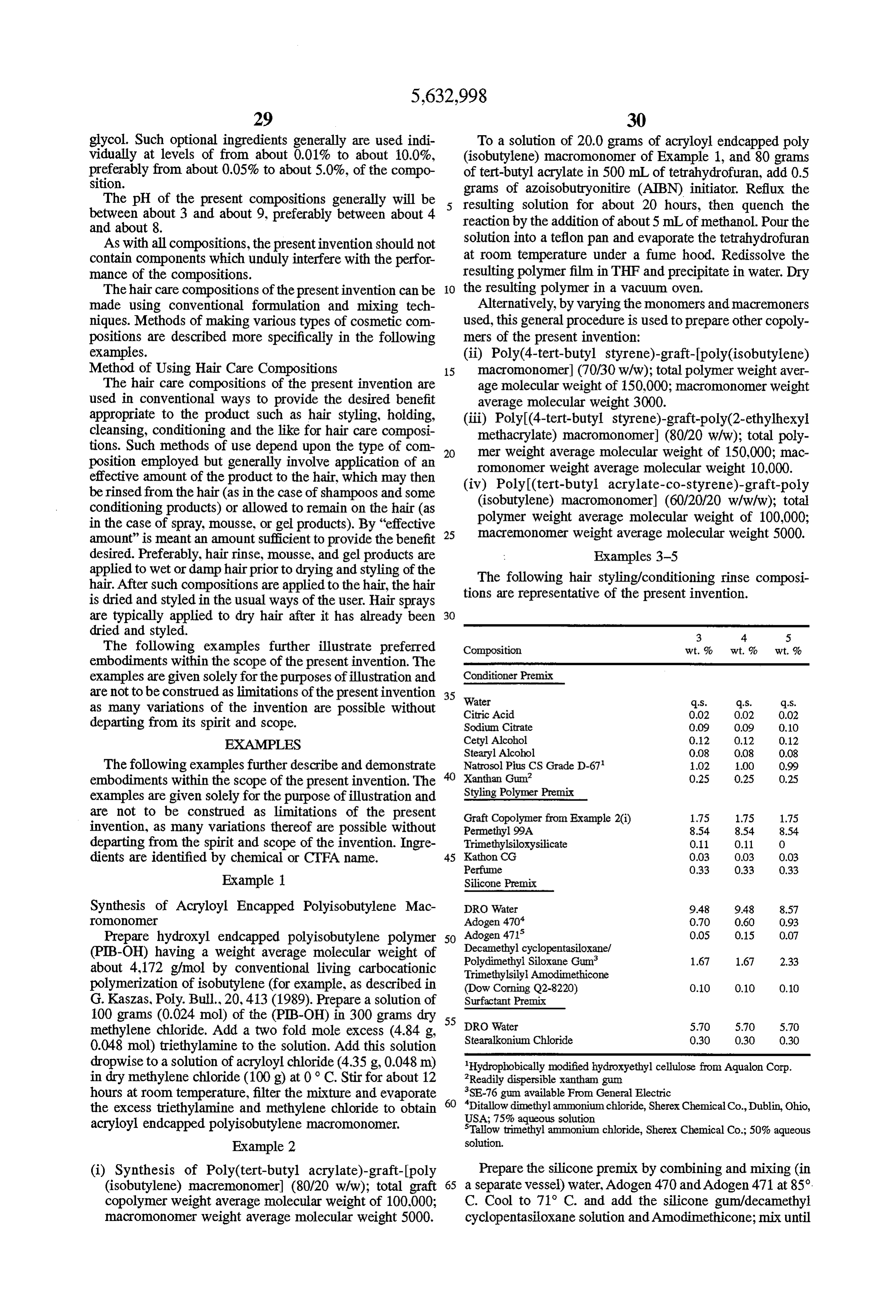
Page 17
homogeneous. Cool to 38° C. while using homogenizer (such as Tekmar). Weight % Prepare the Surfactant premix by combining and mixing (in a separate vessel) water and Stearalkonium Chloride at Ingredient A. B
Styling Agent Premix
Prepare the conditioner premix by combining and mixing (in a separate vessel) the DRO water heated to 71° C., Copolymer Premix of Example 7' 0.00 10.00 adding the Citric acid, sodium citrate, cetyl alcohol, stearyl Silicone Premix alcohol and Natrosol Plus CS grade D-67, and mixing until Silicone gum, GE SE76? 0.30 0.30 Octamethyl cyclotetrasiloxane 170 1.TO homogeneous. Add the Xanthan gum and mix until homo 10 Main Mix geneous.
Prepare the styling polymer premix by combining and Water QS 100 QS 100 Cetyl Alcohol 100 ww.
mixing (in a separate vessel) the graft copolymer, Permethyl Quaternium 18 0.85 0.85 99A, and Trimethylsiloxysilicate until homogeneous. 15 Stearyl Alcohol 0.70 w Combine and mix the styling polymer premix, Kathon CG Hydroxyethyl Cellulose 0.50 Cetyl Hydroxythyl Cellulose m 1.25 and perfume until homogeneous. Further disperse the mix Ceteareth-20 0.35 w ture with an in-line homogenizer (such as Tekmar Fragrance 0.20 O.2O homogenizer) and then cool the mixture to 38°C. Complete Dimethicone copolyol
Citric Acid
wom
the conditioner by adding the conditioner premix, the sili 20 Methylchloroisothiazolinone (and) 0.04 0.04 cone premix and the surfactant premix at 38° C. Mix until methylisothiazolinone homogeneous, then cool the composition to 25° C. Sodium Chloride O.O. 0.01 Apply the compositions defined in Examples 3-5 to the Xanthan Gum M 0.20
hair in the conventional manner to provide effective hair Prepare the conditioner by first comixing all the Main Mix ingredients, conditioning and styling?hold benefits without leaving the 25 heating to about 60° C. with mixing. Cool the mixure to about 45° C. with hair with a sticky/stiff feel. colloid milling (Example A) or mixing (Example B). At this temperature, add the two premixes separately with moderate agitation. Allow the resulting
Example 6 conditioner to cool to room temperature.
"Alternatively, conditioner compositions are prepared with polymer premixes from Example 20ii) and 2Giii).
Polymer Premix with Added Drying Aid *Commercially available from General Electric. Prepare the following polymer premix utilizing conven 30 Dimethyl Di(Hydrogenated Tallow) Ammonium Chloride tional mixing techniques. Commercially available as Polysurf D-67 from Aqualon. Prepare the conditioner by first comixing all the Main Mix
Ingredients Weight% ingredients, heating to about 60° C. with mixing. Cool the 35 mixture to about 45° C. with colloid milling (Example A) or
Graft Copolymer from Example 2(ii) 683 mixing (Example B). At this temperature, add the two
Trimethylsiloxysilicate 100 premixes separately with moderate agitation. Allow the resulting conditioner to cool to room temperature.
Prepare the polymer premix by adding the graft copoly 1 Alternatively, polymer conditioner compositions are prepared with premixes from Example 20ii) and 20iii).
mer to the Permethyl 99A while mixing. Heat to 80°-84° C. 2 Commercially available from General Electric. in a covered vessel, maintaining mixing. Cool to 23-27 C.
and add trimethylsiloxysilicate while mixing. 3 Dimethyl Di(Hydrogenated Tallow) Ammonium Chloride 4 Commercially available as Polysurf D-67 from Aqualon.
Polymer Premix with Added Drying Aid Example 9
Prepare the following polymer premix utilizing conven tional mixing techniques. Shampoo Composition 50 Prepare a shampoo composition from the following com
Ingredients Weight % ponents utilizing conventional mixing techniques.
Polydimethylsiloxane 1.50 Ingredients Weight %
(Dow Corning, Dow Corning 200 Fluid (20 csk)) Styling Agent
Prepare the polymer premix by adding the graft copoly Copolymer Premix from Example 7 15.00 Silicone Premix mer to the isododecane while mixing. Heat to 80°-84° C. in a covered vessel, maintaining mixing. Cool to 23°-27° C. 60 Silicone gum 0.50 and add polydimethylsiloxane while mixing. Dimethicone, 350cs fluid 0.50 Main Mix
Example 8 Water QS 100 Hair Conditioner Ammonium lauryl sulfate 100
Prepare a rinse-off hair conditioner composition from the 65 Ethylene glycol distearate 1.00 following components utilizing conventional mixing tech Xanthan Gum 1.20 niques.
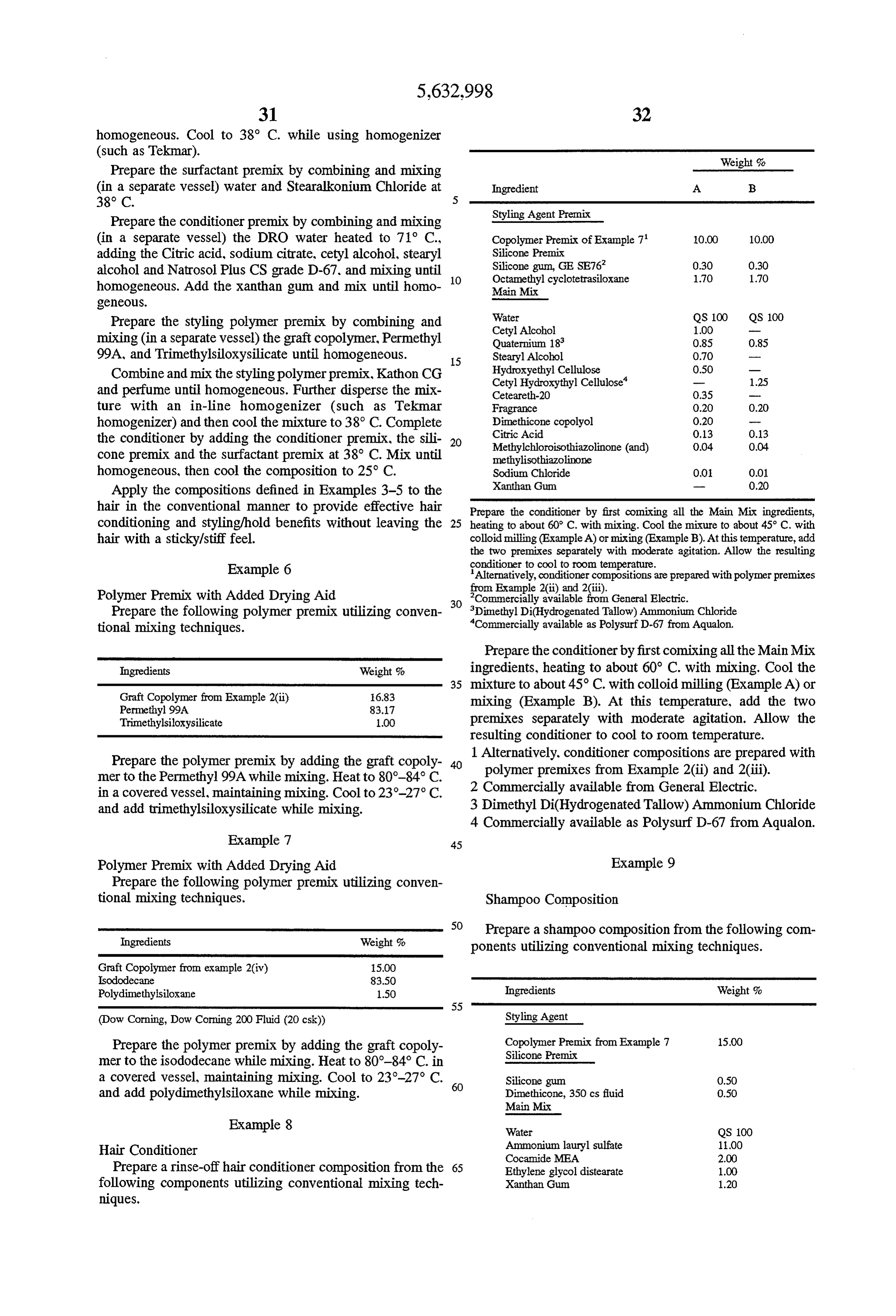
Page 18
-continued vinylidene compounds; unsaturated hydrocarbons; C1-C1s
Ingredients Weight % alcohol esters of organic acids and organic acid anhydrides; and combinations thereof.
Methylchloroisothiazolinone (and) 0.04 4. A composition according to claim 3 wherein said A methylisothiazolinone monomer units comprise hydrophobic monomers selected Citric Acid to pH 4.5 as needed from the group consisting of: acrylic or methacrylic acid esters of C-C alcohols, dicyclopentenyl acrylate,
Prepare the Main Mix by first dissolving the xanthan gum 4-biphenyl acrylate, pentachlorophenyl acrylate, 3,5- in the water with conventional mixing. Add the remaining dimethyladamenty1 acrylate, 3,5-dimethyladamentyl Main Mix ingredients and heat the mixture to 150°F, with 10 methacrylate, 4-methoxycarbonylphenyl methacrylate, tri agitation for 72 hour. Add the Styling Agent and the Silicone methylsilyl methacrylate, styrene, alpha-methylstyrene, Premix sequentially with about 10 minutes of agitation between additions; stir the entire mixture while the batch is t-butylstyrene, vinyl acetate, vinyl neononanoate, vinyl cooled to room temperature. For varied particle size, the pivalate, vinyl propionate, vinyl chloride, vinylidene Styling Agent and Silicone Premix are added at different 15 chloride, vinyl toluene, isobutyl vinyl ether, s-butyl vinyl times using either or both high shear mixing (high speed ether, butadiene, cyclohexadiene, bicycloheptadiene, 2,3- dispersator) or normal agitation. dicarboxylmethyl-1,6-hexadiene, ethylene, propylene, Use the shampoo for cleansing the hair and for providing indene, norbornylene, 3-pinene, C-pinene, and combina a styling benefit. 20 tions thereof.
While particular embodiments of the subject invention 5. A composition according to claim 4 wherein said A have been described, it will be obvious to those skilled in the monomer units comprise hydrophobic monomers selected art that various changes and modifications to the subject from the group consisting of n-butyl methacrylate, isobutyl invention can be made without departing from the spirit and methacrylate, t-butyl acrylate, t-butyl methacrylate, scope of the invention. It is intended to cover, in the 25 appended claims, all such modifications that are within the 2-ethylhexyl methacrylate, methyl methacrylate, indene, norbornylene, B-pinene, C-pinene, vinyl pivalate, vinyl scope of the subject invention.
What is claimed is: neononanoate, dicyclopentenyl acrylate, 4-biphenyl 1. A hair care composition comprising: acrylate, penta chlorophenyl acrylate, 3,5- (A) a graft copolymer having a polymeric backbone and 30 dimethyladamanty1 acrylate, 3,5-dimethyladamentyl a hydrophobic polymeric side chain grafted to said methacrylate, 4-methoxycarbonylphenyl methacrylate, tri backbone, said copolymer formed from the copolymer methylsilyl methacrylate, t-butyl styrene and combinations ization of randomly repeating Amonomer units and at thereof.
least one B macromonomer unit wherein said copoly 6. A composition according to claim 5 wherein said A mer comprises: 35 monomer units comprise hydrophobic monomers selected (i) from about 30% to about 95% by weight of said A from the group consisting of t-butyl styrene, t-butyl acrylate, monomer units, wherein said. A monomer units are monomer units copolymerizable with said B mac t-butyl methacrylate, and combinations thereof. romonomer units; and 7. A composition according to claim 4 wherein said A (ii) from about 5% to about 70% by weight of said B 40 monomer units further comprise hydrophilic monomers macromonomer units, wherein said B macromono selected from the group consisting of unsaturated organic mer units are hydrophobic macromonomer units mono-and poly-carboxylic acids, (meth)acrylamides, (meth) having a polymeric portion and amoiety copolymer acrylates, (meth)acrylate alcohols, organic acid anhydrides, izable with said A monomer units; and esters of organic acid anhydrides, hydrophilic vinyl wherein said Amonomer units, in conjunction with said 45 compounds, hydrophilic allyl compounds, hydrophilic copolymerizable moieties of said B macromonomer imides, salts of the foregoing compounds, and combinations units, form said backbone, the T corresponding to said thereof. .
backbone having a value of at least about 25° C.; 8. A composition according to claim 2 wherein said B wherein said polymeric portion of said B macromonomer macromonomer units are of the formula (T) or (H): unit forms said hydrophobic side chain, the T corre 50 sponding to said side chain having a value of less than R! (I) about 10° C.; wherein said copolymer has a weight average molecular weight greater than about 10,000; ItégéCH=(e)(CH2:ri-E and
(B) a hydrophobic, volatile solvent for said copolymer, 55
said solvent selected from the group consisting of (II) branched hydrocarbons, silicones and combinations thereof. I+CH-i-E.
2. A composition according to claim 1 wherein said A monomer units are ethylenically unsaturated monomer units, 60 R7 and said B macromonomer units are units having a poly meric portion and an ethylenically unsaturated moiety that is Wherein copolymerizable with said. A monomer units. R", R. R, R and Rare, independently, H or C, to Cs 3. A composition according to claim 2 wherein said A straight or branched alkyl group; monomer units comprise hydrophobic monomers selected 65 from the group consisting of acrylic acid esters; methacrylic R=H or C, to C alkyl acid esters; N-alkyl acrylamides; vinyl compounds, R’=C to Cls
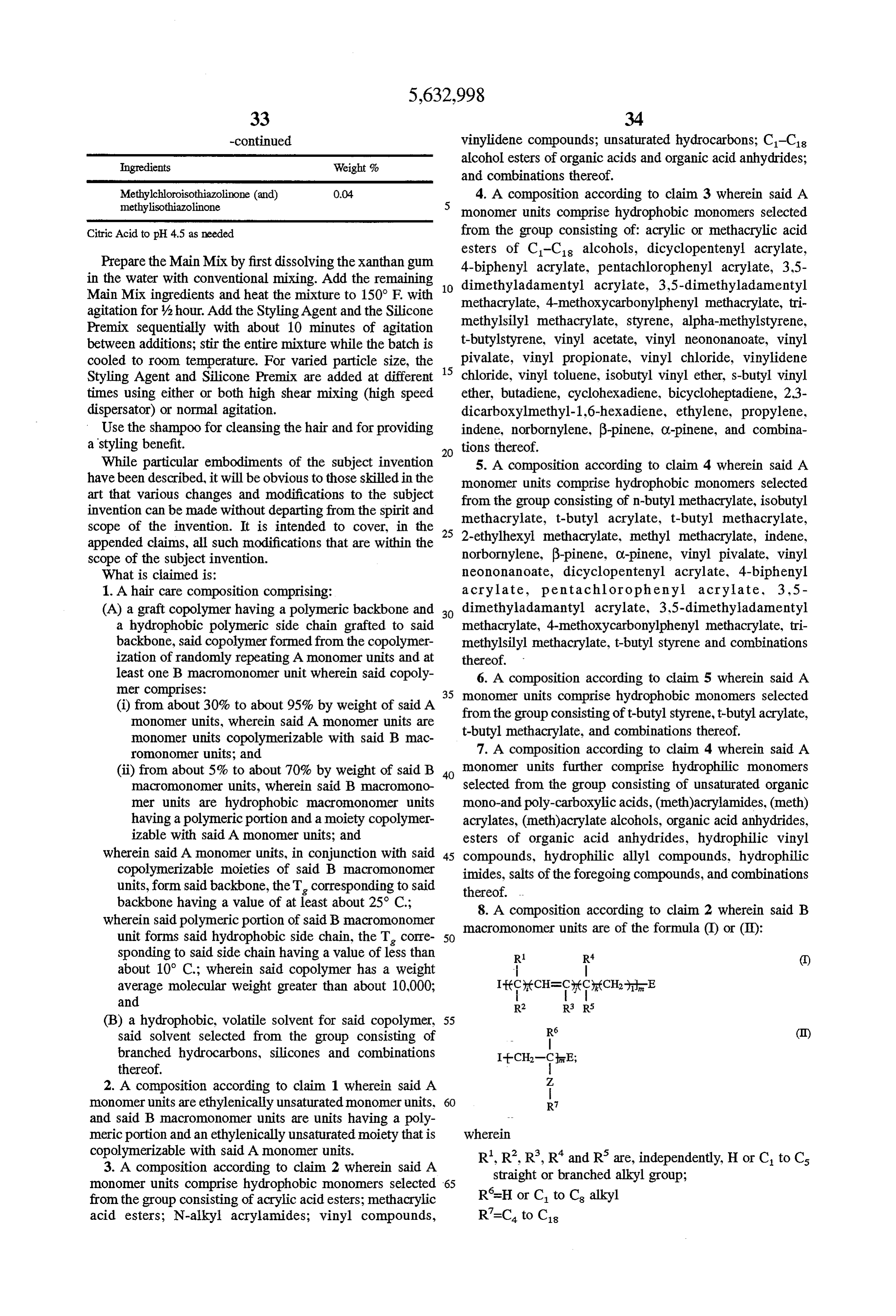
Page 19
methacrylate), poly(isobutylene), poly(isoprene), hydroge nated poly(1,2-butadiene), hydrogenated poly(1,4-
butadiene), hydrogenated poly(isoprene), poly(1,2- -C-O - or -O- butadiene), poly(1-butene), poly(5-methyl-1-hexene), poly (6-methyl-1-heptene), poly(44-dimethyl-1-pentene), poly (iso-butyl vinyl ether), poly4-t-butyl vinyl benzene-co-2- iandkare, independently, an integer of about 1 or greater; ethylhexyl acrylate), poly2-ethylhexyl acrylate-co-octyl j and l are, independently, an integer of about 0 or greater; acrylamide), poly 2-ethyl vinyl benzene-co-octyl m is an integer from 10 about 2000; methacrylate), and combinations thereof. E is an ethylenically unsaturated endcapping group copo 10 13. A composition according to claim 1 wherein said graft lymerizable with said Amonomer units, selected from copolymer is selected from the group consisting of Poly the group consisting of acrylamide, methacrylamide, poly(tert-butylacrylate)-graft-poly(isobutylene) vinyl, allyl, acryloyl, methacryloyl ethacnyloyl. macromonomer, Polypoly(4-tert-butylstyrene)-graft-poly 2-vinylbenzyl, 3-vinylbenzyl, 4-vinylbenzyl, (isobutylene) macromonomer). Poly(4-tert-butylstyrene)- 2-vinylbenzoyl 3-vinylbenzoyi, 4-vinylbonzoyl, 15 graft-poly(2-ethylhexyl methacrylate) macromonomer, 1-butenyl, 1-propenyl, isobutenyl, isoprenyl, Poly(tert-butylacrylate-co-styrene)- graft-poly cyclohexenyl, cyclopentenyl, and combinations (isobutylene)), and combinations thereof.
thereof; and 14. A composition according to claim 1 wherein said I is a chemical initiator moiety. solvent is selected from the group consisting of branched 9. The composition of claim 8 wherein E is selected from 20 chain hydrocarbons containing from 10 to 16 carbon atoms the group consisting of vinyl, alyl, acryloyl, methacryloyl, and combinations thereof.
ethacryloyl 3-vinylbenzyl, 4-vinylbenzyl, 3-vinylbenzoyl, 15. A composition according to claim 14 wherein said 4-vinylbenzoyl, 1-butenyl, 1-propenyl, isobutenyl, and com solvent is selected from the group consisting of branched binations thereof. chain hydrocarbons containing from 12 to 16 carbon atoms 10. The composition according to claim 9 wherein E is 25 and combinations thereof.
Selected from the group consisting of vinyl, allyl, acryloyl, 16. A composition according to claim 15 wherein said methacryloyl, ethacryloyl, 3-vinylbenzyl, 4-vinylbenzyl, solvent comprises isododecane.
and combinations thereof. 17. A composition according to claim 1 wherein said 11. The composition according to claim 10 wherein said solvent is a silicone.
B macromonomer units are selected from the group con 30 18. A composition according to claim 1 comprising from sisting of acryloyl, methacryloyl, or 2-3- or 4-vinyl benzyl about 0.1% to about 25% of said copolymer and from about endcapped polymers of: methacrylic or acrylic acid esters, 0.1% to about 75% of Said solvent, poly(alkenes), hydrogenated poly(alkenes), poly(vinyl 19. A composition according to claim 1 wherein the ethers), poly(vinyl benzenes), and combinations thereof. copolymer exhibits at least two distinct T values, one of 12. The composition according to claim 8 wherein said B 35 said Ts corresponding to said hydrophobic polymeric side macromonomer units are selected from the group consisting chains and having a value of less than about 10° C., another of acryloyl, methacryloyl, or 2-3- or 4-vinyl benzyl end of said T.S corresponding to said backbone and having a capped polymers of: poly(n-butyl acrylate), poly(dodecyl value of at least about 25° C.
acrylate), poly(2-ethylhexyl acrylate), poly(2-ethylbutyl 20. The composition of claim 1 further comprising an acrylate), poly(n-ethyl acrylate), poly(n-heptyl acrylate), 40 aqueous carrier for said graft copolymer and said solvent. poly(n-hexyl acrylate), poly(iso-butyl acrylate), poly(iso 21. A method for styling hair comprising applying the decyl acrylate), poly(iso-propyl acrylate), poly(3- composition of claim 1 to the hair in an amount sufficient to methylbutyl acrylate), poly(2-methylpentyl acrylate), poly style the hair.
(nonyl acrylate), poly(octyl acrylate), poly(propyl acrylate), 22. A method for conditioning hair comprising applying poly (2-ethylhexyl methacrylate), poly(tridecyl 45 the composition of claim 1 to the hair in an amount sufficient methacrylate), poly(hexyl methacrylate), poly(decyl to condition the hair.
methacrylate), poly(octyl methacrylate), poly(octadecyl methacrylate), poly(dodecyl methacrylate), poly(n-pentyl
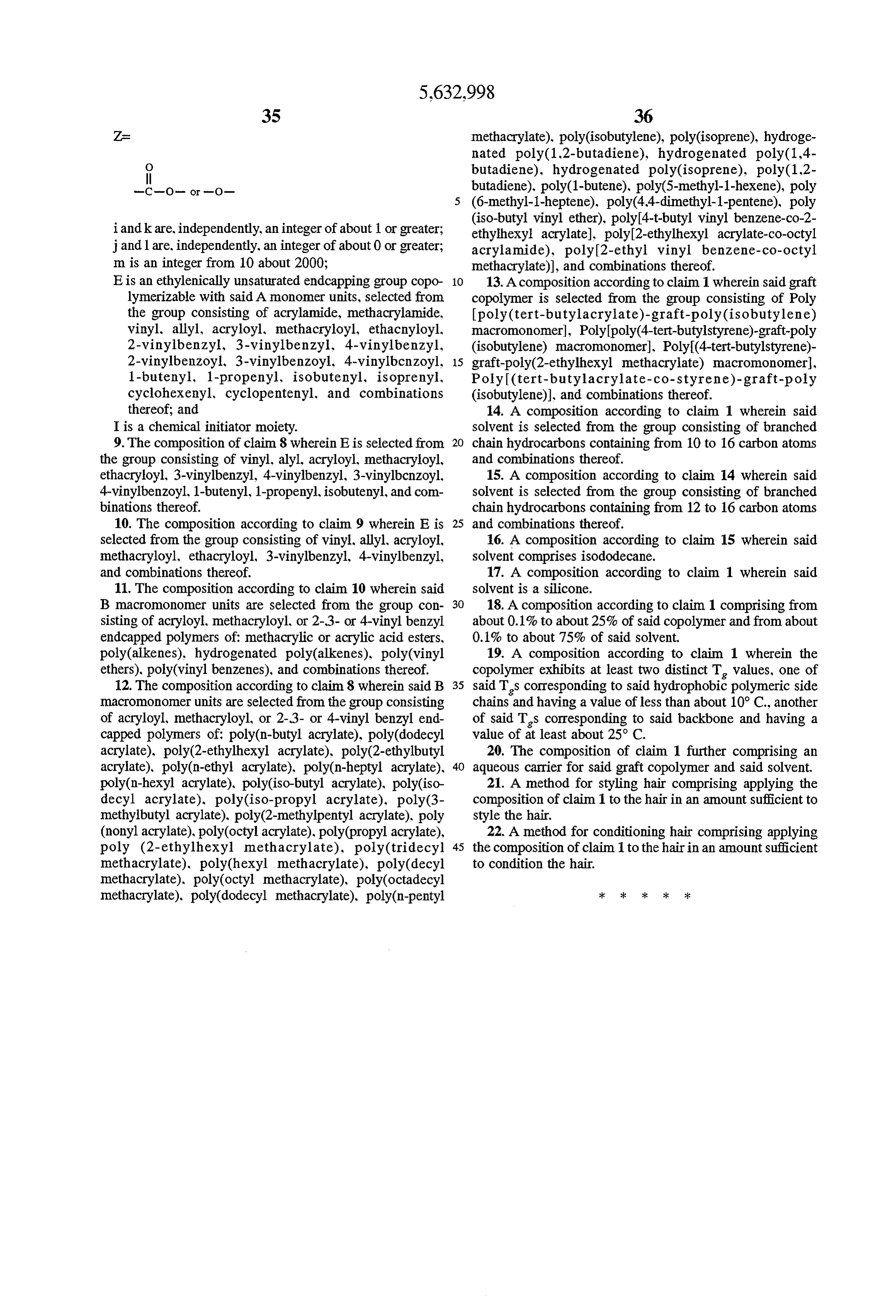
Page 20
UNITED STATES PATENT AND TRADEMARK OFFICE
CERTIFICATE OF CORRECTION
PATENT NO. : 5,632,998 Page 1 of 4
ENVENTOR(S) : Sanjeev Midha and Raymond E. Bolich, Jr.
it is certified that error appears in the above-indentified patent and that said Letters Patent is hereby corrected as shown below:
Zas
At column 3, lines 33-37" --o- or -O- "should read - Z= --o- Or -O- ar. At column 3, line 55 "4-vinylbenzoyl-l-butenyl" should read-4-vinylbenzyl, 1-butenyl-. At column 5, line 11 "lover" should read-lower
At column 7, line 46"B Macromonomers" should read-B macromonomers-, At column 8, lines 41-42"3,5-dimethyladamentyl" should read-3,5-dimethyladamantyl-. At column 8, line 43 "4-methoxycarbonyphenyl"
should read -4-methoxycarbonylphenyl-.
At column 10, lines 36-40" --o- or -O- "should read - Z= --o- of -O- re. At column ll, line 8 "carbanions" should read-carbocations--.
At column 11, line 18 "1,1-diphenyl 14-methylpentyl" should read -1,1-diphenyl-4-methylpentyl-. At column 11, line 30 "selectcd" should read -selected-.
At column 11, line 66"polymerzing" should read-polymerizing-.
At column 12, line 38"avenge" should read-average-.
At column 12, line 42 "avenge" should read -average-.
At column 12, line 43 "avenge" should read-average-.
At column 13, line 60 "point or the" should read-point of the-.
- T
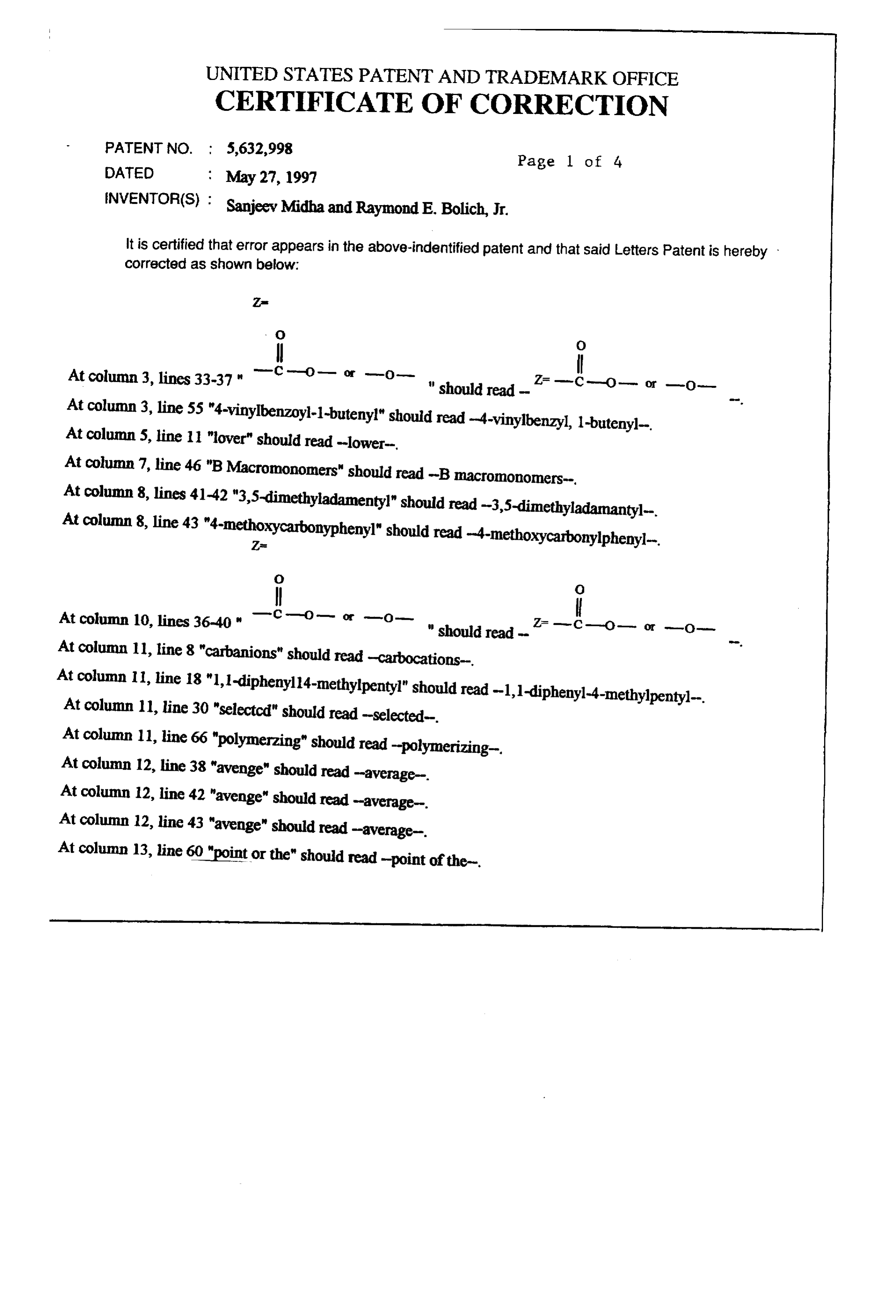
Page 21
UNITED STATES PATENT AND TRADEMARK OFFICE
CERTIFICATE OF CORRECTION
PATENT NO. 5,632,998 Page 2 of 4
INVENTOR(S) : Sanjeev Midha and Raymond E. Bolich, Jr. It is certified that error appears in the above-identified patent and that said Letters Patent is hereby corrected as shown below:
At column 14, line 24"IsopartM and K" should read --Isopart M Hand K-. At column 14, lines 24-25"Isopar" (C-C isoparaffins)" should read-IsopartML (C-C isoparaffins)--. At column 14, line 26"lsododecane" should read-sododecane-.
At column 14, line 32"methox3propyl" should read-methoxypropyl-. At column 14, line 65 "theology" should read-rheology--.
At column 15, line 2 "theology" should read-rheology--.
At column 15, line 36"D. Swem" should read-D. Swern
At column 15, line 40 "Villamarin, et at," should read-Villamarin, et al.--. At column 15, line 43 "Toiletties" should read-Toiletries-.
At column 15, line 59 "glueart" should read -glucan-.
At column 16, line 31 "Pansher-Jackson et at." should read-Ansher-Jackson et al.-. At column 18, line 14"oil rate" should read -citrate
At column 20, line 1 "Laughlin et at." should read -Laughlin et al.-. At column 20, line 35 "bend" should read -bond-.
At column 20, line 43 "about iO" should read-about 10-.
At column 20, line 60 "surfoxide" should read -sulfoxide
At column 20, line 61 "surfoxide" should read -sulfoxide
At column 21, line 43 "chlorides" should read-chloride
At column 22, line 28 "phosphors" should read -phosphorus-.
At column 23, line 14 "Dow Coming" should read-Dow Corning--.
Page 22
UNITED STATES PATENT ANDTRADEMARK OFFICE
CERTIFICATE OF CORRECTION
DATED May 27, 1997 Page 3 of 4 INVENTOR(S) Sanjeev Midha and Raymond E. Bolich, Jr. It is certified that error appears in the above-identified patent and that said Letters Patent is hereby corrected as shown below:
At column 23, line 23 "polyalkyl" should read -polyalkylaryl-.
At column 25, line 44"convened" should read-converted-.
At column 25, line 50"action" should read-anion-.
At column 25, line 55 "monoalkyl-aminoalkyl" should read -monoalkylaminoalkyl-. At column 25, line 62 "salts, The" should read-salts. The-.
At column 26, line 54 "cationic. cellulose" should read-cationic cellulose-. At column 28, line 34 "cathoxylic" should read-carboxylic-.
At column 29, line 65 "macremonomer" should read -macromonomer-. At column 30, line 11 "macremoners" should read-macromonomers-. At column 30, line 18 "graft-poly" should read-graft-poly-.
At column 30, line 22 "graft-poly" should read-graft-poly-.
At column 30, line 25 "macremonomer" should read-macromonomer-. At column 32, line 17 "Hydroxythyl" should read-Hydroxyethyl-. At column 32, line 25 "mixure" should read-mixture--.
At column 34, line 10 the first occurrence of "dimethyladamentyl" should read -dimethyladamantyl-.
At column 35, lines 1-5" c "should read - o n.
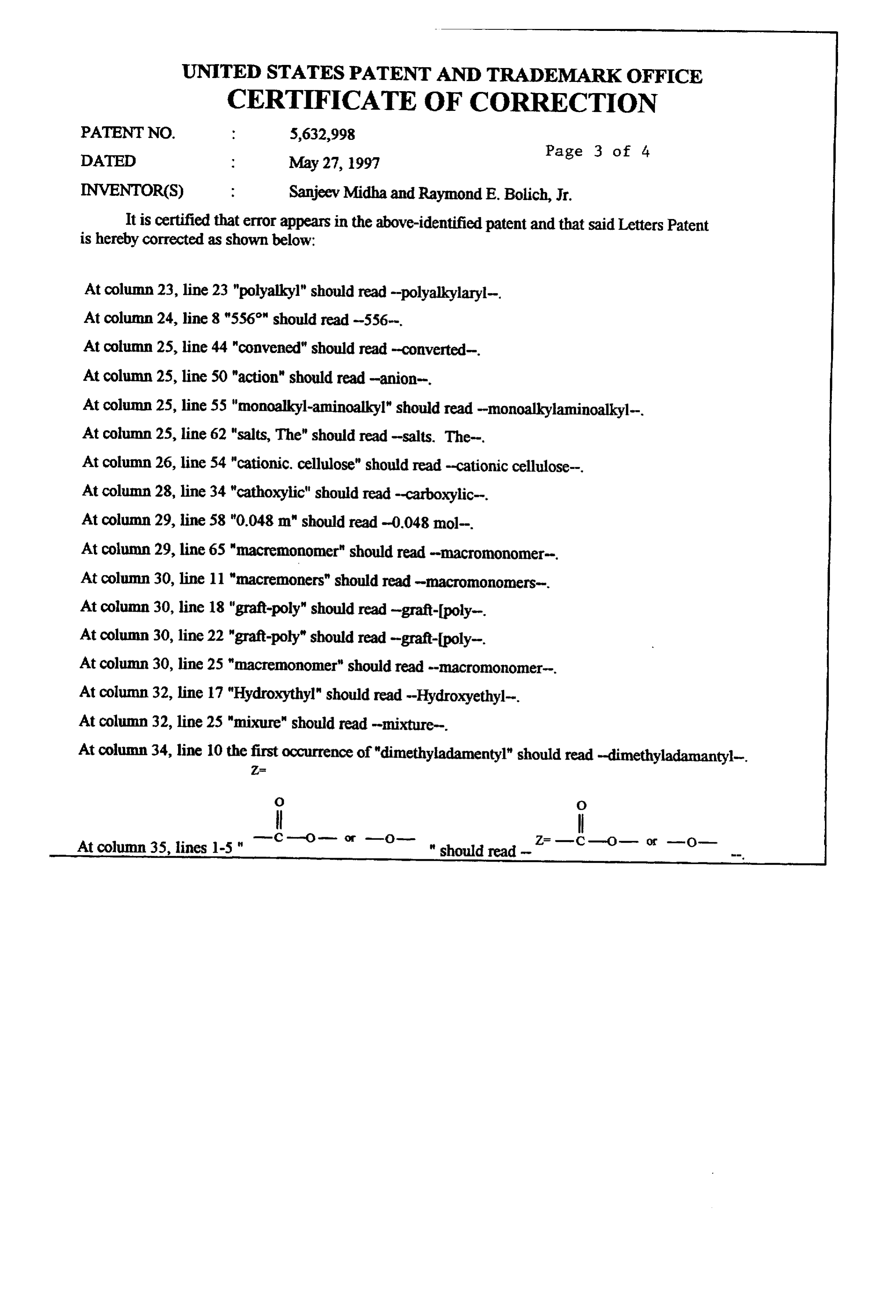
Page 23
UNITED STATES PATENT ANDTRADEMARK OFFICE
CERTFCATE OF CORRECTION
DATED : May 27, 1997 Page 4 of 4 INVENTOR(S) : Sanjeev Midha and Raymond E. Bolich, Jr. It is certified that error appears in the above-identified patent and that said Letters Patent is hereby corrected as shown below:
At column 35, line 13 "ethacnyloyl" should read-ethacryloyl-. At column 35, line 15 "vinylbonzoyl" should read-vinylbenzoyl-. At column 35, line 21 "alyl" should read-allyl-.
At column 35, line 22 "vinylbenzoyl" should read-vinylbenzoyl-. At Col. 19, line 64, “Many" begins a new paragraph.
Signed and Sealed this
Eleventh Day of November, 1997
BRUCE LEHMAN
Attesting Officer Commissioner of Patients and Trade marks
Provenance
- Collection
- Cited prior art
- Original PDF
- patentimages.storage.googleapis.com →
- Filed
- 1996-03-15
- Pages
- 23
- Method
- pdftotext (the PDF's own text layer) + pdftoppm 300dpi page scans
- Source
- Google Patents bibliographic record
- Granted
- 1997-05-27
- Inventors
- Sanjeev Midha; Raymond E. Bolich, Jr.; Procter and Gamble Co
- Transcribed from
- patentimages.storage.googleapis.com →