patent · US3933676
Stabilized aqueous solutions of sodium borohydride
20 January 1976
Page 1 — bibliographic record
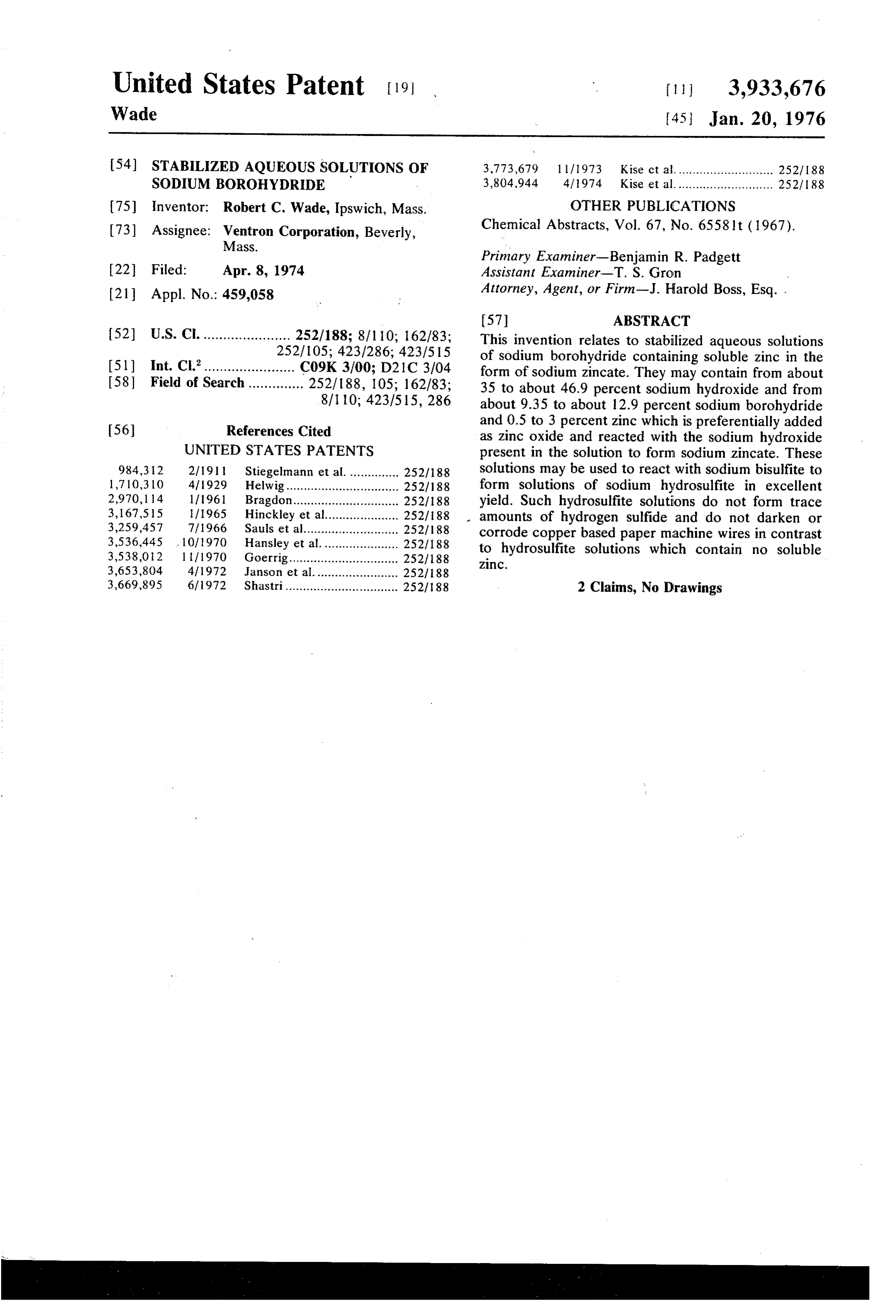
United States Patent 19 [11] 3,933,676 Wade (45) Jan. 20, 1976 54) STABILIZED AQUEOUS SOLUTIONS OF 3,773,679 l l l 1973 Kise et al............................ 252/ 88 SODIUM BOROHYDRDE 3,804,944 4/1974 Kise et al............................ 2521 i 88 75) Inventor: Robert C. Wade, Ipswich, Mass. OTHER PUBLICATIONS 73) Assignee: Ventron Corporation, Beverly, Chemical Abstracts, Vol. 67, No. 6558 it (1967). Mass.
Primary Examiner-Benjamin R. Padgett (22 Filed: Apr. 8, 1974 Assistant Examiner-T. S. Gron (21 Appl. No.: 459,058 Attorney, Agent, or Firm-J. Harold Boss, Esq. .
52 U.S. C. ...................... 252/188; 8/110; 162/83; This invention relates to stabilized aqueous solutions 252/105; 423/286; 4231515 of sodium borohydride containing soluble zinc in the (51) Int. C.’....................... C09K 3700; D21C 3/04 form of sodium zincate. They may contain from about 58) Field of Search .............. 252/188, 105; 162/83; 35 to about 46.9 percent sodium hydroxide and from 8/110; 4231515, 286 about 9.35 to about 12.9 percent sodium borohydride
and 0.5 to 3 percent zinc which is preferentially added as zinc oxide and reacted with the sodium hydroxide
UNITED STATES PATENTS present in the solution to form sodium zincate. These 984,312 2119 l l Stiegelmann et al............... 252/188 solutions may be used to react with sodium bisulfite to 1,710,310 4/1929 Helwig................................ 252/188 form solutions of sodium hydrosulfite in excellent 2,970,114 111961 Bragdon.............................. 252/88 yield. Such hydrosulfite solutions do not form trace 3,167,515 1/1965 Hinckley et al..................... 252/88 amounts of hydrogen sulfide and do not darken or 3,259,457 7/1966 Sauls et al........................... 252/188 corrode copper based paper machine wires in contrast 3,536,445 10/1970 Hansley et al...................... 252/188 to hydrosulfite solutions which contain no soluble 3,538,012 1 / 1970 Goerrig............................... 252/188 zinc.
3,653,804 4/1972 Janson et al........................ 2521.188 3,669,895 6/1972 Shastri................................ 252/88 2 Claims, No Drawings
Page 2
be used in paper making processes where it would be
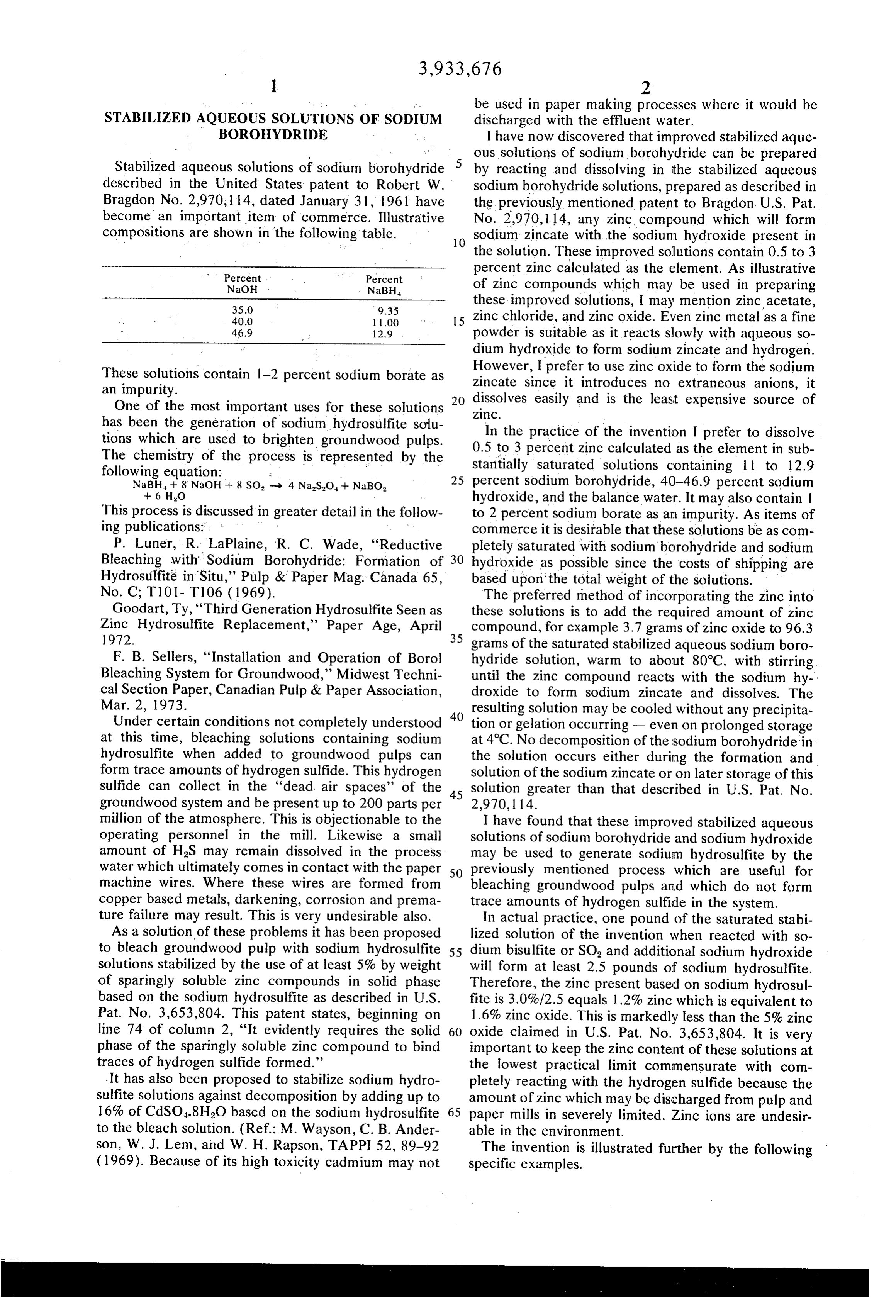
STABILIZED AQUEOUS soLUTIONS OF SODIU discharged with the effluent water. BOROHYDRIDE .. " I have now discovered that improved stabilized aque ous solutions of sodium borohydride can be prepared
Stabilized aqueous solutions of sodium borohydride 5 by reacting and dissolving in the stabilized aqueous described in the United States patent to Robert W. sodium borohydride solutions, prepared as described in Bragdon No. 2,970,114, dated January 31, 1961 have the previously mentioned patent to Bragdon U.S. Pat. become an important item of commerce. Illustrative No. 2,970,114, any zinc compound which will form compositions are shown in the following table. 10 sodium zincate with the sodium hydroxide present in the solution. These improved solutions contain 0.5 to 3
percent zinc calculated as the element. As illustrative
NaOH. NaBH of zinc compounds which may be used in preparing
these improved solutions, I may mention zinc acetate, 40.0 11.00 zinc chloride, and zinc oxide. Even zinc metal as a fine 46.9 29 powder is suitable as it reacts slowly with aqueous so dium hydroxide to form sodium zincate and hydrogen.
However, I prefer to use zinc oxide to form the sodium
These solutions contain 1-2 percent sodium borate as zincate an impurity. since it introduces no extraneous anions, it 20 dissolves easily and is the least expensive source of
One of the most important uses for these solutions has been the generation of sodium hydrosulfite solu zinc. In the practice of the invention I prefer to dissolve tions which are used to brighten groundwood pulps. 0.5 to 3 percent zinc calculated as the element in sub The chemistry of the process is represented by the stantially saturated solutions containing 11 to 12.9
NaBH + 8 NaOH + 8 SO - 4 NaSO + NaBO. 25percent sodium borohydride, 40-46.9 percent sodium + 6 HO hydroxide, and the balance water. It may also contain This process is discussed in greater detail in the follow to 2 percent sodium borate as an impurity. As items of ing publications: : commerce it is desirable that these solutions be as com P. Luner, R. LaPlaine, R. C. Wade, “Reductive pletely saturated with sodium borohydride and sodium Bleaching with Sodium Borohydride: Formation of 30 hydroxide as possible since the costs of shipping are Hydrosulfite in Situ, Pulp & Paper Mag. Canada 65, based upon the total weight of the solutions. No. C; T101-T106 (1969). The preferred method of incorporating the zinc into Goodart, Ty, “Third Generation Hydrosulfite Seen as these solutions is to add the required amount of zinc Zinc Hydrosulfite Replacement,” Paper Age, April compound, for example 3.7 grams of zinc oxide to 96.3
grams of the saturated stabilized aqueous sodium boro
F. B. Sellers, "Installation and Operation of Borol hydride solution, warm to about 80°C. with stirring Bleaching System for Groundwood,' Midwest Techni until the zinc compound reacts with the sodium hy cal Section Paper, Canadian Pulp & Paper Association, droxide to form sodium zincate and dissolves. The Mar. 2, 1973. resulting solution may be cooled without any precipita Under certain conditions not completely understood 40 tion or gelation occurring - even on prolonged storage at this time, bleaching solutions containing sodium at 4°C. No decomposition of the sodium borohydride in hydrosulfite when added to groundwood pulps can the solution occurs either during the formation and form trace amounts of hydrogen sulfide. This hydrogen solution of the sodium zincate or on later storage of this sulfide can collect in the "dead air spaces' of the 45 solution greater than that described in U.S. Pat. No. groundwood system and be present up to 200 parts per 2,970,114.
million of the atmosphere. This is objectionable to the I have found that these improved stabilized aqueous operating personnel in the mill. Likewise a small solutions of sodium borohydride and sodium hydroxide amount of HS may remain dissolved in the process may be used to generate sodium hydrosulfite by the water which ultimately comes in contact with the paper 50 previously mentioned process which are useful for machine wires. Where these wires are formed from bleaching groundwood pulps and which do not form copper based metals, darkening, corrosion and prema trace amounts of hydrogen sulfide in the system. ture failure may result. This is very undesirable also. In actual practice, one pound of the saturated stabi As a solution of these problems it has been proposed lized solution of the invention when reacted with so to bleach groundwood pulp with sodium hydrosulfite 55 dium bisulfite or SO, and additional sodium hydroxide solutions stabilized by the use of at least 5% by weight will form at least 2.5 pounds of sodium hydrosulfite. of sparingly soluble zinc compounds in solid phase Therefore, the zinc present based on sodium hydrosul based on the sodium hydrosulfite as described in U.S. fite is 3.0%/2.5 equals 1.2% zinc which is equivalent to Pat. No. 3,653,804. This patent states, beginning on 1.6% zinc oxide. This is markedly less than the 5% zinc line 74 of column 2, “It evidently requires the solid 60 oxide claimed in U.S. Pat. No. 3,653,804. It is very phase of the sparingly soluble zinc compound to bind important to keep the zinc content of these solutions at traces of hydrogen sulfide formed.' the lowest practical limit commensurate with com . It has also been proposed to stabilize sodium hydro pletely reacting with the hydrogen sulfide because the sulfite solutions against decomposition by adding up to amount of zinc which may be discharged from pulp and 16% of CdSO.8HO based on the sodium hydrosulfite 65 paper mills in severely limited. Zinc ions are undesir to the bleach solution. (Ref: M. Wayson, C. B. Ander able in the environment.
son, W. J. Lem, and W. H. Rapson, TAPPI 52, 89-92 The invention is illustrated further by the following (1969). Because of its high toxicity cadmium may not specific examples.
Page 3
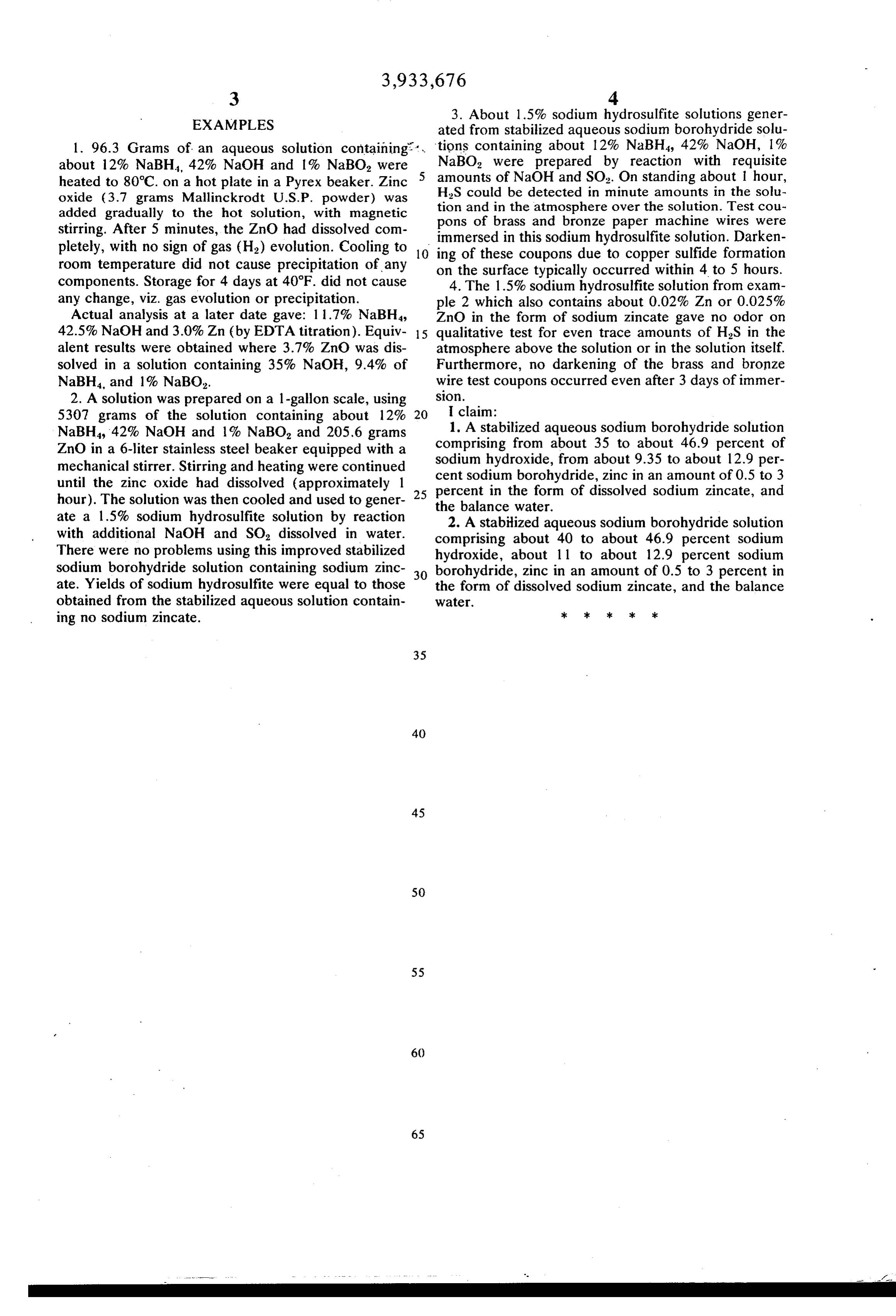
EXAMPLES
3. About 1.5% sodium hydrosulfite solutions gener ated from stabilized aqueous sodium borohydride solu 1. 96.3 Grams of an aqueous solution containing tions containing about 12% NaBH4, 42% NaOH, 1% about 12% NaBH4, 42% NaOH and 1% NaBO were 5 NaBO, were prepared by reaction with requisite heated to 80°C. on a hot plate in a Pyrex beaker. Zinc amounts of NaOH and SO. On standing about 1 hour, oxide (3.7 grams Mallinckrodt U.S. P. powder) was HS could be detected in minute amounts in the solu added gradually to the hot solution, with magnetic tion and in the atmosphere over the solution. Test cou stirring. After 5 minutes, the ZnO had dissolved com pons of brass and bronze paper machine wires were immersed in this sodium hydrosulfite solution. Darken pletely, with no sign of gas (H) evolution. Cooling to 10 ing room temperature did not cause precipitation of any on the of these coupons due to copper sulfide formation components. Storage for 4 days at 40F. did not cause surface typically occurred within 4 to 5 hours. 4. The 1.5% sodium hydrosulfite solution from exam any change, viz. gas evolution or precipitation. ple 2 which also contains about 0.02% Zn or 0.025% Actual analysis at a later date gave: 11.7% NaBH, ZnO in the form of sodium zincate gave no odor on 42.5% NaOH and 3.0% Zn (by EEDTA titration). Equiv- 15 qualitative test for even trace amounts of HS in the alent results were obtained where 3.7% ZnO was dis atmosphere above the solution or in the solution itself. solved in a solution containing 35% NaOH, 9.4% of Furthermore, no darkening of the brass and bronze NaBH, and 1% NaBO. wire test coupons occurred even after 3 days of immer 2. A solution was prepared on a 1-gallon scale, using sion.
5307 grams of the solution containing about 12% 20 claim:
NaBH, 42% NaOH and 1% NaBO, and 205.6 grams comprising 1. A stabilized aqueous sodium borohydride solution from about 35 to about 46.9 percent of
ZnO in a 6-liter stainless steel beaker equipped with a sodium hydroxide, from about 9.35 to about 12.9 per mechanical stirrer. Stirring and heating were continued cent sodium borohydride, zinc in an amount of 0.5 to 3 until the zinc oxide had dissolved (approximately 1 25 percent in the form of dissolved hour). The solution was then cooled and used to gener the balance water. sodium zincate, and ate a 1.5% sodium hydrosulfite solution by reaction 2. A stabilized aqueous sodium borohydride solution with additional NaOH and SO dissolved in water. comprising about 40 to about 46.9 percent sodium There were no problems using this improved stabilized hydroxide, about 1 1 to about 12.9 percent sodium sodium borohydride solution containing sodium zinc- 30 borohydride, zinc in an amount of 0.5 to 3 percent in ate. Yields of sodium hydrosulfite were equal to those the form of dissolved sodium zincate, and the balance obtained from the stabilized aqueous solution contain Water.
ing no sodium zincate. k k is
Provenance
- Collection
- Cited prior art
- Original PDF
- patentimages.storage.googleapis.com →
- Filed
- 1974-04-08
- Pages
- 3
- Method
- pdftotext (the PDF's own text layer) + pdftoppm 300dpi page scans
- Source
- Google Patents bibliographic record
- Granted
- 1976-01-20
- Inventors
- Robert C. Wade; Ventron Corp
- Transcribed from
- patentimages.storage.googleapis.com →