patent · US4342792
Electrodes and method of preparation thereof for use in electrochemical cells
3 August 1982
Page 1 — bibliographic record
United States Patent (19) 11) 4,342,792 Brown et al. 45) Aug. 3, 1982 (54) ELECTRODES AND METHOD OF 3,977,958 8/1976 Caldwell et al................. 204/290 F PREPARATION THEREOF FOR USE IN. 4,076,611 2/1978 Gray ................................ 204/290 F ELECTROCHEMICAL CELLS 4,245,017 l/1981 Haering et al. ..................... 427/226 (75) Inventors: David E. Brown, Weybridge; Stephen 4,281,048 7/1981 Haering et al. ..................... 427/226 M. Hall, Feltham; Mahmood N. Primary Examiner-John D. Smith
Mahmood, Walton-On-Thames, all of Assistant Examiner-Richard Bueker
England Attorney, Agent, or Firm-Brooks, Haidt, Haffner & (73) Assignee: The British Petroleum Company Delahunty
Limited, London, England 57 ABSTRACT (21) Appl. No. 262,415 This invention relates to novel electrodes and a method (22 Filed: May 11, 1981 of preparation thereof for use in electrochemical cells. The novel electrodes contain a combination of electro 30 Foreign Application Priority Data . catalysts deposited on a metal substrate. May 13, 1980 (GB) United Kingdom.............. 8015797 The electrocatalysts are deposited from a homogeneous 51) Int. Cl. ............................................... B05D 5/12 solution of the compounds of (a) at least one metal 52 U.S. C. ...................................... 427/34; 427/123; selected from iron, cobalt, manganese and nickel, (b) at 427/126.3; 427/126.6; 427/377; 427/376,2; least one metal selected from molybdenum, vanadium 427/376.3; 427/376.4; 427/376.5; 427/376.6; and tungsten, and (c) at least one rare earth metal of the 427/226; 427/423; 204/290 R; 204/290 F lanthanide group having an atomic number of 57-71 58) Field of Search.................. 427/123, 126.3, 126.6, inclusive, the metal compounds are decomposed to the 427/377, 34,423, 226, 376.2, 376.3, 376.4, oxides and the oxide coated substrate cured at elevated 376.5, 376.6; 204/290 R, 290 F temperature in a reducing atmosphere. The electrodes (56) References Cited thus produced can be used as an anode or as a cathode
brines.
3,833,357 9/1974 Bianchi et al. ...................... 423/64 3,917,525 11/1975 Bouyet al....................... 204/290 F 10 Claims, 1 Drawing Figure
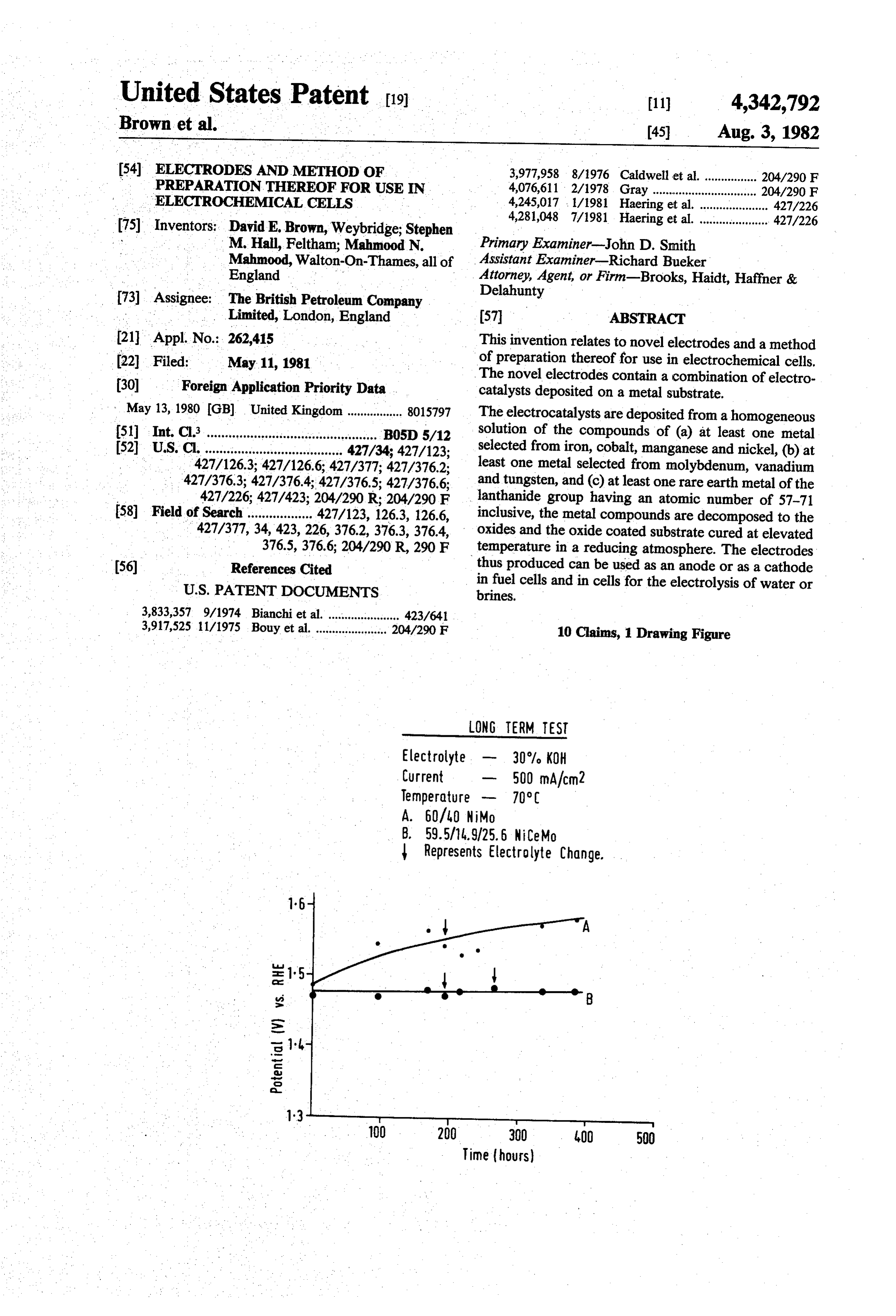
LONG TERM EST
Electrolyte - 30°/ KOH
Temperature - 70°C
Represents Electrolyte Change.
Time hours)
Page 2
Drawing sheet — no readable text.
Page 3
cured in a reducing atmosphere. The electrodes thus
ELECTRODES AND METHOD OF PREPARATION produced show a marked improvement over those dis THEREOF FOR USE IN ELECTROCHEMICAL closed hitherto. It has now been found that the perfor CELLS mance and efficiency of these electrodes can be further improved by adding a third component to these electro
The present invention relates to a method of prepar catalysts.
ing active electrodes and in particular to such elec It is an object of the present invention to provide trodes having improved efficiency and/or stability and electrocatalysts which mitigate the problems of elec the use thereof in electrochemical cells. trode over-potential, low current density, poor thermal An electrochemical cell is a device which has as basic 10 efficiency and high capital costs. components at least one anode and one cathode and an Accordingly, the present invention is a method of electrolyte. The cell may use electrical energy to producing electrodes having electrocatalysts deposited achieve a chemical reaction such as the oxidation or thereon comprising treating a metal electrode substrate reduction of a chemical compound as in an electrolytic so as to coat the substrate surface with a homogeneous cell. Alternatively it can convert inherent chemical 15 solution of the compounds of (i) at least one metal se energy in a conventional fuel into low voltage direct lected from a first group of iron, cobalt, nickel and current electrical energy as in a fuel cell. If the elec manganese, (ii) at least one metal selected from a second trodes in such a cell are of relatively inexpensive mate group of molybdenum, tungsten and vanadium, and (iii) rial such as e.g. iron or nickel, they tend to have low at least one rare earth metal selected from the group of activity. The activity can be improved by coating such 20 lanthanides having an atomic number of 57-71 inclu electrodes with precious metal electrocatalysts such as sive, each of which compounds, when not an oxide, is e.g. platinum, iridium or ruthenium. The level of pre capable of thermal decomposition to the corresponding cious metal required for high activity and stability gen metal oxide, thermally decomposing the metal com erally leads to high costs. pounds, other than the oxides, on the substrate to the The above problems are particularly acute in electro 25 corresponding oxides or mixed oxides and curing the chemical cells used for example for the electrolysis of oxide-coated substrate in a reducing atmosphere at ele water to produce hydrogen and oxygen. Hydrogen is a vated temperature.
versatile raw material. It is for example a most desirable According to a preferred embodiment the present source of fuel and energy due to the clean and non-toxic invention is a method of producing electrodes having nature of its combustion products. In addition, it is used 30 electrocatalysts deposited thereon comprising treating a for example in the fertilizer, metallurgical, and petro metal electrode substrate so as to coat the substrate chemical industries. Whilst demand for hydrogen is surface with a homogeneous solution as hereinafter increasing, production costs from conventional sources defined of a nickel compound, a molybdenum com are also increasing. Water is a natural resource which is pound and a compound of at least one rare earth metal readily and abundantly available and from which hy 35 selected from cerium and lanthanum, all of which are drogen can be produced by electrolysis. However, the capable of thermal decomposition to the corresponding cost of the electrocatalysts used hitherto has detracted oxides or mixed oxides, thermally decomposing the from the commercial vaiability of the water electrolysis metal compounds on the substrate surface to the corre technology. Moreover, the currently used water elec sponding oxides or mixed oxides, and curing the oxide trolysers operate in a 25-30% alkaline solution at coated substrate in a reducing atmosphere at elevated 70-90' C. and exhibit a thermal efficiency of about temperature.
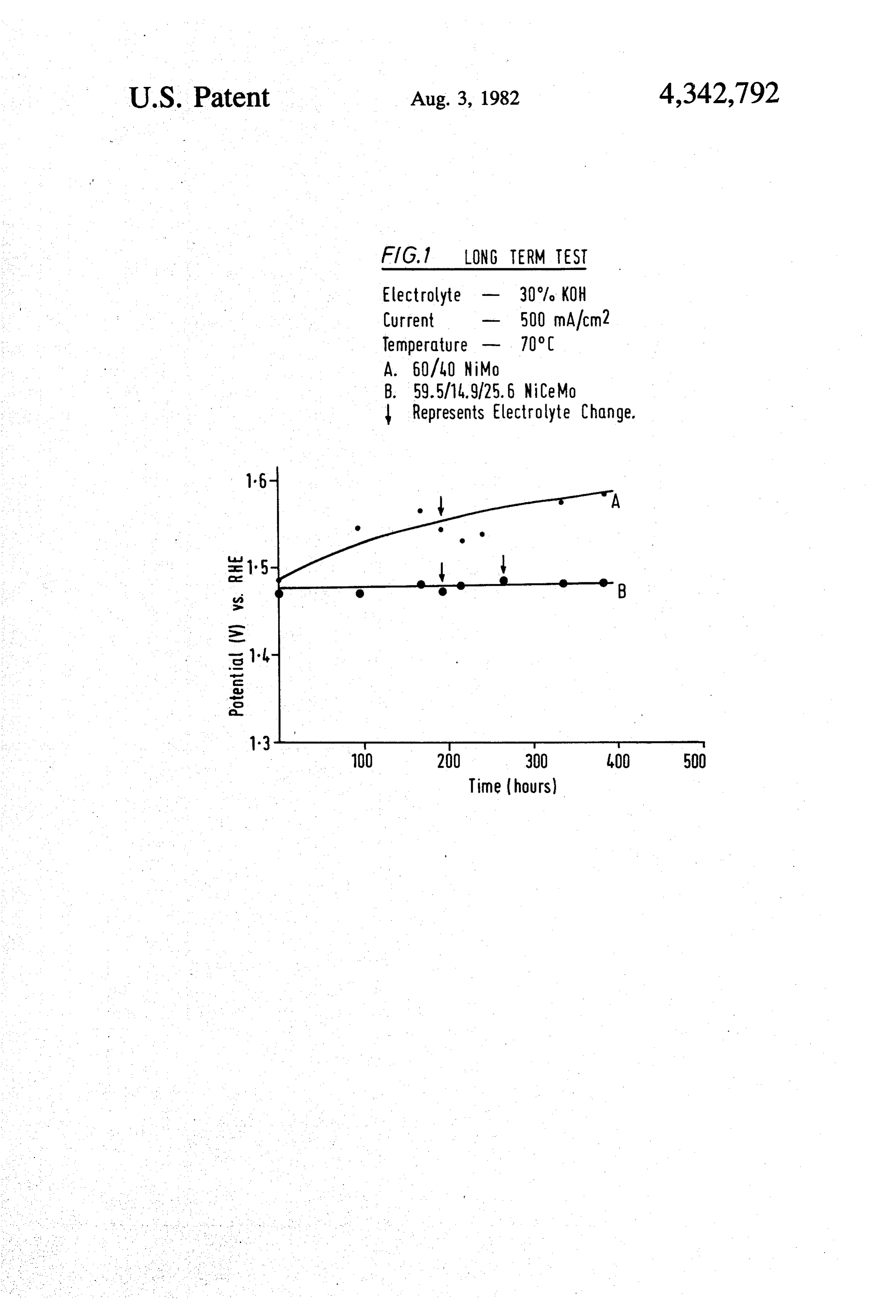
70% at practical current densities of about 200 FIG. 1, the sole FIGURE, represents the results of a mA/cm2. The poor efficiency and low levels of opera long term test of an electrode of the invention (B) as tional current density are also responsible for the high compared with an electrode not in accordance with the capital costs of water electrolysers and the consequent 45 invention (A).
high production costs of electrolytically produced hy The term "homogeneous solution' as used here and drogen. m throughout the specification is meant to embrace both The thermal efficiency of a water electrolyser is gov liquid homogeneous solutions and homogeneous solids. erned by the over-potentials at the electrodes and the The metal electrode substrate on which the coating is losses due to internal resistance at the inter-electrode 50 carried out according to the present invention may be of gap. a relatively inexpensive material such as for instance Some of the problems of over-potential were miti nickel, iron, copper, titanium, and alloys thereof or of gated until recently, only by using noble metals of other metallic substances plated with any of these mate Group VIII of the Periodic Table. Even these expen rials. The substrate may be in the form of wire, tube, sive metals presented problems. For example, ruthe 55 rod, planar or curved sheet, screen or gauze. If the nium oxide electrodes when used for oxygen evolution electrode is to be used as a cathode the substrate may be dissolve in acidic and alkaline electrolytes. Those met nickel or iron whereas for use as an anode a nickel als which do not dissolve during oxygen evolution will screen or nickel plated iron substrate is preferred. at least be covered with an oxide film and lose their The metals of which compounds are present in the activity. More recently, it has been shown in our co homogeneous solution are compounds of (i) at least one pending European patent publication No; 0009406 that metal selected from a first group of iron cobalt, nickel the problems of over-potential at the cathode, for exam and manganese, (ii) at least one metal selected from a ple, can be mitigated by using less expensive metals as second group of molybdenum, vanadium and tungsten electrocatalysts. This publication discloses electrodes and (iii) at least one rare earth metal selected from the having deposited thereon electrocatalysts, for instance 65 group of lanthanides having an atomic number of 57-71 of the nickel-molybdenum type, from a homogeneous inclusive. Each of the compounds present in the solu solution of their compounds which are initially ther tion should be capable of thermal decomposition to the mally decomposed to their oxides and subsequently corresponding oxide. Examples of compounds which
Page 4
may be used include the nitrates and chlorides of the The reducing atmosphere is preferably hydrogen and metals particularly those in the first and lanthanide the heating temperature is preferably between 350 and groups and, specifically for those in the second group, 600 C. In particular, it would appear that optimum the molybdates, tungstates, vanadates, such as e.g. am activity for the electrode, when used as the cathode, is monium paramolybdate, ammonium tungstate and am 5 achieved by reduction at a temperature around 500 C., monium metavanadate. In the homogeneous solution, whereas for use as an anode, the electrode is suitably the ratio of the metal atoms from the lanthanide group reduced above 500 C., preferably around 600 C. Some to the combined metal atoms of the first and second variation in the optimum curing temperature may be groups is suitably between 0.1:10 and 5:10, preferably achieved by varying the duration of the curing treat between 1:10 and 1:4, and the ratio of the metal atoms of 10 ment.
the first group to the metal atoms in the second group is By carrying out the process of the present invention suitably between 1:1 and 5:1. the electrodes produced have a surprisingly high degree The homogeneous solution of the metal compounds of activity and stability.
used for coating may be an intimate mixture of the The steps of electrode preparation may be adapted to respective solid metal compounds in their finely divided 15 produce an appropriate level of catalyst loading on the state, a solid solution of the metal compounds or a solu substrate surface. The catalyst loading is suitably above tion of the compounds in a solvent. An intimate mixture 5 mg/cm2 (based on the weight of the active species of the solid metal compounds may be prepared in ad deposited on the substrate surface), preferably above 10 vance or the compounds may be mixed immediately mg/cm2. The eventual loading will depend upon the prior to contact with the substrate to be coated. An 20 mechanical stability and integrity of the coating re example of the latter case is when the respective metal quired, the substrate used and the cell in which the compounds are sprayed separately but simultaneously electrode is to be used. It has however been found that on to the substrate; if premixed, the mixture may for according to the present invention very low electrode example be sprayed from a single spray gun. In one potentials of the order of +1.48 V vs RHE will produce technique the metal oxides themselves are directly 25 oxygen at a current density of 500 mA/cm2 at 70° C. in sprayed onto the metal electrode substrates. In the case 30% KOH solution. This degree of reduction in elec of solutions in solvents, the solvent may be aqueous trode potential will not only enable operation of the such as for example water, acidic systems or aqueous cells at high current ethanol, or organic, e.g. methanol, ethanol, propanol, increase the economicdensity but will also significantly isopropanol, formamide or dimethyl formamide. The 30 One of the important features ofofthesuch efficiency cells.
choice of a particular solvent will depend upon the present invention is their resistance to oxidation.ofFor electrodes the solubility of the desired metal compounds in the sol example, a nickel-molybdenum-lanthanum electrode vent.
prepared from a nitric acid stabilized solution using a
In certain cases where aqueous systems are used, baking treatment in air at 275 C. showed no increase in there may be a tendency for one or more of the metal 35 overvoltage. That is, the initial potential in mV vs RHE compounds to separate by precipitation, particularly on at 500 mA/cm2 was 101 and remained substantially standing the solution even for a relatively short time. unchanged and stable.
For example an aqueous solution containing nickel ni The present invention is further illustrated with refer trate, ceric nitrate and ammonium molybdate may need ence to the following Examples: a small amount of nitric acid or citric acid to produce a 40 clear solution. Examples If the homogeneous solution is a liquid it may be Electrode Preparation (Electrode Nos: 1-6) applied to the substrate surface to be coated for example by dipping, spraying, or brushing. The coated substrate Two separate homogeneous solutions were prepared is thereafter heated at elevated temperature to decom 45 with only the lanthanide group component being var pose the metal compounds into the corresponding ox ied. Thus, measured volumes of nickel nitrate hexahy ides. The decomposition is suitably carried out in air at drate (2 molar), ammonium paramolybdate tetrahydrate a temperature between 250 C. and 1200° C., preferably (0.143 molar) and ceric nitrate (1.0 molar) or lanthanum between 350° C. and 900 C. The operation of applying nitrate (1.0 molar) were mixed together to give solu a coat of the homogeneous solution to the substrate 50 tions with the required compositions. A few milliliters followed by thermal decomposition may be repeated of concentrated nitric acid was added in each case to several times to ensure adequate coverage of the sub produce a clear, homogeneous solution. strate surface with the metal oxides. Three clean 60 mesh Dutch Twill weave nickel If, on the other hand, the homogeneous solution of screens were then coated each with the respective ho the metal compound is a mixture of solids, whether or 55 mogeneous solutions by dip-pyrolysis or spray pyrolysis not premixed, it may be applied to the substrate by melt as indicated in Table I below. The dip-pyrolysis was spraying techniques such as for example flame spraying carried out by dipping the nickel screen substrate in the or plasma spraying. If this type of techniques is used, the homogeneous solution and then heating in air in a fur steps of coating the substrates with the metal com nace to 300-900 C. The operation was repeated sev pounds and thermal decomposition of the coating are 60 eral times until a visibly satisfactory film of the metal both effected in a single step. This is due to the rela oxides was formed on the nickel screen substrate. The tively high temperature associated with such techniques oxide-coated nickel screen was then heated in a furnace whereby the metal compounds may be expected to under a reducing atmosphere of hydrogen at tempera decompose to their oxides. tures of about 500' C. for 1 hour. The substrate coated with the metal oxides, whether 65 The spray pyrolysis, where indicated in Table I, was from a homogeneous liquid or a mixture of solids, is carried out by applying the coating solution to each side then cured by heating in an oven in a reducing atmo of a clean substrate with a laboratory spray gun. The sphere at a temperature between 250 C. and 700° C. substrate was heated in an oven at 300-900' C. for
Page 5
about 10 minutes, and then allowed to cool to room coating solution. This was an aqueous solution of nickel temperature. The procedure was repeated until the nitrate, ammonium paramolybdate and lanthanum ni required amount of coating had been deposited. Finally trate, to which nitric acid had been added to produce a the resulting substrate was heated in an atmosphere of clear green solution. The atomic ratio of NiMo:La in hydrogen at 500 C. for about 1 hour. the coating solution is listed for each electrode in Table
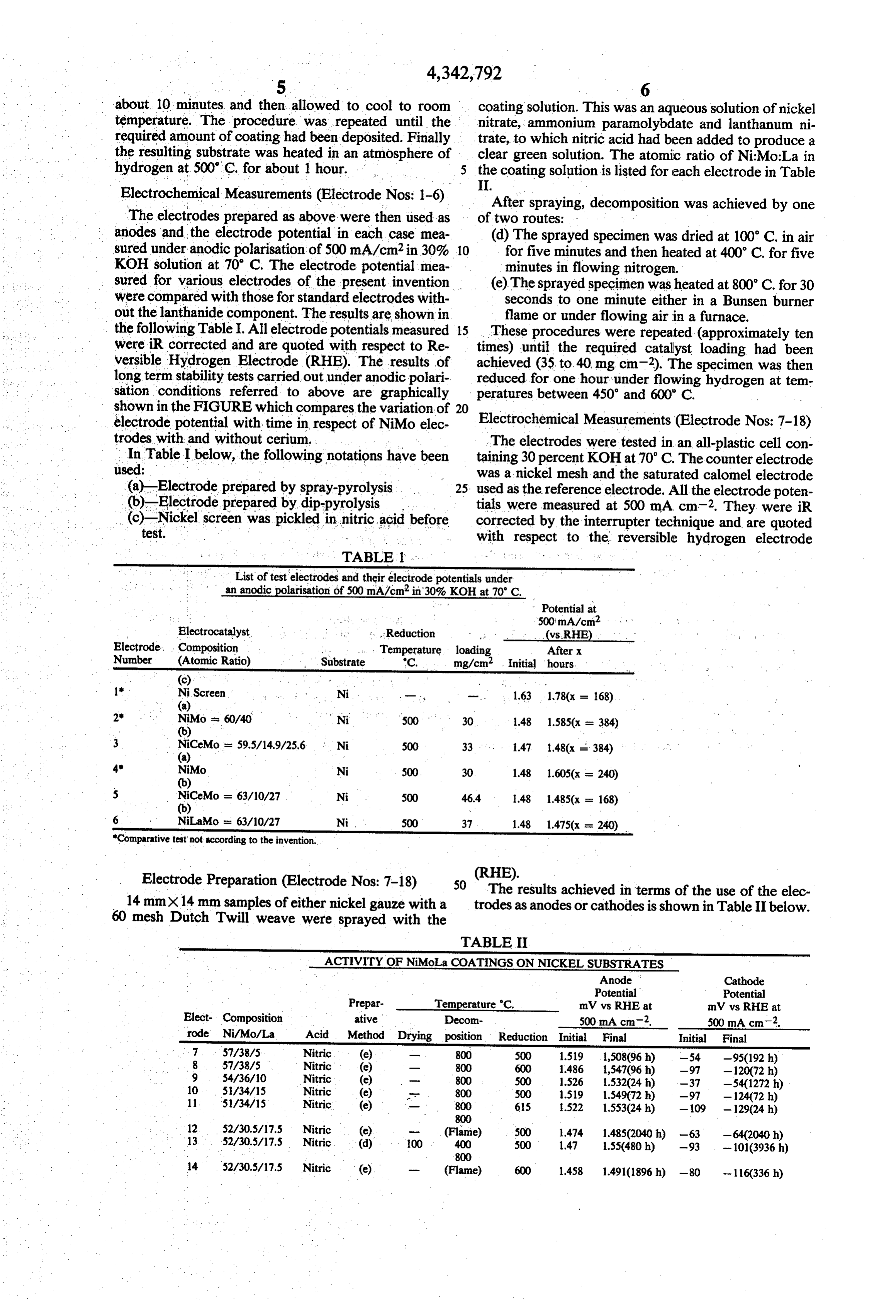
Electrochemical Measurements (Electrode Nos: 1-6) - After spraying, decomposition was achieved by one The electrodes prepared as above were then used as of two routes:
anodes and the electrode potential in each case mea (d) The sprayed specimen was dried at 100° C. in air sured under anodic polarisation of 500 mA/cm2 in 30% 10 for five minutes and then heated at 400 C. for five KOH solution at 70° C. The electrode potential mea minutes in flowing nitrogen.
sured for various electrodes of the present invention (e) The sprayed specimen was heated at 800° C. for 30 were compared with those for standard electrodes with seconds to one minute either in a Bunsen burner out the lanthanide component. The results are shown in flame or under flowing air in a furnace. the following Table I. All electrode potentials measured 15 These procedures were repeated (approximately ten were iR corrected and are quoted with respect to Re times) until the required catalyst loading had been versible Hydrogen Electrode (RHE). The results of achieved (35 to.40 mg cm-2). The specimen was then long term stability tests carried out under anodic polari reduced for one hour under flowing hydrogen at tem sation conditions referred to above are graphically peratures between 450 and 600 C.
shown in the FIGURE which compares the variation of 20 electrode potential with time in respect of NiMo elec Electrochemical Measurements (Electrode Nos:7-18) trodes with and without cerium. The electrodes were tested in an all-plastic cell con
used:
Table I below, the following notations have been taining 30 percent KOH at 70° C. The counter electrode was a nickel mesh and the saturated calomel electrode (a)-Electrode prepared by spray-pyrolysis 25. used as the reference electrode. All the electrode poten (b)-Electrode prepared by dip-pyrolysis tials were measured at 500 mA cm-2. They were iR
test.
screen was pickled in nitric acid before corrected by the interrupter technique and are quoted with respect to the reversible hydrogen electrode
TABLE 1 a
List of test electrodes and their electrode potentials under an anodic polarisation of 500 mA/cm2 in 30% KOH at 70° C.
Potential at
Electrocatalyst ... Reduction -(vs.RE)-
Electrode Composition . . . Temperature. loading After x
Number (Atomic Ratio) Substrate "c. mg/cm. Initial hours.
1. Sisten Ni - 1.63 178(x = 168) 2. Simo = 60/40 Ni 500 30 1.48 1.5850x = 384) 3 Scamo s: 59.5/149/25.6 N 500 33 1.47 1.48(x - 384) 4. Shio Ni 500 30 1.48 1.605(x = 240) 5 Slomo = 63/10/27 Ni 500 46.4 1.48 1.485(x = 168) 6 Simo = 63/10/27 Ni 500 37 1.48 1.475(x = 240) "Comparative test not according to the invention.
Electrode Preparation (Electrode Nos:7-18) 50 (RHE).
The results achieved in terms of the use of the elec 14 mm x 14 mm samples of either nickel gauze with a trodes as anodes or cathodes is shown in Table II below. 60 mesh Dutch Twill weave were sprayed with the
TABLE II
ACTIVITY OF NiMoLa COATINGS ON NICKEL SUBSTRATES
Prepar- Temperature C. nV vs RHE at mV vs RHE at
Elect- Composition ative Decom- 500 mA cm2. 500 mA cm-2. rode Ni/Mova Acid Method Drying position Reduction Initial Final Initial Final 7 57/38/5 Nitric (e) - 800 500 1.519 1,508(96 h) -54 -95(192 h) 8 57/38/5 Nitric (e) 800 600 1.486 1,547(96 h) -97 - 120(72 h) 9 54/36/10 Nitric (e) -- 800 500 1.526 1.532(24 h) -37 -54(1272 h) 10 5/34/15 Nitric (e) - 800 500 1.519 1.549(72 h) -97 - 124(72 h) 11 51/34/15 Nitric (e) - 800 65 1.522 1553(24 h) - 109 - 129(24 h)
12 52/30.5/17.5 Nitric (e) -- (Flame) 500 1.474 1.485(2040 hl) -63 -64(2040 h) 13 52/30.5/17.5 Nitric (d) 00 400 500 147 1.55(480 h) --93 - 101(3936 h)
14 52/30.5/17.5 Nitric (e) - (Flame) 600 1.458 1.491(1896 h) - 80 - 116(336 h)
Page 6
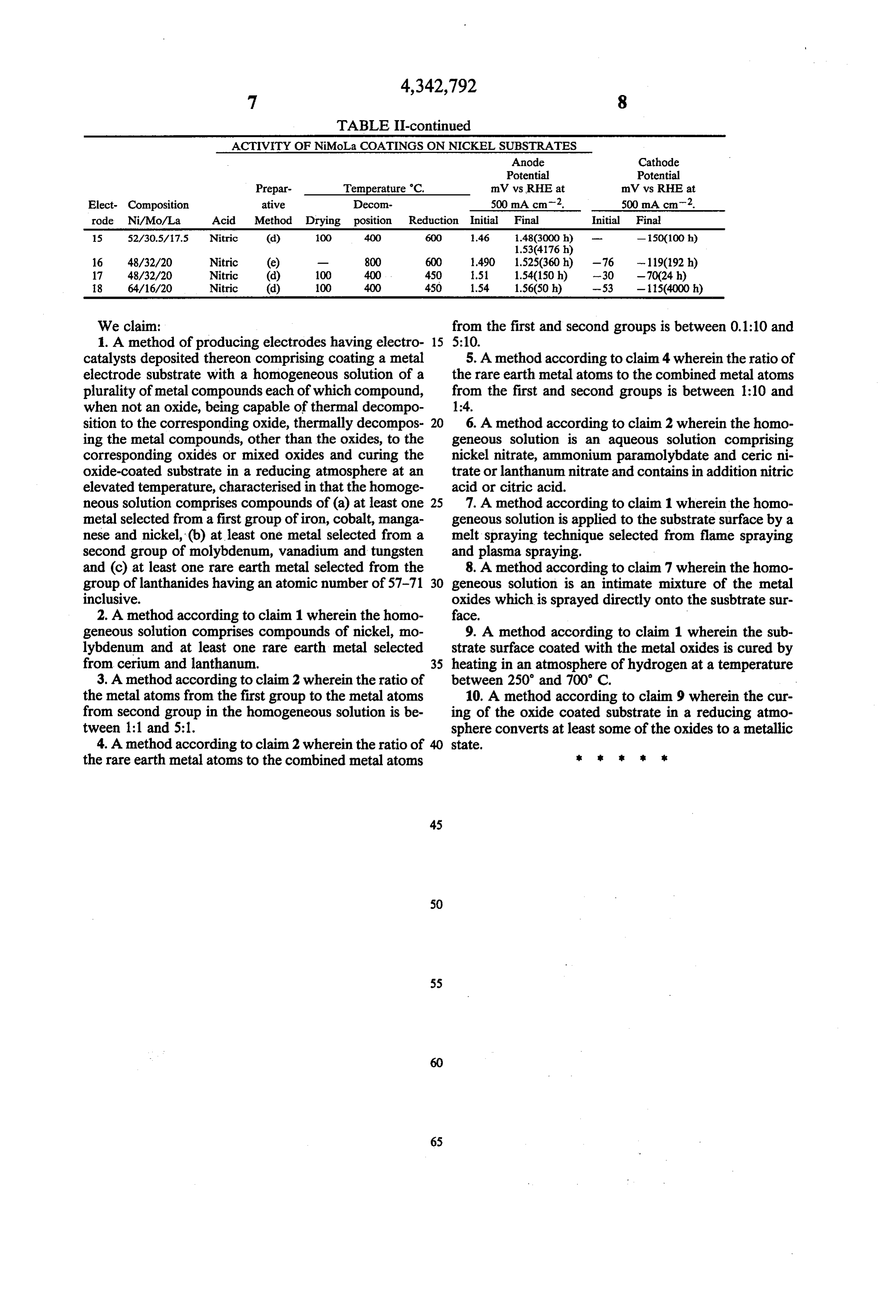
TABLE II-continued
ACTIVETY OF NiMcLa COATINGS ON NICKEEL SUBSTRATES
Prepar- Temperature 'C. mV vs RHE at mV vs RHEat
Elect- Composition ative Decom- 500 mA cm-2. 500 mA cm-2. rode Ni/MoMLa Acid Method Drying position Reduction. Initial Final Initial Final 15 52A30.5/17.5 Nitric (d) OO 400 600 1.46 1.48(3000 h) w - 150(100 h)
16 48/32/20 Nitric (e) 800 600 1.490 1.525(360 hl) -76 - 119(192h) 17 48/32/20 Nitric (d) 100 400 450 5 1.54(150 h) -30 -70(24 h) 8 64/16/20 Nitric (d) 100 400 450 1.54 1.56(50 h) -53 -115(4000 h)
We claim: from the first and second groups is between 0.1:10 and 1. A method of producing electrodes having electro- 15 5:10.
catalysts deposited thereon comprising coating a metal 5. A method according to claim 4 wherein the ratio of electrode substrate with a homogeneous solution of a the rare earth metal atoms to the combined metal atoms plurality of metal compounds each of which compound, from the first and second groups is between 1:10 and when not an oxide, being capable of thermal decompo 1:4.
sition to the corresponding oxide, thermally decompos- 20 6. A method according to claim 2 wherein the homo ing the metal compounds, other than the oxides, to the geneous solution is an aqueous solution comprising corresponding oxides or mixed oxides and curing the nickel nitrate, ammonium paramolybdate and ceric ni oxide-coated substrate in a reducing atmosphere at an trate or lanthanum nitrate and contains in addition nitric elevated temperature, characterised in that the homoge acid or citric acid.
neous solution comprises compounds of (a) at least one 25 7. A method according to claim 1 wherein the homo metal selected from a first group of iron, cobalt, manga geneous solution is applied to the substrate surface by a nese and nickel, (b) at least one metal selected from a melt spraying technique selected from flame spraying second group of molybdenum, vanadium and tungsten and plasma spraying.
and (c) at least one rare earth metal selected from the 8. A method according to claim 7 wherein the homo group of lanthanides having an atomic number of 57-71 30 geneous solution is an intimate mixture of the metal inclusive. oxides which is sprayed directly onto the susbtrate sur 2. A method according to claim 1 wherein the homo face.
geneous solution comprises compounds of nickel, mo 9. A method according to claim 1 wherein the sub lybdenum and at least one rare earth metal selected strate surface coated with the metal oxides is cured by from cerium and lanthanum. 35 heating in an atmosphere of hydrogen at a temperature 3. A method according to claim 2 wherein the ratio of between 250' and 700 C.
the metal atoms from the first group to the metal atoms 10. A method according to claim 9 wherein the cur from second group in the homogeneous solution is be ing of the oxide coated substrate in a reducing atmo tween 1:1 and 5:1. sphere converts at least some of the oxides to a metallic 4. A method according to claim 2 wherein the ratio of 40 state.
the rare earth metal atoms to the combined metal atoms
Provenance
- Collection
- Cited prior art
- Original PDF
- patentimages.storage.googleapis.com →
- Filed
- 1981-05-11
- Pages
- 6
- Method
- pdftotext (the PDF's own text layer) + pdftoppm 300dpi page scans
- Source
- Google Patents bibliographic record
- Granted
- 1982-08-03
- Inventors
- David E. Brown; Stephen M. Hall; Mahmood N. Mahmood; BP PLC
- Transcribed from
- patentimages.storage.googleapis.com →