(Rp1) · also written as a run, Rp1a xxx Rp1n
Coupling Inductance
Also written excitation External Magnetic Field · External Magnetic Field · electromagnetic coupling field · Mutual Inductance Fields
Where it is first named
… ng-Core (190) of Figure (3-23) as to VIC Coil Assembly (580) of Figure (6-1) enters into and passes through both Inductors (L1/L2) simultaneously and offers not only further electron-flow restriction (Rp1/Rp2) to both Inductor Chokes (56/62) but automatically increases voltage potential (xxx V g xxx Vh xxx Vn) of opposite voltage intensity of equal magnitude (66/67) across Resonant Cavity (140 -170)
How it is written
- (Rp1/Rp2) 4× with (Rp2) Mutual Inductance Fields
- (Rp1) 3×
- (Rp1a xxx Rp1n - Rp2a xxx Rp2n) 1× with (Rp2) Mutual Inductance Fields
Rp1a xxx Rp1n is Meyer's shorthand for a run of the same thing: Rp1a is the first, Rp1n the last, and the x's stand for however many lie between. Every stage of the run is this one numeral. A pair before the letters, 583/602a, is a run of two things that go together, one of each per stage.
Drawings 28
-
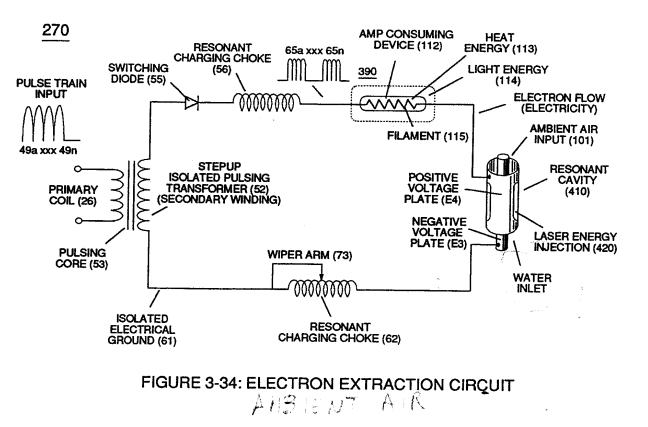
(270) of Figure (3-34) · Gas Processor
-
The figure it sits on · WFC 422DA - Illustrations
-
(270) of (3-34) · In Application of Usage
-
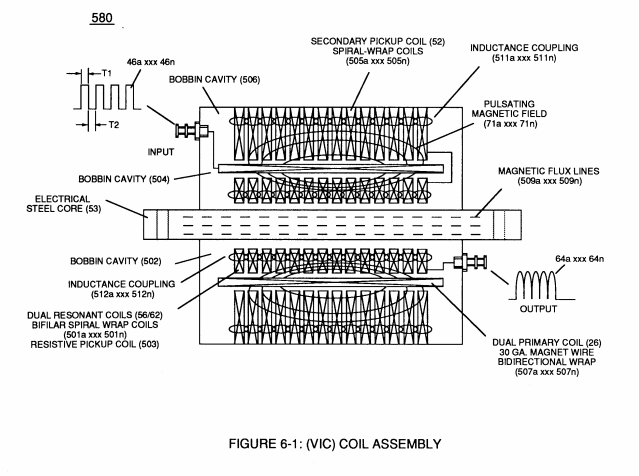
coil-structures (580) of Figure (6-1) · Voltage Intensifier Coil-Assembly
-
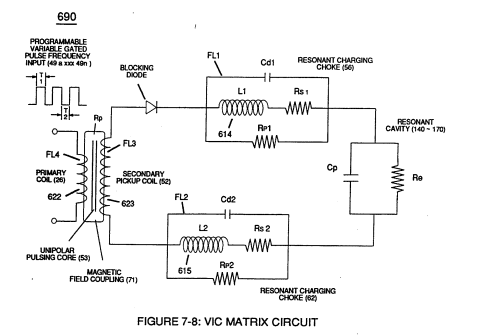
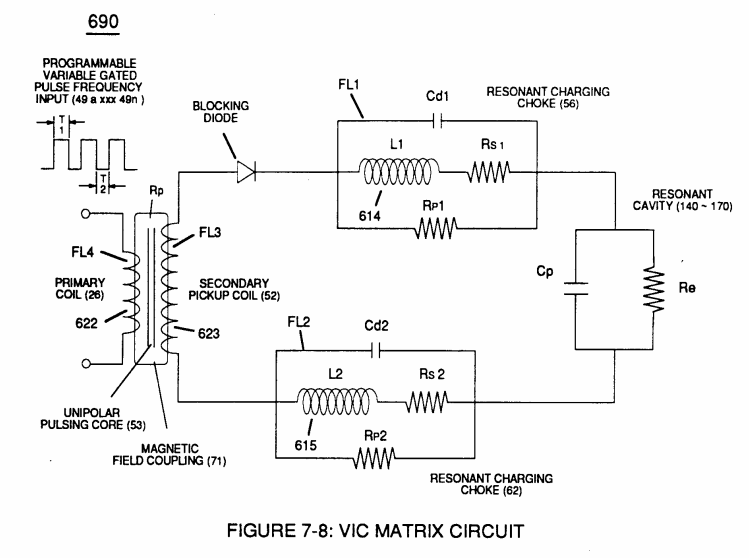
The figure it sits on · VIC Matrix Circuit
-
(T2) of Figure (7-8) · Instant Explosion of Water
-
Figure (7-8) · Resistance (Rs)
-
(690) of Figure (7-8) · Resistance (Rs)
-
(580) of Figure (6-1) · Inductance (FL)
-
(690) of Figure (7-8) · Inductance (FL)
-
(690) of Figure (7-8) · Capacitance (Cd)
-
(690) of Figure (7-8) · Inductance Reactance (Rs - Cd - FL)
-
Figure (7-8) · Inductance Reactance (Rs - Cd - FL)
-
(580) of Figure (6-1) · Multi-layer Coil
-
(690) of Figure (7-8) · Taper Resonant Capacitor (ERt)
-
690 of Figure 7-8 · Circuit Resistance
-
(52) of Figure (7-8) · Electron Bounce Phenomenon
-
(580) of Figure (6-1) (WFC memo 425) · 8-2 - Traveling Voltage Wave-Guides
-
(690) of Figure (7-8) · 8-2 - Traveling Voltage Wave-Guides
-
(52) of Figure (7-8) · 8-3 - Electrical Voltage-Pulse Wave-Transmission
-
(Cp) of Figure (7-8) · 8-4 - State Space (Sp)
-
(690) of Figure (7-8) · 8-6 - VIC Voltage Sync-Pulse Circuit
-
(Cp) of (7-8) · 8-6 - VIC Voltage Sync-Pulse Circuit
-
(690) of Figure (7-8) · Propagating Electrical Stress
-
Figure (3-34) · Propagating Electrical Stress
-
(580) of Figure (6-1) · Voltage to Amp Differential Ratio
-
blocking diode (55) of Figure (3-34) · Voltage to Amp Differential Ratio
-
The figure it sits on · WFC 429 - Illustrations
Where it is named · 8
Inductance Reactance (Rs - Cd - FL) 1×
-
… ng-Core (190) of Figure (3-23) as to VIC Coil Assembly (580) of Figure (6-1) enters into and passes through both Inductors (L1/L2) simultaneously and offers not only further electron-flow restriction (Rp1/Rp2) to both Inductor Chokes (56/62) but automatically increases voltage potential (xxx V g xxx Vh xxx Vn) of opposite voltage intensity of equal magnitude (66/67) across Resonant Cavity (140 -170)
Transformer Action 2×
-
Coupling Inductance (Rp1)
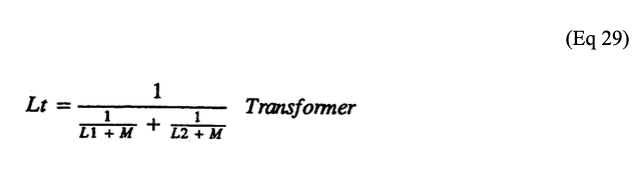
(M) is the mutual inductance of each transformer coil (26/52) being in parallel relationship with fields aiding Coupling Inductance (Rp1) and (Rp2) in (690) of Figure (7-8) is further expressed in the following equation:
-
External Magnetic Field (Rp1/Rp2)
(M) is the mutual inductance of choke coils (L1/L2) since Transformer Magnetic Field (Rp) is the excitation External Magnetic Field (Rp1/Rp2) by way of Unipolar Pulsing Core (53).

Electron Bounce Phenomenon 2×
-
Coupling Inductance (Rp1)
Coupling Inductance (Rp1) and (Rp2) in (690) of Figure (7-8) is further expressed in the following equation: Where, (Lt cc) is the total inductance of Choke Coils (FL1 - FL2), (L1) and (L2) are the inductance of each individu …
-
excitation External Magnetic Field (Rp1/Rp2)
… Transformer (26 - 53 - 52) magnetic field (Rp) with aiding fields, (M) is the mutual inductance of choke coils (L1/L2) since Transformer Magnetic Field (Rp) is the excitation External Magnetic Field (Rp1/Rp2) by way of Unipolar Pulsing Core (53).
Propagating Electrical Stress 3×
-
electromagnetic coupling field (Rp1)
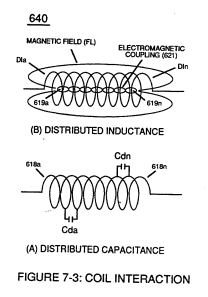
The energized "Resonant Charging Choke" (56) of Figure (7-1) as to Figure (10-1) by way of input voltage-pulses (49a xxx 49n) creates an electromagnetic coupling field (Rp1) of Figure (7-8) due to its self-inductance (640) of Figure 7-3B) crosses over and passes through electrically ground connected Resonant Charging Choke (62), as so illustrated in Figure (10-1)
-
Mutual Inductance Fields (Rp1/Rp2)
... forming "Mutual Inductance Fields" (Rp1/Rp2) once secondary coil (62) is electromagnetically energized by primary coil (56) and vice versa
-
… id "bifilar" wrapped coils (Figure 7-3) as to (990) of Figure (10-3) encourages the compounding effect (increasing magnetic field-strength during each pulsing cycle) of electromagnetic field-strength (Rp1a xxx Rp1n - Rp2a xxx Rp2n) (mutual induction) when applied Pulse-Voltage frequency (49a xxx 49n) of Figure (3-34) passes through the positive energized Resonant Charging Choke (56).