(FR)
(FR)
Where it is first named
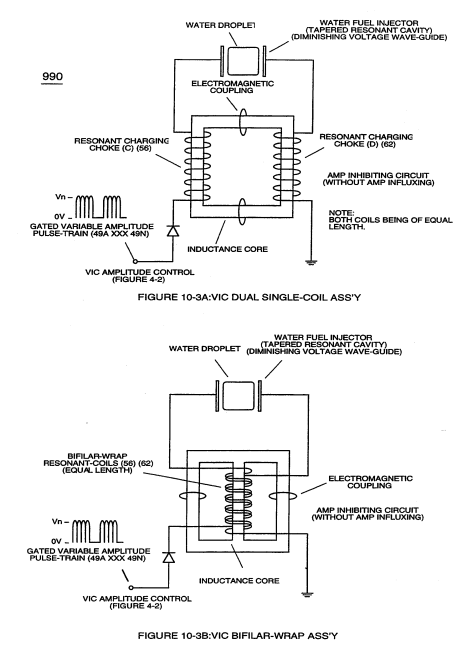
To reduce amp leakage still further, the copper wire of both Resonant Charging Chokes (56/62) can be replaced with a magnetically inductive stainless steel wire (430F/FR) having a resistive value (Ohms) to the flow of electrons while taking on the capacitance and inductance characteristic of a coil wire.
How it is written
- (430F/FR) 2× with (430F)
Drawings 2
-
Figure (10-3 A/B) · Propagating Electrical Stress
-
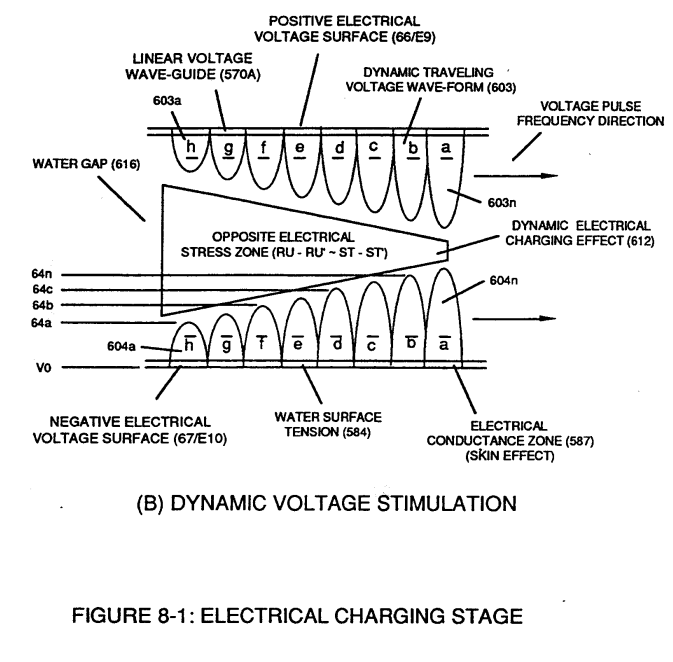
... see Dynamic Voltage Waveform (770) of Figure (8-1), once again. · Voltage to Amp Differential Ratio
Where it is named · 2
Propagating Electrical Stress 1×
-
To reduce amp leakage still further, the copper wire of both Resonant Charging Chokes (56/62) can be replaced with a magnetically inductive stainless steel wire (430F/FR) having a resistive value (Ohms) to the flow of electrons while taking on the capacitance and inductance characteristic of a coil wire.
Voltage to Amp Differential Ratio 1×
-
In Retrospect, the use of Stainless Steel composite coil-wire (430F/FR) consists of both inductance and resistive properties (typically .0048 ohms per foot) which when combined together in metallurgical form aids amp restriction beyond the singularly use of self-inductance magnet (Copper) coil-wire having a lower resistive value.