(83)
Oxygen Nucleus
Where it is first named
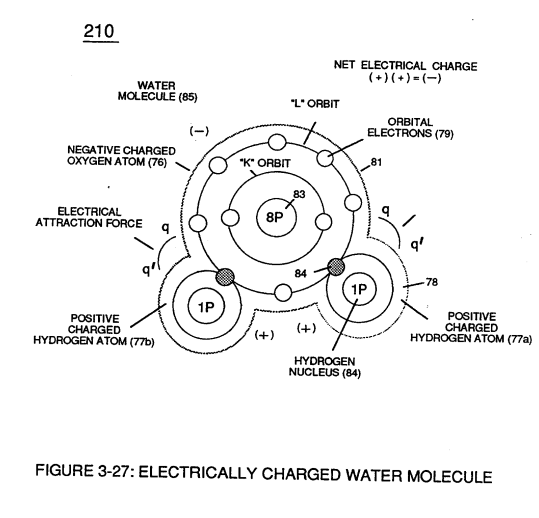
Oxygen atom becomes negative electrical charged (81) since oxygen atom (76), now, has a total of ten negative charged electrons (79a xxx 79n) in its "K" plus "L" orbits while maintaining it's original eight positive charged protons which makes up oxygen nucleus (83).
How it is written
- (83) 2×
- (83/84) 2× with (84) Negative Charged Covalent Electrons
Drawings 7
-
(340) of Figure (3-38) · Gas Modulator Process
-
engine cylinder (102) of Figure (3-38) · Gas Processor
-
Carries this number · Water Fuel Injector (Taper Resonant Cavity Chamber)
-
(510) of Figure (5-2) · In Application of Usage
-
(230) of Figure (3-30) · In Application of Usage
-
(840) of Figure (8-10) · 8-6 - VIC Voltage Sync-Pulse Circuit
-
Carries this number · WFC 427 Illustrations
Where it is named · 4
Electrically Charged Water Molecule 1×
-
oxygen nucleus (83)
Oxygen atom becomes negative electrical charged (81) since oxygen atom (76), now, has a total of ten negative charged electrons (79a xxx 79n) in its "K" plus "L" orbits while maintaining it's original eight positive charged protons which makes up oxygen nucleus (83).
Funneling Effect 3×
-
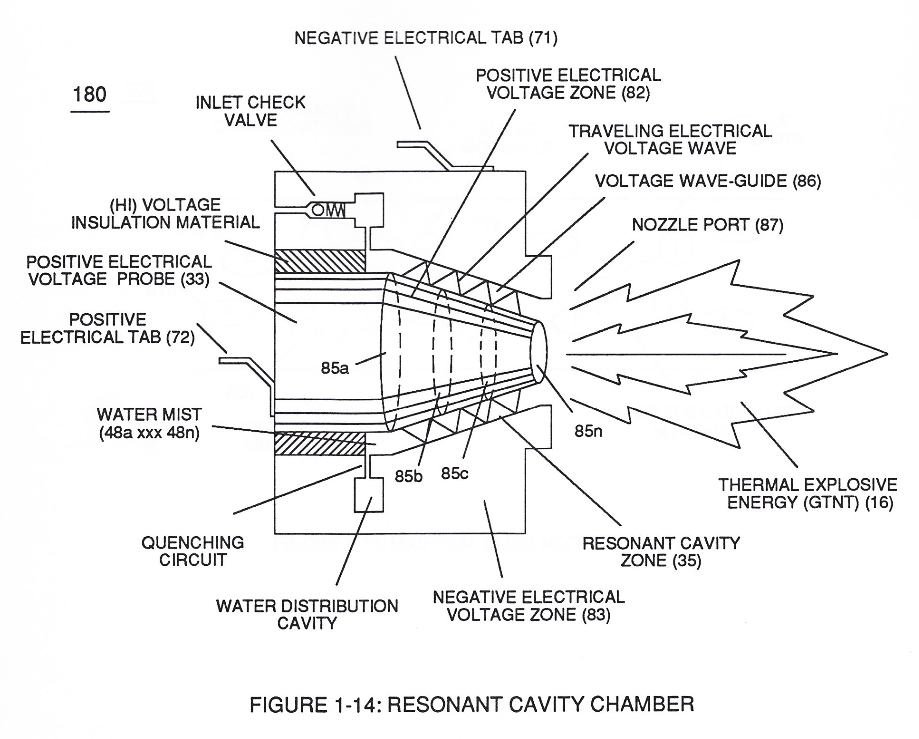
causing Resonant Cavity Zone (35) to function and perform as a voltage wave-guide (86) of Figure (14) since the gradual decrease in cross-sectional circumference area (85) of Figure (14) is in linear progression ... reducing both voltage surfaces areas (83/84) in parallel space relationship from larger segmental area (85a) to smaller segmental area (85n).
-
This resultant "Funneling Effect" (260), now, allows voltage amplitude (Vn) wave-form (58) to travel the length of Resonant Cavity Zone (35) from Start-Point (85a) to End-Point (85n) increasing voltage intensity (xxx VL = Vn) as parallel voltage surfaces (83/84) diminishes in size relationship (85a ~ 85n), as illustrated in (210) of Figure (17).
-
To prevent pre-ignition of gases traveling toward Exit-Port (87), Resonant Cavity (35) open space (open resonant cavity) parallel dimension between positive voltage surface (82) and negative voltage surface (83) is small enough (typically .010 or so) to function as a Quenching Circuit, as illustrated in Figure (24SD) (missing image) (WFC Memo 420).