patent · US5999547
Tunable optical parametric oscillator
7 December 1999
Page 1 — bibliographic record
United States Patent (19) 11 Patent Number: 5,999,547 Schneider et al. (45) Date of Patent: Dec. 7, 1999 54) TUNABLE OPTICAL PARAMETRIC Yang S T et al. “1.9-W CW Ring-Cavitiy KTP singly OSCILLATOR resonant optical parametric oscillator'Optic Letters, Vol. 19, 75 Inventors: Klaus Schneider; Stephan Schiller, No. 7, Apr. 1, 1994, pp. 475-477. both of Constance; Jirgen Mlynek, Breitenbach G et al. “81% conversion efficiency . . . ', ss
Radolfzell-Gittingen; Patrick Journal of the optical Society of America B (Optical Phys Kramper, Constance, all of Germany
73 Assignee: Universität Constance, Konstance, Schiller et al., “Subharmonic-Pumped continuous-wave Germany
Parametric Oscillator” applied Physics Letters, Vol.68, No.
21 Appl. No.: 09/017,964 24, Jun. 10, 1996 pp. 3374-3376.
30 Foreign Application Priority Data Primary Examiner John D. Lee Attorney, Agent, or Firm-Paul Vincent
Feb. 7, 1997 DEI Germany ........................... 197 06 031
Apr. 30, 1997 DEI Germany ...... 1971.8 254 57 ABSTRACT Nov. 19, 1997 DEI Germany ........................... 19751 324 51 Int. Cl. ............................... G02F1/39; H01S 3/108 An optical parameter oscillator System is proposed for use in 52 U.S. Cl. ............................................... 372/21; 35.9/330 a continuous wave pump laser System having a single 58 Field of Search ........................ 372/21, 22; 35.9/326, frequency pump Source. The System comprises a single 359/328,330 resonance resonator having a nonlinear medium to produce 56) References Cited a first and Second parametrically generated wave in response to the pump wave from the Single-frequency pump Source.
3,644,845 2/1972 Harris .................................. 359/330 X of the resonator, means for controlling the pump frequency 5,134,622 7/1992 Deacon ..................................... 372/21 of the pump Source and means for controlling the tempera 5,233,462 8/1993 Wong ... ... 359/330 5,289,491 2/1994 Dixon ............... ... 372/21 X ture of the nonlinear medium. The system provides for a 5,640,405 6/1997 Wallace et al. ........................... 372/21 reliable Singly-resonant optical parametric oscillator capable 5,796,513 8/1998 Stamm et al. .......................... 359/330 of emitting laser light with high Spectral purity and fre OTHER PUBLICATIONS quency Stability over a wide spectral range and is resistant Continuous-wave singly resonant optical parametric . . . to mode hopping.
Bosenberg W R et al. 20 Claims, 3 Drawing Sheets
PUMP SOURCE
CONTROL
TUNING
Page 2
Drawing sheet — no readable text.
Page 3
Drawing sheet — no readable text.
Page 4
Drawing sheet — no readable text.
Page 5
TUNABLE OPTICAL PARAMETRIC hop-free operation over Several minutes and a continuous OSCILLATOR tuning range of 550 MHz has been obtained. These achieve ments of prior art are still far from the practical demands of
This application claims Paris convention priority of high-resolution spectroscopy applications. German patent applications 19706031.5 filed Feb. 7, 1997, In View of these disadvantages of prior art, it is the 19718254.2 filed Apr. 30, 1997 and 19751324.7 filed Nov. principal purpose of the present invention to further improve 19, 1997 the complete disclosures of which are hereby a singly-resonant oscillator of the above mentioned kind in incorporated by reference. Such a fashion that frequency-stable and mode-hop-free
BACKGROUND OF THE INVENTION
operation with continuous frequency tuning is achieved in an efficient, compact, Stable and widely tunable nonlinear
The invention concerns a compact and reliable Singly frequency conversion System.
resonant optical parametric oscillator (SRO) capable of emitting laser light of high Spectral purity and frequency SUMMARY OF THE INVENTION Stability over a wide spectral range.
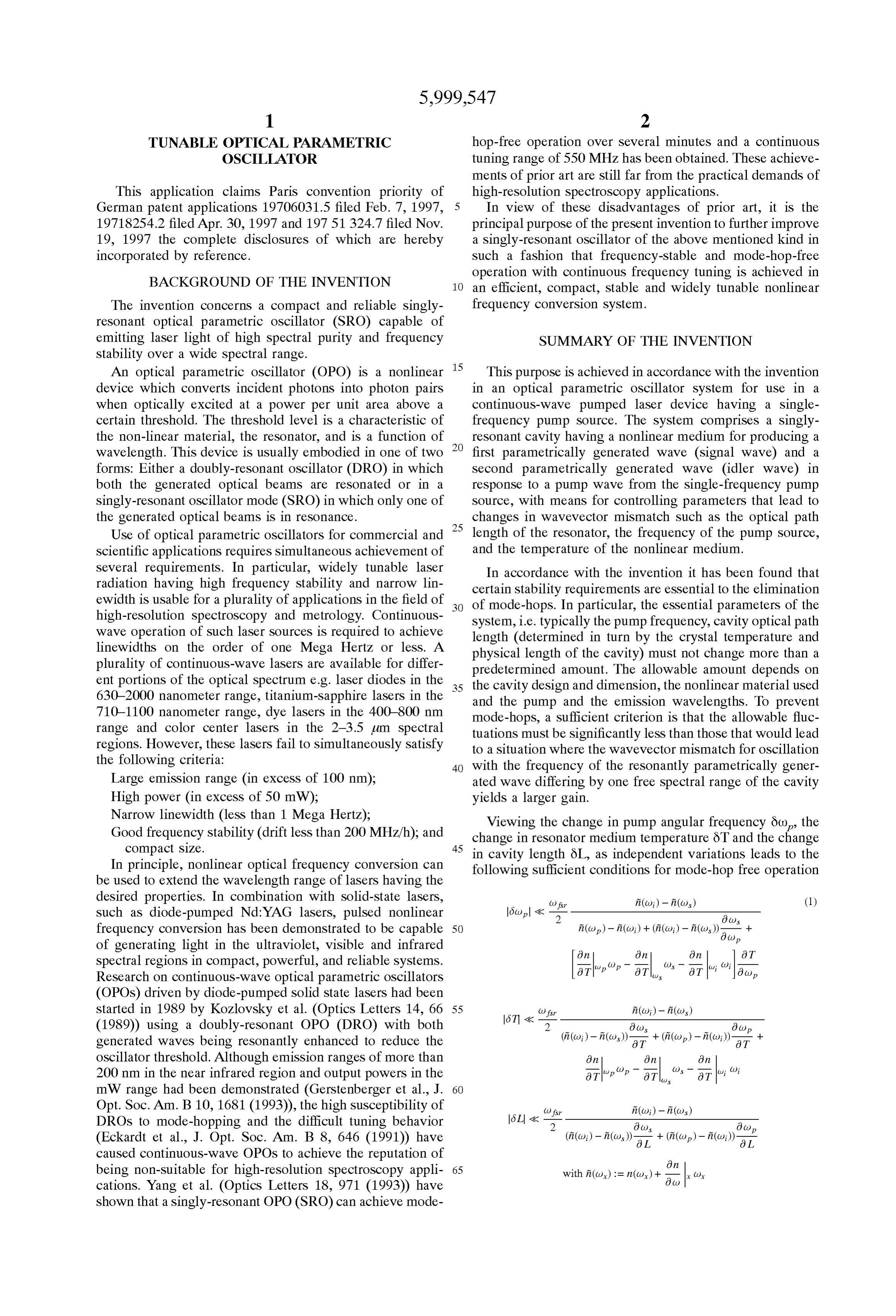
An optical parametric oscillator (OPO) is a nonlinear 15 This purpose is achieved in accordance with the invention device which converts incident photons into photon pairs in an optical parametric oscillator System for use in a when optically excited at a power per unit area above a continuous-wave pumped laser device having a single certain threshold. The threshold level is a characteristic of frequency pump Source. The System comprises a singly the non-linear material, the resonator, and is a function of resonant cavity having a nonlinear medium for producing a wavelength. This device is usually embodied in one of two first parametrically generated wave (signal wave) and a forms: Either a doubly-resonant oscillator (DRO) in which Second parametrically generated wave (idler wave) in both the generated optical beams are resonated or in a response to a pump wave from the Single-frequency pump singly-resonant oscillator mode (SRO) in which only one of Source, with means for controlling parameters that lead to the generated optical beams is in resonance. changes in wavevector mismatch Such as the optical path Use of optical parametric oscillators for commercial and 25 length of the resonator, the frequency of the pump Source, Scientific applications requires simultaneous achievement of and the temperature of the nonlinear medium. Several requirements. In particular, widely tunable laser In accordance with the invention it has been found that radiation having high frequency Stability and narrow lin certain Stability requirements are essential to the elimination ewidth is usable for a plurality of applications in the field of of mode-hops. In particular, the essential parameters of the high-resolution spectroScopy and metrology. Continuous System, i.e. typically the pump frequency, cavity optical path wave operation of Such laser Sources is required to achieve length (determined in turn by the crystal temperature and linewidths on the order of one Mega Hertz or less. A physical length of the cavity) must not change more than a plurality of continuous-wave lasers are available for differ predetermined amount. The allowable amount depends on ent portions of the optical spectrum e.g. laser diodes in the 35 the cavity design and dimension, the nonlinear material used 630-2000 nanometer range, titanium-sapphire lasers in the and the pump and the emission wavelengths. To prevent 710-1100 nanometer range, dye lasers in the 400-800 nm mode-hops, a Sufficient criterion is that the allowable fluc range and color center lasers in the 2-3.5 um spectral tuations must be significantly less than those that would lead regions. However, these laserS fail to Simultaneously Satisfy to a Situation where the wavevector mismatch for oscillation the following criteria: 40 with the frequency of the resonantly parametrically gener Large emission range (in excess of 100 nm), ated wave differing by one free spectral range of the cavity High power (in excess of 50 mW); yields a larger gain.
Narrow linewidth (less than 1 Mega Hertz); Viewing the change in pump angular frequency Öco, the Good frequency stability (drift less than 200 MHz/h); and change in resonator medium temperature ÖT and the change
in cavity length ÖL, as independent variations leads to the
In principle, nonlinear optical frequency conversion can following Sufficient conditions for mode-hop free operation be used to extend the wavelength range of laserS having the desired properties. In combination with Solid-State lasers, (ofsr i(co;) - i(co) (1) Such as diode-pumped Nd:YAG lasers, pulsed nonlinear loop. < (s frequency conversion has been demonstrated to be capable 50 i(co)-i(co;) + (ii (co;) - i(co, ))
of generating light in the ultraViolet, visible and infrared
Spectral regions in compact, powerful, and reliable Systems. C. n n (OilT Research on continuous-wave optical parametric oscillators aatu
(OPOs) driven by diode-pumped solid state lasers had been started in 1989 by Kozlovsky et al. (Optics Letters 14, 66 55 6T1 < (ofsr i(co;) - i(u) (1989)) using a doubly-resonant OPO (DRO) with both 2 - 6(us Ö(top generated waves being resonantly enhanced to reduce the (ito)-ico) of + (ii (co) -ico) of -- oscillator threshold. Although emission ranges of more than n n n 200 nm in the near infrared region and output powers in the a Tepp at 's at tui (Oi mW range had been demonstrated (Gerstenberger et al., J. 60
Opt. Soc. Am. B 10, 1681 (1993)), the high susceptibility of ld L 4& (ofsr i(co;) - i?cus) DROs to mode-hopping and the difficult tuning behavior 6(us da) (Eckardt et al., J. Opt. Soc. Am. B 8, 646 (1991)) have (ii (co;) - i(a)- + (ii (co)- n(o) caused continuous-wave OPOs to achieve the reputation of n being non-Suitable for high-resolution SpectroScopy appli 65 with i(co-) := n(o) + do
cations. Yang et al. (Optics Letters 18, 971 (1993)) have shown that a singly-resonant OPO (SRO) can achieve mode
Page 6
-continued therefore be to reduce the frequency changes of the Signal
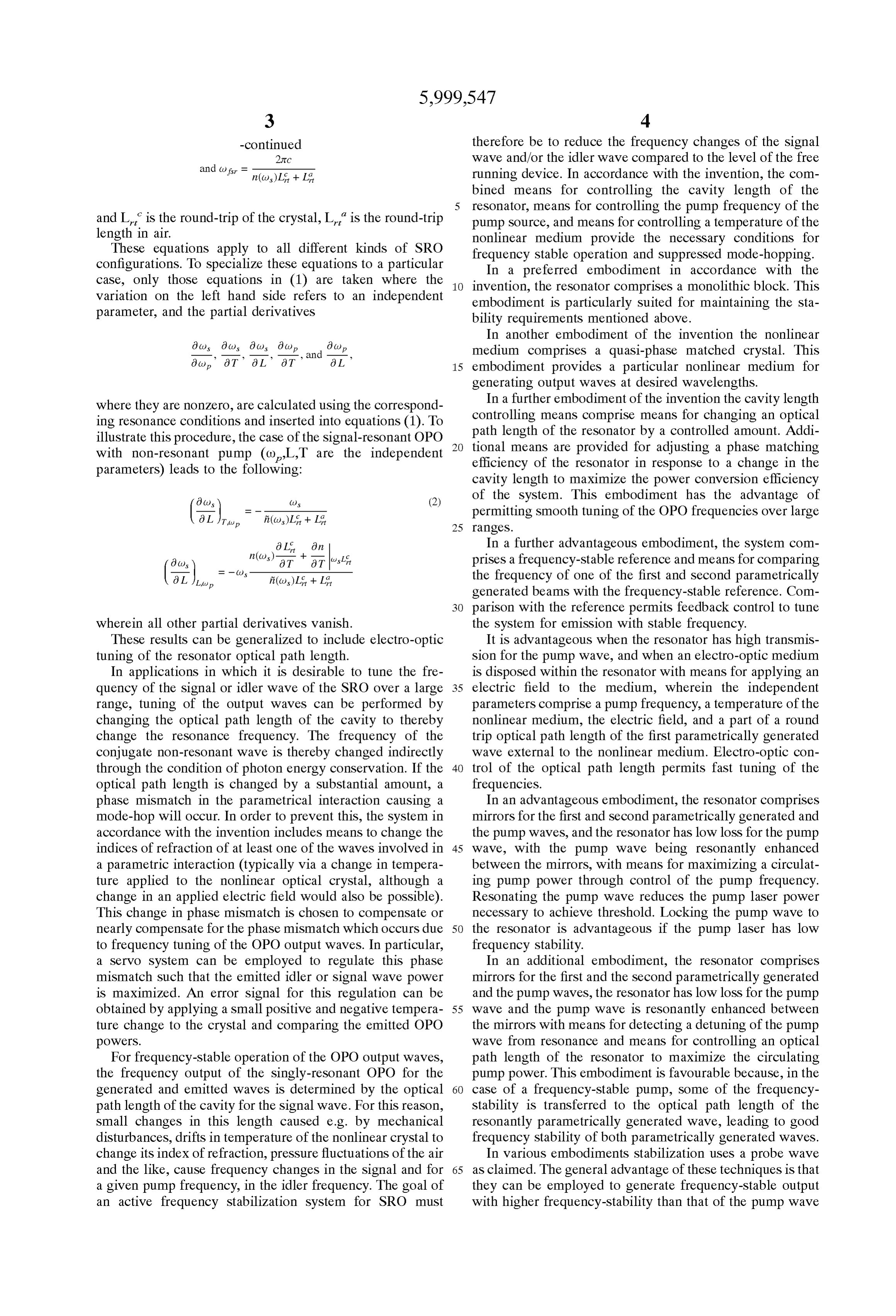
wave and/or the idler wave compared to the level of the free into, Li Lg running device. In accordance with the invention, the com bined means for controlling the cavity length of the resonator, means for controlling the pump frequency of the and L is the round-trip of the crystal, L' is the round-trip pump Source, and means for controlling a temperature of the length in air. nonlinear medium provide the necessary conditions for These equations apply to all different kinds of SRO frequency stable operation and Suppressed mode-hopping. configurations. To specialize these equations to a particular In a preferred embodiment in accordance with the case, only those equations in (1) are taken where the invention, the resonator comprises a monolithic block. This variation on the left hand Side refers to an independent embodiment is particularly Suited for maintaining the Sta parameter, and the partial derivatives bility requirements mentioned above. In another embodiment of the invention the nonlinear da), da), Öcos , -do -, and da) medium comprises a quasi-phase matched crystal. This da) T L T 8L 15 embodiment provides a particular nonlinear medium for generating output waves at desired wavelengths.
where they are nonzero, are calculated using the correspond controllingIn a further embodiment of the invention the cavity length ing resonance conditions and inserted into equations (1). To path length means comprise means for changing an optical illustrate this procedure, the case of the Signal-resonant OPO tional meansofare the resonator by a controlled amount. Addi provided for adjusting a phase matching with non-resonant pump (co.L.T are the independent efficiency of the resonator in response to a change in the parameters) leads to the following: cavity length to maximize the power conversion efficiency (2) of the System. This embodiment has the advantage of
permitting Smooth tuning of the OPO frequencies over large rangeS.
Ö L. n In a further advantageous embodiment, the System com n (cos) T -- T tus L. prises a frequency-stable reference and means for comparing i(cos) L + L, the frequency of one of the first and Second parametrically generated beams with the frequency-stable reference. Com parison with the reference permits feedback control to tune wherein all other partial derivatives vanish. the System for emission with Stable frequency. These results can be generalized to include electro-optic It is advantageous when the resonator has high transmis tuning of the resonator optical path length. Sion for the pump wave, and when an electro-optic medium In applications in which it is desirable to tune the fre is disposed within the resonator with means for applying an quency of the signal or idler wave of the SRO over a large 35 electric field to the medium, wherein the independent range, tuning of the output waves can be performed by parameters comprise a pump frequency, a temperature of the changing the optical path length of the cavity to thereby nonlinear medium, the electric field, and a part of a round change the resonance frequency. The frequency of the trip optical path length of the first parametrically generated conjugate non-resonant wave is thereby changed indirectly wave external to the nonlinear medium. Electro-optic con through the condition of photon energy conservation. If the 40 trol of the optical path length permits fast tuning of the optical path length is changed by a Substantial amount, a frequencies.
phase mismatch in the parametrical interaction causing a In an advantageous embodiment, the resonator comprises mode-hop will occur. In order to prevent this, the System in mirrors for the first and Second parametrically generated and accordance with the invention includes means to change the the pump waves, and the resonator has low loSS for the pump indices of refraction of at least one of the waves involved in 45 wave, with the pump wave being resonantly enhanced a parametric interaction (typically via a change in tempera between the mirrors, with means for maximizing a circulat ture applied to the nonlinear optical crystal, although a ing pump power through control of the pump frequency. change in an applied electric field would also be possible). ReSonating the pump wave reduces the pump laser power This change in phase mismatch is chosen to compensate or necessary to achieve threshold. Locking the pump wave to nearly compensate for the phase mismatch which occurs due 50 the resonator is advantageous if the pump laser has low to frequency tuning of the OPO output waves. In particular, frequency Stability.
a Servo System can be employed to regulate this phase In an additional embodiment, the resonator comprises mismatch Such that the emitted idler or signal wave power mirrors for the first and the Second parametrically generated is maximized. An error Signal for this regulation can be and the pump waves, the resonator has low loSS for the pump obtained by applying a Small positive and negative tempera 55 wave and the pump wave is resonantly enhanced between ture change to the crystal and comparing the emitted OPO the mirrors with means for detecting a detuning of the pump powers. wave from resonance and means for controlling an optical For frequency-stable operation of the OPO output waves, path length of the resonator to maximize the circulating the frequency output of the singly-resonant OPO for the pump power. This embodiment is favourable because, in the generated and emitted waves is determined by the optical 60 case of a frequency-stable pump, Some of the frequency path length of the cavity for the Signal wave. For this reason, Stability is transferred to the optical path length of the Small changes in this length caused e.g. by mechanical resonantly parametrically generated wave, leading to good disturbances, drifts in temperature of the nonlinear crystal to frequency Stability of both parametrically generated waves. change its index of refraction, pressure fluctuations of the air In various embodiments Stabilization uses a probe wave and the like, cause frequency changes in the Signal and for 65 as claimed. The general advantage of these techniques is that a given pump frequency, in the idler frequency. The goal of they can be employed to generate frequency-stable output an active frequency stabilization system for SRO must with higher frequency-stability than that of the pump wave
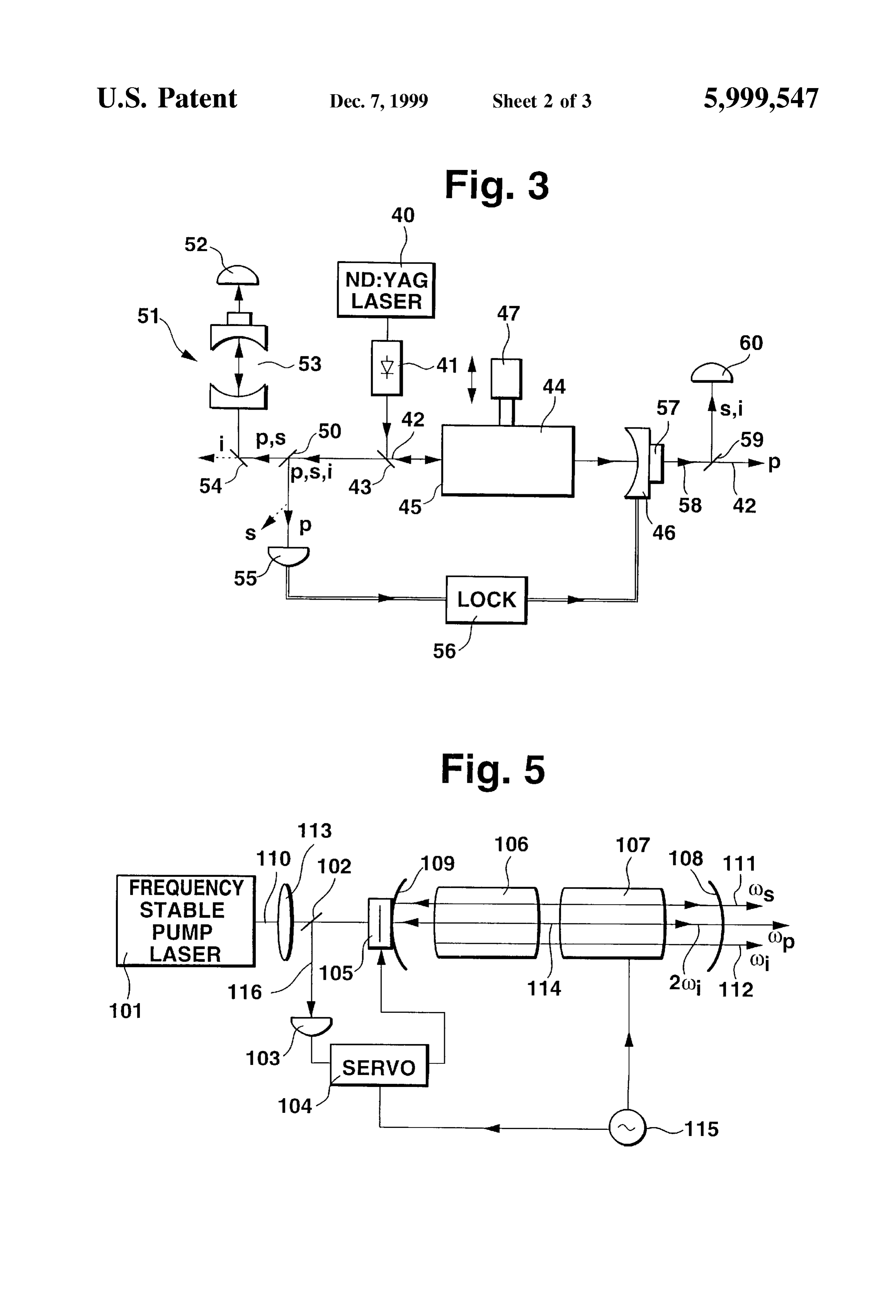
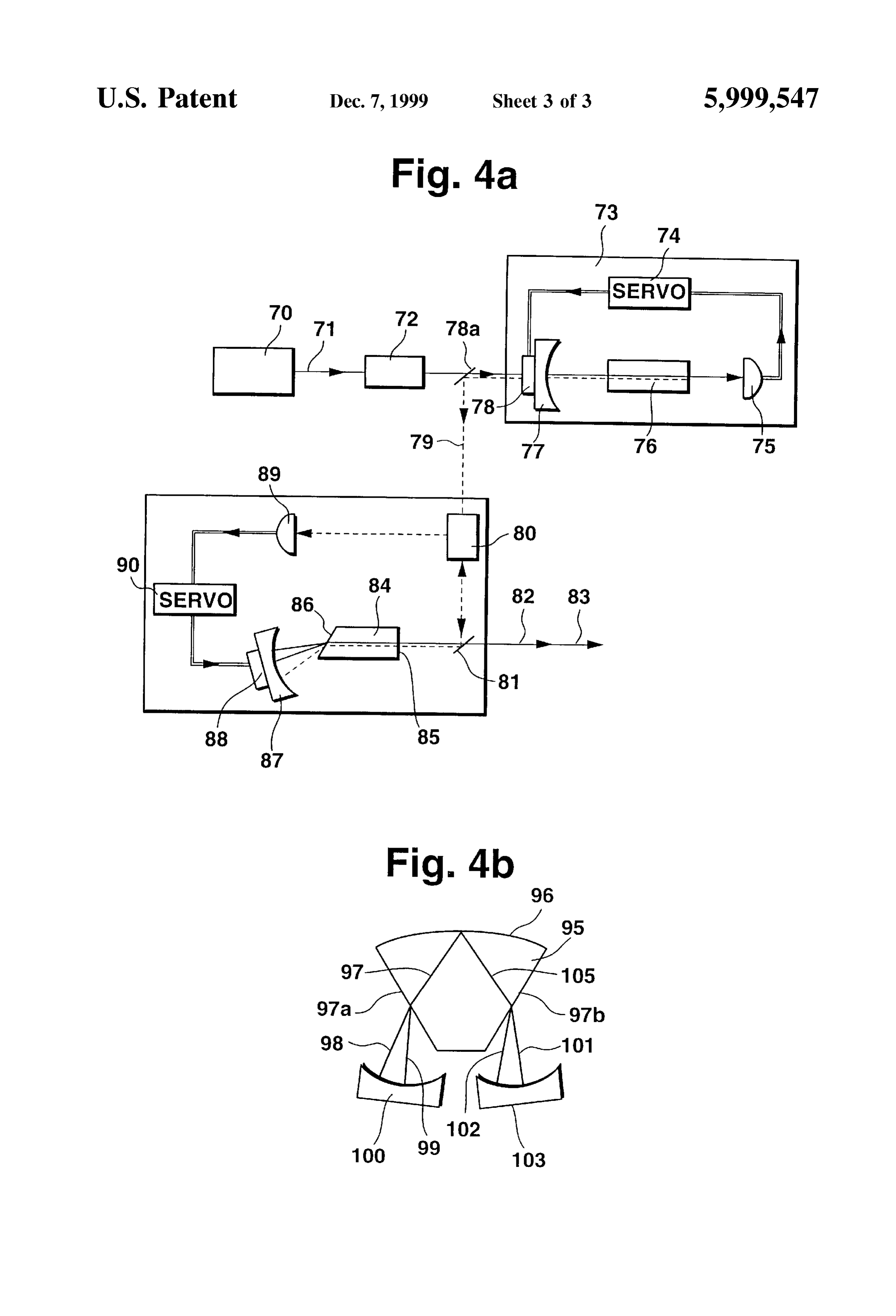
Page 7
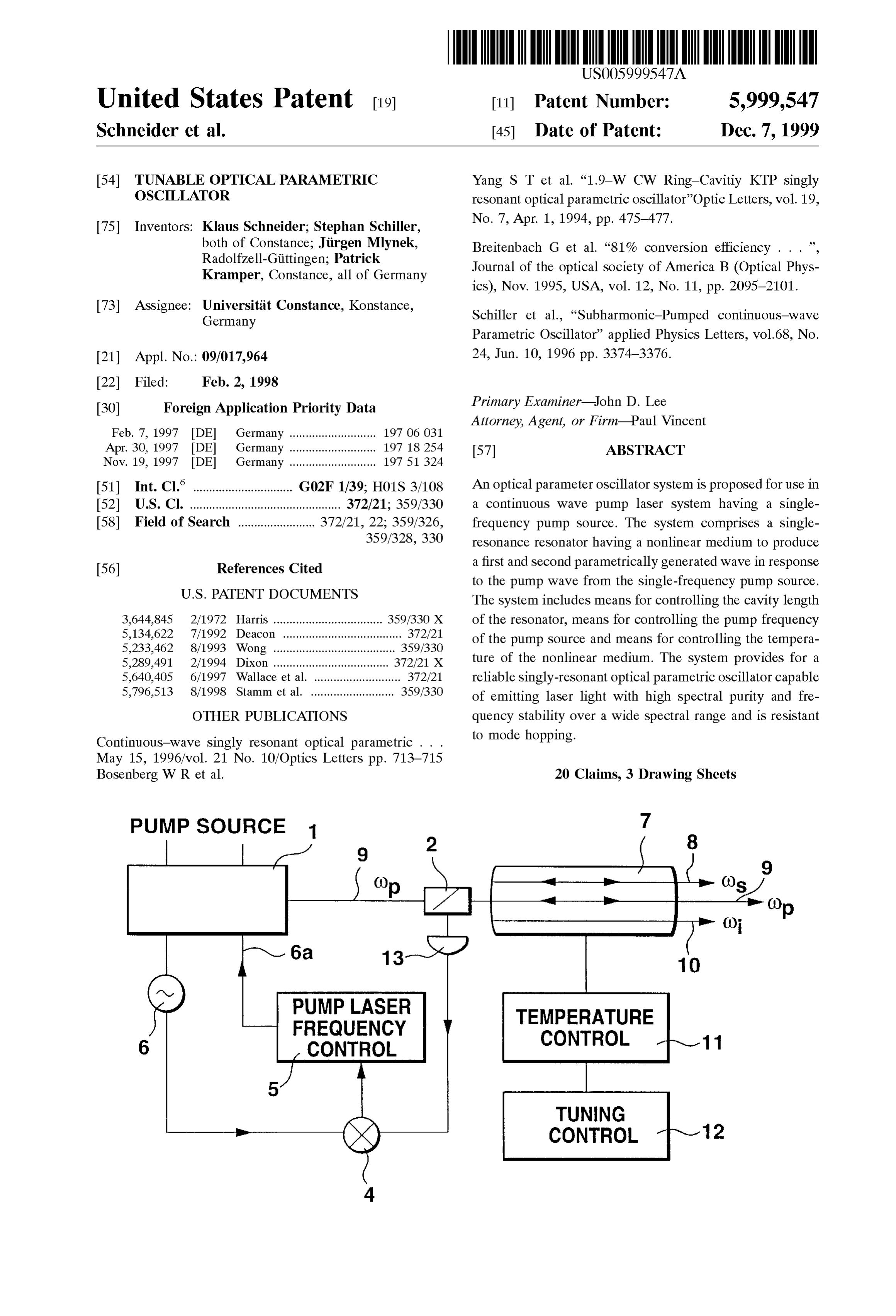
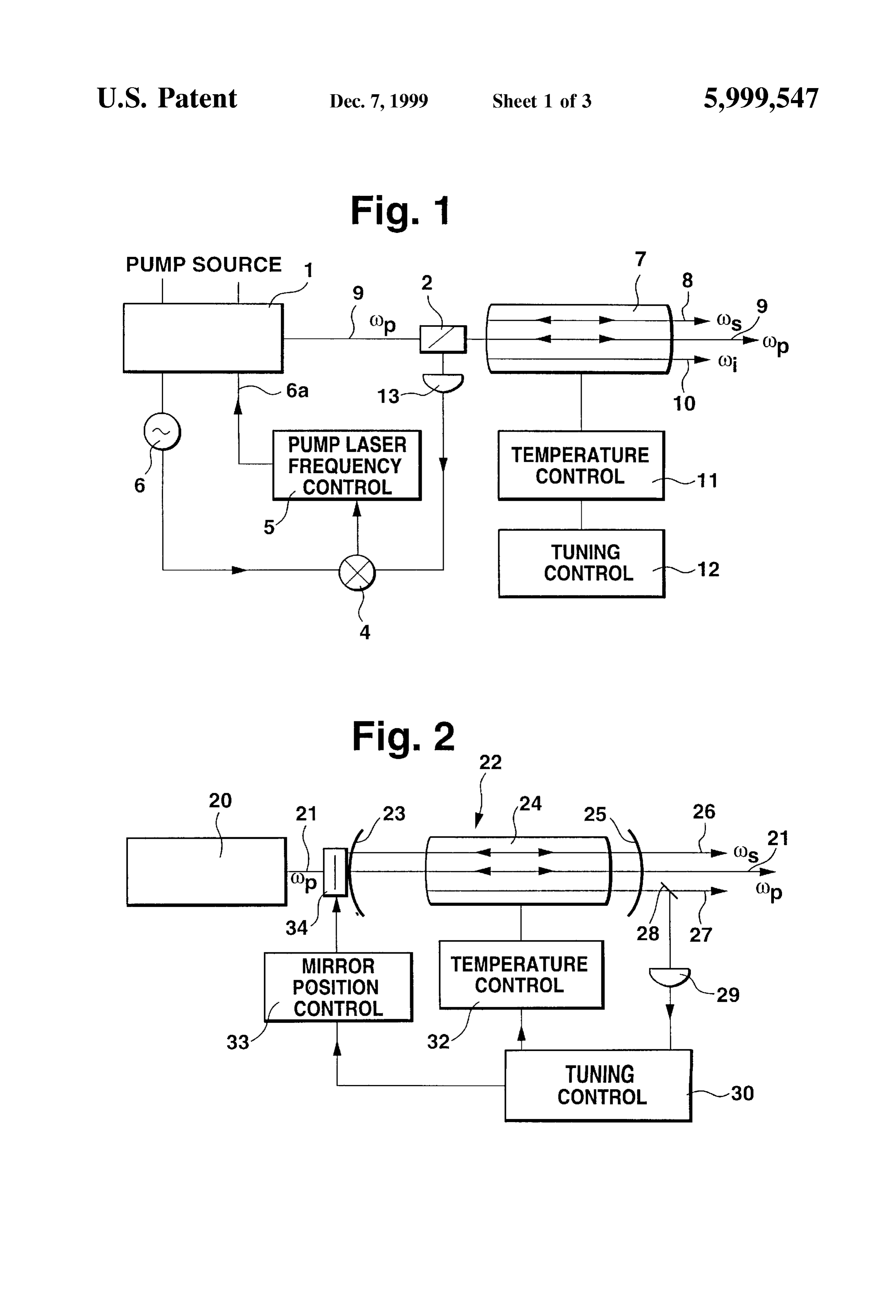
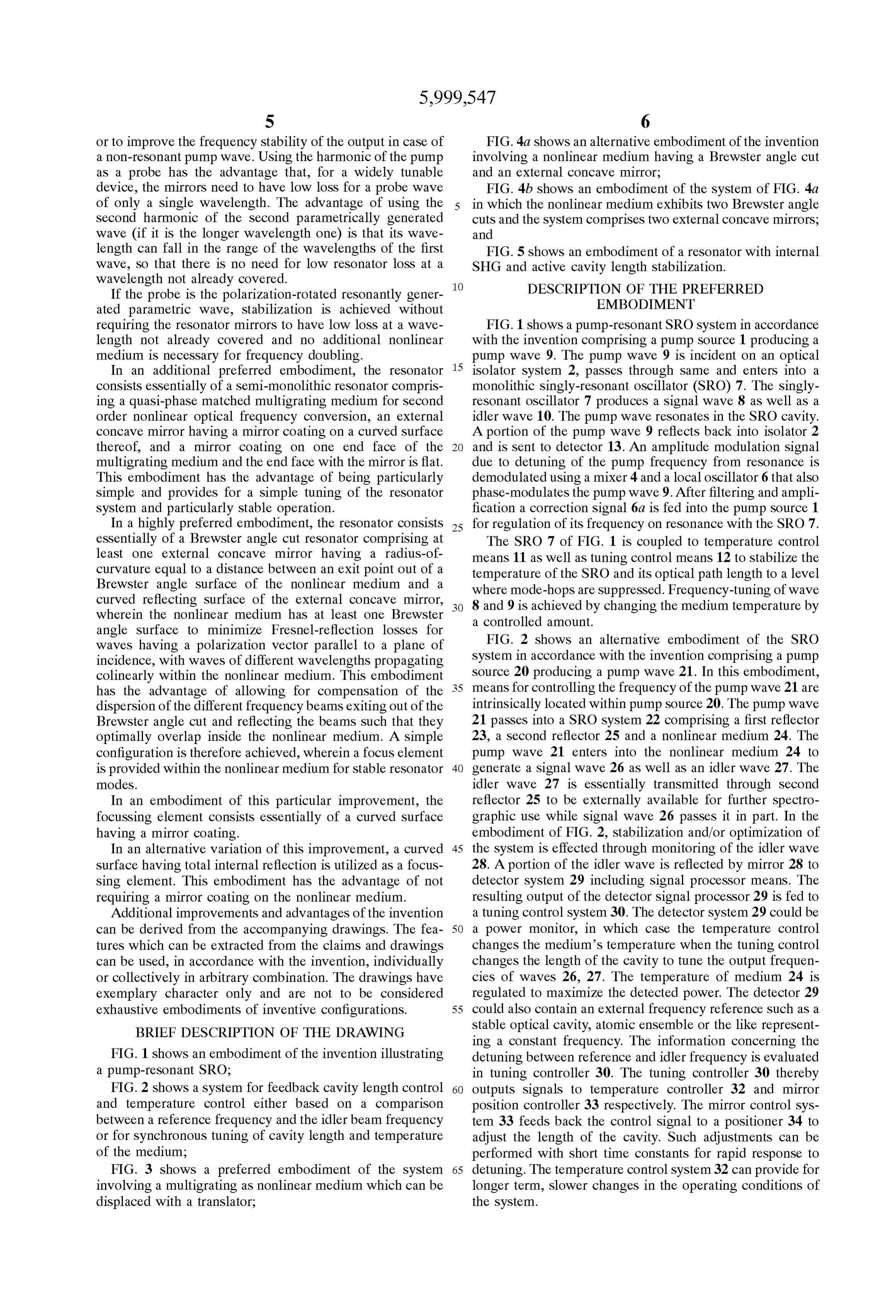
S 6 or to improve the frequency Stability of the output in case of FIG. 4a shows an alternative embodiment of the invention a non-resonant pump wave. Using the harmonic of the pump involving a nonlinear medium having a Brewster angle cut as a probe has the advantage that, for a widely tunable and an external concave mirror; device, the mirrors need to have low loss for a probe wave FIG. 4b shows an embodiment of the system of FIG. 4a of only a single wavelength. The advantage of using the in which the nonlinear medium exhibits two Brewster angle Second harmonic of the Second parametrically generated cuts and the System comprises two external concave mirrors, wave (if it is the longer wavelength one) is that its wave and length can fall in the range of the wavelengths of the first FIG. 5 shows an embodiment of a resonator with internal wave, So that there is no need for low resonator loSS at a SHG and active cavity length stabilization. wavelength not already covered. 1O DESCRIPTION OF THE PREFERRED If the probe is the polarization-rotated resonantly gener EMBODIMENT ated parametric wave, Stabilization is achieved without requiring the resonator mirrors to have low loSS at a wave FIG. 1 shows a pump-resonant SRO system in accordance length not already covered and no additional nonlinear with the invention comprising a pump Source 1 producing a medium is necessary for frequency doubling. pump wave 9. The pump wave 9 is incident on an optical In an additional preferred embodiment, the resonator 15 isolator System 2, passes through Same and enters into a consists essentially of a Semi-monolithic resonator compris monolithic singly-resonant oscillator (SRO) 7. The singly ing a quasi-phase matched multigrating medium for Second resonant oscillator 7 produces a signal wave 8 as well as a order nonlinear optical frequency conversion, an external idler wave 10. The pump wave resonates in the SRO cavity. concave mirror having a mirror coating on a curved Surface A portion of the pump wave 9 reflects back into isolator 2 thereof, and a mirror coating on one end face of the and is Sent to detector 13. An amplitude modulation signal multigrating medium and the end face with the mirror is flat. due to detuning of the pump frequency from resonance is This embodiment has the advantage of being particularly demodulated using a mixer 4 and a local oscillator 6 that also Simple and provides for a simple tuning of the resonator phase-modulates the pump wave 9. After filtering and ampli System and particularly Stable operation. fication a correction signal 6a is fed into the pump Source 1 In a highly preferred embodiment, the resonator consists 25 for regulation of its frequency on resonance with the SRO 7. essentially of a Brewster angle cut resonator comprising at The SRO 7 of FIG. 1 is coupled to temperature control least one external concave mirror having a radius-of means 11 as well as tuning control means 12 to Stabilize the curvature equal to a distance between an exit point out of a temperature of the SRO and its optical path length to a level Brewster angle Surface of the nonlinear medium and a where mode-hops are Suppressed. Frequency-tuning of wave curved reflecting Surface of the external concave mirror, 8 and 9 is achieved by changing the medium temperature by wherein the nonlinear medium has at least one Brewster a controlled amount.
angle Surface to minimize Fresnel-reflection losses for FIG. 2 shows an alternative embodiment of the SRO waves having a polarization vector parallel to a plane of incidence, with waves of different wavelengths propagating System in accordance With the invention comprising a pump colinearly within the nonlinear medium. This embodiment 35 Source 20 producing a pump wave 21. In this embodiment, has the advantage of allowing for compensation of the means for controlling the frequency of the pump wave 21 are dispersion of the different frequency beams exiting out of the intrinsically located within pump Source 20. The pump wave Brewster angle cut and reflecting the beams Such that they 21 passes into a SRO System 22 comprising a first reflector optimally overlap inside the nonlinear medium. A simple 23, a second reflector 25 and a nonlinear medium 24. The configuration is therefore achieved, wherein a focus element pump wave 21 enters into the nonlinear medium 24 to is provided within the nonlinear medium for stable resonator 40 generate a signal wave 26 as well as an idler wave 27. The modes. idler wave 27 is essentially transmitted through second In an embodiment of this particular improvement, the reflector 25 to be externally available for further spectro focussing element consists essentially of a curved Surface graphic use while Signal wave 26 passes it in part. In the having a mirror coating. embodiment of FIG. 2, stabilization and/or optimization of In an alternative variation of this improvement, a curved 45 the System is effected through monitoring of the idler wave Surface having total internal reflection is utilized as a focus 28. A portion of the idler wave is reflected by mirror 28 to sing element. This embodiment has the advantage of not detector System 29 including Signal processor means. The requiring a mirror coating on the nonlinear medium. resulting output of the detector Signal processor 29 is fed to Additional improvements and advantages of the invention a tuning control system 30. The detector system 29 could be can be derived from the accompanying drawings. The fea 50 a power monitor, in which case the temperature control tures which can be extracted from the claims and drawings changes the medium's temperature when the tuning control can be used, in accordance with the invention, individually changes the length of the cavity to tune the output frequen or collectively in arbitrary combination. The drawings have cies of waves 26, 27. The temperature of medium 24 is exemplary character only and are not to be considered regulated to maximize the detected power. The detector 29 exhaustive embodiments of inventive configurations. 55 could also contain an external frequency reference Such as a BRIEF DESCRIPTION OF THE DRAWING Stable optical cavity, atomic ensemble or the like represent ing a constant frequency. The information concerning the
FIG. 1 shows an embodiment of the invention illustrating detuning between reference and idler frequency is evaluated a pump-resonant SRO, in tuning controller 30. The tuning controller 30 thereby FIG. 2 shows a system for feedback cavity length control 60 outputs Signals to temperature controller 32 and mirror and temperature control either based on a comparison position controller 33 respectively. The mirror control sys between a reference frequency and the idler beam frequency tem 33 feeds back the control signal to a positioner 34 to or for Synchronous tuning of cavity length and temperature adjust the length of the cavity. Such adjustments can be of the medium; performed with Short time constants for rapid response to FIG. 3 shows a preferred embodiment of the system 65 detuning. The temperature control System 32 can provide for involving a multigrating as nonlinear medium which can be longer term, slower changes in the operating conditions of displaced with a translator; the System.
Page 8
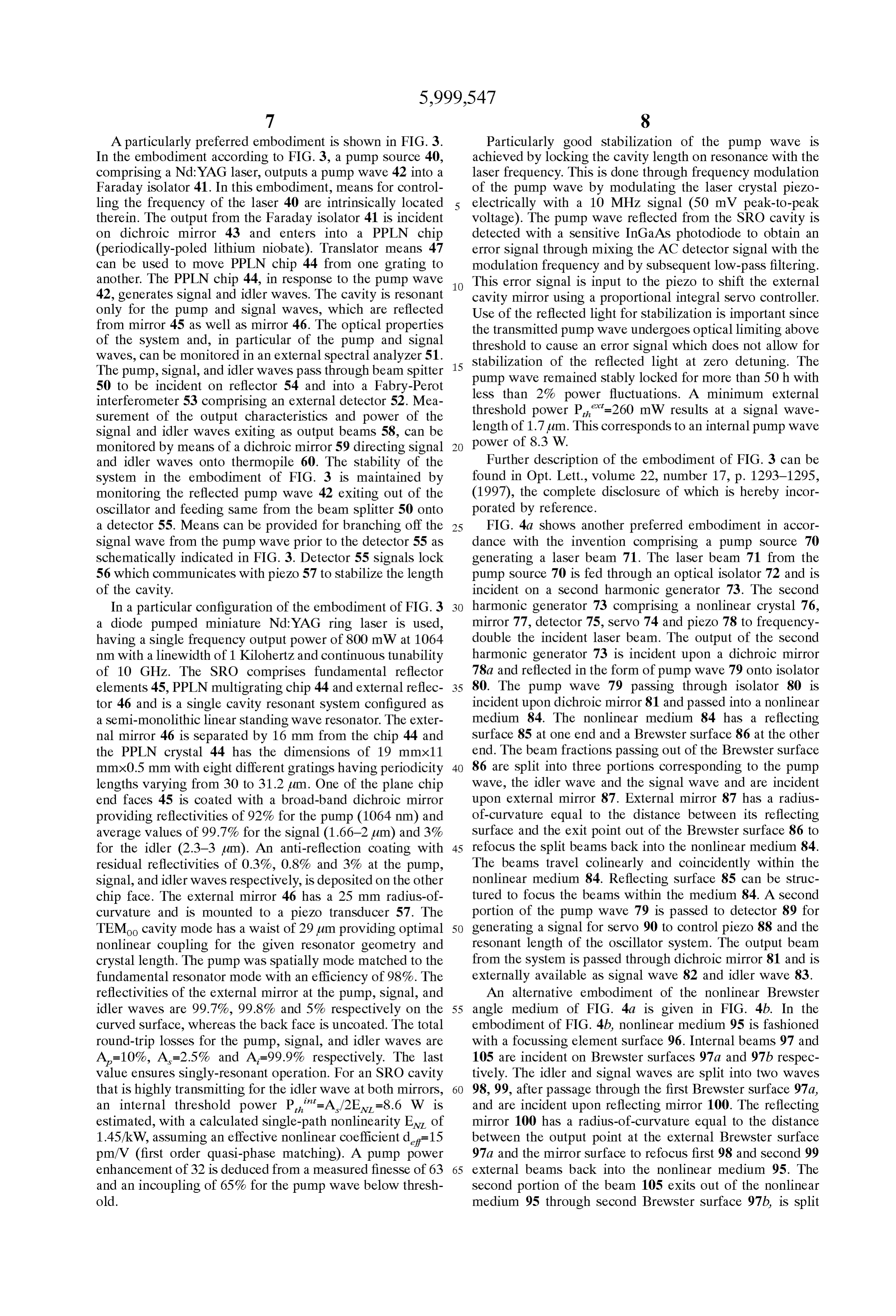
A particularly preferred embodiment is shown in FIG. 3. Particularly good Stabilization of the pump wave is In the embodiment according to FIG. 3, a pump source 40, achieved by locking the cavity length on resonance with the comprising a Nd:YAG laser, outputs a pump wave 42 into a laser frequency. This is done through frequency modulation Faraday isolator 41. In this embodiment, means for control of the pump wave by modulating the laser crystal piezo ling the frequency of the laser 40 are intrinsically located electrically with a 10 MHz signal (50 mV peak-to-peak therein. The output from the Faraday isolator 41 is incident voltage). The pump wave reflected from the SRO cavity is on dichroic mirror 43 and enters into a PPLN chip detected with a sensitive InGaAs photodiode to obtain an (periodically-poled lithium niobate). Translator means 47 error Signal through mixing the AC detector Signal with the can be used to move PPLN chip 44 from one grating to modulation frequency and by Subsequent low-pass filtering. another. The PPLN chip 44, in response to the pump wave This error Signal is input to the piezo to shift the external 42, generates Signal and idler waves. The cavity is resonant cavity mirror using a proportional integral Servo controller. only for the pump and Signal waves, which are reflected Use of the reflected light for stabilization is important since from mirror 45 as well as mirror 46. The optical properties the transmitted pump wave undergoes optical limiting above of the System and, in particular of the pump and Signal waves, can be monitored in an external spectral analyzer 51. 15 threshold to cause an error Signal which does not allow for Stabilization of the reflected light at Zero detuning. The
The pump, Signal, and idler waves pass through beam Spitter pump wave remained 50 to be incident on reflector 54 and into a Fabry-Perot less than 2% powerstably locked for more than 50 h with fluctuations. A minimum external interferometer 53 comprising an external detector 52. Mea threshold power P'=260 mW results at a signal wave Surement of the output characteristics and power of the length of 1.7 um. This corresponds to an internal pump wave Signal and idler waves exiting as output beams 58, can be monitored by means of a dichroic mirror 59 directing signal power of 8.3 W.
and idler waves onto thermopile 60. The stability of the Further description of the embodiment of FIG. 3 can be system in the embodiment of FIG. 3 is maintained by found in Opt. Lett., volume 22, number 17, p. 1293-1295, monitoring the reflected pump wave 42 exiting out of the (1997), the complete disclosure of which is hereby incor oscillator and feeding same from the beam splitter 50 onto porated by reference.
a detector 55. Means can be provided for branching off the 25 FIG. 4a shows another preferred embodiment in accor signal wave from the pump wave prior to the detector 55 as dance with the invention comprising a pump Source 70 schematically indicated in FIG. 3. Detector 55 signals lock generating a laser beam 71. The laser beam 71 from the 56 which communicates with piezo 57 to stabilize the length pump source 70 is fed through an optical isolator 72 and is of the cavity. incident on a Second harmonic generator 73. The Second In a particular configuration of the embodiment of FIG. 3 harmonic generator 73 comprising a nonlinear crystal 76, a diode pumped miniature Nd:YAG ring laser is used, mirror 77, detector 75, servo 74 and piezo 78 to frequency having a single frequency output power of 800 mW at 1064 double the incident laser beam. The output of the second nm with a linewidth of 1 Kilohertz and continuous tunability harmonic generator 73 is incident upon a dichroic mirror of 10 GHz. The SRO comprises fundamental reflector 78a and reflected in the form of pump wave 79 onto isolator elements 45, PPLN multigrating chip 44 and external reflec 35 80. The pump wave 79 passing through isolator 80 is tor 46 and is a Single cavity resonant System configured as incident upon dichroic mirror 81 and passed into a nonlinear a Semi-monolithic linear Standing wave resonator. The exter medium 84. The nonlinear medium 84 has a reflecting nal mirror 46 is separated by 16 mm from the chip 44 and Surface 85 at one end and a Brewster Surface 86 at the other the PPLN crystal 44 has the dimensions of 19 mmx11 end. The beam fractions passing out of the Brewster Surface mmx0.5 mm with eight different gratings having periodicity 40 86 are split into three portions corresponding to the pump lengths varying from 30 to 31.2 tim. One of the plane chip wave, the idler wave and the Signal wave and are incident end faces 45 is coated with a broad-band dichroic mirror upon external mirror 87. External mirror 87 has a radius providing reflectivities of 92% for the pump (1064 nm) and of-curvature equal to the distance between its reflecting average values of 99.7% for the signal (1.66-2 um) and 3% surface and the exit point out of the Brewster surface 86 to for the idler (2.3-3 um). An anti-reflection coating with 45 refocus the split beams back into the nonlinear medium 84. residual reflectivities of 0.3%, 0.8% and 3% at the pump, The beams travel colinearly and coincidently within the Signal, and idler waves respectively, is deposited on the other nonlinear medium 84. Reflecting surface 85 can be struc chip face. The external mirror 46 has a 25 mm radius-of tured to focus the beams within the medium 84. A second curvature and is mounted to a piezo transducer 57. The portion of the pump wave 79 is passed to detector 89 for TEM cavity mode has a waist of 29 um providing optimal 50 generating a signal for servo 90 to control piezo 88 and the nonlinear coupling for the given resonator geometry and resonant length of the oscillator System. The output beam crystal length. The pump was spatially mode matched to the from the system is passed through dichroic mirror 81 and is fundamental resonator mode with an efficiency of 98%. The externally available as signal wave 82 and idler wave 83. reflectivities of the external mirror at the pump, Signal, and An alternative embodiment of the nonlinear Brewster idler waves are 99.7%, 99.8% and 5% respectively on the 55 angle medium of FIG. 4a is given in FIG. 4b. In the curved Surface, whereas the back face is uncoated. The total embodiment of FIG. 4b, nonlinear medium 95 is fashioned round-trip losses for the pump, Signal, and idler waves are with a focussing element surface 96. Internal beams 97 and A=10%, A=2.5% and A=99.9% respectively. The last 105 are incident on Brewster surfaces 97a and 97b respec value ensures Singly-resonant operation. For an SRO cavity tively. The idler and Signal waves are split into two waves that is highly transmitting for the idler wave at both mirrors, 60 98, 99, after passage through the first Brewster Surface 97a, an internal threshold power P."=A/2E=8.6 W is and are incident upon reflecting mirror 100. The reflecting estimated, with a calculated Single-path nonlinearity E of mirror 100 has a radius-of-curvature equal to the distance 1.45/kW, assuming an effective nonlinear coefficient d=15 between the output point at the external Brewster Surface pm/V (first order quasi-phase matching). A pump power 97a and the mirror Surface to refocus first 98 and Second 99 enhancement of 32 is deduced from a measured finesse of 63 65 external beams back into the nonlinear medium 95. The and an incoupling of 65% for the pump wave below thresh second portion of the beam 105 exits out of the nonlinear old. medium 95 through second Brewster surface 97b, is split
Page 9
into third and fourth beams 101, 102 and is incident upon a wave 111 and idler wave 112 are generated in medium 106, Second concave mirror 103. Like mirror 100, mirror 103 has wherein the idler 112 is essentially transmitted through a radius-of-curvature equal to its separation from the exit mirror 108. In a second nonlinear medium 107, the second point of the two beams 101,102 out of the Brewster surface harmonic 114 of the idler wave is generated and resonantly 97b to refocus the beams 101, 102 back into the nonlinear enhanced between the mirrors 108 and 109 which have high medium 95. reflectivity for the wavelength corresponding to wave 114. In a particular embodiment of FIG. 4a, a miniature The portion of wave 114 transmitted through mirror 109 and Nd:YAG ring laser 70 is used as a primary source of the travelling back toward the pump Source is reflected by System, delivering a maximum output power of 1.5 Watt at dichroic mirror 102 and detected at detector 103. The phase 1064 nm with a linewidth of 1 kHz and a frequency modulation produced by the radiofrequency source 115 that instability of about 10 MHz/h. The laser frequency is electro-optically modulates medium 107 is converted into continuously tuned through 10 GHz by temperature control amplitude modulation on wave 116 if wave 114 exhibits a of the Nd:YAG crystal. The laser beam 71 is frequency detuning with respect to the cavity resonance. The amplitude doubled in the external resonator 73 to produce a maximum modulation is converted into an error Signal in Servo System output power of 1.1 Watt at 532 nm. The SRO is a standing 15 104 which, after amplification, is fed to the actuator 105 wave monolithic cavity containing a 7.5 mm long which moves mirror 109 to keep the wave 114 in resonance. MgO:LiNbO crystal 84 (type-I phase matching). The cavity The frequency-stability of the emitted waves 111, 112 is design is adapted to provide low loSS for the p-polarized thereby enhanced.
Signal wave and good overlap of Signal, idler, and pump We claim:
waves within the crystal 84 over a wide tuning range. The 1. An optical parametric oscillator System for use in a first property is implemented by using a crystal cut at continuous-wave pumped laser device having a single Brewsters angle (65.9) for the center signal wavelength. frequency pump Source, the System comprising: The transmission loSS for the Signal wave remains low over a single resonance resonator having a nonlinear medium a relatively wide tuning range. The dispersion change of for producing a first parametrically generated wave and Signal, idler, and pump waves is compensated by means of 25 a Second parametrically generated wave in response to an external cavity mirror 87 placed at a distance equal to its a pump wave from the Single-frequency pump Source, radius-of-curvature of 25 mm from the exit point on the Said resonator having low loSS for said first parametri Brewster face 86. In this fashion, waves exiting at any angle cally generated wave and high transmission for Said are retroreflected to assure colinear propagation and good Second parametrically generated wave; and overlap of the three waves inside the crystal 84. This means for limiting temporal variations of independent geometry requires a focussing mirror 85 at the other end of parameters influencing an optical path length of Said the crystal 84 to obtain a stable resonator mode for pump and resonator and a wavevector mismatch of parametric signal. The crystal 84 can be configured with a 10 mm generation to a level Substantially Smaller than that Spherically polished end face which is dielectrically coated which would lead to a change in wave vector mismatch with average reflectivities of 92%, 99.5%, 2% for the pump, 35 comparable to a difference of wavevector mismatches Signal, and idler waves respectively. The range where the corresponding to frequencies of Said first parametri reflectivity drops from 98% to 5% extends from 1040 to cally generated wave Spaced by one free Spectral range 1085 nm. The external mirror 87, mounted on a PZT 88 for of Said resonator.
cavity length locking, provides average reflectivities of 98% 2. The System of claim 1, wherein Said resonator is a for the pump, 99% for the signal and 90% for the idler. A 40 monolithic block.
simple AR-coating is added to the Brewster face 86 to 3. The system of claim 1, wherein said nonlinear medium reduce pump wave losses. SRO operation is ensured by a comprises a quasi-phasematched crystal.
total round-trip power loss of more than 98% for the idler 4. The System of claim 1, wherein Said resonator has high wave. The pump waist is 18 um leading to a calculated transmission for Said pump wave and Said independent Single pass nonlinearity E =1.5/kW. (An effective nonlin 45 parameters comprise a pump wave frequency, a temperature ear coefficient d=4.7 pm/V has been assumed.) The of Said nonlinear medium, and a round-trip optical path expected internal threshold for the SRO with double-passed length of Said first parametrically generated wave external to idler is P=As?4E =3.3 W for a round trip signal loSS Said nonlinear medium.
A=2%. The expected external threshold is reduced to 0.15 5. The system of claim 1, wherein said resonator has high W by the pump wave enhancement factor measured to be 22. 50 transmission for Said pump wave, an electro-optic medium Oscillation occurred at pump powers above 200 mW and is disposed within Said resonator, and Said limiting means Stable operation was ensured by locking the cavity length on comprise means for applying an electric field to Said resonance with the pump frequency and a pump wave phase medium, wherein Said independent parameters comprise a is modulated within the nonlinear crystal 84. Since the pump frequency, a temperature of Said nonlinear medium, transmitted pump wave undergoes optical limiting, the 55 Said electric field, and a part of a round-trip optical path reflected pump light is used to generate an appropriate error length of Said first parametrically generated wave external to Signal to lock on Zero detuning of the pump wave. A Said nonlinear medium.
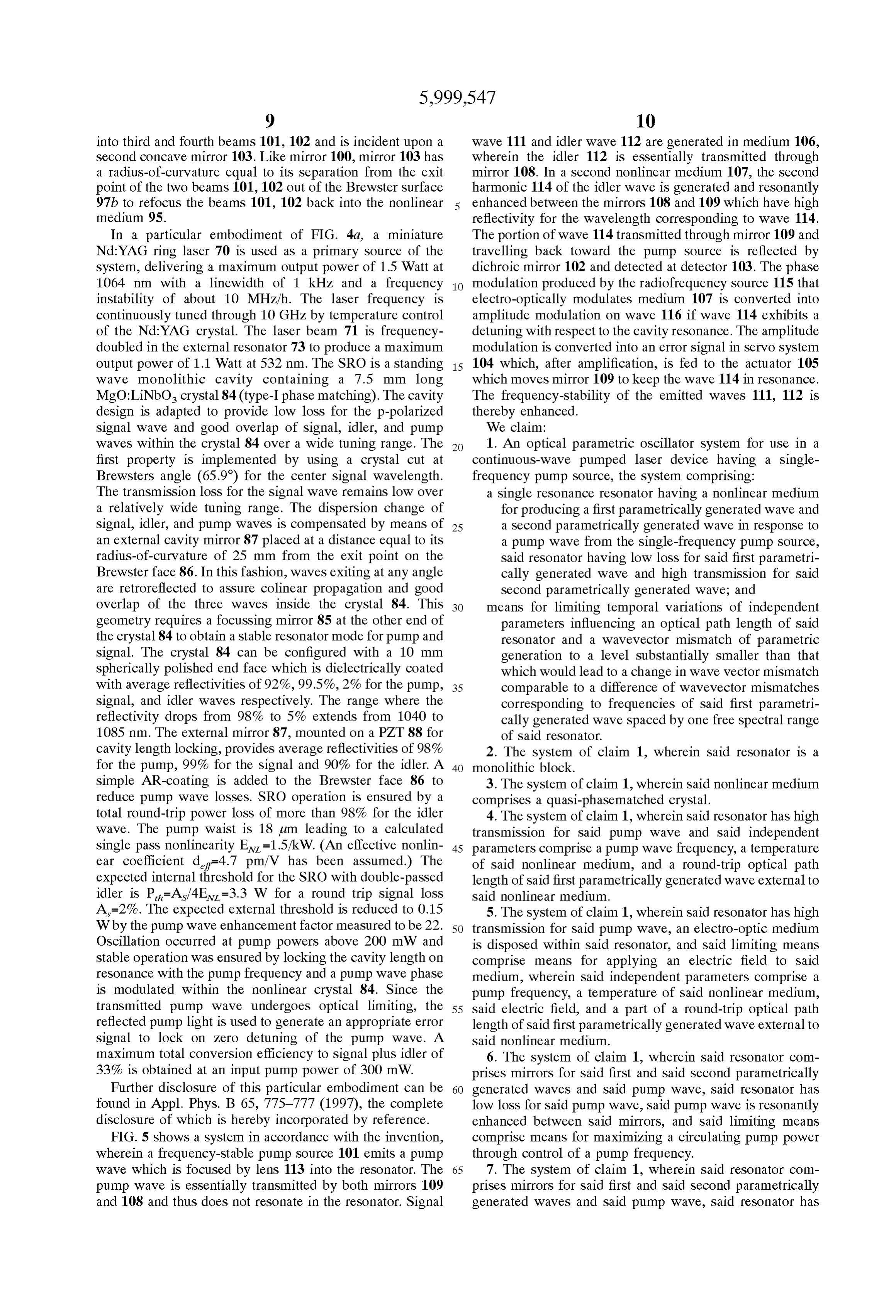
maximum total conversion efficiency to Signal plus idler of 6. The System of claim 1, wherein Said resonator com 33% is obtained at an input pump power of 300 mW. prises mirrors for Said first and Said Second parametrically Further disclosure of this particular embodiment can be 60 generated waves and Said pump wave, Said resonator has found in Appl. Phys. B 65, 775–777 (1997), the complete low loSS for Said pump wave, Said pump wave is resonantly disclosure of which is hereby incorporated by reference. enhanced between Said mirrors, and Said limiting means FIG. 5 shows a system in accordance with the invention, comprise means for maximizing a circulating pump power wherein a frequency-stable pump Source 101 emits a pump through control of a pump frequency.
wave which is focused by lens 113 into the resonator. The 65 7. The system of claim 1, wherein said resonator com pump wave is essentially transmitted by both mirrors 109 prises mirrors for Said first and Said Second parametrically and 108 and thus does not resonate in the resonator. Signal generated waves and Said pump wave, Said resonator has
Page 10
low loSS for Said pump wave and Said pump wave is Said resonator and Sending Said Selected part into Said resonantly enhanced between Said mirrors, wherein Said resonator, and further comprising means to rotate polariza limiting means comprise means for controlling an optical tion of Said Selected part before entering Said resonator. path length of Said resonator to maximize a circulating pump 15. The system of claim 1, wherein said resonator consists power.
essentially of a Semi-monolithic resonator comprising a 8. The system of claim 6, wherein a transmission of an input coupling mirror for Said pump wave is optimized for quasi-phasematched multigrating medium, an external con maximum power conversion to one of Said first and Said Said thereof, wherein a firsta end cave mirror having mirror coating on a curved Surface face of Said multigrating medium
Second parametrically generated waves.
9. The system of claim 7, wherein a transmission of an is flat and has a mirror coating and a Second end face of Said input coupling mirror for Said pump wave is optimized for medium has an anti-reflection coating, and further compris maximum power conversion to one of Said first and Said ing means to translate Said medium.
Second generated waves. 16. The system of claim 15, wherein said mirror coating 10. The system of claim 1, wherein said limiting means on said first end face has different spectral reflectivity comprise means for controlling an optical path length of Said 15 properties on different gratings. resonator, means for changing an optical path length by a 17. The system of claim 15, wherein said anti-reflection controlled amount, and means for adjusting a phase mis coating has different spectral reflectivity properties on dif match of Said resonator in response to a change in Said ferent gratings.
optical path length to maximize a power conversion effi 18. The system of claim 1, wherein said resonator consists ciency of the System. essentially of a Brewster-angle cut resonator comprising at 11. The System of claim 1, further comprising a least one external concave mirror having a radius of curva frequency-stable reference, means for comparing a fre ture equal to a distance between an exit point out of a quency of one of Said first and Said Second parametrically Brewster-angle Surface of Said nonlinear medium and a generated waves with Said reference, and means for adjust curved reflecting Surface of Said external concave mirror, ing Said frequency of one of Said waves to minimize a 25 wherein Said nonlinear medium has at least one Brewster detuning between Said frequency and Said reference. angle Surface to minimize Fresnel-reflection losses for 12. The system of claim 11, wherein said resonator waves having a polarization vector parallel to a plane of comprises mirrors having high reflectivity at a wavelength of a probe wave circulating in Said resonator, and Said incidencecolinearly with waves of different wavelength propagating within Said nonlinear medium, further comprising limiting means comprise means for detection of a detuning of Said probe wave from resonance and means for minimiz means for focussing within Said nonlinear medium. ing Said detuning of Said probe wave by one of controlling 19. The system of claim 18, wherein said focussing means Said frequency of Said pump Wave and controlling an optical consists essentially of a curved Surface having a mirror path length of Said resonator. coating.
13. The system of claim 12, wherein said probe wave is 35 20. The system of claim 18, wherein said focussing means generated as a Second harmonic of one of Said pump wave, consists essentially of a curved Surface having total internal Said first and Said Second parametrically generated waves. reflection.
14. The system of claim 12, wherein said probe wave is obtained by Selecting a part of Said first wave emitted from
Provenance
- Collection
- Cited prior art
- Original PDF
- patentimages.storage.googleapis.com →
- Filed
- 1998-02-02
- Pages
- 10
- Method
- pdftotext (the PDF's own text layer) + pdftoppm 300dpi page scans
- Source
- Google Patents bibliographic record
- Granted
- 1999-12-07
- Inventors
- Klaus Schneider; Stephan Schiller; Jurgen Mlynek; Patrick Kramper; Universitat Constance
- Transcribed from
- patentimages.storage.googleapis.com →