patent · US20050286601A1
Surface catalyst infra red laser
29 December 2005
Page 1 — bibliographic record
(19) United States (12) Patent Application Publication (10) Pub. No.: US 2005/0286601A1
Zupper0 et al. (43) Pub. Date: Dec. 29, 2005 (54) SURFACE CATALYST INFRA RED LASER Publication Classification
(75) Inventors: Anthony C. Zuppero, Pollock Pines,
CA (US); Jawahar M. Gidwani, San (51) Int. Cl. ................................................. H01S 3/095 Francisco, CA (US) (52) U.S. Cl. ................................................................ 372/89 Correspondence Address:
BAKER & MCKENZE LLP
805 THIRDAVENUE - 29TH FLOOR (57) ABSTRACT
(73) Assignee: Neokismet, L.L.C. An energy converter reacts hydrocarbons and air on a catalyst configuration to produce a population inversion. A (21) Appl. No.: 11/084,425 photovoltaic System may extract the radiating energy, and a (22) Filed: Mar. 18, 2005 laser System may extract a significant fraction of the reaction energy in the form of coherent radiation. The flooding of the
Related U.S. Application Data catalyst adsorption Sites with fuel and the choice of catalyst predisposes the adsorbing oxygen molecules to create mono (60) Division of application No. 10/218,706, filed on Aug. atomic oxygen hot-atoms, which deposit the considerable 14, 2002, now Pat. No. 6,944,202, which is a division energy of oxygen adsorption directly into a reaction channel of application No. 09/691,948, filed on Oct. 19, 2000, of adjacent, adsorbed and Simple fuel radicals, thereby now Pat. No. 6,678,305, and which is a continuation producing simple, energetic product molecules, concentrat in-part of application No. 09/589,669, filed on Jun. 7, ing the energy in one or a few modes, and Strongly favoring 2000, now Pat. No. 6,327,859, which is a division of inverted populations. A Solid State method to Stimulate application No. 09/304,979, filed on May 4, 1999, precursor chemisorbed specie dissociation accelerates the now Pat. No. 6,114,620. reaction rates, providing a method to greatly intensify pulsed power output, increase efficiency, and to facilitate nano (60) Provisional application No. 60/160,527, filed on Oct. Scale and micro-Scale thermal energy heat rejection pro 20, 1999. CCSSCS.
Page 2
Drawing sheet — no readable text.
Page 3
Drawing sheet — no readable text.
Page 4
US 2005/0286601 A1 Dec. 29, 2005
SURFACE CATALYST INFRA RED LASER occur in many Systems. For example, research has shown that when gas phase oxygen atoms react with deuterium
CROSS-REFERENCE TO RELATED adsorbed on a tungsten Surface, OD radicals are formed in APPLICATIONS the inverted State, with the highest population appearing at vibrational level 6. This represents a substantial fraction of 0001) This application claims the benefit of the U.S. the available reaction energy being concentrated in the Provisional Patent Application No. 60/160,527 filed on Oct. inverted state. Shin, H K, “Vibrationally Excited OD Radi 20, 1999, and entitled SURFACE CATALYST INFRA RED cals From The Reaction Of Oxygen-Atoms With Chemi LASER sorbed Deuterium On Tungsten,” Journal Of Physical
TECHNICAL FIELD OF THE INVENTION
0009 Similar research showed that gas phase atomic 0002 The present invention relates generally to solid oxygen reacting with adsorbed hydrogen on the Surface State devices for converting or extracting energy from produces population inverted, OH radicals within 100 fem hydrocarbon-Oxidizer reactions. More specifically, this toseconds. Ree J, Kim Y H, Shin H K, “Dynamics Of invention relates to a significant improvement of the proceSS Gas-Surface Interactions: Reaction Of Atomic Oxygen With for the efficient conversion and extraction of energy in the Chemisorbed Hydrogen On Tungsten,” Journal Of Physical form of optical emissions and of coherent radiation and from Chemistry A, V. 101(#25), pp. 4523-4534, Jun. 19, 1997. reactants Such as hydrocarbons, hydrogen or other combus 0010. It was shown in Kim, M. S. and J. Ree, “Reaction tible materials reacting on a catalyst Surface with air or other of Gas-Phase Atomic Hydrogen with Chemisorbed Hydro oxidizers.
gen Atoms on an Iron Surface,” Bulletin of the Korean
BACKGROUND OF THE INVENTION
Chemical Society, Volume 18, Number 9 (1997), COMMU
NICATIONS, pp. 985-994, that gas phase atomic hydrogen 0003. One method to convert chemical reactant energy reacts with chemisorbed hydrogen on an iron Surface to form directly into useful work Such as electricity uses electro population inverted, desorbed diatomic hydrogen molecules. chemical couples Such as batteries and fuel cells. In this 0011. It is known that when atomic oxygen in the gas method, a Substantial fraction of the reactant bond energies phase reacts with carbon monoxide adsorbed on a platinum may be converted directly into electrical potential. However, catalyst Surface, the fraction of reactive collisions producing the physical chemistry underlying these processes limits the molecules having vibrational energies corresponding to lev rate of Such conversion Substantially. The result is a power els v3=9 to 13 is found to be very high and exhibits a per mass and power per Volume that is orders of magnitude vibrational population inversion. Ree, J.; Y. H. Kim, and H. Smaller than that of a mechanical engine. K. Shin, “Reaction of atomic oxygen with adsorbed carbon 0004 Another method uses gas dynamic processes to monoxide on a platinum Surface,” Journal of Chemical convert chemical energy directly into a dynamic State exhib Physics, Jan. 8, 1996, Volume 104, Issue 2, pp. 742-757. iting a population inversion. The energy is extracted from This would be useful except for the fact that the mono atomic oxygen atoms for this reaction must be created using this System as coherent radiation. However, the reactants and inefficient means, namely electric arcs. exhausts of this method are usually dangerous and incom patible with human Safety considerations. Moreover, these 0012 Yet another research has shown that mono-atomic devices cannot be efficiently miniaturized. oxygen atoms can be created directly on a catalytic Surface by irradiation with UV light. The most probable result of 0005 Therefore, it is highly desirable to have a simpler Such irradiation is the production of mono-atomic oxygen method and System for extracting efficiently without having atoms. The next most probable result is desorption. The to use harmful products and without producing hazardous issue with this approach is the low efficiency of the genera byproducts in the process. tion and conversion of UV light into dissociated oxygen 0006. A recent research suggests that certain simple, atoms. Tripa, C. Emil, Christopher R. Arumaninayagam, energetic atoms reacting on a catalytic Surface produce John T. Yates, Jr., “Kinetics measurements of CO photo products exhibiting a population inversion. An inverted oxidation on Pt(111),” Journal of Chemical Physics, Jul. 22, population is the prerequisite for Stimulated emission of 1996, Volume 105, Issue 4, pp. 1691-1696. radiation, which is one method to remove the energy from 0013 A related research has also shown that oxygen the reaction and to retain its high degree of usefulness. molecules preferentially adsorb on the Step sites of a catalyst 0007 One problem in the prior state of technology is the Such as platinum, and that photo generated mono-atomic process of creating highly energetic Species on the catalyst oxygen atoms preferentially react with other radicals or Surface, Such as hot atoms and mono-atomic oxygen, that 1) molecules also adsorbed on the Step Sites. Atomic and retain a significant amount of the chemical energy for molecular species generated by the photolysis of aligned reactions, instead of dissipating it as a heat of adsorption, molecules adsorbed on crystalline Solids tend to move and 2) that will produce an inverted population as a product preferentially in particular directions relative to the crystal of the reaction. The issue in the creation of hot atoms, Such Surface. For example, photo-generated mono-atomic oxygen as mono-atomic oxygen, is that it usually takes more elec reacts preferentially with adsorbed CO to make excited State trical energy to produce the hot atoms than can be extracted CO2. The feature here is the efficiency of reaction of the hot atoms with other Surface reactants. An issue here is the from the resulting chemical reactions. preferential production of hot atoms. Tripa, C. Emil; John T. 0008 Research has suggested that mono-atomic, ener Yates Jr, "Surface-aligned reaction of photo generated oxy getic Specie reacting with Simple adsorbed specie may form gen atoms with carbon monoxide targets,” Nature, Vol 398, Vibrationally inverted products, and that this inversion may pages 591-593 (1999), Apr. 15 1999.
Page 5
US 2005/0286601 A1 Dec. 29, 2005
0.014) Another research showed that the UV photons to concentrate, again favoring an inverted population. Fur create hot electrons on a catalyst metal Surface and which thermore, mono-atomic oxygen atoms Supplied externally to interact Strongly with adsorbed oxygen to cause the trapped the catalytic Surface may cause a population inversion in the oxygen atoms to dissociate or desorb. The Salient point is products of carbon monoxide reaction to carbon dioxide and that adsorbates trap in metastable States before they disso in the Surface catalyzed oxidation of hydrogen. ciate, and that hot electrons can Stimulate Such States effi 0019 Heretofore, the oxygen adsorption process wasted ciently. Experiments showed that gas phase oxygen mol approximately half the reaction energy as heat on the cata ecules adsorb first as a Superoxo-like specie (molecule lyst Surface. Therefore, a new method to conserve Such Singly charged on Surface) and are then trapped in a shallow energy and extract it into useful energy is highly desired. barrier of order 0.1 eV. Then the molecule may overcome the barrier and become a peroxo-like specie (doubly charged) in SUMMARY OF THE INVENTION a barrier of order 0.5 eV. Finally, the molecule may over come this barrier and dissociate into hot atoms. The exist 0020. The present invention is directed to a method and ence of precursor phases is apparently fairly common and System for using a catalyst and reactants to create the observed in various forms of platinum, palladium and iri “simple, energetic atoms’ needed for the generation of the dium catalysts. Nolan, P. D.; B. R. Lutz, P. L. Tanaka, J. E. inverted population. In one embodiment, the present inven Davis, and C. B. Mullins, “Molecularly chemisorbed inter tion captures the reaction energy based on the principle that mediates to oxygen adsorption on Pt (111): A molecular Some energetic atoms reacting on a catalytic Surface produce beam and electron energy-loSS Spectroscopy Study,” Journal products exhibiting a population inversion. Of Chemical Physics Volume 111, Number 8, Aug. 22 1999. 0021. This invention creates population inverted reaction Nolan PD, Lutz B R, Tanaka P L, Mullins C B, “Direct products from fuel and oxidizer reactions on a catalyst Verification of a high-translational-energy molecular precur Surface. A laser operating on the inverted population would sor to oxygen dissociation on Pd(111).” Surface Science V. efficiently extract the energy from the System. One embodi 419(#1) pp. L107-L113, Dec. 24, 1998. Nolan, P. D.; B. R. ment uses the hot atom produced during dissociative adsorp Lutz, P. L. Tanaka, J. E. Davis, and C. B. Mullins, “Trans tion of oxygen on catalyst Surfaces to provide energetic lational Energy Selection of Molecular Precursors to Oxy oxygen free radicals on those Surfaces and to cause direct gen Adsorption on Pt(111).” Physical Review Letters, VOL and prompt reaction with a fuel Specie, also on the catalyst UME 81, NUMBER 15 Oct. 12 1998. Davis, J. E.; P. D. Surface, which biases reactions towards formation of popu Nolan, S. G. Karseboom, and C. B. Mullins, “Kinetics and lation inverted products. Examples of fuel specie include, dynamics of the dissociative chemisorption of oxygen on but are not limited to, hydrogen, a hydroxyl, a carbon Ir(111),” J. Chem. Phys. 107(3), Jul. 15 1997, pp. 943, 10 monoxide or a hydrocarbon fragment. pageS.
0.015 Inverted products can be formed by associative 0022. Another embodiment of this invention creates a desorption. Experiments have shown that nitrogen mol population inversion by biasing the reaction by choice of catalyst Species to form product molecules that are Stretched ecules formed upon catalytic decomposition of ammonia at the moment of desorption from the catalyst Surface. (cracking) over Ru may show a vibrational population Another embodiment creates the population inversion by inversion. The associative reaction begins with the atomic biasing the reactants by choice of catalyst to cause simple Separation of the nitrogen atoms being Similar to that of the reactants with a large fraction of their energy available upon Surface catalyst atoms and just Slightly greater than that of asSociative desorption. Another embodiment uses a Solid the ground State of a product nitrogen molecule. Murphy, M. State method to provide hot electrons directly, and without J.; J. F. Skelly, and A. Hodgson; B. Hammer, “Inverted the use of UV light, which in turn stimulates dissociation of vibrational distributions from N2 recombination at Ru(001): the precursor, peroxo-chemisorbed oxidizer, and cause an Evidence for a metastable molecular chemisorption well.” avalanche of Surface reactions.
Journal of Chemical Physics-Apr. 8, 1999-Volume 110,
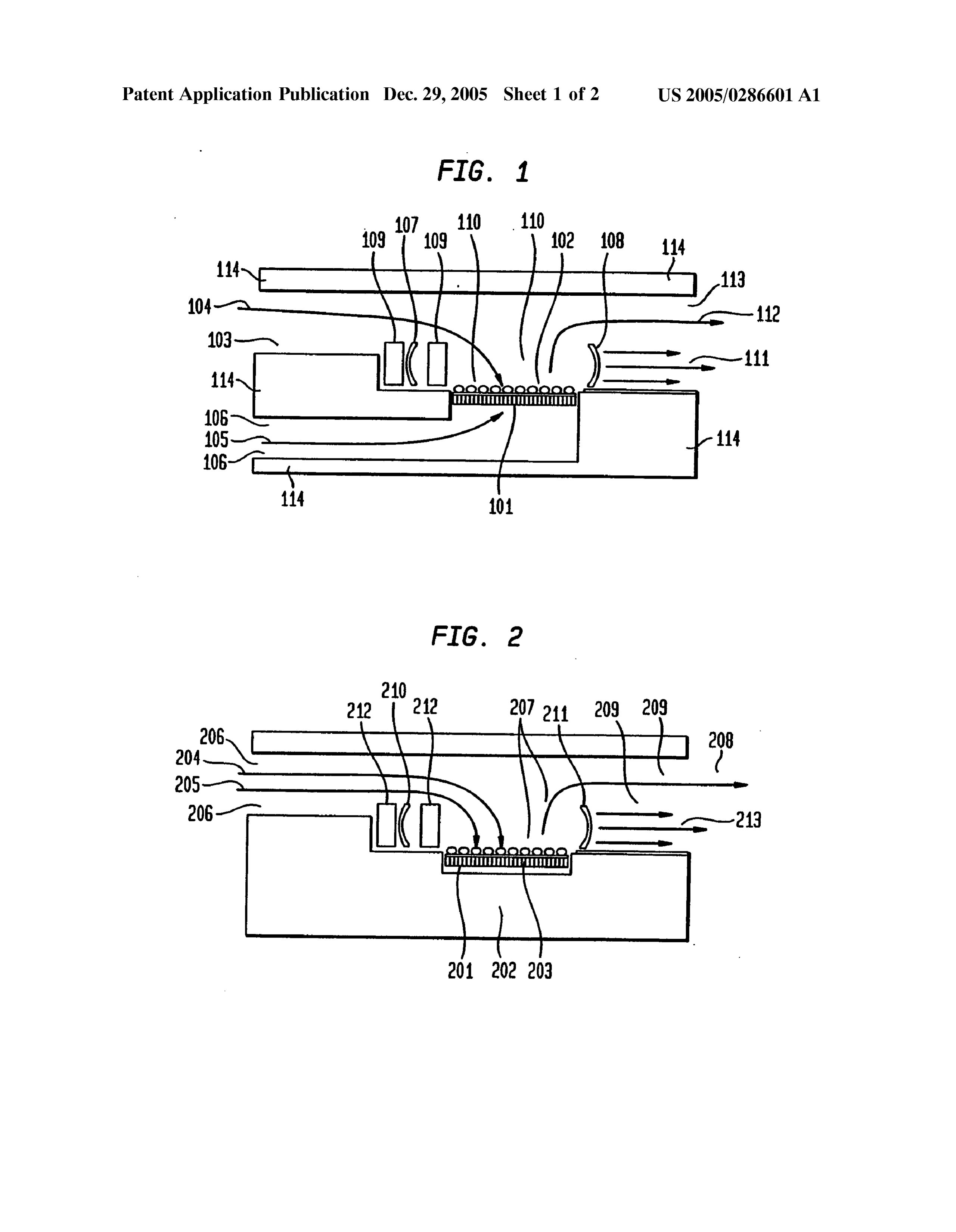
Issue 14, pp. 6954-6962. 0023. In one embodiment, the present invention uses a laser to extract the energy from an inverted population, 0016 That reaction rates can be stimulated and increased resulting in conversion of a Substantial fraction, and in Some by many orders of magnitude with picoSecond duration and cases a majority, of the chemical reaction energy into one or timing is illustrated by recent experiments depicted in a Several, nearly monochromatic, coherent beams of light. technical publication. Bonn, M.; S. Funk, Ch. Hess, D. N. Such a beam retains the high quality of the energy and is Denzler, C. Stampfl, M. Scheffler, M. Wolf, G. Ertl, most useful because it can be efficiently converted into “Phonon-Versus Electron-Mediated Desorption and Oxida electricity, for example, by passing a monochromatic beam tion of CO on Ru(0001),” Science, Volume 285, Number into a photovoltaic cell with band gap Slightly Smaller than 5430 Issue of Aug. 13 1999, pp. 1042-1045. the beam photon energy, and equally efficiently into 0.017. The stretched molecule represents the initial con mechanical forces through other means. dition where the atomic Separation during the vibrational BRIEF DESCRIPTION OF THE DRAWINGS oscillation Starts with the association reaction at the extrema, defining a reaction product in the highest excited State. It is 0024 Preferred embodiments of the present invention noted “Vibrational” modes also include the vibration of any will now be described, by way of example only, with Specie on the Surface against that Surface. reference to the accompanying drawings in which: 0.018 Simple reactant radicals on the catalyst surface 0025 FIG. 1 shows a schematic cross section of an may preferentially form in mechanically simple ways, which apparatus for energy generation using Separated reactants in often Strongly favor a Single vibrational mode for the energy one embodiment of the present invention;
Page 6
US 2005/0286601 A1 Dec. 29, 2005
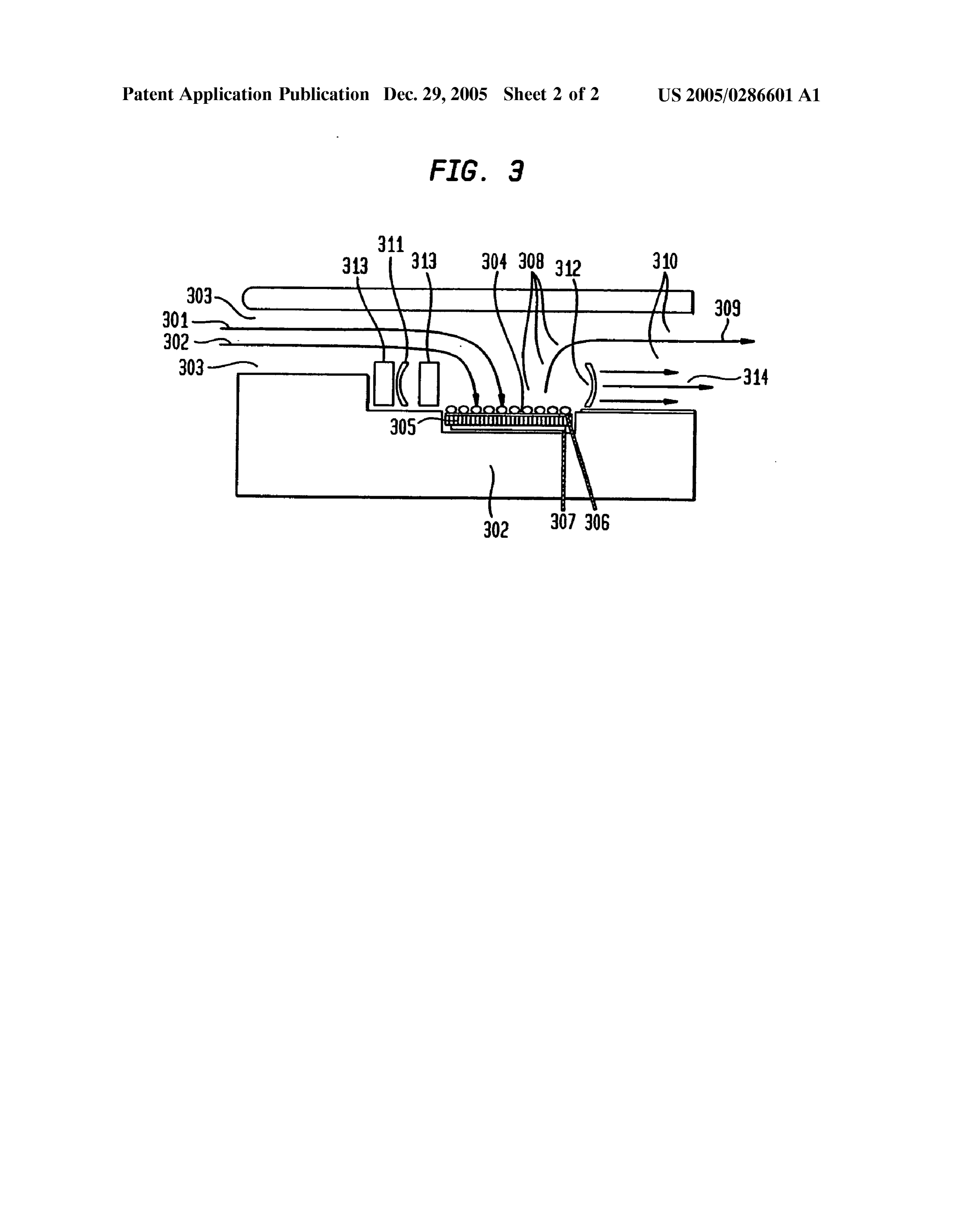
0.026 FIG. 2 illustrates a cross section of an apparatus in 0032. According to the present invention, a hot atom one embodiment of the present invention for generating formed from the dissociation process is made to react before energy using free flowing, mixed reactants for forming it can reach equilibrium on the catalyst Surface and thereby inverted excited State products, and does not dissipate the energy as heat to the Substrate or 0.027 FIG. 3 illustrates a cross section of an apparatus in catalyst lattice but instead makes nearly all of the energy of one embodiment for generating power by externally Stimu adsorption available for population inversion. lating and triggering reactions. 0033. In one embodiment of the present invention, the use of a Surface with approximately a monolayer or greater
DETAILED DESCRIPTION OF THE coverage of fuel reactant also reduces the adsorption energy PREFERRED EMBODIMENT OF THE of the Oxygen adsorbed species, which adsorption heat INVENTION would otherwise become unavailable to reaction products. 0028. The present invention is directed to biasing the 0034. The present invention is also directed to extracting reactions occurring on the Surface of a catalyst toward those the energy from the multiple quantum levels associated with that deliver a Substantial fraction of the energy into product the vibrational energy of newly formed product species, Species that exhibit, as a result of the methods of this whether or not the Specie remains adsorbed on the Surface of invention, a population inversion. the catalyst. The multiple quantum transitions are all dipole 0029 Stretched molecules associated with adsorption active for Specie on a Surface.
and desorbtion have closely related, reversible effects, both 0035) In one embodiment of the present invention, an related to population inversion. A method of the present optical System, for example, a laser, causes Stimulated invention in one embodiment uses the hot atoms created emission of radiation to occur between the highly populated, upon dissociative chemisorption reacting with a fuel-rich higher vibrational quantum number energy levels and the catalyst Surface; in another embodiment, a method in the sparsely populated, lower quantum number levels, and present invention uses Stretched molecules produced during thereby removes a Substantial fraction of the energy in the asSociative desorbtion from a catalyst Surface; in yet another form of coherent radiation.
embodiment, the method of the present invention uses 0036). In one embodiment, a photovoltaic device may excited State Simple products either desorbing from catalyst transform the radiation emitted due to the population inver Surfaces or vibrating on those Surfaces for a usefully long sion directly into electricity, with or without the use of time; all methods being capable of producing reaction lasers.
products with population inversions.
0.030. According to one embodiment of this invention a 0037. The laser may use overtone transitions between levels, resulting in multiples, e.g., double, triple or higher, of catalyst Surface is flooded with fuel, Such as ethanol, metha the transition frequencies usually associated with Single nol, alchohols or gaseous products of a hydrocarbon level transitions.
reformer. The products of hydrocarbon reformer may include, but are not limited to, CO and H2. A catalyst is 0038. This can be accomplished by the use of an optical chosen Such that all or nearly all the reactants adsorb on the cavity tuned to an overtone transition, for example, Spanning catalyst Surface. Many catalysts Satisfy these criteria, espe 2, 3 or more vibrational transitions of the excited State cially the platinum group catalysts. The fuels chemisorb and reaction product, and optically enclosing the Surface reac dissociate into simple radicals on the catalyst Surface, Such tion Zone. The excited State products are typically hydroxyl, as a platinum catalyst. Under favorable conditions, Such as a water molecule, a Carbon Monoxide, or carbon dioxide when the catalyst Surface is cooled or when the mixture is Specie.
fuel-rich, the adsorbed fuel molecules will occupy most of 0039. Another way to accomplish this is to use sequential the Surface Sites and leave relatively few sites for oxygen laser Stimulation pulses of different frequencies to control adsorption. The oxygen, upon adsorption under these con and Sequence the transitions of the inverted product specie. ditions, dissociates via a process where it is observed that The radiation is amplified each time it passes through the nearly the entire dissociation energy is shared equally inverted medium. Such a sequence of input radiation between two, mono-atomic oxygen atoms, or free radicals, Sequentially depopulates Selected inverted levels of the each moving away from the dissociation Site with approxi multi-level vibrational energy levels of the inverted prod mately 1 electron volt (“eV”) of energy, that is, with nearly uctS.
all the chemisorption dissociation energy. These free radi cals with 1 eV of kinetic energy are referred to as “hot 0040. The state of the art of making laser cavities permits atoms. geometries that are favorable to having reactants and cham 0031. In the present invention, such hot atoms almost bers within optical resonance region. One way to do this is exclusively find adsorbed fuel radicals as the first, nearest to form a laser cavity from a photonic band gap cylinder and next nearest collision partners, because the catalyst cavity, wherein the cavity is formed by confinement of light Surface is flooded with fuel. Accordingly, the hot atom free within a hollow core (a large air hole) in a silica-air photonic radical places non-thermal energy directly into the chemical crystal fiber.
reaction coordinate and promptly reacts with the collision 0041. In one embodiment of the present invention, the partner, as a result of having approximately 1 eV of energy, use of overtone transitions magnifies the frequency or which is approximately twice the measured activation energy difference between upper level transitions and lower energy (typically 0.5 eV) needed to initiate the reaction, and level transitions and hence allows this invention to Select forms reaction products that are by necessity born in their Such transitions and to Sequence their Stimulation and emis highest excited vibrational State. Sion. That is, the Stimulated emission may be stimulated first
Page 7
US 2005/0286601 A1 Dec. 29, 2005
between the highest levels, then between medium levels and 0049. The present invention is also directed to causing on down to lower levels, in Sequence. The anharmonic reaction avalanches, which in turn may be used to cause high nature of the potential well associated with the multi-level peak power pulses of coherent radiation. In one embodiment transitions of the chemical reaction products causes energy of the present invention, Specie Such as the perOXO precursor level Spacing of upper level transitions to become closer adsorbed oxygen molecules are Stimulated to dissociate compared to lower level transitions as the energy level upon electrical command using hot electrons generated by a approaches the top of the potential well, which permits Solid State forward biased diode. In Such a diode, the catalyst differentiation and Selection of desired transitions. is the metal electrode and diode element of a metal-Semi conductor, Schottky diode. When the metal element has a 0042. In one embodiment, use of the strong electric fields thickness less than a few times the energy mean free path of found at the catalyst Surface breaks the Symmetry, induces electrons in that diode, those electrons injected into the molecular polarization and causes otherwise forbidden metal due to a forward bias are formed as hot electrons with molecular transitions Such as multiple overtone transitions energy at least the same order of magnitude as the Sum of the of adsorbed, Vibrationally excited products, to exhibit Strong forward bias and the Schottky barrier height. dipole transition matrix elements. This in turn permits multi-quantum transitions and renders these transitions to be 0050. These intermediate peroxo species have an activa active candidates for Stimulated emission. tion barrier against dissociation of order 0.3 electron Volts. Typical dissociative adsorption activation barriers for Such 0043. The present invention also provides a way to insert trapping mediated adsorbates are of order 0.1 to 0.6 electron the reacting Species on to the Surface So that the infrared volts. The typical Schottky barrier of a diode formed absorptions of the reactants absorb the least possible fraction between the metals platinum, palladium, tungsten, copper, of the desired emissions, resulting in a net increase in the Silver and gold and a Semiconductor Such as Silicon are efficiency of the System. typically of order 0.5 volts. A forward bias of 0.5 volts would flood the surface of the catalyst and its adsorbates with 1 eV 0044) In one embodiment, the fuel species, known for hot electrons.
broadband long wavelength infra red absorbtions, may be inserted from a porous Substrate, from within tubes, and/or 0051. In one embodiment of the present invention, lim from channels that reflect IR radiation at the laser frequen iting the Stimulation electron energy not only causes a cies, and where Such tubes may have micro-meter or nano triggering of the transition of the adsorbate precursor States meter holes drilled into them to permit fluid flow, and where to dissociation but also biases the triggering So the transition Such tubes or channels may have catalyst clusters or layers does not go backwards, towards desorption. If the adsorbate placed on their Surfaces. One Such a System is a wicking fuel does go backwards, limiting the Stimulation electron energy delivery system. This system would include a fuel bed, increases the fraction that go the desired direction. The which can be a wetted material Such as metal wool or fibers appropriate value for the Stimulation energy is a value leSS wetted by fuel or a channel of fuel, and a porous Substrate than the energy of the dissociation barrier. A good choice of whose Surface includes catalyst or catalyst clusters. The energy is also above that of the barrier to the State just before porous Substrate is in contact with the wicking System. The dissociation. For example, for perOXO State oxygen on plati Substrate may be a Zeolite, an aerogell, or an aerogell or num, the barriers have a difference of order 0.2 eV. The ideal other Suitable Substrate permeated with holes Such as may be hot electrons produced by our invention would have an drilled with a laser. energy spread less than this difference, for example of 0.2 eV, and an absolute value within the reactivity range for the 0.045. In one embodiment, the use of overtone radiation adsorbed state, for example, of order 0.1 to 1 eV. may place the predominant frequency of the cavity out of 0052 Another method to bias the absorbtions of radiation range and Significantly above the Spectral regions associated favoring the dissociation path is to enhance the vibration with intense IR absorption. levels of that Specie, Such as a peroxo-chemisorbed Specie. 0046) The present invention is also directed to causing To do this, the present invention may use an optical cavity adsorbed molecular species in excited States to extend the to enhance that radiation. For example, peroxo-chemisorbed vibrational lifetimes of the product specie so that the vibra oxygen on platinum has a 690 per centimeter (infra red tion energy is minimally dissipated into the lattice during the optical) resonance. An optical Source of Such radiation, Such energy extraction process. as produced by an electrical discharge or by a diode laser, would Selectively Stimulate this resonance.
0047. In one embodiment, the substrate upon which the 0053. Yet another method may provide such optical catalyst clusters reside may be a non-conductor, wherein radiation in a manner that can be sequenced both in fre using the non-conductor has been shown to increase the quency and in time. A chirped laser is a method to do this. lifetime of certain Vibrating specie by orders of magnitude Some of the radiation that is produced by the method and over that of the same Species on a conducting Substrate. apparatus of this invention may be tailored to be this desired radiation.
0.048. In one embodiment, the substrate may be chosen so that the vibration frequencies of the Substrate mismatch 0054 According to the present invention, other specie on those of the catalyst. This isolates and decouples the Super the catalyst Surface, Such as fuel molecules or radicals may lattice vibrations from the Substrate vibrations. This be used as hot electron absorbers. AS Such, they would increases the lifetime of a product in an excited State on that dissociate into radicals themselves or transfer energy to the Surface. Such material may include, for example, chemical perOXO- and Superoxo-chemisorbed oxygen precursors, to Vapor deposited diamond, with very high relative phonon Stimulate the reaction avalanche.
frequencies, or in another example lead, with very low 0055. In one embodiment, when control over the timing phonon frequencies. of reaction initiation is desired, the catalyst may be chosen
Page 8
US 2005/0286601 A1 Dec. 29, 2005
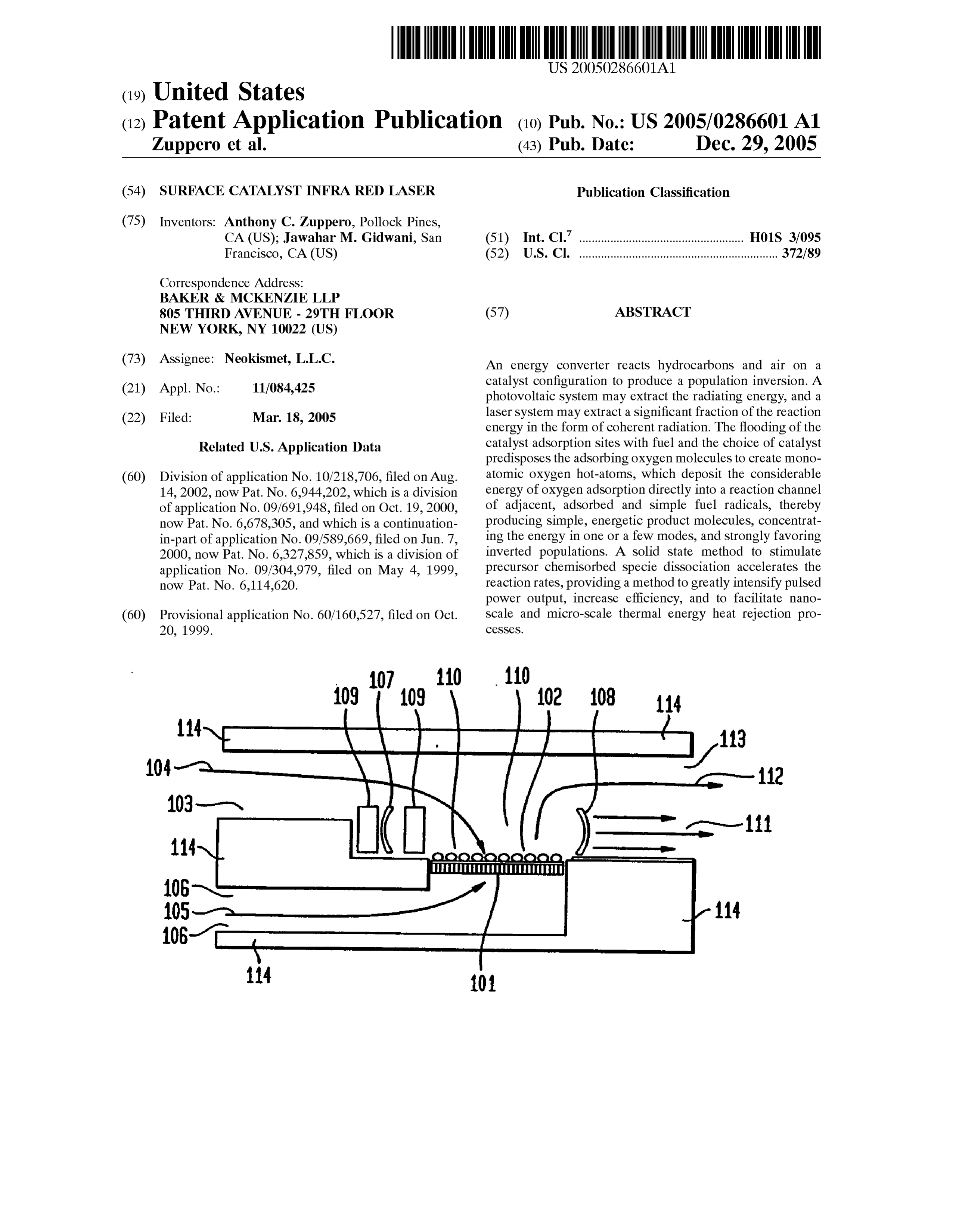
to have a charged precursor with higher activation barriers formed by laser mirror 107 and laser output mirror 108, a against dissociation, a condition which normally makes a laser control system 109, and the greater optical cavity 110, catalyst leSS active. enclose the region of catalytic Surface reactions 110 and 0056. In one embodiment, the power conversion device extract energy in the form of coherent light 111. Exhaust 112 of the present invention using hot atoms may include: leaves the system and flows through the exit channel 113. Structural materials 114 Support these elements and form the 0057 substrate(s) such as the catalyst itself, silica, alu fuel, air and exhaust channels.
mina, titania, Semiconductor, or convenient materials on 0067. In another embodiment, the present invention uses which a catalyst, Such as platinum nanoclusters, is placed; Stretched molecule associative desorbtion or excited State 0.058 a means of flooding the catalyst Surface with fuel, products desorbing from catalyst Surfaces. In this embodi Such as a porous Substrate fed with liquid fuel, ment, a power conversion device may include: 0059 a mechanism of bringing air as the oxidizer into the 0068 substrate(s) such as the catalyst itself, silica, alu chamber, Such as a channel permitting air input and reaction mina, titania, a Semiconductor or well chosen materials on product exhaust to flow over the catalyst Surface; which a similarly well chosen catalyst is placed; 0060 hydrocarbon reactant fuel, such as liquid ethanol, 0069 a mechanism for bringing fuel and air (the oxi methanol, higher alchohols, or-the product of hydrocarbon dizer), into the chamber, Such as a channel permitting reformers, Such as mixtures containing hydrogen and carbon reactant input and reaction product exhaust to flow over the monoxide; catalyst Surface;
0061 a poly-chromatic, resonant optical cavity enclosing 0070 liquid ethanol, methanol, higher alchohols, or the the catalyst Surface reaction region; and product of hydrocarbon reformers, Such as mixtures con 0062) a laser system using the optical cavity to extract taining hydrogen and carbon monoxide, as the hydrocarbon coherent radiation from the inverted population of reaction reactant fuel;
products. 0071 a poly-chromatic, resonant optical cavity enclosing 0.063. According to one embodiment, the hot atoms pro the catalyst Surface reaction region; and duce associated reactants born in their highest Vibrational 0072 a laser system using the optical cavity to extract States, obviating the need to Supply Such monatomic Specie coherent radiation from the inverted population of reaction externally. products.
0064. In some reactant-oxidizer-catalyst cases the reac 0073. According to this embodiment, combinations of tants, Such as hydroxyl radicals, desorb immediately, which reactant and catalyst, which have been chosen to favor places them in a long-lived State (approximately 200 pico production of inverted products, are caused to flow into the Seconds between collisions with other gas molecules, and reaction chamber containing the catalyst Surfaces and where lifetimes of 10 to 100 collisions) compared to lifetimes on the optically enclosing resonant cavity and its associated the catalyst metal Surface (1 to Several picoseconds). The laser System extracts a Significant fraction of the product laser System in this case Stimulates transitions to remove the reaction energy as radiation. The products are then vibrational energy. The hydroxyl will not find many other exhausted and removed from the optically enclosed System, hydroxyls with which to resonantly exchange energy, which removes ground State Species and maintains the thereby precluding rapid thermalization via resonant colli population inversion.
Sional eXchange of the molecular vibrational excitations. 0074. One way to achieve this has the optical cavity 0065. In other cases the products, typically vibrationally enclosing only a region close to the catalyst Surface, that is, excited OH or CO, may remain on the catalyst Surface, and to use a Surface laser, while permitting gas flow out of the in this case the lifetime of the vibrations would be of order Surface region. The State of the art of Surface lasers, Such as picoSeconds. In this case the catalytic Surface electric field disc lasers and Single mode photonic band gap Systems causes multiquantum transitions to become more Strongly permits Such cylinder Symmetry, air hole Systems. dipole active, and the laser System may now induce transi 0075 Also, catalysts may be chosen according to the tions on the Second, third or 4th overtone, for example of the method wherein the catalyst exhibits a "pressure gap, as it excited State OH or CO. With turnover numbers of order is referred to in the technical literature. AS is the case with 10,000 per site per Second, typical of good catalysts oper CO oxidation on Ruthenium, the Oxygen rich adsorption ating in their desired operating conditions, a 100 layer per lowers the oxygen heat of adsorption, permitting the desired centimeter (“cm”) reaction chamber would yield 100 watts oxidation and making Ru one of the most active catalysts, per cubic centimeter of inverted population. This permits whereas the characterizations performed under ultra high Stimulated emission under conditions that would otherwise be too difficult. Vacuum conditions show Ru to be one of the least catalytic. 0.066 FIG. 1 schematically shows a cross section of a 0076. In this embodiment, one may tailor the properties device to implement some of these concepts. In FIG. 1, a of the desired catalyst. It has been observed that otherwise substrate 101 on which a catalyst 102 is affixed, where a gas catalytically inactive metals, Such as gold, are caused to flow channel 103 guides air 104 over the catalyst 102. The become reactive, and relatively good catalysts, as the num catalyst substrate 101 is porous and permits the flow of fuel ber of underlying metal layerS is decreased, down to 1 and 2 monolayers, for example.
105 from the fuel side of the substrate 101, which liquid or gaseous fuel is guided to the substrate 101 by the fuel 0077. At 6 or more monolayers, the affinity of gold for channel 106. A polychromatic resonant optical cavity, dissociation of oxygen has been observed to be negligible.
Page 9
US 2005/0286601 A1 Dec. 29, 2005
As the number of monolayers decreases to 3 or 2, the affinity 0090 According to one embodiment, pulsing the diode is Sufficient to dissociate oxygen, but not to bind it too with 0.5 to 1 volt for short times, Such as fractions of a Strongly to the gold metal, making the 2 monolayer catalyst picoSecond, raises the energy of a large fraction of the efficient. At 1 monolayer the affinity of the gold substrate doubly charged molecular oxygen to the level needed to catalyst for oxygen is So Strong that the oxygen becomes dissociate.
unavailable for reaction.
0091. The hot electrons created upon such instantaneous 0078. In one method to choose catalysts of the present heating of a metal on a thermal insulating Substrate may be invention, a method of tailoring and choosing the catalyst used in a regenerative feedback mode to further Stimulate favoring a stretched molecule may include: the peroxo-like Specie. In this way, a very Small amount of 0079 creating a list of catalyst candidates from the entire initial Stimulator energy may be needed, compared to the energy output of the System.
Set of metals, 0092 FIG. 3 shows a cross section of an apparatus to 0080 choosing the catalyst metals with the interatomic implement some of these concepts. FIG. 3 shows reactions spacing of catalyst atoms Such that the reaction product exit on the catalyst Surface are Stimulated to occur in pulses, channel would form a product with a stretched bond; concentrating the Subsequent radiated energy in a Small 0.081 forming a catalyst cluster including atomic mono time. A fuel 301 and air 302 mixture enter the reaction Zone layers in a cluster of nanometers dimension on an oxide through the input channel 303 and contact the catalyst Substrate; surface 304 and physisorb, chemisorb or adsorb. The cata lyst 304 and the semiconductor substrate 305 form a Schot 0082 choosing the number of monolayers to control the tky diode. The thickness of the catalyst 304 is of order 1 to affinity for both oxygen and fuel. 5 nanometers, which is less than the mean free path of 0.083 For example, choose a gold catalyst of 2 monolay electrons in preferred catalysts Such as platinum, palladium, erS thickness placed on titania to favor carbon monoxide tungsten, rhodium, ruthenium, copper, Silver or gold. oxidation. 0093. A short electrical pulse with positive on the catalyst 0084 FIG. 2 shows a cross section of an apparatus to electrode 306 and negative on the semiconductor ohmic contact 307 causes a forward bias and a forward current in implement some of these concepts. FIG.2 shows a substrate 201 resting on a support 202 and on which a catalyst 203 is the diode formed by the catalyst-Semiconductor element. affixed, causes fuel 204 and air 205 entering from the input The electrons of this forward current have an excess energy channel 206 to react, excited State products to be formed and approximately equal to and in excess of the forward bias radiate in the reaction channel 207, and causes exhaust 208 Voltage, and these flood the catalyst Surface, initiating a chemical reaction avalanche. The hot electrons cause to leave via the exhaust channel 209. A polychromatic resonant optical cavity, formed by laser mirror 210 and laser adsorbed, chemisorbed molecular species trapped in precur Sor States to Surmount their activation barriers and adsorb as output mirror 211, a laser control System 212, and the greater optical cavity and reaction Zone 207, enclose the region of atomic Specie on the catalyst Surface. catalytic Surface reactions and extract energy in the form of 0094. The electrical trigger pulse causes the reactants to coherent light 213. react all at once and together, causing orders of magnitude 0085. In another embodiment, the present invention increase in the concentration of products, Such as excited favoring the Stimulation and timing of reaction avalanches State specie radiating in the reaction channel 308. Exhaust 309 leaves via the exhaust channel 310.
may include:
0.086 a chamber similar to the one used in the previous 0095 Alaser formed by laser mirror 311 and laser output embodiment; mirror 312, a laser control system 313, and the greater optical cavity and reaction Zone 308, enclose the region of 0.087 a semiconductor Substrate and catalyst forming a catalytic Surface reactions and extract energy in the form of Schottky diode, with catalyst thickness less than or approxi coherent light 314.
mately equal to a few times the energy mean free path of 0096. While the invention has been particularly shown electrons in the metal; and described with respect to a preferred embodiment 0088 a mechanism providing a pulsed forward bias on thereof, it will be understood by those skilled in the art that the diode. the foregoing and other changes in form and details may be 0089. In one embodiment, a short-pulse light source such made therein without departing from the Spirit and Scope of as a laser may also be used to provide the hot electrons to the invention. For example, those skilled in the art will energize the trapped adsorbate. For example, Such a light appreciate that the features of the invention may Sometimes Source will cause a chemisorbed perOXO-like doubly charged be used to advantage without a corresponding use of the oxygen molecular Specie on a platinum catalyst to accelerate other features shown or described herein above. Similarly, its transition over the approximately 0.29 eV barrier, where Some features may be combined, within the Scope and the molecular Specie preferentially moves So as to dissociate. equivalents of the present invention, to achieve a desired result.
This favors dissociation because the reverse reaction, cre ation of the Super-OXO-like, Singly charged molecular oxy 1. A method for creating hot atoms as a Source of energetic gen, has a higher activation barrier energy, and the physi free radicals on a catalyst Surface comprising: Sorbed specie has an even higher activation barrier. The laser may provide the fastest and shortest pulses. Alternatively a adsorbing a molecule on a catalyst via a precursor medi hot electron injector diode may be used. ated trapping,
Page 10
US 2005/0286601 A1 Dec. 29, 2005
flooding a Surface of the catalyst with one or more the flooding includes flooding the catalyst Surface with reactant molecules. Oxidizer radicals to cause a bias of the dissociative 2. The method of claim 1, wherein the adsorbing includes: chemisorption process toward a creation of hot atom adsorbing an oxygen molecule; and fuel free radicals, wherein a collision partner of the hot trapping the oxygen molecule on one of platinum and atom is the fuel Specie.
silver. 6. The method of claim 1, wherein the hot atom-contain 3. The method of claim 1, the method further including: ing molecule is fuel.
cooling the catalyst to induce condensation and concen 7. The method of claim 6, further including: tration on the catalyst Surface. Selecting the catalyst as one or a combination of platinum, 4. The method of claim 1, wherein the flooding includes: palladium, iridium, Rhenium, Rhodium. flooding the catalyst Surface with fuel to cause a bias of 8. The method of claim 6, further including: the dissociative chemisorption process toward the cre ation of hot atom oxygen free radicals, wherein a Selecting the reactant Specie as one or combination of collision partner of the hot atom is the fuel. methanol, ethanol, and a product of hydrocarbon 5. The method of claim 1, wherein the method further reformers.
includes: 9-50. (canceled)
Selecting a catalyst Such that the oxidizer chemisorption, dissociation, and physisorption energy is a fraction of the available chemical bond energy; and
Provenance
- Collection
- Patents citing this work
- Original assignee
- Neokismet LLC
- Pages
- 10
- Method
- pdftotext (the PDF's own text layer) + pdftoppm 300dpi page scans
- Patent office record
- patents.google.com →
- Source
- Google Patents citing-documents table
- Inventors
- Anthony Zuppero; Jawahar Gidwani; Neokismet LLC
- Published
- 2005-12-29
- Transcribed from
- patentimages.storage.googleapis.com →