patent · US5048042
Catalytic method for inhibiting deposit formation in methane Raman cells
10 September 1991
Page 1 — bibliographic record
United States Patent (19) 11) Patent Number: 5,048,042 Moser et al. (45) Date of Patent: Sep. 10, 1991 (54) CATALYTIC METHOD FOR INHIBITING 4,751,714 6/1988 Chen ....................................... 372/3 DEPOSIT FORMATION IN METHANE 4,816,289 3/1989 Komatsu et al. ................. 423/447.3 RAMAN CELLS Primary Examiner-Léon Scott, Jr.
(75) Inventors: Thomas P. Moser, Redondo Beach;
Donald R. Dewhirst, Torrance, both
Attorney, Agent, or Firm-Mary E. Lachman; W. J.
Streeter; W. K. Denson-Low of Calif. (57) ABSTRACT (73) Assignee: Hughes Aircraft Company, Los A methane Raman cell is provided with a catalytic Angeles, Calif. composite comprising palladium on a titania substrate, (21) Appl. No.: 615,118 which promotes the hydrogenation of gas products formed by the decomposition of methane from arcing, 22) Fied: Nov. 19, 1990 and thereby inhibits the reaction of these gas products (51) Int. Cl. ................................................ HO1S 3/22 to form deposits which adhere to the windows of the (52) U.S.C. ........................................... 372/59; 372/3 Raman cell. This Raman cell has greatly increased life. 58) Field of Search ...................................... 372/3, 59 In an alternative embodiment, further improvements (56) References Cited may be obtained by adding hydrogen dopant gas to the methane.
4,327,337 4/1982 Liu . 15 Claims, 1 Drawing Sheet
Page 2
Drawing sheet — no readable text.
Page 3
adding hydrogen dopant gas to the methane. An im
CATALYTIC METHOD FOR INHIBITING proved Raman cell including this catalytic composite is DEPOST FORMATION IN METHANE RAMAN also provided in accordance with the present invention. CELLS The above-discussed and many other features and attendant advantages of the present invention will be
BACKGROUND OF THE INVENTION come better understood by reference to the following 1. Field of the Invention detailed description.
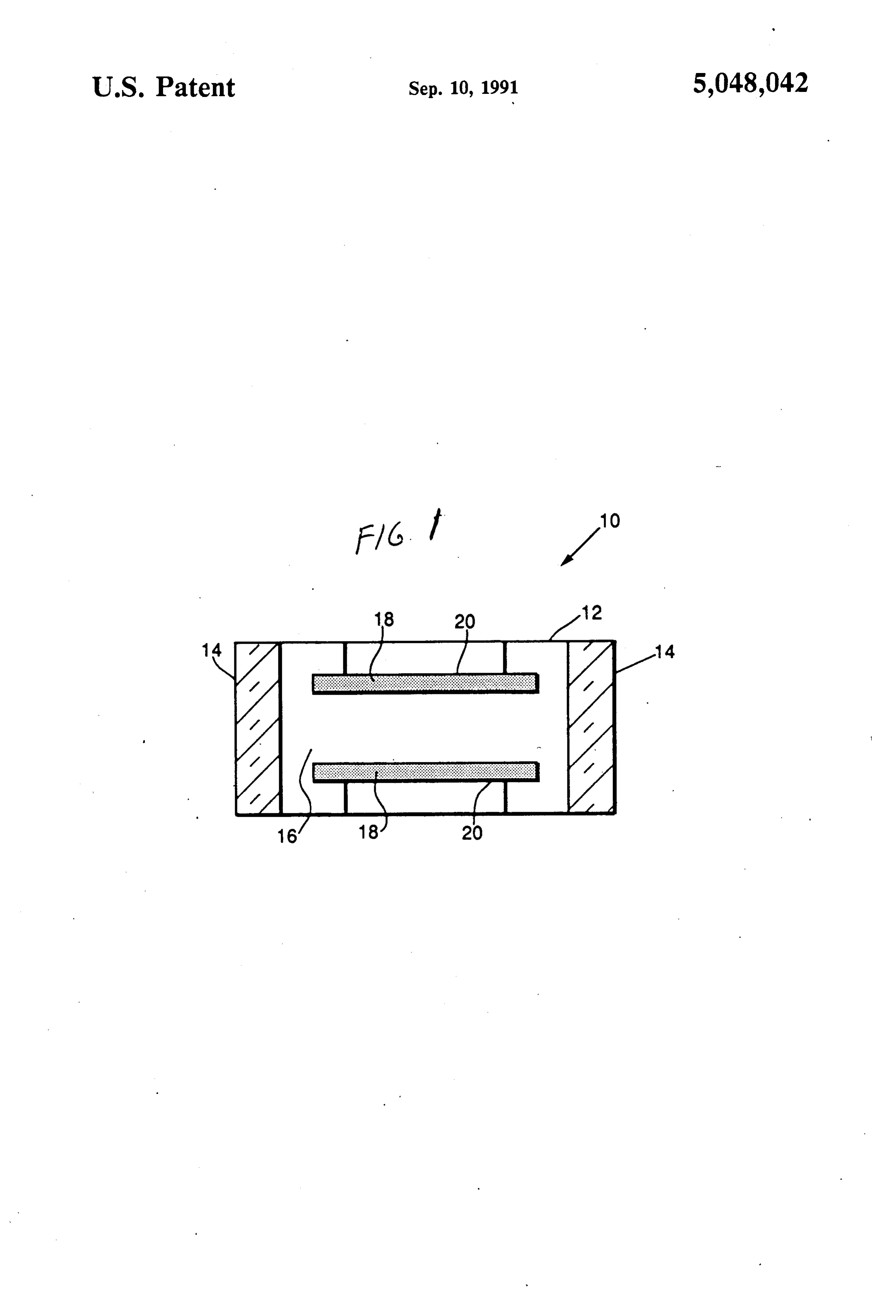
The present invention relates generally to a catalytic method for inhibiting the plasma polymerization of 10 BRIEF DESCRIPTION OF THE DRAWINGS methane. More particularly, the present invention re The figure is a schematic representation of one em lates to the use of a palladium catalyst on a titania sub bodiment of the Raman laser cell of the present inven strate in a Raman laser cell comprising methane, to tion.
inhibit the formation of deposits on the windows of the DESCRIPTION OF THE PREFERRED Raman cell. The present invention also relates to an EMBODIMENTS improved Raman laser cell incorporating such a cata 15 lytic composite. It has previously been observed that during the oper 2. Description of Related Art ation of a Raman cell laser system, arcing frequently Raman laser cells are often used in laser systems to occurs at the pump beam focus and decomposes the shift the frequency of the laser output beam from one 20 methane gas, leading to the formation of deposits on the wavelength to another. The Raman laser cell contains a cell windows. It was also believed that heating of the selected gaseous scattering medium with which the methane gas from the Raman scattering process con pump beam interacts and is thereby converted to a tributed to this process. As discussed in further detail secqnd beam of a different wavelength. The structure below, we have confirmed that arcing alone leads to and function of such Raman laser cells are well known methane decomposition. The decomposition of methane in the art and will not be detailed here. Because of its 25 in a gas plasma, particularly in an arcing condition, can high Raman scattering coefficient, methane is a useful readily produce free methyl radicals (CH3.), as indi gaseous medium for Raman cells. However, it has been cated in the following equation:
found that methane decomposes when subjected to the high intensity beam of the pump laser and leads to the CH4-CH3.--H.
formation of deposits on the cell windows which de 30 grade cell performance. These methyl radicals are extremely chemically active One approach to this problem is described in U.S. and can readily interact with each other to form ethane, Pat. No. 4,751,714 to Da-Wun Chen, where the diffi which may then decompose to free ethyl radicals that culty is attributed to the spontaneous decomposition of can react with other ethyl radicals or methyl radicals or methane into carbon and hydrogen when subjected to a 35 other free radicals to form long chain hydrocarbons. high intensity beam. The carbon formed then deposits This process is known in the art and is referred to as on the inside of the transparent windows of the Raman chain propagation. Progressively higher molecular cell and degrades transmission through these windows. weight products are formed. Free radical branching can Chen added free gaseous hydrogen to the cell in an quickly lead to the formation of unsaturated hydrocar attempt to maintain the decomposition and recombina bons which undergo plasma-induced polymerization to tion reactions for methane in equilibrium and thus pre produce organic materials which deposit on the inside vent the deposition of carbon particles on the cell win of the windows of the Raman cell. These deposits are dow. While this method may lessen the problem with formed within the laser beam footprint on the window, regard to carbon deposits, it does not prevent the build which suggests up of organic deposits on the windows, and thus does coating from the that
laser surface heating of the window beam aids in the polymerization not provide a completely satisfactory solution. process. This deposition occurs slowly over a large Thus, a present need exists to provide an effective number of shots and will gradually method for preventing the formation of deposits on the mance. It is difficult to avoid arcingdegrade cell perfor completely, partic optical windows of a Raman cell using methane gas as ularly for short path length configurations, which are the scattering medium. There is also a need for an in 50 the preferred configurations for Raman cells. Conse proved Raman cell in which deposits are not formed on quently, this problem cannot simply be avoided. the optical windows.
In accordance with the present invention, this prob
SUMMARY OF THE INVENTION lem is solved by providing a catalytic composite com The general purpose of this invention is to provide a 55 prising palladium on a titania substrate within the method for inhibiting the formation of deposits on the Raman cell in contact with the methane gas. When windows of a methane Raman cell. This method pos methyl radicals and hydrogen species are formed as sesses all of the advantages of the prior methods dis indicated in the equation above, this catalytic composite cussed above while overcoming their above-noted sig promotes the recombination of the methyl radicals and nificant disadvantages. 60 hydrogen species to form methane. Thus, the chain The above general purpose of the present invention is propagation sequence described above is terminated. In accomplished by providing a catalytic composite com addition, the catalyst promotes hydrogenation of any prising palladium on a titania substrate, which promotes olefinic species which have been formed, to thus pre the hydrogenation of radicals formed from methane by vent further chain branching reactions which lead to arcing and thereby inhibits the reaction of these radicals 65 high molecular weight deposits. Thus, the present cata to form deposits which adhere to the windows of the lytic composite promotes the hydrogenation of the Raman cell. In an alternative embodiment of the present various gas products formed by the decomposition of invention, further improvements may be obtained by methane when it is exposed to arcing conditions.
Page 4
A preferred catalytic composite in accordance with tion, the dust is controlled by wrapping the composite the present invention is formed by impregnating titania of the present invention in a sheet of material which can (TiO2) pellets with palladium (Pd). The pellets are filter the dust particles and which is unreactive with the chosen to have a wide pore diameter which allows for catalyst, such as Nomex (a registered trademark of rapid diffusion of the catalyst into the pellets. Pellets Donaldson Company, Inc. for a nylon product). The having a diameter of about 1/16 to inch (0.16 to 0.64 wrapped composite is then inserted into cylinders of cm) are suitable for the present catalytic composite. perforated sheet metal. Two such cylinders in parallel Suitable TiO2 pellets are available from Harshaw/Fil arrangement were used.
trol of Cleveland, Ohio or Norton Company of Akron, In accordance with another alternative embodiment Ohio. The titania substrate in accordance with the pres 10 of the present invention, further improvement in inhibit ent invention may be in a form other than pellets, such ing the formation of deposits on the cell window may be as a monolith, reticulated monolith, or plates. However achieved by doping the methane fill gas with a small the pellet form is preferred. amount of hydrogen, in the amount of about 0.5 to 3 The TiO2 pellets are impregnated, preferably by the volume percent. This added hydrogen provides a plen incipient wetness technique, with a solution comprising 15 tiful supply of hydrogen to further promote the reaction a chemical complex of palladium and a suitable solvent, of the methyl radicals with hydrogen as described such as water. The impregnated pellets are dried, above. In the tests described herein, the cell was flushed heated at about 200 C. in helium, and then calcined in with hydrogen at 1 atmosphere (760mm) pressure be flowing oxygen at about 400 C. It has been found that fore being pressurized with methane, which yielded chloride-free noble metal salts, such as tetraammine-pal 20 about 1.5 volume percent of hydrogen at the cell pres ladium (II) nitrate, Pd(NH3)4(NO3)2, produce cata sure used.
lytic composites having catalytic performance superior To determine the effectiveness of the method of the to composites formed from chloride containing noble present invention, tests were performed with and with metal complexes. Using chloride free metal salts and the out the catalytic composite of the present invention. incipient wetness technique in accordance with the 25 First, tests were performed without the catalytic com present invention, uniform distribution of the palladium posite in order to understand the polymer deposition throughout the titania substrate is produced. The palla problem itself. To accomplish these tests in a timely dium preferably comprises about 0.1 to 5 percent by manner, an accelerated test method was implemented. weight of the composite. The term "impregnation' is Since the gas decomposition is believed to result from used herein in its accepted meaning of forcing a liquid 30 arcing at the pump beam focus, tests were run in a small substance into the spaces of a porous solid. This impreg volume Raman cell with intentionally induced arcing. nation maximizes the utilization of the substrate surface A short focal length lens (F/16) at the cell input created area in and throughout the entire pellet. the arcing. The arcing could be observed through side While the previous discussion has been focused on port windows which transversed the cell. After each the impregnation of the metal salt into the substrate, it is 35 test, a gas sample was drawn from the cell and analyzed not intended to so limit the present invention. Rather, by gas chromatography. The gas chromatograph ulti the improved catalytic activity of the present method is lized a flame ionization detector (FID) and was cali achieved by using a palladium catalyst on a titania Sub brated for the six lowest saturated hydrocarbons (meth strate where intimate contact between the catalyst and ane through hexane) although no hydrocarbons with substrate is achieved by other means besides impregna greater than four carbons were observed in the tests. tion. The gas chromatograph was also calibrated for ethyl The above-described palladium on titania catalytic ene. The use of the small volume cell helped to concen composite is placed within the Raman cell in contact trate the contaminant gases once they were formed. As with the methane gas. As is known in the art, a Raman few as 5,000 shots produced a measurable result. This cell comprises a hollow housing structure which has 45 enabled many tests to be run in a short period of time. openings at opposite ends, to which are joined the opti It was confirmed that arcing is a necessary condition cal windows which are transparent to the wavelengths for methane gas decomposition. Previously it was of radiation produced by the pump laser and by the thought that energy imparted to the gas from the Raman cell. The gaseous methane scattering medium is Raman scattering process might contribute in some way contained within the sealed housing structure. In accor 50 to methane decomposition, but no contaminant gases dance with the present invention, there is also provided were observed in tests without arcing. Therefore, heat an improved Raman cell 10 comprising: a hollow hous ing of the methane gas from the Raman scattering pro ing structure 12 with openings at opposite ends, to cess by itself does not lead to methane decomposition or which are joined optical windows 14 that are transpar the resultant polymer deposition.
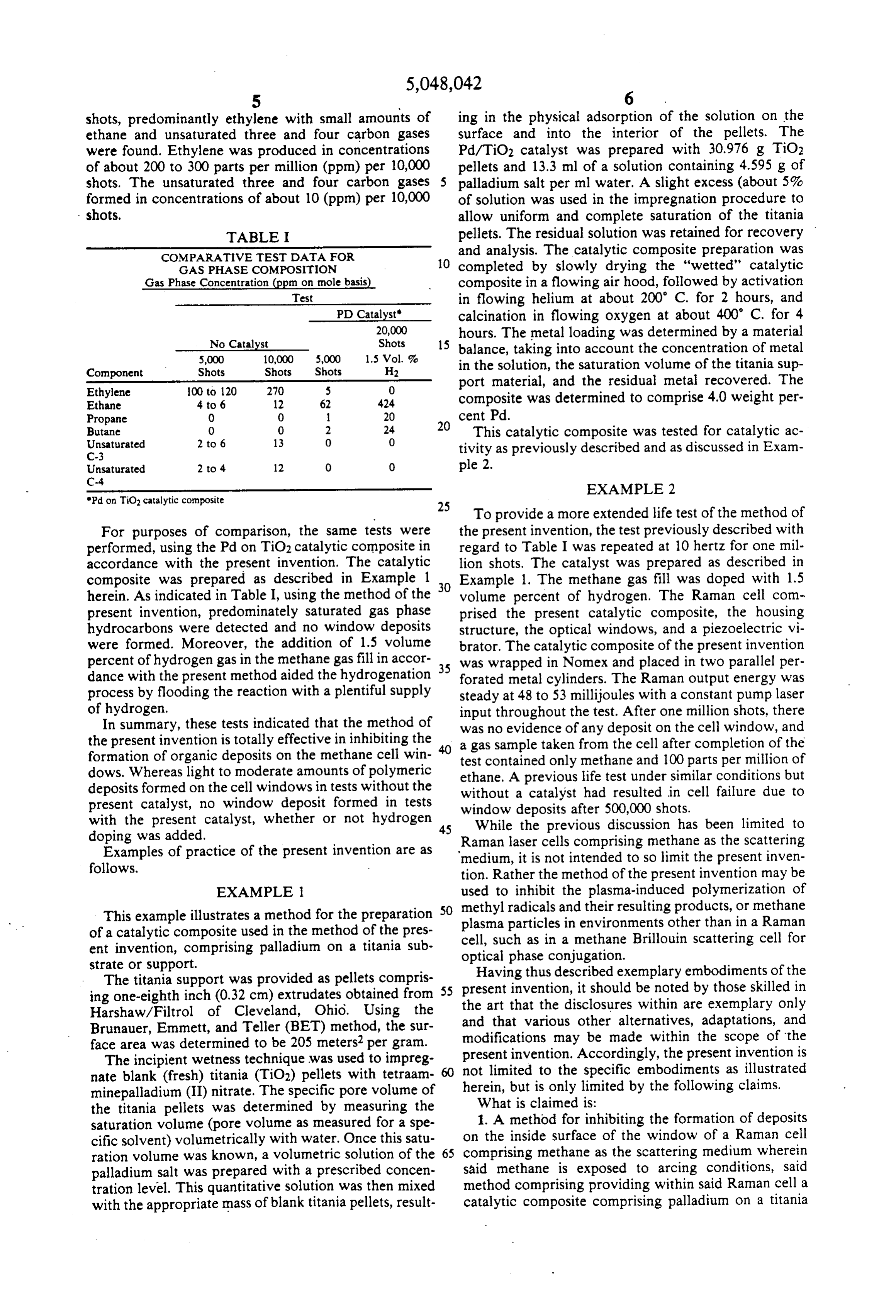
ent to the previously noted wavelengths of radiation; a 55 In order to characterize the extent of methane de gaseous methane scattering medium 16 contained composition, the resultant contaminant gases were iden within the housing structure 12; and the above de tified and their concentrations were measured. The test scribed palladium on titania catalytic composite 18, results with induced arcing are summarized in Table I. contained within holder 20 which is within and at Tests completed without the catalyst of the present tached to housing structure 12. Optionally, a piezoelec invention produced a considerable amount of ethylene, tric vibrator, (not shown) may be incorporated within together with trace amounts of other olefins. In general, the housing structure to aid in mixing the cell gas and a relatively high concentration of ethylene was coinci thus assist in the bulk mass transfer of excited or olefinic dent with organic deposition on the Raman cell win species to the surface of the catalyst for hydrogenation. dows. The unidentified three and four carbon molecules It was found that the catalytic composite of the pres 65 listed in Table I had retention times near, but not ex ent invention produced suspended catalyst "dust" parti actly matching, that of propane and butane, respec cles which intensified the arcing effect. In accordance tively. These were assumed to be unsaturated three and with an alternative embodiment of the present inven four carbon molecules. After tests of 5,000 and 10,000
Page 5
shots, predominantly ethylene with small amounts of ing in the physical adsorption of the solution on the ethane and unsaturated three and four carbon gases surface and into the interior of the pellets. The were found. Ethylene was produced in concentrations Pd/TiO2 catalyst was prepared with 30.976 g TiO2 of about 200 to 300 parts per million (ppm) per 10,000 pellets and 13.3 ml of a solution containing 4.595 g of shots. The unsaturated three and four carbon gases palladium salt per ml water. A slight excess (about 5% formed in concentrations of about 10 (ppm) per 10,000 of solution was used in the impregnation procedure to shots. allow uniform and complete saturation of the titania TABLE I pellets. The residual solution was retained for recovery COMPARATIVE TEST DATA FOR and analysis. The catalytic composite preparation was GAS PHASE COMPOSITION O completed by slowly drying the "wetted' catalytic Gas Phase Concentration (ppm on mole basis) composite in a flowing air hood, followed by activation Test in flowing helium at about 200 C. for 2 hours, and
PD Catalyst" calcination in flowing oxygen at about 400° C. for 4
No Catalyst
Shots hours. The metal loading was determined by a material 15 balance, taking into account the concentration of metal
Component Shots Shots Shots H2 in the solution, the saturation volume of the titania sup Ethylene 100 to 120 270 5 O port material, and the residual metal recovered. The
Ethane 4 to 6 12 62 424 composite was determined to comprise 4.0 weight per Propane 0 O 20 cent Pod.
Butane O O 2 24 20 This catalytic composite was tested for catalytic ac Unsaturated 2 to 6 13 O O tivity as previously described and as discussed in Exam
Unsaturated 2 to 4 12 O 0 ple 2.
EXAMPLE 2
"Pd on TiO2 catalytic composite 25
To provide a more extended life test of the method of
For purposes of comparison, the same tests were the present invention, the test previously described with performed, using the Pd on TiO2 catalytic composite in regard to Table I was repeated at 10 hertz for one mil accordance with the present invention. The catalytic lion shots. The catalyst was prepared as described in composite was prepared as described in Example 1 30 Example 1. The methane gas fill was doped with 1.5 herein. As indicated in Table I, using the method of the volume percent of hydrogen. The Raman cell com present invention, predominately saturated gas phase prised the present catalytic composite, the housing hydrocarbons were detected and no window deposits structure, the optical windows, and a piezoelectric vi were formed. Moreover, the addition of 1.5 volume brator. The catalytic composite of the present invention percent of hydrogen gas in the methane gas fill in accor 35 was wrapped in Nomex and placed in two parallel per dance with the present method aided the hydrogenation forated metal cylinders. The Raman output energy was process by flooding the reaction with a plentiful supply steady at 48 to 53 millijoules with a constant pump laser of hydrogen. input throughout the test. After one million shots, there In summary, these tests indicated that the method of was no evidence of any deposit on the cell window, and the present invention is totally effective in inhibiting the 40 a gas sample taken from the cell after completion of the formation of organic deposits on the methane cell win test contained only methane and 100 parts per million of dows. Whereas light to moderate amounts of polymeric ethane. A previous life test under similar conditions but deposits formed on the cell windows in tests without the without a catalyst had resulted in cell failure due to present catalyst, no window deposit formed in tests window deposits after 500,000 shots.
with the present catalyst, whether or not hydrogen 45 While the previous discussion has been limited to doping was added. Raman laser cells comprising methane as the scattering Examples of practice of the present invention are as medium, it is not intended to so limit the present inven follows. tion. Rather the method of the present invention may be EXAMPLE used to inhibit the plasma-induced polymerization of
This example illustrates a method for the preparation methyl
SO radicals and their resulting products, or methane of a catalytic composite used in the method of the pres cell, such as in ainmethane plasma particles environments other than in a Raman ent invention, comprising palladium on a titania sub optical phase conjugation. Brillouin scattering cell for strate or support. Having thus described exemplary embodiments of the The titania support was provided as pellets compris ing one-eighth inch (0.32 cm) extrudates obtained from 55 present the art invention, it should be noted by those skilled in that the disclosures within are exemplary only
Harshaw/Filtrol of Cleveland, Ohio. Using the and that various
Brunauer, Emmett, and Teller (BET) method, the sur modifications mayother be alternatives, adaptations, and made within the scope of the face area was determined to be 205 meters per gram.
The incipient wetness technique was used to impreg present invention. Accordingly, the present invention is nate blank (fresh) titania (TiO2) pellets with tetraam 60 not limited to the specific embodiments as illustrated minepalladium (II) nitrate. The specific pore volume of herein, What but is only limited by the following claims.
is claimed is:
the titania pellets was determined by measuring the saturation volume (pore volume as measured for a spe on1.the A method for inhibiting the formation of deposits inside surface of the window of a Raman cell cific solvent) volumetrically with water. Once this satu ration volume was known, a volumetric solution of the 65 comprising methane as the scattering medium wherein palladium salt was prepared with a prescribed concen said methane is exposed to arcing conditions, said tration level. This quantitative solution was then mixed method comprising providing within said Raman cell a with the appropriate mass of blank titania pellets, result catalytic composite comprising palladium on a titania
Page 6
substrate whereby said catalytic composite promotes 10. The method as set forth in claim 9 wherein said the hydrogenation of radicals formed during said arcing palladium comprises about 0.1 to 5 percent by weight of and thereby inhibits the reaction of said radicals to form said catalytic composite.
said deposits. 11. A Raman laser cell comprising: 2. The method as set forth in claim 1 wherein said 5 (a) a hollow housing structure, having openings at palladium comprises about 0.1 to 5 percent by weight of opposite ends thereof;
said catalytic composite. (b) two optical windows, each disposed at one said 3. The method as set forth in claim 1 wherein said opposite end of said housing structure and being titania comprises about 90 percent anatase phase and transparent to radiation of a chosen wavelength; about 10 percent rutile phase. O (c) a gaseous scattering medium comprising methane 4. The method as set forth in claim 1 wherein said contained in said housing structure; and substrate comprises pellets. (d) a catalytic composite comprising palladium on a 5. The method as set forth in claim 4 wherein said titania substrate disposed within said housing struc pellets have a diameter within the range of about 1/16 tle.
to inch (0.16 to 0.64 cm). 15 12. The Raman laser cell as set forth in claim 11 fur 6. The method as set forth in claim 1 wherein said ther comprising a perforated cylinder for containing catalyst is impregnated in said substrate. said catalytic composite and controlling suspended par 7. The method as set forth in claim 1 further compris ticles produced therefrom.
ing mixing said methane with hydrogen gas in the 13. The Raman laser cell as set forth in claim 11 amount of about 0.5 to 3.0 percent by volume. 20 wherein said methane is mixed with hydrogen gas in the 8. The method as set forth in claim 7 wherein said amount of about 0.5 to 3.0 percent by volume. hydrogen gas is present in the amount of about 1.5 per 14. The Raman laser cell as set forth in claim 11 cent by volume. wherein said palladium comprises about 0.1 to 5 percent 9. A method for inhibiting the polymerization of gas by weight of said catalytic composite. products formed by a methane plasma comprising ex 25 15. The Raman laser cell as set forth in claim 11 fur posing said gas products to a catalytic composite com ther comprising mixing means located within said hous prising palladium on a titania substrate whereby said ing structure for mixing said gaseous medium to provide catalytic composite promotes the hydrogenation of said improved contact with said catalytic composite. gas products to thereby inhibit said polymerization. k s
Provenance
- Collection
- Cited prior art
- Original PDF
- patentimages.storage.googleapis.com →
- Filed
- 1990-11-19
- Pages
- 6
- Method
- pdftotext (the PDF's own text layer) + pdftoppm 300dpi page scans
- Source
- Google Patents bibliographic record
- Granted
- 1991-09-10
- Inventors
- Thomas P. Moser; Donald R. Dewhirst; Hughes Aircraft Co
- Transcribed from
- patentimages.storage.googleapis.com →