patent · US3451949
Catalyst for reforming hydrocarbons
24 June 1969
Page 1 — bibliographic record
United States Patent Office Patented June3,451,949
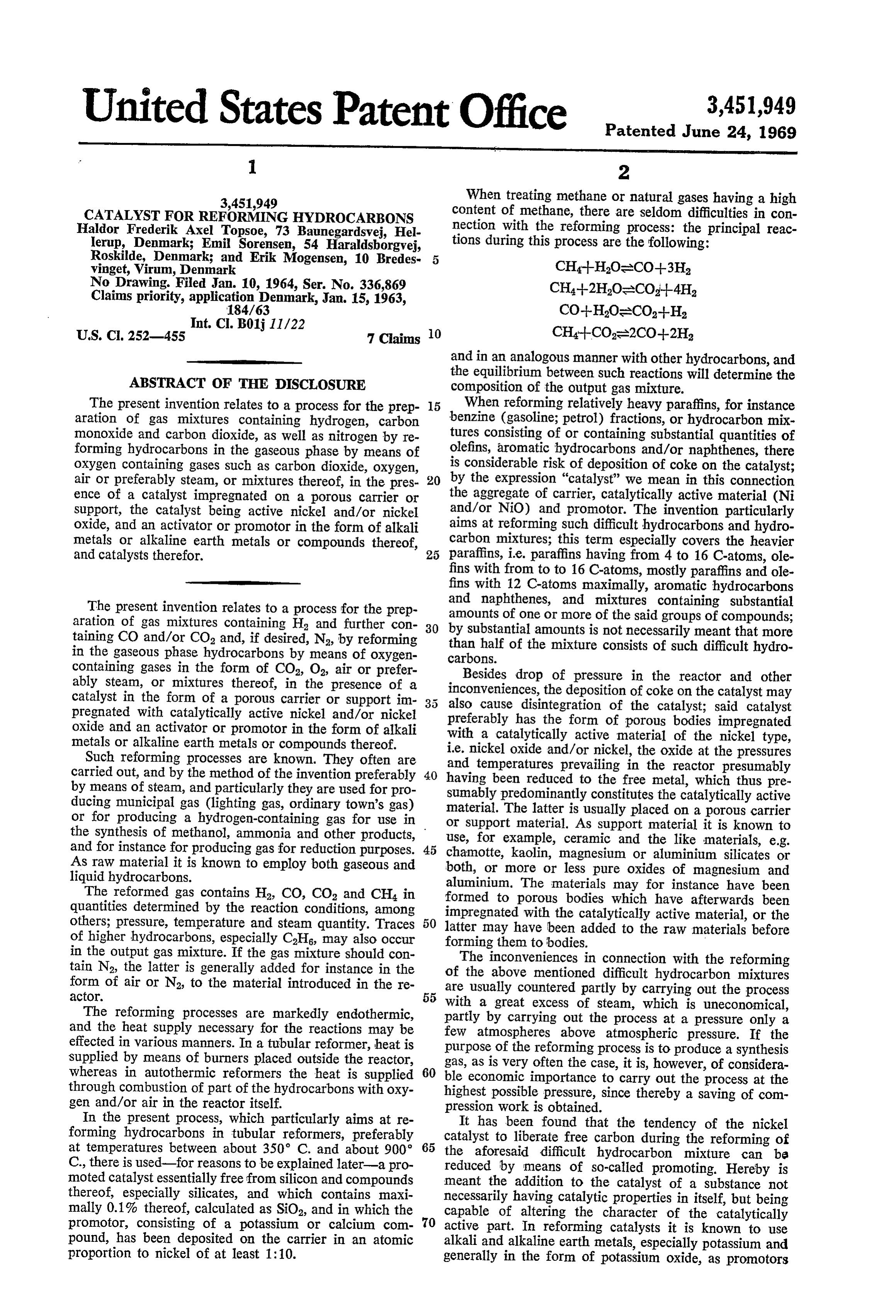
3,451,949 When treating methane or natural gases having a high CATALYST FOR REFORMING HYDROCARBONS content of methane, there are seldom difficulties in con Haldor Frederik Axel Topsoe, 73 Baunegardsvej, Hel nection with the reforming process: the principal reac erup, Denmark; Emil Sorensen, 54 Haraldsborgvei, tions during this process are the following: Roskilde, Denmark; and Erik Mogensen, 10 Bredes vinget, Virum, Denmark CH-HOeCO--3H
No Drawing. Filed Jan. 10, 1964, Ser. No. 336,869 CHA-2H2OsaCO-4H. Claims priority, application Denmark, Jan. 15, 1963, 184/63 CO-H2OseCO--H
U.S. C. 252 455 7 Claims 10 CH-CO2e2CO-2H and in an analogous manner with other hydrocarbons, and
ABSTRACT OF THE DISCLOSURE
the equilibrium between such reactions will determine the composition of the output gas mixture.
The present invention relates to a process for the prep 15 When reforming relatively heavy paraffins, for instance aration of gas mixtures containing hydrogen, carbon benzine (gasoline; petrol) fractions, or hydrocarbon mix monoxide and carbon dioxide, as well as nitrogen by re tures consisting of or containing substantial quantities of forming hydrocarbons in the gaseous phase by means of olefins, aromatic hydrocarbons and/or naphthenes, there oxygen containing gases such as carbon dioxide, oxygen, is considerable risk of deposition of coke on the catalyst; air or preferably steam, or mixtures thereof, in the pres 20 by the expression "catalyst' we mean in this connection ence of a catalyst impregnated on a porous carrier or the aggregate of carrier, catalytically active material (Ni support, the catalyst being active nickel and/or nickel and/or NiO) and promotor. The invention particularly oxide, and an activator or promotor in the form of alkali aims at reforming such difficult hydrocarbons and hydro metals or alkaline earth metals or compounds thereof, carbon mixtures; this term especially covers the heavier and catalysts therefor. 25 paraffins, i.e. paraffins having from 4 to 16 C-atoms, ole fins with from to to 16 C-atoms, mostly paraffins and ole fins with 12 C-atoms maximally, aromatic hydrocarbons
The present invention relates to a process for the prep and naphthenes, and mixtures containing substantial aration of gas mixtures containing Ha and further con 30 by amounts of one or more of the said groups of compounds; taining CO and/or CO2 and, if desired, N2, by reforming thansubstantial amounts is not necessarily meant that more half of the mixture consists of such difficult hydro in the gaseous phase hydrocarbons by means of oxygen carbons.
containing gases in the form of CO2, O2, air or prefer Besides drop of pressure in the reactor and other ably steam, or mixtures thereof, in the presence of a catalyst in the form of a porous carrier or support im inconveniences, the deposition of coke on the catalyst may also cause disintegration of the catalyst; said catalyst pregnated with catalytically active nickel and/or nickel preferably has the form of porous bodies impregnated oxide and an activator or promotor in the form of alkali with a catalytically active material of the nickel type, metals or alkaline earth metals or compounds thereof.
Such reforming processes are known. They often are i.e. nickel oxide and/or nickel, the oxide at the pressures and temperatures prevailing in the reactor presumably carried out, and by the method of the invention preferably 40 having been reduced to the free metal, which thus pre by means of steam, and particularly they are used for pro sumably predominantly constitutes the catalytically active ducing municipal gas (lighting gas, ordinary town's gas) material. The latter is usually placed on a porous carrier or for producing a hydrogen-containing gas for use in or the synthesis of methanol, ammonia and other products, use,support material. As support material it is known to for example, ceramic and the like materials, e.g.
and for instance for producing gas for reduction purposes. 45 chamotte, kaolin, magnesium or aluminium silicates or As raw material it is known to employ both gaseous and both, or more or less pure oxides of magnesium and liquid hydrocarbons. aluminium. The materials may for instance have been The reformed gas contains H2, CO, CO2 and CH4 in formed to porous bodies which have afterwards been quantities determined by the reaction conditions, among impregnated with the catalytically active material, or the others; pressure, temperature and steam quantity. Traces 50 latter may have of higher hydrocarbons, especially C2H6, may also occur forming them to been added to the raw materials before bodies.
in the output gas mixture. If the gas mixture should con tain N2, the latter is generally added for instance in the ofThe inconveniences in connection with the reforming the above mentioned difficult hydrocarbon mixtures form of air or N2 to the material introduced in the re are usually countered partly by carrying out the process actOr. 55
The reforming processes are markedly endothermic, partly with a great excess of steam, which is uneconomical, by carrying out the process at a pressure only a and the heat supply necessary for the reactions may be few atmospheres above atmospheric pressure. If the effected in various manners. In a tubular reformer, heat is purpose of the reforming process is to produce a synthesis supplied by means of burners placed outside the reactor, gas, as is very often the case, it is, however, of considera whereas in autothermic reformers the heat is supplied 60 ble economic through combustion of part of the hydrocarbons with oxy highest possibleimportance to carry out the process at the pressure, since thereby a saving of com gen and/or air in the reactor itself. pression work is obtained.
In the present process, which particularly aims at re It has been found that the tendency of the nickel forming hydrocarbons in tubular reformers, preferably catalyst to liberate free carbon during the reforming of at temperatures between about 350° C. and about 900 65 the aforesaid difficult hydrocarbon mixture can be C., there is used-for reasons to be explained later-a pro reduced by means of so-called promoting. Hereby is moted catalyst essentially free from silicon and compounds meant the addition to the catalyst of a substance not thereof, especially silicates, and which contains maxi necessarily having catalytic properties in itself, but being mally 0.1% thereof, calculated as SiO2, and in which the capable of altering the character of the catalytically promotor, consisting of a potassium or calcium com 70 active part. In reforming catalysts it is known to use pound, has been deposited on the carrier in an atomic alkali and alkaline earth metals, especially potassium and proportion to nickel of at least 1:10. generally in the form of potassium oxide, as promotors
Page 2
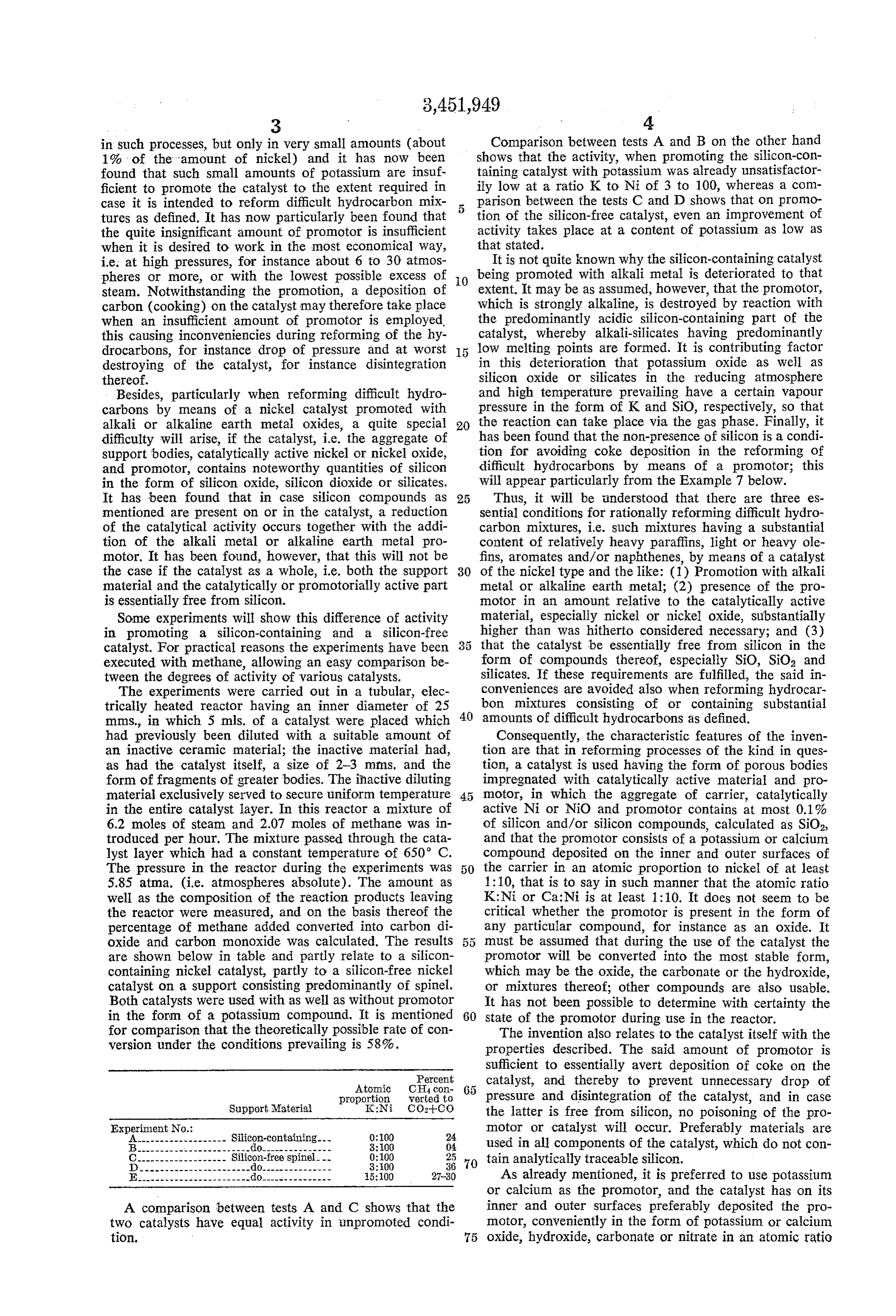
in such processes, but only in very small amounts (about Comparison between tests A and B on the other hand 1% of the amount of nickel) and it has now been shows that the activity, when promoting the silicon-con found that such small amounts of potassium are insuf taining catalyst with potassium was already unsatisfactor ficient to promote the catalyst to the extent required in ily low at a ratio K to Ni of 3 to 100, whereas a com case it is intended to reform difficult hydrocarbon mix parison between the tests C and D shows that on promo tures as defined. It has now particularly been found that tion of the silicon-free catalyst, even an improvement of the quite insignificant amount of promotor is insufficient activity takes place at a content of potassium as low as when it is desired to work in the most economical way, that stated.
i.e. at high pressures, for instance about 6 to 30 atmos It is not quite known why the silicon-containing catalyst pheres or more, or with the lowest possible excess of O being promoted with alkali metal is deteriorated to that steam. Notwithstanding the promotion, a deposition of extent. It may be as assumed, however, that the promotor, carbon (cooking) on the catalyst may therefore take place which is strongly alkaline, is destroyed by reaction with when an insufficient amount of promotor is employed. the predominantly acidic silicon-containing part of the this causing inconveniencies during reforming of the hy catalyst, whereby alkali-silicates having predominantly drocarbons, for instance drop of pressure and at worst low melting points are formed. It is contributing factor destroying of the catalyst, for instance disintegration in this deterioration that potassium oxide as well as thereof. silicon oxide or silicates in the reducing atmosphere Besides, particularly when reforming difficult hydro and high temperature prevailing have a certain vapour carbons by means of a nickel catalyst promoted with pressure in the form of K and SiO, respectively, so that alkali or alkaline earth metal oxides, a quite special 20 the reaction can take place via the gas phase. Finally, it difficulty will arise, if the catalyst, i.e. the aggregate of has been found that the non-presence of silicon is a condi support bodies, catalytically active nickel or nickel oxide, tion for avoiding coke deposition in the reforming of and promotor, contains noteworthy quantities of silicon difficult hydrocarbons by means of a promotor; this in the form of silicon oxide, silicon dioxide or silicates. will appear particularly from the Example 7 below. It has been found that in case silicon compounds as 25 Thus, it will be understood that there are three es mentioned are present on or in the catalyst, a reduction sential conditions for rationally reforming difficult hydro of the catalytical activity occurs together with the addi carbon mixtures, i.e. such mixtures having a substantial tion of the alkali metal or alkaline earth metal pro content of relatively heavy paraffins, light or heavy ole motor. It has been found, however, that this will not be fins, aromates and/or naphthenes, by means of a catalyst the case if the catalyst as a whole, i.e. both the support 30 of the nickel type and the like: (1) Promotion with alkali material and the catalytically or promotorially active part metal or alkaline earth metal; (2) presence of the pro is essentially free from silicon. motor in an amount relative to the catalytically active Some experiments will show this difference of activity material, especially nickel or nickel oxide, substantially in promoting a silicon-containing and a silicon-free higher than was hitherto considered necessary; and (3) catalyst. For practical reasons the experiments have been that the catalyst be essentially free from silicon in the executed with methane, allowing an easy comparison be form of compounds thereof, especialiy SiO, SiO, and tween the degrees of activity of various catalysts. silicates. If these requirements are fulfilled, the said in The experiments were carried out in a tubular, elec conveniences are avoided also when reforming hydrocar trically heated reactor having an inner diameter of 25 40 bon mixtures consisting of or containing substantial mms, in which 5 mls. of a catalyst were placed which amounts of difficult hydrocarbons as defined. had previously been diluted with a suitable amount of Consequently, the characteristic features of the inven an inactive ceramic material; the inactive material had, tion are that in reforming processes of the kind in ques as had the catalyst itself, a size of 2-3 mms. and the tion, a catalyst is used having the form of porous bodies form of fragments of greater bodies. The inactive diluting impregnated with catalytically active material and pro material exclusively served to secure uniform temperature motor, in which the aggregate of carrier, catalytically in the entire catalyst layer. In this reactor a mixture of active Ni or NiO and promotor contains at most 0.1% 6.2 moles of steam and 2.07 moles of methane was in of silicon and/or silicon compounds, calculated as SiO2, troduced per hour. The mixture passed through the cata and that the promotor consists of a potassium or calcium lyst layer which had a constant temperature of 650 C. compound deposited on the inner and outer surfaces of The pressure in the reactor during the experiments was the carrier in an atomic proportion to nickel of at least 5.85 atma, (i.e. atmospheres absolute). The amount as 1:10, that is to say in such manner that the atomic ratio well as the composition of the reaction products leaving K:Ni or Ca:Ni is at least 1:10. It does not seem to be the reactor were measured, and on the basis thereof the Critical whether the promotor is present in the form of percentage of methane added converted into carbon di any particular compound, for instance as an oxide. It oxide and carbon monoxide was calculated. The results must be assumed that during the use of the catalyst the are shown below in table and partly relate to a silicon promotor will be converted into the most stable form, containing nickel catalyst, partly to a silicon-free nickel which may be the oxide, the carbonate or the hydroxide, catalyst on a support consisting predominantly of spinel. or mixtures thereof; other compounds are also usable. Both catalysts were used with as well as without promotor It has not been possible to determine with certainty the in the form of a potassium compound. It is mentioned 60 State of the promotor during use in the reactor. for comparison that the theoretically possible rate of con The invention also relates to the catalyst itself with the version under the conditions prevailing is 58%. properties described. The said amount of promotor is Sufficient to essentially avert deposition of coke on the
Percent
Atomic CH4 con catalyst, and thereby to prevent unnecessary drop of proportion verted to pressure and disintegration of the catalyst, and in case
Support Materia K:Ni CO2-CO the latter is free from silicon, no poisoning of the pro Experiment No.:
motor or catalyst will occur. Preferably materials are 3:00 04 used in all components of the catalyst, which do not con 70 tain analytically traceable silicon.
5:100 27-30 As already mentioned, it is preferred to use potassium or calcium as the promotor, and the catalyst has on its
A comparison between tests A and C shows that the inner and outer surfaces preferably deposited the pro two catalysts have equal activity in unpromoted condi motor, conveniently in the form of potassium or calcium tion, 5 oxide, hydroxide, carbonate or nitrate in an atomic ratio
Page 3
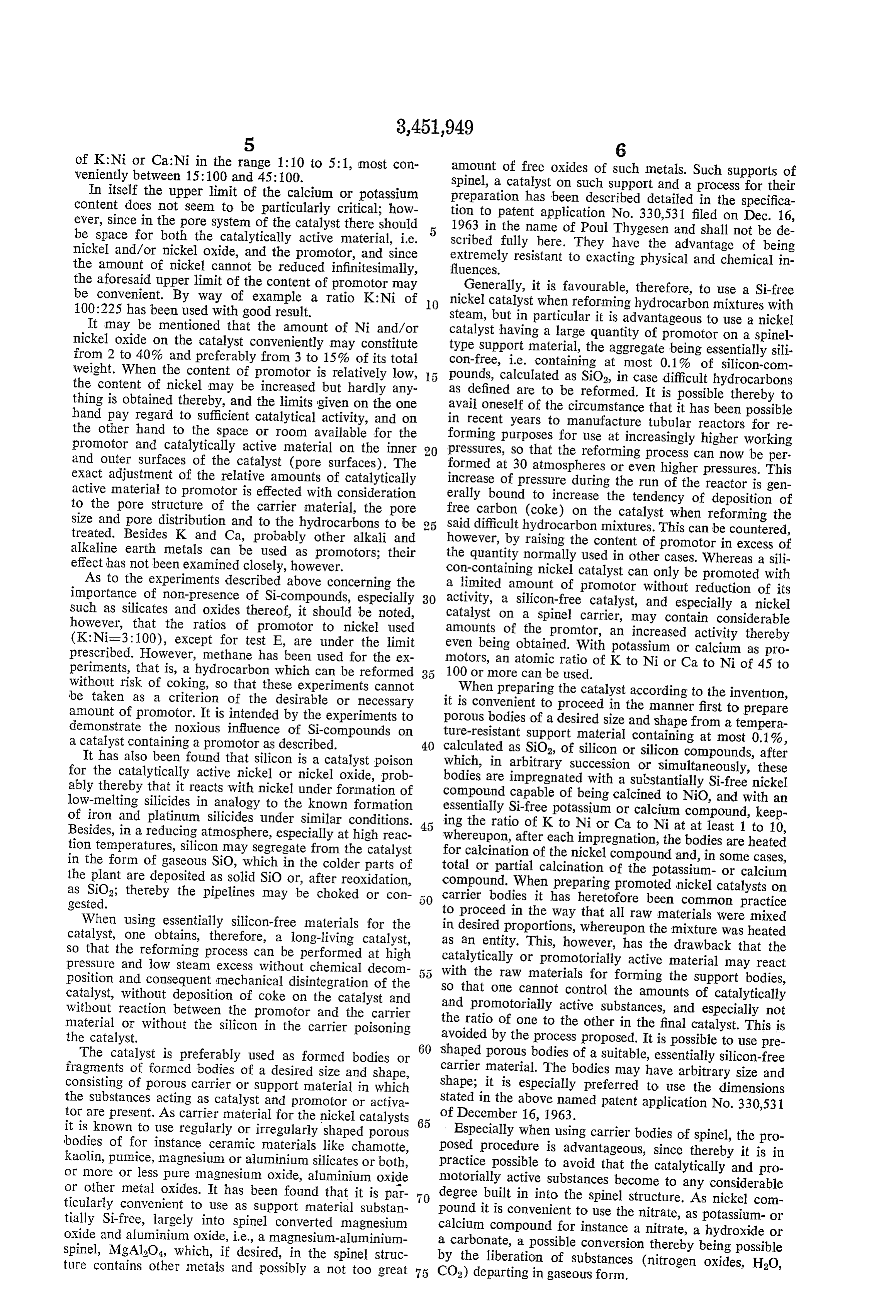
of K:Ni or Ca:Ni in the range 1:10 to 5:1, most con amount of free oxides of such metals. Such supports of veniently between 15:100 and 45:100. spinel, a catalyst on such support and a process for their In itself the upper limit of the calcium or potassium preparation has been described detailed in the specifica content does not seem to be particularly critical; how tion to patent application No. 330,531 filed on Dec. 16, ever, since in the pore system of the catalyst there should 1963 in the name of Poul Thygesen and shall not be de be space for both the catalytically active material, i.e. 5 scribed nickel and/or nickel oxide, and the promotor, and since extremelyfully here. They have the advantage of being resistant to exacting physical and chemical in the amount of nickel cannot be reduced infinitesimally, fluences.
the aforesaid upper limit of the content of promotor may Generally, it is favourable, therefore, to use a Si-free be convenient. By way of example a ratio K:Ni of 10 nickel catalyst when reforming hydrocarbon mixtures with 100:225 has been used with good result. Steam, but in particular it is advantageous to use a nickel It may be mentioned that the amount of Ni and/or catalyst having a large quantity of promotor on a spinel nickel oxide on the catalyst conveniently may constitute type Support material, the aggregate being essentially sili from 2 to 40% and preferably from 3 to 15% of its total con-free, i.e. containing at most 0.1% of silicon-com weight. When the content of promotor is relatively low, 5 pounds, calculated as SiO2, in case difficult hydrocarbons the content of nickel may be increased but hardly any as defined are to be reformed. It is possible thereby to thing is obtained thereby, and the limits given on the one avail oneself of the circumstance that it has been possible hand pay regard to sufficient catalytical activity, and on in recent years to manufacture tubular reactors for re the other hand to the space or room available for the forming promotor and catalytically active material on the inner 20 pressures,purposes so that for use at increasingly higher working the reforming process can now be per and outer surfaces of the catalyst (pore surfaces). The exact adjustment of the relative amounts of catalytically formed at 30 atmospheres or even higher pressures. This increase of pressure during the run of the reactor is gen active material to promotor is effected with consideration erally bound to increase the tendency of deposition of to the pore structure of the carrier material, the pore free carbon (coke) on the catalyst when reforming the size and pore distribution and to the hydrocarbons to be said difficult hydrocarbon mixtures. This can be countered, treated. Besides K and Ca, probably other alkali and however, by raising the content of promotor in excess of alkaline earth metals can be used as promotors; their the quantity normally used in other cases. Whereas a sili effect has not been examined closely, however. con-containing nickel catalyst can only be promoted with As to the experiments described above concerning the a limited amount of promotor without reduction of its importance of non-presence of Si-compounds, especially 30 activity, a silicon-free catalyst, and especially a nickel such as silicates and oxides thereof, it should be noted, catalyst on a spinel carrier, may contain considerable however, that the ratios of promotor to nickel used amounts of the promtor, an increased activity thereby (K:Ni=3:100), except for test E, are under the limit prescribed. However, methane has been used for the ex even being obtained. With potassium or calcium as pro motors, an atomic ratio of K to Ni or Ca to Ni of 45 to periments, that is, a hydrocarbon which can be reformed 100 or more can be used.
without risk of coking, so that these experiments cannot When preparing the catalyst according to the invention, be taken as a criterion of the desirable or necessary amount of promotor. It is intended by the experiments to itporous is convenient to proceed in the manner first to prepare bodies of a desired size and shape from a tempera demonstrate the noxious influence of Si-compounds on ture-resistant support material containing at most 0.1%, a catalyst containing a promotor as described. 40 calculated as SiO2, of silicon or silicon compounds, after It has also been found that silicon is a catalyst poison which, in arbitrary succession or simultaneously, these for the catalytically active nickel or nickel oxide, prob bodies are ably thereby that it reacts with nickel under formation of compound impregnated with a substantially Si-free nickel capable of being calcined to NiO, and with an low-melting silicides in analogy to the known formation essentially of iron and platinum silicides under similar conditions. ing the ratioSi-free of K potassium or calcium compound, keep to Ni or Ca to Ni at at least 1 to 10,
Besides, in a reducing atmosphere, especially at high reac tion temperatures, silicon may segregate from the catalyst whereupon, after each impregnation, the bodies are heated for calcination of the nickel compound and, in some cases, in the form of gaseous SiO, which in the colder parts of total or partial calcination of the potassium- or calcium the plant are deposited as solid SiO or, after reoxidation, compound. When preparing promoted nickel catalysts on as SiO2; thereby the pipelines may be choked or con carrier bodies gested. it has heretofore been common practice When using essentially silicon-free materials for the to proceed in the Way that all raw materials were mixed catalyst, one obtains, therefore, a long-living catalyst, in desired proportions, whereupon the mixture was heated So that the reforming process can be performed at high as an entity. This, however, has the drawback that the catalytically or promotorially active material may react pressure and low steam excess without chemical decom 5 5 with the raw materials for forming the support bodies, position and consequent mechanical disintegration of the catalyst, without deposition of coke on the catalyst and So that one cannot control the amounts of catalytically without reaction between the promotor and the carrier and promotorially active substances, and especially not material or without the silicon in the carrier poisoning the ratio of one to the other in the final catalyst. This is the catalyst. avoided by the process proposed. It is possible to use pre The catalyst is preferably used as formed bodies or 60 shaped porous bodies of a suitable, essentially silicon-free fragments of formed bodies of a desired size and shape, carrier material. The bodies may have arbitrary size and consisting of porous carrier or support material in which shape; it is especially preferred to use the dimensions the Substances acting as catalyst and promotor or activa Stated in the above named patent application No. 330,531 tor are present. As carrier material for the nickel catalysts of December 16, 1963.
it is known to use regularly or irregularly shaped porous Especially when using carrier bodies of spinel, the pro bodies of for instance ceramic materials like chamotte, posed procedure is advantageous, since thereby it is in kaolin, pumice, magnesium or aluminium silicates or both, practice possible to avoid that the catalytically and pro or more or less pure magnesium oxide, aluminium oxide motorially active substances become to any considerable or other metal oxides. It has been found that it is par degree built in into the spinel structure. As nickel com ticularly convenient to use as support material substan pound tially Si-free, largely into spinel converted magnesium calciumitcompound is convenient to use the nitrate, as potassium- or for instance a nitrate, a hydroxide or oxide and aluminium oxide, i.e., a magnesium-aluminium a carbonate, a possible conversion thereby being possible Spinel, MgAl2O4, which, if desired, in the spinel struc by the liberation of Substances ture contains other metals and possibly a not too great CO2) departing in gaseous form. (nitrogen oxides, HO,
Page 4
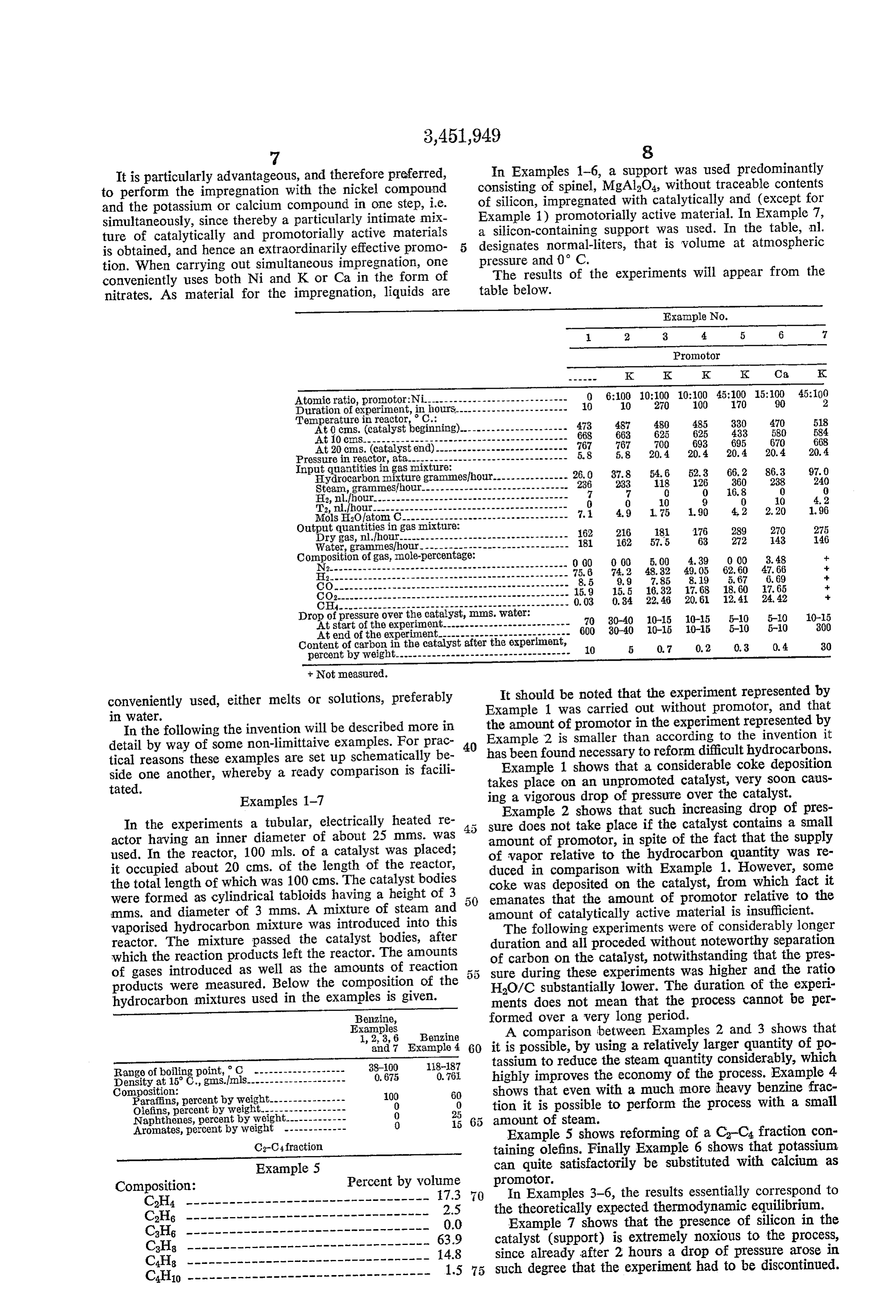
It is particularly advantageous, and therefore preferred, In Examples 1-6, a support was used predominantly to perform the impregnation with the nickel compound consisting of spinel, MgAl2O4, without traceable contents and the potassium or calcium compound in one step, i.e. of silicon, impregnated with catalytically and (except for Example 1) promotorially active material. In Example 7, simultaneously, since thereby a particularly intimate mix ture of catalytically and promotorially active materials adesignates silicon-containing support was used. In the table, nil.
is obtained, and hence an extraordinarily effective promo 5 pressure andnormal-liters,
that is volume at atmospheric tion. When carrying out simultaneous impregnation, one The results of the experiments will appear from the conveniently uses both Ni and K or Ca in the form of nitrates. As material for the impregnation, liquids are table below.
Example No.
Promotor - - -- - - K K K K Ca K
Atomigratio, promotor:Ni------------------------------ O 6:100 10:100 0:100 45:100 15:100 45:100 Duration of experiment, in hours------------------------ O 10 270 100 170 90 2 Temperature
At 0 cms. in(catalyst
C.: 473 487 480 485 330 470 518 At 10 cms.-------- 668 663 625 625 433 580 584 At 20 cms. (catalys 767 767 700 693 695 670 668 Pressure in reactor, ata.--- -- 5.8 5.8 20.4 20.4 20.4 20.4 20.4 Input quantities in gas mixture:
Hydrocarbon mixture grammes/hour---------------- 26.0 37.8 54.6 52.3 66.2 86.3 97.0 Steam, grammes/hour------------------ ---- 236 233 8 126 360 238 240 H2,nllhour.----------- ---- 7 7 0 0 6.8 O O T2,nlfhour-------- ---- 0 0 10 9 0. 10 4.2 Mols HaOlatom C------- - - - - - - - - - - - - - - - - - - - - - - - - - - - 7. 4.9 1.75 1.90 42 2.20 1.96 Output quantities in gas mixture:
Drygas, inlfhour---------- 62 216 181 176 289 270 275 Water, grammes hour----- - --- 18 62 57.5 63 272 43 46 Composition
N of gas, mole-percentage: 0 00 5.00 4.39 000 3.48
DropAtofstart pressure of theover the catalyst, mms. water:
experiment--------------------------- 70 30-40 10-15 10-15 5-10 5-10 10-15 At end of the experiment---------------------------- 600 30-40 0-15 0-15 5-0 5-10 300 Content of carbon in the catalyst after the experiment, percent by Weight------------------------------------- O 5 0.7 0.2 0.3 0.4 30 tNot measured.
conveniently used, either melts or solutions, preferably It should be noted that the experiment represented by in water. Example 1 was carried out without promotor, and that In the following the invention will be described more in the amount of promotor in the experiment represented by detail by way of some non-limittaive examples. For prac 40 has Example 2 is smaller than according to the invention it tical reasons these examples are set up schematically be been found necessary to reform difficult hydrocarbons. side one another, whereby a ready comparison is facili Example 1 shows that a considerable coke deposition tated.
takes place on an unpromoted catalyst, very soon caus
Examples 1-7 ing a vigorous drop of pressure over the catalyst.
Example 2 shows that such increasing drop of pres
In the experiments a tubular, electrically heated re sure does not take place if the catalyst contains a small actor having an inner diameter of about 25 mms. was amount of promotor, in spite of the fact that the supply used. In the reactor, 100 mls. of a catalyst was placed; of vapor relative to the hydrocarbon quantity was re it occupied about 20 cms. of the length of the reactor, duced in comparison with Example 1. However, some the total length of which was 100 cms. The catalyst bodies coke was deposited on the catalyst, from which fact it were formed as cylindrical tabloids having a height of 3 50 emanates that the amount of promotor relative to the imms. and diameter of 3 mms. A mixture of steam and amount of catalytically active material is insufficient. vaporised hydrocarbon mixture was introduced into this The following experiments were of considerably longer reactor. The mixture passed the catalyst bodies, after duration and all proceded without noteworthy separation which the reaction products left the reactor. The amounts of carbon on the catalyst, notwithstanding that the pres of gases introduced as well as the amounts of reaction sure during these experiments was higher and the ratio products were measured. Below the composition of the HO/C substantially lower. The duration of the experi hydrocarbon mixtures used in the examples is given. ments does not mean that the process cannot be per Benzine,
Examples formed over a very long period.
i, 2, 3, 6 Benzine A comparison between Examples 2 and 3 shows that and 7 Example 4 60 it is possible, by using a relatively larger quantity of po
Range of boiling point, C ------------------- 38-00 118-87 tassium to reduce the steam quantity considerably, which
Density at 15 C., gms.fmls------- 0.675 0.76 highly improves the economy of the process. Example 4 Composition:
Paraffins, percent by weight.-- - 100 60 shows that even with a much more heavy benzine frac
Olefins, percent by weight.--- - 0. 0. tion it is possible to perform the process with a small Naphthenes, percent by weight.-- - O 25 65 amount of steam.
Aromates, percent by weight ------------- O i5 Example 5 shows reforming of a C-C fraction con C-C fraction taining olefins. Finally Example 6 shows that potassium.
Example 5 can quite satisfactorily be substituted with calcium as
Composition: Percent by volume promotor.
C2H4 ---------------------------------- 17.3 In Examples 3-6, the results essentially correspond to C2H6 ---------------------------------- 2.5 the theoretically expected thermodynamic equilibrium. Cahs ---------------------------------- 0.0 Example 7 shows that the presence of silicon in the C3H8 ---------------------------------- 63.9 catalyst (support) is extremely noxious to the process, C4H8 ---------------------------------- 14.8 75 Such since already after 2 hours a drop of pressure arose in C4H10 ---------------------------------- 1.5 degree that the experiment had to be discontinued.
Page 5
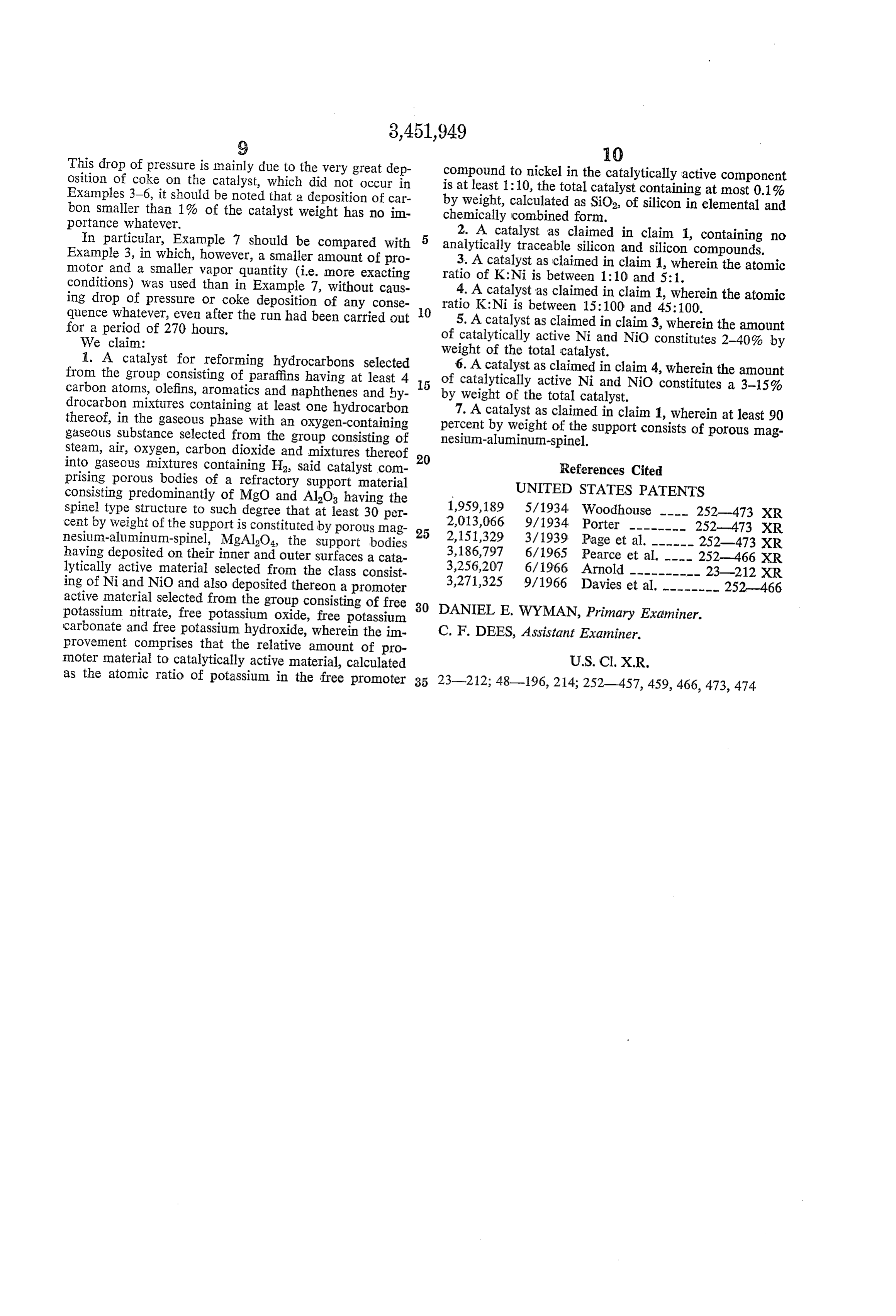
This drop of pressure is mainly due to the very great dep O osition of coke on the catalyst, which did not occur in compound to nickel in the catalytically active component Examples 3-6, it should be noted that a deposition of car is at least 1:10, the total catalyst containing at most 0.1% bon smaller than 1% of the catalyst weight has no im by weight, calculated as SiO2, of silicon in elemental and chemically combined form.
portance whatever. 2. A catalyst as claimed in claim i, containing no in particular, Example 7 should be compared with analytically traceable silicon and silicon compounds. Example 3, in which, however, a smaller amount of pro 3. A catalyst as claimed in claim 1, wherein the atomic motor and a smaller vapor quantity (i.e. more exacting ratio of K:Ni is between 1:10 and 5:1. conditions) was used than in Example 7, without caus 4. A catalyst as claimed in claim 1, wherein the atomic ing drop of pressure or coke deposition of any conse ratio K:Ni is between 15:100 and 45:100. quence whatever, even after the run had been carried out O for a period of 270 hours. 5. A catalyst as claimed in claim 3, wherein the amount We claim: of catalytically active Ni and NiO constitutes 2-40% by 1. A catalyst for reforming hydrocarbons selected weight of the total catalyst.
from the group consisting of paraffins having at least 4 5 of catalytically asactive 6. A catalyst claimed in claim 4, wherein the amount
Ni and NiO constitutes a 3-15% carbon atoms, olefins, aromatics and naphthenes and hy by weight of the total catalyst. drocarbon mixtures containing at least one hydrocarbon 7. A catalyst as claimed in claim 1, wherein at least 90 thereof, in the gaseous phase with an oxygen-containing percent by weight of the support consists of porous mag gaseous substance selected from the group consisting of nesium-aluminum-spinel.
steam, air, oxygen, carbon dioxide and mixtures thereof 20 into gaseous mixtures containing H2, said catalyst com References Cited prising porous bodies of a refractory support material UNITED STATES PATENTS consisting predominantly of MgO and Al2O3 having the spinel type structure to such degree that at least 30 per 1,959,189 5/1934 Woodhouse - 252-473 XR cent by weight of the Support is constituted by porous mag 2,013,066 9/1934 Porter ------- 252-473 XR nesium-aluminum-spinel, MgAl2O4, the support bodies 25 2,151,329 3/1939 Page et al. ------ 252-473 XR having deposited on their inner and outer surfaces a cata 3,186,797 6/1965 Pearce et al. 252-466 XR lytically active material selected from the class consist 3,256,207 6/1966 Arnold ---------- 23-212 XR ing of Ni and NiO and also deposited thereon a promoter 3,271,325 9/1966 Davies et al. -------- 252-466 active material selected from the group consisting of free 30 potassium nitrate, free potassium oxide, free potassium DANIEL E. WYMAN, Primary Examiner. carbonate and free potassium hydroxide, wherein the im C. F. DEES, Assistant Examiner.
provement comprises that the relative amount of pro moter material to catalytically active material, calculated U.S. C, X.R. as the atomic ratio of potassium in the free promoter 35 23-212; 48-196, 214; 252-457, 459, 466, 473,474
Provenance
- Collection
- Cited prior art
- Original PDF
- patentimages.storage.googleapis.com →
- Filed
- 1964-01-10
- Pages
- 5
- Method
- pdftotext (the PDF's own text layer) + pdftoppm 300dpi page scans
- Source
- Google Patents bibliographic record
- Granted
- 1969-06-24
- Inventors
- Haldor Frederik Axel Topsoe; Emil Sorensen; Erik Mogensen
- Transcribed from
- patentimages.storage.googleapis.com →