patent · US4628010
Fuel cell with storable gas generator
9 December 1986
Page 1 — bibliographic record
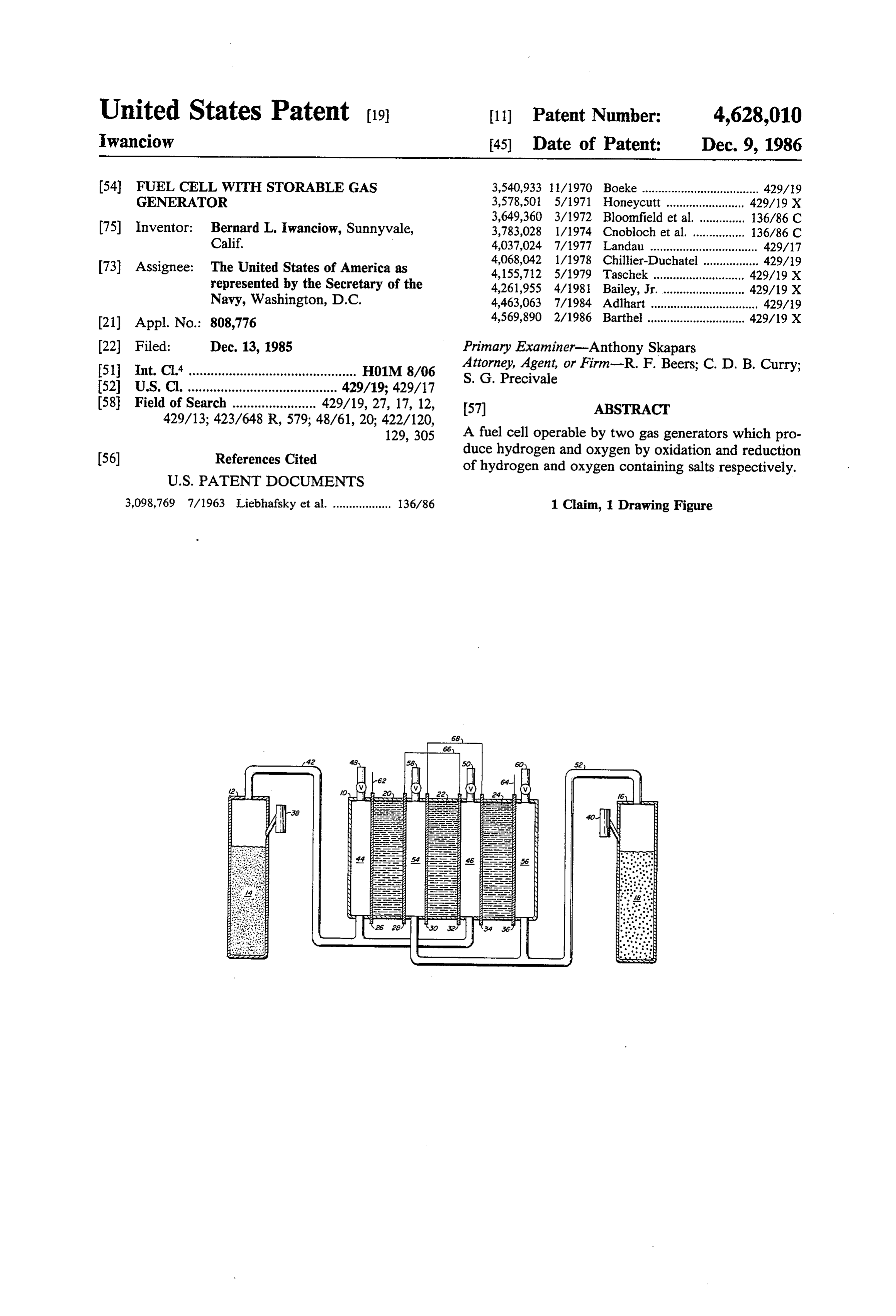
United States Patent (19) 11 Patent Number: 4,628,010 Iwanciow 45) Date of Patent: Dec. 9, 1986 54 FUEL CELL WITH STORABLE GAS 3,540,933 1 1/1970 Boeke .................................... 429/19 GENERATOR 3,578,501 5/1971 Honeycutt ........................ 429/19 X
75) Inventor: Bernard L. Iwanciow, Sunnyvale, 3,783,028 1/1974 Cnobloch et al. ................ 136/86 C Calif. 4,037,024 7/1977 Landau ................................. 429/17 73) Assignee: The United States of America as 4,068,042 1/1978 Chillier-Duchatel ................. 429/19 4,155,712 5/1979 Taschek ............................ 429/19 X represented by the Secretary of the 4,261,955 4/1981 Bailey, Jr. ......................... 429/19 X Navy, Washington, D.C. 4,463,063 7/1984 Adlhart ................................. 429/19 (21) Appl. No.: 808,776 4,569,890 2/1986 Barthel .............................. 429/19 X 22 Filed: Dec. 13, 1985 Primary Examiner-Anthony Skapars 51) Int. Cl. .............................................. H01M. 8/06 Attorney, Agent, or Firm-R. F. Beers; C. D. B. Curry; S. G. Precivale 52 U.S.C. ......................................... 429/19; 429/17 58) Field of Search ....................... 429/19, 27, 17, 12, (57) ABSTRACT
129, 305 A fuel cell operable by two gas generators which pro 56 References Cited duce hydrogen and oxygen by oxidation and reduction of hydrogen and oxygen containing salts respectively.
3,098,769 7/1963 Liebhafsky et al. .................. 136/86 1 Claim, 1 Drawing Figure
Page 2
Drawing sheet — no readable text.
Page 3
potential of 35 volts, and therefore is especially suited
FUEL CELL WITH STORABLE GAS GENERATOR for use as a primary electric power source for missile power systems.
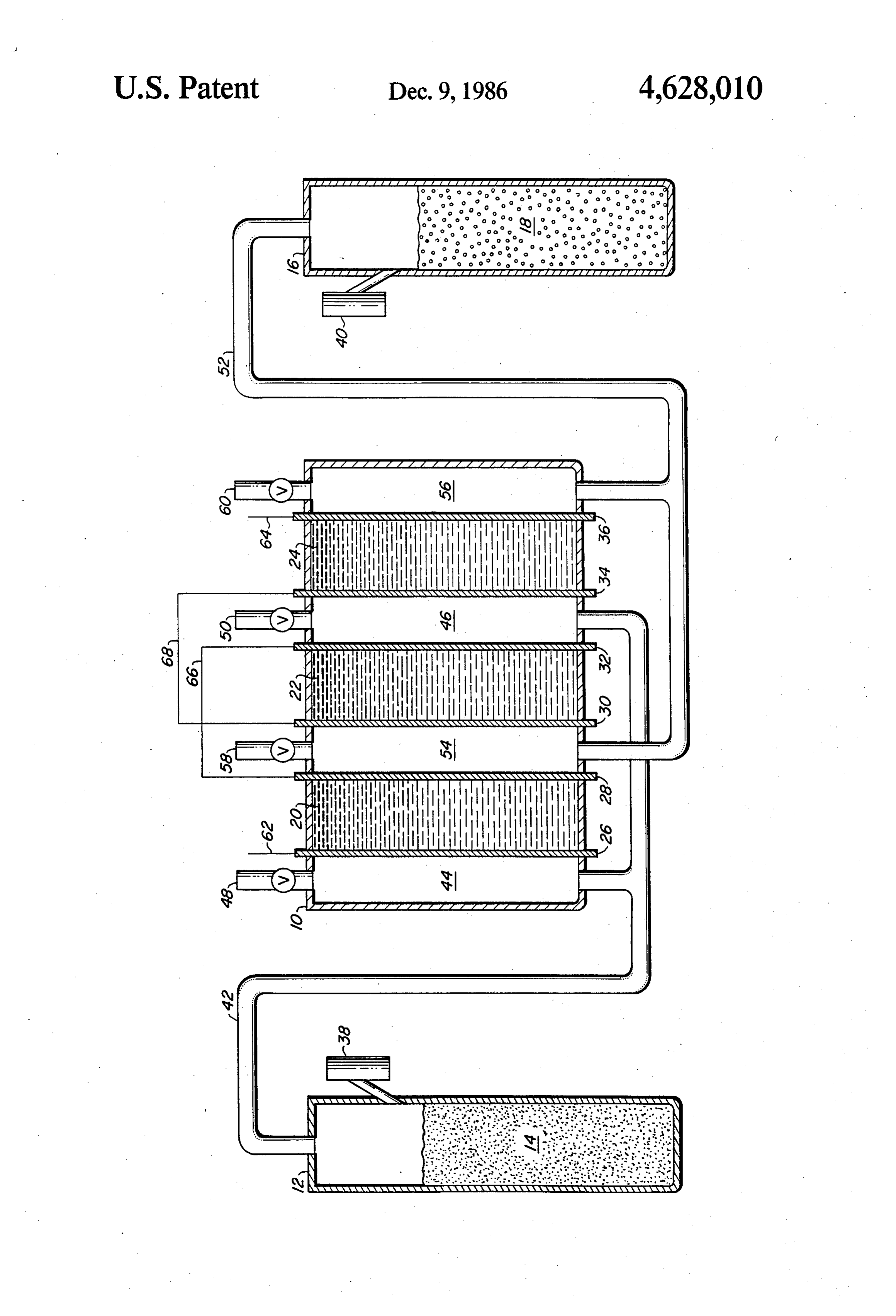
BACKGROUND OF THE INVENTION Key advantages of this invention are the extremely 1. Field of the Invention high specific energy that can be achieved with a hy This invention relates to fuel cells. More particularly, drogen/oxygen fuel cell and the availability of suitable the invention relates to fuel cells based upon the use of storable gas generator compositions. Chemical gas gen solid composition hydrogen and oxygen gas generators. erator compositions are available that produce essen The presently claimed invention is particularly useful in 10 tially pure oxygen and pure hydrogen as the only gase providing a storable high specific energy system. ous effluent (greater than 99.9%). 2. Description of the Prior Art In the accompanying FIGURE, an embodiment of Various techniques have been attempted in the prior the system of the present invention is illustrated in sche art to develop fuel cells which will supply electrical matic form, showing three cells. The hydrogen and energy at unusually high energy densities. Some state of oxygen used by the fuel cell assembly 10 are chemically the art fuel cells operate with high pressure gas storage, 15 bound as solid components in separate gas generators. which requires heavy and bulky cylinders, which also The hydrogen gas generator 12 contains the heteroge pose an explosion hazard in the event of rupture due to neous hydrogen gas generating composition 14, com severe impact. Other fuel cells utilize cryogenic materi prising a hydrogen containing salt and an oxidizing als, where an additional system is required to vaporize agent. Particularly good results have been achieved and supply the materials to the fuel cell. 20 using lithium borohydride (LiBH4) as the salt and iron
Specific applications of fuel cells include missile elec (III) oxide (Fe2O3) as the oxidizing agent. The oxygen tric power supplies. Due to the weight constraints, state gas generator 16 contains the heterogeneous oxygen gas of the art batteries such as those noted above and those generating composition 18, comprising an oxygen con such as zinc/silver oxide systems, are often unsatisfac tory. The present invention, on the other hand, is light 25 taining sodium salt and a reducing agent. Especially suitable is chlorate (NaClO3) as the salt and elemental iron weight. Rated at the same power level and duration, the (Fe) as the reducing agent. fuel cell of this invention is only 30-40% of the weight Fuel cell assembly 10 is comprised of a plurality of of state of the art systems.
State of the art methods of operating fuel cells are voltage. The FIGUREin series sets of cells connected to develop the necessary only illustrates three cells in based upon closed cycle systems where generated water 30 series. Depending upon the needs of a particular system, is removed from the cell and condensed to be used as potable water. These systems were designed for very the number of cells may vary. For example, a minimum long duration operation generally greater than 500 of 44 cells is required to develop 35 volts. The fuel cell can be fed by one pair of gas generators or sequentially hours, rather than for short duration, along the order of initiated 1000 seconds. 35 hydrogen and oxygen gas generators. The only Most systems operate at steady state, and therefore critical consideration is that both hydrogen and oxygen require auxiliary systems to maintain this state. Temper gas must be present in the fuel cell assembly simulta ature control and water removal and condensation are neously in order for the cell to be operational. The two factors which affect those systems. The present FIGURE only shows one pair of hydrogen and oxygen invention utilizes a system which operates in a continu generators 12 and 16, which illustrates the general con ous varying state, ie. the temperature is permitted to rise cept.
to its final value and water is allowed to accumulate in A suitable electrolyte is a water solution of potassium the electrolyte, thereby eliminating the need for addi hydroxide at a concentration of about 35 weight per tional subsystems. cent, and is stored in chambers 20, 22 and 24. The hy 45 drogen acts as a fuel gas while the oxygen acts as the
SUMMARY OF THE INVENTION oxidant gas. The cell membranes 26, 28, 30, 32, 34 and An object of the present invention is to provide a 36, are disks of a porous material such as porous nickel method of extremely high energy storage. (26 weight percent nickel), having approximately 75% A further object of the present invention is to provide volume porosity. Alternately, composite membranes a fuel cell operable by hydrogen and oxygen. 50 consisting of powdered teflon and platinum catalyst These and other objects have been demonstrated by coated carbon, pressed onto a nickel screen, can be the present invention wherein high energy storage is used.
achieved by means of a hydrogen/oxygen fuel cell The gas generators can be initiated upon demand by where the hydrogen and oxygen are stored as solids and means of igniters 38 and 40. In this manner, the chemi released through gas generator reactions. 55 cal reactions in each generator are initiated and hydro BRIEF DESCRIPTION OF THE DRAWING gen and oxygen gas are produced. Hydrogen is generated by a reaction which occurs in
The invention will be described in further detail with generator 12, The following illustrates the type of reac reference to the accompanying drawing wherein: tions involved:
the single FIGURE is a schematic representation of a 60 hydrogen and oxygen gas generator based fuel cell.
DESCRIPTION OF THE PREFERRED The reactants and all of the products except hydrogen EMBODIMENT are solids. Gaseous hydrogen then is fed by means of This invention entails a hydrogen/oxygen open cycle 65 manifold 42 into the fuel cell assembly 10, specifically fuel cell which derives its working fluid from solid gas entering chambers 44 and 46. These chambers are pro composition gas generators. This system is capable of vided with automatic pressure relief valves 48 and 50 delivering 2 kilowatts of power for 1000 seconds at a respectively. These valved outlets also operate to ex
Page 4
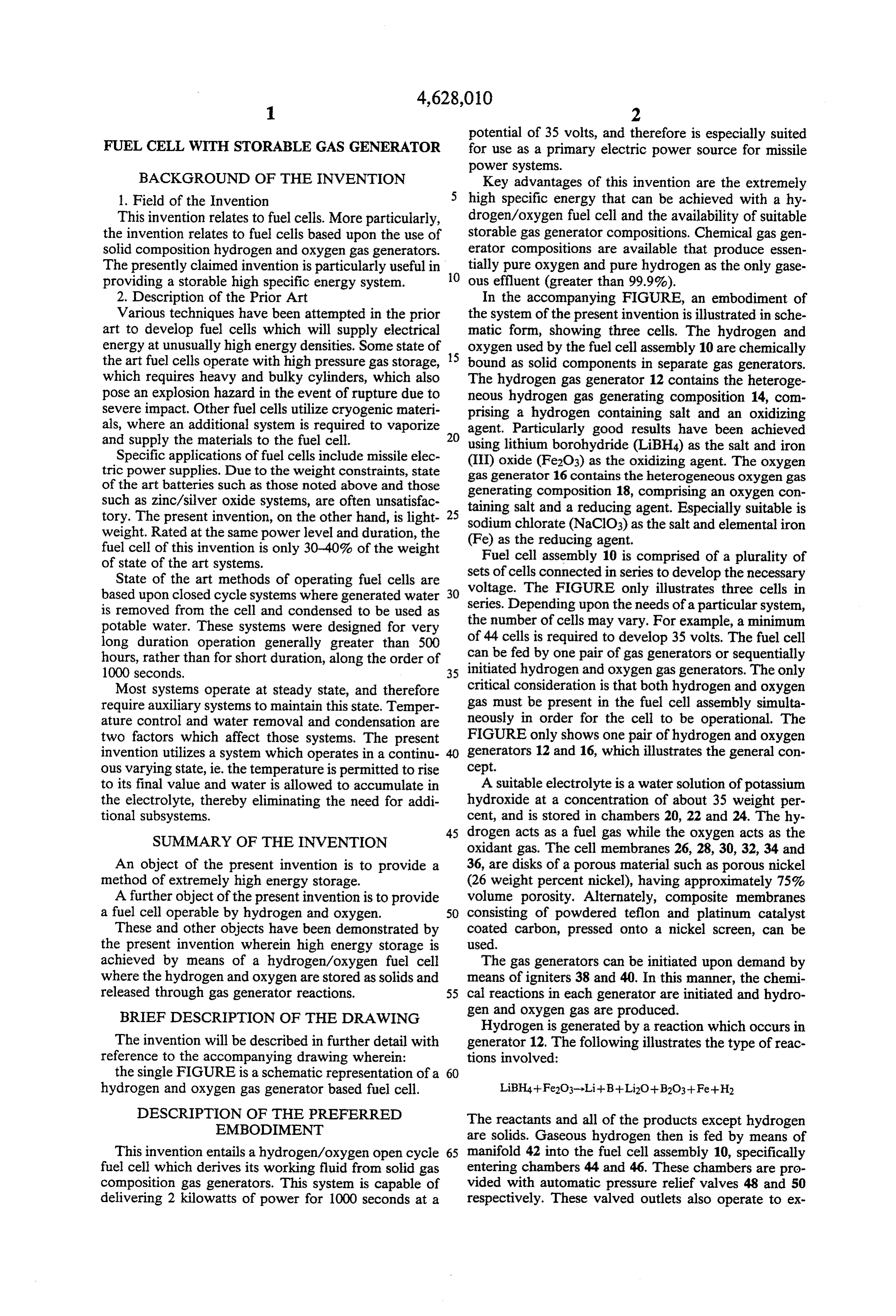
haust any impurities which enter the chamber from the A typical operation parameter is a pressure of 75 psia fuel gas. in the gas generators. At this pressure, the vapor pres The compound lithium borohydride (LiBH4) is an sure of water is about 300 F., however, the hydrogen excellent chemical for storing hydrogen. The decompo and oxygen are released at about 1500 F. Fortunately, sition of this compound into its elements yields approxi several factors minimize this apparent problem which mately 0.185 pounds of hydrogen per pound of starting would normally result in evaporation of the water in the material. On a volumetric basis, this represents 0.123 fuel cell electrolyte, or otherwise force the fuel cell to g/cc. The corresponding volume storage efficiency of be operated at extremely high pressures to balance the liquid hydrogen is only 0.07 g/cc, so the efficiency of vapor pressure of water at the elevated temperature. hydrogen storage in LiBH4 is almost double that of O The factors that eliminate this problem are: (1) only a liquid hydrogen. small amount of hydrogen and oxygen are required The reaction produces sufficient heat to cause the (about 0.048 and 0.385 pounds of released gas, respec LiBH4 to decompose thermally, thereby less than the tively); (2) the specific heat of oxygen gas, the major stoichiometric amount indicated above of the iron (III) constituent, is only about 0.2 cal/g, only 20% of the oxide is required to release all of the hydrogen. The 15 value for water; (3) the mass of electrolyte is selected to particular reaction defined by the above equation pro limit the temperature rise to about 170 F., well below duces hydrogen gas at 10% gravimetric efficiency, but the equilibrium vapor pressure of the electrolyte at the even this composition is efficient for volumetric storage cell operating pressure. The added water dilutes the of hydrogen. About 0.111 g/cc of reaction mixture is electrolyte by about 10%, therefore only minor changes produced, again exceeding the volumetric storage ca 20 in the performance of the cell are observed. pacity of liquid hydrogen. The fuel cell reactions that govern power generation In a manner similar to that of the hydrogen generator in the system are:
composition, a solid gas generator composition is avail able which produces essentially 100% pure oxygen as H2--20H-2H2+2e (anode) the gaseous product. Using sodium chlorate (NaClO3), 25 oxygen is generated by a reaction in generator 16. The 1/202--H2O-20H-2e (cathode) following illustrates the type of reactions involved: H2--1/202-H2O (net reaction)
30 Thus hydrogen and oxygen entering through manifolds
This reaction delivers 34.5% of its weight as pure oxy 42 and 52 respectively, combine in fuel cell assembly 10 gen, which corresponds to a volumetric storage effi in an alkaline electrolyte to produce water and electric ciency of 0.932 g/cc of reaction mixture compared to a power at about 0.8 volts per cell. For example, hydro volumetric storage efficiency of 1.142 g/cc for liquid gen in chamber 44 reacts with the electrolyte in cham oxygen. Gaseous oxygen then is fed by means of mani 35 ber 20 at the cell membrane/electrode 26. Likewise, fold 52 into the fuel cell assembly 10, specifically enter oxygen in chamber 54 reacts with the electrolyte in ing chambers 54 and 56. These chambers are provided chamber 20 and 22 at the cell membranes/electrodes 28 with automatic pressure relief valves 58 and 60 respec and 30 respectively, and so forth. Since the reaction is a tively, which operate like valves 48 and 50. The heat two electron process, the formation of only a half mole release from this reaction is sufficient to raise the reac of water, about 9 g, will result in the flow of one Fara tion to the thermal decomposition temperature of the day (96500 coulombs) of electricity. Leads 62 and 64 mixture therefore even smaller quantities of iron can connected to electrodes 26 and 36 respectively, are used sustain the reaction. The temperature of the oxygen and to deliver electrical current to apparatus supplied by the the hydrogen gases that are evolved from the generator cell assembly. Leads 66 and 68 operate to connect the compositions are adjustable by controlling the amount 45 individual cells in series.
of elemental iron and iron (III) oxide in the reaction Combining the cell voltage with the coulombic out mixture. The gases are typically released at tempera put results in a specific power density (theoretical) of tures about 1500' F., but these temperatures can be 1620 watt-hours per pound of water generated. More lowered and the rate of gas release correspondingly over, the voltage, coulombic and thermodynamic effi decreased within certain limits. 50 ciencies of the hydrogen/oxygen fuel cell are all high, Both of these gas generators react in a manner analo with the principal loss being the voltage efficiency at gous to the burning of solid propellants, ie. the reaction high current drains. Generally, the voltage efficiency front advances at a constant rate. The rate of reaction remains at approximately 60-80%, while the coulombic for the oxygen generator is sensitive to the operating and thermodynamic efficiencies remain near 100%, pressure. On the other hand, the rate of reaction for the 55 thereby yielding an overall cell efficiency of about hydrogen generator is not sensitive to the operating 60-80%. In comparison, a standard zincAsilver oxide pressure. The rate is adequately defined by a power law battery yields a theoretical power density of approxi reaction rate identical to that used for conventional mately 230 watt-hours per pound of reactants con propellants. Furthermore, the typical range of reaction sumed, but only at an efficiency of 35%, thereby de rates is similar to those observed in propellant combus grading the delivered power density to about 80 watt tion (ie. 0.1 to 0.6 in/min at 1000 psia). hours per pound of reactants consumed. Thus, the de A major difference between these gas generators and livered power density of the hydrogen/oxygen fuel cell conventional solid propellant gas generators is that a is about 16 times as great as that of the zincMsilver oxide significant quantity of the reaction mixture remains battery.
behind as a porous solid mass of reaction products. The 65 The foregoing description has been set forth merely reaction residue is sufficiently porous to allow the oxy to illustrate the invention and is not intended to be limit gen and the hydrogen to permeate freely through the ing. Since modification of the described embodiment reacted bed of spent gas generator products. incorporating the spirit and substance of the invention
Page 5
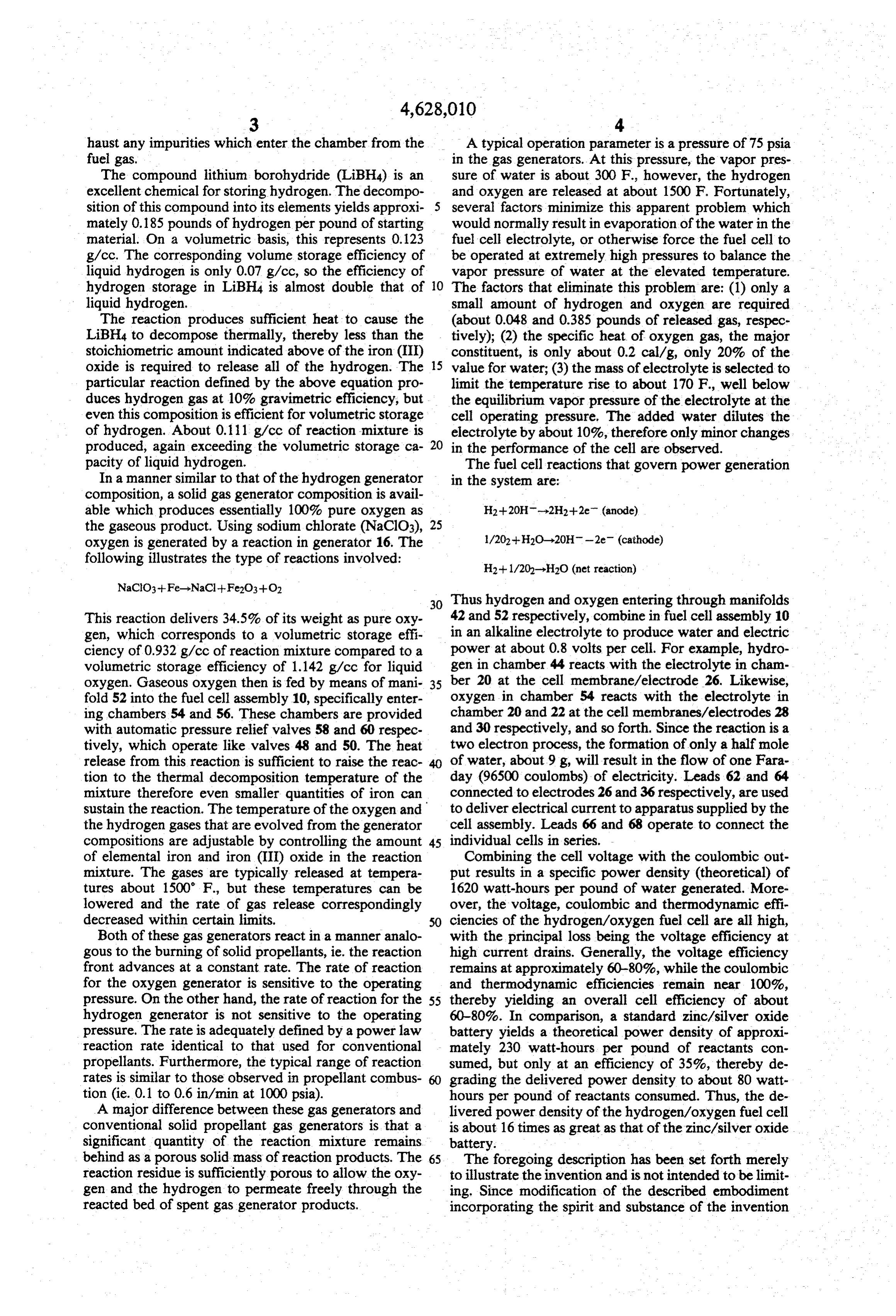
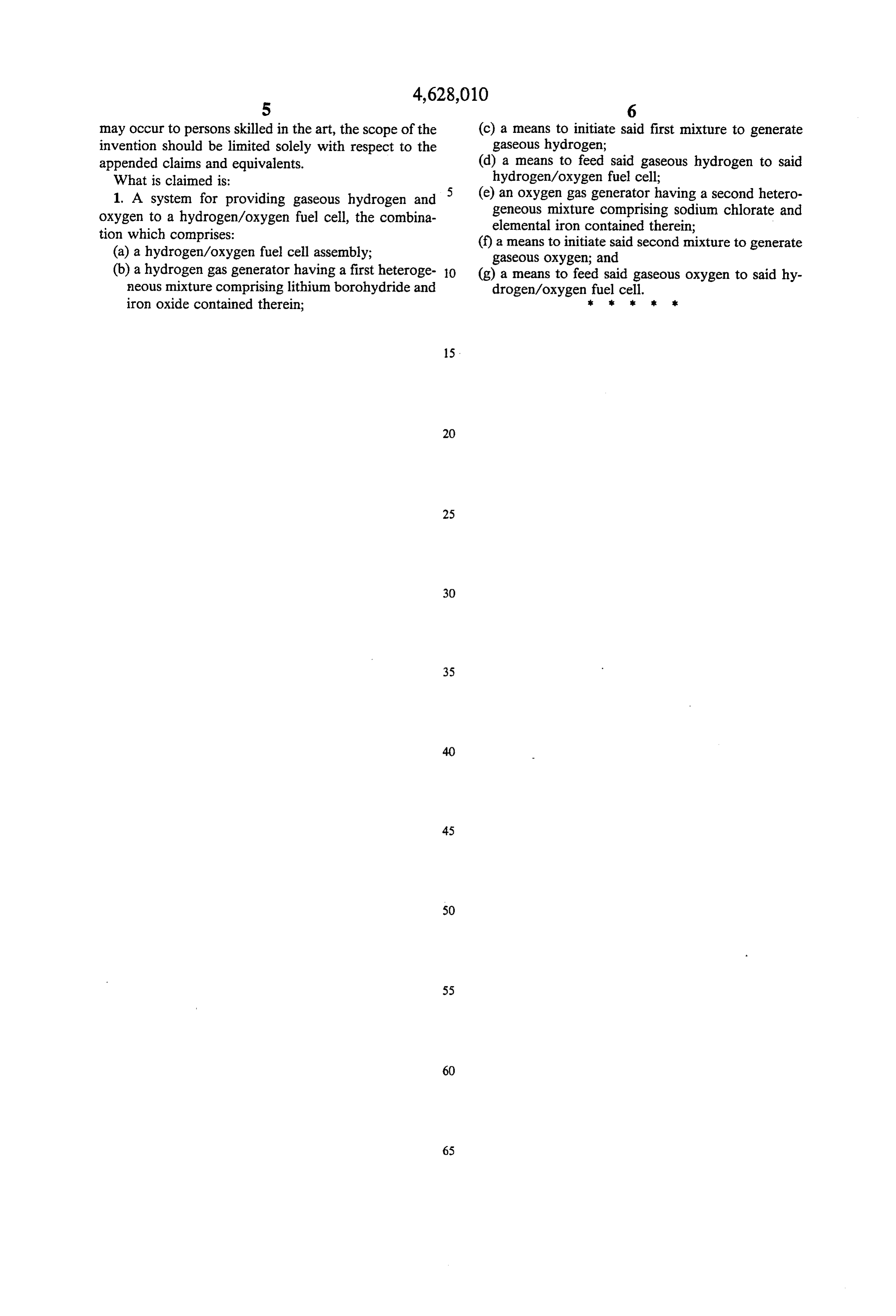
may occur to persons skilled in the art, the scope of the (c) a means to initiate said first mixture to generate invention should be limited solely with respect to the gaseous hydrogen;
appended claims and equivalents. (d) a means to feed said gaseous hydrogen to said What is claimed is: hydrogen/oxygen fuel cell; 1. A system for providing gaseous hydrogen and (e) an oxygen gas generator having a second hetero oxygen to a hydrogen/oxygen fuel cell, the combina geneous mixture comprising sodium chlorate and tion which comprises: elemental iron contained therein; (a) a hydrogen/oxygen fuel cell assembly; (f) a means to initiate said second mixture to generate gaseous oxygen; and (b) a hydrogen gas generator having a first heteroge O (g) a means to feed said gaseous oxygen to said hy neous mixture comprising lithium borohydride and drogen/oxygen fuel cell.
iron oxide contained therein; k is k sk
Provenance
- Collection
- Cited prior art
- Original PDF
- patentimages.storage.googleapis.com →
- Filed
- 1985-12-13
- Pages
- 5
- Method
- pdftotext (the PDF's own text layer) + pdftoppm 300dpi page scans
- Source
- Google Patents bibliographic record
- Granted
- 1986-12-09
- Inventors
- Bernard L. Iwanciow; US Department of Navy
- Transcribed from
- patentimages.storage.googleapis.com →