patent · US4569890
Process for increasing the heating value of fuel gas mixtures containing hydrogen
11 February 1986
Page 1 — bibliographic record
. / a8 X R. 4. . . . . . . . .
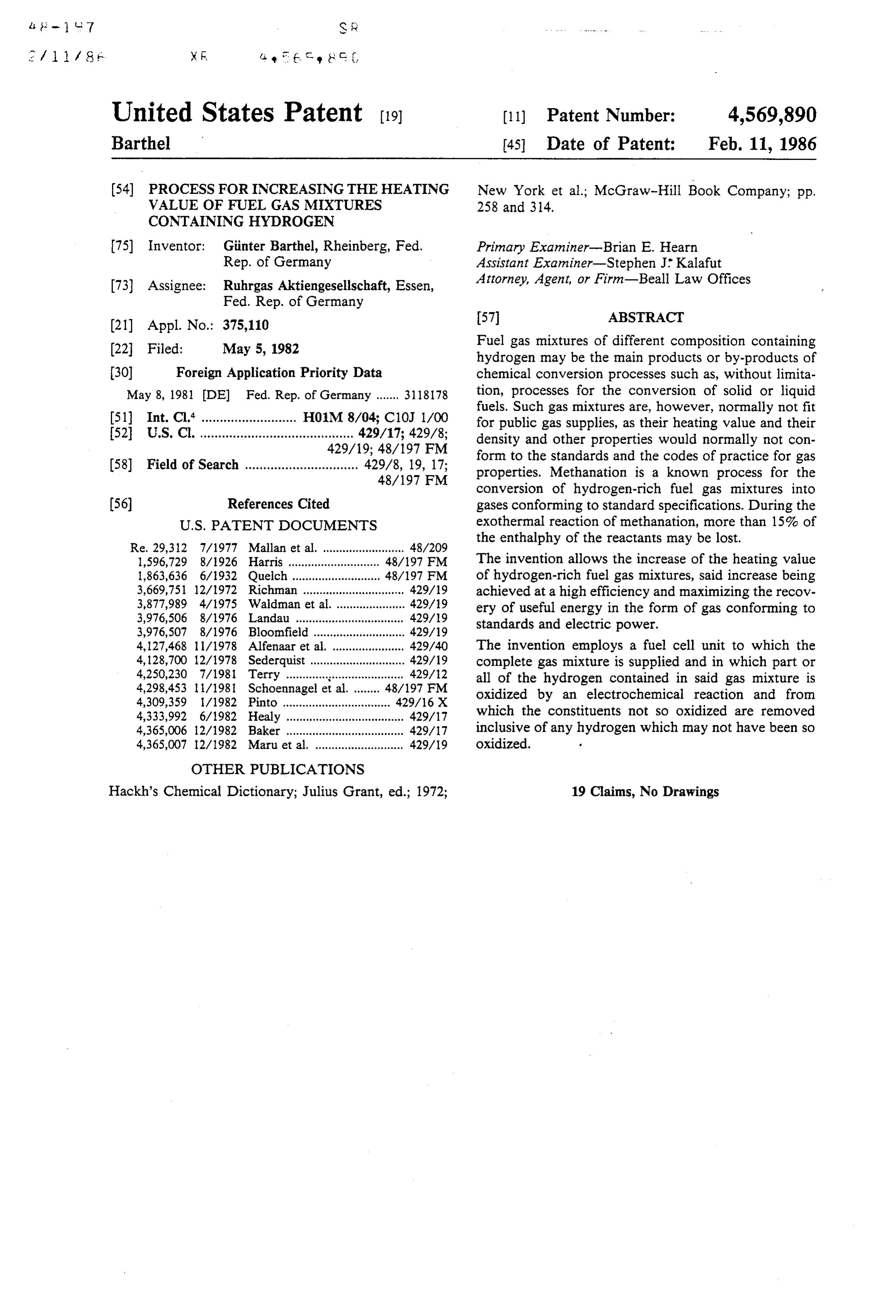
United States Patent (19) (11) Patent Number: 4,569,890 Barthel 45 Date of Patent: Feb. 11, 1986 (54) PROCESS FOR INCREASING THE HEATING New York et al.; McGraw-Hill Book Company; pp. VALUE OF FUEL GAS MIXTURES 258 and 314,
CONTAINING HYDROGEN
75) Inventor: Ginter Barthel, Rheinberg, Fed. Primary Examiner-Brian E. Hearn Rep. of Germany Assistant Examiner-Stephen J. Kalafut 73 Assignee: Ruhrgas Aktiengesellschaft, Essen, Attorney, Agent, or Firm-Beall Law Offices Fed. Rep. of Germany (21) Appl. No.: 375,110 57 ABSTRACT (22 Filed: May 5, 1982 Fuel gas mixtures of different composition containing hydrogen may be the main products or by-products of 30 Foreign Application Priority Data chemical conversion processes such as, without limita May 8, 1981 (DE Fed. Rep. of Germany ....... 31 1878 tion, processes for the conversion of solid or liquid fuels. Such gas mixtures are, however, normally not fit 51 Int. Cl." .......................... HOM 8/04; C10J 1/00 for public gas supplies, as their heating value and their 52 U.S. Cl. .......................................... 429/17; 429/8; density and other properties would normally not con 429/19; 48/197 FM form to the standards and the codes of practice for gas 58) Field of Search ............................... 429/8, 19, 17; properties. Methanation is a known process for the
conversion of hydrogen-rich fuel gas mixtures into (56) References Cited gases conforming to standard specifications. During the
Re. 29,322 7/1977 Mallan et al. ......................... 48/209 the enthalphy of the reactants may be lost.
1,596,729 8/1926 Harris .......... ... 48/197 FM The invention allows the increase of the heating value 1,863,636 6/1932 Quelch ..... ... 48/197 FM of hydrogen-rich fuel gas mixtures, said increase being 3,669,751 12/1972 Richman ............................... 429/19 achieved at a high efficiency and maximizing the recov 3,877,989 4/1975 Waldman et al. ... 429/19 ery of useful energy in the form of gas conforming to 3,976,506 8/1976 Landau ............ ... 429/9 standards and electric power. 3,976,507 8/1976 Bloomfield ...... ... 429/19 4,127,468 /1978 Alfenaar et al. ... ... 429/40 The invention employs a fuel cell unit to which the 4,128,700 12/1978 Sederquist ....... ... 429/19 complete gas mixture is supplied and in which part or 4,250,230 7/1981 Terry .............sers sers - - - - - - - - - - - 429/12 4,298,453 1 1/1981 Schoennagel et al ... 48/197 FM all of the hydrogen contained in said gas mixture is 4,309,359 1/1982 Pinto ................................. 429/16 X oxidized by an electrochemical reaction and from 4,333,992 6/1982 Healy .................................... 429/17 which the constituents not so oxidized are removed 4,365,006 12/1982 Baker ....... ... 429/17 inclusive of any hydrogen which may not have been so 4,365,007 12/1982 Maru et al. ........................... 429/19 oxidized.
OTHER PUBLICATIONS
Hackh's Chemical Dictionary; Julius Grant, ed.; 1972; 19 Claims, No Drawings
Page 2
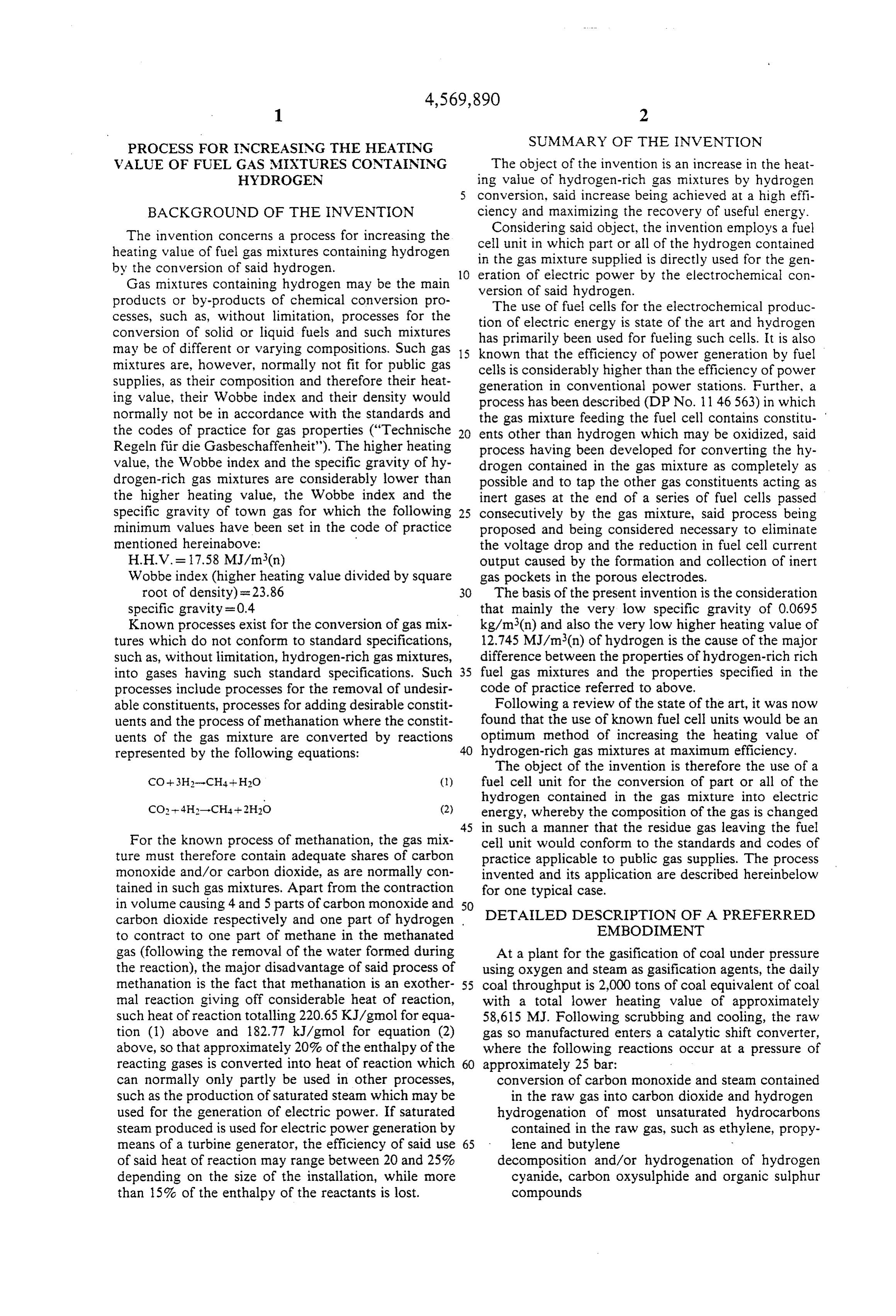
PROCESS FOR INCREASING THE HEATING SUMMARY OF THE INVENTION VALUE OF FUEL GAS MIXTURES CONTAINING The object of the invention is an increase in the heat HYDROGEN ing value of hydrogen-rich gas mixtures by hydrogen conversion, said increase being achieved at a high effi
BACKGROUND OF THE INVENTION ciency and maximizing the recovery of useful energy. The invention concerns a process for increasing the cellConsidering said object, the invention employs a fuel heating value of fuel gas mixtures containing hydrogen in the gas mixture part unit in which or all of the hydrogen contained supplied is directly used for the gen by the conversion of said hydrogen. 10 eration of electric power by the electrochemical con Gas mixtures containing hydrogen may be the main products or by-products of chemical conversion pro version The of said hydrogen.
use of fuel cells for the electrochemical produc cesses, such as, without limitation, processes for the tion of electric energy is state of the art and hydrogen conversion of solid or liquid fuels and such mixtures has primarily been used for fueling such cells. It is also may be of different or varying compositions. Such gas 15 known that the efficiency of power generation by fuel mixtures are, however, normally not fit for public gas cells is considerably higher than the efficiency of power supplies, as their composition and therefore their heat generation in conventional power stations. Further, a ing value, their Wobbe index and their density would process has been described (DP No. 11 46563) in which normally not be in accordance with the standards and the gas mixture feeding the fuel cell contains constitu the codes of practice for gas properties ("Technische 20 ents other than hydrogen which may be oxidized, said Regeln fir die Gasbeschaffenheit"). The higher heating process having been developed for converting the hy value, the Wobbe index and the specific gravity of hy drogen contained in the gas mixture as completely as drogen-rich gas mixtures are considerably lower than possible and to tap the other gas constituents acting as the higher heating value, the Wobbe index and the inert gases at the end of a series of fuel cells passed specific gravity of town gas for which the following 25 consecutively by the gas mixture, said process being minimum values have been set in the code of practice proposed and being considered necessary to eliminate mentioned hereinabove: the voltage drop and the reduction in fuel cell current H.H.V. = 17.58 MJ/m3(n) output caused by the formation and collection of inert Wobbe index (higher heating value divided by square gas pockets in the porous electrodes. root of density) sat 23.86 30 The basis of the present invention is the consideration specific gravity = 0.4 that mainly the very low specific gravity of 0.0695 Known processes exist for the conversion of gas mix kg/m3(n) and also the very low higher heating value of tures which do not conform to standard specifications, 12.745 MJ/m3(n) of hydrogen is the cause of the major such as, without limitation, hydrogen-rich gas mixtures, difference between the properties of hydrogen-rich rich into gases having such standard specifications. Such 35 fuel gas mixtures and the properties specified in the processes include processes for the removal of undesir code of practice referred to above. able constituents, processes for adding desirable constit Following a review of the state of the art, it was now uents and the process of methanation where the constit found that the use of known fuel cell units would be an uents of the gas mixture are converted by reactions optimum method of increasing the heating value of represented by the following equations: 40 hydrogen-rich gas mixtures at maximum efficiency. The object of the invention is therefore the use of a
CO-3H-CH4+ H2O (l) fuel cell unit for the conversion of part or all of the hydrogen contained in the gas mixture into electric
CO3 + 4H-CH4+2H2O (2) energy, whereby the composition of the gas is changed 45 in such a manner that the residue gas leaving the fuel
For the known process of methanation, the gas mix cell unit would conform to the standards and codes of ture must therefore contain adequate shares of carbon practice applicable to public gas supplies. The process monoxide and/or carbon dioxide, as are normally con invented and its application are described hereinbelow tained in such gas mixtures. Apart from the contraction for one typical case.
in volume causing 4 and 5 parts of carbon monoxide and 50 DETAILED DESCRIPTION OF A PREFERRED carbon dioxide respectively and one part of hydrogen .
to contract to one part of methane in the methanated EMBODIMENT gas (following the removal of the water formed during At a plant for the gasification of coal under pressure the reaction), the major disadvantage of said process of using oxygen and steam as gasification agents, the daily methanation is the fact that methanation is an exother- 55 coal throughput is 2,000 tons of coal equivalent of coal mal reaction giving off considerable heat of reaction, with a total lower heating value of approximately such heat of reaction totalling 220.65 KJ/gnol for equa 58,615 MJ. Following scrubbing and cooling, the raw tion (1) above and 182.77 kJ/gnol for equation (2) gas so manufactured enters a catalytic shift converter, above, so that approximately 20% of the enthalpy of the where the following reactions occur at a pressure of reacting gases is converted into heat of reaction which 60 approximately 25 bar:
can normally only partly be used in other processes, conversion of carbon monoxide and steam contained such as the production of saturated steam which may be in the raw gas into carbon dioxide and hydrogen used for the generation of electric power. If saturated hydrogenation of most unsaturated hydrocarbons steam produced is used for electric power generation by contained in the raw gas, such as ethylene, propy means of a turbine generator, the efficiency of said use 65 lene and butylene - of said heat of reaction may range between 20 and 25% decomposition and/or hydrogenation of hydrogen depending on the size of the installation, while more cyanide, carbon oxysulphide and organic Sulphur than 15% of the enthalpy of the reactants is lost. compounds
Page 3
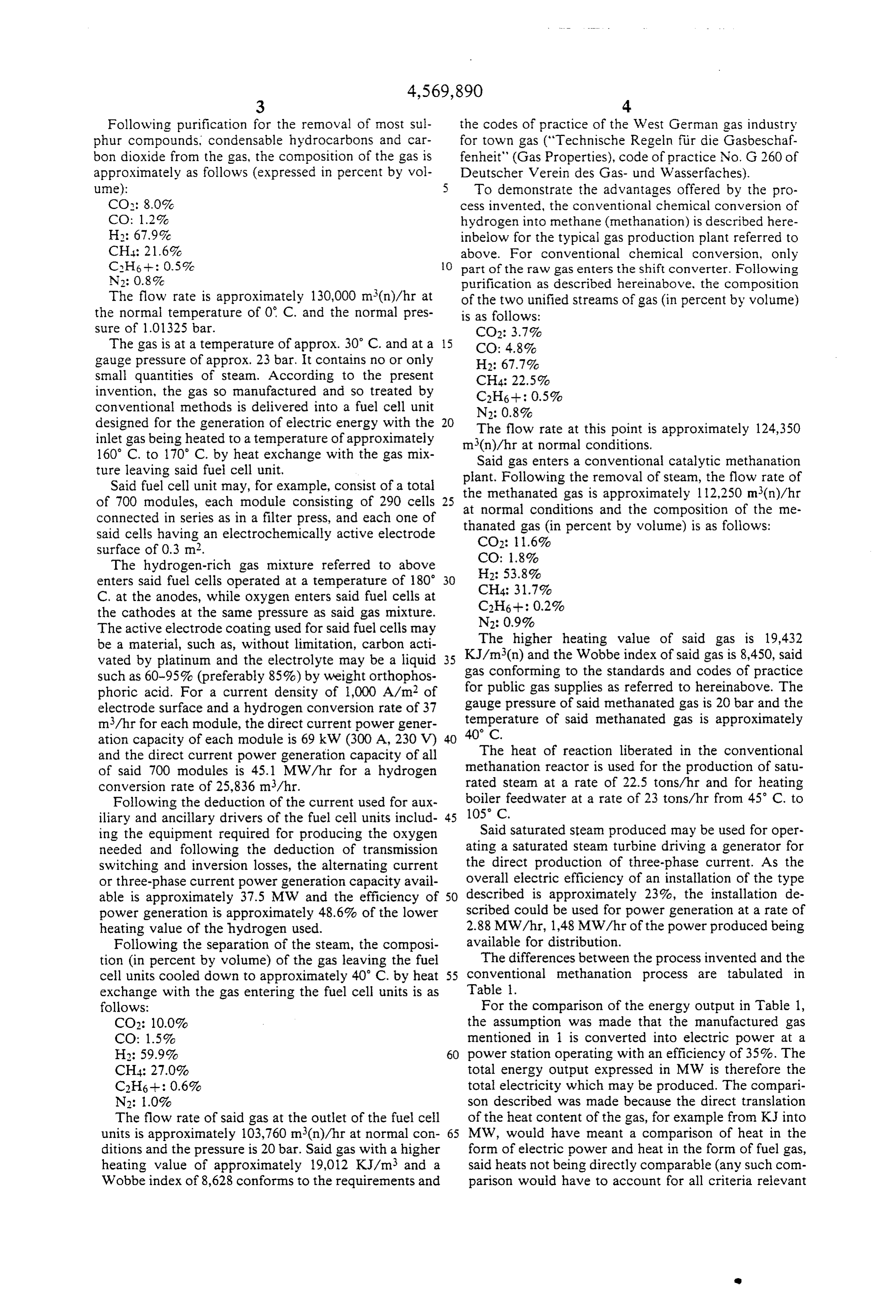
Following purification for the removal of most sul the codes of practice of the West German gas industry phur compounds, condensable hydrocarbons and car for town gas ("Technische Regeln flir die Gasbeschaf. bon dioxide from the gas, the composition of the gas is fenheit" (Gas Properties), code of practice No. G 260 of approximately as follows (expressed in percent by Vol Deutscher Verein des Gas- und Wasserfaches). ume): To demonstrate the advantages offered by the pro CO: 8.0% cess invented, the conventional chemical conversion of CO: 1.2% hydrogen into methane (methanation) is described here H: 67.9% inbelow for the typical gas production plant referred to CH: 21.6% above. For conventional chemical conversion, only CH6 -- : 0.5% O part of the raw gas enters the shift converter. Following N: 0.8% purification as described hereinabove, the composition The flow rate is approximately 130,000 m(n)/hr at of the two unified streams of gas (in percent by volume) the normal temperature of O. C. and the normal pres is as follows:
sure of 101325 bar. CO2: 3.7%
The gas is at a temperature of approx. 30° C. and at a 15 CO; 4.8% gauge pressure of approx. 23 bar. It contains no or only H2: 67.7% small quantities of steam. According to the present CH4; 22.5% invention, the gas so manufactured and so treated by conventional methods is delivered into a fuel cell unit N: 0.8% designed for the generation of electric energy with the The flow rate at this point is approximately 124,350 inlet gas being heated to a temperature of approximately m(n)/hr at normal conditions. 160 C. to 170° C. by heat exchange with the gas mix Said gas enters a conventional catalytic methanation ture leaving said fuel cell unit, plant. Following the removal of steam, the flow rate of Said fuel cell unit may, for example, consist of a total the methanated gas of 700 modules, each module consisting of 290 cells at normal conditionsis and
connected in series as in a filter press, and each one of thanated gas (in percent bythevolume)composition of the me is as follows:
said cells having an electrochemically active electrode CO2: 11.6% surface of 0.3 m2.
The hydrogen-rich gas mixture referred to above CO: 1.8% enters said fuel cells operated at a temperature of 180 30 H2: 53.8%
C. at the anodes, while oxygen enters said fuel cells at CH4; 31.7% the cathodes at the same pressure as said gas mixture. C2H6 -- : 0.2%
The active electrode coating used for said fuel cells may N: 0.9% be a material, such as, without limitation, carbon acti The higher heating value of said gas is 19,432 vated by platinum and the electrolyte may be a liquid 35 KJ/m(n) and the Wobbe index of said gas is 8,450, said such as 60-95% (preferably 85%) by weight orthophos gas conforming to the standards and codes of practice phoric acid. For a current density of 1,000 A/m2 of for public gas supplies as referred to hereinabove. The gauge pressure of said methanated gas is 20 bar and the electrode surface and a hydrogen conversion rate of 37 temperature of said methanated gas is approximately mi/hr for each module, the direct current power gener 40° C.
ation capacity of each module is 69 kW (300 A, 230 V) 40
The heat of reaction liberated in the conventional and the direct current power generation capacity of all of said 700 modules is 45.1 MW/hr for a hydrogen methanation reactor is used for the production of satu conversion rate of 25,836 m/hr. rated steam at a rate of 22.5 tons/hr and for heating Following the deduction of the current used for aux boiler feedwater at a rate of 23 tons/hr from 45 C. to iliary and ancillary drivers of the fuel cell units includ 45 105 C.
ing the equipment required for producing the oxygen Said saturated steam produced may be used for oper needed and following the deduction of transmission ating a saturated steam turbine driving a generator for switching and inversion losses, the alternating current the direct production of three-phase current. As the or three-phase current power generation capacity avail overall electric efficiency of an installation of the type able is approximately 37.5 MW and the efficiency of 50 described is approximately 23%, the installation de power generation is approximately 48.6% of the lower scribed could be used for power generation at a rate of heating value of the hydrogen used. 2.88 MW/hr, 1,48 MW/hr of the power produced being Following the separation of the steam, the composi available for distribution.
tion (in percent by volume) of the gas leaving the fuel The differences between the process invented and the cell units cooled down to approximately 40 C. by heat 55 conventional methanation process are tabulated in exchange with the gas entering the fuel cell units is as Table .
follows: For the comparison of the energy output in Table 1, CO2: 10.0% the assumption was made that the manufactured gas CO: 1.5% mentioned in 1 is converted into electric power at a H: 59.9% 60 power station operating with an efficiency of 35%. The CH: 27.0% total energy output expressed in MW is therefore the C2H6 -- : 0.6% total electricity which may be produced. The compari N2: 1.0% son described was made because the direct translation The flow rate of said gas at the outlet of the fuel cell of the heat content of the gas, for example from KJ into units is approximately 103,760 m (n)/hr at normal con 65 MW, would have meant a comparison of heat in the ditions and the pressure is 20 bar. Said gas with a higher form of electric power and heat in the form of fuel gas, heating value of approximately 19,012 KJ/m3 and a said heats not being directly comparable (any such com Wobbe index of 8,628 conforms to the requirements and parison would have to account for all criteria relevant
Page 4
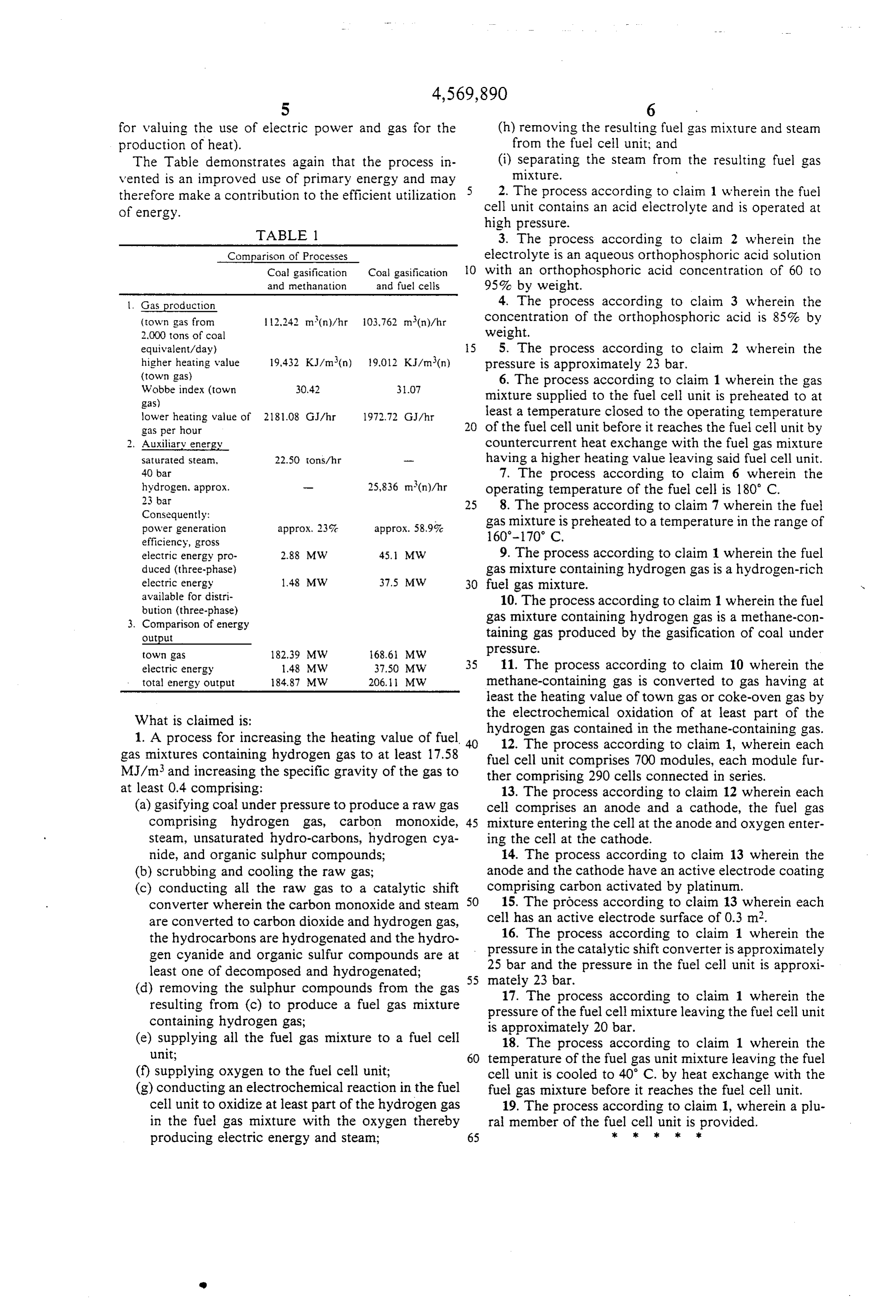
for valuing the use of electric power and gas for the (h) removing the resulting fuel gas mixture and steam production of heat). from the fuel cell unit; and The Table demonstrates again that the process in (i) separating the steam from the resulting fuel gas vented is an improved use of primary energy and may mixture.
therefore make a contribution to the efficient utilization 2. The process according to claim 1 wherein the fuel of energy. cell unit contains an acid electrolyte and is operated at high pressure.
TABLE 1. 3. The process according to claim 2 wherein the
Comparison of Processes electrolyte is an aqueous orthophosphoric acid solution Coal gasification Coal gasification O with an orthophosphoric acid concentration of 60 to and methanation and fuel cells 95% by weight.
l. Gas production 4. The process according to claim 3 wherein the (town gas from concentration of the orthophosphoric acid is 85% by
2,000 tons of coal weight.
equivalent/day) 5 5. The process according to claim 2 wherein the higher heating value 19,432 KJ/m(n) 19,012 KJ/m3(n) pressure is approximately 23 bar.
(town gas) 6. The process according to claim 1 wherein the gas
gas) mixture supplied to the fuel cell unit is preheated to at lower heating value of 2181.08 GJ/hr 1972.72 GJAhr least a temperature closed to the operating temperature gas per hour of the fuel cell unit before it reaches the fuel cell unit by Auxiliary energy countercurrent heat exchange with the fuel gas mixture Saturated steam, 22.50 tons/hr having a higher heating value leaving said fuel cell unit. 40 bar 7. The process according to claim 6 wherein the hydrogen, approx. 25,836 m(n)/hr operating temperature of the fuel cell is 180° C. 23 bar
Consequently:
25 8. The process according to claim 7 wherein the fuel power generation approx. 23% approx. 58.9% gas mixture is preheated to a temperature in the range of efficiency, gross 160-17O C.
electric energy pro- 2.88 MW 45 MW 9. The process according to claim 1 wherein the fuel duced (three-phase) gas mixture containing hydrogen gas is a hydrogen-rich electric energy 148 MW 37.5 MW 30 fuel gas mixture.
available for distri bution (three-phase) 10. The process according to claim 1 wherein the fuel 3. Comparison of energy gas mixture containing hydrogen gas is a methane-con Output taining gas produced by the gasification of coal under town gas 18239 MW 68.6 MW pressure.
electric energy 48 MW 37.50 MW 11. The process according to claim 10 wherein the
total energy output 84.8 MW 206. MW methane-containing gas is converted to gas having at least the heating value of town gas or coke-oven gas by
What is claimed is: the electrochemical oxidation of at least part of the 1. A process for increasing the heating value of fuel 40 hydrogen
gas contained in the methane-containing gas.
process according to claim 1, wherein each gas mixtures containing hydrogen gas to at least 17.58 fuel cell unit comprises 700 modules, each module fur MJ/m3 and increasing the specific gravity of the gas to ther comprising 290 cells connected in series. at least 0.4 comprising: 13. The process according to claim 12 wherein each (a) gasifying coal under pressure to produce a raw gas cell comprises an anode and a cathode, the fuel gas comprising hydrogen gas, carbon monoxide, 45 mixture entering the cell at the anode and oxygen enter steam, unsaturated hydro-carbons, hydrogen cya ing the cell at the cathode.
nide, and organic sulphur compounds; 14. The process according to claim 13 wherein the (b) scrubbing and cooling the raw gas; anode and the cathode have an active electrode coating (c) conducting all the raw gas to a catalytic shift comprising carbon activated by platinum. converter wherein the carbon monoxide and steam 50 15. The process according to claim 13 wherein each are converted to carbon dioxide and hydrogen gas, cell has an active electrode surface of 0.3 m.
the hydrocarbons are hydrogenated and the hydro 16. The process according to claim 1 wherein the gen cyanide and organic sulfur compounds are at pressure in the catalytic shift converter is approximately least one of decomposed and hydrogenated; 25 bar and the pressure in the fuel cell unit is approxi 55 mately 23 bar.
(d) removing the sulphur compounds from the gas 17. The process according to claim 1 wherein the resulting from (c) to produce a fuel gas mixture pressure of the fuel cell mixture leaving the fuel cell unit containing hydrogen gas; is approximately 20 bar.
(e) supplying all the fuel gas mixture to a fuel cell 18. The process according to claim 1 wherein the unit; 60 temperature of the fuel gas unit mixture leaving the fuel (f) supplying oxygen to the fuel cell unit; cell unit is cooled to 40° C. by heat exchange with the (g) conducting an electrochemical reaction in the fuel fuel gas mixture before it reaches the fuel cell unit. cell unit to oxidize at least part of the hydrogen gas 19. The process according to claim 1, wherein a plu in the fuel gas mixture with the oxygen thereby ral member of the fuel cell unit is provided.
producing electric energy and steam; 65 k k s
Provenance
- Collection
- Cited prior art
- Original PDF
- patentimages.storage.googleapis.com →
- Filed
- 1982-05-05
- Pages
- 4
- Method
- pdftotext (the PDF's own text layer) + pdftoppm 300dpi page scans
- Source
- Google Patents bibliographic record
- Granted
- 1986-02-11
- Inventors
- Gunter Barthel; Ruhrgas AG
- Transcribed from
- patentimages.storage.googleapis.com →