patent · US3294586
Fuel cell with movable casing and electrodes and method for operating fuel cell withan anode containing an alkaline earth metal
27 December 1966
Page 1
Dec. 27, 1966 J. A. M. LE DUC 3,294,586
FUEL CELL WITH MOWABLE CASING AND ELECTRODES AND
METHOD FOR OPERATING FUEL CELL WITH AN ANODE
CONTAINING AN ALKALINE EARTH METAL
Filed March 1, 1962 4. Sheets-Sheet l FIG.
OO 200 300 4 OO SOO 600 7oo
CURRENT DENSITY, AM BAT2
JOSEPH ADREN M, LEDUC
AGENT
AT TORNEYS
Page 2
Dec. 27, 1966 J. A. M. LE DUC 3,294,586
FUE CELL WITH MOWABLE CASING AND ELECTRODES AND
METHOD FOR OPERATING FUEL CELL WITH AN ANODE
CONTAINING AN ALKALINE EARTH METAL
Filed March 1, l962 4. Sheets-Sheet 2
Z ziz Z %
J54 % 43 49 6 A
Gar X - A
JOSEPH ADREN M. LEDUC
AGENT AT TORNEYs
Page 3
AND ELECTRODES ANS
METHOD FOR OPERATING FUEL CELL WITH AN ANODE
CONTAINING AN ALKALINE EARTH METAL
Filed March l, 1962 4. Sheets-Sheet 3
INVENTOR.
JOSEPH ADREN M. LEDUC
s. Aeolic novel,
AGENT
At TORNEYS
Page 4
Dec. 27, 1966FUEL CELL WITH MOVABLE
CASING AND ELECTRODES AND
METHOD FOR OPERATING FUEL CELL WITH AN ANODE
CONTAINING AN ALKALINE EARTH METAL
Filed March 1, 962 4. Sheets-Sheet 4 SËN
FIG. 8
INVENTOR.
JOSEPH ADREN M. EDUC
Page 5
United States Patent Office 3,294,586 Patented Dec. 27, 1966
gen fuel cell system is that the fuel cell output varies 3,294,586 considerably with the concentration of the electrolyte due FUEL CELL WITH MOVABLE CASING AND ELEC in part to a marked difference in the activities of the TRODES AND METEOD FOR OPERATENG FUEL solutions.
CELL WITH AN ANODE CONTAINING AN The voltage of an operating fuel cell is always less than ALKALINE EARTH METAL the calculated cell potential, the decrease being due to Joseph Adrien M. Le Duc, Short Hiiis, N.J., assignor to certain unavoidable losses such as energy associated with Pullman incorporated, a corporation of Delaware the preparation of the fuel to a form suitable for use in Filed Mar. 1, 1962, Ser. No. 176,532 the cell, polarization (activation, concentration, etc.),
O voltage drop caused by ohmic resistance as the current
This invention relates to a new and improved process flows through electrodes, electrolyte and current conduc for converting the energy liberated by a chemical reaction tors. It can be seen, therefore, than on an average basis directly into electrical energy. In a more particular as fuel cells developed to date are capable of producing cur rent of only lower voltage of the order of about 0.9-2.0 pect the present invention relates to an improved fuel cell capable of generating current of a relatively higher 5 volts (O.C.P.) even at elevated temperatures, leaving voltage. much to be desired in the way of increasing power out It is known that considerable time and money are put. It also is manifested that any fuel cell which allows being expended in order to develop electrochemical de operation for even a few tenths of a volt higher repre vices commonly referred to as fuel cells which are capa sents, on a percentage basis, a large increase in power ble of transforming the energy released by chemical re 20 and a valuable contribution to the efficiency of fuel cells. action directly into electrical energy. For each system, It is an object of this invention to provide an improved the theoretical or standard cell potential can be calculated fuel cell capable of generating current of relatively higher using thermodynamic principles from the following voltage.
equation: Another object is to provide a power cell from which 25 high current densities can be drawn with minimized loss
T - F Another object is to provide a fuel cell having a good wherein E0=standard cell potential, volts (with reactants power output when operated at ambient temperatures and and products in a state of unit activity) pressures.
AF0=standard free energy change for the cell reaction 30 Another object is to provide a fuel cell in which an in question, kilocalories aqueous electrolyte is employed and which generates cur n=number of electrons transferred in the cell reaction rent of higher voltage than presently known fuel cells. (equivalents) A further object is to provide a fuel cell which is readily F=the faraday, 96,500 coulombs per equivalent. adapted to continuous operation for a prolonged period It is seen, therefore, that the theoretical cell potential or of time without the necessity of continuously charging fuel from an external source.
E.M.F. (electromotive force) of any particular fuel cell A further object is to provide a fuel cell having the is related to the free energy change associated with the above characteristics and in which the fuel is one that is chemical reaction taking place therein.
One type of fuel cell which has received considerable 40 readily stored and handled.
A still further object is to provide a power cell which, attention is the high pressure hydrogen-oxygen fuel cell; in addition to its value as a source of electrical current, in this cell, hydrogen is used as fuel coupled with oxygen also leads to the production of a valuable by-product. as the oxidant and is usually operated at a higher tem A still further object is to provide an improved fuel perature of about 250-400 F., a pressure of from 300 cell and design therefor of the consumable electrode type. 600 pounds per square inch using about 20-40 percent 45 Various other objects and advantages of this invention aqueous potassium hydroxide as electrolyte. The calcu will become apparent to those skilled in the art from the lated open circuit potential (O.C.P.) of this cell is 1.17 accompanying description and disclosure. volts. The low temperature hydrogen-oxygen fuel cell Accordingly the above objects are accomplished by the which is usually operated at a temperature of 140-160° F.
and at about ambient pressure to 150 pounds per square 50 alkaline which process earth comprises reacting a fuel comprising an metal and an oxidant electrochemically in inch has a slightly higher calculated E.M.F. of 1.23 volts. an aqueous medium in a cell provided with means for Another type of power cell is the so-called consumable bringing the fuel and oxidant into the proximity of suit electrode fuel cell. An example of this type is the sodium amalgam-oxygen fuel cell, the calculated open circuit po able electrodes at which the electrochemical reactions tential of which is 2.2 volts when operated at 150 F. and 55 take place and from which the current produced within the cell is withdrawn. Of the alkaline earth metals em ambient pressure using aqueous sodium hydroxide elec trolyte and amalgam containing about 0.5 percent by ployed, i.e., strontium, calcium and barium, barium metal weight of sodium. Although the E.M.F. based on the use is preferred and thus, for illustrative purposes and con of pure sodium is higher, advantage of the difference in venience, the following discussion is drawn primarily to free energy cannot be taken thereof in view of the high 60 the use of barium as the fuel. The oxidizing agent in reactivity of pure sodium with the aqueous electrolyte. cludes oxygen and the halogens (chlorine, fluorine, bro Another disadvantage, of course, is the fact that there are mine and iodine), of which oxygen and chlorine are pre hazards involved in handling pure sodium as well as so ferred.
dium in a dissolved state. In practice the open circuit During operation of the power cell of this invention, voltage of the sodium amalgam-oxygen system varies with 65 the alkaline earth metal fuel is oxidized to the respective the concentration of the electrolyte; for example, when positively charged ions releasing electrons at the electrode using 10-20 percent aqueous sodium hydroxide, the volt (anode) with which it is in contact. The oxidation or age is 1.9-2.1 volts (O.C.P.) and when using a 45-50 anodic reaction which takes place during the electro percent solution, the voltage is 1.5-1.6 volts (O.C.P.). chemical process of this invention, and the calculated When the cell is operating under load, the voltage is, of 70 E.M.F. thereof are as follows:
course, Substantially lower than the open circuit voltages.
Thus, another disadvantage of the sodium amalgam-oxy 2Ba->2Bath-4e E0=2.90 volts (1)
Page 6
While the fuel is being oxidized at the anode, the oxi well as soluble metal oxides, and any combination thereof dant is being reduced at the other electrode and passes are suitable. Typical examples of such alkaline-produc into the aqueous medium as negatively charged ions. It ing compounds are sodium hydroxide, potassium hy is to be understood that, unless indicated otherwise, the droxide, lithium hydroxide, barium hydroxide, calcium term “oxidant' as used herein to describe the reactant hydroxide, strontium hydroxide, and soluble oxides such which is brought into proximity with the cathode, is in as barium oxide, calcium oxide and strontium oxide. tended to include any agent capable of accepting elec The initial concentration of the added alkaline com trons, and includes oxygen and the halogens. The term pound may vary over a relatively wide range such as from "oxygen' as used herein includes pure molecular oxygen very dilute solutions to saturated solutions, the concen as well as oxygen-containing gases such as air and mix O tration depending upon the solubility of the particular tures of oxygen with nitrogen or other inert gases in all compound employed. For example, in the case of the mole ratios. When oxygen is used as the oxidant, the alkali metal hydroxides the concentration thereof may reduction or cathodic reaction which takes place and the vary between about 0.05 and about 20 molar and is pref calculated potential thereof are as follows which assumes erably between about 0.1 and about 5 molar. . In the that no peroxide ion is formed: 5 case of the less soluble alkaline metal hydroxides such as O-2H2O-4e->4OH E0-0.401 volt (2) those of the alkaline earth metals, the cencentration em However, it is known that peroxide ion formation occurs ployed is usually saturated (from about 0.2 to about 6.0 according to the following equation: molar) at the operating temperature of the cell. In this respect, it is noted that when barium, for example, is em
O--HO--2e->HO --OH- (3) 20 ployed as the fuel, barium hydroxide forms and due to the theoretical potential of which is minus 0.078 volt. its relatively low solubility it usually precipitates from the The formation of peroxide ions can be inhibited by the aqueous medium without an adverse effect on the per presence of a catalyst such as silver, manganese, nickel, formance of the cell. The barium hydroxide is readily recovered as a valuable product of the process of this cobalt, iron, rare earth metals, etc., to decompose or pre 25 invention vent the formation of the peroxide ion according to the by simple liquid-solid separation techniques. following equation: When the halogens are used as the cathode reactant or oxidant, an electrolyte is usually added to the aqueous
HO-->OH --O (4) medium which yields ions of the same type which are
The following equation expresses the dependence of the 30 kali being formed at the cathode. For this purpose, the al oxygen half cell on the activity (a) of peroxide ion which metal and alkaline earth metal halides are suitable. may form: For example, when chlorine is used as the oxidant, typical examples of suitable added electrolytes are so
E= -0.030 log atto-0.052 (5) dium chloride, potassium chloride, barium chloride, stron As the activity or concentration of peroxide is decreased, 35 tium chloride and any combination thereof. When the the potential of the oxygen half cell increases as shown oxidant is a halogen, the aqueous medium may be acidic by the following tabulation: or alkaline. Inasmuch as the chemical reactivity of bar ium is less in an alkaline medium than in acidic solutions, 4HO2- E (volts) the cell is usually operated using an aqueous medium 1 ---------------------------------- -0.052 40 which contains, in addition to the metal chloride, an 10 -------------------------------- --0.10 added hydroxyl-yielding compound such as one of the 10" ------------------------------- --0.25 above-mentioned metal hydroxides or oxides. Thus the net chemical reaction of the barium-oxygen The temperature at which the electrolyte is maintained system is: and at which the fuel cell is operated varies between about 20 and about 250° C. The cell also may be oper 45 ated over a wide range of pressure and generally the and the calculated E.M.F. thereof varies approximately pressure is between atmospheric and about 700 pounds between 3.30 volts and 2.8 volts, depending upon the ac per square inch. Any combination of pressure and tem tivities of the various reacting species. perature may be employed with the preferred limitation When chlorine is used as the oxidant, the reduction 50 the that they be so regulated to maintain the electrolyte in reaction which takes place at the cathode, and the cal liquid phase. The preferred operating temperature culated E.M.F. thereof are as follows: ranges between about 20° C. and about 90° C. Although good performance is realized at room temperature and
Cl-4-2e->2Cl E0- 1.36 volts (7) atmospheric pressure, the electrode surface tends to in crease in temperature when the cell is operated at high the net reaction of the barium-chlorine fuel cell system 55 current and calculated E.M.F. thereof being as follows: densities of the order of about 200 to 300 amperes per square foot of apparent electrode surface and higher.
Ba--Cl->Batt--2Cl E0=426 volts (8) Thus from the standpoint of continuous generation of The effect of peroxide formation is not considered in current of such high intensities it is usually preferred to this system when chlorine is used as the oxidant. pressure the cell even when operating at room tempera In accordance with the process of this invention, the 60 ture. It is to be understood that the term “apparent electrode above electrochemical reactions are effected by bringing surface' as used herein with respect to expressing cur the metallic fuel such as barium and the oxidant into contact with suitable electrodes in an aqueous electrolyte. rent density, is defined as the geometric dimensions of the Although the electrolyte may initially be water without 65 electrode without consideration of the surface area con an added ionizable compound, for more efficient opera tributed by the porous surface of the particular electrode. tion and improved conductivity, at least one water soluble The fuel cell of this invention is operated at any de ionizable compound is preferably added as a component sired current density and voltage depending upon the design of each individual cell and the manner in which of the electrolyte system. When the oxidant is oxygen, the aqeuous electrolyte is usually alkaline and for this 70 twoTheor accompanying more cells are interconnected.
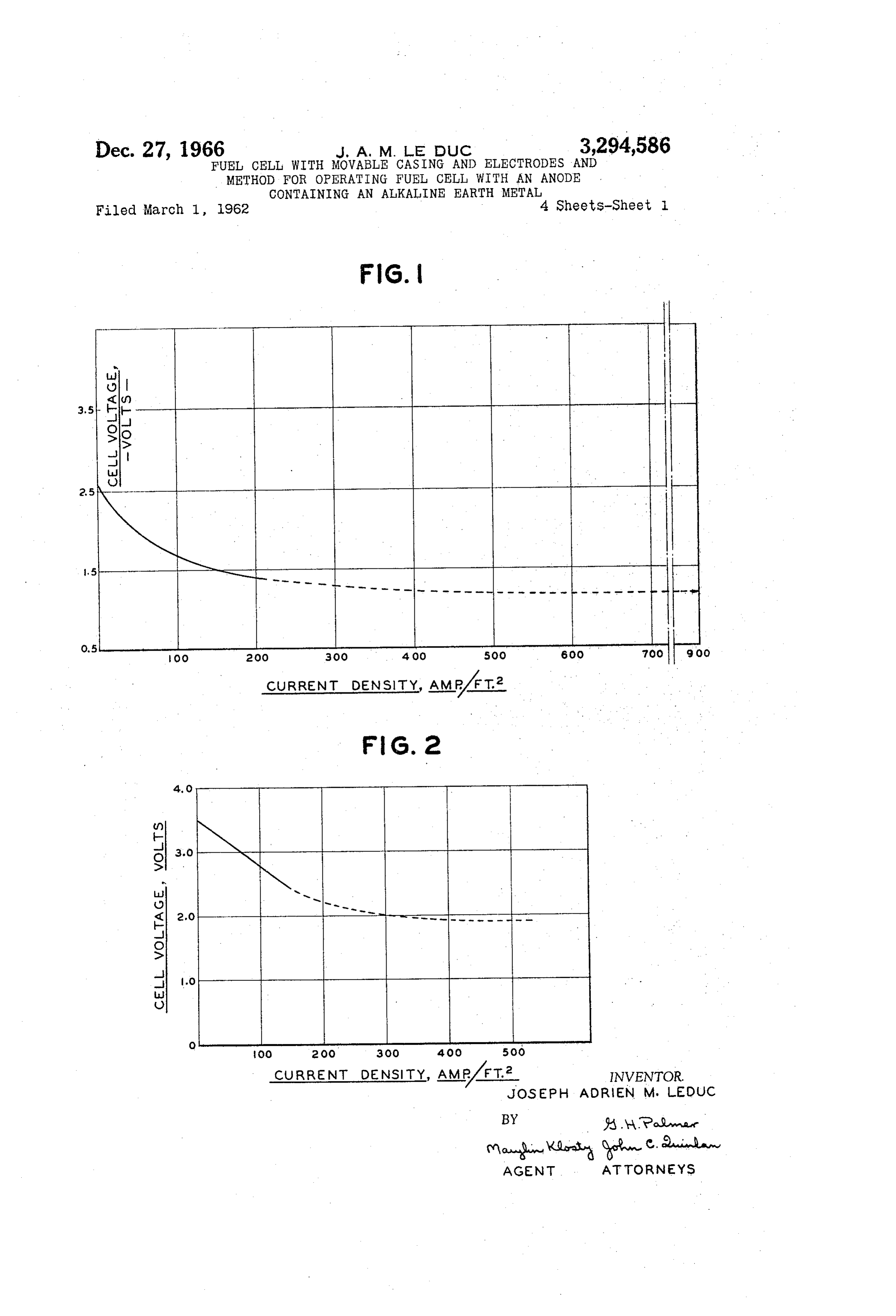
graphs of FIGURES 1 and 2, are purpose there is used any water soluble compound which the power curves of the barium-oxygen and barium-chlo when in solution renders the medium alkaline and which does not impair the chemical reactions taking place at rine fuel cells, respectively, of this invention. the electrodes. For example, metal hydroxides such as Reference to these curves shows that the power cells
the alkali metal and alkaline earth metal hydroxides as 75 densities this invention generate electrical energy of current up to about 1000 amperes per square foot of
Page 7
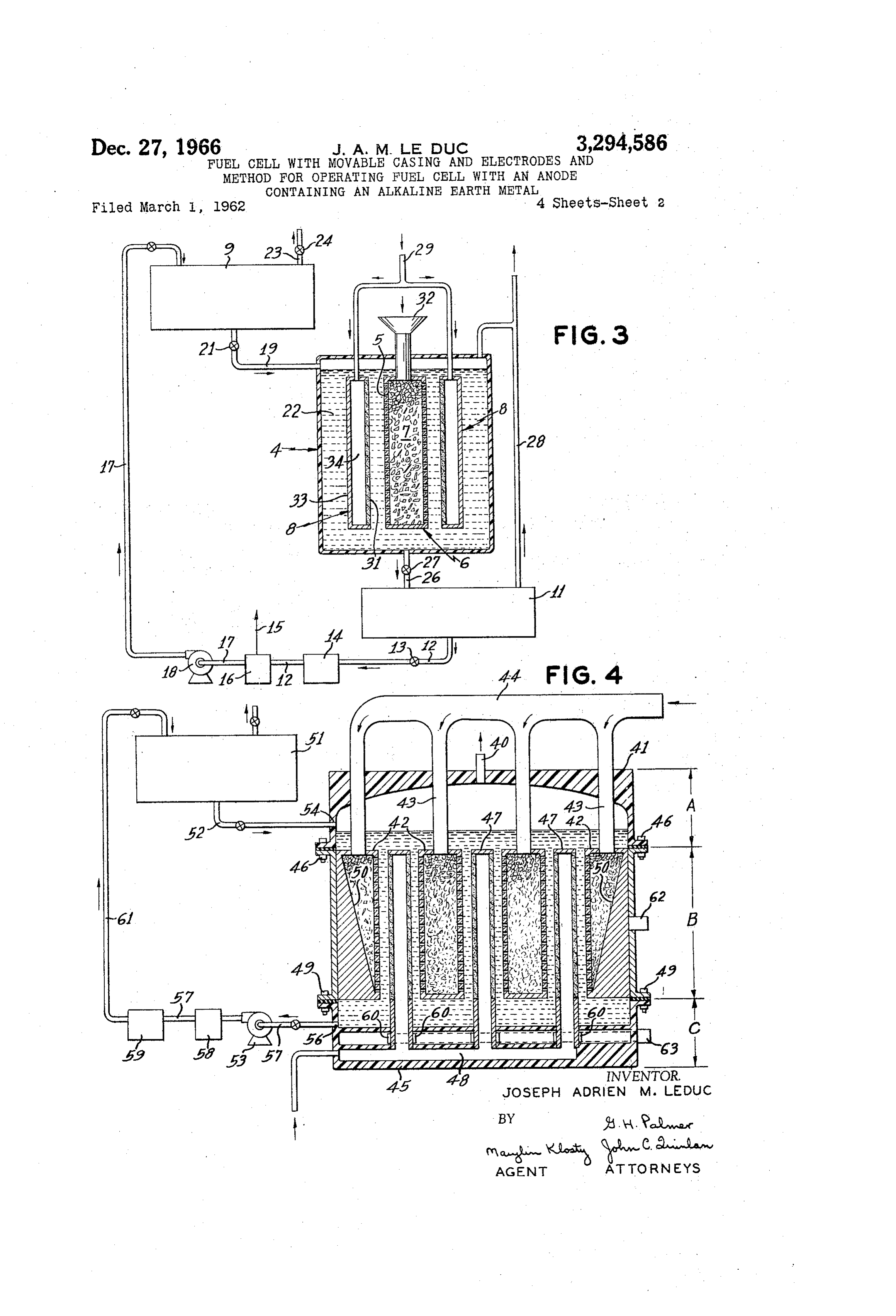
apparent electrode surface or higher. Within these cur conductive metal including salts, oxides, etc., thereof rent densities, the cell potential of the barium-oxygen homogeneously distributed at least within the pores of fuel cell in which aqueous barium hydroxide is used as an inert substrate such as polyethylene prepared in ac the electrolyte (FIGURE 1) ranges between 2.6 and cordance with the methods disclosed in my prior and co about 1.2 volts which corresponds to power densities, on pending application Serial Number 162,221, filed Decem the basis of 100 and 1000 amperes per square foot, of ber 26, 1961, now Patent No. 3,235,473. The cathode between about 170 and about 1200 watts per square foot also may be composed of carbon or graphite and may con of electrode surface. For the barium-chlorine system in tain catalysts such as silver-silver salt additives. which an aqueous solution comprising barium chloride is In view of the fact that the oxidant which is brought used, for example (FIGURE 2), the cell potential var 0 into contact with the electrolyte and which undergoes ies between 3.5 and about 1.8 volts which corresponds chemical reaction is in the gaseous state, it is preferred to power densities, on the basis of 100 and 1000 amperes that the cathode be in the form of a hollow member pro per square foot, of between about 275 and about 1800 vided with an inlet for introducing the gaseous reactant watts per square foot of electrode surface. therein. One such form is illustrated by gas electrodes When it is desired to produce current of high amper 5 8 of the accompanying FIGURE 3 which comprises the age and low voltage, individual fuel cells are connected electrically conductive porous surface 31 and support 33 in parallel and in producing current of low amperage which together enclose space 34 into which the gaseous and high voltage, individual fuel cells are connected in oxidant is introduced under a slight pressure by means of series as known to those skilled in the art. inlet 29 which feeds each of gas electrodes 8. For a further understanding of the present invention, 20 In operating the cell of FIGURE 3, aqueous electrolyte reference is made to FIGURES 3-8 of the accompany 22 containing barium hydroxide, for example, is fed to ing drawings. the cell from reservoir 9 by means of line 19 having FIGURES 3-6 represent longitudinal views in eleva valve 21 thereon in an amount sufficient to fully immerse tion of apparatus in which the electrochemical reactions electrodes 6 and 8. As the electrochemical reactions pro of this invention are effected. 25 ceed, barium ions form and when the electrolyte becomes FIGURE 7 is an end view of the apparatus shown in saturated with barium hydroxide, it is withdrawn from the FIGURE 6 taken on line 7-7. lower portion of the cell by means of line 26 having valve FIGURE 8 is a longitudinal view in elevation of an 27 thereon into electrolyte reservoir 11. The electrolyte improved cathode assembly. is then passed into cooler 14 by means of line 12 having The barium-oxidant fuel cell illustrated by accompany 30 valve 13 thereon wherein the electrolyte is cooled to ing FIGURE 3 comprises the cell container 4 having dis precipitate barium hydroxide. The solution and precipi posed therein electrodes typically illustrated by electrode tate are then passed to filtration zone 16 wherein solid assembly 6 and 3, and is provided with electrolyte feed barium hydroxide is separated and withdrawn therefrom source 9 and electrolyte reservoir 1, reservoir 11 being by means of line 15 as a product of the process. The connected to the electrolyte feed source 9 by means of 35 filtrate is then pumped through line 17 by means of pump lines 12 and 17 having cooler 14, filtration Zone 16 and 18 and is returned to electrolyte feed reservoir 9. The pump 18 thereon. cell is also provided with vents 23 and 28 to prevent The inner walls of the cell body 4 are composed of any build-up of water vapor pressure within the respective suitable material or coated material which is chemically electrolyte reservoirs, and by means of which unreacted inert to the electrolyte and chemicals produced by the 40 gases are vented. When the fuel cell is not in opera cell and is also an electrically non-conductive material tion, electrolyte is removed therefrom and is conveniently such as vinyl or other plastic or resin, rubber, refractories, stored in reservoir 11 so that the barium fuel is not in or coated metals. The cell body may have a cross sec contact with the aqueous electrolyte. tion of any desired shape such as circular, rectangular It is to be understand that although the fuel cell of or square. 45 FIGURE 3 is shown with the single barium electrode The barium fuel 7 is in the form of particles of any positioned between two gas diffusion electrodes the cell suitable and convenient shape and dimensions such as may contain any number of alternating barium and gas chunks, wires, chopped wires, broken pieces or slices of diffusion electrodes in which case the type of gas elec barium. The fuel also may be used in the form of fluid trode shown in the drawing is positioned at either end of ized particles. That portion of fuel electrode 6 having 50 the cell and the other gas electrodes have a completely barium fuel 7 contained therein which is submerged in reactive and conductive porous surface as illustrated by electrolyte 22 is composed of an electroconductive metal the accompanying FIGURE 4.
such as steel, stainless steel, nickel, etc. At least that In accordance with the accompanying FIGURE 4 a portion of fuel electrode 6 which faces gas electrode 8 three-section fuel cell is typically illustrated comprising: is in the form of a screen or other perforated or porous 55 (A) an upper section or dome 4: having vent 40 which structure 5 having apertures sufficiently small to retain is connected to the middle section of the cell by any suit the fuel particles within the electrode. Fuel electrode able means such as bolts 46; (B) the middle or anode 6 is provided with a means for introducing fuel particles section comprising fuel electrodes 42 connected to barium to the interior of the electrode. Although the fuel in let 32 is shown in FIGURE 3 as a funnel-shaped inlet 60 feed inlet 43 which in turn is connected to manifold 44; and (C) the bottom section comprising the base of the port, it is to be understood that any automatic feeding cell 45 connected to the middle section by bolts 49, and devices are suitable. The inlet port may be connected to which the gas diffusion electrodes 47 and current dis to means (not shown) in which the barium fuel is ma tribution grids 60 (wires or bars) are fastened and at chined to the desired particle size and shape.
The gas electrode employed in the fuel cells of this 65 tached and to cathode terminus 63. The upper section (A) lower section (C) of the cell are composed of, or invention comprises an electrically conductive material coated with, an electrically non-conductive material and through which the gaseous oxidant diffuses towards the may be, for example, cement or coated metals, whereas surface in contact with the electrolyte. The electrocon the middle section (B) is made of an electrically con ductive material is any one of the elements of Groups ductive material such as steel or other metal. IB, IIB, III-VIII, inclusive, of the Periodic Chart of the 70 Barium electrodes 42 are of the type described above elements, as well as the race earth metals and any com in connection with FIGURE 3 and comprise barium par bination thereof. The conductor may be in the form of sintered powder or specially prepared porous metal, or ticles contained within the perforated support. In order carbon. Also included within the scope of this invention to facilitate the flow of barium particles into the end is a gas diffusion electrode comprising the electrically 75 electrodes and to avoid the accumulation of particles
Page 8
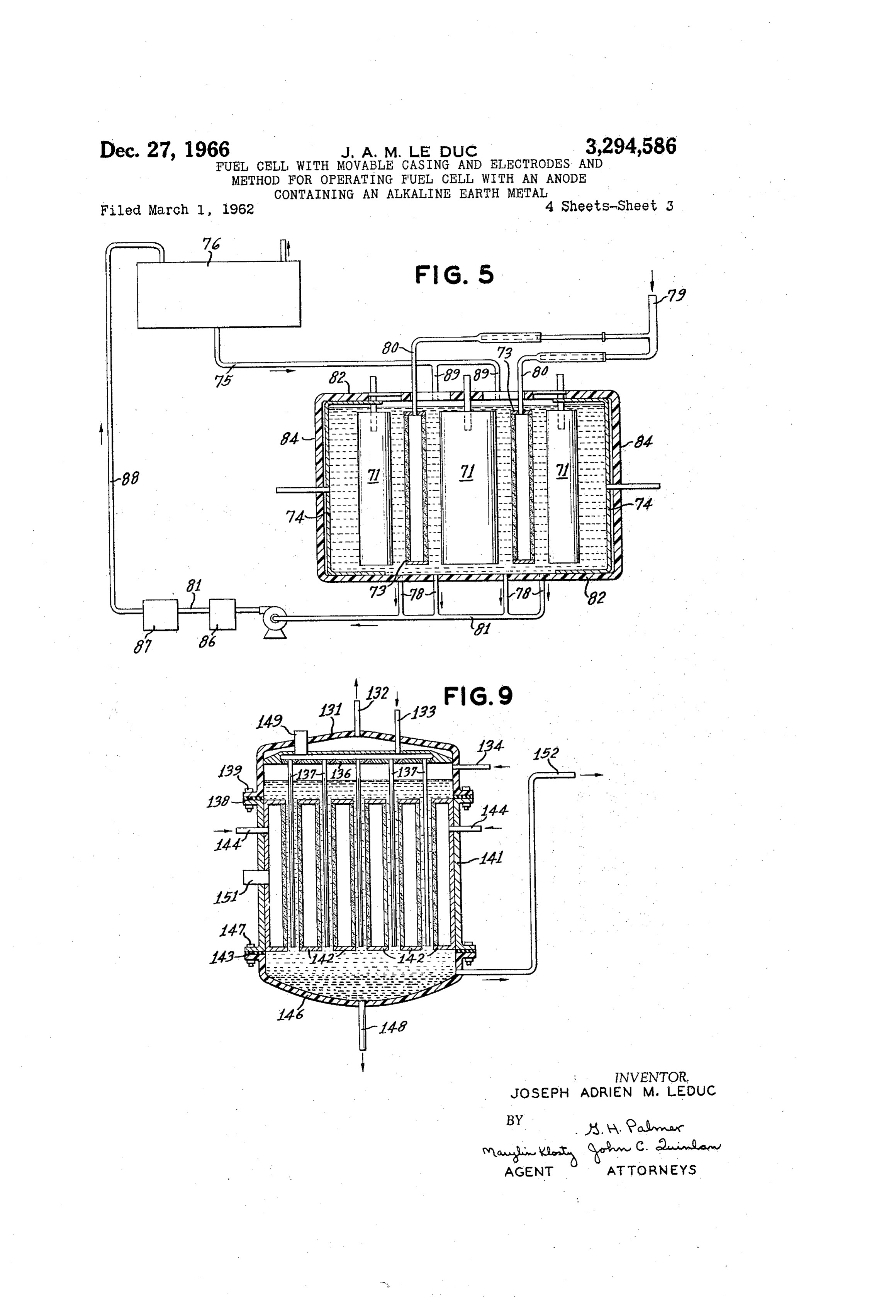
therein which do not become subjected to the electro lower casing is also provided with means for movement chemical reaction taking place at the surface thereof, of the electrodes such as the sliding means shown within they are shaped as shown, the terminal portions 50 having the top casing. The connecting lines such as oxidant a substantially triangular cross section and being com manifold 79, electrolyte inlet 75, as well as electrolyte posed of a solid conductive material connected to the outlet 8 are constructed of flexible tubing in the form Walls of the metallic middle section (B) having anode of a coil or spring, or as shown in the drawing specifically terminus 62 thereon. with respect to manifold 79, they may be composed of As shown in FIGURE 4 of the drawing, the barium sections which slide or pass one within the other like the electrodes 42, except for the outer ones, are positioned Sections of a telescope. Another means for effecting between the reactive porous surface of gas electrodes O movement of the gas diffusion electrodes, electrolyte inlet 47 which are fed with oxidant by means of inlet 48 posi and outlet lines, comprises rolling connecting lines 80, 89 tioned in the base of the cell, the gas flowing in an up and 78, respectively, along their respective distributing wardly direction. In operation, the barium and oxidant manifolds. The circulation of electrolyte and removal of are fed to the anode and the cathode, respectively, and precipitated barium hydroxide product is accomplished aqueous electrolyte is fed to the cell from electrolyte res 5 as described above by passing the electrolyte from the cell ervoir 51 by means of line 52 and cell inlet 54. As shown through outlet 83 into cooler 86 through filtration zone in the drawing the electrolyte is pumped in a downward 37, line 88 and into electrolyte reservoir 76. ly direction passing between the outer surfaces of the Another illustration of apparatus particularly useful for anodes and cathodes. It is to be understood, however, operation of the cell to which a predetermined quantity that the electrolyte may also be charged to the cell by 20 of barium metal is charged is illustrated by the accom means of an inlet positioned within the lower section of panying FIGURE 6. This apparatus comprises support the cell such that the flow is in an upwardly direction. bars 92 having disposed therein bellows 93 to which gas The lower section (C) of the cell is provided with elec electrode assembly 94 and fuel electrodes 96 are fastened trolyte outlet 56 which in turn leads into line 57 having by line 108 and bars 107, respectively. The bellows pump 53 thereon, the electrolyte again being passed into 25 themselves are interconnected by end bars 98 having cooler 58, filtration zone 59 and through line 6i into elec plates 97 fastened thereto. The gas and fuel electrodes trolyte reservoir 51 as described above. are also connected to the upper and lower support beams The type of cell structure shown in FIGURE 4 is readi 92 by means such that the electrodes are readily moved ly disassembled, which feature is particularly advanta 30 such as by rolling or sliding means along the support. geous when it becomes necessary to clean the cell, replace In operation, oxidant is fed to the gas electrodes by means component parts and electrodes or transport the cell. of inlet 99 and aqueous electrolyte is charged to, and dis The fuel cells of this invention are such that fuel may charged from, the cell by means of movable manifolds be stored within the cell in any amount required to oper 12 and 101, respectively, which are connected directly ate it for a prolonged period of time without the necessity 35 to the gas electrodes by the individual inlet 103 and out of carrying fuel by external means or continuously charg let 08, respectively.
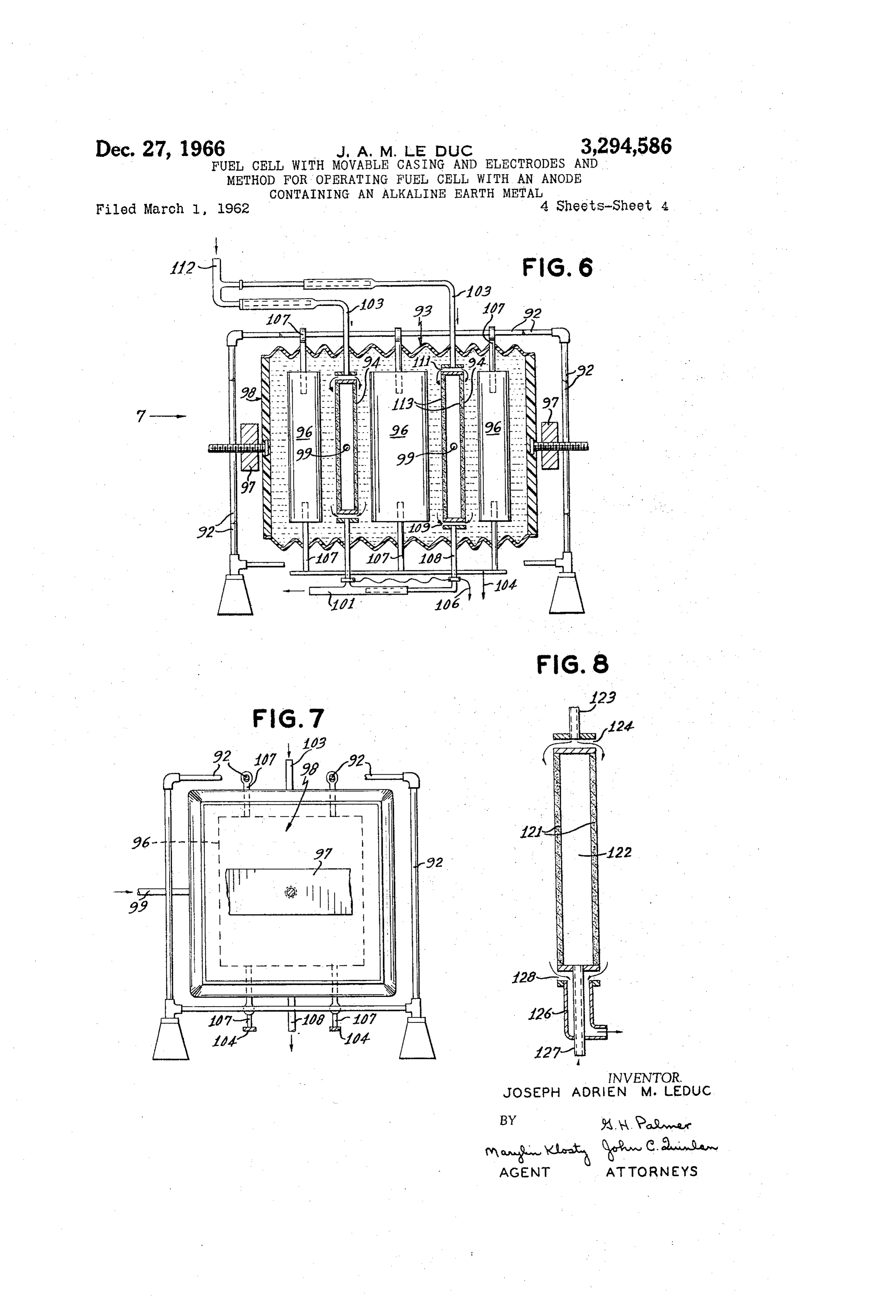
ing fuel to the cell. In accordance with this embodi As the barium metal is consumed, pressure is exerted ment of the present invention, the cell is charged with a by various means on plates 97 causing end plates 98 to predetermined quantity of barium in the form of solid move inwardly thereby also effectuating contraction of plates or blocks, the quantity being calculated accord 40 bellows 93 and concomitant movement of the electrodes ing to the power demand. As the electrochemical re inwardly. As noted above in connection with FIGURE actions proceed, barium metal is consumed by conversion 5, the displacement of the assembly can be monitored by to barium ions and the thickness of the block of fuel is a sensing device located between the electrodes which, decreased while the gap of electrolyte between the fuel upon demand, are moved accordingly. The fuel and gas electrode and the gas diffusion electrode is correspond 45 electrodes are connected to flexible and movable bus bars ingly increased. The gap of electrolyte is usually main 104 and 96, respectively, by means of which current is tained between about 0.07 and about 0.25 inch. As the withdrawn from the cell.
barium metal is consumed the blocks of barium are The accompanying FIGURE 7 is an end view of the moved by mechanical or motor-driven means towards the cell illustrated in FIGURE 6, the numerals being the gas diffusion electrodes in order to maintain the distance same as those employed to designate the corresponding between them. The displacement of the electrodes can be 50 parts shown in side elevation.
monitored by a sensing device located between the elec As shown in detail in FIGURE 6, gas diffusion elec trodes which, upon demand (external load, gap or elec trodes 94 comprise: an inner hollow section to which trolyte), is moved accordingly. A constant displace gaseous oxidant is fed through inlet 99 leading into the ment is effectuated when the external load is constant. middle section of the electrode, the two electroconductive This particular embodiment of the present invention is 55 porous surfaces 143, upper section 103 through which illustrated by the accompanying FIGURES 5 and 6, , electrolyte is fed from distributing manifold 112 and which illustrate two means of accomplishing movement from which electrolyte passes into the cell through aper of the electrodes, namely, by the sliding assembly of FIG tures 11, and a lower section 108 having apertures 109 URE 5 and the accordion-like cell shown in FIGURE 6. 60 through which electrolyte flows and passes out of the The cell illustrated by FIGURE 5 comprises fuel elec cell and into electrolyte outlet manifold 101. As shown trodes 71 in the form of solid blocks of barium having in FIGURE 6, the upper and lower apertures 111 and positioned therebetween gas diffusion electrodes 73 which 109, respectively, of gas electrodes 94 may either be are fed with oxidant by means of inlet 79. Electrolyte is aligned with the fuel electrodes as shown by electrode 94 fed to the cell by means of inlet manifold 75 which is 65 positioned to the left of the center fuel electrode, or above fed electrolyte from source 76. and below the fuel electrode as shown by the electrode The casing of the cell body comprises walls 82 and 84 positioned to the right of the center fuel electrode. The which enclose the inner movable walls 74. To accom latter type of electrode is usually preferred inasmuch as it plish movement of the electrodes as the barium fuel is allows operation of the gas diffusion electrode at a cur consumed, pressure is exerted on inner section 74 by 70 rent density approximately equivalent to that of the fuel mechanical or electrically driven means causing section electrode. This type of gas electrode which has the addi 74 to move inwardly thereby also moving the fuel elec tional function of serving as the inlet and outlet for elec trodes along the upper part of the cell casing 82. Addi trolyte is particularly suitable for the type of fuel cell tional support is provided for barium electrodes 71 by illustrated by FIGURES 5 and 6 It is to be understood, connecting them to lower casing 82 in which event the 75 however, that such gas diffusion electrodes may also be
Page 9
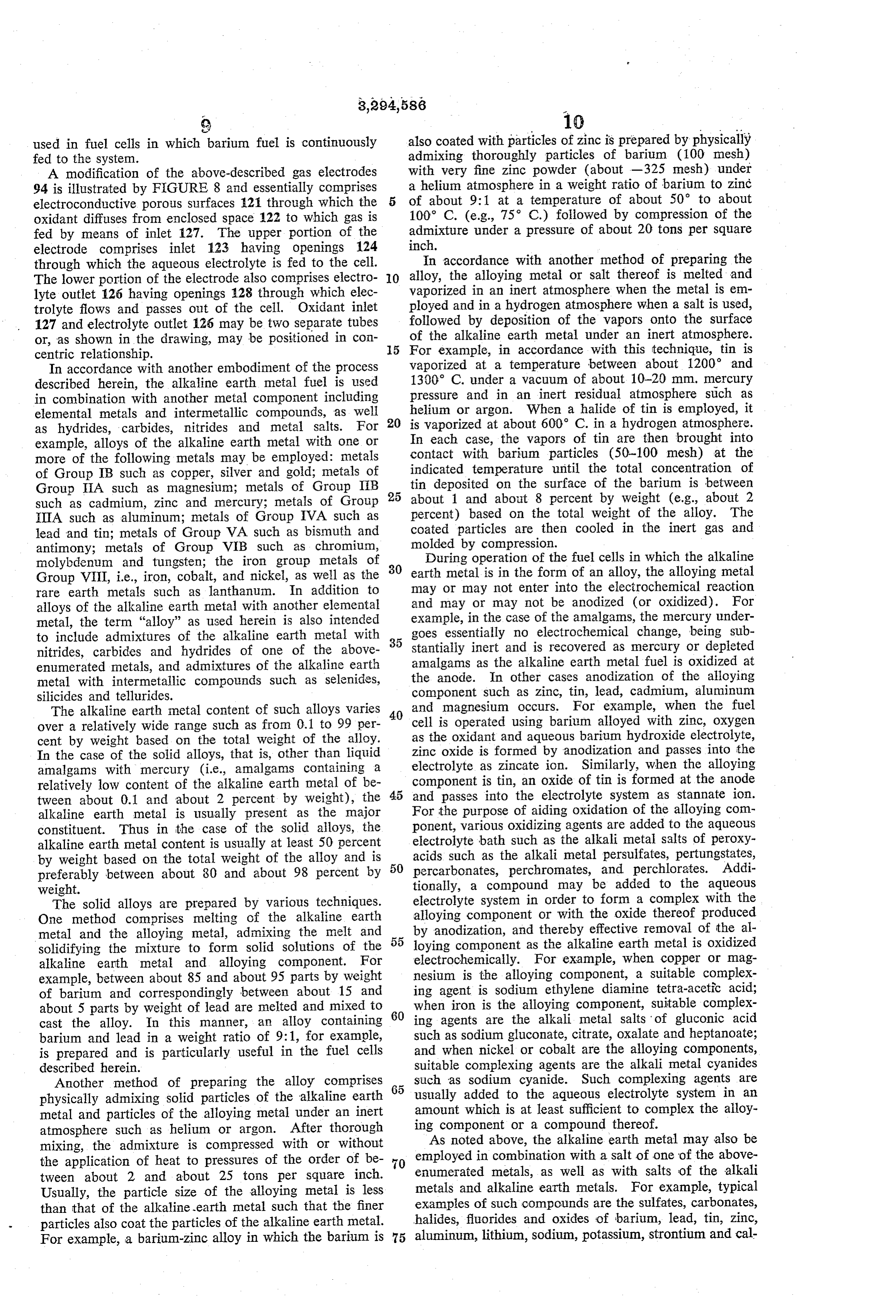
used in fuel cells in which barium fuel is continuously also coated with particles of zinc is prepared by physically fed to the system. admixing thoroughly particles of barium (100 mesh) A modification of the above-described gas electrodes with very fine zinc powder (about -325 mesh) under 94 is illustrated by FIGURE 8 and essentially comprises a helium atmosphere in a weight ratio of barium to zinc electroconductive porous surfaces 121 through which the of about 9:1 at a temperature of about 50 to about oxidant diffuses from enclosed space 122 to which gas is 100° C. (e.g., 75 C.) followed by compression of the fed by means of inlet 127. The upper portion of the admixture under a pressure of about 20 tons per square electrode comprises inlet 123 having openings 124 inch.
through which the aqueous electrolyte is fed to the cell. In accordance with another method of preparing the The lower portion of the electrode also comprises electro 0 alloy, the alloying metal or salt thereof is melted and lyte outlet 126 having openings 128 through which elec vaporized in an inert atmosphere when the metal is em trolyte flows and passes out of the cell. Oxidant inlet ployed and in a hydrogen atmosphere when a salt is used, 127 and electrolyte outlet 126 may be two separate tubes followed by deposition of the vapors onto the surface or, as shown in the drawing, may be positioned in con 5 of the alkaline earth metal under an inert atmosphere. centric relationship. For example, in accordance with this technique, tin is In accordance with another embodiment of the process vaporized at a temperature between about 1200 and described herein, the alkaline earth metal fuel is used 1300° C. under a vacuum of about 10-20 mm. mercury in combination with another metal component including pressure and in an inert residual atmosphere such as elemental metals and intermetallic compounds, as well 20 helium or argon. When a halide of tin is employed, it as hydrides, carbides, nitrides and metal salts. For is vaporized at about 600 C. in a hydrogen atmosphere. example, alloys of the alkaline earth metal with one or In each case, the vapors of tin are then brought into more of the following metals may be employed: metals indicated contact with barium particles (50-100 mesh) at the of Group IB such as copper, silver and gold; metals of temperature until the total concentration of Group IIA such as magnesium; metals of Group IIB 25 tin deposited on the surface of the barium is between such as cadmium, zinc and mercury; metals of Group about 1 and about 8 percent by weight (e.g., about 2 IIIA such as aluminum; metals of Group IVA such as percent) based on the total weight of the alloy. The lead and tin; metals of Group VA such as bismuth and coated particles are then cooled in the inert gas and antimony; metals of Group VIB such as chromium, molded by compression.
molybdenum and tungsten; the iron group metals of 30 During operation of the fuel cells in which the alkaline Group VIII, i.e., iron, cobalt, and nickel, as well as the earth metal is in the form of an alloy, the alloying metal rare earth metals such as lanthanum. In addition to may or may not enter into the electrochemical reaction alloys of the alkaline earth metal with another elemental and may or may not be anodized (or oxidized). For metal, the term “alloy' as used herein is also intended example, in the case of the amalgams, the mercury under to include admixtures of the alkaline earth metal with 35 goes essentially no electrochemical change, being sub nitrides, carbides and hydrides of one of the above stantially inert and is recovered as mercury or depleted enumerated metals, and admixtures of the alkaline earth amalgams as the alkaline earth metal fuel is oxidized at metal with intermetallic compounds such as selenides, the anode. In other cases anodization of the alloying silicides and tellurides. component such as zinc, tin, lead, cadmium, aluminum The alkaline earth metal content of such alloys varies 40 and magnesium occurs. For example, when the fuel over a relatively wide range such as from 0.1 to 99 per cell is operated using barium alloyed with zinc, oxygen cent by weight based on the total weight of the alloy. as the oxidant and aqueous barium hydroxide electrolyte, In the case of the solid alloys, that is, other than liquid Zinc oxide is formed by anodization and passes into the amalgams with mercury (i.e., amalgams containing a electrolyte as zincate ion. Similarly, when the alloying relatively low content of the alkaline earth metal of be component is tin, an oxide of tin is formed at the anode tween about 0.1 and about 2 percent by weight), the 45 and passes into the electrolyte system as stannate ion. alkaline earth metal is usually present as the major For the purpose of aiding oxidation of the alloying com constituent. Thus in the case of the solid alloys, the ponent, various oxidizing agents are added to the aqueous alkaline earth metal content is usually at least 50 percent electrolyte bath such as the alkali metal salts of peroxy acids such as the alkali metal persulfates, pertungstates, by weight based on the total weight of the alloy and is 50 percarbonates, preferably between about 80 and about 98 percent by perchromates, and perchlorates. Addi weight. tionally, a compound may be added to the aqueous The solid alloys are prepared by various techniques. electrolyte system in order to form a complex with the One method comprises melting of the alkaline earth alloying component or with the oxide thereof produced metal and the alloying metal, admixing the melt and by anodization, and thereby effective removal of the al solidifying the mixture to form solid solutions of the 55 loying component as the alkaline earth metal is oxidized alkaline earth metal and alloying component. For nesium electrochemically. For example, when copper or mag example, between about 85 and about 95 parts by weight is the alloying component, a suitable complex of barium and correspondingly between about 15 and ing agent is sodium ethylene diamine tetra-acetic acid; about 5 parts by weight of lead are melted and mixed to when iron is the alloying component, suitable complex cast the alloy. In this manner, an alloy containing 60 ing agents are the alkali metal salts of gluconic acid barium and lead in a weight ratio of 9:1, for example, such as sodium gluconate, citrate, oxalate and heptanoate; is prepared and is particularly useful in the fuel cells and when nickel or cobalt are the alloying components, described herein. suitable complexing agents are the alkali metal cyanides Another method of preparing the alloy comprises Such as sodium cyanide. Such complexing agents are physically admixing solid particles of the alkaline earth usually added to the aqueous electrolyte system in an metal and particles of the alloying metal under an inert amount which is at least sufficient to complex the alloy atmosphere such as helium or argon. After thorough ing component or a compound thereof. mixing, the admixture is compressed with or without As noted above, the alkaline earth metal may also be the application of heat to pressures of the order of be 70 employed in combination with a salt of one of the above tween about 2 and about 25 tons per square inch. enumerated metals, as well as with salts of the alkali Usually, the particle size of the alloying metal is less metals and alkaline earth metals. For example, typical than that of the alkaline earth metal such that the finer examples of such compounds are the sulfates, carbonates, particles also coat the particles of the alkaline earth metal. halides, fluorides and oxides of barium, lead, tin, zinc, For example, a barium-zinc alloy in which the barium is 75 aluminum, lithium, sodium, potassium, strontium and cal
Page 10
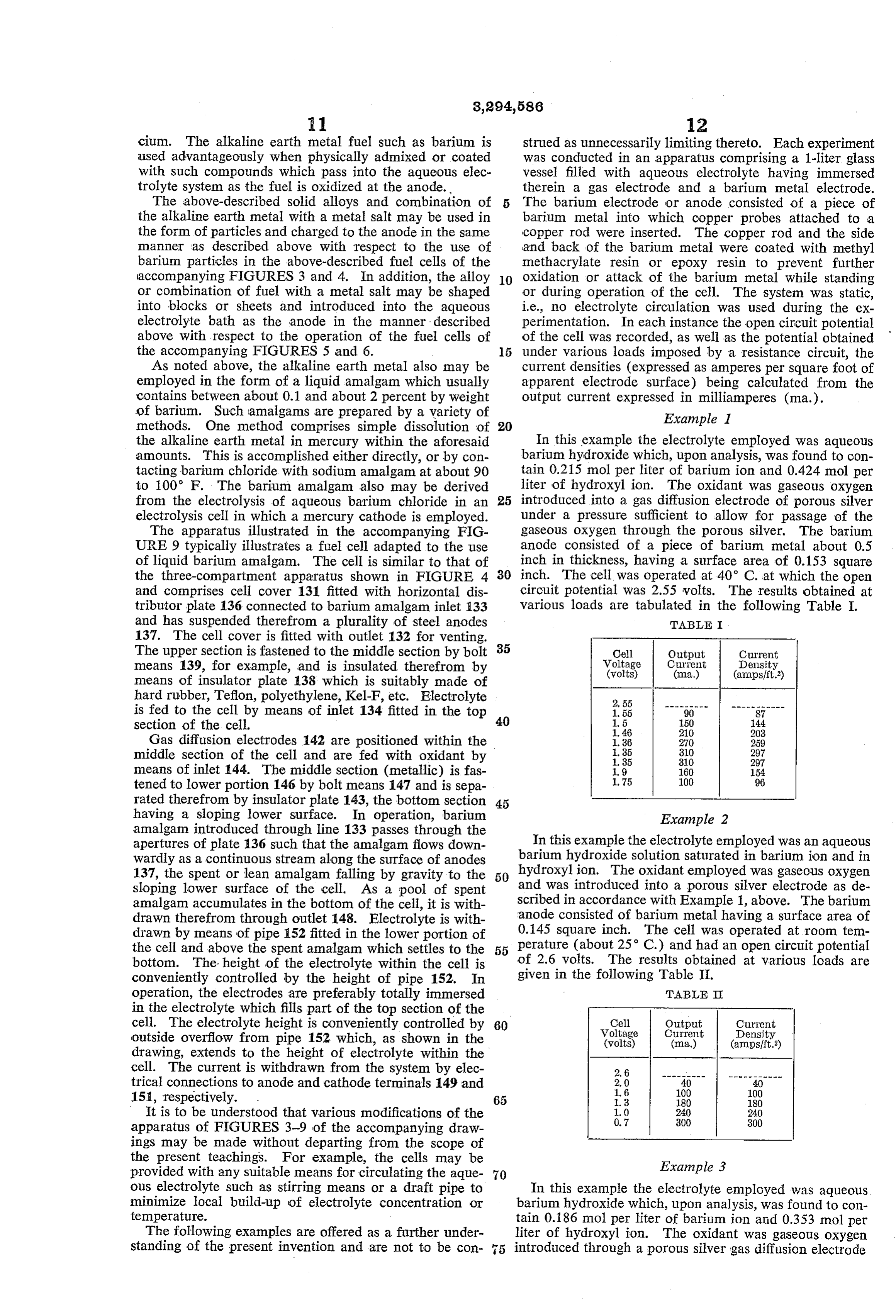
cium. The alkaline earth metal fuel such as barium is strued as unnecessarily limiting thereto. Each experiment used advantageously when physically admixed or coated was conducted in an apparatus comprising a 1-liter glass with such compounds which pass into the aqueous elec vessel filled with aqueous electrolyte having immersed trolyte system as the fuel is oxidized at the anode. therein a gas electrode and a barium metal electrode. The above-described solid alloys and combination of The barium electrode or anode consisted of a piece of the alkaline earth metal with a metal salt may be used in barium metal into which copper probes attached to a the form of particles and charged to the anode in the same copper rod were inserted. The copper rod and the side manner as described above with respect to the use of and back of the barium metal were coated with methyl barium particles in the above-described fuel cells of the methacrylate resin or epoxy resin to prevent further accompanying FIGURES 3 and 4. In addition, the alloy 10 oxidation or attack of the barium metal while standing or combination of fuel with a metal salt may be shaped or during operation of the cell. The system was static, into blocks or sheets and introduced into the aqueous i.e., no electrolyte circulation was used during the ex electrolyte bath as the anode in the manner described perimentation. In each instance the open circuit potential above with respect to the operation of the fuel cells of of the cell was recorded, as well as the potential obtained the accompanying FIGURES 5 and 6. 5 under various loads imposed by a resistance circuit, the As noted above, the alkaline earth metal also may be current densities (expressed as amperes per square foot of employed in the form of a liquid amalgam which usually apparent electrode surface) being calculated from the contains between about 0.1 and about 2 percent by weight output current expressed in milliamperes (ma.). gf barium. Such amalgams are prepared by a variety of Example I methods. One method comprises simple dissolution of 20 the alkaline earth metal in mercury within the aforesaid In this example the electrolyte employed was aqueous amounts. This is accomplished either directly, or by con barium hydroxide which, upon analysis, was found to con tacting barium chloride with sodium amalgam at about 90 tain 0.215 mol per liter of barium ion and 0.424 mol per to 100 F. The barium amalgam also may be derived liter of hydroxyl ion. The oxidant was gaseous oxygen from the electrolysis of aqueous barium chloride in an 25 introduced into a gas diffusion electrode of porous silver electrolysis cell in which a mercury cathode is employed. under a pressure sufficient to allow for passage of the The apparatus illustrated in the accompanying FIG gaseous oxygen through the porous silver. The barium URE 9 typically illustrates a fuel cell adapted to the use anode consisted of a piece of barium metal about 0.5 of liquid barium amalgam. The cell is similar to that of inch in thickness, having a surface area of 0.153 square the three-compartment apparatus shown in FIGURE 4 30 inch. The cell was operated at 40° C. at which the open and comprises cell cover 131 fitted with horizontal dis circuit potential was 2.55 volts. The results obtained at tributor plate 136 connected to barium amalgam inlet 133 various loads are tabulated in the following Table I. and has suspended therefrom a plurality of steel anodes TABLE I 137. The cell cover is fitted with outlet 132 for venting.
The upper section is fastened to the middle section by bolt 35 Cell
Voltage
Output
Current
Current
Density means 139, for example, and is insulated therefrom by (volts) (ma.) (ampsfift.2) means of insulator plate 138 which is suitably made of hard rubber, Teflon, polyethylene, Kel-F, etc. Electrolyte 2.55 --------- ----------- is fed to the cell by means of inlet 134 fitted in the top 40 55 90 87 section of the cell. 1, 5
Gas diffusion electrodes 142 are positioned within the 36
middle section of the cell and are fed with oxidant by 1.35 30 297 means of inlet 144. The middle section (metallic) is fas .9
tened to lower portion 146 by bolt means 147 and is sepa rated therefrom by insulator plate 143, the bottom section having a sloping lower surface. In operation, barium Example 2 amalgam introduced through line 133 passes through the apertures of plate 136 such that the amalgam flows down In this example the electrolyte employed was an aqueous wardly as a continuous stream along the surface of anodes barium hydroxide solution saturated in barium ion and in 137, the spent or lean amalgam falling by gravity to the 50 hydroxyl ion. The oxidant employed was gaseous oxygen sloping lower surface of the cell. As a pool of spent and was introduced into a porous silver electrode as de amalgam accumulates in the bottom of the cell, it is with scribed in accordance with Example 1, above. The barium drawn therefrom through outlet 148. Electrolyte is with anode consisted of barium metal having a surface area of drawn by means of pipe i52 fitted in the lower portion of 0.145 square inch. The cell was operated at room tem the cell and above the spent amalgam which settles to the 55 perature (about 25 C.) and had an open circuit potential bottom. The height of the electrolyte within the cell is of 2.6 volts. The results obtained at various loads are conveniently controlled by the height of pipe 152. In given in the following Table II. operation, the electrodes are preferably totally immersed - TABLE in the electrolyte which fills part of the top section of the cell. The electrolyte height is conveniently controlled by 60 Cell
Woltage
Output
Current
Current
Density outside overflow from pipe 152 which, as shown in the (volts) (ma.) (ampsfift.2) drawing, extends to the height of electrolyte within the cell. The current is withdrawn from the system by elec 2.6 --------- ----------- trical connections to anode and cathode terminals 149 and 2.0 40 40 151, respectively. 16 100 100
It is to be understood that various modifications of the 0 240 240
apparatus of FIGURES 3-9 of the accompanying draw ings may be made without departing from the scope of the present teachings. For example, the cells may be Example 3 provided with any suitable means for circulating the aque ous electrolyte such as stirring means or a draft pipe to In this example the electrolyte employed was aqueous minimize local build-up of electrolyte concentration or barium hydroxide which, upon analysis, was found to con temperature. tain 0.186 mol per liter of barium ion and 0.353 mol per The following examples are offered as a further under liter of hydroxyl ion. The oxidant was gaseous oxygen standing of the present invention and are not to be con- 5 introduced through a porous silver gas diffusion electrode
Page 11
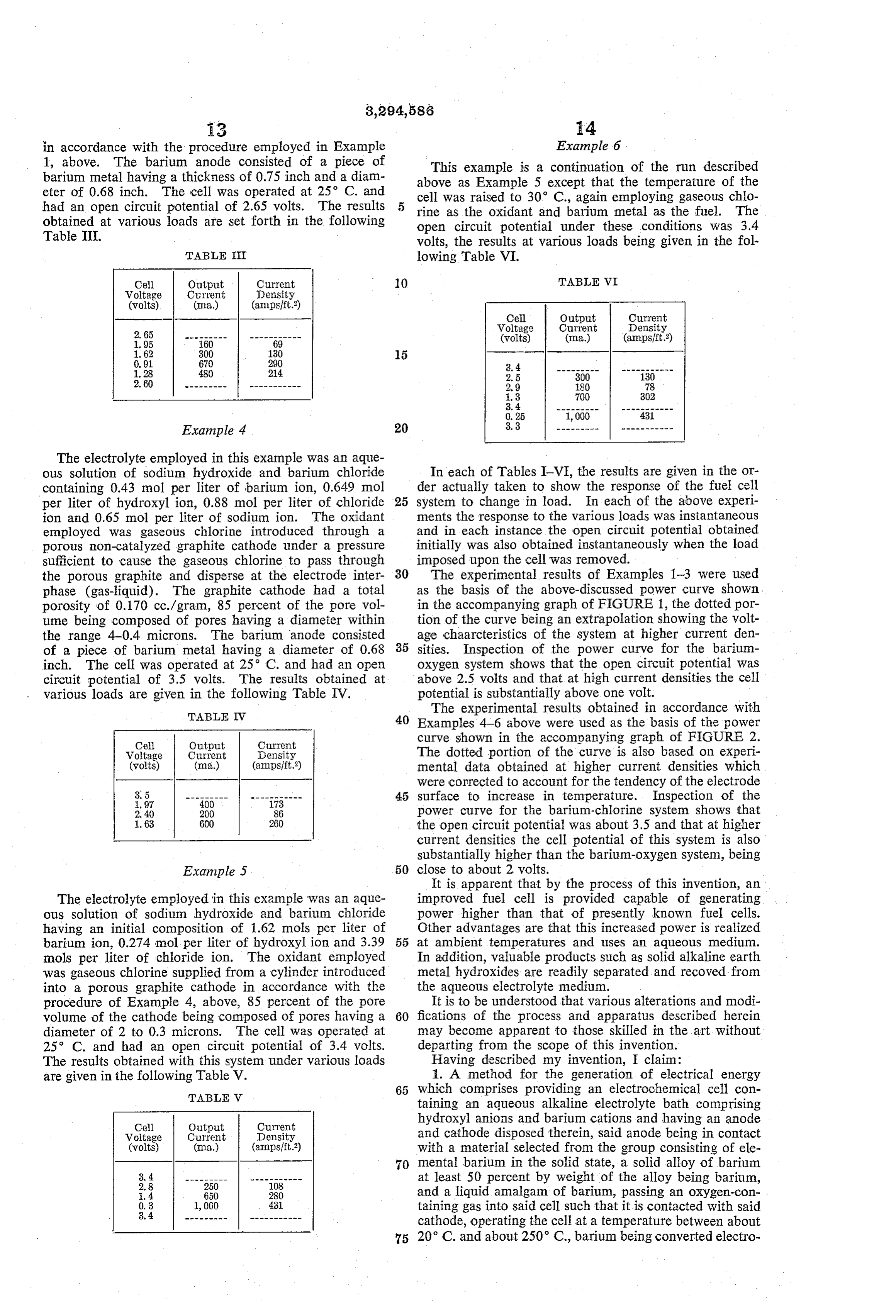
in accordance with the procedure employed in Example Example 6 1, above. The barium anode consisted of a piece of This example is a continuation of the run described barium metal having a thickness of 0.75 inch and a diam above as Example 5 except that the temperature of the eter of 0.68 inch. The cell was operated at 25° C. and cell was raised to 30° C., again employing gaseous chlo had an open circuit potential of 2.65 volts. The results 5 rine as the oxidant and barium metal as the fuel. The obtained at various loads are set forth in the following open circuit potential under these conditions was 3.4 Table III. volts, the results at various loads being given in the fol
Cell Output Current 10 TABLE WI
Woltage Current Density
Cell Output Current
Woltage Current Density 2.65 --------- ----------- (volts) (ma.) (ampsfift.2)
0.91 670 290 8.4 --------- -----------
2.60 --------- ----------- 2.9 80 78
Example 4 20 3.8 --------- -----------
The electrolyte employed in this example was an aque ous solution of sodium hydroxide and barium chloride In each of Tables I-VI, the results are given in the or containing 0.43 mol per liter of barium ion, 0.649 mol der actually taken to show the response of the fuel cell per liter of hydroxyl ion, 0.88 mol per liter of chloride 25 system to change in load. In each of the above experi ion and 0.65 mol per liter of sodium ion. The oxidant ments the response to the various loads was instantaneous employed was gaseous chlorine introduced through a and in each instance the open circuit potential obtained porous non-catalyzed graphite cathode under a pressure initially was also obtained instantaneously when the load sufficient to cause the gaseous chlorine to pass through imposed upon the cell was removed. the porous graphite and disperse at the electrode inter 30 The experimental results of Examples 1-3 were used phase (gas-liquid). The graphite cathode had a total as the basis of the above-discussed power curve shown. porosity of 0.170 cc./gram, 85 percent of the pore vol in the accompanying graph of FIGURE 1, the dotted por ume being composed of pores having a diameter within tion of the curve being an extrapolation showing the volt the range 4-0.4 microns. The barium anode consisted age chaarcteristics of the system at higher current den of a piece of barium metal having a diameter of 0.68 35 sities. Inspection of the power curve for the barium inch. The cell was operated at 25° C. and had an open oxygen system shows that the open circuit potential was circuit potential of 3.5 volts. The results obtained at above 2.5 volts and that at high current densities the cell various loads are given in the following Table IV. potential is substantially above one volt.
TABLE TV
The experimental results obtained in accordance with 40 Examples 4-6 above were used as the basis of the power
Cell Output Current curve shown in the accompanying graph of FIGURE 2. Voltage Current Density The dotted portion of the curve is also based on experi (volts) (ma.) (ampsift.2) mental data obtained at higher current densities which were corrected to account for the tendency of the electrode 3.5 ! --------- ----------- 45 surface to increase in temperature. Inspection of the
2, 40 200 86 power curve for the barium-chlorine system shows that 1.63 600 260 the open circuit potential was about 3.5 and that at higher current densities the cell potential of this system is also substantially higher than the barium-oxygen system, being
It is apparent that by the process of this invention, an
The electrolyte employed in this example was an aque improved fuel cell is provided capable of generating ous solution of sodium hydroxide and barium chloride power higher than that of presently known fuel cells. having an initial composition of 1.62 mols per liter of Other advantages are that this increased power is realized barium ion, 0.274 mol per liter of hydroxyl ion and 3.39 55 at ambient temperatures and uses an aqueous medium. mols per liter of chloride ion. The oxidant employed In addition, valuable products such as solid alkaline earth was gaseous chlorine supplied from a cylinder introduced metal hydroxides are readily separated and recoved from into a porous graphite cathode in accordance with the the aqueous electrolyte medium. procedure of Example 4, above, 85 percent of the pore It is to be understood that various alterations and modi volume of the cathode being composed of pores having a 60 fications of the process and apparatus described herein diameter of 2 to 0.3 microns. The cell was operated at may become apparent to those skilled in the art without 25 C. and had an open circuit potential of 3.4 volts. departing from the scope of this invention. The results obtained with this system under various loads Having described my invention, I claim: are given in the following Table V. 1. A method for the generation of electrical energy 65 which comprises providing an electrochemical cell con
TABLEV taining an aqueous alkaline electrolyte bath comprising Cell Output Current hydroxyl anions and barium cations and having an anode Woltage Current Density and cathode disposed therein, said anode being in contact (volts) (ma.) (ampsfift.) with a material selected from the group consisting of ele 70 mental barium in the solid state, a solid alloy of barium
at least 50 percent by weight of the alloy being barium, .. 4 650 280 and a liquid amalgam of barium, passing an oxygen-con
taining gas into said cell such that it is contacted with said cathode, operating the cell at a temperature between about 75 20° C. and about 250 C., barium being converted electro
Page 12
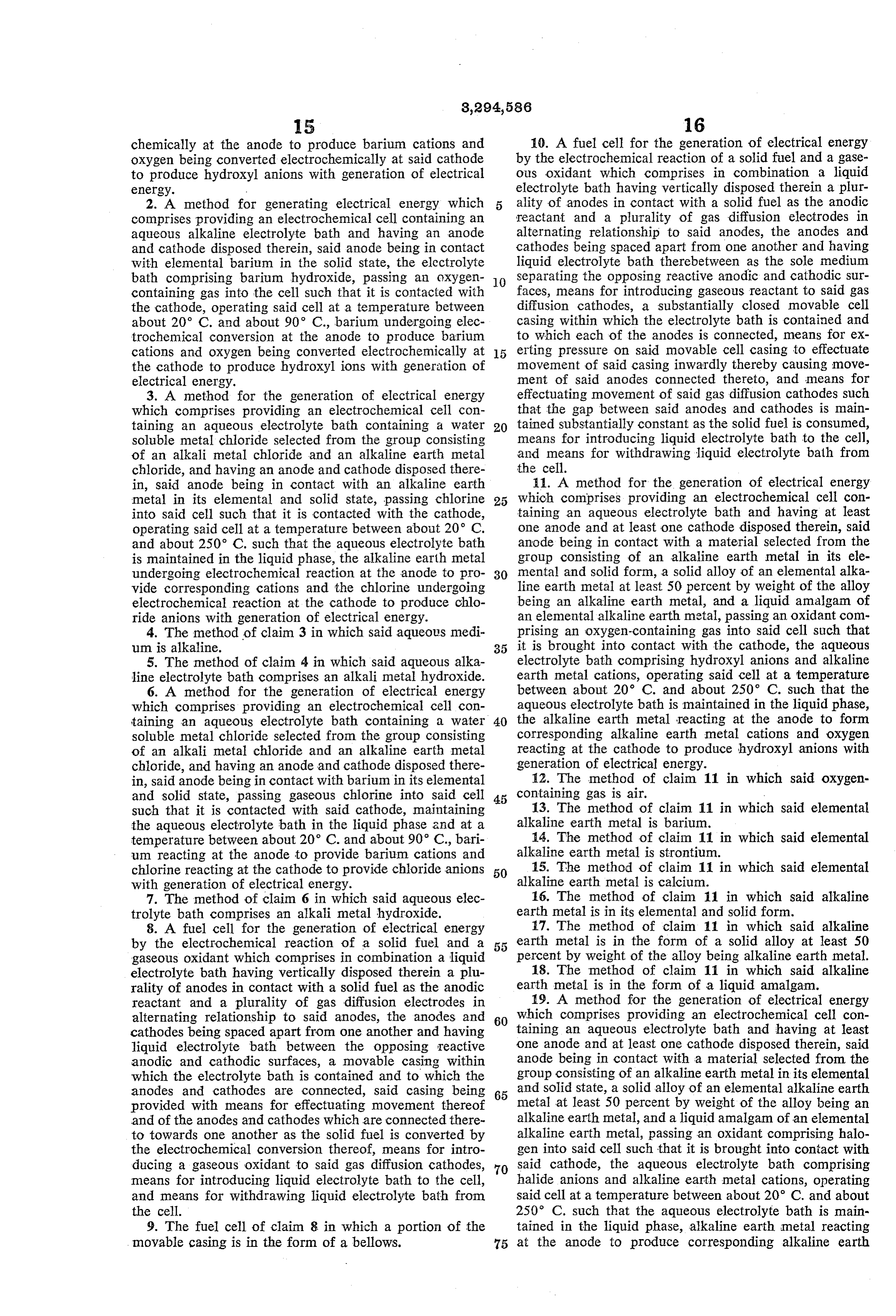
chemically at the anode to produce barium cations and 10. A fuel cell for the generation of electrical energy oxygen being converted electrochemically at said cathode by the electrochemical reaction of a solid fuel and a gase to produce hydroxyl anions with generation of electrical ous oxidant which comprises in combination a liquid energy. electrolyte bath having vertically disposed therein a plur 2. A method for generating electrical energy which ality of anodes in contact with a solid fuel as the anodic comprises providing an electrochemical cell containing an reactant and a plurality of gas diffusion electrodes in aqueous alkaline electrolyte bath and having an anode alternating relationship to said anodes, the anodes and and cathode disposed therein, said anode being in contact cathodes being spaced apart from one another and having with elemental barium in the solid state, the electrolyte liquid electrolyte bath therebetween as the sole medium bath comprising barium hydroxide, passing an oxygen 10 separating the opposing reactive anodic and cathodic sur containing gas into the cell such that it is contacted with faces, means for introducing gaseous reactant to said gas the cathode, operating said cell at a temperature between diffusion cathodes, a substantially closed movable cell about 20° C. and about 90° C., barium undergoing elec casing within which the electrolyte bath is contained and trochemical conversion at the anode to produce barium to which each of the anodes is connected, means for ex cations and oxygen being converted electrochemically at 5 erting pressure on said movable cell casing to effectuate the cathode to produce hydroxyl ions with generation of movement of said casing inwardly thereby causing move electrical energy. ment of said anodes connected thereto, and means for 3. A method for the generation of electrical energy effectuating movement of said gas diffusion cathodes such which comprises providing an electrochemical cell con that the gap between said anodes and cathodes is main taining an aqueous electrolyte bath containing a water 20 tained substantially constant as the solid fuel is consumed, soluble metal chloride selected from the group consisting means for introducing liquid electrolyte bath to the cell, of an alkali metal chloride and an alkaline earth metal and means for withdrawing liquid electrolyte bath from chloride, and having an anode and cathode disposed there the cell.
in, said anode being in contact with an alkaline earth 1. A method for the generation of electrical energy metal in its elemental and solid state, passing chlorine 25 which comprises providing an electrochemical cell con into said cell such that it is contacted with the cathode, taining an aqueous electrolyte bath and having at least operating said cell at a temperature between about 20° C. one anode and at least one cathode disposed therein, said and about 250° C. such that the aqueous electrolyte bath anode being in contact with a material selected from the is maintained in the liquid phase, the alkaline earth metal group consisting of an alkaline earth metal in its ele undergoing electrochemical reaction at the anode to pro 30 mental and solid form, a solid alloy of an elemental alka vide corresponding cations and the chlorine undergoing line earth metal at least 50 percent by weight of the alloy electrochemical reaction at the cathode to produce chlo being an alkaline earth metal, and a liquid amalgam of ride anions with generation of electrical energy. an elemental alkaline earth metal, passing an oxidant com 4. The method of claim 3 in which said aqueous medi prising an oxygen-containing gas into said cell such that um is alkaline. 35 it is brought into contact with the cathode, the aqueous 5. The method of claim 4 in which said aqueous alka electrolyte bath comprising hydroxyl anions and alkaline line electrolyte bath comprises an alkali metal hydroxide. earth metal cations, operating said cell at a temperature 6. A method for the generation of electrical energy between about 20° C. and about 250° C. such that the which comprises providing an electrochemical cell con aqueous electrolyte bath is maintained in the liquid phase, taining an aqueous electrolyte bath containing a water 40 the alkaline earth metal reacting at the anode to form soluble metal chloride selected from the group consisting corresponding alkaline earth metal cations and oxygen of an alkali metal chloride and an alkaline earth metal reacting at the cathode to produce hydroxyl anions with chloride, and having an anode and cathode disposed there generation of electrical energy. in, said anode being in contact with barium in its elemental 2. The method of claim 11 in which said oxygen and solid state, passing gaseous chlorine into said cell 45 containing gas is air.
such that it is contacted with said cathode, maintaining 13. The method of claim 11 in which said elemental the aqueous electrolyte bath in the liquid phase and at a alkaline earth metal is barium. temperature between about 20° C. and about 90° C., bari 14. The method of claim 11 in which said elemental um reacting at the anode to provide barium cations and alkaline earth metal is strontium. chlorine reacting at the cathode to provide chloride anions 50 15. The method of claim 11 in which said elemental with generation of electrical energy. alkaline earth metal is calcium. 7. The method of claim 6 in which said aqueous elec 16. The method of claim 11 in which said alkaline trolyte bath comprises an alkali metal hydroxide. earth metal is in its elemental and solid form. 8. A fuel cell for the generation of electrical energy 17. The method of claim 11 in which said alkaline by the electrochemical reaction of a solid fuel and a earth metal is in the form of a solid alloy at least 50 gaseous oxidant which comprises in combination a liquid percent by weight of the alloy being alkaline earth metal. electrolyte bath having vertically disposed therein a plu 18. The method of claim 11 in which said alkaline rality of anodes in contact with a solid fuel as the anodic earth metal is in the form of a liquid amalgam. reactant and a plurality of gas diffusion electrodes in 19. A method for the generation of electrical energy alternating relationship to said anodes, the anodes and 60 which comprises providing an electrochemical cell con cathodes being spaced apart from one another and having taining an aqueous electrolyte bath and having at least liquid electrolyte bath between the opposing reactive one anode and at least one cathode disposed therein, said anodic and cathodic surfaces, a movable casing within anode being in contact with a material selected from the which the electrolyte bath is contained and to which the group consisting of an alkaline earth metal in its elemental anodes and cathodes are connected, said casing being 65 and Solid state, a solid alloy of an elemental alkaline earth provided with means for effectuating movement thereof metal at least 50 percent by weight of the alloy being an and of the anodes and cathodes which are connected there alkaline earth metal, and a liquid amalgam of an elemental to towards one another as the solid fuel is converted by alkaline earth metal, passing an oxidant comprising halo the electrochemical conversion thereof, means for intro gen into said cell such that it is brought into contact with ducing a gaseous oxidant to said gas diffusion cathodes, 70 said cathode, the aqueous electrolyte bath comprising means for introducing liquid electrolyte bath to the cell, halide anions and alkaline earth metal cations, operating and means for withdrawing liquid electrolyte bath from said cell at a temperature between about 20° C. and about the cell. 250 C. Such that the aqueous electrolyte bath is main 9. The fuel cell of claim 8 in which a portion of the tained in the liquid phase, alkaline earth metal reacting movable casing is in the form of a bellows. 75 at the anode to produce corresponding alkaline earth
Page 13
metal cations and halogen reacting at the cathode to pro References Cited by the Examiner duce halide anions with generation of electrical energy. UNITED STATES PATENTS 20. The method of claim 19 in which said elemental alkaline earth metal is barium. 852,464. 5/1907 Sokal ------------ 136-160.3 21. The method of claim 19 in which said elemental 1/1960 Crowley et al. -------- 136-86
alkaline earth metal is strontium. 2,976,342 Morehouse et al. ---- 136-86 X 22. The method of claim 19 in which said elemental 3,031,518 4/1962 Werner et al. -------- 136-86 alkaline earth metal is calcium. 3,043,898 7/1962 Miller et al.---------- 136-86 23. The method of claim 19 in which said halogen is OTHER REFERENCES
24. The method of claim 19 in which said alkaline Survey of State of the Art Fuel Cell Development, earth metal is in its elemental and solid form. Mar. 30, 1961, pp. 82-84.
25. The method of claim 19 in which said alkaline earth metal is in the form of a solid alloy at least 50 WINSTON A. DOUGLAS, Primary Examiner. percent by weight of the alloy being alkaline earth metal. 15 JOHN R. SPECK, ALLEN B. CURTIS, H. FEELEY, 26. The method of claim 19 in which said alkaline Examiners. earth metal is in the form of a liquid amalgam.

Provenance
- Collection
- Cited prior art
- Original PDF
- patentimages.storage.googleapis.com →
- Filed
- 1962-03-01
- Pages
- 13
- Method
- pdftotext (the PDF's own text layer) + pdftoppm 300dpi page scans
- Source
- Google Patents bibliographic record
- Granted
- 1966-12-27
- Inventors
- Duc Joseph Adrien M Le; Pullman Inc
- Transcribed from
- patentimages.storage.googleapis.com →