patent · US4407705
Production of negative ions of hydrogen
4 October 1983
Page 1 — bibliographic record
United States Patent (19) 11 4,407,705 Garscadden et al. (45) Oct. 4, 1983 54 PRODUCTION OF NEGATIVE ONS OF 4,220,510 9/1980 Brueck et al. ............... 204/1571 A
HYDROGEN
Primary Examiner-Howard S. Williams (75) Inventors: Alan Garscadden, Yellow Springs; Attorney, Agent, or Firm-Donald J. Singer; Bobby D. William F. Bailey; Gary L. Duke, Scearce both of Dayton, all of Ohio
73 Assignee: The United States of America as represented by the Secretary of the A process for generating negative ions of hydrogen Air Force, Washington, D.C. isotopes is described which comprises cooling the hy 21 Appl. No.: 263,629 drogen gas below 300 K., and preferably to about 200 K., vibrationally exciting the molecules of the gas, and 22 Filed: May 14, 1981 the dissociating the molecules by electron impact into 51 Int. Cl. ........................ B01J 19/08; B01J 19/12; neutral hydrogen atoms and negative hydrogen ions. BOJ 19/26 Alternatively, the gas may first be vibrationally excited 52) U.S.C. ............................................. 204/157. H by heating or the like, and then cooled translationally, 58 Field of Search ........................ 204/157.1 H, 164: for example, by rapid expansion prior to dissociation by 423/648 R electron impact. The processes of this invention are characterized by control of non-equilibrium conditions 56) References Cited to obtain large increases in dissociative attachment rates
4,092,405 5/1978 von Rosenberg et al. ... 204/157.1 A having a higher vibrational energy state.
4,176,025 11/1979 Chen et al. .................. 204/157. A 14 Claims, 7 Drawing Figures
GAS STORAGE
HEAT OR NOZZLE SEPARATOR / D SCHARGE EXPANS ON DS CHARGE
EXTRACTOR
EXTERNAL
ONZATION
Page 2
Drawing sheet — no readable text.
Page 3
Drawing sheet — no readable text.
Page 4
GAS STORAGE
HEAT SEPARATOR / EXCHANGER H DS CHARGE DSCHARGE EXTRACTOR
EXTERNA
ONZATION
HEAT OR NOZZLE SEPARATOR / DS CHARGE EXPANS ON DS CHARGE EXTRACTOR
EXTERNAL
ONZATION
Page 5
Drawing sheet — no readable text.
Page 6
These and other objects of the invention will become
PRODUCTION OF NEGATIVE ONS OF apparent as the description thereof proceeds.
HYDROGEN
SUMMARY OF THE INVENTION
RIGHTS OF THE GOVERNMENT 5 In accordance with the foregoing principles and ob The invention described herein may be manufactured negative jects of the present invention, a process for generating and used by or for the Government of the United States comprises ions of hydrogen isotopes is described which for all governmental purposes without the payment of preferably cooling the hydrogen gas below 300 K., and to about 200 K., vibrationally exciting the any royalty. O molecules of the gas, and then dissociating the mole BACKGROUND OF THE INVENTION cules by electron impact into neutral hydrogen atoms This invention relates generally to the field of pro and negative hydrogen ions. Alternatively, the gas may cesses for generating ionic particle beams, and more then becooled first vibrationally excited by heating or the like, and particularly to the field of processes for production of 15 pansion priortranslationally, for example, by rapid ex negative ions. Specifically, this invention comprises a processes of this invention are by to dissociation electron impact. The process for high efficiency production of negative ions of non-equilibrium conditions to obtain largebyincreases characterized control of hydrogen isotopes (protium, deuterium and tritium). in dissociative attachment rates by increasing popula Considerable interest exists for the production of tion of hydrogen gas molecules having a higher vibra intense beams of negative ions useful for such applica 20 tional energy state.
tions as low energy kinetic studies, material properties studies, high energy accelerator applications, produc EDESCRIPTION OF THE DRAWINGS tion of fast neutral beams for controlled thermonuclear The processes of this invention will be more clearly fusion studies, energy beam weapons devices, and other understood from the following detailed description of processes requiring directed energy beams. 25 specific embodiments thereof read in conjunction with Existing processes for producing negative ions fall the accompanying drawings wherein.
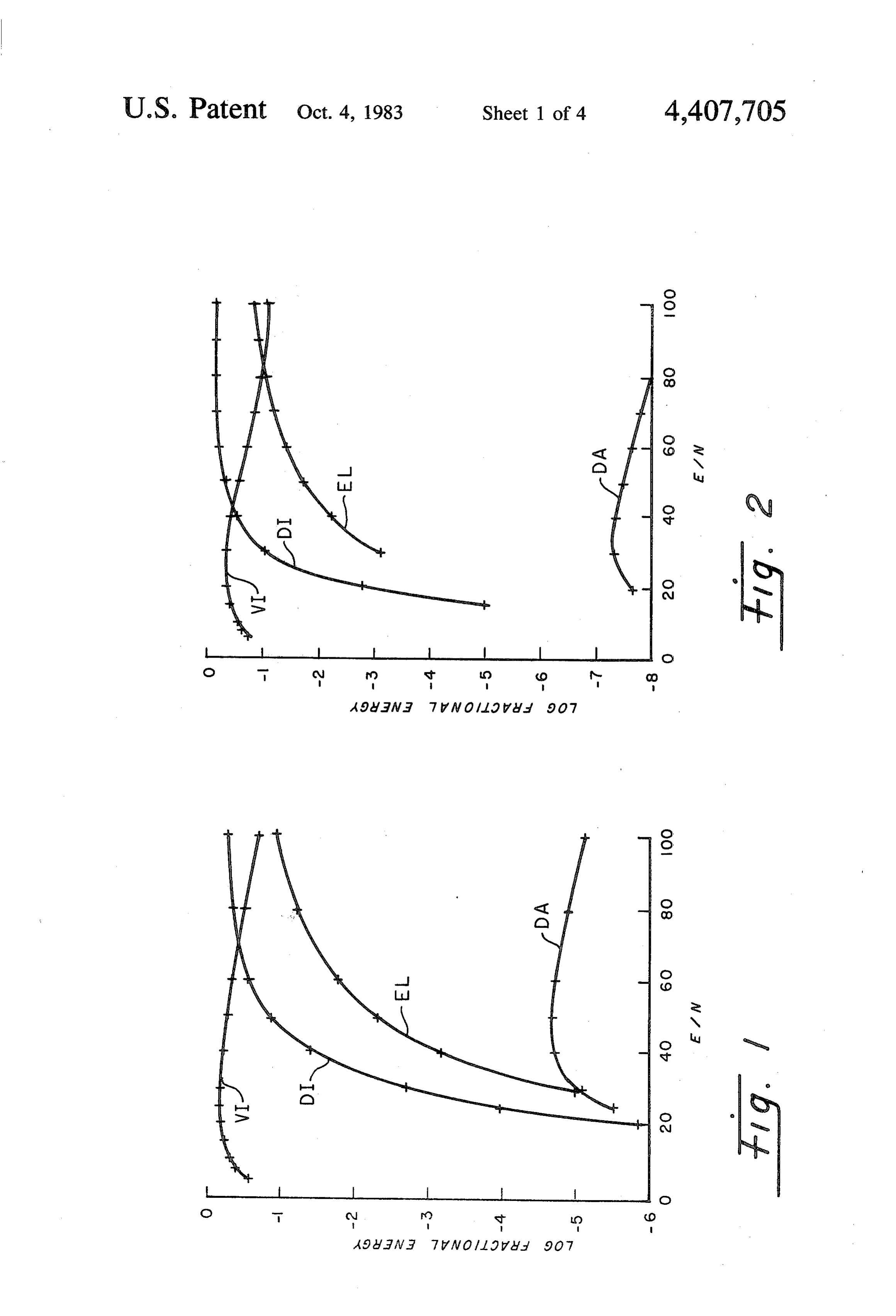
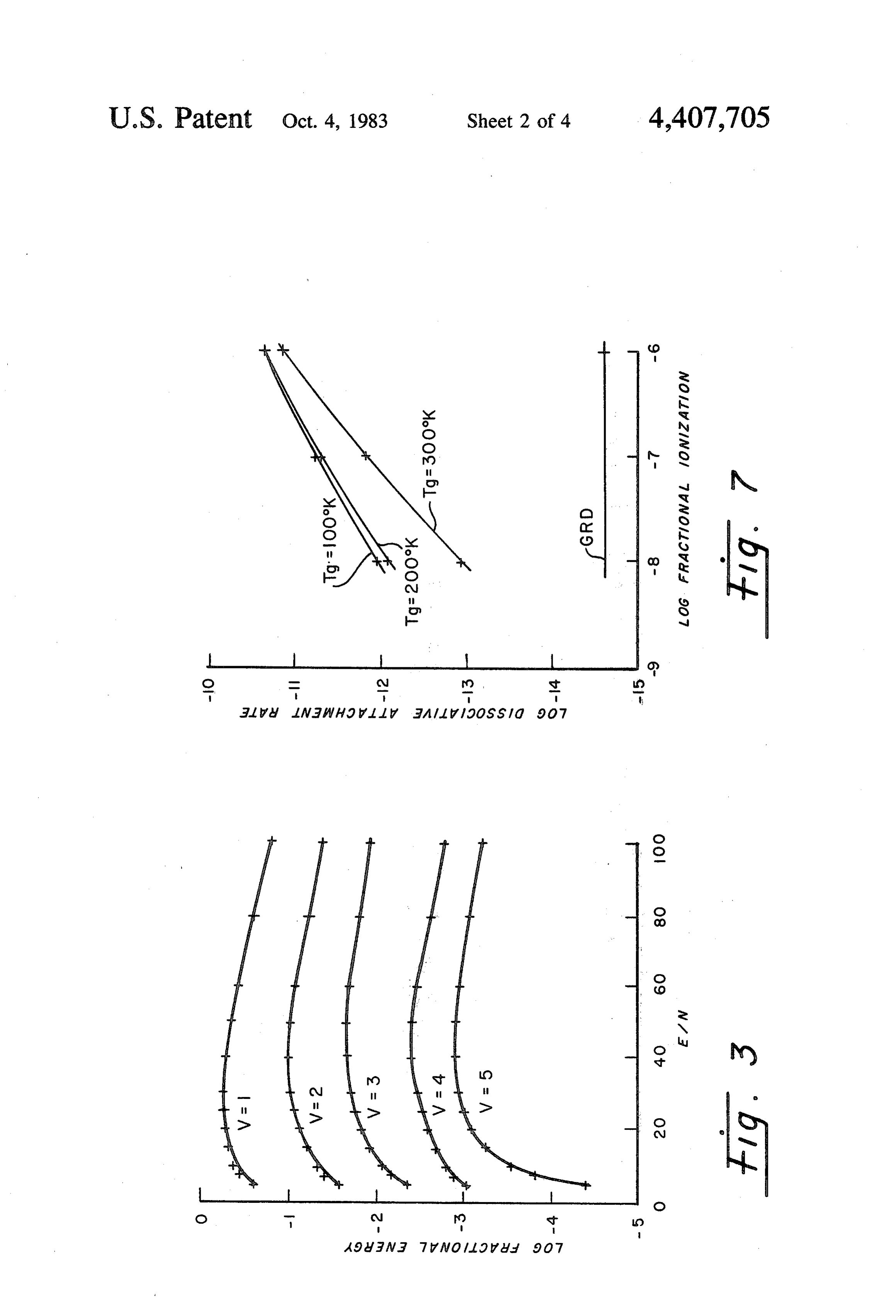
into four broad categories, including double charge FIG. 1 shows the calculated fractional energy deposi exchange for converting a positive ion beam into a tion as a function of E/N (volt.cm2) for hydrogen (pro negative ion beam, surface generated negative ions from tium) for various excitation channels of the molecule. charged particle bombardment, laser focus generation, 30 FIG. 2 shows fractional energy deposition versus and electrical discharge generation. E/N for deuterium.
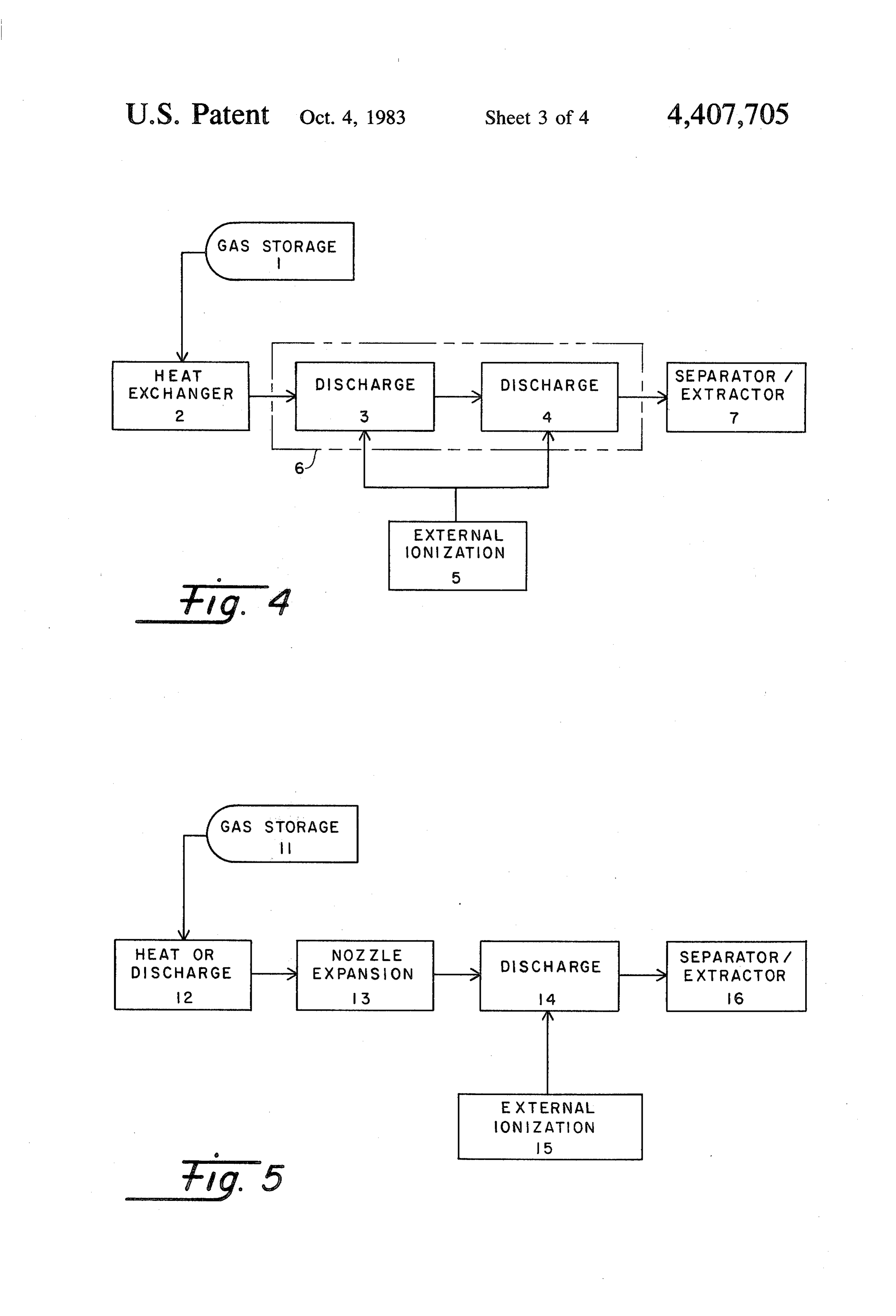
Prior art devices and method for the production of FIG. 3 shows the calculated fractional energy deposi negative ion beams are lacking in capability for generat tion into various vibrational energy states of the hydro ing beams of sufficient intensity suitable for applications gen molecule as a function of E/N. such as ion sources, or generation of fast neutral beams. 35 mentFIG. 4 is a schematic representation of one embodi Production of negatively charged hydrogen isotope of a process for generating negative hydrogen ions ions according to the present invention comprises the according to this invention. process of cooling (reducing the translational energy of) FIG. 5 is a schematic representation of an alternate molecular hydrogen gas to a temperature of about 200 40 FIG. 6 is a of embodiment a process of this invention.
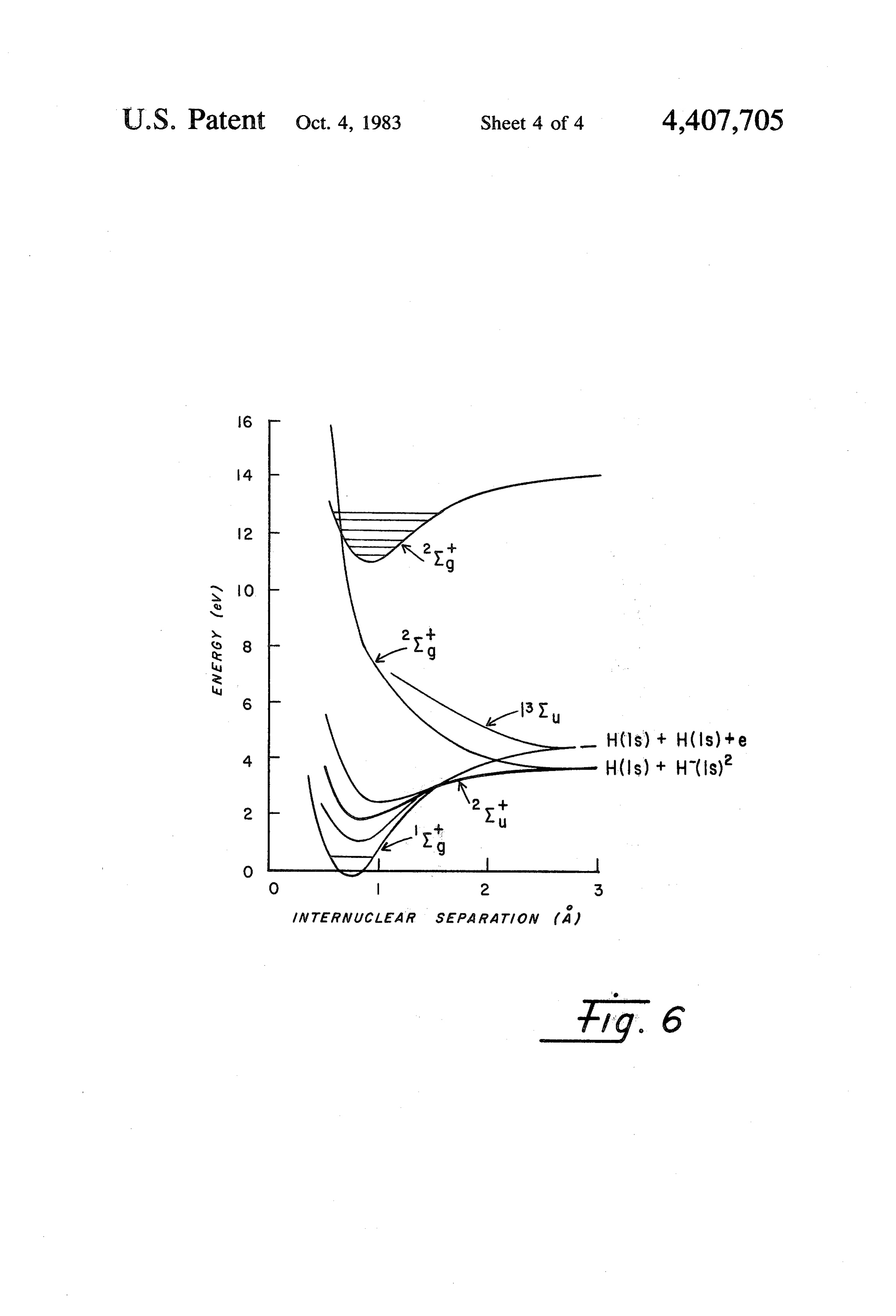
Kelvin; vibrationally exciting the molecules of the cule depictingpotential some energy diagram for the H2 mole negative ion states thereof, and the cooled gas by an excitation means, such as electrical discharge, electron beam, or laser irradiation; and disso products of some of the dissociating states. ciating the translationally cold and vibrationally excited tiveFIG. 7 is a graphical representation of the dissocia attachment rate as a function of fractional ioniza molecules by electron impact to form one neutral hy drogen atom and one negatively charged hydrogen ion 45 tionthe within a discharge for various gas temperatures of processes of this invention.
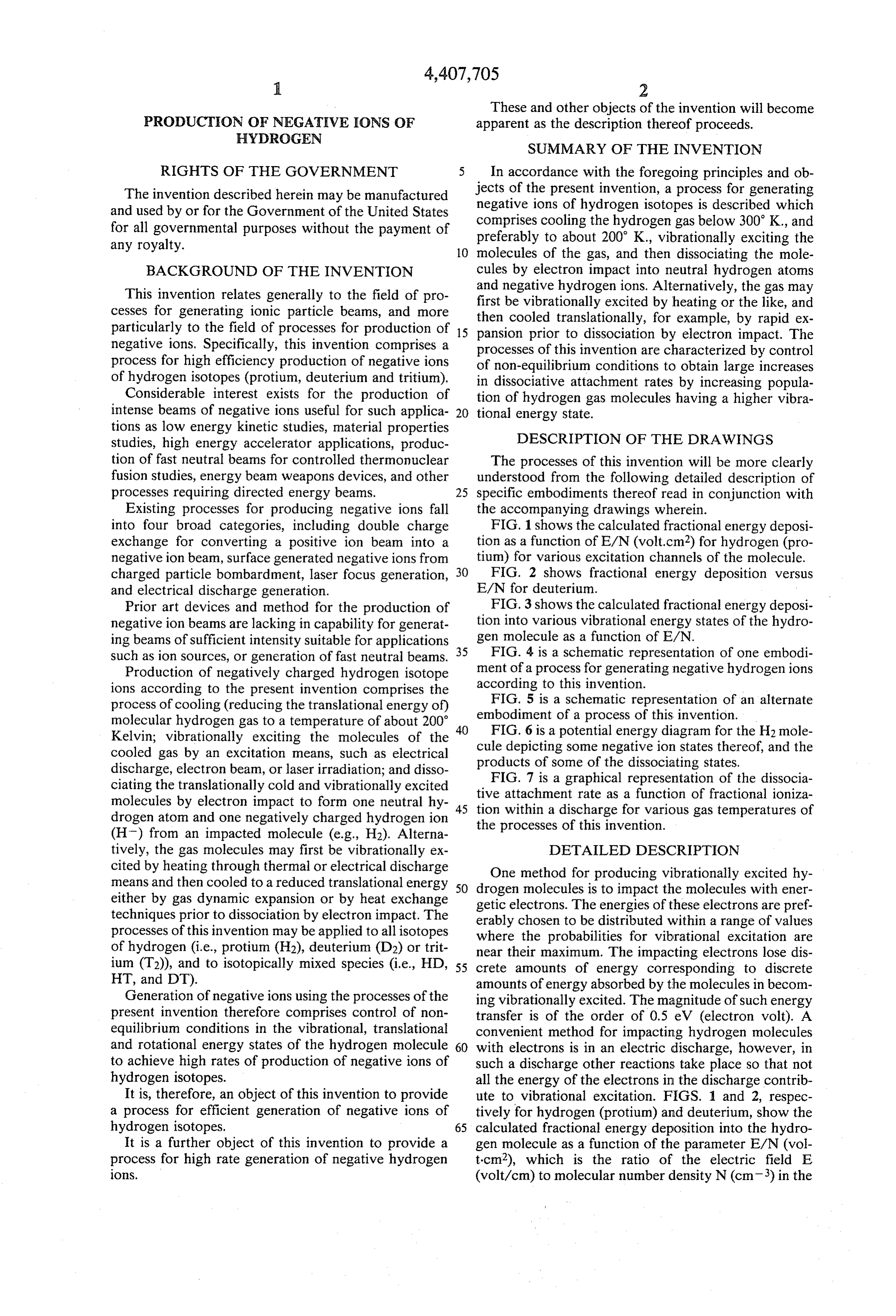
(H) from an impacted molecule (e.g., H2). Alterna tively, the gas molecules may first be vibrationally ex DETAILED DESCRIPTION cited by heating through thermal or electrical discharge One method for producing vibrationally excited hy means and then cooled to a reduced translational energy 50 drogen molecules is to impact the molecules with ener either by gas dynamic expansion or by heat exchange getic electrons. The energies of these electrons are pref techniques prior to dissociation by electron impact. The erably chosen to be distributed within a range of values processes of this invention may be applied to all isotopes where the probabilities for vibrational excitation are of hydrogen (i.e., protium (H2), deuterium (D2) or trit near their maximum. The impacting electrons lose dis ium (T2)), and to isotopically mixed species (i.e., HD, 55 crete amounts of energy corresponding to discrete HT, and DT). amounts of energy absorbed by the molecules in becom Generation of negative ions using the processes of the ing vibrationally excited. The magnitude of such energy present invention therefore comprises control of non transfer is of the order of 0.5 eV (electron volt). A equilibrium conditions in the vibrational, translational convenient method for impacting hydrogen molecules and rotational energy states of the hydrogen molecule 60 with electrons is in an electric discharge, however, in to achieve high rates of production of negative ions of such a discharge other reactions take place so that not hydrogen isotopes. all the energy of the electrons in the discharge contrib It is, therefore, an object of this invention to provide ute to vibrational excitation. FIGS. 1 and 2, respec a process for efficient generation of negative ions of tively for hydrogen (protium) and deuterium, show the hydrogen isotopes. 65 calculated fractional energy deposition into the hydro It is a further object of this invention to provide a gen molecule as a function of the parameter E/N (vol process for high rate generation of negative hydrogen t-cm2), which is the ratio of the electric field E 1O.S. (volt/cm) to molecular number density N (cm3) in the
Page 7
discharge. This ratio determines the main discharge parameters, i.e., for given pressure and temperature Nu (E - E)
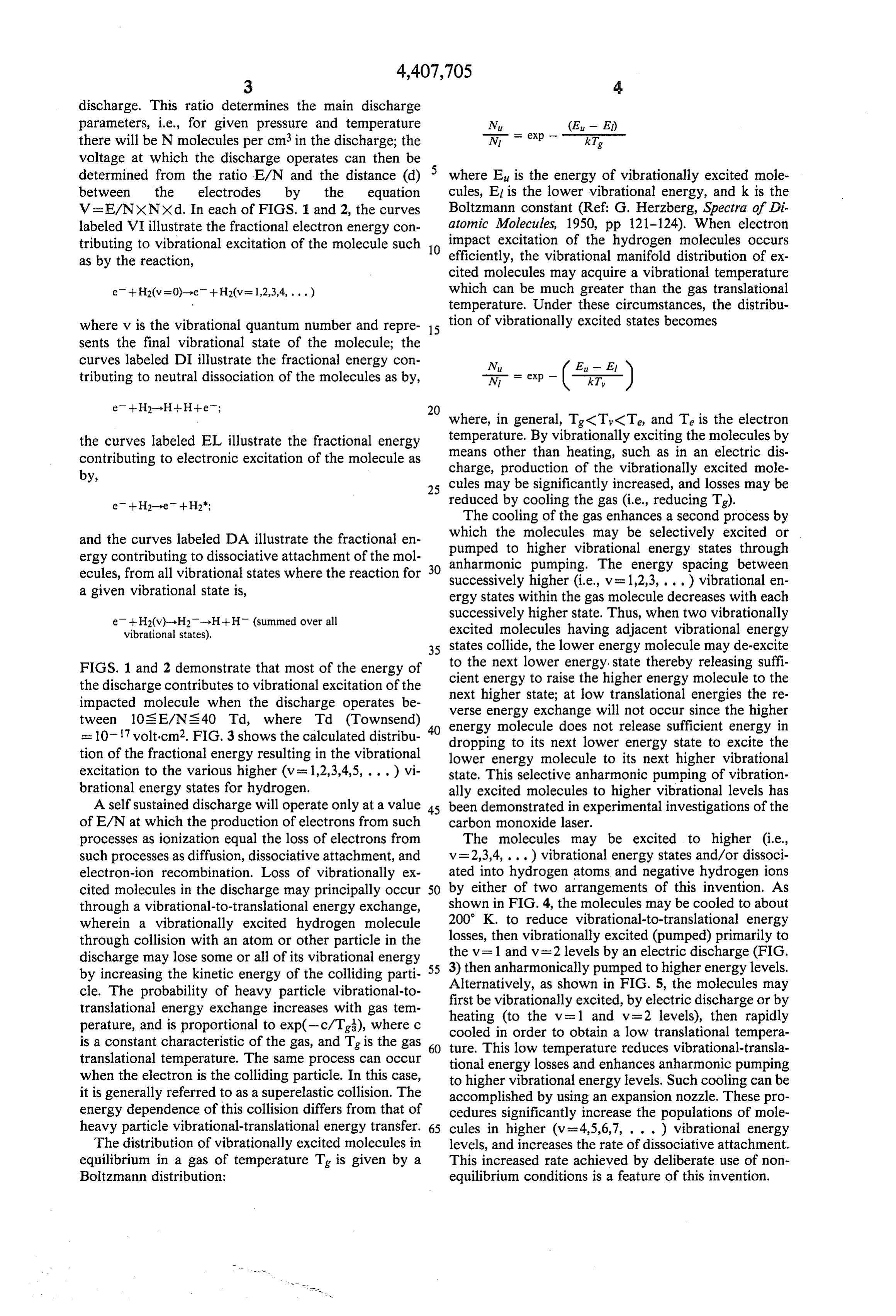
there will be N molecules per cm3 in the discharge; the Nt kTg voltage at which the discharge operates can then be determined from the ratio E/N and the distance (d) 5 where E is the energy of vibrationally excited mole between the electrodes by the equation cules, El is the lower vibrational energy, and k is the V-E/NXNxd. In each of FIGS. 1 and 2, the curves Boltzmann constant (Ref: G. Herzberg, Spectra of Di labeled VI illustrate the fractional electron energy con atomic Molecules, 1950, pp 121-124). When electron tributing to vibrational excitation of the molecule such 10 impact excitation of the hydrogen molecules occurs as by the reaction, efficiently, the vibrational manifold distribution of ex cited molecules may acquire a vibrational temperature which can be much greater than the gas translational temperature. Under these circumstances, the distribu where v is the vibrational quantum number and repre 15 tion of vibrationally excited states becomes sents the final vibrational state of the molecule; the curves labeled DI illustrate the fractional energy con tributing to neutral dissociation of the molecules as by,
where, in general, Tg.<Ty<Te, and Te is the electron the curves labeled EL illustrate the fractional energy temperature. By vibrationally exciting the molecules by contributing to electronic excitation of the molecule as means other than heating, such as in an electric dis by, charge, production of the vibrationally excited mole 25 cules may be significantly increased, and losses may be reduced by cooling the gas (i.e., reducing Tg).
The cooling of the gas enhances a second process by and the curves labeled DA illustrate the fractional en which the molecules may be selectively excited or ergy contributing to dissociative attachment of the mol pumped anharmonic to higher vibrational energy states through pumping. The energy spacing between
ecules, from all vibrational states where the reaction for successively higher a given vibrational state is, (i.e., v= 1,2,3,...) vibrational en ergy states within the gas molecule decreases with each e--H2(v)-H2-H-I-H (summed over all successively higher state. Thus, when two vibrationally vibrational states). excited molecules having adjacent vibrational energy 35 states collide, the lower energy molecule may de-excite
FIGS. 1 and 2 demonstrate that most of the energy of cient to the next lower energy, state thereby releasing suffi the discharge contributes to vibrational excitation of the next higher energy to raise the higher energy molecule to the impacted molecule when the discharge operates be verse energystate; at low translational energies the re exchange will not occur since the higher tween 10s E/Ns 40 Ta, where Td (Townsend) 40 energy molecule does not release sufficient energy in = 10-17 volt-cm2. FIG. 3 shows the calculated distribu dropping to its next lower energy state to excite the tion of the fractional energy resulting in the vibrational lower energy molecule to its next higher vibrational excitation to the various higher (vs 1,2,3,4,5, . . . ) vi state. This selective anharmonic pumping of vibration brational energy states for hydrogen. ally excited molecules to higher vibrational levels has A self sustained discharge will operate only at a value 45 been demonstrated in experimental investigations of the of E/N at which the production of electrons from such carbon monoxide laser.
processes as ionization equal the loss of electrons from The molecules may be excited to higher (i.e., such processes as diffusion, dissociative attachment, and v=2,3,4, ...) vibrational energy states and/or dissoci electron-ion recombination. Loss of vibrationally ex ated into hydrogen atoms and negative hydrogen ions cited molecules in the discharge may principally occur 50 by either of two arrangements of this invention. As through a vibrational-to-translational energy exchange, shown in FIG. 4, the molecules may be cooled to about wherein a vibrationally excited hydrogen molecule 200 K. to reduce vibrational-to-translational energy through collision with an atom or other particle in the losses, then vibrationally excited (pumped) primarily to discharge may lose some or all of its vibrational energy the 3) v = 1 and v=2 levels by an electric discharge (FIG.
then anharmonically pumped to higher energy levels.
by increasing the kinetic energy of the colliding parti 55 cle. The probability of heavy particle vibrational-to Alternatively, as shown in FIG. 5, the molecules may translational energy exchange increases with gas tem heating (to the vs excited, first be vibrationally 1 and by electric discharge or by v=2 levels), then rapidly perature, and is proportional to exp(-c/T3), where c cooled in order to obtain a low translational tempera is a constant characteristic of the gas, and T is the gas 60 ture. This low temperature reduces vibrational-transla translational temperature. The same process can occur tional energy losses and enhances anharmonic pumping when the electron is the colliding particle. In this case, to higher vibrational energy levels. Such cooling can be it is generally referred to as a superellastic collision. The accomplished by using an expansion nozzle. These pro energy dependence of this collision differs from that of cedures significantly increase the populations of mole heavy particle vibrational-translational energy transfer. 65 cules in higher (v= 4,5,6,7, . . . ) vibrational energy The distribution of vibrationally excited molecules in levels, and increases the rate of dissociative attachment. equilibrium in a gas of temperature T is given by a This increased rate achieved by deliberate use of non Boltzmann distribution: equilibrium conditions is a feature of this invention.
Page 8
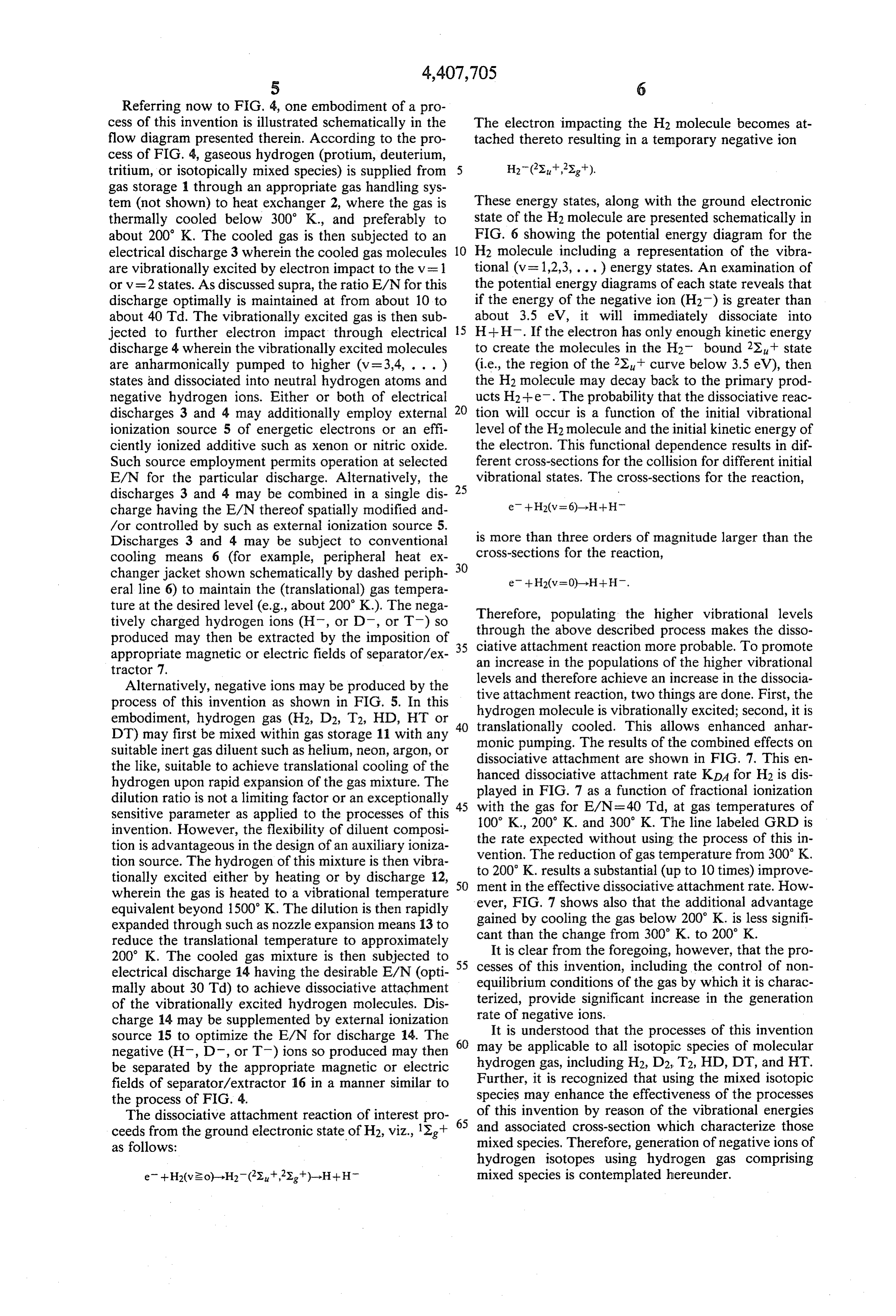
Referring now to FIG. 4, one embodiment of a pro cess of this invention is illustrated schematically in the The electron impacting the H2 molecule becomes at flow diagram presented therein. According to the pro tached thereto resulting in a temporary negative ion cess of FIG. 4, gaseous hydrogen (protium, deuterium, tritium, or isotopically mixed species) is supplied from gas storage 1 through an appropriate gas handling sys tem (not shown) to heat exchanger 2, where the gas is These energy states, along with the ground electronic thermally cooled below 300 K., and preferably to state of the H2 molecule are presented schematically in about 200 K. The cooled gas is then subjected to an FIG. 6 showing the potential energy diagram for the electrical discharge 3 wherein the cooled gas molecules 10 H2 molecule including a representation of the vibra are vibrationally excited by electron impact to the v = 1 tional (v=1,2,3,...) energy states. An examination of or v =2 states. As discussed supra, the ratio E/N for this the potential energy diagrams of each state reveals that discharge optimally is maintained at from about 10 to if the energy of the negative ion (H2) is greater than about 40 Ta. The vibrationally excited gas is then sub about 3.5 eV, it will immediately dissociate into jected to further electron impact through electrical 5 H+H. If the electron has only enough kinetic energy discharge 4 wherein the vibrationally excited molecules to create the molecules in the H2 bound 2X state are anharmonically pumped to higher (v=3,4, . . . ) (i.e., the region of the 2X curve below 3.5 eV), then states and dissociated into neutral hydrogen atoms and the H2 molecule may decay back to the primary prod negative hydrogen ions. Either or both of electrical ucts H2--e. The probability that the dissociative reac discharges 3 and 4 may additionally employ external 20 tion will occur is a function of the initial vibrational ionization source 5 of energetic electrons or an effi level of the H2 molecule and the initial kinetic energy of ciently ionized additive such as xenon or nitric oxide. the electron. This functional dependence results in dif Such source employment permits operation at selected ferent cross-sections for the collision for different initial E/N for the particular discharge. Alternatively, the vibrational states. The cross-sections for the reaction, discharges 3 and 4 may be combined in a single dis 25 charge having the E/N thereof spatially modified and /or controlled by such as external ionization source 5.
Discharges 3 and 4 may be subject to conventional is more than three orders of magnitude larger than the cooling means 6 (for example, peripheral heat ex cross-sections for the reaction, changer jacket shown schematically by dashed periph 30 eral line 6) to maintain the (translational) gas tempera ture at the desired level (e.g., about 200 K.). The nega Therefore, populating the higher vibrational levels tively charged hydrogen ions (H, or D, or T) so through the above described process makes the disso produced may then be extracted by the imposition of appropriate magnetic or electric fields of separator/ex 35 ciative attachment reaction more probable. To promote an increase in the populations of the higher vibrational tractor 7.
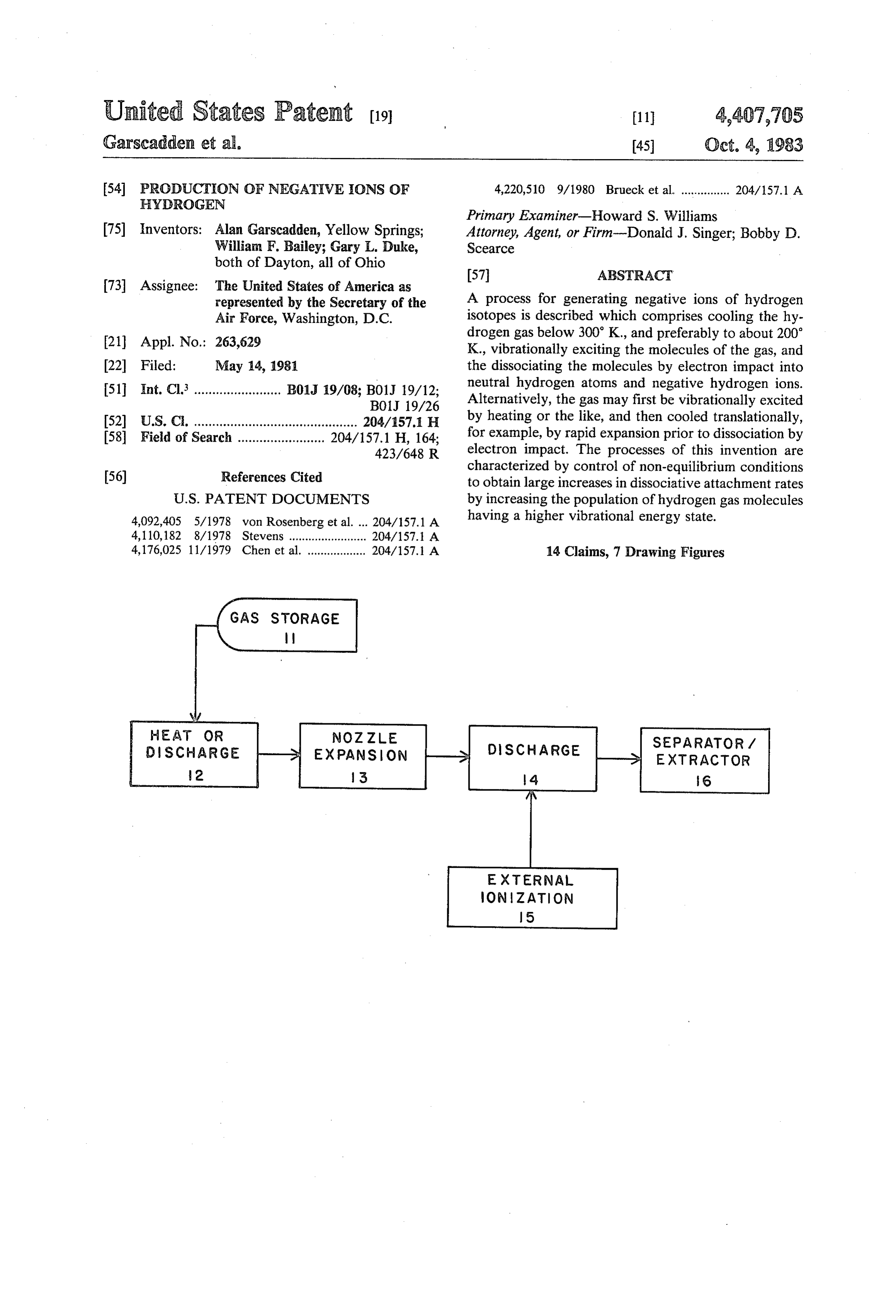
Alternatively, negative ions may be produced by the levels and therefore achieve an increase in the dissocia process of this invention as shown in FIG. 5. In this tive attachment reaction, two things are done. First, the embodiment, hydrogen gas (H2, D2, T2, HD, HT or 40 hydrogen molecule is vibrationally excited; second, it is DT) may first be mixed within gas storage 11 with any monic pumping.cooled.
translationally
The
This allows enhanced anhar results of the combined effects on suitable inert gas diluent such as helium, neon, argon, or dissociative attachment are shown the like, suitable to achieve translational cooling of the hanced dissociative attachment rateinKDA FIG. 7. This en for H2 is dis hydrogen upon rapid expansion of the gas mixture. The dilution ratio is not a limiting factor or an exceptionally played in FIG. 7 as a function of fractional ionization sensitive parameter as applied to the processes of this 45 with the gas for E/N=40 Ta, at gas temperatures of 100 K., 200 K. and 300 K. The line labeled GRD is invention. However, the flexibility of diluent composi the rate expected without using the process of this in tion is advantageous in the design of an auxiliary ioniza vention.
tion source. The hydrogen of this mixture is then vibra to 200 K.The reduction of gas temperature from 300 K. results a substantial (up to 10 times) improve tionally excited either by heating or by discharge 12, wherein the gas is heated to a vibrational temperature 50 ment in the effective dissociative attachment rate. How ever, FIG. 7 shows also that the additional advantage equivalent beyond 1500 K. The dilution is then rapidly gained by cooling the gas below 200 K. is less signifi expanded through such as nozzle expansion means 13 to reduce the translational temperature to approximately cant than the change from 300 K. to 200 K. 200 K. The cooled gas mixture is then subjected to 55 It is clear from the foregoing, however, that the pro cesses of this invention, including the control of non electrical discharge 14 having the desirable E/N (opti equilibrium mally about 30 Ta) to achieve dissociative attachment terized, provide conditions of the gas by which it is charac of the vibrationally excited hydrogen molecules. Dis significant increase in the generation charge 14 may be supplemented by external ionization rate of negative ions.
source 15 to optimize the E/N for discharge 14. The 60 may It is understood that the processes of this invention negative (H, D, or T) ions so produced may then be applicable to all isotopic species of molecular be separated by the appropriate magnetic or electric hydrogen gas, including H2, D2, T2, HD, DT, and HT. fields of separator/extractor 16 in a manner similar to Further, it is recognized that using the mixed isotopic the process of FIG. 4. species may enhance the effectiveness of the processes The dissociative attachment reaction of interest pro of this invention by reason of the vibrational energies 65 and associated cross-section which characterize those ceeds from as follows:
the ground electronic state of H2, viz., Sgt mixed species. Therefore, generation of negative ions of hydrogen isotopes using hydrogen gas comprising mixed species is contemplated hereunder.
Page 9
External ionization sources 5 and 15 may comprise 3. The process of claim 2 wherein the electrical dis such as an electron gun, a source of monochromatic charge is operated at an E/N ratio of from about 10 to light which may operate in conjunction with a photo- about 40 Townsend.
4. A process for producing negatively charged ions of cathode for the discharge, or by photoionization of the 5 hydrogen medium (hydrogen gas) in the discharge. Other sources which comprises;
of externally induced ionization within the discharge a. cooling hydrogen gas to below 300 K.; may be used as may occur to one with skill in the field b. subjecting said gas to an electrical discharge to vibrationally excite the molecules of said gas to a of this invention. In a closed cycle system wherein the predetermined vibrationally excited energy state; hydrogen gas may be recirculated, the processes of this 10 c. anharmonically pumping by laser radiation said invention may be applied to hydrogen gas comprising cooled and vibrationally excited gas molecules to a tritium (T2) or mixed molecules thereof (HT, DT). The higher vibrationally excited energy state; and tritium species, being radioactive, will itself contribute d. impacting the cooled and vibrationally excited to supplemental ionization through its (3 decay. hydrogen gas molecules with energetic electrons It is understood that the foregoing description of 15 to produce, by dissociative attachment, neutral processes representative of the present invention is not hydrogen atoms and negatively charged hydrogen inclusive of all embodiments contemplated hereunder, 5. The process of claims 1, 2 or 4 wherein the hydro and that the configuration of component parts and oper- gen gas is cooled to about 200 K. ating parameters for the processes embodied herein may 20 6. The process of claim 1, 2 or 4, further comprising be varied within the scope of the appended claims, as the step of separating the negatively charged hydrogen might occur to one having skill in the field of this inven- ions from the remainder of the hydrogen gas. tion. Therefore, all such embodiments have not been 7. The process of claim 1, 2, or 4 wherein the hydro shown in complete detail. Other embodiments may be gen gas contains a hydrogen isotope selected from the developed without departing from the spirit and scope 25 group of the appended claims.
consisting of protium deuterium, and tritium, 8. The process of claim 4 wherein the electrical dis
We claim:
in . charge is operated at an E/N ratio of from about 10 to 1. A process for producing negatively charged ions of about 40 Townsend.
. Ap s for producing neg y g 9. The process of claims 4 or 8 wherein the predeter hydrogen which comrises: o 30 mined vibrationally excited energy state is selected a. cooling hydrogen gas to below 300 K.; from the group consisting of v = 1 and v=2, and the b. vibrationally exciting the molecules of the said higher vibrationally excited energy state is selected hydrogen gas to a first vibrational energy state from the group consisting of v=3, V = 4, v=5, v=6, higher than the ground vibrational state; and v=7.
c. anharmonically pumping said gas to a second vi- 35 10. A process for producing negatively charged ions brationally excited state higher than said first state;
of hydrogen which comprises:
and a. heating hydrogen gas to vibrationally excite the d. impacting the cooled and vibrationally excited molecules of said gas;
hydrogen gas molecules with energetic electrons 40 b. tional rapidly expanding said gas to reduce the transla energy of the molecules of said gas; and to produce, by dissociative attachment, neutral c. impacting said gas molecules with energetic elec hydrogen atoms and negatively charged hydrogen trons to produce, by dissociative attachment, neu 1O.S. tral hydrogen atoms and negatively charged hy 2. A process for producing negatively charged ions of drogen ions.
hydrogen which comprises: 45 11. The process of claim 0 wherein the hydrogen gas a. cooling hydrogen gas to below 300 K.; contains a hydrogen isotope selected from the group b. subjecting said gas to an electrical discharge to consisting of protium, deuterium, and tritium. vibrationally excite the molecules of said gas to a 12. The process of claim 10 wherein the hydrogen gas first vibrationally excited energy state; is heated in an electrical discharge operated at an E/N c. anharmonically pumping said gas to a second vi 50 ratio of from about 10 to about 40 Townsend. brationally excited state higher than said first state; gen13.gas
The process of claims 10 or 12 wherein the hydro is contained in a gas mixture of hydrogen and a and .. a - aseous diluent selected from the group consisting of d. impacting the cooled and vibrationally excited E. neon, and argon. group 8. hydrogen gas molecules with energetic electrons 55 the14.stepTheofprocess to produce, by dissociative attachment, neutral of claim 10 or 12 further comprising separating the negative hydrogen ions from hydrogen atoms and negatively charged hydrogen the remainder of the gas.
ions. :: ; ; k :
Provenance
- Collection
- Cited prior art
- Original PDF
- patentimages.storage.googleapis.com →
- Filed
- 1981-05-14
- Pages
- 9
- Method
- pdftotext (the PDF's own text layer) + pdftoppm 300dpi page scans
- Source
- Google Patents bibliographic record
- Granted
- 1983-10-04
- Inventors
- Alan Garscadden; William F. Bailey; Gary L. Duke; United States Department of the Air Force
- Transcribed from
- patentimages.storage.googleapis.com →