patent · US3759679
Production of methane rich fuel gas
18 September 1973
Page 1 — bibliographic record
United States Patent Office Patented Sept. 18, 1973
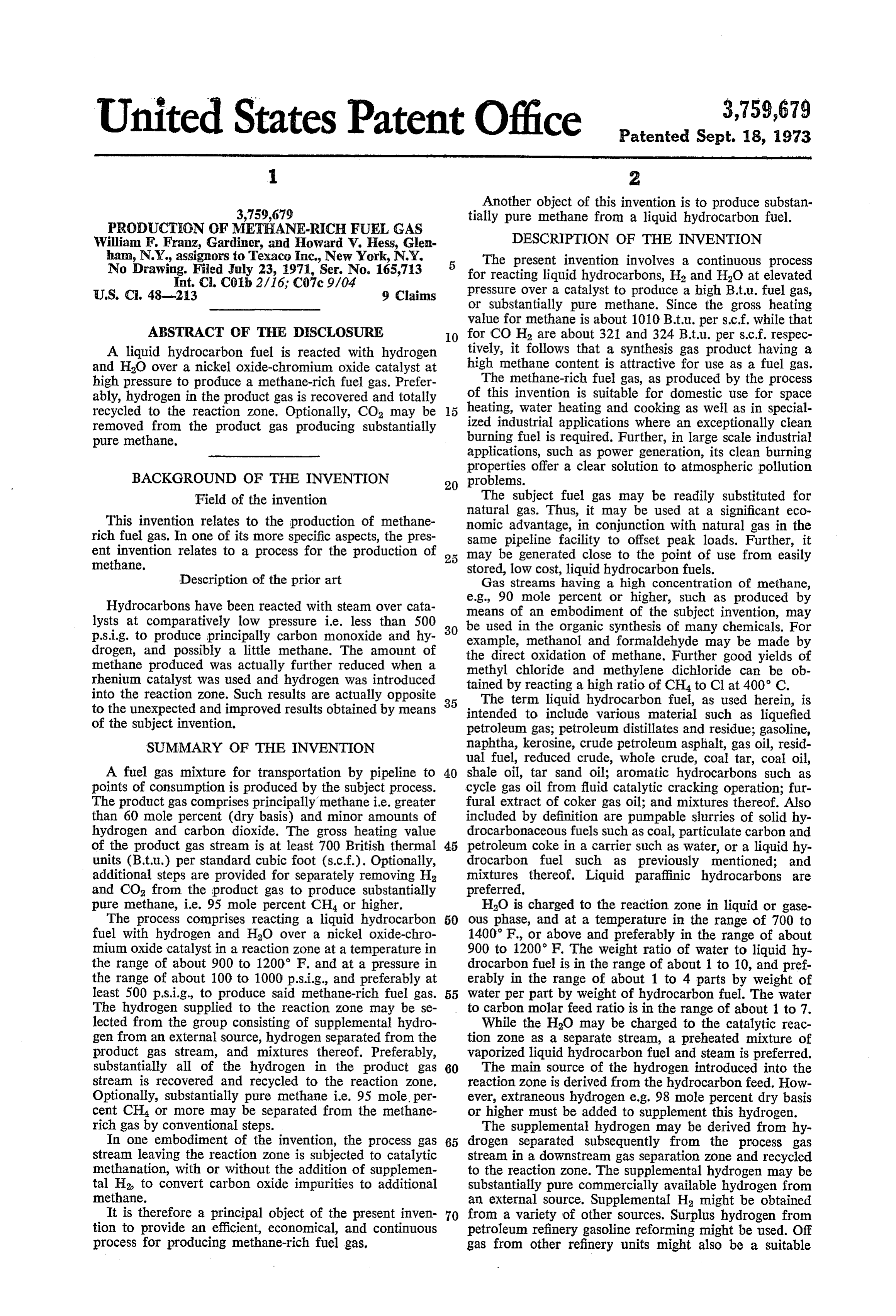
Another object of this invention is to produce substan 3,759,679 tially pure methane from a liquid hydrocarbon fuel.
PRODUCTION OF METHANE-RECH FUEL (GAS
William F. Franz, Gardiner, and Howard W. Hess, Glen DESCRIPTION OF THE INVENTION ham, N.Y., assignors to Texaco Inc., New York, N.Y. The present invention involves a continuous process No Drawing. Filed July 23, 1971, Ser. No. 165,713 for reacting liquid hydrocarbons, H and H2O at elevated Int. C. COb 2/16, CO7c 9/04 pressure over a catalyst to produce a high B.t.u. fuel gas,
or substantially pure methane. Since the gross heating value for methane is about 1010 B.t.u. per s.c.f. while that
ABSTRACT OF THE DESCLOSURE O for CO H2 are about 321 and 324 B.t.u. per s.c.f. respec A liquid hydrocarbon fuel is reacted with hydrogen tively, it follows that a synthesis gas product having a and H2O over a nickel oxide-chromium oxide catalyst at high methane content is attractive for use as a fuel gas. high pressure to produce a methane-rich fuel gas. Prefer The methane-rich fuel gas, as produced by the process ably, hydrogen in the product gas is recovered and totally of this invention is suitable for domestic use for space recycled to the reaction zone. Optionally, CO2 may be 5 heating, water heating and cooking as well as in special removed from the product gas producing substantially ized industrial applications where an exceptionally clean pure methane. burning fuel is required. Further, in large scale industrial applications, such as power generation, its clean burning properties offer a clear solution to atmospheric pollution
BACKGROUND OF THE INVENTION 20 problems.
Field of the invention The subject fuel gas may be readily substituted for natural gas. Thus, it may be used at a significant eco
This invention relates to the production of methane nomic advantage, in conjunction with natural gas in the rich fuel gas. In one of its more specific aspects, the pres same pipeline facility to offset peak loads. Further, it ent invention relates to a process for the production of 25 may be generated close to the point of use from easily methane. stored, low cost, liquid hydrocarbon fuels. Description of the prior art Gas streams having a high concentration of methane, e.g., 90 mole percent or higher, such as produced by
Hydrocarbons have been reacted with steam over cata means of an embodiment of the subject invention, may lysts at comparatively low pressure i.e. less than 500 30 be used in the organic synthesis of many chemicals. For p.s.i.g. to produce principally carbon monoxide and hy example, methanol and formaldehyde may be made by drogen, and possibly a little methane. The amount of the direct oxidation of methane. Further good yields of methane produced was actually further reduced when a methyl chloride and methylene dichloride can be ob rhenium catalyst was used and hydrogen was introduced into the reaction zone. Such results are actually opposite 35 tained by reacting a high ratio of CH4 to Cl at 400° C. The term liquid hydrocarbon fuel, as used herein, is to the unexpected and improved results obtained by means intended to include various material such as liquefied of the subject invention. petroleum gas; petroleum distillates and residue; gasoline, SUMMARY OF THE INVENTION naphtha, kerosine, crude petroleum asphalt, gas oil, resid ual fuel, reduced crude, whole crude, coal tar, coal oil,
A fuel gas mixture for transportation by pipeline to 40 shale oil, tar sand oil; aromatic hydrocarbons such as points of consumption is produced by the subject process. cycle gas oil from fluid catalytic cracking operation; fur The product gas comprises principally methane i.e. greater fural extract of coker gas oil; and mixtures thereof. Also than 60 mole percent (dry basis) and minor amounts of included by definition are pumpable slurries of solid hy hydrogen and carbon dioxide. The gross heating value drocarbonaceous fuels such as coal, particulate carbon and of the product gas stream is at least 700 British thermal 45 petroleum coke in a carrier such as water, or a liquid hy units (B.t.u.) per standard cubic foot (s.c.f.). Optionally, drocarbon fuel such as previously mentioned; and additional steps are provided for separately removing H2 mixtures thereof. Liquid paraffinic hydrocarbons are and CO2 from the product gas to produce substantially preferred.
pure methane, i.e. 95 mole percent CH or higher. H2O is charged to the reaction zone in liquid or gase The process comprises reacting a liquid hydrocarbon 50 ous phase, and at a temperature in the range of 700 to fuel with hydrogen and HO over a nickel oxide-chro 1400 F., or above and preferably in the range of about mium oxide catalyst in a reaction zone at a temperature in 900 to 1200°F. The weight ratio of water to liquid hy the range of about 900 to 1200° F. and at a pressure in drocarbon fuel is in the range of about 1 to 10, and pref the range of about 100 to 1000 p.s.i.g., and preferably at erably in the range of about 1 to 4 parts by weight of least 500 p.s.i.g., to produce said methane-rich fuel gas. 55 water per part by weight of hydrocarbon fuel. The water The hydrogen supplied to the reaction zone may be se to carbon molar feed ratio is in the range of about 1 to 7. lected from the group consisting of supplemental hydro While the HO may be charged to the catalytic reac gen from an external source, hydrogen separated from the tion Zone as a separate stream, a preheated mixture of product gas stream, and mixtures thereof. Preferably, vaporized liquid hydrocarbon fuel and steam is preferred. substantially all of the hydrogen in the product gas 60 The main source of the hydrogen introduced into the stream is recovered and recycled to the reaction zone. reaction zone is derived from the hydrocarbon feed. How Optionally, substantially pure methane i.e. 95 mole per ever, extraneous hydrogen e.g. 98 mole percent dry basis cent CH4 or more may be separated from the methane or higher must be added to supplement this hydrogen. rich gas by conventional steps. The supplemental hydrogen may be derived from hy In one embodiment of the invention, the process gas 65 drogen separated subsequently from the process gas stream leaving the reaction zone is subjected to catalytic stream in a downstream gas separation zone and recycled methanation, with or without the addition of supplemen to the reaction zone. The supplemental hydrogen may be tal H2 to convert carbon oxide impurities to additional substantially pure commercially available hydrogen from methane. an external source. Supplemental H2 might be obtained It is therefore a principal object of the present inven 70 from a variety of other sources. Surplus hydrogen from tion to provide an efficient, economical, and continuous petroleum refinery gasoline reforming might be used. Off process for producing methane-rich fuel gas. gas from other refinery units might also be a suitable
Page 2
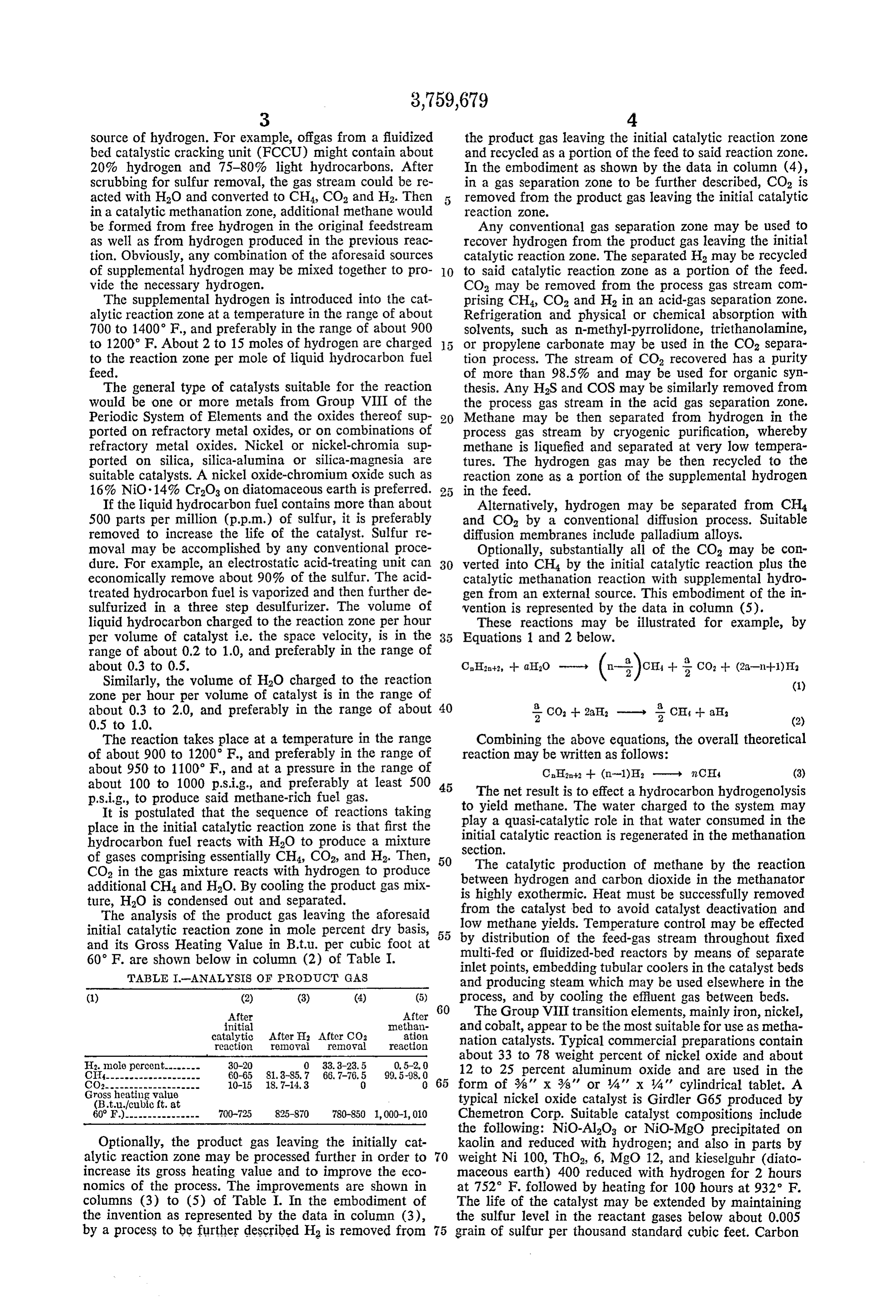
source of hydrogen. For example, offgas from a fluidized the product gas leaving the initial catalytic reaction Zone bed catalystic cracking unit (FCCU) might contain about and recycled as a portion of the feed to said reaction Zone. 20% hydrogen and 75-80% light hydrocarbons. After In the embodiment as shown by the data in column (4), scrubbing for sulfur removal, the gas stream could be re in a gas separation zone to be further described, CO2 is acted with HO and converted to CH4, CO and H2. Then 5 removed from the product gas leaving the initial catalytic in a catalytic methanation zone, additional methane would reaction zone.
be formed from free hydrogen in the original feedstream Any conventional gas separation zone may be used to as well as from hydrogen produced in the previous reac recover hydrogen from the product gas leaving the initial tion. Obviously, any combination of the aforesaid sources catalytic reaction zone. The separated H may be recycled of supplemental hydrogen may be mixed together to pro O to said catalytic reaction zone as a portion of the feed. vide the necessary hydrogen. CO may be removed from the process gas stream Com The supplemental hydrogen is introduced into the cat prising CH, CO2 and H2 in an acid-gas separation Zone. alytic reaction zone at a temperature in the range of about Refrigeration and physical or chemical absorption with 700 to 1400°F, and preferably in the range of about 900 solvents, such as n-methyl-pyrrolidone, triethanolamine, to 1200°F. About 2 to 15 moles of hydrogen are charged or propylene carbonate may be used in the CO2 separa to the reaction zone per mole of liquid hydrocarbon fuel tion process. The stream of CO2 recovered has a purity feed. of more than 98.5% and may be used for organic Syn The general type of catalysts suitable for the reaction thesis. Any HS and COS may be similarly removed from would be one or more metals from Group VIII of the the process gas stream in the acid gas separation Zone. Periodic System of Elements and the oxides thereof Sup 20 Methane may be then separated from hydrogen in the ported on refractory metal oxides, or on combinations of process gas stream by cryogenic purification, whereby refractory metal oxides. Nickel or nickel-chromia Sup methane is liquefied and separated at very low tempera ported on silica, silica-alumina or silica-magnesia are tures. The hydrogen gas may be then recycled to the suitable catalysts. A nickel oxide-chromium oxide such as reaction zone as a portion of the supplemental hydrogen 16% NiO 14% CrO on diatomaceous earth is preferred. 25 in the feed.
If the liquid hydrocarbon fuel contains more than about Alternatively, hydrogen may be separated from CH4 500 parts per million (p.p.m.) of sulfur, it is preferably and CO by a conventional diffusion process. Suitable removed to increase the life of the catalyst. Sulfur re diffusion membranes include palladium alloys. moval may be accomplished by any conventional proce Optionally, substantially all of the CO2 may be con dure. For example, an electrostatic acid-treating unit can 30 verted into CH4 by the initial catalytic reaction plus the economically remove about 90% of the sulfur. The acid catalytic methanation reaction with supplemental hydro treated hydrocarbon fuel is vaporized and then further de gen from an external source. This embodiment of the in sulfurized in a three step desulfurizer. The volume of vention is represented by the data in column (5). liquid hydrocarbon charged to the reaction Zone per hour These reactions may be illustrated for example, by per volume of catalyst i.e. the space velocity, is in the 35 Equations 1 and 2 below.
range of about 0.2 to 1.0, and preferably in the range of
Similarly, the volume of H2O charged to the reaction
zone per hour per volume of catalyst is in the range of 3. about 0.3 to 2.0, and preferably in the range of about 40 2 CO - 2aH, -) 2 CEI -- a (2)
The reaction takes place at a temperature in the range Combining the above equations, the overall theoretical of about 900 to 1200 F., and preferably in the range of reaction may be written as follows: about 950 to 1100 F., and at a pressure in the range of CEI -- (n-1)H, --> in CH4 (3) about 100 to 1000 p.s.i.g., and preferably at least 500 45 The net result is to effect a hydrocarbon hydrogenolysis p.s.i.g., to produce said methane-rich fuel gas.
It is postulated that the sequence of reactions taking to yield methane. The water charged to the system may play a quasi-catalytic role in that water consumed in the place in the initial catalytic reaction Zone is that first the initial catalytic reaction is regenerated in the methanation hydrocarbon fuel reacts with H2O to produce a mixture section.
of gases comprising essentially CH4, CO2, and H2. Then, 50 The catalytic production of methane by the reaction CO in the gas mixture reacts with hydrogen to produce additional CH4 and H2O. By cooling the product gas mix isbetween hydrogen and carbon dioxide in the methanator highly exothermic. Heat must be successfully removed ture, HO is condensed out and separated.
The analysis of the product gas leaving the aforesaid from the catalyst bed to avoid catalyst deactivation and low methane yields. Temperature control may be effected initial catalytic reaction zone in mole percent dry basis, 55 by distribution of the feed-gas stream throughout fixed and its Gross Heating Value in B.t.u. per cubic foot at multi-fed or fluidized-bed reactors by means of separate 60° F. are shown below in column (2) of Table I. inlet points, embedding tubular coolers in the catalyst beds TABLE IANALYSIS OF PRODUCT GAS and producing steam which may be used elsewhere in the () (2) (3) (4) (5) process, and by cooling the effluent gas between beds.
60 The Group VIII transition elements, mainly iron, nickel, initial catalytic. After H. After CO2 methan ation and cobalt, appear to be the most suitable for use as metha reaction removal removal reaction nation catalysts. Typical commercial preparations contain H2. mole percent-------- 30-20 O 33.8-23.5 0.5-2.0 about 33 to 78 weight percent of nickel oxide and about
CF4-------------- 60-65 83-85, 7 66, 7-6, 5 99,5-98.0 12 to 25 percent aluminum oxide and are used in the CO2-------------------- 10-15 18, 7-4, 3 O 0. 65 form of 3%' x 3%' or '4' x 4' cylindrical tablet. A Gross heating value typical nickel oxide catalyst is Girdler G65 produced by
60F.)---------------- 700-725 825–870 780-850 1,000-1,010 Chemetron Corp. Suitable catalyst compositions include the following: NiO-Al2O3 or NiO-MgO precipitated on
Optionally, the product gas leaving the initially cat kaolin and reduced with hydrogen; and also in parts by alytic reaction Zone may be processed further in order to 70 weight Ni 100, Thoa, 6, MgO 12, and kieselguhr (diato increase its gross heating value and to improve the eco maceous earth) 400 reduced with hydrogen for 2 hours nomics of the process. The improvements are shown in at 752 F. followed by heating for 100 hours at 932 F. columns (3) to (5) of Table I. In the embodiment of The life of the catalyst may be extended by maintaining the invention as represented by the data in column (3), the sulfur level in the reactant gases below about 0.005 by a process to be further described H2 is removed from 75 grain of sulfur per thousand standard cubic feet. Carbon
Page 3
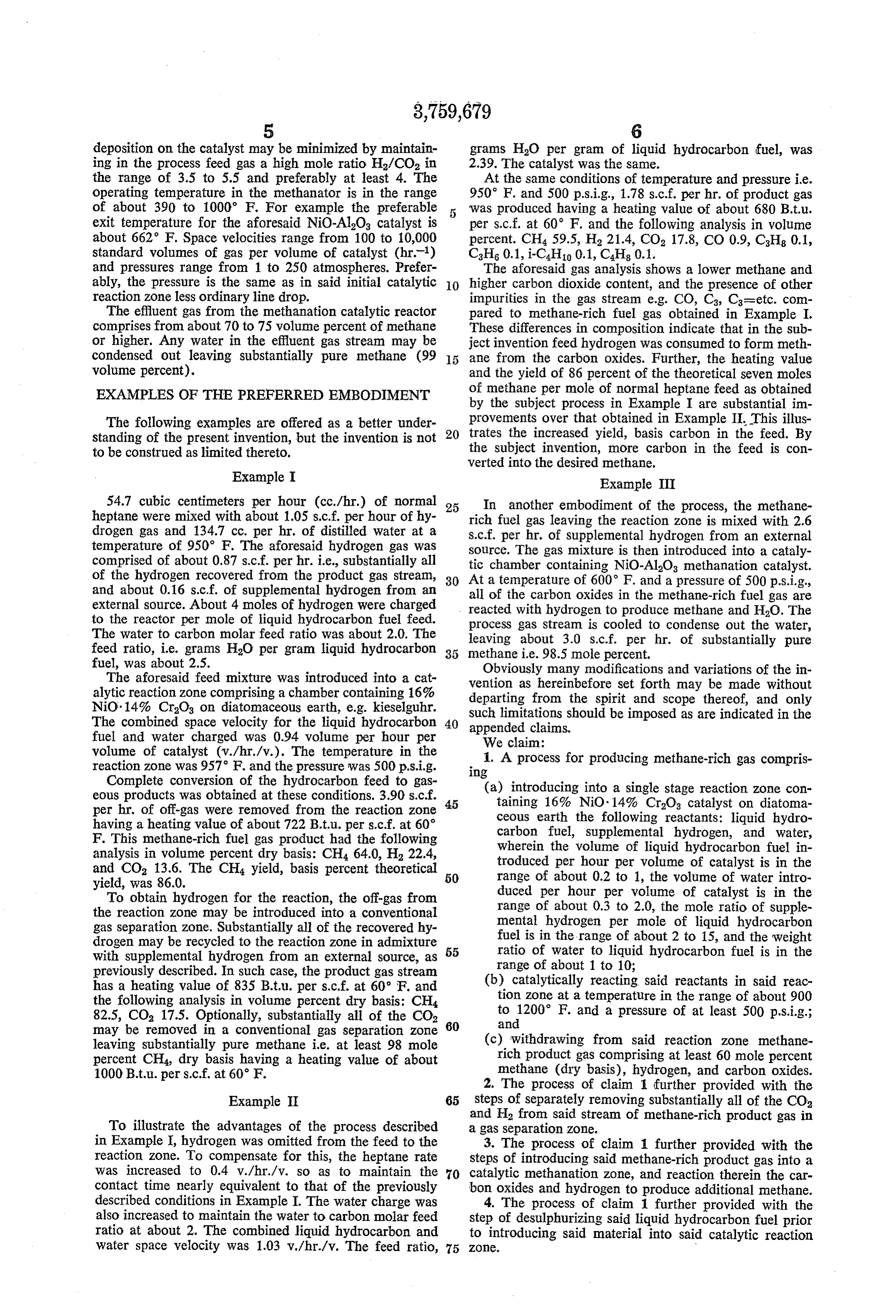
deposition on the catalyst may be minimized by maintain grams H2O per gram of liquid hydrocarbon fuel, was ing in the process feed gas a high mole ratio H2/CO2 in 2.39. The catalyst was the same. the range of 3.5 to 5.5 and preferably at least 4. The At the same conditions of temperature and pressure i.e. operating temperature in the methanator is in the range 950 F. and 500 p.s.i.g., 1.78 s.c.f. per hr. of product gas of about 390 to 1000 F. For example the preferable was produced having a heating value of about 680 B.t.u. exit temperature for the aforesaid NiO-Al2O3 catalyst is per s.c.f. at 60° F. and the following analysis in volume about 662 F. Space velocities range from 100 to 10,000 percent. CH 59.5, H2. 21.4, CO2 17.8, CO 0.9, CH 0.1, standard volumes of gas per volume of catalyst (hr.) C3H6 0.1, i-C4H10 0.1, C4H8 0.1. and pressures range from 1 to 250 atmospheres. Prefer The aforesaid gas analysis shows a lower methane and ably, the pressure is the same as in said initial catalytic O higher carbon dioxide content, and the presence of other reaction zone less ordinary line drop. impurities in the gas stream e.g. CO, Ca, Ca=etc. com The effluent gas from the methanation catalytic reactor pared to methane-rich fuel gas obtained in Example I. comprises from about 70 to 75 volume percent of methane These differences in composition indicate that in the sub or higher. Any water in the effluent gas stream may be ject invention feed hydrogen was consumed to form meth condensed out leaving substantially pure methane (99 5 ane from the carbon oxides. Further, the heating value volume percent). and the yield of 86 percent of the theoretical seven moles EXAMPLES OF THE PREFERRED EMBODIMENT of methane per mole of normal heptane feed as obtained by the subject process in Example I are substantial im
The following examples are offered as a better under provements over that obtained in Example II. This illus trates the increased yield, basis carbon in the feed. By standing of the present invention, but the invention is not 20 the to be construed as limited thereto. subject invention, more carbon in the feed is con verted into the desired methane,
Example I Example III 54.7 cubic centimeters per hour (cc./hr.) of normal heptane were mixed with about 1.05 s.c.f. per hour of hy 25 richIn fuelanother embodiment of the process, the methane gas leaving the reaction zone is mixed with 2.6 drogen gas and 134.7 cc. per hr. of distilled water at a S.c.f. per hr. of supplemental hydrogen from an external temperature of 950 F. The aforesaid hydrogen gas was source. The gas mixture is then introduced into a cataly comprised of about 0.87 s.c.f. per hr. i.e., substantially all tic chamber containing NiO-Al2O3 methanation catalyst. of the hydrogen recovered from the product gas stream, At a temperature of 600 F. and a pressure of 500 p.s.i.g., and about 0.16 s.c.f. of supplemental hydrogen from an 30 all of the carbon oxides in the methane-rich fuel gas are external source. About 4 moles of hydrogen were charged reacted with hydrogen to produce methane and H2O. The to the reactor per mole of liquid hydrocarbon fuel feed. process gas stream is cooled to condense out the water, The water to carbon molar feed ratio was about 2.0. The leaving about 3.0 s.c.f. per hr. of substantially pure feed ratio, i.e. grams HO per gram liquid hydrocarbon methane i.e. 98.5 mole percent. fuel, was about 2.5. Obviously many modifications and variations of the in The aforesaid feed mixture was introduced into a cat vention as hereinbefore set forth may be made without alytic reaction zone comprising a chamber containing 16% departing from the spirit and scope thereof, and only NiO.14% CrO3 on diatomaceous earth, e.g. kieselguhr.
The combined space velocity for the liquid hydrocarbon 40 such limitations should be imposed as are indicated in the appended claims.
fuel and water charged was 0.94 volume per hour per We claim:
volume of catalyst (v./hr./v.). The temperature in the 1. A process for producing methane-rich gas compris reaction zone was 957 F. and the pressure was 500 p.s.i.g. 1ng
Complete conversion of the hydrocarbon feed to gas eous products was obtained at these conditions. 3.90 s.c.f. 45 (a)taining introducing into a single stage reaction zone con 16%. NiO 14% Cr2O3 catalyst on diatoma per hr. of off-gas were removed from the reaction Zone ceous earth the following reactants: liquid hydro having a heating value of about 722 B.t.u. per s.c.f. at 60 carbon fuel, supplemental hydrogen, and water, F. This methane-rich fuel gas product had the following wherein the volume of liquid hydrocarbon fuel in analysis in volume percent dry basis: CH 64.0, Ha 22.4, troduced per hour per volume of catalyst is in the and CO 13.6. The CH yield, basis percent theoretical 50 range of about 0.2 to 1, the volume of water intro yield, was 86.0. duced per hour per volume of catalyst is in the To obtain hydrogen for the reaction, the off-gas from range of about 0.3 to 2.0, the mole ratio of supple the reaction zone may be introduced into a conventional mental hydrogen per mole of liquid hydrocarbon gas separation zone. Substantially all of the recovered hy fuel is in the range of about 2 to 15, and the weight drogen may be recycled to the reaction zone in admixture 55 ratio of water to liquid hydrocarbon fuel is in the with supplemental hydrogen from an external source, as range of about 1 to 10;
previously described. In such case, the product gas stream (b) catalytically reacting said reactants in said reac has a heating value of 835 B.t.u. per s.c.f. at 60° F. and tion zone at a temperature in the range of about 900 the following analysis in volume percent dry basis: CH4.
82.5, CO. 17.5. Optionally, substantially all of the CO 60 to
200" F. and a pressure of at least 500 p.s.i.g.;
may be removed in a conventional gas separation Zone (c) withdrawing from said reaction zone methane leaving substantially pure methane i.e. at least 98 mole percent CH4, dry basis having a heating value of about rich product gas comprising at least 60 mole percent 1000 B.t.u. per s.c.f. at 60 F. methane (dry basis), hydrogen, and carbon oxides. 2. The process of claim 1 further provided with the
Example II 65 steps of separately removing substantially all of the CO and H2 from said stream of methane-rich product gas in
To illustrate the advantages of the process described a gas separation zone.
in Example I, hydrogen was omitted from the feed to the 3. The process of claim 1 further provided with the reaction zone. To compensate for this, the heptane rate steps of introducing said methane-rich product gas into a was increased to 0.4 v./hr./v. so as to maintain the 70 catalytic methanation zone, and reaction therein the car contact time nearly equivalent to that of the previously bon oxides and hydrogen to produce additional methane. described conditions in Example I. The water charge was 4. The process of claim 1 further provided with the also increased to maintain the water to carbon molar feed step of desulphurizing said liquid hydrocarbon fuel prior ratio at about 2. The combined liquid hydrocarbon and to introducing said material into said catalytic reaction water space velocity was 1.03 v./hr./v. The feed ratio, 5 ZOne.
Page 4
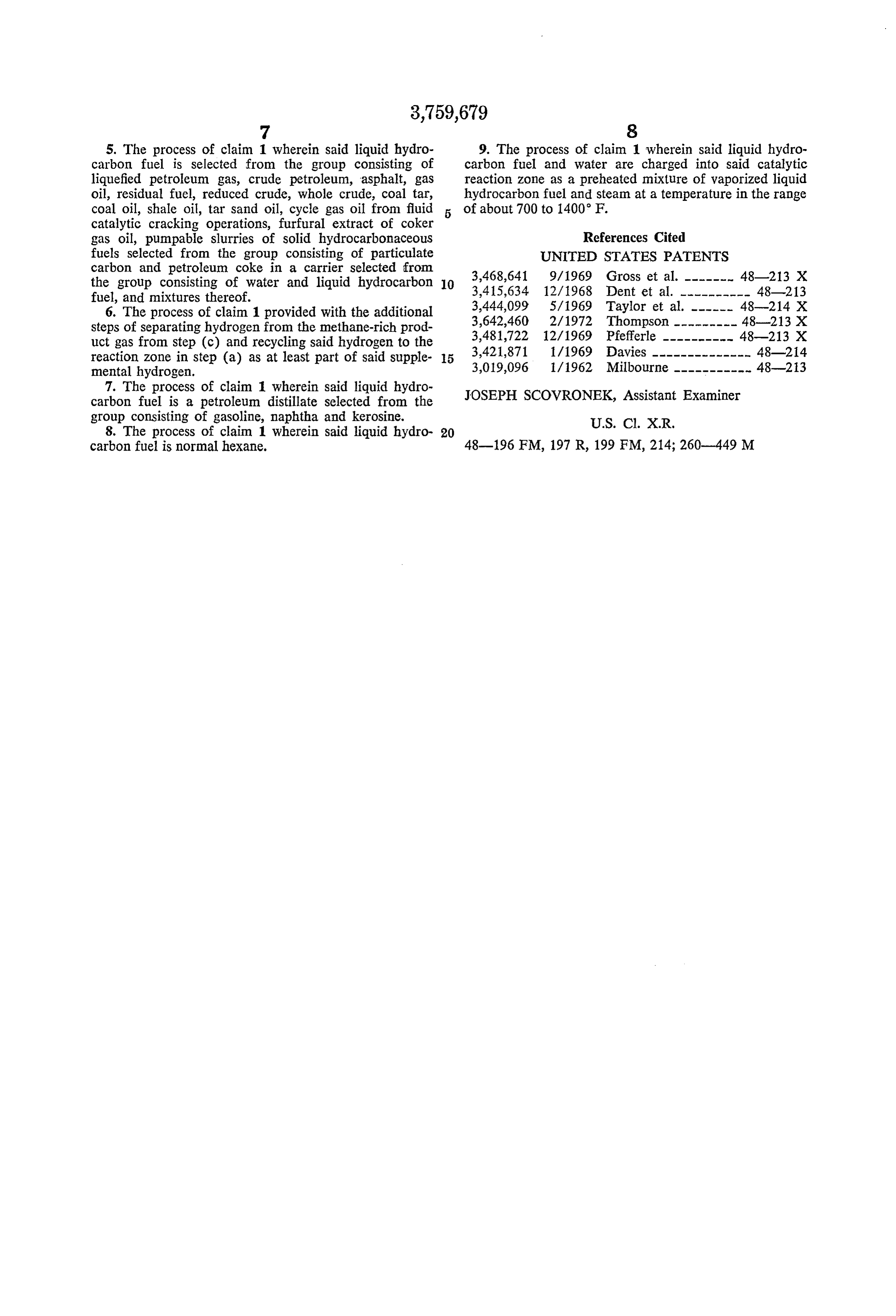
5. The process of claim 1 wherein said liquid hydro 9. The process of claim 1 wherein said liquid hydro carbon fuel is selected from the group consisting of carbon fuel and water are charged into said catalytic liquefied petroleum gas, crude petroleum, asphalt, gas reaction zone as a preheated mixture of vaporized liquid oil, residual fuel, reduced crude, whole crude, coal tar, hydrocarbon fuel and steam at a temperature in the range coal oil, shale oil, tar sand oil, cycle gas oil from fluid of about 700 to 1400°F.
catalytic cracking operations, furfural extract of coker gas oil, pumpable slurries of solid hydrocarbonaceous References Cited fuels selected from the group consisting of particulate UNITED STATES PATENTS carbon and petroleum coke in a carrier selected from the group consisting of water and liquid hydrocarbon O 3,468,641
fuel, and mixtures thereof. 3,444,099 5/1969 Taylor et al. ------ 48-214 X 6. The process of claim 1 provided with the additional 3,642,460 2/1972 Thompson --------- 48-213 X steps of separating hydrogen from the methane-rich prod uct gas from step (c) and recycling said hydrogen to the 3,481,722 12/1969 Pfefferle --------- 48-213 X reaction zone in step (a) as at least part of said supple 5 3,421,871 1/1969 Davies -------------- 48-214 mental hydrogen. 3,019,096 1/1962 Milbourne ----------- 48-213 7. The process of claim 1 wherein said liquid hydro carbon fuel is a petroleum distillate selected from the JOSEPH SCOVRONEK, Assistant Examiner group consisting of gasoline, naphtha and kerosine. U.S. C. X.R. 8. The process of claim 1 wherein said liquid hydro carbon fuel is normal hexane. 48-196 FM, 197 R, 199 FM, 214; 260-449 M
Provenance
- Collection
- Cited prior art
- Original PDF
- patentimages.storage.googleapis.com →
- Filed
- 1971-07-23
- Pages
- 4
- Method
- pdftotext (the PDF's own text layer) + pdftoppm 300dpi page scans
- Source
- Google Patents bibliographic record
- Granted
- 1973-09-18
- Inventors
- W Franz; H Hess; Texaco Inc
- Transcribed from
- patentimages.storage.googleapis.com →