patent · US1556183
Production of thermoinduction currents
6 October 1925
Page 1
Drawing sheet — no readable text.
Page 2
Patented Oct. 6, 1925. 1,556,183
UNITED STATES PATENT OFFICE.
ELEMER VIz, of BUDAPEST. HUNGAPY, ASSIGNOR OF ONE-RALE TO MAX. MEIN.
HARDT. OF COWENTRY, ENGLAND.
PRODUCTION OF THT PRIOINIUCTION CUF23:NTs.
Application filed December 23, 1922. Serial No. 60s,803.
To Gill whom it may concern: the intensity of the magnetic fields is pe Be it known that I, ELEYáR Viz, a citi it dically and rapidly changed which pro Zen of Hungary, and a resident of Buda dices inductive effects corresponding to this pest, in Hungary, have invented new and periodical change. The alternating currents useful Improvements in the Production of aising may also be change into rectified or 60 Thermoinduction Currents, of which the i titation. cirrents by theans of suitable coin following is a specification.
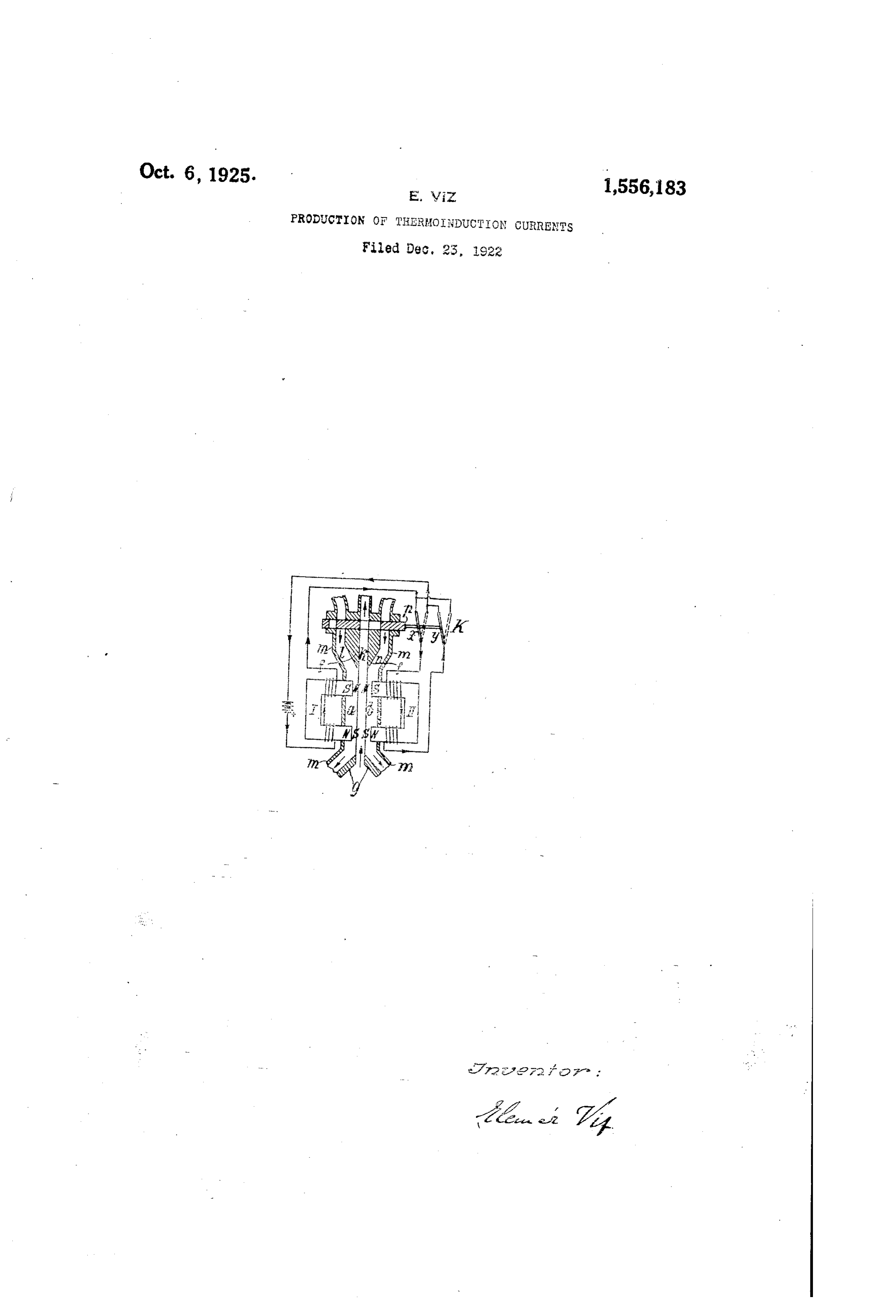
This invention relates particularly to the he'e The carrying out of the method will be production of electric currents by varying imatic recisely explained by the diagi'an 10 the magnetic lines by means of thermal representation given in the drawing. 65 variants. For a fill inderstanding of the principle It is a well known principle that the per of operation tipon which the invention is meability of soft iron can be altered by the based reference is made to the accompany thermal action for the production of mag ino dra wine which is a sectional view of an 15 netic fields of varying flux density with con al)in its enly dying the invention. sequent production of induced currents in Referring to the drawing. I and II are coils subject to such fields. Many attempts two electro-magnets which are provided have been made to employ this principle to lines with soft iron screen ( and b. The magnetic practical advantage in the generation of which emanate from the electro-mag 20 electric currents, but devices heretofore con nets I and T. seek the paths which possess structed with this end in view have proven the ly maximum permeability, and consequent the magnetic lines are for the most part to be unsuccessful in producing power of sufficient magnitude to warrant their rise closed by these screens, whereby two sepa rate magnetic circuits are formed.
commercially. that if iron be heated 80 25 The principal advantages of my inven thatIt isit demonstratable gradually becomes diamagnetic, the tion are to obviate this deficiency and to at tain the desired results by an organization advance toward this condition being that is structurally simple, compact and markedly rapir between 22?) cantiari'. until a state f absolute totality is reached highly efficient in the production of a g approximating 30 mented electrical energy. 60° centigi's de. On heat. The characteristic ficture of the present in or the soft iron Screens a and b while in invention lies in the fact that by the action position in front of the electro-magnets of heat two separate magnetic circuits, the and I within these limits of temperatures, placed opposite each other, are caused to and loss of their permeability is the quicker more complete the higher the heat is to 90 35 act upon each other in suchwise that alter nately first by the action of heat a state of thewhich they are subjected. In consequence, screens at increasing temperaturies : lov mutual repulsion between these two circuits an increasing is produced and then this state caused to pass between thenumber of lines of force to poles of said opposite elec 95 cease by cooling off (or vice versa) whilst 40 an electrical energy corresponding to the tro-magnets until the permeability of said energy of the heat action is obtained. screens is entirely lost whereupon all power The means for carrying out the method lines will he allowed to pass through said screens, which means that said screens have according to this invention are based upon been deprived of their screening effect. the arrangement of two magnets placed near 45 each other, the magnetic fields of which are My invention makes use of the fact that 00 protected from each other by two soft iron the Screens (7 and h allow the lines of force to pass at a certain degree of heat, while at a screens or armatures, each of which leads temperatire being about 20 to 30° centi the lines of force from one pole of a magnet glade below this upper limit said screens are 05 to the other pole thereof, as long as such 50 soft iron armatures are cold, but when the alle to cut of the majority of the power iron armatures are brought up to a deter change lines. By the thus produced immense mined higher temperature they will no through ofalternately the number of lines of force allowing the power longer deflect the lines of magnetic force. lines to pass and cutting them off, I induce 0. By heating and again cooling the protec 55 tive soft iron armatures in rapid succession, electro-magnetic currents within the induc
Page 3
tion windings of 'the electro-magnet II. temperature near the critical limit effects a Since I use very thin screens (for instance relatively large change, and above all a very screens of 0.5 millimeters thickness) the in high rate of change in the magnetic flux in fluence upon the magnetic reluctance of the the magnets.
magnetic circuit in consequence of the In the particular embodiment, the electric change of permeability of the screens, is current induced by the changes in the lines O very small. It is a fact that the loss of lines of force is superimposed upon the exciting of force incident to the increase in magnetic current and may be taken from the circuit reluctance is relatively small as compared at the points X and Y. However, the char 10 to the magnetic flux caused to pass to the in acter and disposition of induction windings duction windings due to the decrease in per through which the change of magnetic flux s meability of the screens. During the cool is caused to take place may vary within wide ing of the screens the opposite phenomenon limits, and the dependence or independence will be observed. The change of permeabili of the induction coils from the exciting cir 15 ty as the result of the cooling effect takes cuit is a matter of detail. place suddenly without any marked period I am also aware that the efficiency of the of transition with the result that the flow of system of generation of electric current magnetic lines of force to the induction a}ove described may be increased in various windings is suddenly interrupted. WVVS.
20 According to the drawing, the perma What I claim and desire to secure by Let nent exciting current is passed into windings of the electro-magnet I, then through the te's1. PatentIn of the United States, is:
apparatus for producing electric contact a of the commutator K into the currents, the combination of a magnetic cir windings of the electro-magnet II, and then cuit composed of two sections of high per 25 through the contact by back to the exciting meability separated by air gaps, means of battery. The position of the commutator K high magnetic permeability disposed in the during the heating of the screens must be such that the magnetic arms lying opposite gaps in spaced relation to both sections and means constructed and arranged to alter each other have the same polarity, so that nately heat and cool said means. 30 the direction of the induced current will be 2. Apparatus according to claim 1, where the same as the direction of the exciting cur in the means in the gap is composed of two NS rent, whereby the induced current will members spaced from each other in the di strengthen the exciting current rection of the width of the gap. The soft iron screens a and b arranged 35 opposite each other are in the drawing as 3. Apparatus according to Film 1, where in the means in the gap is composed of two 100 sociated with structural parts f and of of thin sheets spaced in the direction of the non-magnetic material to form a hollow width of the gap.
channell. Said channel is surrounded by a 4. In apparatus for producing electric casing in of non-magnetic material, whereby currents, the combination of a magnetic cir 40 further channels l and n are formed on the cuit composed of two sections of high per outer sides of the soft iron screens a and b. meability separated by air gans, two sheets OS A slide p is arranged to alternately open and of material having a high degree of per close said channels k, l, n at each stroke. meahility, disposed in the gaps in spaced re Through the channel a heating medium is lation to each other and to the sections and 45 passed rapidly, while alternately therewith means associated with the said sheets and a cooling medium is passed through the con the magnets for defining separate gas pas 8 duits land n. By these means the screens a sages, one between the sheets and one at the and b are heated at one stroke of the slide opposite side of each sheet. p and cooled at the next stroke. I further 5. In apparatus for producing electric 50 connect said commutator K positively with currents, the combination of a magnetic cir said slide p in order to reverse the induced cuit composed of two sections of high per '' currents periodically with the heating and mes bility separated by air gaps, magnetic cooling of the screens a and b. Thereby, a screening means of high permeabilitv dis direct current results. As a matter of course posed in the gaps in spaced relation to the 55 I may use any equivalent means for the slide sections, means for alternately heatinor and and the commutator K shown in Fig. 1. cooling the screening means, a source of elec In the foregoing I have described one tric current, coils on the sections inter-con form of apparatus for carrying out the prin neoted to define a circuit, switch means for ciple on which the invention is based. It is reversing the current flow through the coil understood, however, that there is consider on one of the sections and means making : able latitude in regard to specific detail. the current reversal dependent on the means 125. The salient point is the application of soft for heating and cooling the screening means iron screens between opposing magnets whereby a relatively small rise or fall of ELEMER WIZ.
Provenance
- Collection
- Cited prior art
- Original PDF
- patentimages.storage.googleapis.com →
- Filed
- 1922-12-23
- Pages
- 3
- Method
- pdftotext (the PDF's own text layer) + pdftoppm 300dpi page scans
- Source
- Google Patents bibliographic record
- Granted
- 1925-10-06
- Inventors
- Viz Elemer; MAX MEIN HARDT
- Transcribed from
- patentimages.storage.googleapis.com →