patent · US4395582
Combined solar conversion
26 July 1983
Page 1 — bibliographic record
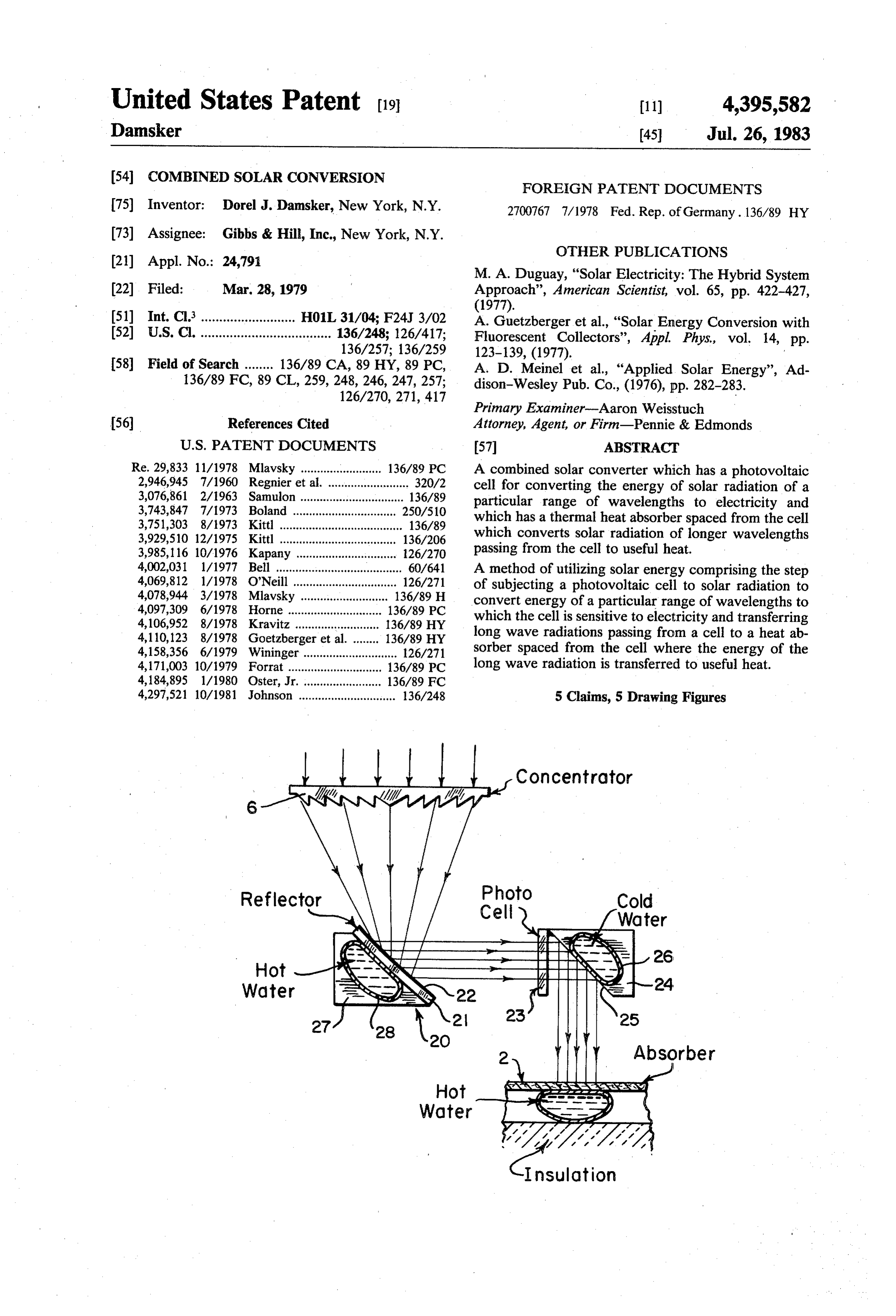
United States Patent (19) 11) 4,395,582 Damsker 45 Jul. 26, 1983 (54) COMBINED SOLAR CONVERSION FOREIGN PATENT DOCUMENTS 75) Inventor: Dorel J. Damsker, New York, N.Y. 2700767 7/1978 Fed. Rep. of Germany. 136/89 HY 73) Assignee: Gibbs & Hill, Inc., New York, N.Y.
OTHER PUBLICATIONS
M. A. Duguay, "Solar Electricity: The Hybrid System (22) Filed: Mar. 28, 1979 Approach'', American Scientist, vol. 65, pp. 422-427,
51) Int. Cl........................... H01L 31/04; F24J 3/02 A. Guetzberger et al., "Solar Energy Conversion with 52 U.S. C. .................................... 136/248; 126/417; Fluorescent Collectors”, Appl. Phys, vol. 14, pp.
58 Field of Search ........ 136/89 CA, 89 HY, 89 PC, A. D. Meinel et al., "Applied Solar Energy', Ad 136/89 FC, 89 CL, 259, 248,246, 247, 257; dison-Wesley Pub. Co., (1976), pp. 282-283.
Primary Examiner-Aaron Weisstuch 56) References Cited Attorney, Agent, or Firm-Pennie & Edmonds
Re. 29,833 11/1978 Mlavsky ......................... 136/89 PC A combined solar converter which has a photovoltaic 2,946,945 7/1960 Regnier et al. ......................... 320/2 cell for converting the energy of solar radiation of a 3,076,861 2/1963 Samulon ................................ 136/89 particular range of wavelengths to electricity and 3,743,847 7/1973 Boland .... ... 250/510 3,751,303 8/1973 Kittl ...................................... 136/89 which has a thermal heat absorber spaced from the cell 3,929,510 12/1975 Kittl .... ... 136/206 which converts solar radiation of longer wavelengths 3,985,116 10/1976 Kapany ... 126/270 passing from the cell to useful heat. 4,002,031 1/1977 Bell ....................................... 60/641 A method of utilizing solar energy comprising the step 4,069,812 1/1978 O'Neill ..., ... 126/271 of subjecting a photovoltaic cell to solar radiation to 4,078,944 3/1978 Mlavsky .. ... 136/89 H convert energy of a particular range of wavelengths to 4,097,309 6/1978 Horne ...... ... 136/89 PC which the cell is sensitive to electricity and transferring 4,106,952 8/1978 Kravitz .......................... 136/89 HY 4,110,123 8/1978 Goetzberger et al. ........ 136/89 HY long wave radiations passing from a cell to a heat ab 4,158,356 6/1979 Wininger ............................. 126/271 sorber spaced from the cell where the energy of the 4,171,003 10/1979 Forrat ...... ... 136/89 PC long wave radiation is transferred to useful heat. 4,184,895 1/1980 Oster, Jr. . ... 136/89 FC 4,297,521 10/1981 Johnson .............................. 136/248 5 Claims, 5 Drawing Figures
ConCentro for
Insulation
Page 2
Drawing sheet — no readable text.
Page 3
Drawing sheet — no readable text.
Page 4
COMBINED SOLAR CONVERSION DISCLOSURE OF INVENTION
Broadly, the invention comprises a method of utiliz
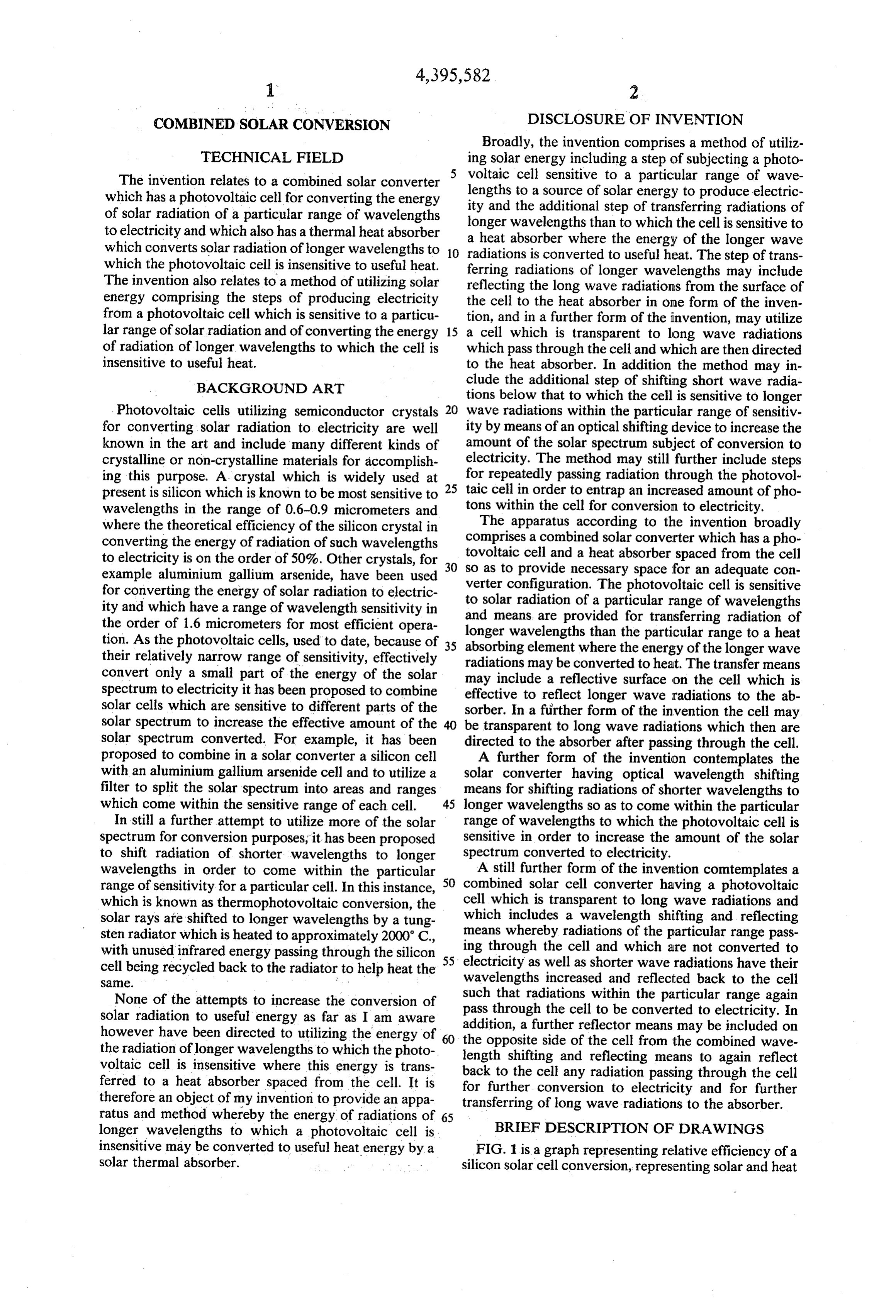
TECHNICAL FIELD ing solar energy including a step of subjecting a photo The invention relates to a combined solar converter voltaic cell sensitive to a particular range of wave which has a photovoltaic cell for converting the energy lengths to a source of solar energy to produce electric of solar radiation of a particular range of wavelengths ity and the additional step of transferring radiations of longer wavelengths than to which the cell is sensitive to to electricity and which also has a thermal heat absorber a heat absorber where the energy of the longer wave which converts solar radiation of longer wavelengths to 10 radiations is converted to useful heat. The step of trans which the photovoltaic cell is insensitive to useful heat. ferring radiations of longer wavelengths may include The invention also relates to a method of utilizing solar reflecting the long wave radiations from the surface of energy comprising the steps of producing electricity the cell to the heat absorber in one form of the inven from a photovoltaic cell which is sensitive to a particu tion, and in a further form of the invention, may utilize lar range of solar radiation and of converting the energy 15 a cell which is transparent to long wave radiations of radiation of longer wavelengths to which the cell is which pass through the cell and which are then directed insensitive to useful heat. to the heat absorber. In addition the method may in BACKGROUND ART clude the additional step of shifting short wave radia tions below that to which the cell is sensitive to longer
Photovoltaic cells utilizing semiconductor crystals 20 wave radiations within the particular range of sensitiv for converting solar radiation to electricity are well ity by means of an optical shifting device to increase the known in the art and include many different kinds of amount of the solar spectrum subject of conversion to crystalline or non-crystalline materials for accomplish electricity. The method may still further include steps ing this purpose. A crystal which is widely used at for repeatedly passing radiation through the photovol present is silicon which is known to be most sensitive to 25 taic cell in order to entrap an increased amount of pho wavelengths in the range of 0.6-0.9 micrometers and tons within the cell for conversion to electricity. where the theoretical efficiency of the silicon crystal in The apparatus according to the invention broadly converting the energy of radiation of such wavelengths comprises a combined solar converter which has a pho to electricity is on the order of 50%. Other crystals, for tovoltaic cell and a heat absorber spaced from the cell example aluminium gallium arsenide, have been used 30 so as to provide necessary space for an adequate con verter configuration. The photovoltaic cell is sensitive for converting the energy of solar radiation to electric to ity and which have a range of wavelength sensitivity in andsolar radiation of a particular range of wavelengths means are provided for transferring radiation of the order of 1.6 micrometers for most efficient opera longer wavelengths than the particular range to a heat tion. As the photovoltaic cells, used to date, because of 35 absorbing element where the energy of the longer wave their relatively narrow range of sensitivity, effectively radiations may be converted to heat. The transfer means convert only a small part of the energy of the solar may include a reflective surface on the cell which is spectrum to electricity it has been proposed to combine effective to reflect longer wave radiations to the ab solar cells which are sensitive to different parts of the sorber. In a flirther form of the invention the cell may solar spectrum to increase the effective amount of the be transparent to long wave radiations which then are solar spectrum converted. For example, it has been directed to the absorber after passing through the cell. proposed to combine in a solar converter a silicon cell A further form of the invention contemplates the with an aluminium gallium arsenide cell and to utilize a solar converter having optical wavelength shifting filter to split the solar spectrum into areas and ranges means for shifting radiations of shorter wavelengths to which come within the sensitive range of each cell. 45 longer wavelengths so as to come within the particular Instill a further attempt to utilize more of the solar range of wavelengths to which the photovoltaic cell is spectrum for conversion purposes, it has been proposed sensitive in order to increase the amount of the solar to shift radiation of shorter wavelengths to longer spectrum converted to electricity.
wavelengths in order to come within the particular A still further form of the invention comtemplates a range of sensitivity for a particular cell. In this instance, 50 combined solar cell converter having a photovoltaic which is known as thermophotovoltaic conversion, the cell which is transparent to long wave radiations and solar rays are shifted to longer wavelengths by a tung which includes a wavelength shifting and reflecting sten radiator which is heated to approximately 2000 C., means whereby radiations of the particular range pass with unused infrared energy passing through the silicon 55 ing through the cell and which are not converted to electricity as well as shorter wave radiations have their cell being recycled back to the radiator to help heat the wavelengths
Sae. increased and reflected back to the cell None of the attempts to increase the conversion of pass such that radiations within the particular range again solar radiation to useful energy as far as I am aware addition, through the cell to be converted to electricity. In however have been directed to utilizing the energy of 60 the opposite a further reflector means may be included on the radiation of longer wavelengths to which the photo length shiftingsideand of the cell from the combined wave reflecting means to again reflect voltaic cell is insensitive where this energy is trans back to the cell any radiation passing through the cell ferred to a heat absorber spaced from the cell. It is for further conversion to electricity and for further therefore an object of my invention to provide an appa transferring of long wave radiations to the absorber. ratus and method whereby the energy of radiations of 65 BRIEF DESCRIPTION OF DRAWINGS longer wavelengths to which a photovoltaic cell is insensitive may be converted to useful heat energy by a FIG. 1 is a graph representing relative efficiency of a solar thermal absorber. silicon solar cell conversion, representing solar and heat
Page 5
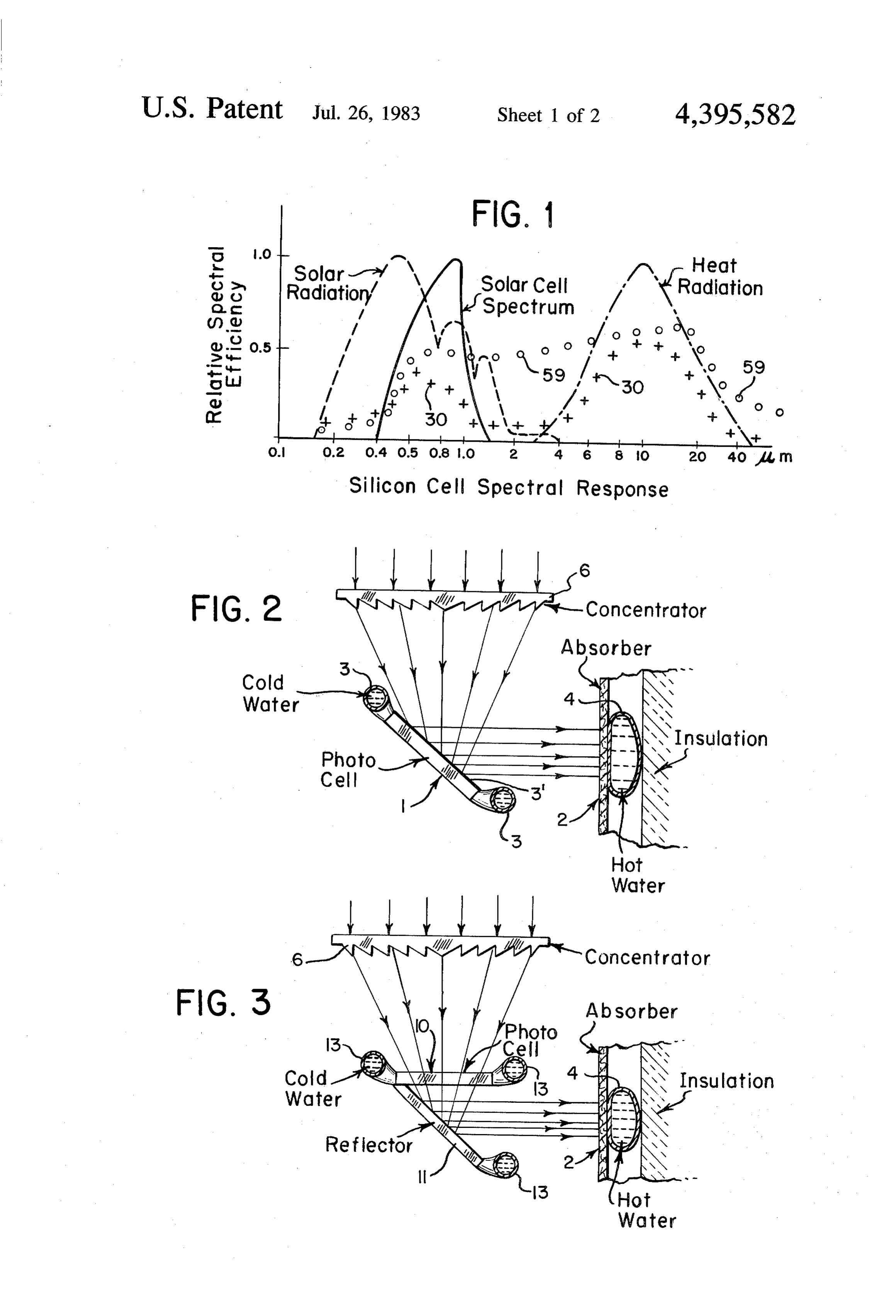
radiation and representing relative power response of with a reflective material or by utilizing reflective prop several embodiments of a combined solar converter erties of any encapsulation material surrounding the constructed according to the invention, all as functions cell.
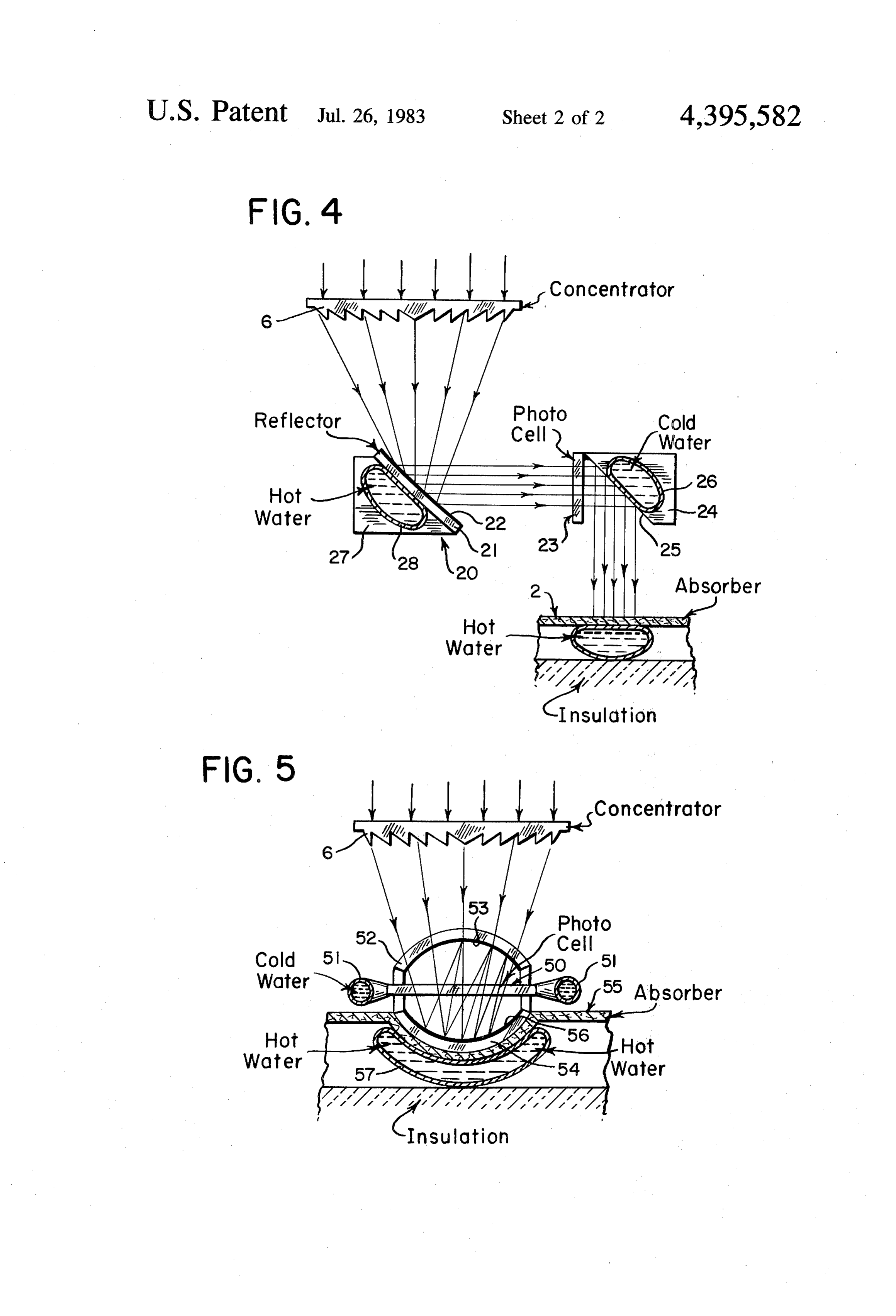
of wavelength; Some of the radiation coming from the concentrator FIG. 2 is a diagrammatic view of a combined solar 6 and falling into the cell 1 is converted to heat at the converter constructed according to the invention photo cell and this heat is carried off by the cold water wherein a photovoltaic cell has a reflective surface for conduits 3 which may also connect with the heating transferring long wave radiations to a heat absorber; grid, not shown, in order that the heat produced by the FIG. 3 is a diagrammatic view of a further embodi cell may be utilized. Thus the combined solar converter ment of a combined solar converter constructed ac 10 of FIG. 2, in addition to converting solar radiation to cording to the invention wherein the photovoltaic cell electricity, also converts a good part of the radiation to is transparent to long wave radiations which are then useful heat both by the conversion of long wave radia transferred to a heat absorber; tion to useful heat by the absorber and also by the heat FIG. 4 is a diagrammatic view of a further embodi ing of the water used to cool the cell.
ment of a combined solar converter constructed ac 15 Referring to FIG. 3, the photo cell 10 of the com cording to the invention utilizing means for shifting bined converter shown differs from that of FIG. 2 in shorter wave radiations to longer wave radiations prior that it has a non-reflective outer surface and in that the to the radiations impinging on the photovoltaic cell; and cell is transparent to radiations having wavelengths FIG. 5 is a diagrammatic view of a further embodi longer and shorter than the particular range. A reflector ment of a combined solar converter constructed ac 20 11 is provided on the side opposite the cell from the cording to the invention, illustrating means for repeat source of radiation for reflecting the radiation occur edly passing radiation through a photovoltaic cell. ring in the particular range which passes through the BEST MODE FOR CARRYING OUT THE cell and which is not converted to electricity and for further reflecting radiation of longer wavelength than
INVENTION 25 the particular range which passes through the photo Referring to FIG. 1, the relative efficiency of a sili cell onto the heat absorber 2. In this instance the reflec consolar cell conversion of radiation into electricity as tor 11 serves as a transfer means for transferring radia a function of wavelength is illustrated, with the cell tion to the absorber. The outer surface of the cell can be being most sensitive to radiation in wavelengths in a made non-reflective by inclusion of anti-reflective coat particular range of 0.6-0.9 micrometers and where the 30 ings, selective etching or a combination of both. Cold theoretical efficiency of such conversion is on the order water conduits 13 connected to a heat grid, not shown, of 50%. As shown, much of the solar radiation is in the serve to cool both the cell 10 and the reflector 11. area of wavelengths shorter than the particular sensitiv Referring to FIG. 1, the transmitting characteristic or ity range for silicon while solar heat radiation is in the relative power response of the combined solar con area of wavelengths longer than the particular range. 35 verter of FIG. 3 as it varies with wavelength is illus Photo cells comprised of other materials would have a trated. As shown by line 30, incoming radiation is con different solar cell spectrum, as for example, aluminium verted to electricity at shorter wavelengths while the gallium arsenide which is most efficient in the range of radiation reflected by the reflector 11 onto the absorber 1.6 micrometers. Thus it becomes apparent that when a 2 is converted to heat at longer wavelengths. Thus as solar cell alone is used in a solar converter, that much of 40 with the solar converter of FIG. 2, the converter con the energy of the solar spectrum is ineffective for the verts solar radiation into electricity by the cell 10 and, conversion of solar energy into useful energy. Thus if in addition, converts radiation into useful heat by the the shorter and longer wavelengths of the solar spec absorber 2 and by the heating of the cooling water used trum besides the wavelengths falling within the particu to cool the cell and the reflector. lar range of sensitivity of the silicon could be converted, 45 FIG. 4 illustrates a combined solar converter includ the overall efficiency of a solar converter would be ing an optical wavelength shifting means 20 comprising increased. a glass surface 21, which is coated with a wavelength Referring to FIG. 2, there is illustrated a combined increasing reflective material 22, for example, doped solar converter construction including a silicon photo indium oxide, which serves to increase the wavelength voltaic cell 1 and a heat absorber 2 which is spaced from 50 of the solar radiations coming from the Fresnel lens the cell. The cell 1 is cooled by cold water conduits 3 in concentrator 6. The reflective surface reflects the order to increase the efficiency of the conversion of waves onto, the photovoltaic cell 23 mounted on a car radiation energy to electricity. The heat absorber 2 rying member 24, which has a reflective surface 25 preferably is coated with an anodized dendritic tungsten which in turn reflects radiation passing through the cell coating in order to retain heat and thus is non-transpar 55 23 onto the absorber 2. Carrying member 24 includes a ent or opaque to the visible spectrum. The absorber 2 in cold water conduit 26 utilized to cool the cell 23 and turn contacts a water conduit 4 which forms part of a which connects with a hot water grid, not shown, in the hot water grid, not shown. A concentrator in the form same manner as the cold water conduits in the embodi of a Fresnel-type lens 6 is provided for concentrating ments of FIGS. 2 and 3.
incident solar rays onto the cell 1. The cell 1 in turn has In addition, the glass surface 21 is mounted on a car an outer reflective surface 3' by which some of the rying member 27 containing a hot water conduit 28 radiation of wavelengths longer than the particular which is heated by long wave radiations impinging onto range of wavelengths to which the cell is sensitive and the wavelength shifting means member and which leads the energy of which is not converted into electricity is to the hot water grid. The cell 23 is transparent to long transferred to the heat absorber 2 where the energy of 65 wave radiations above the particular range of sensitivity the radiation is converted to heat which is then carried of the cell and to those radiations falling within the off by the hot water conduit 4 to the heating grid. The particular range the energy of which is not converted to reflective surface may be obtained by coating the cell electricity by the cell.
Page 6
The optical wavelength shifting means 20, besides by the line 59 where it is seen that the efficiency of solar changing the wavelength, further acts in conjunction radiation converted to electricity is substantially greater with the concentrator lens 6 to focus and reflect solar than that of the embodiment of FIG. 4. radiation on to the cell 23. The lengthening of solar While I have illustrated embodiments of the com radiation wavelengths by the optical wavelength shift bined converter in diagrammatical form, it is obvious ing means 20 serves to match the solar radiation with that the converter can be assembled in solar installations the solar cell spectrum as shown in FIG. 1 by effec in a number of ways to assure maximum exposure to the tively moving the solar radiation to the right. The result solar radiation during different parts of the day. For is that the transmitting characteristic or relative power example, the embodiment of FIG. 2, wherein long wave response of the combined solar converter is vastly im 10 radiation is reflected off the surface of a cell, may be proved as shown by line 30 of FIG. 1. This shifting of used to line or pave mirror panels serving to direct or the radiation spectrum to fit with the cell spectrum in concentrate the solar radiation.
order to increase efficiency differs from the thermo It is also obvious that different kinds of cells may be photovoltaic concept as previously discussed in that employed together in a converter according to the in radiation of shorter wavelengths is being shifted to 15 vention where the different cells are combined together radiation of longer wavelengths, the energy of which is to make up a single complex cell having multijunction then converted. In the thermophotovoltaic concept areas in order to increase the range of wavelengths to utilizing an intermediate hot radiator, the energy of which the complex cell is sensitive. radiation of shorter wavelength is lost and not con I claim:
verted. FIG. 5 illustrates a further embodiment of a 20 1. A method of utilizing solar energy comprising the combined solar converter in which solar rays are to a steps of (a) subjecting a photovoltaic cell to a source of great extent trapped within the converter and reflected solar radiation, said cell being sensitive to radiation of a through the photovoltaic cell a number of times to particular range of wavelengths and insensitive and thus assure maximum conversion of radiation energy to elec transparent to radiation of greater and shorter wave trical energy. The cell 50 of FIG. 5, like the cells of 25 lengths than said radiation of particular range, thereby FIGS. 2 and 3, has cold water conduits 51 leading to a converting the energy of part of said radiation of partic heating grid, not shown. The cell 50 in addition has ular range to electricity; (b) directing part of said radia glass covers 52 and 54 positioned on either side of the tion of greater and shorter wavelengths after they have cell with the cover 52 having a reflective surface 53 on passed through said cell to an energy absorber spaced the side facing the cell and the cover 54 having a reflec 30 from said cell to convert the energy of the same to heat; tive surface 56 on the side facing the cell and with the (c) shifting the wavelengths of any radiation that passes cover 54 being in contact with a heat absorber 55. Both through the cell to longer wavelengths; and (d) reflect reflective surfaces preferably are coated with a doped ing the shifted radiation of longer wavelengths back indium oxide coating so that they also may act as a towards said cell to produce electricity therefrom. wavelength shifting means similar to that of FIG. 4 with 35 2. A method of utilizing solar energy according to the cover 52 acting as a first optical wavelength shifting claim 1 including the additional step of reflecting any means and the cover 54 acting as a second optical wave shifted radiation of longer wavelengths that may pass length shifting means. through said cell back towards said cell. A hot water conduit 57 contacts the absorber 55 and 3. A combined solar converter adapted to be exposed leads to a heating grid, not shown, to which the con 40 to a source of solar radiation, comprising a photovoltaic duits 51 are also connected. cell sensitive to solar radiation of a particular range of As shown in FIG. 5, solar radiation coming from the wavelengths so as to convert the energy of part of said concentrator passes through cover 52 where radiation radiation of particular range to electricity, wherein said of shorter wavelengths is lengthened to come within the cell is transparent and thus insensitive to solar radiation particular range of sensitivity of cell 50 and then im 45 of shorter and longer wavelengths than said particular pinges upon the cell 50. Some of the radiation within the range, an energy absorber positioned to receive radia particular range is converted into electricity by the cell tion of said longer wavelengths passing through said 50 while the part not converted, along with radiations cell for converting the energy of the same to heat, a first of longer and shorter wavelengths, than the particular optical wavelength shifting means positioned between range, pass through the cell to impinge upon the coating 50 the radiation source and said cell for shifting radiation 56 where radiation of longer wavelength greater than of said shorter wavelengths to longer wavelengths to the particular range is converted to heat. The wave come within said particular range, and a second optical lengths of some of the radiation passing through the cell shifting means positioned on the opposite side of said are increased and reflected back again through the cell cell from said first optical shifting means for shifting 50 where radiation falling within the particular range 55 radiation passing through said cell into longer wave may again be converted to electricity and any of the lengths and for reflecting the shifted radiation of longer remaining radiation then passed onto the reflective sur wavelengths back towards said cell. face 53 which again redirects the radiation back to the 4. A combined solar converter according to claim 3 cell 50 while at the same time increasing wavelengths wherein said first optical shifting means has a reflective where again some of the radiation is converted to elec 60 surface for shifting radiation reflected from said second trical energy. The radiation of long wavelengths to optical shifting means and passing through said cell which the cell 50 is not sensitive will be converted to back towards said cell.
heat energy by the absorber. The effect of this construc 5. A combined solar converter adapted to be exposed tion is that much more of the solar radiation falling to a source of solar radiation, comprising a photovoltaic within the particular range is converted to useful elec 65 cell sensitive to solar radiation of a particular range of tricity. wavelengths so as to convert the energy of part of said The improved conversion characteristic of the com radiation of particular range to electricity, wherein said bined solar converter of FIG. 5 is represented in FIG. 1 cell is transparent and thus insensitive to solar radiation
Page 7
of shorter and longer wavelengths than said particular doped indium oxide positioned between the radiation range, an energy absorber spaced from said cell and positioned to receive radiation of shorter and longer source and the cell for shifting
radiation of. shorter
wavelengths passing through said cell for convering wavelengths to longer wavelengths to come within said the energy of the same to heat, and optical wavelength 5 particular range. - shifting means comprising a glass surface coated with is k it is is

Provenance
- Collection
- Cited prior art
- Original PDF
- patentimages.storage.googleapis.com →
- Filed
- 1979-03-28
- Pages
- 7
- Method
- pdftotext (the PDF's own text layer) + pdftoppm 300dpi page scans
- Source
- Google Patents bibliographic record
- Granted
- 1983-07-26
- Inventors
- Dorel J. Damsker; Gibbs and Hill Inc
- Transcribed from
- patentimages.storage.googleapis.com →