patent · US4244328
Procedure for the operation of combustion engine
13 January 1981
Page 1 — bibliographic record
United States Patent (19) 11) 4,244,328 Lindstrom 45 Jan. 13, 1981
54 PROCEDURE FOR THE OPERATION OF Attorney, Agent, or Firm-Burns, Doane, Swecker & COMBUSTON ENGINE Mathis
(76) Inventor: Olle B. Lindstrom, Lorensviksv 14,
S-18363 Taby, Sweden An improved process and apparatus for preparing a gaseous mixture of hydrocarbon and carbon monoxide 21 Appl. No.: 885,324 to be supplied to the air/fuel mixture of a combustion - - engine is disclosed. The process and apparatus are use 22 Filed: Mar. 10, 1978 ful in reducing the amount of noxious components and (30) Foreign Application Priority Data aldehydes in the engine exhaust gas. In one embodiment of the invention, an improved process and combustion
Mar, 17, 1977 (SE) Sweden .................."...i...... 7703011 engine are provided for reducing the noxious compo
nents and aldehydes. Recycled, water vapor-containing
FO2B 47/00 exhaust gas is mixed with at least one lower alcohol.
52 U.S.C. ....................................... 123/3; 123/25 F;
Subsequently, the lower alcohol is catalytically steam 123/568; 123/1 A reformed in the presence of the exhaust gas to form a 58 Field of Search ................. 123/25 R, 25 A, 25 E, gaseous mixture of hydrogen and carbon monoxide, at 123/25 F, 25 B, 3, 32 ST, 1 A, 127, 119A least a portion of the water vapor and energy required for the steam reforming being provided by the exhaust 56 References Cited gas. The hydrogen/carbon monoxide mixture is com
bined with a mixture of air and a disparate primary engine fuel, and the combined mixture is supplied to a 3,717,129 2/1973 Fox ...................................... 123/1 A combustion zone wherein the mixture is combusted to 3,963,000 6/1976 Kosaka et al. ... 123/3 produce an exhaust gas having a reduced amount of 3,968,775 7/1976 Harpman ...... ... 123/3 noxious components and aldehydes. Preferably, the 4,003,343 /1977 Lee ............... 123/ A lower alcohol is methanol, the primary fuel is gasoline, 4,086,877 5/1978 Henkel et al. .... ... 23/3 and the steam reforming is carried out in the presence of 4,088,450 5/1978 Kosaka et al. .... ... 123/3 a noble metal catalyst or a nickel catalyst. 4,143,620 3/1979 McGuchi et al. ....................... 123/3
Primary Examiner-Craig R. Feinberg 10 Claims, 1 Drawing Figure
Page 2
Drawing sheet — no readable text.
Page 3
in the methanol-gasoline distribution between the differ
PROCEOURE FOR THE OPERATION OF ent cylinders in the engine. The high heat of evapora COMBUSTON ENGINE tion of methanol produces cooling of the components where methanol is being vaporized. These problems
In the past years methanol has received attention as 5 require considerable redesign of the combustion engine, an additive to gasoline. Methanol has a high octane which in turn prevents a fast introduction of the new number and it is therefore possible to replace the lead motor fuel. Increased motor wear has also been ob additive in gasoline with an additive having up to 20% served and it appears that some lead should be added to methanol. In this way, the lead emissions in the exhaust the gasoline to overcome this problem. gas are eliminated. Also, there will be a lower content 10 The methanol additive is not completely free of prob of nitrogen oxides, carbon monoxides and unburnt hy lems from an environmental point of view in spite of drocarbons in the exhaust gas. - reduced emissions of unburnt hydrocarbons, carbon Another approach to improving the exhaust gas qual monoxide and nitrogen oxides. Small quantities of alde ity is to add hydrogen to the combustion engine. Hydro hydes are produced in the combustion and the influence gen addition makes it possible to operate at a higher air 15 of these aldehydes on the environment and public to fuel ratio resulting in a lower content of unburnt health has not been clarified. - hydrocarbons and carbon monoxide. A particularly Pure hydrogen would of course be an ideal motor advantageous procedure to supply hydrogen is de fuel from many viewpoints, and is the subject of consid scribed in my earlier U.S. Pat. No. 3,918,412. Accord erable interest. The prime difficulty is, however, the ing to that patent, hydrogen is produced by steam re storage. The hydrogen would occupy a volume which forming of a part of the fuel in a catalytic reactor by is at least as large as the volume of, for example, metha reaction with steam and carbon dioxide. A portion of nol with the same energy content. To convert a more the exhaust gas is recirculated to the catalytic reactor energy-rich fuel like gasoline to 100% hydrogen re where it is mixed with part of the liquid fuel which then quires a process system of a considerable size. The ideal is converted to hydrogen and carbon monoxide. This 25 would of course be if motor fuel could be supplied with procedure gives improved fuel economy and good con a hydrogen additive instead of the methanol additive trol of unburnt hydrocarbons and carbon monoxide as being discussed above. This would provide a compro well as of nitrogen oxides. It is also disclosed in my mise meeting all the conflicting requirements which are earlier patent that lower alcohols can be used as fuel. put on motor fuel as discussed above. It is not, however, Part of the alcohol fuel is supplied directly to the com 30 possible to bind hydrogen in gasoline. bustion engine and part of it to the catalytic reactor for The drawback associated with my earlier U.S. patent steam reforming to hydrogen and carbon monoxide. referred to above when used with gasoline is the com A serious drawback with the alcohol fuels is their low paratively high temperature needed for steam reform energy content. One liter of gasoline is equivalent to ing. This, among other things, has the effect of produc two liters of methanol which means that a methanol fuel 35 ing a low energy recovery from the exhaust gas steam. car must carry twice as much fuel tanks as a corre Application of the invention disclosed in my earlier sponding gasoline car. - patent to alcohol fuels, on the other hand, requires com The method as discussed above comprising supplying paratively large volumes for, e.g., the fuel tanks. a small quantity of methanol to gasoline may therefore While this invention is related to the method of sup be considered as a good compromise which meets the 40 plying methanol to gasoline and the method of supply requirement for high energy content of the fuel as well ing hydrogen to the fuel-air mixture according to my as the requirements for good environmental qualities. earlier U.S. Pat. No. 3,918,412, it eliminates the prob The advantages and drawbacks of methanol addition to lems which are connected with methanol addition to gasoline for cars are presently being evaluated. The gasoline as described above as well as other problems present state of the art is reported in the proceedings 45 which are associated with the procedure according to from the seminar "Methanol as a Fuel,' conducted in U.S. Pat. No. 3,918,412.
Stockholm Mar. 21, 22 and 24, 1976. In these proceed In the description which follows, it is noted that the ings, the environmental advantages of such processes present invention uses the same primary fuels as are were elucidated. Also, a number of practical problems normally used in methanol addition to gasoline. which must be solved in changing to a methanol addi 50 One object of the present invention is to eliminate the tive in gasoline were discussed. risk for phase separation in methanol-gasoline mixtures. Several different problems exist. One well known A second object is to reduce corrosion and material problem is the risk of phase separation. This depends changes in the fuel system of the engine. partly on the composition of the gasoline and partly on A third object is to eliminate the uneven distribution its water content. It is difficult to prevent water vapor 55 of fuel components between the different cylinders of from coming into the tank and other spaces carrying the engine.
fuel. The methanol additive also produces special mate A fourth object is to eliminate the risk or vapor lock rials problems. For instance, the additive produces cor and freezing of, e.g., the carburetor, caused by the high rosion on light metal components and otherwise affects heat of vaporization of the methanol. components made of polymers and rubbers in systems 60 A fifth object is to improve the fuel economy by such as the fuel system. By choice of proper materials utilization of part of the energy content of the exhaust which are resistant in the particular chemical environ gases.
ment, these material problems may be solved. The ad A sixth object is to improve the quality of the exhaust Vantages with the methanol additives are of course gas associated with the methanol addition to gasoline by dependent on the chemical composition and reactivity 65 eliminating or at least drastically reducing the aldehyde of methanol. The most difficult motor problems also emissions.
depend on the inherent properties of the methanol. The A seventh object is to allow freedom in the choice of high vapor pressure of methanol thus gives differences the composition of the motor fuels.
Page 4
An eight object of the invention is to make possible a and a disparate primary engine fuel. Operatively con simple rebuilding of existing engines. nected to said combining means are means for supplying A ninth object is to require only simple modification the hydrogen/carbon monoxide/air/primary fuel mix of the distribution system and fuel supply system to ture to a combustion zone within said combustion en convert to the new fuel system. gine. Finally, means are provided for combusting said In one aspect of this invention a process is provided mixture in said combustion zone to produce an exhaust for reducing the amount of noxious components and gas comprising a reduced amount of noxious compo aldehydes in the exhaust gas of an operating combustion nents and aldehydes.
engine. A water vapor-containing exhaust gas stream All these highly desired advantages and properties from the combustion engine is recycled to a first Zone O are produced by means of the present invention in an wherein the exhaust gas stream is mixed with a separate extremely simple and surprising way. The essence of the feed stream comprising at least one lower alcohol. The present invention is a combination of several factors. lower alcohol containing feed stream is catalytically One important factor is that the methanol is never steam reformed in a steam reforming Zone in the pres mixed with the gasoline but is distributed separately and ence of said exhaust gas stream to form a gaseous mix 15 contained in a special tank on the vehicle. The second ture comprising hydrogen and carbon monoxide, factor is that most of the methanol is changed to hydro whereby at least a portion of the water vapor and en gen and carbon monoxide in a special catalytic reactor ergy required for said steam reforming is provided by whereafter the gaseous mixture is supplied to the en said exhaust gas stream. The gaseous mixture of hydro gine, e.g., by mixing the gasoline-air-fuel mixture in the gen and carbon monoxide is combined with a mixture of carburetor. The third factor is that the methanol is con air and a disparate primary engine fuel, and the hy verted to hydrogen and carbon monoxide by reaction drogen/carbon monoxide/air/primary fuel mixture is supplied to a combustion zone within said combustion with rate water vapor in the recirculated exhaust gas. If the of recirculation is to be reduced, it is possible to engine. The mixture is combusted in said combustion supply additional water to the methanol. A fourth im zone to produce an exhaust gas comprising a reduced 25 portant factor is that the steam reforming of the metha amount of noxious components and aldehydes. nol may proceed at a comparatively low temperature of In another aspect of the present invention, an im about 300° C. This makes possible recovery of an im proved combustion engine is provided which emits an portant part of the energy content of the exhaust gas by exhaust gas containing a reduced amount of noxious direct and possibly also indirect contact between the components and aldehydes. The combustion engine reaction mixture and the exhaust gas stream. comprises means operatively connected to a first Zone The invention thus consists of a new method to pro for recycling a water vapor-containing exhaust gas duce a gas mixture containing hydrogen and carbon stream thereto. Means are provided for introducing into monoxide to be added to the fuel/air mixture for a com said first zone a separate feed stream to be mixed with bustion engine for the purpose of reducing the content said exhaust gas stream, which separate feed stream of noxious components
in the exhaust gases given off comprises at least one lower alcohol. Means are also provided within said first zone for catalytically steam terized by the hydrogen and theThe from the combustion engine. invention is charac carbon monoxide being reforming said lower alcohol-containing feed stream in the presence of said exhaust gas stream to form a gase produced by steam reforming of methanol in a catalytic ous mixture comprising hydrogen and carbon monox 40 reactor, by at least part of the requirement of water ide, whereby at least a portion of the water vapor and vapor for the steam reforming and also the energy for energy required for said stream reforming is provided the reaction being satisfied by supplying exhaust gas by said exhaust gas stream. Adjacent to said first zone, from the combustion engine to the catalytic reactor means are disposed for combining said gaseous mixture where it is mixed with the methanol and by the metha of hydrogen and carbon monoxide with a mixture of air 45 nol being supplied from a special methanol system con and disparate primary engine fuel. Operatively con taining a tank, conduits and feeding means for the sup nected to said combining means are means for supplying plying of methanol to the catalytic reactor. the hydrogen/carbon monoxide/air/primary fuel mix The invention shall now be described in more detail ture to a combustion zone within said combustion en by means of the accompanying single FIGURE which gine. Finally, means for combusting said mixture in said 50 shows means for carrying out the procedure according combustion zone to produce an exhaust gas comprising to the invention.
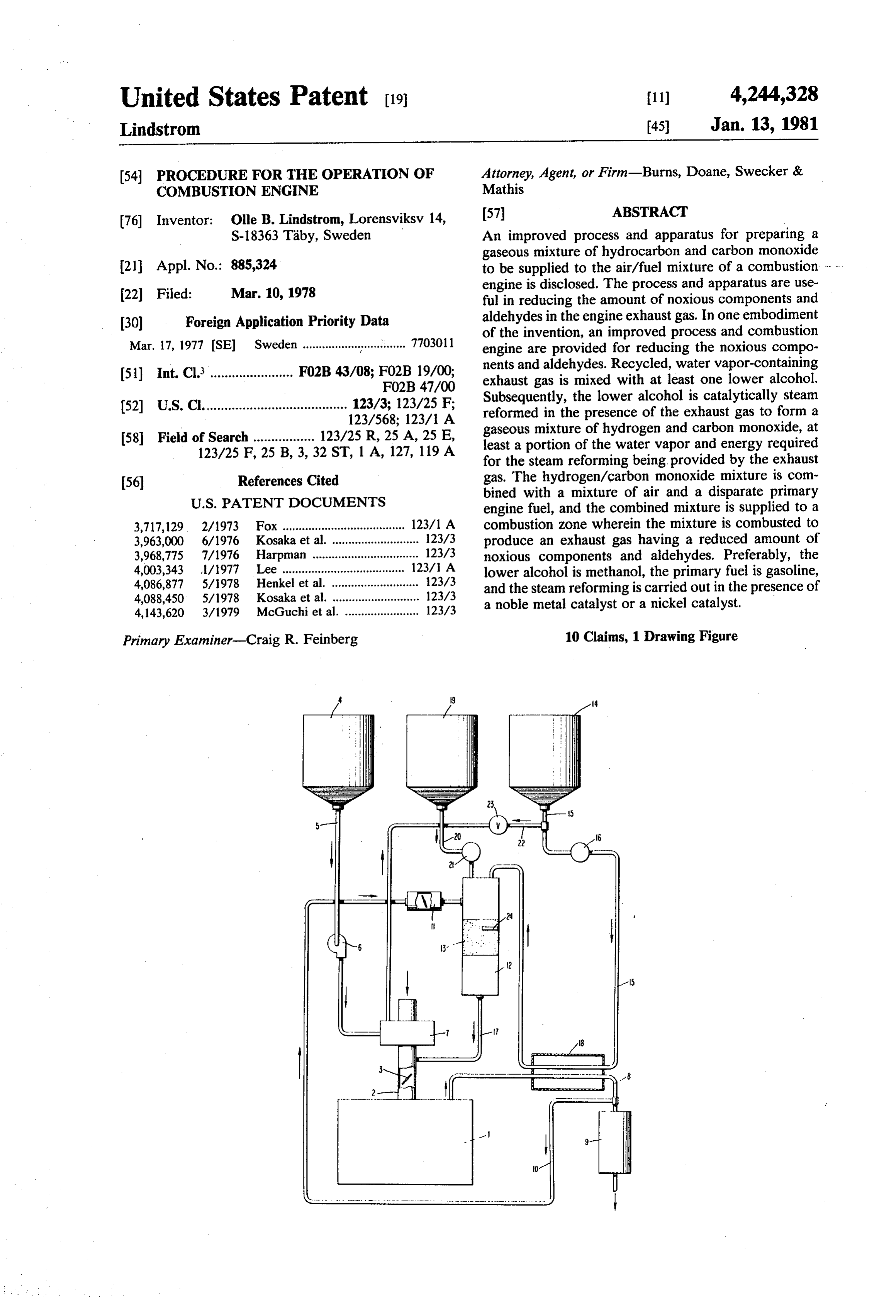
a reduced amount of noxious components in the alde The engine 1 is supplied by an inlet pipe 2 having a hydes are provided. choke 3. The gasoline is supplied from a gasoline tank 4 In yet another aspect of the present invention, an by means of a conduit 5 containing a fuel pump 6 to a improved combustion engine with exhaust gas recircu 55 carburetor 7 in a known manner. The exhaust gases lation is provided. The improvement is as follows: leave the engine via the exhaust gas stream for recircu means are provided for mixing a feed stream comprising lation. The flow is controlled by means of, e.g., a choke at least one lower alcohol with a water vapor-contain 11 to the catalytic reactor 12 which contains a catalyst ing exhaust gas stream in a first zone. Within said first 13. Methanol is also supplied to the catalytic reactor zone, means are provided for catalytically steam re from a methanol tank 14 by a conduit 15 which contains forming said lower alcohol-containing feed stream in a feeding means 16. A conduit 17 carries recirculated the presence of said exhaust gas stream to form a gase exhaust gas as well as hydrogen, carbon monoxide a ous mixture comprising hydrogen and carbon monox non-reacted methanol to the inlet pipe 2. ide, whereby at least a portion of the water vapor and It may be of advantage to vaporize the methanol energy required for said steam reforming is provided by 65 prior to feeding it into the catalytic reactor 12. The said exhaust gas stream. Disposed adjacent to said first FIGURE shows a vaporizer 18 in the conduit 15 which zone are means for combining said gaseous mixture of may be employed for this purpose. Heat is supplied to hydrogen and carbon monoxide with a mixture of air the vaporizer from the exhaust gas flow.
Page 5
It was mentioned above that it is sometimes of advan U.S. Pat. No. 3,918,412. In the present invention, how tage to supply additional water to the catalytic reactor. ever, only the methanol is added to the catalytic reac The FIGURE also shows a water tank 19 which may be tor, from a single tank. The main fuel is added directly used to supply the catalytic reactor 12 with additional to the engine from another tank via its own feeding water via a conduit 20 with a feeding means 21. aS
There exist several possibilities to carry out the Methanol is particularly advantageous in minimizing startup procedure. One possibility is to start up the problems with soot formation and also starting up as system on methanol and then convert to two-fuel opera compared to the case when gasoline is used for the tion when the catalyst has obtained a temperature of steam reforming reaction.
about 300 C. To start on methanol, the FIGURE also 10 It should be noted here that it may be desirable to shows a separate conduit 22 which may be employed additionally incorporate a certain amount of lead in the when the system is started up on methanol. The conduit gasoline to eliminate wear problems which sometimes contains a valve 23 controlled by a temperature indica arise with completely lead-free gasoline. When such tor 24. A similar valve in the gasoline system, which lead-containing gasoline is used with the procedure valve is not shown in the FIGURE, prevents supply of 15 according to the U.S. Pat. No. 3,918,412, the catalyst gasoline to the engine until the catalytic reactor has may be poisoned after a long period of operation. attained its temperature of operation, whereafter the (However, there are some catalysts developed for ex direct methanol supply is shut off by means of the valve haust gas cleaning with leaded gasoline. These catalysts
Combustion engines with exhaust gas recirculation 20 may used also produce certain steam reforming effect when as catalysts for the procedure according to the are available on the market and represent technology present known to those skilled in this art. Therefore, no more in U.S. invention.)
Pat. No.
Suitable catalysts are disclosed, e.g., 3,918,412. The catalyst which is de details are required. A description of this technology is scribed in the U.S. Pat. No. 3,828,736 has also proven to
The methanol system, including the catalytic reactor, invention. Particularly useful catalysts areto noble 25 be useful with the procedure according the present is thus an improvement to a known combustion engine catalysts on carriers and noble metal catalysts onmetal pel with exhaust gas recirculation. Since part of the com bustion energy is derived from the methanol, it is neces lets,A but nickle catalysts may also be used at advantage. special advantage with nobel metal based catalysts sary to reduce the supply of gasoline to the carburetor correspondingly by adjusting the carburetor. It is fre 30 isresidual their better oxidation resistance in the presence of oxygen in the gas mixture which is supplied to quently useful to work with a volume flow of methanol the catalytic reactor compared to, for instance, nickel which is about 5-30% of the volume flow for the gaso based catalysts. The temperature of operation depends line. A particularly advantageous range is 10-20% of the volume flow for the gasoline which is equivalent to on the type of catalyst and the kind of alcohol fuel. It is 5-10% of the combustion energy derived from the 35 normally within the range of 200-600 C, preferably methanol. within the range of 250-400 C. and most preferably Methanol is of course a particularly good fuel for use within the range of 275-350° C. with methanol and a in the present invention based on its low production noble metal catalyst.
costs and the ability to produce methanol from a large EXAMPLE 1. number of solid fuels ranging from coal to municipal refuse. The invention is, however, not limited to metha This invention has been demonstrated in a motor rig nol but may equally well be applied to other lower at the Royal Institute of Technology in Stockholm. The alcohols, e.g., ethyl alcohol, isopropanol or similar engine, a four cylinder Volvo B20 A, was placed in a lower alcohols and mixtures thereof. So called methyl test rig. The power from the motor was dissipated by fuel may also be used. Methyl fuel is composed mainly 45 means of a brake generator delivering the electrical of methyl alcohol but also contains a minor part of was energy to a load resistance. The outgoing exhaust gas higher alcohols. The description which follows will use analyzed by means of gas chromatographs and an as an exemplary fuel methanol, i.e., technical fuel in IR- analytical instrument (URAS-2) for nitrogen oxides. which a major part, i.e., about more than 90%, is com This engine is normally equipped with exhaust gas re posed of methyl alcohol. The methanol may addition 50 circulation. An Engelhard PTX exhaust gas reactor was ally contain water, in some cases up to about 50%, so as mounted in the pipe for exhaust gas recirculation and to support the steam reforming reaction and reduce the the reactor was insulated. The exhaust gas flow was exhaust gas recirculation. calibrated by means of a valve. The nozzles in the car Since the methanol never comes into contact with the buretor had been replaced to give a reduction of the main fuel of the engine in its liquid state, there are no 55 gasoline flow to 95% of the normal flow for this engine restrictions on the choice of the main fuel for the com when using 100% gasoline. The methanol was fed from bustion engine. It is therefore possible to use different a special tank and vaporized in the vaporizer 18, princi kinds of fuels, e.g., gasoline, diesel oil and other energy pally shown in the FIGURE, before the introduction rich liquid fuels. into the catalytic reactor 12. The engine was run at an Furthermore, there are no restrictions as regards the 60 air/fuel ratio of 1.2 whereby the methanol flow was design of the combustion engine and its principal func adjusted to amount to 10% of the flow of gasoline on a tion. The invention may thus be applied equally as well volume basis.
with Otto-engines as with diesel engines, Wankel At 5.8 kW output power, exhaust gas contained 0.2% engines, gas turbines and other combustion engines with CO, about 0.02% nitrogen oxide and only traces of internal combustion of the fuel. 65 unburnt hydrocarbons.
The catalytic reactor is a central component in the It was not possible to run the engine at this high present system which is used in the application of the air/fuel ratio on straight gasoline in the conventional invention. This reactor is adequately described in the manner without misfire.
Page 6
EXAMPLE 2
1. A process for reducing the amount of noxious components and aldehydes in the exhaust gas of an
A similar experiment was run at 7.2 kW output power operating combustion engine which employs a fuel with an air-fuel ratio as high as 1.55. In this experiment comprising gasoline and methanol comprising the steps the noble metal catalyst was substituted for a commer 5 of:
cial nickel catalyst, Girdler G 56, which attained a tem (a) recycling a water vapor-containing exhaust gas perature of operation.of 690° C. The methanol feed was stream from the combustion engine to a first zone 35% of the gasoline feed on a volume basis. The exhaust wherein the exhaust gas stream is mixed with a gas contained 0.16% CO, 25 ppm unburnt hydrocar separate feed stream comprising methanol in a bons and non-detectable NOx, that is below 10 ppm. O fixed amount selected from within the range of The fuel consumption was about 15% less than for a about 5 to 35 percent by volume based on the corresponding conventional run with operation on amount of gasoline supplied to the combustion straight gasoline and exhaust gas cleaning. The flow of engine which is fed from a storage Zone through a recirculated exhaust gas was 5.4% of the total exhaust vaporization zone;
gas stream. Experimental runs with the nickel catalyst 15 (b) catalytically steam reforming said vaporous me reactor were carried out with methanol feeds up to 60% thanol-containing feed stream in a steam reforming of the volumetric flow of gasoline with the same out zone in the presence of said exhaust gas stream to standing results. form a gaseous mixture comprising hydrogen and These very spectacular results were also obtained carbon monoxide, whereby at least a portion of the when the methanol was substituted for ethanol and 20 water vapor and energy required for said steam isopropanol. reforming is provided by said exhaust gas stream; As compared to the procedure according to the U.S. (c) combining said gaseous mixture of hydrogen and Pat. No. 3,918,412, the present invention provides a carbon monoxide with a mixture of air and gaso simplified start up procedure and also a reduction of line;
harmful emissions during the starting period. The cata 25 (d) supplying the hydrogen/carbon monoxide/air/- lyst reached the temperature of operation within 10-20 gasoline mixture to a combustion zone within said seconds.
combustion engine;
In the Examples described above no special precau (e) combusting said mixture in said combustion Zone to produce an exhaust gas comprising a reduced tions were taken for the starting procedure. One precau 30 amount of noxious components and aldehydes. tion would be, however, to delay supplying the metha 2. The process according to claim 1 wherein the nol feed to the catalytic reactor until the reactor has steam reforming is carried out in the presence of a noble reached the temperature of operation. This could be metal catalyst and at a temperature within the range of done by means of a temperature indicator controlling a 275 to 350° C.
shut-off valve in the methanol pipe. Another precaution 35 3. The process according to claim 1 wherein the would be to start the engine on methanol and then go steam reforming is carried out at a temperature within over to dual-fuel operation when the catalytic reactor the range of 250' to 400° C.
has reached the temperature of operation. Components 4. The process according to claim 1 wherein addi 22, 23 and 24 in the FIGURE are provided for this tional water is delivered to the steam reforming zone embodiment of the invention. 40 from a water tank.
The above examples are illustrative only. The teach 5. The process according to claim 1 wherein the ings of this invention and the present state of the art in methanol is introduced in an amount of about 10 per the engine technology and catalytic reforming and cata cent by volume based on the amount of gasoline sup lytic reactor fields will readily suggest to one skilled in plied to the combustion zone. this art suitable designs and procedures in accordance 45 6. The process according to claim 1 wherein the ratio with this invention for any particular motor type or of air to primary fuel is about 1:2. main fuel to be employed, as well as other variations 7. The process according to claim 1 wherein the within the scope of this invention. It should also be methanol is vaporized in a vaporization zone with heat recognized from the above that one of the main advan from the exhaust gas stream.
tages of the present invention is the large number of SO 8. The process according to claim 1 wherein the possibilities which exist for modification of existing methanol is introduced in a fixed amount selected from systems to encompass the present invention using avail within the range of about 10 to 20 percent by volume able components. This is a highly important, practical based on the amount of gasoline supplied to the combus advantage of the present invention as compared to more tion zone.
sophisticated solutions to the extremely important and 55 9. The process according to claim 1 wherein the controversial problems discussed above. steam reforming is carried out in the presence of a noble The principles, preferred embodiments and modes of metal catalyst and at a temperature within the range of operation of the present invention have been described 200 to 600 C. and wherein the process is continuous. in the foregoing specification. The invention which is 10. The process according to claim 9 wherein prior to intended to be protected herein, however, is not to be 60 performing steps (a) through (e), a fuel stream compris construed as limited to the particular forms disclosed, ing at least one lower alcohol is mixed with air and the since these are to be regarded as illustrative rather than mixture combusted within said combustion engine for a restrictive. Variations and changes may be made by period of time sufficient to raise the temperature of the those skilled in the art without departing from the spirit steam reforming zone to within the range at which of the present invention. 65 steam reforming is carried out.
What is claimed is:
Provenance
- Collection
- Cited prior art
- Original PDF
- patentimages.storage.googleapis.com →
- Filed
- 1978-03-10
- Pages
- 6
- Method
- pdftotext (the PDF's own text layer) + pdftoppm 300dpi page scans
- Source
- Google Patents bibliographic record
- Granted
- 1981-01-13
- Inventors
- Olle B. Lindstrom
- Transcribed from
- patentimages.storage.googleapis.com →