patent · US3828736
Method and apparatus for operating combustion engines
13 August 1974
Page 1 — bibliographic record
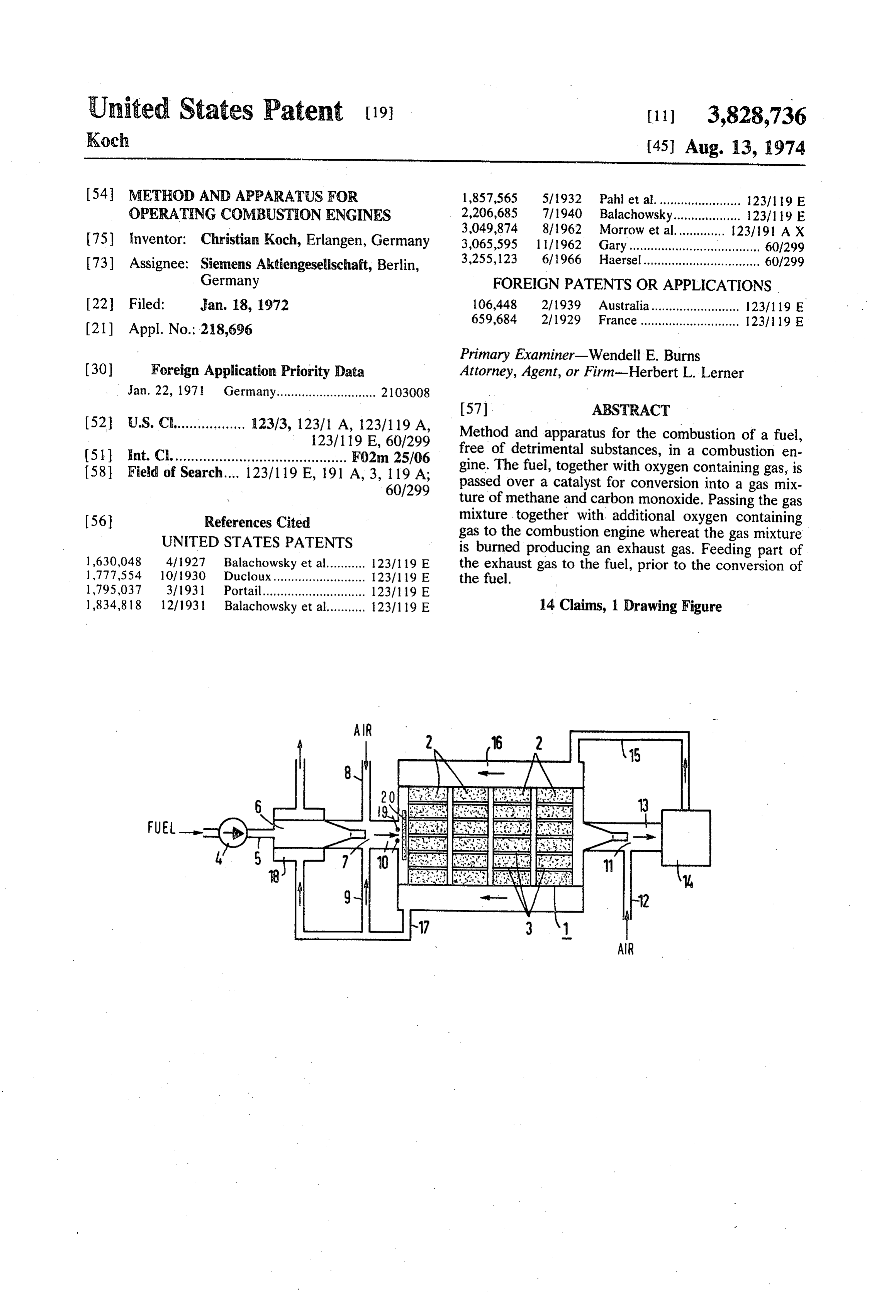
United States Patent (19) 11) 3,828,736 Koch (45) Aug. 13, 1974 54 METHOD AND APPARATUS FOR 1857,565 5/1932 Pahl et al........................ 12311 19 E OPERATING COMBUSTION ENGINES 2,206,685 7/1940 Balachowsky................... 123/19 E
75 Inventor: Christian Koch, Erlangen, Germany 3,065,595 l l 1962 Gary..................................... 60,299 73 Assignee: Siemens Aktiengeselischaft, Berlin, 3,255,123 6/1966 Haersel................................. 60/299 Germany FOREIGN PATENTS OR APPLICATIONS 22 Filed: Jan. 18, 1972 106,448 2/1939 Australia......................... 123/119 E 659,684 21929 France ............................ 12311 19 E
Primary Examiner-Wendell E. Burns (30) Foreign Application Priority Data Attorney, Agent, or Firm-Herbert L. Lerner Jan. 22, 1971 Germany............................ 2103008
(52) U.S. Cl.................. 123/3, 123/1 A, 12311 19 A, Method and apparatus for the combustion of a fuel, 123/119 E, 60/299 free of detrimental substances, in a combustion en (51 int. C. ........................................... F02m 25/06 gine. The fuel, together with oxygen containing gas, is 58 Field of Search.... 123/119 E, 191 A, 3, 119 A; passed over a catalyst for conversion into a gas mix
ture of methane and carbon monoxide. Passing the gas (56) References Cited mixture together with additional oxygen containing UNITED STATES PATENTS gas to the combustion engine whereat the gas mixture is burned producing an exhaust gas. Feeding part of
the exhaust gas to the fuel, prior to the conversion of the fuel.
1795,037 3/1931 Portail............................. 12311 19 E 1,834,818 12/1931 Balachowsky et al........... 12311 19 E 14 Claims, Drawing Figure
Page 2
Drawing sheet — no readable text.
Page 3
METHOD AND APPARATUS FOR OPERATING or a nickel-platinum mixed catalyst. The nautre of the COMBUSTION ENGENES catalyst must in each case be such that it makes possi ble, the conversion of the fuel into a gase mixture con
The invention concerns a method for the operation sisting largely of methane and carbon monoxide. Ad of combustion engines and apparatus for carrying out vantageously, nickel sponge serving as the methanizing this method. . catalyst can be used. Nickel sponge is nickel with a Combustion engines are generally operated with large active surface, which does not sinter together at fuels which, in order to obtain a high octane number, the temperature prevailing at the catalyst. The advan have a certain content of cyclic hydrocarbons and/or tage of the gas mixture produced in the conversion at additives such as lead compounds. While these sub O the catalyst, which contains almost exclusively meth stances assure a high quality of the fuels and improve ane and carbon monoxide as the combustible gases, is their combustion properties, their use also entails dis that a fuel with an octane number of over 100, and in advantages and not inconsiderable danger. These sub the range of about 110, is thereby fed to the combus stances constitute a source of air and environment po tion engine itself. The combustion engine can, thereby, lution and, in particular, cause the appearance of sub 5 be operated with an antiknock fuel, but not at the ex stances injurious to health, in the exhaust gases of the pense of tolerating detrimental substances. combustion engines. The catalyst used for the conversion of the fuel can It is an object of the invention to avoid the mentioned be advantageously doped with uranium. The doping disadvantages in the operation of combustion engines, particularly maintains the active centers in the catalyst. i.e., to reduce particularly the danger of air and envi 20 ronment pollution and to prevent the presence of sub The invention will be explained in further detail with stances injurious to health in the exhaust gases. the aid of the Drawing and several embodiment Exam This is achieved by the invention by passing a fuel ples.
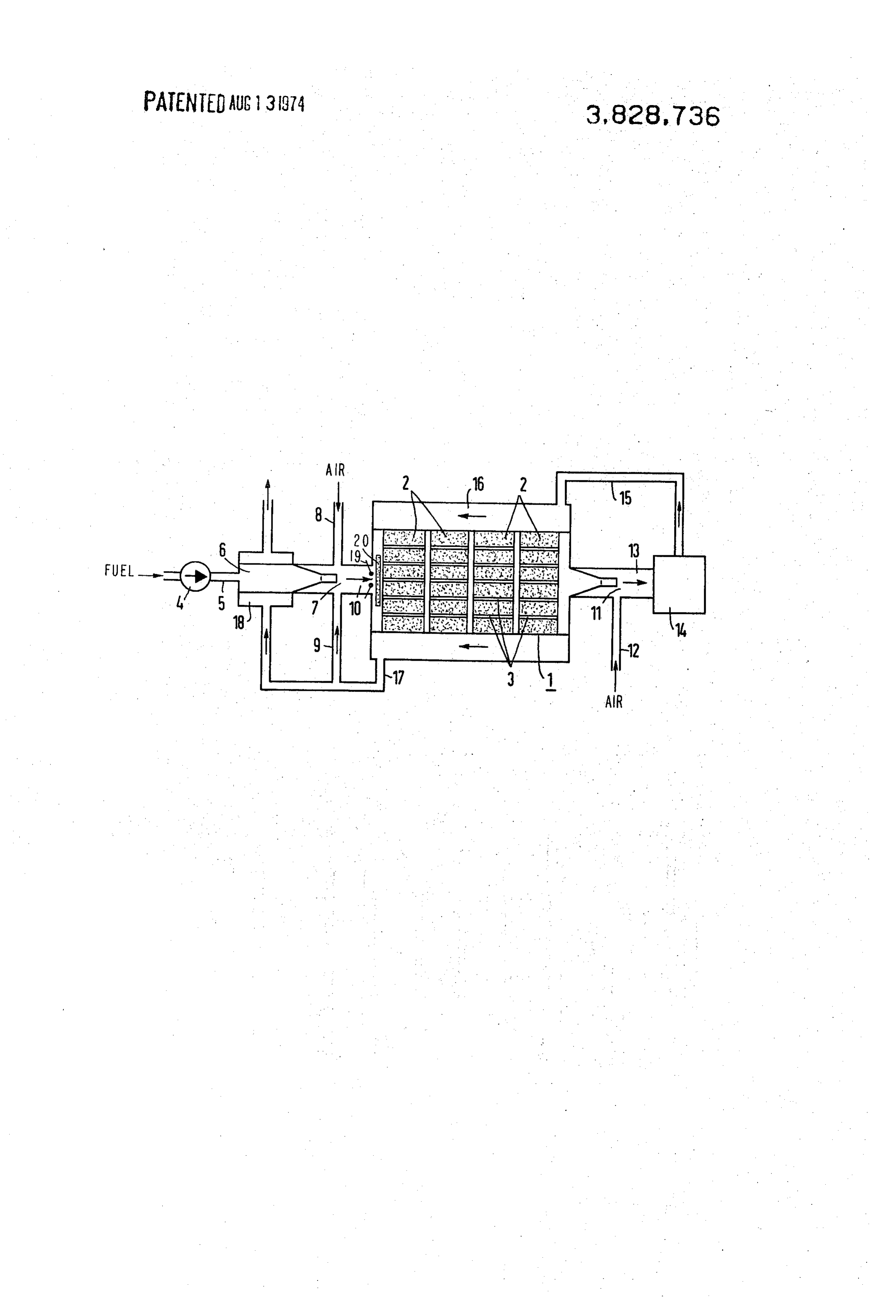
free of detrimental substances over a catalyst, at ele The FIGURE schematically illustrates, in cross sec vated temperatures, to convert the fuel to a gas mixture 25 tion, a preferred embodiment of a device for carrying containing methane and carbon monoxide, while add out the method of the invention. The catalyst is con ing oxygen containing gas required for conversion with tained in a porous catalyst carrier, which is arranged in out the formation of carbon black. The gas mixture ob a catalyst chamber 1. The catalyst carrier can consist, tained in this conversion is fed to the combustion en advantageously, of one or several highly porous sin gine, together with fresh air, and is burned in the en 30 tered stones 2, which have a multiplicity of passage gine. A part of the exhaust gases produced in the com openings 3, being arranged approximately parallel to bustion engine is recycled to the fuel, free of detrimen each other. The fuel is fed by pump 4, via a pipeline 5 tal substances, prior to its conversion at the catalyst. to an evaporator 6 ahead of the entrance of the catalyst Fuels free of detrimental substances are understood chamber . A mixing nozzle 7, for mixing the evapo to be fuels which contain no additives and are in partic 35 rated fuel with the oxygen containing gas is at the evap ular lead free, contain no cyclic hydrocarbons or only orator 6. Fresh air can be fed to the mixing nozzle 7, a very low percentage of such hydrocarbons, and have via a pipeline 8. A part of the exhaust gases of the com a low sulfur content of less than about 10 parts per mil bustion engine through pipeline 9 is fed to the evapo lion. A low percentage of cyclic hydrocarbons is under 40 rated fuel at mixing nozzle 7. The fuel gas mixture stood to be one which does not exceed the percentage flows, through a pipeline 10, to the catalyst chamber 1, normally present in conventional distilled gasolines. in which the fuel is converted into a gas containing The method according to the invention requires no methane and carbon monoxide. Located at the output fuels to which additives have been admixed for the pur of the catalyst chamber is a further mixing nozzle 11 pose of increasing the octane number, but on the con for mixing the gas mixture, obtained by the conversion trary makes it possible to use fuels of low octane num 45 of the fuel at the catalyst, with fresh air fed to the mix ber, for instance, fuels with an octane number of about ing nozzle 11 via pipeline 12. The mixture obtained in 40, this manner flows through pipeline 13 to the combus According to the method of the invention, the fuel tion engine 14, for instance an internal combustion en free of detrimental substances is passed over a catalyst 50 gine or a gas turbine, and is burned thereat. The ex for conversion into a gas mixture containing methane haust gases are discharged from the combustion engine and carbon monoxide, adding oxygen containing gas 14 via a pipeline 15 and recycled into a heat exchanger required for the conversion, free of carbon black, ad 16 which is attached to the catalyst chamber 1. The ex vantageously at a temperature of 300 to 500°C, Fresh haust gas leaves the heat exchanger 16 via pipeline 17. air can advantageously be added to the fuel prior to the 55 Part of the exhaust gas is then fed via pipeline 9 to the catalytic conversion. The gas mixture obtained in the mixing nozzle 7. The main part enters heat exchanger catalytic conversion is fed to the combustion engine 18, which is attached to the evaporator 6. In heat ex and is burned there. Part of the exhaust gases produced changer 16, the heat content of the exhaust gas is uti in the combustion is fed back to the fuel, free detrinen lized for maintaining the temperature required at the tal materials, Advantageously, the temperature re 60 catalyst. The heat exchanger 18 utilizes the exhaust quired for the catalytic conversion for the fuel is sup heat for evaporating the fuel.
plied by utilizing the heat content of the exhaust gases. In a catalyst chamber, with inside dimensions of ap The energy for maintaining the temperature at the cate proximately 80 mm x 80 mm x 215 mm, the catalyst alyst can, however, also be supplied by additional de carrier is, for instance, arranged in the form of four mu vices, for instance, a gasoline burner, the exhaust gases 65 tually parallel, perforated plates which have a thickness of which are used to maintain the temperature. of 50 mm each and a mutual spacing of 5 mm fron one Advantageously used as the catalyst for the conver another with resulting spaces between the perforated sion of the fuel is a nickel catalyst, a platinum catalyst plates. The perforated plates are advantageously sin
Page 4
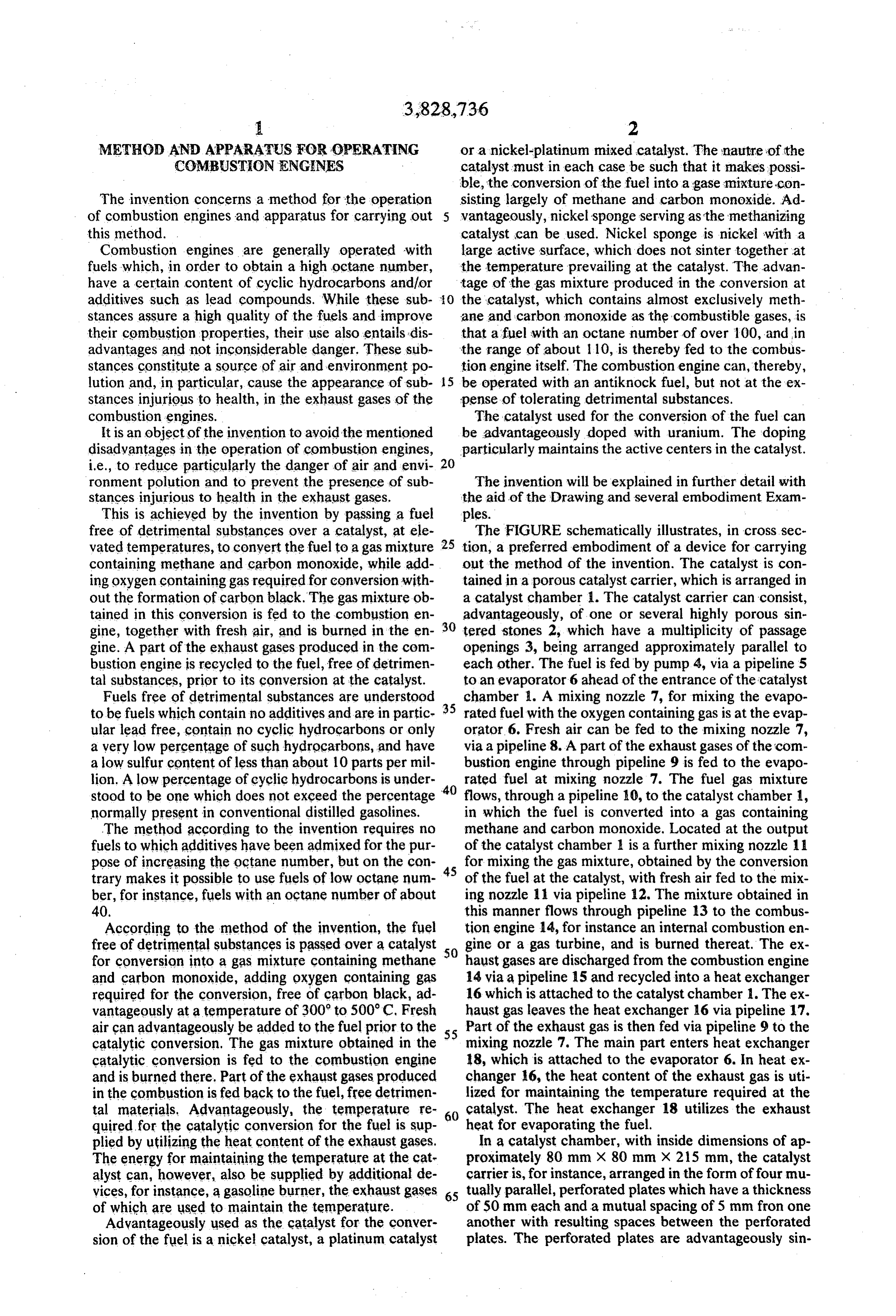
tered bodies, which are provided with a multiplicity of 4CH+2Co+2Co+12N, -- approximately 29 kcal/Mol of fuel passage openings which are arranged approximately gas mixture (4.57 liters) parallel to each other. The sintered bodies consist ad vantageously of a highly porous material such as alumi num oxide or magnesium-aluminum silicate. The pore 5 i.e., a weakly exothermic reaction takes place. volume of the sintered body is 20 to 60 percent and Fresh air is admixted to the gas mixture produced preferably 40 to 50 percent. The passage openings, in after leaving the catalyst chamber and this mixture is the form of holes perpendicular to the surface, with a burned in an internal combustion engine, for instance, diameter, for intance, in the range of 0.1 to 2 mm, serve in an Otto motor. Here the reaction takes place: for the passage of the gas or the gas mixture, respec 10 tively, and extend in the flow direction of these gases. 4CH--2CO-2CO-12N, -- 90-86N --> The passage openings, however, also transport the NHome-H-1 gas mixture (4.57 liters)
fresh air (10.29 liters) gases to the catalytically active centers in the free pores 8CO--8HO-48N of the sintered bodies. The number of passage openings Maanamm exhaust gas (14.03 liters) per cm depends on their diameter. With a diameter of 15 about 1 mm, 1 cm of perforated plate surface has, for instance, about 40 holes. In the internal combustion engine, 64 volume units of The perforated plate adjacent to the inlet of the cata exhaust gas are therefore generated from 65 volume lyst chamber contains as a catalyst, for instance, only units of gas mixture and fresh air, and a theoretical platinum, while the remaining three perforated plates 20 combustion temperature of about 1,765 C is obtained contain, for instance, a platinum-nickel mixed catalyst. in the combustion.
The insertion of the catalyst into the catalyst carrier is One can also see from the reaction equation above accomplished in a manner known per se. The catalyst that exhaust gas and fresh air are advantageously ad carrier can, for instance, be saturated with solutions of mixed with the evaporated fuel in a ratio of 1:1 prior a nickel salt, a platinum salt or a platinum acid and the 25 to entering the catalyst chamber. About 1.8 liter of ex active metal can be produced subsequently by an after haust gas and fresh air are used here, for instance, to treatment in the catalyst carrier. The catalyst carrier, 1 g of fuel. The ratio between exhaust gas and fresh air for instance, can be saturated with a solution of nickel can also be chosen differently. To the gas mixture, leav (II) chloride, NiCl, and the salt can be converted by 30 ing the catalyst chamber there is admixed, prior to en treatment with an alkali solution into nickel hydroxide tering the combustion engine, fresh air, preferably in Ni(OH), which subsequently is converted to elemental such a quantity that a combustion as complete as possi nickel by reduction with hydrogen. For introducing ble is ensured in the combustion engine. platinum into the catalyst carrier, the latter can be satu In the conventional combustion process in an inter rated with an aqueous solution of hexachloroplatinic 35 nal combustion engine, the following reaction would (IV) acid, H(PtCl6) and the acid can be reduced to take place, considered theoretically, if the same fuel is platinum by hydrogen. In order to reduce the salt or the used, assuming complete combustion: acid, respectively, the catalyst carrier is brought to an elevated temperature, for instance, under the action of C7H14 - 10.5O2-42N2 - 7CO-7HO--42N
a gas mixture of 10 percent hydrogen and 90 percent 40 fuel fresh air exhaust gas nitrogen. For a nickel catalyst, a catalyst charge of for instance 10 to 80 mg/cm of catalyst carrier is used, From 53.5 volume units of fuel and fresh air, 56 volume while for a platinum catalyst, the charge is for instance, units of exhaust gas would be produced here, with a re 5 to 10 mg/cm. If the catalyst is doped with uranium, sulting theoretical combustion temperature of about the uranium content is about 1 to 3 percent by weight 45 1990° C.
of the catalyst content. A comparison between the method according to the As already explained, fuels without lead are used in invention and the conventional method shows that the the method of the invention. Simple distilled gasolines combustion temperature attainable by the method ac of low octane number, for instance, gasolines without cording to the invention is lower. If the same combus additives or gasolines that have been subjected to no 50 tion engine is used, the attainable output is thereby re additional reforming processes, for increasing the oc duced. This output reduction, compared with the con tane number, are sufficient. Due to the simplified pro ventional methods of burning fuels, directly, however, duction processes, such gasolines are substantially can be compensated for in the method according to the cheaper than the gasolines normally used in combus invention, at least partially by the provision that the gas tion engines. 55 mixture fed to the combustion engine has an octane If, for instance, distilled gasoline, free of detrimental number of about 110 and can, therefore, be com substances, with an average overall formula of CH4 is pressed higher in the combustion engine, whereby an used, such a fuel may contain, among other substances increase in output is obtained.
hexane and heptane, and if one adds to this fuel, ex Beyond this, there is an advantageous effect in the haust gas and fresh air at a definite ratio, the following 60 method according to the invention, in that the exhaust reaction takes place in the catalyst chamber of a device gases, due to the low combustion temperature and the for carrying out the method according to the invention: complete combustion of the gaseous fuel as compared to the conventional liquid fuel, i.e., gasolines, contain substantially less carbon monoxide.
65 In the conversion that takes place in the catalyst chamber, a gas mixture containing methane and carbon
O2-6N, --- monoxide is produced from fuel, exhaust gas and fresh fuel (g) exhaust gas (1.83 liters) fresh air (1.71 liters) air. Other combustible components such as hydrogen
Page 5
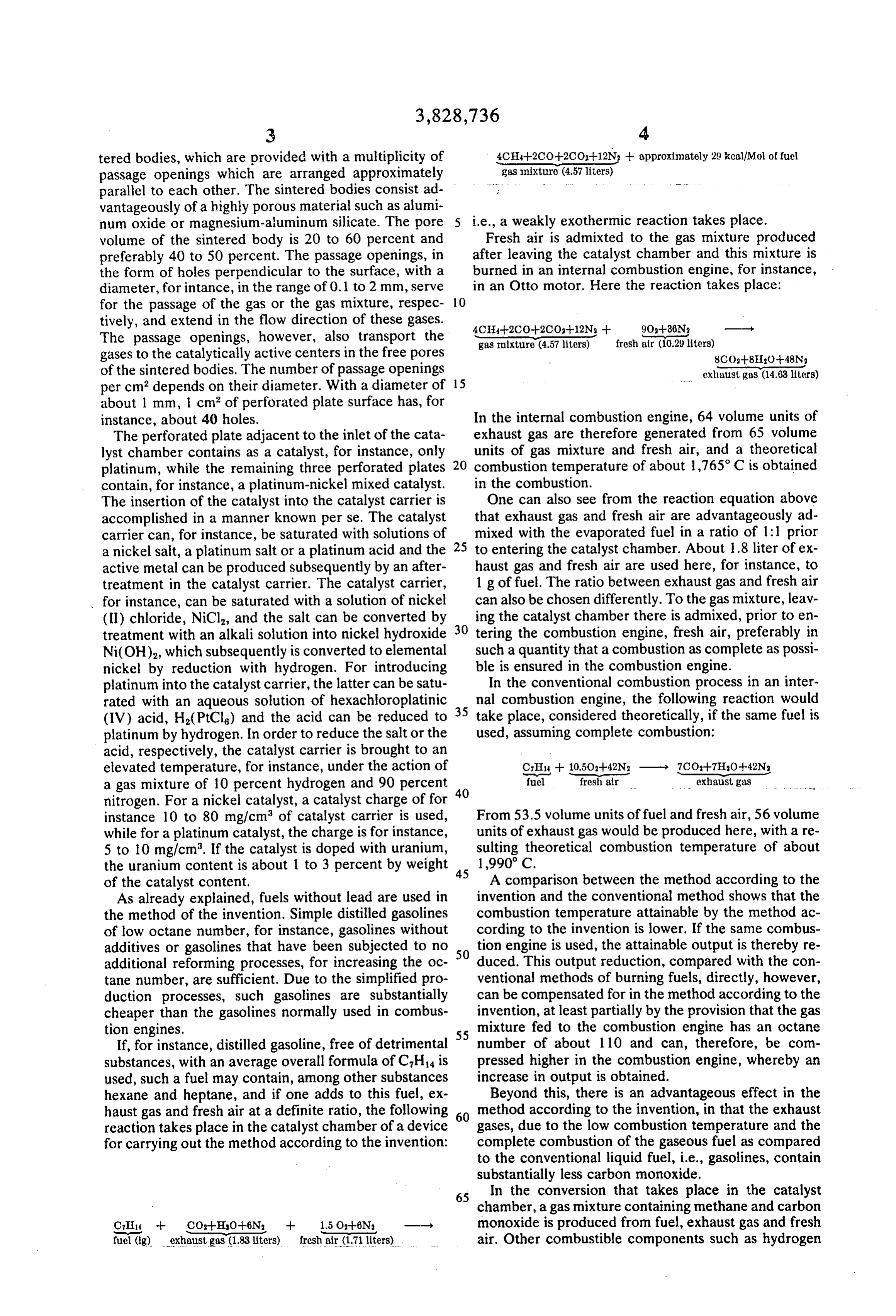
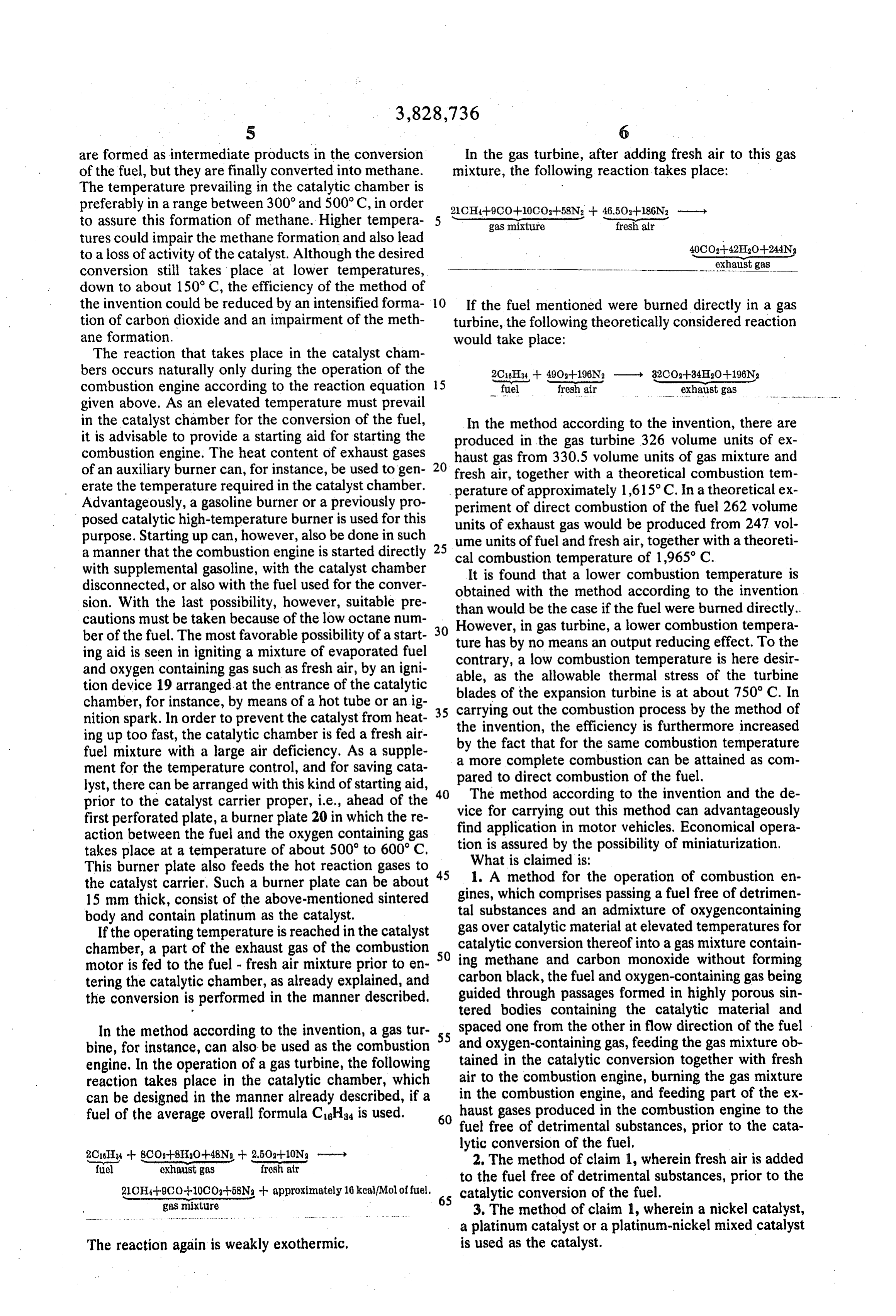
S 6 are formed as intermediate products in the conversion In the gas turbine, after adding fresh air to this gas of the fuel, but they are finally converted into methane. mixture, the following reaction takes place: The temperature prevailing in the catalytic chamber is preferably in a range between 300° and 500°C, in order 21CH4-9CO--10CO-58N2 - 46.5O2--186N2 - to assure this formation of methane. Higher tempera 5 N-H-1 gas mixture
fresh air tures could impair the methane formation and also lead 40CO+42H,0+244N, to a loss of activity of the catalyst. Although the desired n--who-mm-mm exhaust gas conversion still takes place at lower temperatures, down to about 150°C, the efficiency of the method of the invention could be reduced by an intensified forma 10 If the fuel mentioned were burned directly in a gas tion of carbon dioxide and an impairment of the meth turbine, the following theoretically considered reaction ane formation. would take place:
The reaction that takes place in the catalyst cham bers occurs naturally only during the operation of the 2C18H34 - 490--196N2 - 32CO-34HO--196N combustion engine according to the reaction equation 15 fuel fresh air exhaust gas given above. As an elevated temperature must prevail in the catalyst chamber for the conversion of the fuel, In the method according to the invention, there are it is advisable to provide a starting aid for starting the produced in the gas turbine 326 volume units of ex combustion engine. The heat content of exhaust gases haust gas from 330.5 volume units of gas mixture and of an auxiliary burner can, for instance, be used togen- 20 fresh air, together with a theoretical combustion tem erate the temperature required in the catalyst chamber. perature of approximately 1,615°C. In a theoretical ex Advantageously, a gasoline burner or a previously pro periment of direct combustion of the fuel 262 volume posed catalytic high-temperature burner is used for this units of exhaust gas would be produced from 247 vol purpose. Starting up can, however, also be done in such ume units of fuel and fresh air, together with a theoreti a manner that the combustion engine is started directly 25 cal combustion temperature of 1,965 C.
with supplemental gasoline, with the catalyst chamber It is found that a lower combustion temperature is disconnected, or also with the fuel used for the conver obtained with the method according to the invention sion. With the last possibility, however, suitable pre than would be the case if the fuel were burned directly. cautions must be taken because of the low octane num ber of the fuel. The most favorable possibility of a start 30 ture However, in gas turbine, a lower combustion tempera ing aid is seen in igniting a mixture of evaporated fuel contrary, has by no means an output reducing effect. To the and oxygen containing gas such as fresh air, by an igni able, as the a low combustion temperature is here desir tion device 19 arranged at the entrance of the catalytic blades of the allowable expansion thermal stress of the turbine turbine is at about 750° C. In chamber, for instance, by means of a hot tube or an ig 35 carrying out the combustion nition spark. In order to prevent the catalyst from heat the invention, the efficiency process is by the method of furthermore increased ing up too fast, the catalytic chamber is fed a fresh air fuel mixture with a large air deficiency. As a supple abymore the fact that for the same combustion temperature ment for the temperature control, and for saving cata pared tocomplete combustion can be attained as com lyst, there can be arranged with this kind of starting aid, 40 The method according to ofthetheinvention direct combustion fuel.
and the de prior to the catalyst carrier proper, i.e., ahead of the vice for carrying out this method can advantageously first perforated plate, a burner plate 20 in which the re find application in motor vehicles. Economical opera action between the fuel and the oxygen containing gas tion is assured by the possibility of miniaturization. takes place at a temperature of about 500' to 600° C.
This burner plate also feeds the hot reaction gases to 45 What is claimed is:
1. A method for the operation of combustion en the catalyst carrier, Such a burner plate can be about gines, which comprises passing a fuel free of detrimen 15 mm thick, consist of the above-mentioned sintered tal substances and an admixture of oxygencontaining body and contain platinum as the catalyst.
If the operating temperature is reached in the catalyst gas over catalytic material at elevated temperatures for chamber, a part of the exhaust gas of the combustion 50 catalytic conversion thereof into a gas mixture contain motor is fed to the fuel - fresh air mixture prior to en carbon black, and ing methane carbon monoxide without forming tering the catalytic chamber, as already explained, and guided throughthepassages fuel and oxygen-containing gas being the conversion is performed in the manner described. tered bodies containing formed in highly porous sin the catalytic material and
In the method according to the invention, a gas tur spaced one from the other in flow direction of the fuel bine, for instance, can also be used as the combustion and oxygen-containing gas, feeding the gas mixture ob engine. In the operation of a gas turbine, the following tained in the catalytic conversion together with fresh reaction takes place in the catalytic chamber, which air to the combustion engine, burning the gas mixture can be designed in the manner already described, if a in the combustion engine, and feeding part of the ex fuel of the average overall formula C6Hsa is used. 60 haust gases produced in the combustion engine to the fuel free of detrimental substances, prior to the cata
lytic conversion of the fuel.
fuel
exhaust gas
Wrennemanna fresh air 2. The method of claim 1, wherein fresh air is added to the fuel free of detrimental substances, prior to the 21CH-9C0--10CO-58N -- approximately 16 kcal/Mol of fuel.
Yamnommer gas mixture 65 catalytic conversion of the fuel.
3. The method of claim 1, wherein a nickel catalyst, a platinum catalyst or a platinum-nickel mixed catalyst
The reaction again is weakly exothermic, is used as the catalyst.
Page 6
4. The method of claim 3, wherein a catalyst doped the fuel having a mixing nozzle for mixing evaporated with uranium is used. fuel with the oxygen-containing gas, said pump and said 5. The method of claim 1, wherein the fuel gas mix evaporator being located in said flow direction sequen ture is fed over the catalyst at a temperature of 300° to tially ahead of and communicating with an entrance to 500° C. said catalytic chamber, said catalytic chamber also hav 6. The method of claim 1, wherein the heat required ing an exit, a further mixing nozzle for mixing with for the conversion of the fuel at the catalyst is supplied fresh air the gaseous product obtained by catalysis of by utilizing the heat content of the exhaust gases leav the evaporated fuel and the oxygen-containing gas in ing the combustion engine. - said catalytic chamber, said further mixing nozzle ex 7. Method according to claim 1 wherein the fuel has 10 tending from said exit and being connectible to a com a low octane number. bustion engine.
8. Method according to claim 1 wherein the oxygen 11. Device according to claim 10 including heat ex containing gas is air in an approximate given amount changer means located adjacent said catalytic chamber corresponding to about 14 percent of the quantity of and said evaporator, said heat exchanger means being air required for stoichiometric combustion of the fuel 15 connectible to the exhaust discharge of the combustion and, in addition to the given amount of air, admixing engine for passing hot exhaust gases therethrough to therewith and with the fuel an amount of the combus tion engine exhaust gases that is approximately equal to heat 12.
said catalytic chamber and said evaporator.
Device according to claim 10 wherein at least the the given amount of air.
9. Method according to claim 1 which comprises, at 20 chambersintered closest body to said entrance to said catalytic contains a catalyst differing from that con start-up of the combustion engine, applying the heat tained in the next succeeding content of exhaust gas from a burner to the catalytic tion of flow of the fuel and gassintered bodies in direc mixture.
material so as to raise the temperature of the catalytic material to elevated temperature for catalytic conver ity13. of
Device according to claim 10 wherein said plural sintered bodies comprises a first sintered body lo
10. A device for the operation of combustion engines cated closest to said entrance to said catalytic chamber which comprises a catalytic chamber, a catalyst and containing platinum as catalyst, and three succeed containing porous catalyst carrier disposed in said cata ing sintered bodies in flow direction of the fuel and gas lytic chamber, said catalyst carrier comprising a plural mixture containing a platinum-nickel mixed catalyst. ity of highly porous sintered bodies spaced one from 30 14. Device according to claim 10 comprising an igni the other in flow direction of a mixture of fuel and oxy tion device located at said entrance to said catalytic gen-containing gas, said sintered bodies being formed chamber, and a burner plate disposed adjacent to and with a multiplicity of passages for the fuel and gas mix upstream of the sintered body closest to said entrance ture extending substantially parallel to one another, a in flow direction of 2kthexkfuelis andk gas
mixture.
pump for feeding the fuel, an evaporator for vaporizing 35
Provenance
- Collection
- Cited prior art
- Original PDF
- patentimages.storage.googleapis.com →
- Filed
- 1972-01-18
- Pages
- 6
- Method
- pdftotext (the PDF's own text layer) + pdftoppm 300dpi page scans
- Source
- Google Patents bibliographic record
- Granted
- 1974-08-13
- Inventors
- C Koch; Siemens Corp
- Transcribed from
- patentimages.storage.googleapis.com →