patent · US3918412
Fuel treatment for combustion engines
11 November 1975
Page 1 — bibliographic record
United States Patent (19) (11) 3,918,412 Lindstrom (45) Nov. 11, 1975 (54) FUEL TREATMENT FOR COMBUSTION 2,749,223 6/1956 Harrington........................., 123/133 ENGINES 3,186,394 6/1965 Ramun............................ 123/122 D 3,294,073 l2/1966 Bressan........................... 123/19 A 76 Inventor: Olle B. Lindstrom, Lorensviksvagen 3,635,200 lf 1972 Rundell................................... 123/3 14, Vigbyholm, S-18363 Taby, 3,682, 142 8/1972 Newkirk ................................. 123/3 Sweden 3,717, 129 2/1973 Fox ................................. 12311 19 E 3,828,736 8/1974 Koch....................................... 23/3
21 Appl. No.: 397,165 Primary Evaminer-Charles J. Myhre Related U.S. Application Data Assistant Examiner-David D. Reynolds Attorney, Agent, or Firm-Burns, Doane, Swecker & 63 Continuation-in-part of Ser. No. 137,562, April 26, Mathis 97 l, abandoned.
(30) Foreign Application Priority Data (57) ABSTRACT Sept. 14, 1970 Sweden............................... 6000/70 Polluting components in exhausts from combustion engines are reduced through a reforming reactor 52 U.S. Cl.................... 123/3; 48/106; 12311 19 A placed between the fuel supply and the engine. Fuel 51 Int. Cl........................................... F02B 43/08 prior to delivery to the combustion chamber of the en 58 Field of Search........ 23/19 A, 119 E, 3, 1 A, gine is passed through the reforming reactor at a tem 123/121, 122, 133; 60/39.12, 39.02; 48/106, perature between about 250°C. and about 1000°C. 22 and in the presence of a reforming catalyst and water to convert in the reforming reactor at least a part of 56) References Cited the fuel to carbon monoxide and hydrogen by reaction UNITED STATES PATENTS with steam. A portion of the flow of exhaust gas from 1,630,048 5/1927 Balachowsky et al........... 12311 19 E the combustion engine is delivered to the reforming 1717,767 6/1929 Diaz ................................ 12311 19 E reactor and therein mixed with the fuel delivered to 1,795,037 3/1931 Portail............................. i 231 19 E the reforming reactor.
2,201.965 5/1940 Cook ...................................... 123/3 13 Claims, 2 Drawing Figures 2,655,786 10/1953 Carr................................... 60/39.12
avarayr aaZ 7a axe-Wawasaa a1aaaawaar
awasaWa a yeaaaaa
Page 2
Drawing sheet — no readable text.
Page 3
Drawing sheet — no readable text.
Page 4
FUEL TREATMENT FOR COMBUSTION ENGINES lower amounts of carbon monoxide and hydrocarbons.
SUMMARY OF THE INVENTION
RELATED APPLICATIONS Accordingly, a primary object of the present inven This application is a continuation-in-part of applica 5 tion is to utilize the concept of using carbon monoxide tion Ser. No. 137,562, filed Apr. 26, 1972, now aban and hydrogen as fuel for combustion engines so that the doned. exhaust gas content of unburned hydrocarbons, carbon BACKGROUND OF THE INVENTION monoxide, oxides of nitrogen, and the like are substan tially reduced or essentially eliminated.
1. Field of the Invention 10 Other objects and advantages of the present inven This invention relates to Otto cycle internal combus tion will become apparent to one skilled in the art from tion engines and, more particularly, to methods and ap the following summary of the invention and description paratus for reducing the amount of polluting compo of the preferred embodiments: nents in exhausts from combustion engines. In accordance with the present invention, a method 2. State of the Art 15 and apparatus for reducing the amount of harmful or The conventional passenger car with an Otto cycle polluting components in the exhaust flow that comes internal combustion engine is responsible for a substan from an Otto cycle internal combustion engine are pro tial part of the air pollution in industrialized countries. vided in which fuel, before it is delivered in gaseous Many hundreds of components have been identified in state to the combustion zone or chamber of the engine, exhaust gases from automobile engines. The most dan is passed through a reforming reactor with a reforming gerous components from an environmental quality catalyst disposed therein, preferably at a temperature standpoint are, in general, carbon monoxide, unburned between about 250 and about 1000C., to convert at hydrocarbons (both heavy and light), oxides of nitro least a part of the fuel to carbon monoxide and hydro gen, and particulate material, including lead com gen by reaction with water (as steam). The invention pounds (when gasoline with organic lead compounds 25 is characterized in that a portion, preferably between or additives is used as fuel). Because of the great dan about 5 and about 50%, of the exhaust flow from the ger to health that these atmospheric contaminants or combustion engine is delivered to the reforming reac impurities from passenger vehicles constitute, more tor and mixed there with the fuel delivered to the re stringent demands and regulations concerning permis forming reactor. The heat content of the exhaust gas is sible discharge are being made. 30
Because these demands and regulations are being tion which used for the energy requirement of the reforming reac made more and more stringent, it has been anticipated bustion product is endothermic. The steam present as a com that structural or mechanical solutions such as better necessarily take part in the recirculated exhaust gas will fuel injection, recycling of exhaust gases, afterburning the in the reforming reaction. When 35 reforming reaction of unburned materials in the exhaust, and the like will a large quantity of carbon is carried out in the presence of not be sufficient. It has also been predicted that a final dioxide, some of the carbon catalytic stage must be adopted so that the exhaust dioxide may also react with the fuel in side reactions giving carbon monoxide, hydrogen, etc. in addition to gases are substantially freed of carbon monoxide, and the products of the reforming reaction. of unburned hydrocarbons. This development toward a final catalytic stage leads indirectly to the elimination 40 tionA certain combustion of fuel and/or reforming reac products may also occur in the reactor. In such a of the lead problem. That is, the catalysts that are being case, air, as required, is also introduced into the re considered are poisoned by lead. Automobile manufac turers, therefore, have decided to reduce the compres ucts of thereactor.
forming This combustion of fuel and the prod reforming reaction is so adapted that the re sion ratio of the engine so that 91 octane gasoline, with 45 out lead additives, can be used. forming reaction is substantially isothermal at a suit The oxides of nitrogen present a harder problem to able reforming reaction temperature that varies ac solve catalytically. In this case, attempts are usually cording to the type of reforming catalyst and fuel. For made to hold temperatures in the combustion chamber example, the reforming reaction may range from about as low as possible by exhaust recycling, water injection, 50 200 to 300°C. for methanol up to about 1000°C. for or the like. hydrocarbons, or above that range for other fuels as It is possible, however, that the measures indicated may be required.
above which are known to those skilled in the art will The reactor may also be heated by delivery of com not be sufficient to hold impurities or contaminants in bustion gases from a combustion burner or by dispo exhausts to an acceptable level, partly in view of the sition of the reactor in a surrounding combustion population growth and partly in view of the rising living 55 chamber. Any extra supply of heat may also be effected standards in the world which may have the effect that by other techniques, e.g., with use of combustion tubes the number of cars will increase faster than the popula in the catalyst chamber of the reactor, by electric heat tion. Attention, therefore, has focused on fuels other ing elements, or the like. Heat may also be supplied di than gasoline. For example, ammonia, hydrogen, meth 60 rectly from the non-circulated portion of the exhaust anol or the hydrogen/carbon monoxide mixture which gas by heat exchange via tubes in the reactor or the may be obtained by the so-called reforming of metha like.
nol, i.e., the catalytic reaction of methanol with steam, These and other aspects of the present invention will have been considered. Mixtures of carbon monoxide be readily apparent to one skilled in the art to which and hydrogen can be used, with relatively simple modi 65 the invention pertains from the claims and the follow fications, as fuel for combustion engines such as the ing more detailed description of preferred embodi conventional Otto cycle internal combustion engines, ments when read in conjunction with the appended and it has been found that the exhaust gases have much drawing.
Page 5
The flow control devices 3, 9, 14 and 17 indicated in
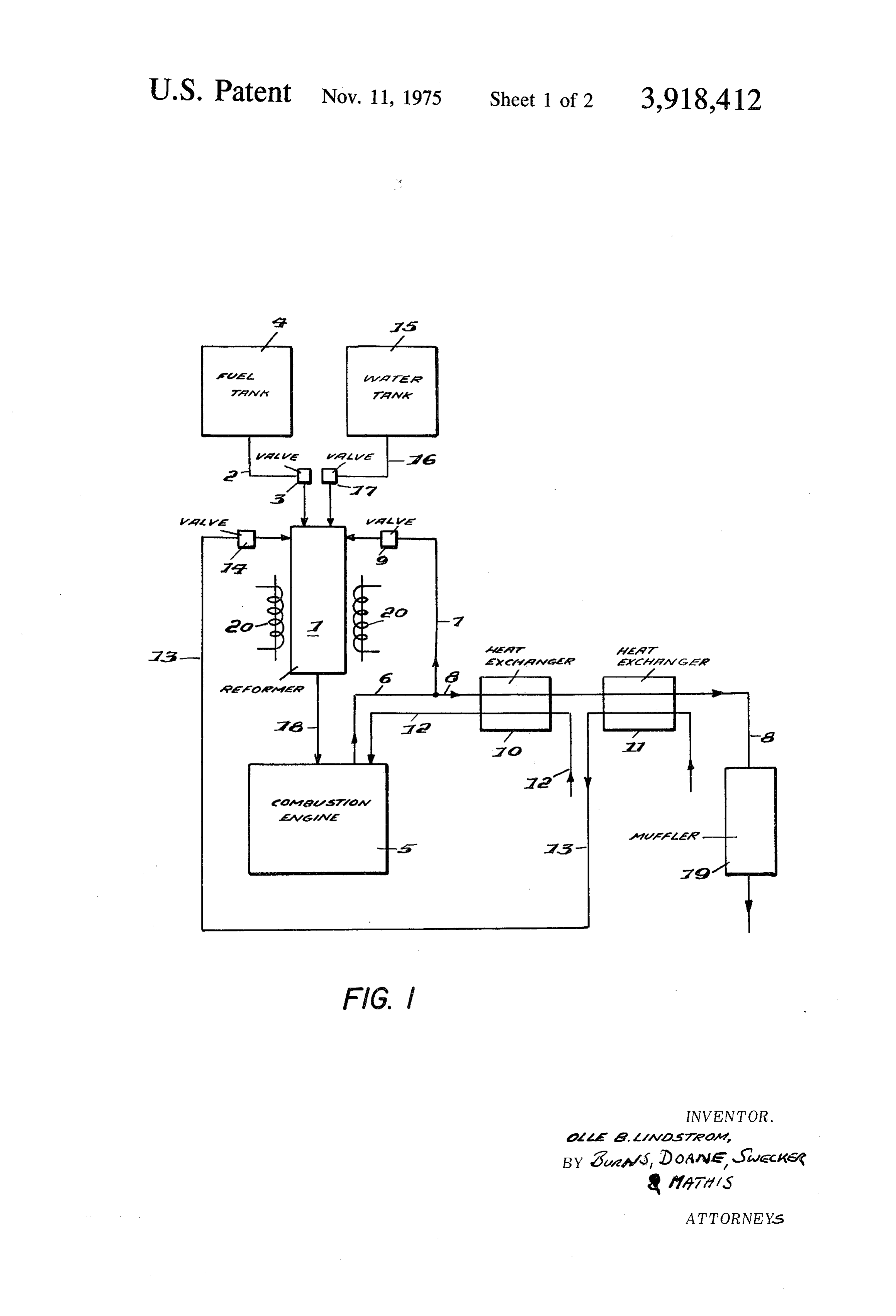
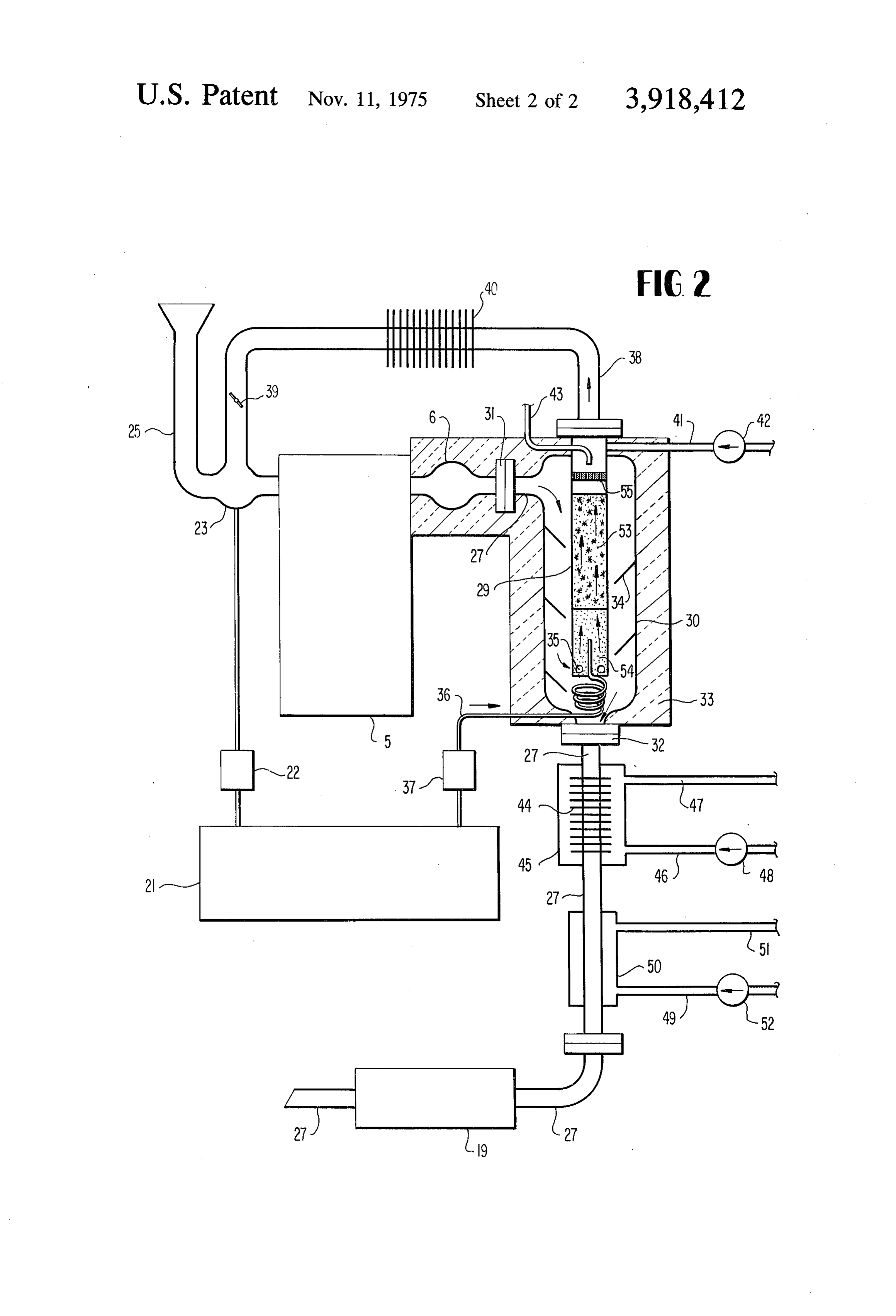
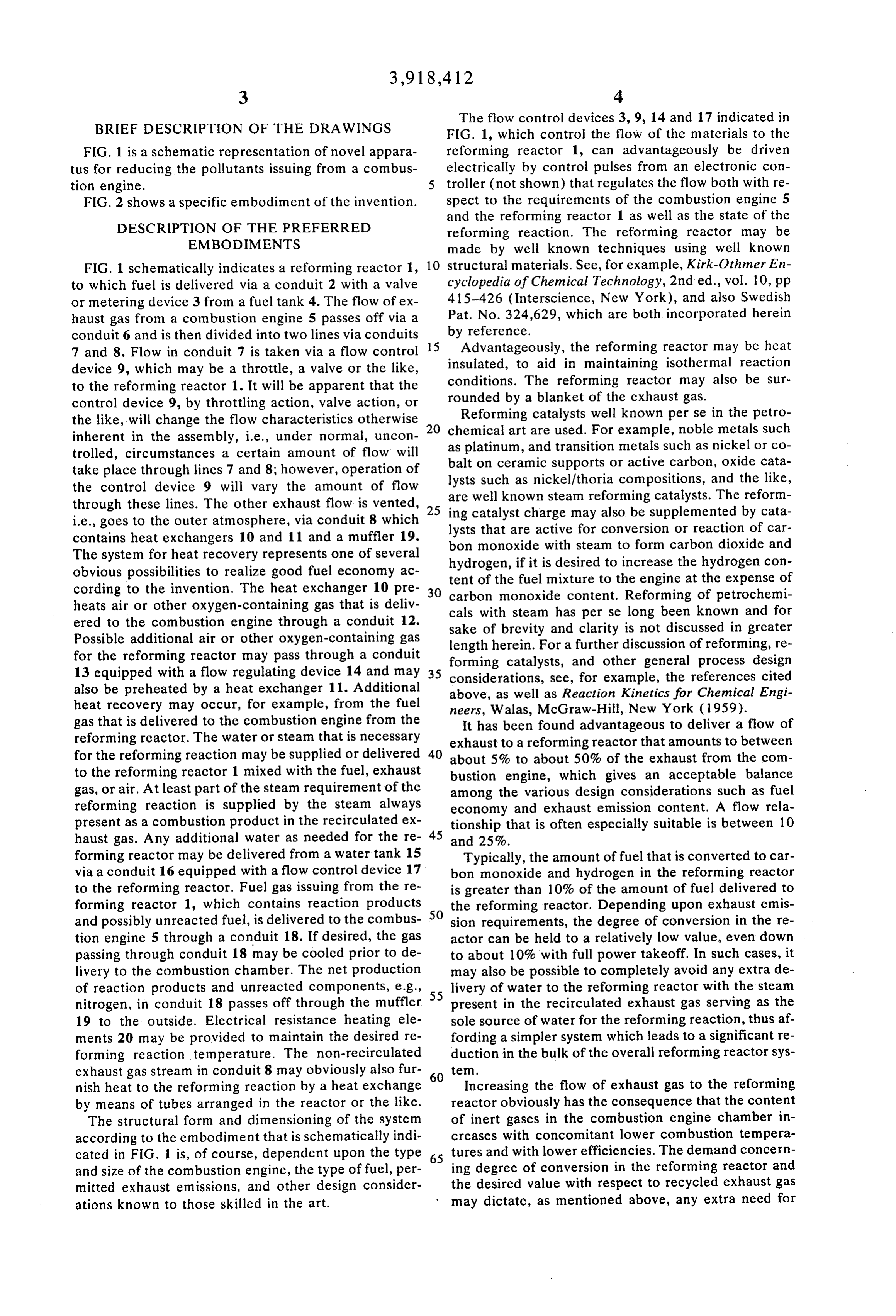
BRIEF DESCRIPTION OF THE DRAWINGS FIG. 1, which control the flow of the materials to the FIG. 1 is a schematic representation of novel appara reforming reactor 1, can advantageously be driven tus for reducing the pollutants issuing from a combus electrically by control pulses from an electronic con tion engine. troller (not shown) that regulates the flow both with re FIG. 2 shows a specific embodiment of the invention. spect to the requirements of the combustion engine 5 and the reforming reactor 1 as well as the state of the
DESCRIPTION OF THE PREFERRED reforming reaction. The reforming reactor may be EMBODIMENTS made by well known techniques using well known FIG. 1 schematically indicates a reforming reactor 1, 10 structural materials. See, for example, Kirk-Othmer En to which fuel is delivered via a conduit 2 with a valve cyclopedia of Chemical Technology, 2nd ed., vol. 10, pp or metering device 3 from a fuel tank 4. The flow of ex 415-426 (Interscience, New York), and also Swedish haust gas from a combustion engine 5 passes off via a Pat. No. 324,629, which are both incorporated herein conduit 6 and is then divided into two lines via conduits by reference.
7 and 8. Flow in conduit 7 is taken via a flow control 15 Advantageously, the reforming reactor may be heat device 9, which may be a throttle, a valve or the like, insulated, to aid in maintaining isothermal reaction to the reforming reactor 1. It will be apparent that the conditions. The reforming reactor may also be sur control device 9, by throttling action, valve action, or rounded
Reforming by a blanket of the exhaust gas.
catalysts well known per se in the petro the like, will change the flow characteristics otherwise 20 chemical art are used. For example, noble metals such inherent in the assembly, i.e., under normal, uncon as platinum, and transition metals such as nickel or co trolled, circumstances a certain amount of flow will take place through lines 7 and 8; however, operation of balt on ceramic supports or active carbon, oxide cata the control device 9 will vary the amount of flow lysts are such as nickel?thoria compositions, and the like, well known steam reforming catalysts. The reform through these lines. The other exhaust flow is vented, 25 ing catalyst i.e., goes to the outer atmosphere, via conduit 8 which lysts that arechargeactive may also be supplemented by cata for conversion or reaction of car contains heat exchangers 10 and 11 and a muffler 19. bon monoxide with steam
The system for heat recovery represents one of several hydrogen, if it is desired totoincrease form carbon dioxide and obvious possibilities to realize good fuel economy ac tent of the fuel mixture to the enginethe hydrogen con cording to the invention. The heat exchanger 10 pre 30 carbon monoxide content. Reforming ofthepetrochemi at expense of heats air or other oxygen-containing gas that is deliv cals ered to the combustion engine through a conduit 12. sake with of steam has per se long been known and for brevity and clarity is not discussed in greater
Possible additional air or other oxygen-containing gas length herein. For a further discussion of reforming, re for the reforming reactor may pass through a conduit forming catalysts, and other general process design 13 equipped with a flow regulating device 14 and may 35 considerations, see, for example, the references cited also be preheated by a heat exchanger 11. Additional above, as well as Reaction Kinetics for Chemical Engi heat recovery may occur, for example, from the fuel neers, Walas, McGraw-Hill, New York (1959). gas that is delivered to the combustion engine from the It has been found advantageous to deliver a flow of reforming reactor. The water or steam that is necessary exhaust to a reforming reactor that amounts to between for the reforming reaction may be supplied or delivered 40 about 5% to about 50% of the exhaust from the com to the reforming reactor 1 mixed with the fuel, exhaust bustion engine, which gives an acceptable balance gas, or air. At least part of the steam requirement of the among the various design considerations such as fuel reforming reaction is supplied by the steam always economy and exhaust emission content. A flow rela present as a combustion product in the recirculated ex tionship that is often especially suitable is between 10 haust gas. Any additional water as needed for the re 45 and 25%.
forming reactor may be delivered from a water tank 15 Typically, the amount of fuel that is converted to car via a conduit 16 equipped with a flow control device 17 bon monoxide and hydrogen in the reforming reactor to the reforming reactor. Fuel gas issuing from the re is greater than 10% of the amount of fuel delivered to forming reactor 1, which contains reaction products the reforming reactor. Depending upon exhaust emis and possibly unreacted fuel, is delivered to the combus 50 sion requirements, the degree of conversion in the re tion engine 5 through a conduit 18. If desired, the gas actor can be held to a relatively low value, even down passing through conduit 18 may be cooled prior to de to about 10% with full power takeoff. In such cases, it livery to the combustion chamber. The net production may also be possible to completely avoid any extra de of reaction products and unreacted components, e.g., 55 livery of water to the reforming reactor with the steam nitrogen, in conduit 18 passes off through the muffler present in the recirculated exhaust gas serving as the 19 to the outside. Electrical resistance heating ele sole source of water for the reforming reaction, thus af ments 20 may be provided to maintain the desired re fording a simpler system which leads to a significant re forming reaction temperature. The non-recirculated duction in the bulk of the overall reforming reactor sys exhaust gas stream in conduit 8 may obviously also fur 60 tem.
nish heat to the reforming reaction by a heat exchange Increasing the flow of exhaust gas to the reforming by means of tubes arranged in the reactor or the like. reactor obviously has the consequence that the content The structural form and dimensioning of the system of inert gases in the combustion engine chamber in according to the embodiment that is schematically indi creases with concomitant lower combustion tempera cated in FIG. 1 is, of course, dependent upon the type 65 tures and with lower efficiencies. The demand concern and size of the combustion engine, the type of fuel, per ing degree of conversion in the reforming reactor and mitted exhaust emissions, and other design consider the desired value with respect to recycled exhaust gas ations known to those skilled in the art. may dictate, as mentioned above, any extra need for
Page 6
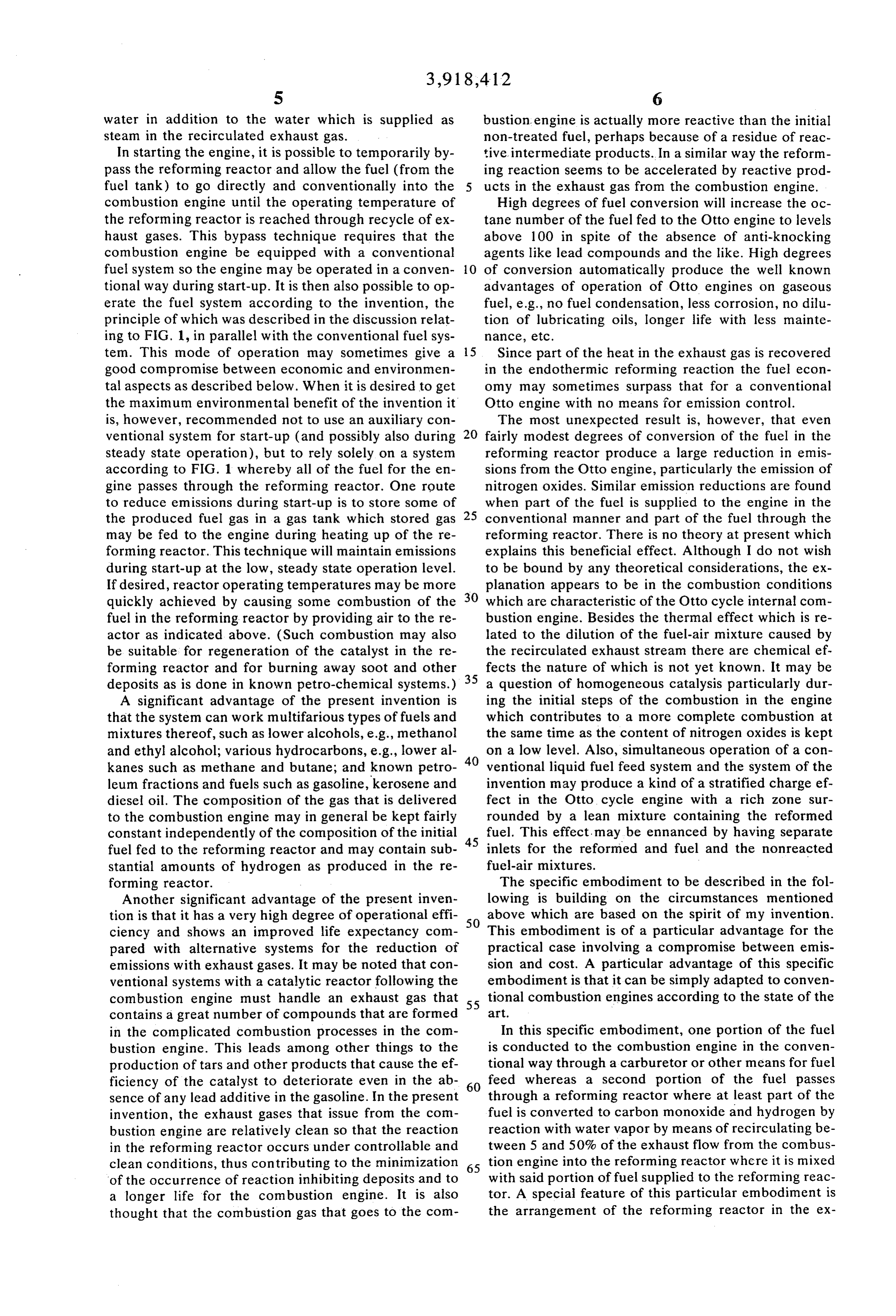
S 6 water in addition to the water which is supplied as bustion engine is actually more reactive than the initial steam in the recirculated exhaust gas. non-treated fuel, perhaps because of a residue of reac In starting the engine, it is possible to temporarily by tive intermediate products. In a similar way the reform pass the reforming reactor and allow the fuel (from the ing reaction seems to be accelerated by reactive prod fuel tank) to go directly and conventionally into the 5 ucts in the exhaust gas from the combustion engine. combustion engine until the operating temperature of High degrees of fuel conversion will increase the oc the reforming reactor is reached through recycle of ex tane number of the fuel fed to the Otto engine to levels haust gases. This bypass technique requires that the above 100 in spite of the absence of anti-knocking combustion engine be equipped with a conventional agents like lead compounds and the like. High degrees fuel system so the engine may be operated in a conven O of conversion automatically produce the well known tional way during start-up. It is then also possible to op advantages of operation of Otto engines on gaseous erate the fuel system according to the invention, the fuel, e.g., no fuel condensation, less corrosion, no dilu principle of which was described in the discussion relat tion of lubricating oils, longer life with less mainte ing to FIG. 1, in parallel with the conventional fuel sys nance, etc.
tem. This mode of operation may sometimes give a 15 Since part of the heat in the exhaust gas is recovered good compromise between economic and environmen in the endothermic reforming reaction the fuel econ tal aspects as described below. When it is desired to get omy may sometimes surpass that for a conventional the maximum environmental benefit of the invention it Otto engine with no means for emission control. is, however, recommended not to use an auxiliary con The most unexpected result is, however, that even ventional system for start-up (and possibly also during 20 fairly modest degrees of conversion of the fuel in the steady state operation), but to rely solely on a system reforming reactor produce a large reduction in emis according to FIG. 1 whereby all of the fuel for the en sions from the Otto engine, particularly the emission of gine passes through the reforming reactor. One route nitrogen oxides. Similar emission reductions are found to reduce emissions during start-up is to store some of when part of the fuel is supplied to the engine in the the produced fuel gas in a gas tank which stored gas 25 conventional manner and part of the fuel through the may be fed to the engine during heating up of the re reforming reactor. There is no theory at present which forming reactor. This technique will maintain emissions explains this beneficial effect. Although I do not wish during start-up at the low, steady state operation level. to be bound by any theoretical considerations, the ex If desired, reactor operating temperatures may be more planation appears to be in the combustion conditions quickly achieved by causing some combustion of the 30 which are characteristic of the Otto cycle internal com fuel in the reforming reactor by providing air to the re bustion engine. Besides the thermal effect which is re actor as indicated above. (Such combustion may also lated to the dilution of the fuel-air mixture caused by be suitable for regeneration of the catalyst in the re the recirculated exhaust stream there are chemical ef forming reactor and for burning away soot and other 35 fects the nature of which is not yet known. It may be deposits as is done in known petro-chemical systems.) a question of homogeneous catalysis particularly dur A significant advantage of the present invention is ing the initial steps of the combustion in the engine that the system can work multifarious types of fuels and which contributes to a more complete combustion at mixtures thereof, such as lower alcohols, e.g., methanol the same time as the content of nitrogen oxides is kept and ethyl alcohol; various hydrocarbons, e.g., lower al 40 on a low level. Also, simultaneous operation of a con kanes such as methane and butane; and known petro ventional liquid fuel feed system and the system of the leum fractions and fuels such as gasoline, kerosene and invention may produce a kind of a stratified charge ef diesel oil. The composition of the gas that is delivered fect in the Otto cycle engine with a rich zone sur to the combustion engine may in general be kept fairly rounded by a lean mixture containing the reformed constant independently of the composition of the initial 45 fuel. This effect. may be ennanced by having separate fuel fed to the reforming reactor and may contain sub inlets for the reformed and fuel and the nonreacted stantial amounts of hydrogen as produced in the re fuel-air mixtures.
forming reactor. The specific embodiment to be described in the fol Another significant advantage of the present inven lowing is building on the circumstances mentioned tion is that it has a very high degree of operational effi 50 above which are based on the spirit of my invention. ciency and shows an improved life expectancy com This embodiment is of a particular advantage for the pared with alternative systems for the reduction of practical case involving a compromise between emis emissions with exhaust gases. It may be noted that con sion and cost. A particular advantage of this specific ventional systems with a catalytic reactor following the embodiment is that it can be simply adapted to conven combustion engine must handle an exhaust gas that 55 tional combustion engines according to the state of the contains a great number of compounds that are formed art.
in the complicated combustion processes in the com In this specific embodiment, one portion of the fuel bustion engine. This leads among other things to the is conducted to the combustion engine in the conven production of tars and other products that cause the ef tional way through a carburetor or other means for fuel ficiency of the catalyst to deteriorate even in the ab 60 feed whereas a second portion of the fuel passes sence of any lead additive in the gasoline. In the present through a reforming reactor where at least part of the invention, the exhaust gases that issue from the con fuel is converted to carbon monoxide and hydrogen by bustion engine are relatively clean so that the reaction reaction with water vapor by means of recirculating be in the reforming reactor occurs under controllable and tween 5 and 50% of the exhaust flow from the combus clean conditions, thus contributing to the minimization 65 tion engine into the reforming reactor where it is mixed of the occurrence of reaction inhibiting deposits and to with said portion of fuel supplied to the reforming reac a longer life for the combustion engine. It is also tor. A special feature of this particular embodiment is thought that the combustion gas that goes to the com the arrangement of the reforming reactor in the ex
Page 7
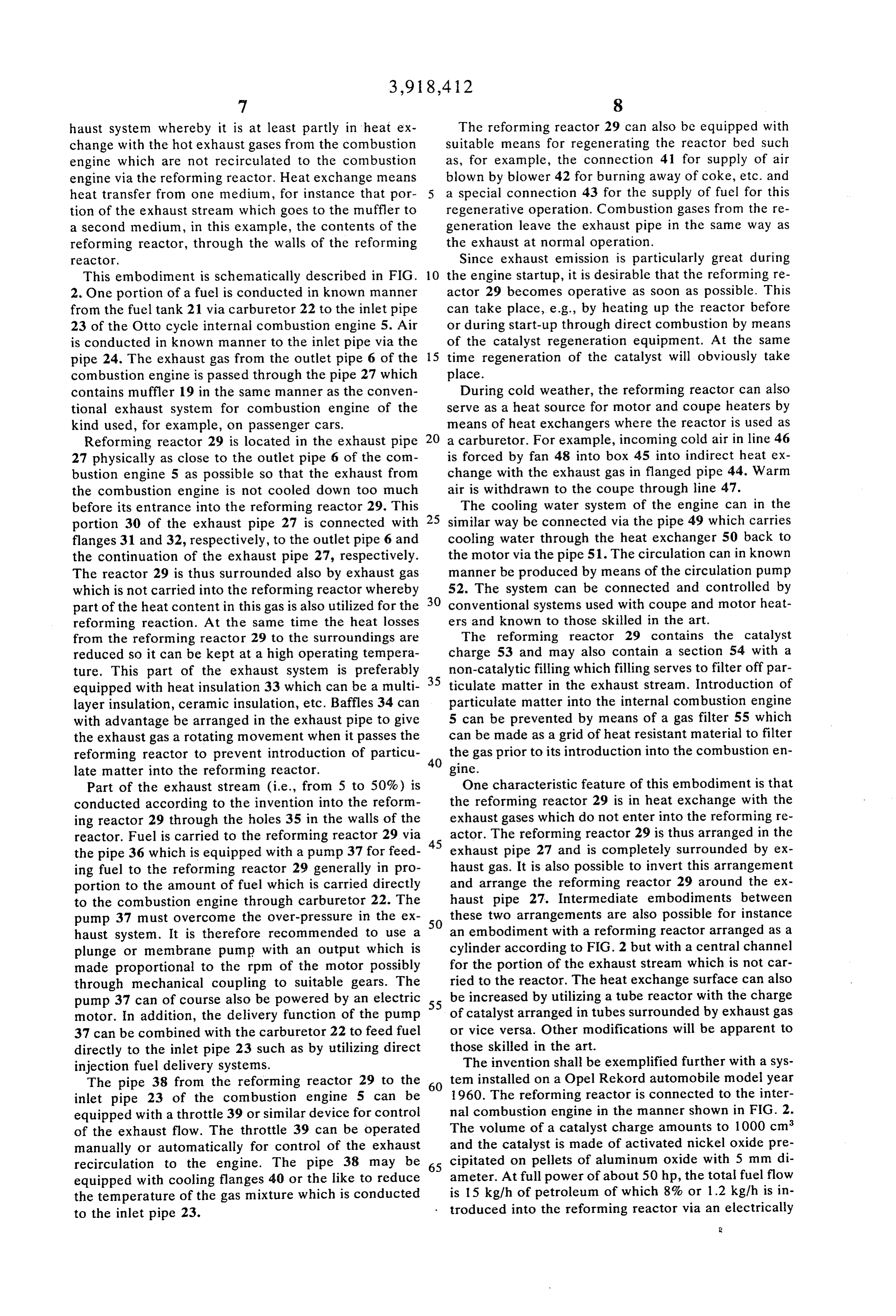
haust system whereby it is at least partly in heat ex The reforming reactor 29 can also be equipped with change with the hot exhaust gases from the combustion suitable means for regenerating the reactor bed such engine which are not recirculated to the combustion as, for example, the connection 41 for supply of air engine via the reforming reactor. Heat exchange means blown by blower 42 for burning away of coke, etc. and heat transfer from one medium, for instance that por a special connection 43 for the supply of fuel for this tion of the exhaust stream which goes to the muffler to regenerative operation. Combustion gases from the re a second medium, in this example, the contents of the generation leave the exhaust pipe in the same way as reforming reactor, through the walls of the reforming the exhaust at normal operation. reactor, Since exhaust emission is particularly great during This embodiment is schematically described in FIG. 10 the engine startup, it is desirable that the reforming re 2. One portion of a fuel is conducted in known manner actor 29 becomes operative as soon as possible. This from the fuel tank 21 via carburetor 22 to the inlet pipe can take place, e.g., by heating up the reactor before 23 of the Otto cycle internal combustion engine 5. Air or during start-up through direct combustion by means is conducted in known manner to the inlet pipe via the of the catalyst regeneration equipment. At the same pipe 24. The exhaust gas from the outlet pipe 6 of the 15 time regeneration of the catalyst will obviously take combustion engine is passed through the pipe 27 which place.
contains muffler 19 in the same manner as the conven During cold weather, the reforming reactor can also tional exhaust system for combustion engine of the serve as a heat source for motor and coupe heaters by kind used, for example, on passenger cars. means of heat exchangers where the reactor is used as Reforming reactor 29 is located in the exhaust pipe 20 a carburetor. For example, incoming cold air in line 46 27 physically as close to the outlet pipe 6 of the com is forced by fan 48 into box 45 into indirect heat ex bustion engine 5 as possible so that the exhaust from change with the exhaust gas in flanged pipe 44. Warm the combustion engine is not cooled down too much air is withdrawn to the coupe through line 47. before its entrance into the reforming reactor 29. This The cooling water system of the engine can in the portion 30 of the exhaust pipe 27 is connected with 25 similar way be connected via the pipe 49 which carries flanges 31 and 32, respectively, to the outlet pipe 6 and cooling water through the heat exchanger 50 back to the continuation of the exhaust pipe 27, respectively. the motor via the pipe 51. The circulation can in known The reactor 29 is thus surrounded also by exhaust gas manner be produced by means of the circulation pump which is not carried into the reforming reactor whereby 30 52. The system can be connected and controlled by part of the heat content in this gas is also utilized for the conventional systems used with coupe and motor heat reforming reaction. At the same time the heat losses ers and known to those skilled in the art. from the reforming reactor 29 to the surroundings are The reforming reactor 29 contains the catalyst reduced so it can be kept at a high operating tempera charge 53 and may also contain a section 54 with a ture. This part of the exhaust system is preferably 35 non-catalytic filling which filling serves to filter off par equipped with heat insulation 33 which can be a multi ticulate matter in the exhaust stream. Introduction of layer insulation, ceramic insulation, etc. Baffles 34 can particulate matter into the internal combustion engine with advantage be arranged in the exhaust pipe to give 5 can be prevented by means of a gas filter 55 which the exhaust gas a rotating movement when it passes the can be made as a grid of heat resistant material to filter reforming reactor to prevent introduction of particu 40 the gas prior to its introduction into the combustion en late matter into the reforming reactor. gine.
Part of the exhaust stream (i.e., from 5 to 50%) is One characteristic feature of this embodiment is that conducted according to the invention into the reform the reforming reactor 29 is in heat exchange with the ing reactor 29 through the holes 35 in the walls of the exhaust gases which do not enter into the reforming re reactor. Fuel is carried to the reforming reactor 29 via actor. The reforming reactor 29 is thus arranged in the the pipe 36 which is equipped with a pump 37 for feed 45 exhaust pipe 27 and is completely surrounded by ex ing fuel to the reforming reactor 29 generally in pro haust gas. It is also possible to invert this arrangement portion to the amount of fuel which is carried directly and arrange the reforming reactor 29 around the ex to the combustion engine through carburetor 22. The haust pipe 27. Intermediate embodiments between pump 37 must overcome the over-pressure in the ex 50 these two arrangements are also possible for instance haust system. It is therefore recommended to use a an embodiment with a reforming reactor arranged as a plunge or membrane pump with an output which is cylinder according to FIG. 2 but with a central channel made proportional to the rpm of the motor possibly for the portion of the exhaust stream which is not car through mechanical coupling to suitable gears. The ried to the reactor. The heat exchange surface can also pump 37 can of course also be powered by an electric 55 be increased by utilizing a tube reactor with the charge motor. In addition, the delivery function of the pump of catalyst arranged in tubes surrounded by exhaust gas 37 can be combined with the carburetor 22 to feed fuel or vice versa. Other modifications will be apparent to directly to the inlet pipe 23 such as by utilizing direct those skilled in the art.
injection fuel delivery systems. The invention shall be exemplified further with a sys The pipe 38 from the reforming reactor 29 to the 60 tem installed on a Opel Rekord automobile model year inlet pipe 23 of the combustion engine 5 can be 1960. The reforming reactor is connected to the inter equipped with a throttle 39 or similar device for control nal combustion engine in the manner shown in FIG. 2. of the exhaust flow. The throttle 39 can be operated The volume of a catalyst charge amounts to 1000 cm manually or automatically for control of the exhaust and the catalyst is made of activated nickel oxide pre recirculation to the engine. The pipe 38 may be 65 cipitated on pellets of aluminum oxide with 5 mm di equipped with cooling flanges 40 or the like to reduce ameter. At full power of about 50 hp, the total fuel flow the temperature of the gas mixture which is conducted is 15 kg/h of petroleum of which 8% or 1.2 kg/h is in to the inlet pipe 23. troduced into the reforming reactor via an electrically
Page 8
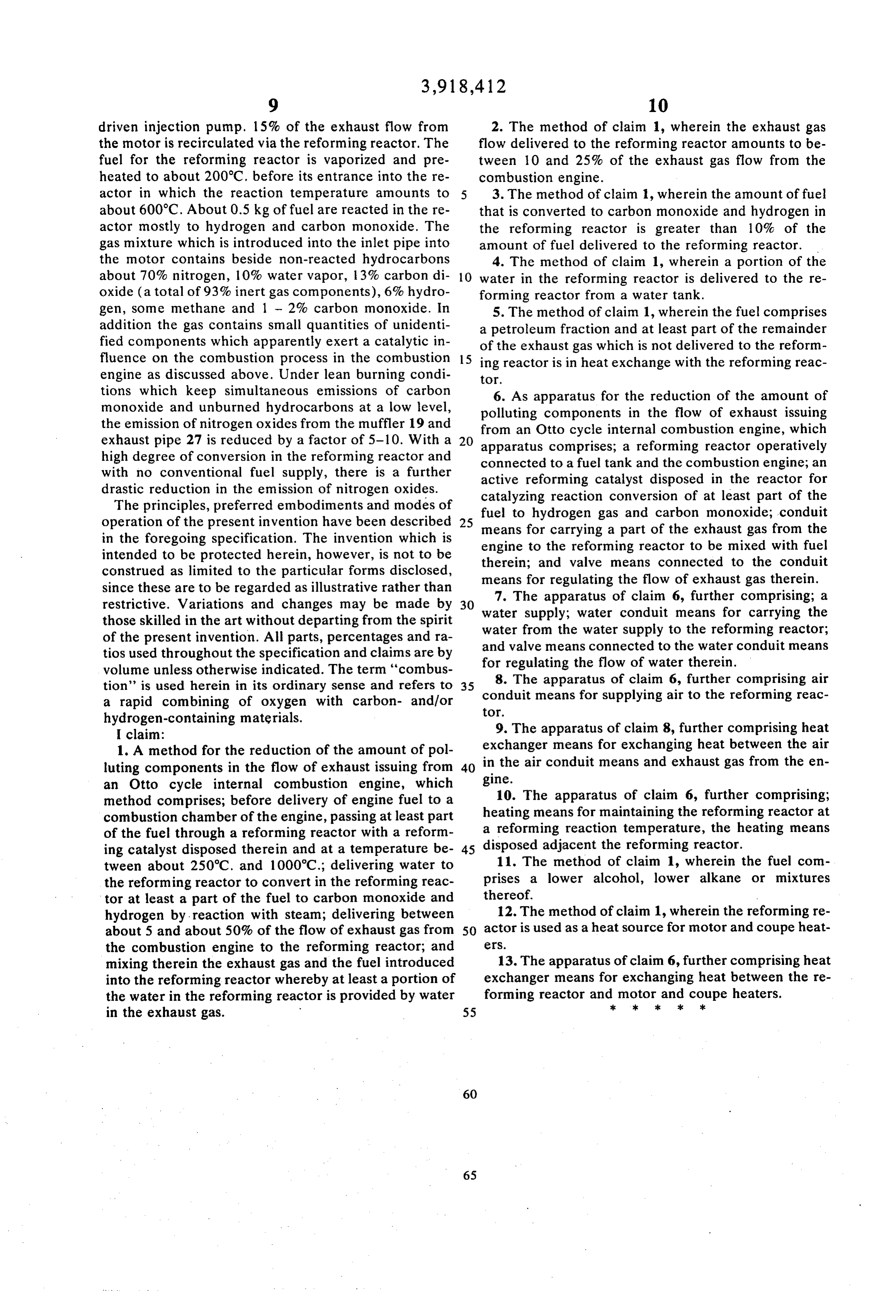
driven injection pump, 15% of the exhaust flow from 2. The method of claim 1, wherein the exhaust gas the motor is recirculated via the reforming reactor. The flow delivered to the reforming reactor amounts to be fuel for the reforming reactor is vaporized and pre tween 10 and 25% of the exhaust gas flow from the heated to about 200°C, before its entrance into the re combustion engine.
actor in which the reaction temperature amounts to 3. The method of claim 1, wherein the amount of fuel about 600°C. About 0.5 kg of fuel are reacted in the re that is converted to carbon monoxide and hydrogen in actor mostly to hydrogen and carbon monoxide. The the reforming reactor is greater than 10% of the gas mixture which is introduced into the inlet pipe into amount of fuel delivered to the reforming reactor. the motor contains beside non-reacted hydrocarbons 4. The method of claim 1, wherein a portion of the about 70% nitrogen, 10% water vapor, 13% carbon di 10 water in the reforming reactor is delivered to the re oxide (a total of 93% inert gas components), 6% hydro forming reactor from a water tank.
gen, some methane and 1 - 2% carbon monoxide. In 5. The method of claim 1, wherein the fuel comprises addition the gas contains small quantities of unidenti a petroleum fraction and at least part of the remainder fied components which apparently exert a catalytic in of the exhaust gas which is not delivered to the reform fluence on the combustion process in the combustion 15 ing reactor is in heat exchange with the reforming reac engine as discussed above. Under lean burning condi tOr.
tions which keep simultaneous emissions of carbon 6. As apparatus for the reduction of the amount of monoxide and unburned hydrocarbons at a low level, polluting components in the flow of exhaust issuing the emission of nitrogen oxides from the muffler 19 and from an Otto cycle internal combustion engine, which exhaust pipe 27 is reduced by a factor of 5-10. With a 20 apparatus comprises; a reforming reactor operatively high degree of conversion in the reforming reactor and connected to a fuel tank and the combustion engine; an with no conventional fuel supply, there is a further active reforming catalyst disposed in the reactor for drastic reduction in the emission of nitrogen oxides. catalyzing reaction conversion of at least part of the The principles, preferred embodiments and modes of fuel operation of the present invention have been described 25 meansto for hydrogen gas and carbon monoxide; conduit carrying a part of the exhaust gas from the in the foregoing specification. The invention which is engine to the reforming reactor to be mixed with fuel intended to be protected herein, however, is not to be therein; and valve construed as limited to the particular forms disclosed, means for regulatingmeans the connected to the conduit flow of exhaust gas therein.
since these are to be regarded as illustrative rather than 7. The apparatus of claim 6, further comprising; a restrictive. Variations and changes may be made by 30 water supply; water conduit means for carrying the those skilled in the art without departing from the spirit water from the water supply to the reforming reactor; of the present invention. All parts, percentages and ra and valve means connected to the water conduit means tios used throughout the specification and claims are by for regulating the flow of water therein. volume unless otherwise indicated. The term "combus 8. The apparatus of claim 6, further comprising air tion' is used herein in its ordinary sense and refers to 35 conduit a rapid combining of oxygen with carbon- and/or means for supplying air to the reforming reac
hydrogen-containing materials.
I claim: 9. The apparatus of claim 8, further comprising heat 1. A method for the reduction of the amount of pol exchanger means for exchanging heat between the air luting components in the flow of exhaust issuing from 40 in the air conduit means and exhaust gas from the en an Otto cycle internal combustion engine, which gine. 10. The apparatus of claim 6, further comprising; method comprises; before delivery of engine fuel to a combustion chamber of the engine, passing at least part heating means for maintaining the reforming reactor at of the fuel through a reforming reactor with a reform a reforming reaction temperature, the heating means ing catalyst disposed therein and at a temperature be 45 disposed adjacent the reforming reactor. tween about 250°C. and 1000°C.; delivering water to 11. The method of claim 1, wherein the fuel com the reforming reactor to convert in the reforming reac prises a lower alcohol, lower alkane or mixtures tor at least a part of the fuel to carbon monoxide and thereof.
hydrogen by reaction with steam; delivering between 12. The method of claim 1, wherein the reforming re about 5 and about 50% of the flow of exhaust gas from 50 actor is used as a heat source for motor and coupe heat the combustion engine to the reforming reactor; and S.
mixing therein the exhaust gas and the fuel introduced 13. The apparatus of claim 6, further comprising heat into the reforming reactor whereby at least a portion of exchanger means for exchanging heat between the re the water in the reforming reactor is provided by water forming reactor andk motor
andsk coupe
heaters.
in the exhaust gas. 55
Provenance
- Collection
- Cited prior art
- Original PDF
- patentimages.storage.googleapis.com →
- Filed
- 1973-09-14
- Pages
- 8
- Method
- pdftotext (the PDF's own text layer) + pdftoppm 300dpi page scans
- Source
- Google Patents bibliographic record
- Granted
- 1975-11-11
- Inventors
- Olle B Lindstrom
- Transcribed from
- patentimages.storage.googleapis.com →