patent · US4012301
Method and apparatus for the initiation of chemical reactions
15 March 1977
Page 1 — bibliographic record
United States Patent to (11) 4,012,301 Rich et al. 45 Mar. 15, 1977 54) METHOD AND APPARATUS FOR THE Primary Examiner-Howars S. Williams INITIATION OF CHEMICAL REACTIONS Attorney, Agent, or Firm-David J. Zobkiw 75) Inventors: Joseph W. Rich, East Aurora; John
W. Raymonda, Williamsville, both of 57 ABSTRACT
N.Y. Laser radiation is employed to initiate and promote 73) Assignee: Calspan Corporation, Buffalo, N.Y. chemical reactions by creating states of molecular vi brational mode excitation exceeding those appropriate 22) Filed: July 28, 1975 to the translational temperature of the medium in one 21 Appl. No.: 599,512 or more of the reactants. In favorable cases, vibrational excitation in a certain vibrational normal mode of a 52) U.S. Cl. .................... 204/157.1 R; 204/158 R; reactant will act to accelerate the rate of a desired 204/162 R; 204/DIG. 11; 250/527, chemical reaction. The reactants can be pressurized so 51 int. Cl......................... B01J 1/10; B01K 1100that their vibration-rotation spectrum can be broad 58) Field of Search ............. 204/DIG. 11, 157. 1 R,ened to the point that laser radiation can be absorbed 204/158 R, 162 R; 250/527 without the need for exact coincidence between a line 56) References Cited or lines of the spectrum of the reactant and that of available lasers. Provision can be made for isolation
OTHER PUBLICATIONS and analysis of products, recycling of unused reactants, Mayer et al., Applied Optics, vol. 17, No. 12 (Dec. 15, temperature control of reactants and real-time moni 1970) pp. 516-519. toring of the state of vibrational excitation of the reac Ambartzumian et al., Applied Optics, vol. 11, No. 2 tants.
Karlov, Applied Optics, vol. 13, No. 2 (Feb. 1974), pp.
301-309. 16 Claims, 5 Drawing Figures
REACTION
RECOVERY
SOURCE
Page 2
Drawing sheet — no readable text.
Page 3
Drawing sheet — no readable text.
Page 4
the benefits and problems associated with the use of
METHOD AND APPARATUS FOR THE INITIATION catalysts.
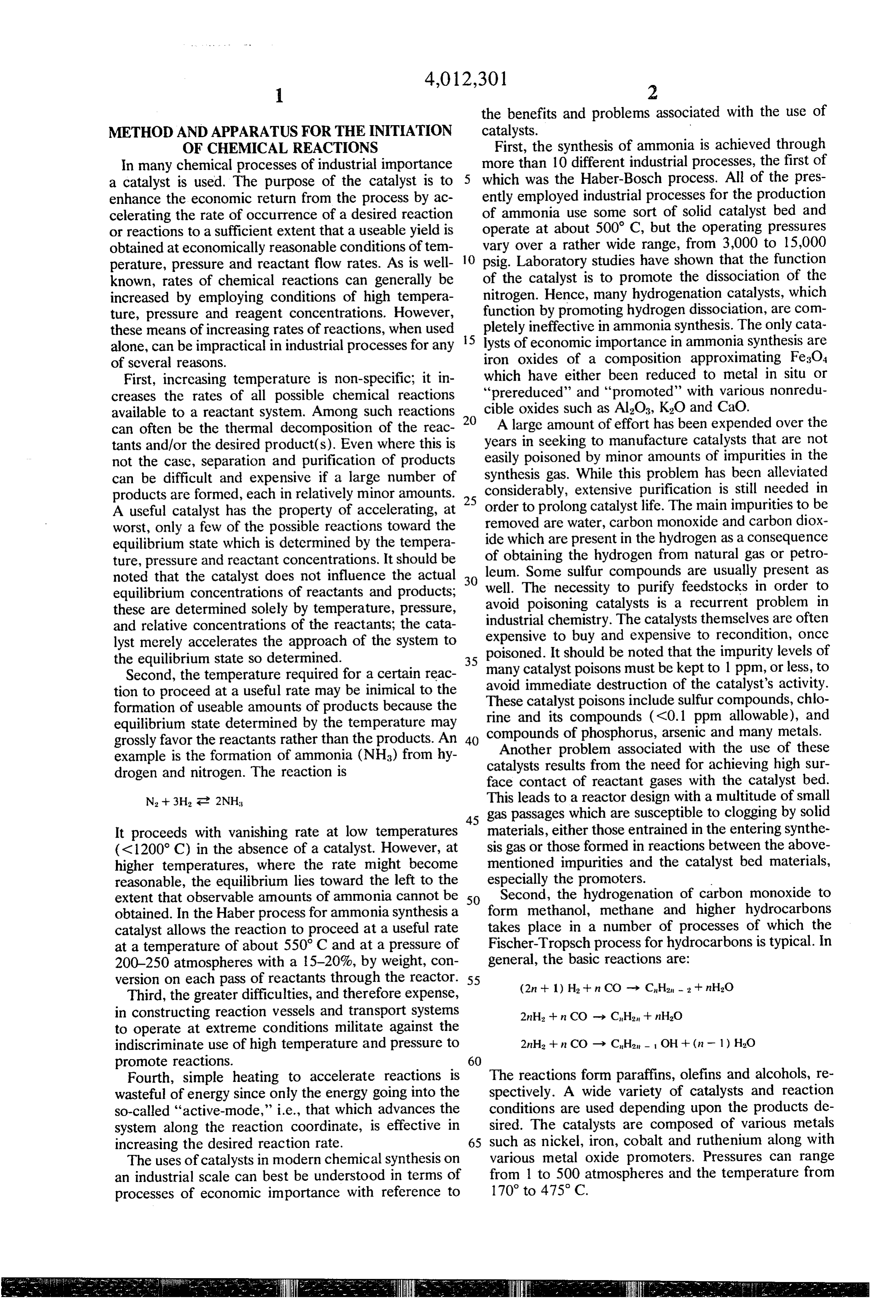
OF CHEMICAL REACTIONS First, the synthesis of ammonia is achieved through In many chemical processes of industrial importance more than 10 different industrial processes, the first of a catalyst is used. The purpose of the catalyst is to which was the Haber-Bosch process. All of the pres enhance the economic return from the process by ac ently employed industrial processes for the production celerating the rate of occurrence of a desired reaction of ammonia use some sort of solid catalyst bed and or reactions to a sufficient extent that a useable yield is operate at about 500 C, but the operating pressures obtained at economically reasonable conditions oftem 10 vary over a rather wide range, from 3,000 to 15,000 perature, pressure and reactant flow rates. As is well psig. Laboratory studies have shown that the function known, rates of chemical reactions can generally be of the catalyst is to promote the dissociation of the increased by employing conditions of high tempera nitrogen. Hence, many hydrogenation catalysts, which ture, pressure and reagent concentrations. However, function by promoting hydrogen dissociation, are com these means of increasing rates of reactions, when used 15 pletely ineffective in ammonia synthesis. The only cata alone, can be impractical in industrial processes for any lysts of economic importance in ammonia synthesis are of several reasons. iron oxides of a composition approximating Fe3O4 First, increasing temperature is non-specific; it in which have either been reduced to metal in situ or creases the rates of all possible chemical reactions 'prereduced' and "promoted' with various nonredu available to a reactant system. Among such reactions cible oxides such as Al2O3, KO and CaO. can often be the thermal decomposition of the reac 20 A large amount of effort has been expended over the tants and/or the desired product(s). Even where this is years in seeking to manufacture catalysts that are not not the case, separation and purification of products easily poisoned by minor amounts of impurities in the can be difficult and expensive if a large number of synthesis gas. While this problem has been alleviated products are formed, each in relatively minor amounts. 25 considerably, extensive purification is still needed in A useful catalyst has the property of accelerating, at order to prolong catalyst life. The main impurities to be worst, only a few of the possible reactions toward the removed are water, carbon monoxide and carbon diox ide which are present in the hydrogen as a consequence equilibrium state which is determined by the tempera of obtaining the hydrogen from natural gas or petro ture, pressure and reactant concentrations. It should be noted that the catalyst does not influence the actual 30 leum. Some sulfur compounds are usually present as equilibrium concentrations of reactants and products; well. The necessity to purify feedstocks in order to avoid poisoning catalysts is a recurrent problem in these are determined solely by temperature, pressure, industrial chemistry. The catalysts themselves are often and relative concentrations of the reactants; the cata lyst merely accelerates the approach of the system to expensive to buy and expensive to recondition, once the equilibrium state so determined. 35 poisoned. It should be noted that the impurity levels of
Second, the temperature required for a certain reac avoidmany catalyst poisons must be kept to 1 ppm, or less, to tion to proceed at a useful rate may be inimical to the These immediate catalyst destruction of the catalyst's activity.
poisons include sulfur compounds, chlo formation of useable amounts of products because the rine and its compounds equilibrium state determined by the temperature may compounds of phosphorus,(<0.1 ppm allowable), and arsenic and many metals.
grossly favor the reactants rather than the products. An 40
Another problem associated with the use of these example is the formation of ammonia (NH3) from hy catalysts results from the need for achieving high sur drogen and nitrogen. The reaction is face contact of reactant gases with the catalyst bed. N + 3H P 2NH This leads to a reactor design with a multitude of small 45 gas passages which are susceptible to clogging by solid
It proceeds with vanishing rate at low temperatures materials, either those entrained in the entering synthe (< 1200° C) in the absence of a catalyst. However, at sis gas or those formed in reactions between the above higher temperatures, where the rate might become mentioned impurities and the catalyst bed materials, reasonable, the equilibrium lies toward the left to the especially the promoters.
extent that observable amounts of ammonia cannot be 50 Second, the hydrogenation of carbon monoxide to obtained. In the Haber process for ammonia synthesis a form methanol, methane and higher hydrocarbons catalyst allows the reaction to proceed at a useful rate takes place in a number of processes of which the at a temperature of about 550°C and at a pressure of Fischer-Tropsch process for hydrocarbons is typical. In 200–250 atmospheres with a 15-20%, by weight, con general, the basic reactions are:
version on each pass of reactants through the reactor. 55 (2n + 1) H + n CO --> CH - + nHO Third, the greater difficulties, and therefore expense, in constructing reaction vessels and transport systems 2nh -- in CO --> CH -- no to operate at extreme conditions militate against the indiscriminate use of high temperature and pressure to 2nH2 + n CO -> CH2 - OH -- (n - 1) HO
Fourth, simple heating to accelerate reactions is The reactions form paraffins, olefins and alcohols, re wasteful of energy since only the energy going into the spectively. A wide variety of catalysts and reaction so-called “active-mode,' i.e., that which advances the conditions are used depending upon the products de system along the reaction coordinate, is effective in sired. The catalysts are composed of various metals increasing the desired reaction rate. 65 such as nickel, iron, cobalt and ruthenium along with The uses of catalysts in modern chemical synthesis on various metal oxide promoters. Pressures can range an industrial scale can best be understood in terms of from 1 to 500 atmospheres and the temperature from processes of economic importance with reference to 170° to 475 C.
Page 5
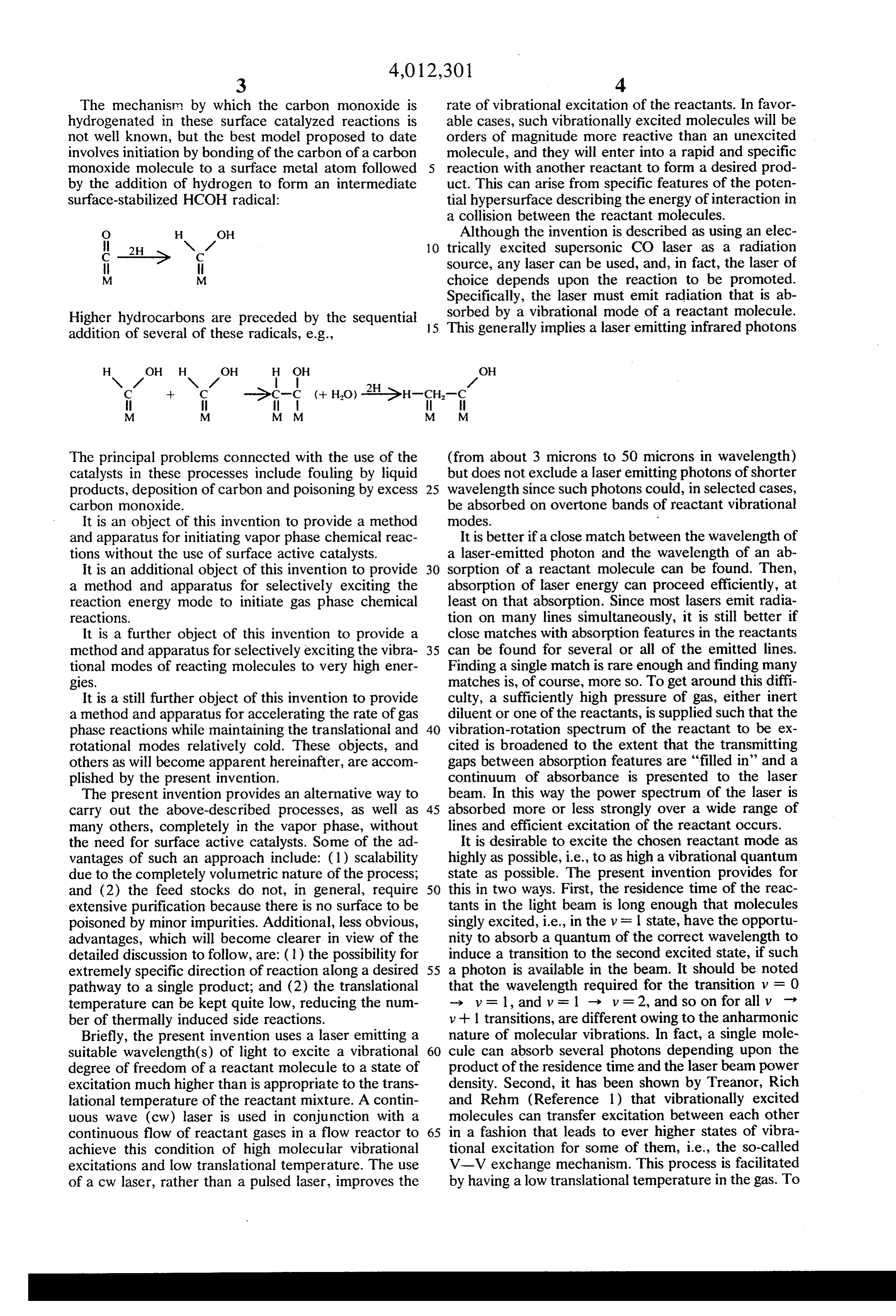
The mechanism by which the carbon monoxide is rate of vibrational excitation of the reactants. In favor hydrogenated in these surface catalyzed reactions is able cases, such vibrationally excited molecules will be not well known, but the best model proposed to date orders of magnitude more reactive than an unexcited involves initiation by bonding of the carbon of a carbon molecule, and they will enter into a rapid and specific monoxide molecule to a surface metal atom followed 5 reaction with another reactant to form a desired prod by the addition of hydrogen to form an intermediate uct. This can arise from specific features of the poten surface-stabilized HCOH radical: tial hypersurface describing the energy of interaction in a collision between the reactant molecules.
Although the invention is described as using an elec
HQ OH 10 trically excited supersonic CO laser as a radiation
source, any laser can be used, and, in fact, the laser of choice depends upon the reaction to be promoted.
Specifically, the laser must emit radiation that is ab sorbed by a vibrational mode of a reactant molecule.
Higher hydrocarbons are preceded by the sequential 15 This addition of several of these radicals, e.g., generally implies a laser emitting infrared photons
HQ OH HQ OH H gh OH
The principal problems connected with the use of the (from about 3 microns to 50 microns in wavelength) catalysts in these processes include fouling by liquid but does not exclude a laser emitting photons of shorter products, deposition of carbon and poisoning by excess 25 wavelength since such photons could, in selected cases, carbon monoxide. be absorbed on overtone bands of reactant vibrational It is an object of this invention to provide a method modes.
and apparatus for initiating vapor phase chemical reac It is better if a close match between the wavelength of tions without the use of surface active catalysts. a laser-emitted photon and the wavelength of an ab It is an additional object of this invention to provide 30 sorption of a reactant molecule can be found. Then, a method and apparatus for selectively exciting the absorption of laser energy can proceed efficiently, at reaction energy mode to initiate gas phase chemical least on that absorption. Since most lasers emit radia reactions. tion on many lines simultaneously, it is still better if It is a further object of this invention to provide a close matches with absorption features in the reactants method and apparatus for selectively exciting the vibra 35 can be found for several or all of the emitted lines. tional modes of reacting molecules to very high ener Finding a single match is rare enough and finding many geS. matches is, of course, more so. To get around this diffi It is a still further object of this invention to provide culty, a sufficiently high pressure of gas, either inert a method and apparatus for accelerating the rate of gas diluent or one of the reactants, is supplied such that the phase reactions while maintaining the translational and 40 vibration-rotation spectrum of the reactant to be ex rotational modes relatively cold. These objects, and cited is broadened to the extent that the transmitting others as will become apparent hereinafter, are accom gaps between absorption features are "filled in' and a plished by the present invention. continuum of absorbance is presented to the laser The present invention provides an alternative way to beam. In this way the power spectrum of the laser is carry out the above-described processes, as well as 45 absorbed more or less strongly over a wide range of many others, completely in the vapor phase, without lines and efficient excitation of the reactant occurs. the need for surface active catalysts. Some of the ad It is desirable to excite the chosen reactant mode as vantages of such an approach include: (1) scalability highly as possible, i.e., to as high a vibrational quantum due to the completely volumetric nature of the process, state as possible. The present invention provides for and (2) the feed stocks do not, in general, require 50 this in two ways. First, the residence time of the reac extensive purification because there is no surface to be tants in the light beam is long enough that molecules poisoned by minor impurities. Additional, less obvious, singly excited, i.e., in the v = 1 state, have the opportu advantages, which will become clearer in view of the nity to absorb a quantum of the correct wavelength to detailed discussion to follow, are: (1) the possibility for induce a transition to the second excited state, if such extremely specific direction of reaction along a desired 55 a photon is available in the beam. It should be noted pathway to a single product; and (2) the translational that the wavelength required for the transition v = 0 temperature can be kept quite low, reducing the num -> v = 1, and v = 1 -> v = 2, and so on for all v ber of thermally induced side reactions. v + 1 transitions, are different owing to the anharmonic Briefly, the present invention uses a laser emitting a nature of molecular vibrations. In fact, a single mole suitable wavelength(s) of light to excite a vibrational 60 cule can absorb several photons depending upon the degree of freedom of a reactant molecule to a state of product of the residence time and the laser beam power excitation much higher than is appropriate to the trans density. Second, it has been shown by Treanor, Rich lational temperature of the reactant mixture. A contin and Rehm (Reference 1) that vibrationally excited uous wave (cw) laser is used in conjunction with a molecules can transfer excitation between each other continuous flow of reactant gases in a flow reactor to in a fashion that leads to ever higher states of vibra achieve this condition of high molecular vibrational tional excitation for some of them, i.e., the so-called excitations and low translational temperature. The use V-V exchange mechanism. This process is facilitated of a cw laser, rather than a pulsed laser, improves the by having a low translational temperature in the gas. To
Page 6
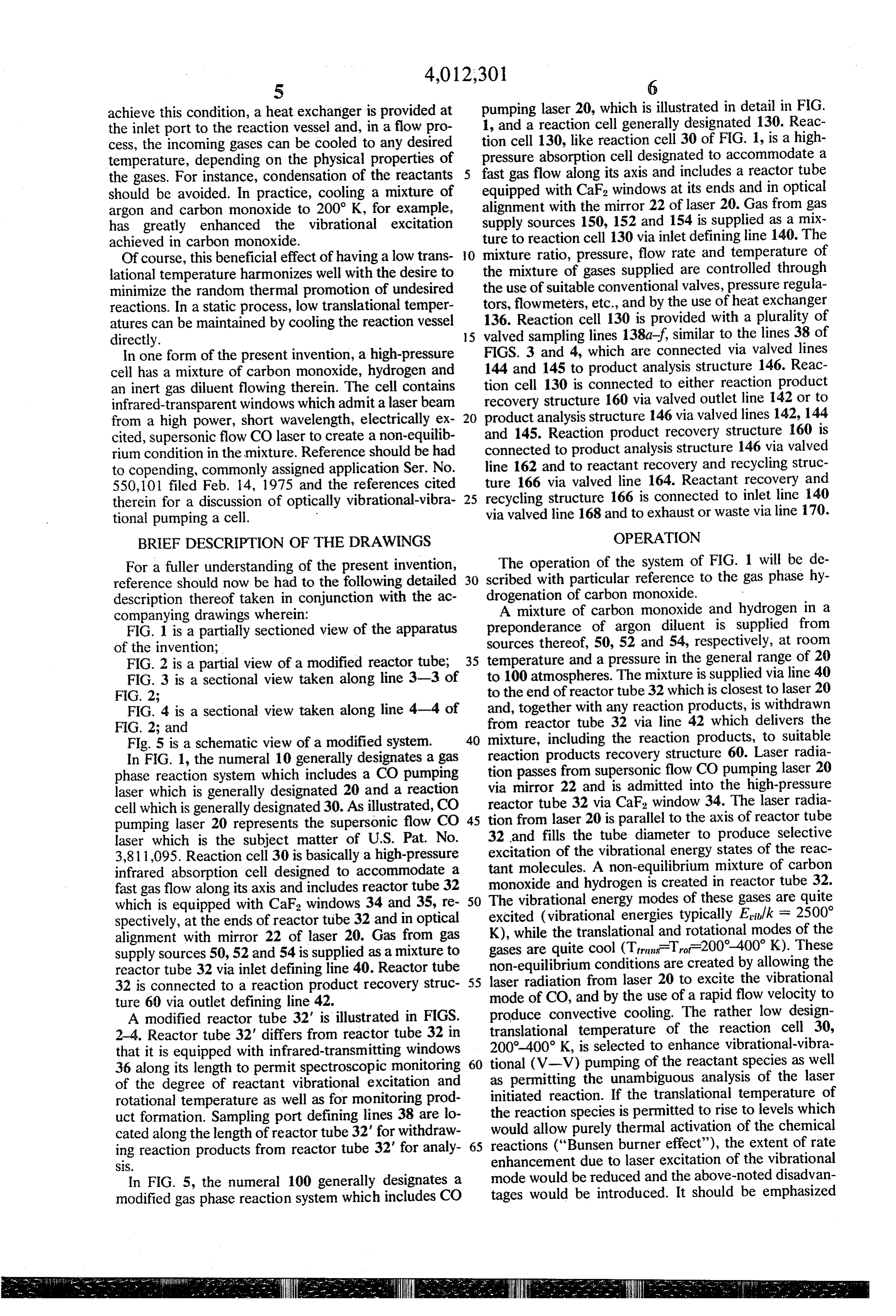
achieve this condition, a heat exchanger is provided at pumping laser 20, which is illustrated in detail in FIG. the inlet port to the reaction vessel and, in a flow pro 1, and a reaction cell generally designated 130. Reac cess, the incoming gases can be cooled to any desired tion cell 130, like reaction cell 30 of FIG. 1, is a high temperature, depending on the physical properties of pressure absorption cell designated to accommodate a the gases. For instance, condensation of the reactants 5 fast gas flow along its axis and includes a reactor tube should be avoided. In practice, cooling a mixture of equipped with CaF2 windows at its ends and in optical argon and carbon monoxide to 200 K, for example, alignment with the mirror 22 of laser 20. Gas from gas has greatly enhanced the vibrational excitation supply sources 150, 152 and 154 is supplied as a mix achieved in carbon monoxide. ture to reaction cell 130 via inlet defining line 140. The Of course, this beneficial effect of having a low trans mixture ratio, pressure, flow rate and temperature of
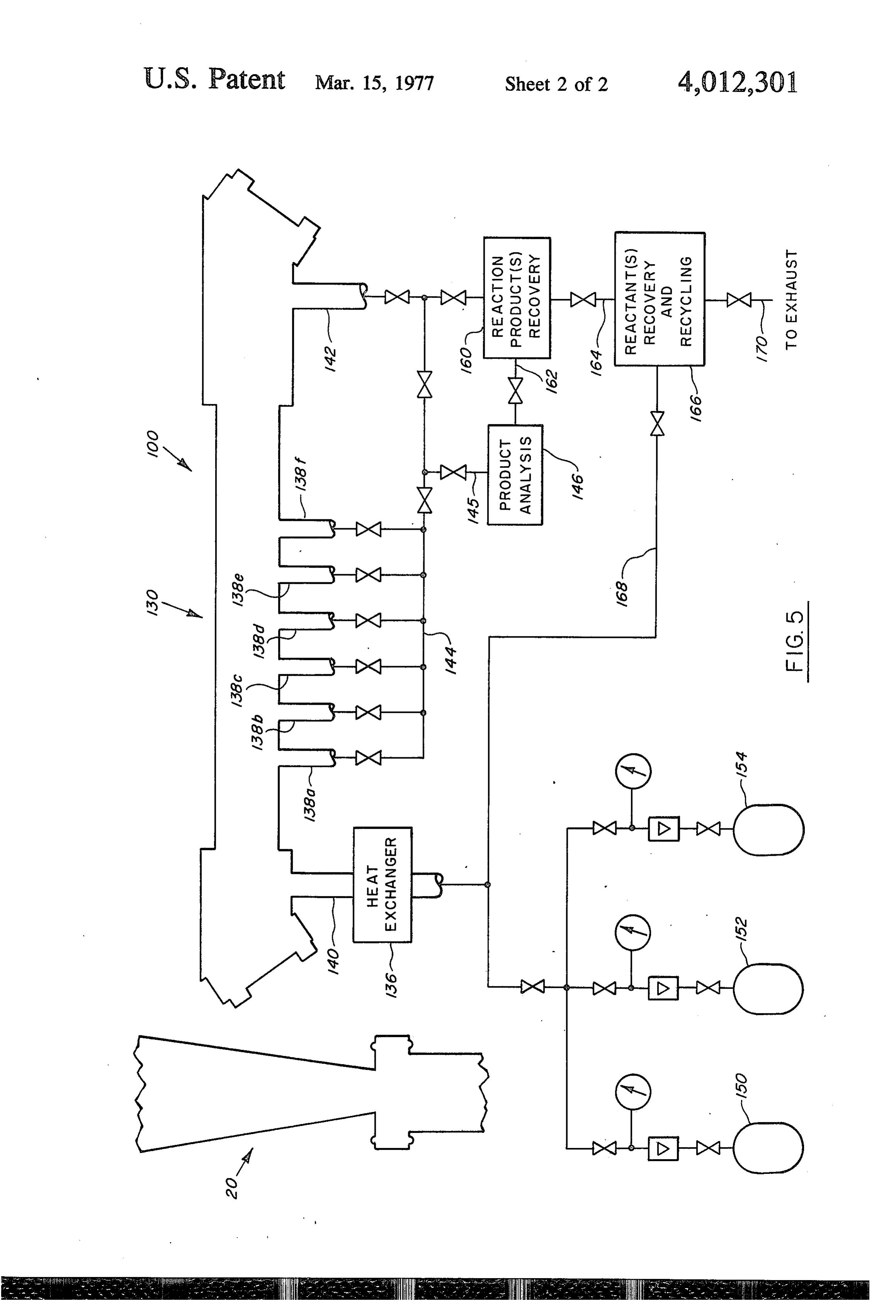
lational temperature harmonizes well with the desire to the mixture of gases supplied are controlled through minimize the random thermal promotion of undesired the use of suitable conventional valves, pressure regula reactions. In a static process, low translational temper tors, flowmeters, etc., and by the use of heat exchanger atures can be maintained by cooling the reaction vessel 136. Reaction cell 130 is provided with a plurality of directly. 15 valved sampling lines 138a–f, similar to the lines 38 of in one form of the present invention, a high-pressure FIGS. 3 and 4, which are connected via valved lines cell has a mixture of carbon monoxide, hydrogen and 144 and 145 to product analysis structure 146. Reac an inert gas diluent flowing therein. The cell contains tion cell 130 is connected to either reaction product infrared-transparent windows which admit a laser beam recovery structure 160 via valved outlet line 142 or to from a high power, short wavelength, electrically ex 20 product analysis structure 146 via valved lines 142,144 cited, supersonic flow CO laser to create a non-equilib and 145. Reaction product recovery structure 160 is rium condition in the mixture. Reference should be had connected to product analysis structure 146 via valved to copending, commonly assigned application Ser. No. line 162 and to reactant recovery and recycling struc 550, 101 filed Feb. 14, 1975 and the references cited ture 166 via valved line 164. Reactant recovery and recycling structure 166 is connected to inlet line 140 therein for a discussion of optically vibrational-vibra 25 via tional pumping a cell. valved line 168 and to exhaust or waste via line 170. BRIEF DESCRIPTION OF THE DRAWINGS OPERATION
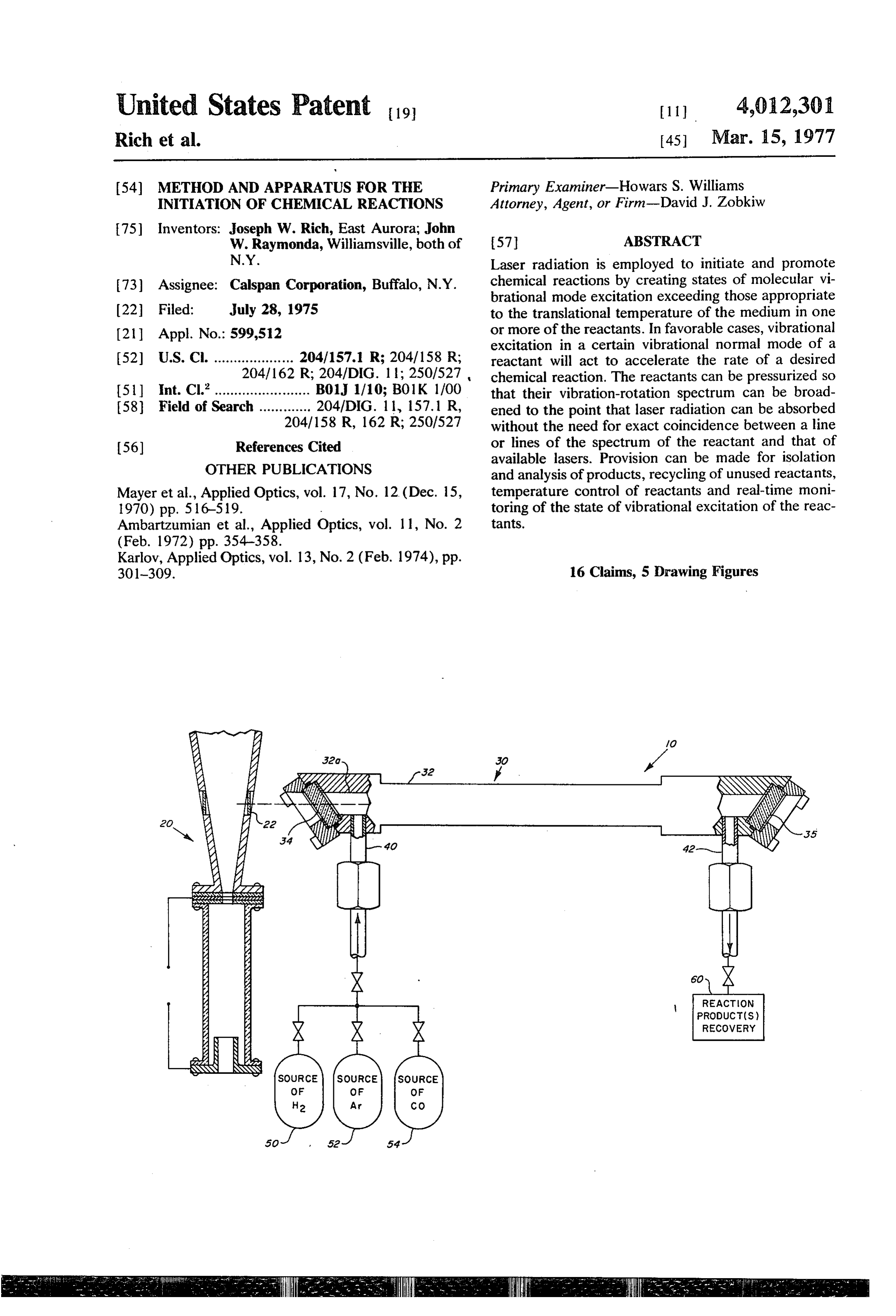
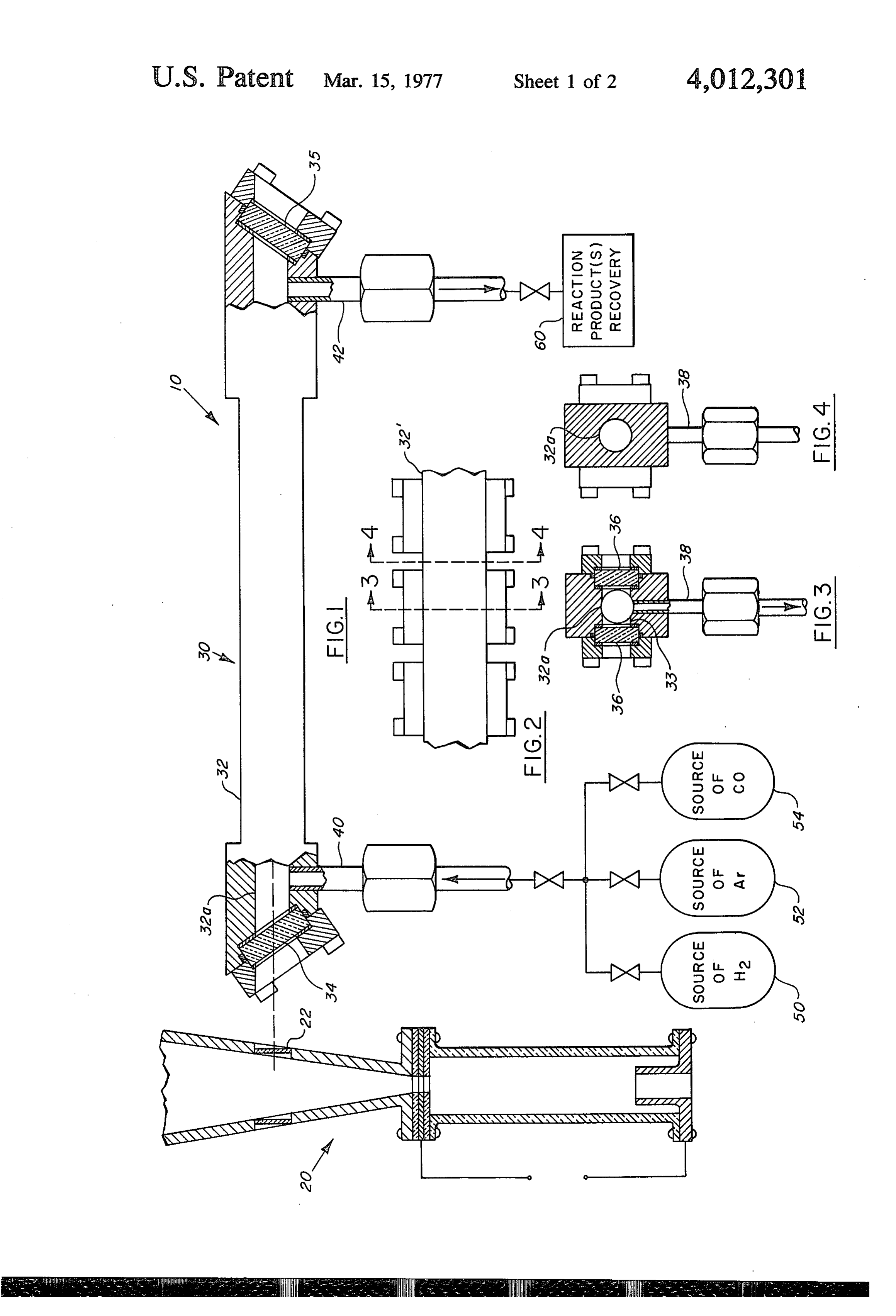
For a fuller understanding of the present invention, The operation of the system of FIG. 1 will be de reference should now be had to the following detailed 30 scribed with particular reference to the gas phase hy description thereof taken in conjunction with the ac drogenation of carbon monoxide.
companying drawings wherein: A mixture of carbon monoxide and hydrogen in a FIG. 1 is a partially sectioned view of the apparatus preponderance of argon diluent is supplied from of the invention; sources thereof, 50, 52 and 54, respectively, at room FIG. 2 is a partial view of a modified reactor tube; 35 temperature and a pressure in the general range of 20 FIG. 3 is a sectional view taken along line 3-3 of to 100 atmospheres. The mixture is supplied via line 40 FIG. 2; to the end of reactor tube 32 which is closest to laser 20 FIG. 4 is a sectional view taken along line 4-4 of and, from together with any reaction products, is withdrawn reactor tube 32 via line 42 which delivers the
FIG. 2; and
Flg. 5 is a schematic view of a modified system. 40 mixture, including the reaction products, to suitable In FIG. 1, the numeral 10 generally designates a gas reaction products recovery structure 60. Laser radia phase reaction system which includes a CO pumping tion passes from supersonic flow CO pumping laser 20 laser which is generally designated 20 and a reaction reactorvia mirror 22 and is admitted into the high-pressure cell which is generally designated 30. As illustrated, CO tube 32 via CaF2 window 34. The laser radia pumping laser 20 represents the supersonic flow CO 45 tion from laser 20 is parallel to the axis of reactor tube laser which is the subject matter of U.S. Pat. No. 32 and fills the tube diameter to produce selective excitation of the vibrational energy states of the reac 3,81 1,095. Reaction cell 30 is basically a high-pressure infrared absorption cell designed to accommodate a tant molecules. A non-equilibrium mixture of carbon monoxide and hydrogen is created in reactor tube 32.
fast gas flow along its axis and includes reactor tube 32 50 The vibrational energy modes of these gases are quite which is equipped with CaF2 windows 34 and 35, re excited (vibrational energies typically Eri?k = 2500 Spectively, at the ends of reactor tube 32 and in optical alignment with mirror 22 of laser 20. Gas from gas K), while the translational and rotational modes of the supply sources 50, 52 and 54 is supplied as a mixture to gases are quite cool (Trn Trois-200-400 K). These reactor tube 32 via inlet defining line 40. Reactor tube 55 non-equilibrium conditions are created by allowing the 32 is connected to a reaction product recovery struc mode of CO, and by laser laser radiation from 20 to excite the vibrational the use of a rapid flow velocity to ture 60 via outlet defining line 42. produce convective cooling. The rather low design A modified reactor tube 32' is illustrated in FIGS.
2-4. Reactor tube 32' differs from reactor tube 32 in translational temperature of the reaction cell 30, that it is equipped with infrared-transmitting windows 200-400 K, is selected to enhance vibrational-vibra tional (V-V) pumping of the reactant species as well 36 along its length to permit spectroscopic monitoring 60 as of the degree of reactant vibrational excitation and permitting the unambiguous analysis of the laser rotational temperature as well as for monitoring prod initiated reaction. If the translational temperature of uct formation. Sampling port defining lines 38 are lo the reaction species is permitted to rise to levels which cated along the length of reactor tube 32' for withdraw would allow purely thermal activation of the chemical ing reaction products from reactor tube 32' for analy 65 reactions ("Bunsen burner effect'), the extent of rate enhancement due to laser excitation of the vibrational
In FIG. 5, the numeral 100 generally designates a mode would be reduced and the above-noted disadvan modified gas phase reaction system which includes CO tages would be introduced. It should be emphasized
Page 7
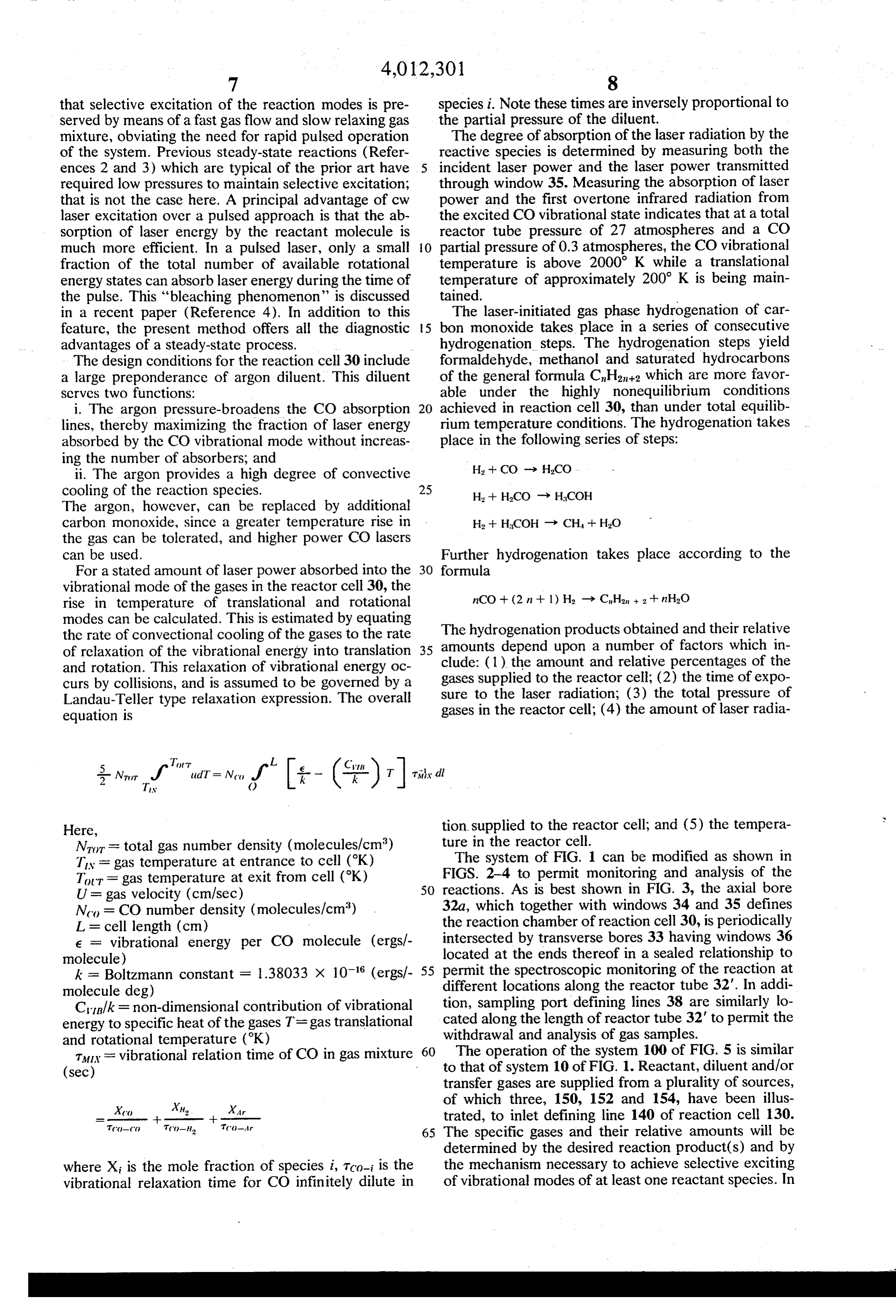
that selective excitation of the reaction modes is pre species i. Note these times are inversely proportional to Served by means of a fast gas flow and slow relaxing gas the partial pressure of the diluent. mixture, obviating the need for rapid pulsed operation The degree of absorption of the laser radiation by the of the System. Previous steady-state reactions (Refer reactive species is determined by measuring both the ences 2 and 3) which are typical of the prior art have incident laser power and the laser power transmitted required low pressures to maintain selective excitation; through window 35. Measuring the absorption of laser that is not the case here. A principal advantage of cw power and the first overtone infrared radiation from laser excitation over a pulsed approach is that the ab the excited CO vibrational state indicates that at a total Sorption of laser energy by the reactant molecule is reactor tube pressure of 27 atmospheres and a CO much more efficient. In a pulsed laser, only a small O partial pressure of 0.3 atmospheres, the CO vibrational fraction of the total number of available rotational temperature is above 2000 K while a translational energy states can absorb laser energy during the time of temperature of approximately 200 K is being main the pulse. This "bleaching phenomenon" is discussed tained.
in a recent paper (Reference 4). In addition to this The laser-initiated gas phase hydrogenation of car feature, the present method offers all the diagnostic 15 bon monoxide takes place in a series of consecutive advantages of a steady-state process. hydrogenation steps. The hydrogenation steps yield The design conditions for the reaction cell 30 include formaldehyde, methanol and saturated hydrocarbons a large preponderance of argon diluent. This diluent of the general formula CH2n+2 which are more favor serves two functions: able under the highly nonequilibrium conditions i. The argon pressure-broadens the CO absorption 20 achieved in reaction cell 30, than under total equilib lines, thereby maximizing the fraction of laser energy rium temperature conditions. The hydrogenation takes absorbed by the CO vibrational mode without increas place in the following series of steps: ing the number of absorbers; and H, + CO -> HCO ii. The argon provides a high degree of convective
H -- HCO - HCOH
The argon, however, can be replaced by additional carbon monoxide, since a greater temperature rise in H + HCOH - CH -- HO the gas can be tolerated, and higher power CO lasers can be used. Further hydrogenation takes place according to the For a stated amount of laser power absorbed into the 30 formula vibrational mode of the gases in the reactor cell 30, the rise in temperature of translational and rotational nCO -- (2n -- 1) H --> CH n2O modes can be calculated. This is estimated by equating the rate of convectional cooling of the gases to the rate The hydrogenation products obtained and their relative of relaxation of the vibrational energy into translation 35 amounts depend upon a number of factors which in and rotation. This relaxation of vibrational energy oc clude: (1) the amount and relative percentages of the curs by collisions, and is assumed to be governed by a gases supplied to the reactor cell; (2) the time of expo Landau-Teller type relaxation expression. The overall sure gases to the laser radiation; (3) the total pressure of in the reactor cell; (4) the amount of laser radia equation is
-- Ink T the di
Here, tion supplied to the reactor cell; and (5) the tempera Nor = total gas number density (molecules/cm) ture in the reactor cell.
Ty = gas temperature at entrance to cell (K) The system of FIG. 1 can be modified as shown in Tott = gas temperature at exit from cell (K) FIGS. 2-4 to permit monitoring and analysis of the U = gas velocity (cm/sec) 50 reactions. As is best shown in FIG. 3, the axial bore No = CO number density (molecules/cm) 32a, which together with windows 34 and 35 defines L = cell length (cm) the reaction chamber of reaction cell 30, is periodically e = vibrational energy per CO molecule (ergs/- intersected by transverse bores 33 having windows 36 molecule) located at the ends thereof in a sealed relationship to R = Boltzmann constant = 1.38033 x 10" (ergs/- 55 permit the spectroscopic monitoring of the reaction at molecule deg) different locations along the reactor tube 32". In addi Clin?k = non-dimensional contribution of vibrational tion, sampling port defining lines 38 are similarly lo energy to specific heat of the gases T=gas translational cated along the length of reactor tube 32' to permit the and rotational temperature (K) withdrawal and analysis of gas samples. Tuv = vibrational relation time of CO in gas mixture 60 The operation of the system 100 of FIG. 5 is similar (sec) to that of system 10 of FIG. 1. Reactant, diluent and/or transfer gases are supplied from a plurality of sources, of which three, 150, 152 and 154, have been illus
Xar trated, to inlet defining line 140 of reaction cell 130.
65 The specific gases and their relative amounts will be determined by the desired reaction product(s) and by where X is the mole fraction of species i, Tco-i is the the mechanism necessary to achieve selective exciting vibrational relaxation time for CO infinitely dilute in of vibrational modes of at least one reactant species. In
Page 8
very high pressures or by energy transfer using a trace some reactions it is necessary and/or desirable to use a amount of CO as the primary absorber transfer gas which absorbs the radiation energy emitted of the CO laser by pumping laser 20 and transfers this energy by inelas radiation. Once excited, the N2 will self-pump by the tic molecular collisions to the reactant species. The V-V exchange mechanism and will become reactive. rates of flow, pressures and ratios of the gases supplied 5 The vibrational-translational (V-T) relaxation of N2 is by sources 150, 152 and 154 are controlled through the extremely slow and radiative decay will also be negligi use of conventional means such as valves, pressure ble because N is non-polar. The reaction can be car regulators and flow meters. Heat exchanger 136 is ried on at low translational temperature favoring the located in line 140 at the inlet of reaction cell 130 to exothermic formation of ammonia. regulate the temperature of the mixture of gases sup 10 The CO laser has the bulk of its output in the wave plied to reaction cell 130. At least one reactant species length range in which the water molecule, H2O, absorbs in the mixture of gases flowing through reaction cell in the bending mode. Thus, absorption of CO laser 130 is selectively vibrationally excited by the radiation radiation will tend to straighten the normally bent H2O energy emitted by pumping laser 20 as described above molecule and place it in a more reactive state. This in regard to system 10 of FIG.1. The reaction pro 15 could have application in such reactions as the steam duct(s) together with any unreacted gases, diluent and reforming of hydrocarbons, in which hydrocarbons are transfer gas are withdrawn from reaction cell 130 via allowed to react with steam in the presence of a catalyst line 142 and are delivered to the reaction product re resulting in desired alterations of structure and molecu covery structure 160 which includes structure for re lar weight distributions.
moving and storing the reaction product(s) supplied 20 Although preferred embodiments of the present in via line 142. The residual gases made up of the unre vention have been illustrated and described, other acted gases, diluent, transfer gas and unrecovered reac changes will occur to those skilled in the art. For exam tion products such as water pass via line 164 from ple, the argon diluent can be eliminated, the hydroge reaction product recovery structure 160 to reactant nation products may be recycled in the reactor cell or recovery and recycling structure which includes struc 25 may serially pass through a plurality of reactor cells to ture for removing and purifying the unreacted gases, carry the hydrogenation process to the desired point. diluent and transfer gas. Water and other undesired The number of gas sources can be varied to meet the products, reactants, diluent or transfer gases are ex requirements of the reactions desired. The flows in the hausted via line 170. Recovered reactants, diluent, various lines can be controlled and correlated as is transfer gas as well as intermediate reaction products 30 conventional in the fluid handling and chemical pro can be recycled for further processing and are supplied cessing arts. Other laser sources may be used and the via line 168 from reactant recovery and recycling struc laser cell windows will be mounted at the proper Brew ture 166 to line 140. It may be necessary to provide a ster's angle for the wavelength of the laser radiation pump or other conventional structure in line 168 to and the material of the windows to minimize laser radi repressurize the recycled gases and it may be necessary 35 ation losses due to reflections off the windows. It is or desirable to regulate the gases supplied from sources therefore intended that the scope of the present inven 150, 152 and 154 in response to the amount and com position of the recycled gases supplied via line 168 and tion is to be limited only by the scope of the appended claims.
such systems are conventional in the fluid handling art.
Analysis of the products and rate of reaction is ac 40 REFERENCES complished by product analysis structure 146. Product 1. Treanor, C. E., J. W. Rich and R. G. Rehm, "Vi analysis structure 146 consists of conventional chemi brational Relaxation of Anharmonic Oscillators with cal and/or physical analysis devices and is connected Exchange-Dominated via lines 138a–f and line 145 for the analysis of the Physics, Volume 48,Collisions,” number Journal of Chemical
rates of reaction and for determining the reaction prod 45 1798-1807.
ucts at various points in the system. Product analysis 2. Yogev. A., R. M. J. Loewenstein and D. Amar, structure 146 is also alternately connectable to either “Photochemistry in the Electronic Ground State. I. line 142 to analyze the total reaction and its products Vapor Phase Irradiation or to reaction product recovery structure 160 for the Continuous Wave Carbon of Organic Compounds by analysis of the recovered reaction product(s). If de of the American Chemical Society,Gas
Volume 94, num sired, the product analysis structure may be connected ber 4 (Feb. 23, 1972) 1091-1096.
to reaction product recovery structure 160 to permit 3. Yogev, A., R. M. J. Loewenstein-Benmair, "Pho recovery and recycling of the reaction product(s), re tochemistry in the Electronic Ground State. II. Selec actants, diluent and/or transfer gases.
There are other reactions to which the concept of 55 tive Decomposition of trans-2-Butene by Pulsed Car laser catalysis is applicable. The most obvious of these bon Dioxide Laser,” Journal of the American Chemical is the synthesis of ammonia, NH, from H2 and N2. As Society, Volume 95, number 25 (Dec. 12, 1973) outlined earlier, this synthesis is carried out industrially 8487-8489.
4. Letokhov, V. A. and A. A. Makarov, "Kinetics of by several processes, including the Haber process, all of which involve subjecting a mixture of H2 and N to high 60 Excitation of Molecular Vibrations by Infrared Laser pressures over a catalyst at about 400 to 650° C. The Radiation,” Soviet Physics JETP, Volume 36, number 6 catalysts are all easily poisoned and therefore extensive (June, 1973) 1091-1096.
purification of the process gases is required. It has been We claim:
found that the key role of the catalyst is to promote the 1. A method for initiating and accelerating vapor cleavage of the N bond. This reaction can be pro 65 phase chemical reactions in a mixture of reactant spe moted in the vapor phase by inducing vibrational exci cies including the steps of tation of the N with a laser. The N can be excited supplying a plurality of reactant species to a reaction directly by a CO laser in double molecule transitions at chamber,
Page 9
continuously flowing the reactant species through the the rate of vapor phase chemical reactions is accel reaction chamber, erated while the translational and rotational modes maintaining the reaction chamber at a pressure such of the mixture of reactant species is maintained that the vibration-rotation spectra of the reactant relatively cold; and withdrawing the reaction prod species are pressure-broadened to enhance the 5 ucts from the reaction chamber. efficiency of absorption of laser radiation; 9. Apparatus for initiating and accelerating vapor selectively exciting vibrational modes of at least one phase chemical reactions in a mixture of reactant spe of the continuously flowing reactant species with a cies including:
continuous wave laser which emits radiation that is reaction vessel means defining a flow-through high absorbed by the vibrational mode of at least one i0 pressure cell having inlet means for supplying a reactant species to achieve a condition of high plurality of reactant species, outlet means for with molecular vibrational excitations and low transla drawing reaction products and a pair of optically tional temperature to create a nonequilibrium mix aligned windows which are transparent to laser ture of the reactant species whereby the rate of radiation; and vapor phase chemical reactions is accelerated 15 means including a continuous wave, high power, while the translational and rotational modes of the short wavelength, electrically excited supersonic mixture of reactant species is maintained relatively flow laser for selectively creating a state of vibra cold; and withdrawing the reaction products from tional excitation of at least one of the reactant the reaction chamber. species whereby the vibrational degree of freedom of said at least one reactant species is much higher 2. The method of claim 1 further including the step of 20 than is appropriate supplying diluent at a pressure in the range of 20 to 100 to the translational temperature atmospheres so that the vibration-rotation spectrum of of the mixture of reactant species so that vapor the reactant species to be excited is pressure-broad phase chemical reactions are promoted. ened. 10. The apparatus of claim 9 further including: 3. The method of claim 1 wherein hydrogen and 25 reactant means, species storage means and diluent storage nitrogen are the reactant species. means connecting said reactant species storage 4. The method of claim 1 wherein carbon monoxide means and said diluent storage means to said inlet and hydrogen are the reactant species. means for supplying said reactant species and dilu 5. The method of claim 1 wherein a mixture of reac tant species is supplied to a reaction chamber. 30 meanstoforsaid ent reaction vessel means; and controlling the relative amounts and pres 6. The method of claim 1 wherein the step of supply sures of the reactant species and diluent supplied to ing a plurality of reactant species to a reaction chamber said reaction vessel means. includes controlling the temperature of the reactant 11. The apparatus of claim 10 further including Species supplied to the reaction chamber. means for controlling the temperature of the reactant 7. The method of claim 1 further including the steps 35 species and diluent supplied to said reaction vessel of: eaS.
recovering the reaction product;
Sampling withdrawn reaction products and reaction for12.supplyingThe apparatus of claim 9 further including means products at selected locations in the reaction at a pressure inert in diluent to said reaction vessel means the range of 20 to 100 atmospheres chamber; 40 whereby the vibration-rotation spectrum of the mixture recovering reaction products; and of reactant species is pressure broadened. recovering and recycling unreacted reaction species. 13. The apparatus of claim 9 wherein said reaction 8. A method for initiating and accelerating vapor vessel means is provided with means for monitoring the phase chemical reactions in a mixture of reactant spe 45 chemical reactions in said reaction vessel means. cies including the steps of: 14. The apparatus of claim 9 wherein said reaction Supplying a plurality of reactant species to a reaction vessel means is provided with means for withdrawing chamber; samples from said reaction vessel means. continuously flowing the reactant species through the 15. The apparatus of claim 9 further including: reaction chamber; 50 reactant species storage means;
maintaining the reaction chamber at a pressure such means connecting said reactant species storage that the vibration-rotation spectra of the reactant means to said inlet means and including means Species are pressure-broadened to enhance the controlling the relative amounts, pressures and efficiency of absorption of laser radiation; temperatures of said reactant species supplied to Selectively exciting vibrational modes of at least one 55 said reaction vessel means. of the continuously flowing reactant species by 16. The apparatus of claim 15 further including: using a transfer gas which absorbs radiation energy reaction product recovery means connected to said emitted by a continuous wave pumping laser and outlet means; and transfers the absorbed energy to the reactant spe reactant recovery and recycling means connected to cies by inelastic molecular collisions to achieve a 60 said reaction product recovery means and said condition of high molecular vibrational excitations means connecting said reactant species storage and low translational temperature to create a none means to said inlet means.
quilibrium mixture of the reactant species whereby k g :
Provenance
- Collection
- Cited prior art
- Original PDF
- patentimages.storage.googleapis.com →
- Filed
- 1975-07-28
- Pages
- 9
- Method
- pdftotext (the PDF's own text layer) + pdftoppm 300dpi page scans
- Source
- Google Patents bibliographic record
- Granted
- 1977-03-15
- Inventors
- Joseph W. Rich; John W. Raymonda; Calspan Corp
- Transcribed from
- patentimages.storage.googleapis.com →