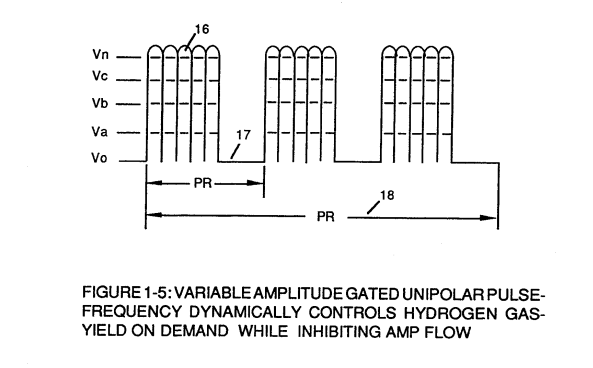
Figure (1-5)
Variable Amplitude Gated Unipolar Pulse- Frequency Dynamically Controls Hydrogen
How it is written
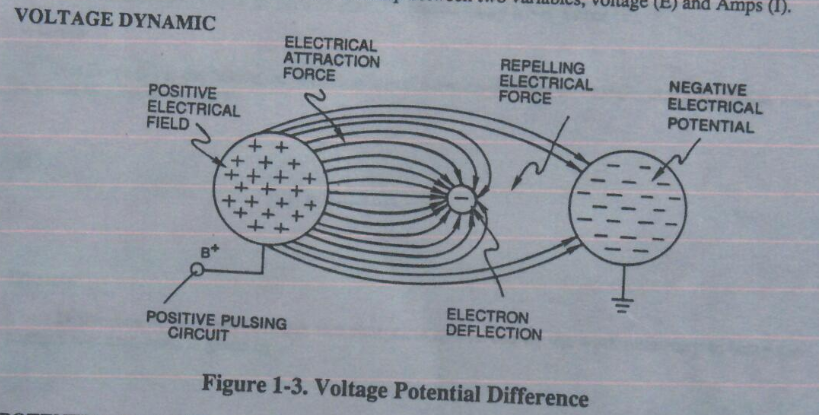
- (1-5) 8×
Drawings 3
-
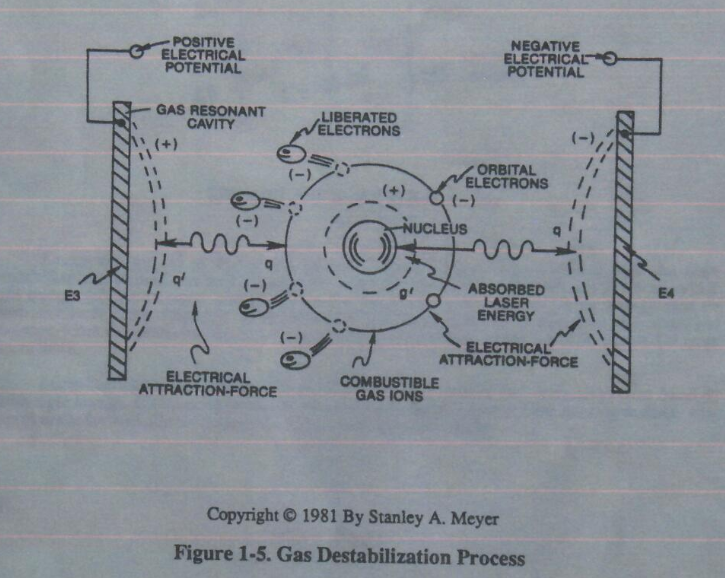
weakening the electrical attraction-force (qq') between the orbital electrons and the nucleus, as illustrated in Figure 1-5 as to Figure 20JX. · LASER INTERACTION
-
Figure (1-5) · LC Voltage
-
Beside the passage · ATOMIC INTERACTION TO VOLTAGE STIMULATION
On this figure 2
Where it is named · 8
WFC 417 — WFC 417 2×
-
Figure 1-5. Electrical Polarization Process
-
Placement of an pulse-voltage potential across the Excitor-Array (ER) while inhibiting or preventing electron flow within the Voltage Intensifier Circuit (AA) causes the water molecule to separate into its component parts by, momentarily, pulling away orbital electrons from the water molecule, as illustrated in Figure 1-5.
ATOMIC INTERACTION TO VOLTAGE STIMULATION 1×
-
Voltage potential within an electrical circuit can cause one or more electrons to be dislodged from the atom due to opposite electrical polarity attraction between unlike charged entities, as shown in Figure 1-5 (see Figure 1-3 again) as to Newton's and Coulomb's Laws of electrical-force.
Gas Destabilization Process 1×
-
Placement of a pulse-voltage potential across the Excitor-Array (ER) of Gas Resonant Cavity (t) while inhibiting or preventing electron flow within the Voltage Intensifier Circuit (AA) causes the Gas Atom of Argon (Ar) to become an positive charged ion by pulling away orbital electrons from the gas molecule or gas atom, as illustrated in Figure 1-5.
LASER INTERACTION 1×
-
weakening the electrical attraction-force (qq') between the orbital electrons and the nucleus, as illustrated in Figure 1-5 as to Figure 20JX.
Electron Extraction Process 1×
-
Laser activated or laser primed gas ions repels the "dislodged" electrons being consumed, as illustrated in Figure 1-5.
LC Voltage 2×
-
Figure (1-5)